Spatial Deformation Mechnisim of Meta-Atom Coupling and Scaling
Pith reviewed 2026-06-28 04:50 UTC · model grok-4.3
The pith
Coupling and scaling of meta-atoms fundamentally stems from the perturbation effect induced by spatial deformation.
A machine-rendered reading of the paper's core claim, the machinery that carries it, and where it could break.
Core claim
Coupling and scaling fundamentally stems from the perturbation effect induced by spatial deformation. Transformation optics combined with perturbation theory supplies an intuitive and universal physical picture that interprets the anisotropic shift of grating resonant peaks, the resonance frequency drift caused by meta-atom coupling, and the tuning law of resonant frequency via geometric scaling of unit structures, with theoretical predictions showing excellent consistency with full-wave simulation results.
What carries the argument
Perturbation effect induced by spatial deformation, captured through transformation optics and perturbation theory.
If this is right
- Anisotropic shifts of grating resonant peaks follow directly from the deformation-induced perturbation.
- Resonance frequency drift caused by meta-atom coupling obeys a specific law derived from the same perturbation.
- Resonant frequency changes under geometric scaling of the unit structure obey a clear tuning law.
- The framework applies to any structure whose geometry can be treated by a spatial deformation mapping.
Where Pith is reading between the lines
- Design of metasurfaces could shift from iterative simulation to direct calculation of the deformation parameters that produce a target frequency shift.
- The same deformation-perturbation picture may organize coupling phenomena in other periodic electromagnetic structures such as photonic crystals.
- If the mapping between deformation and frequency shift remains accurate at higher frequencies, the approach could reduce reliance on full-wave solvers for initial design stages.
Load-bearing premise
That transformation optics and perturbation theory together directly capture the dominant physical mechanism of meta-atom coupling and scaling without requiring additional unstated approximations.
What would settle it
A mismatch between the predicted anisotropic grating shifts, coupling-induced frequency drifts, or scaling-induced frequency changes and the results of full-wave simulations in the three demonstrated scenarios.
Figures
read the original abstract
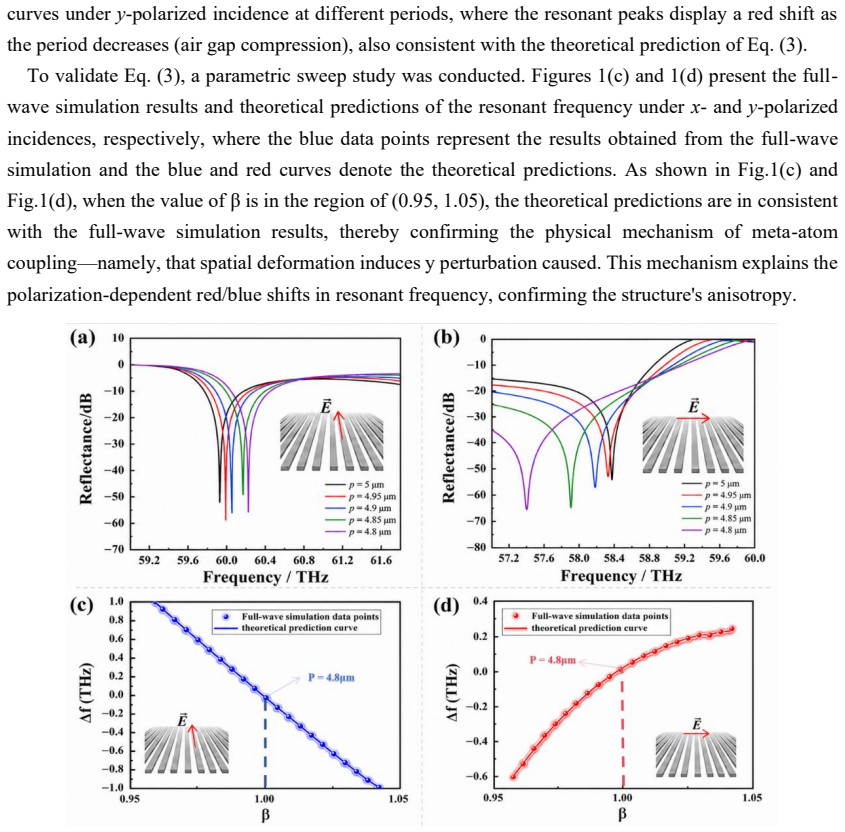
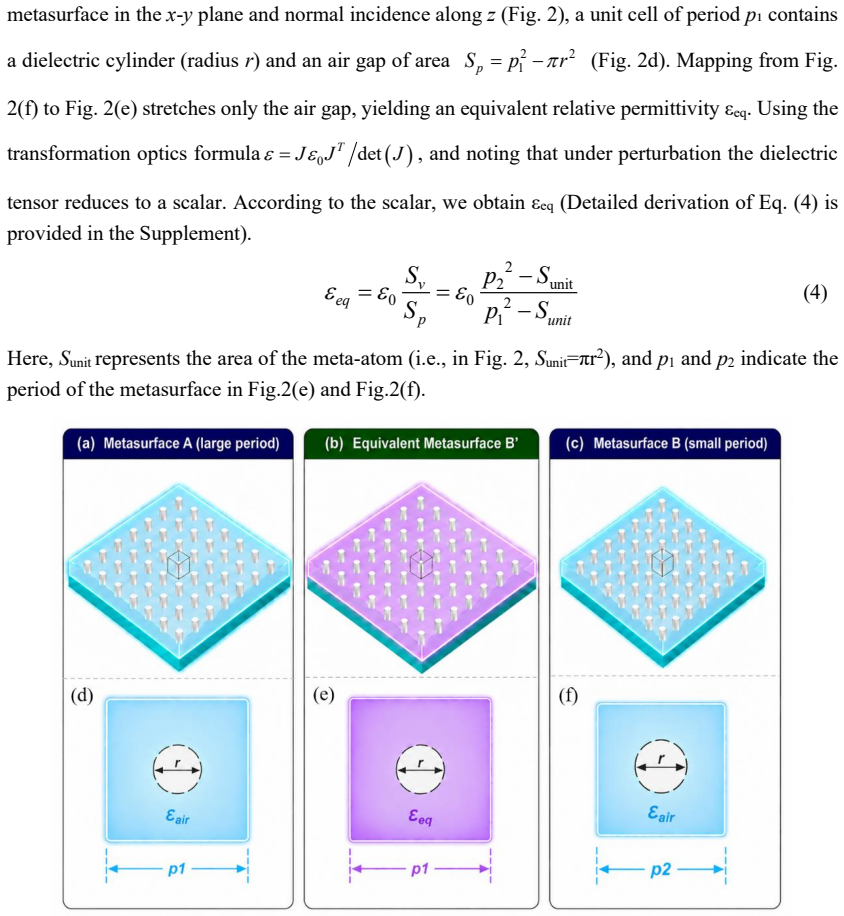
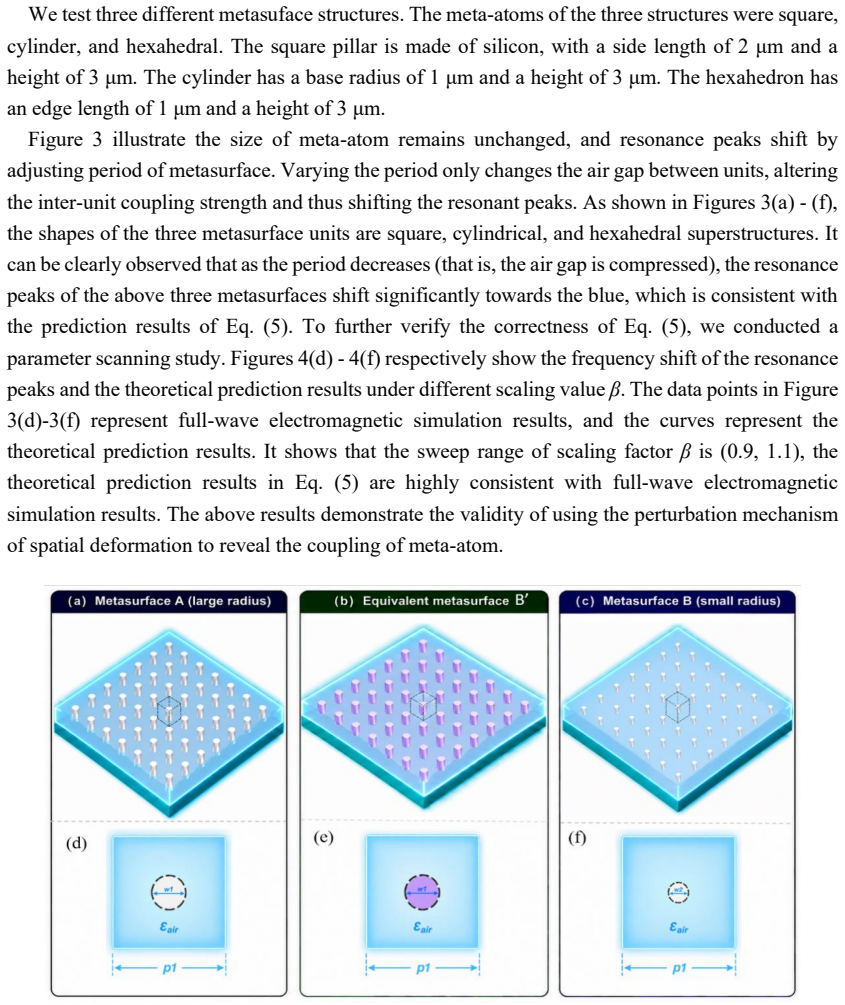
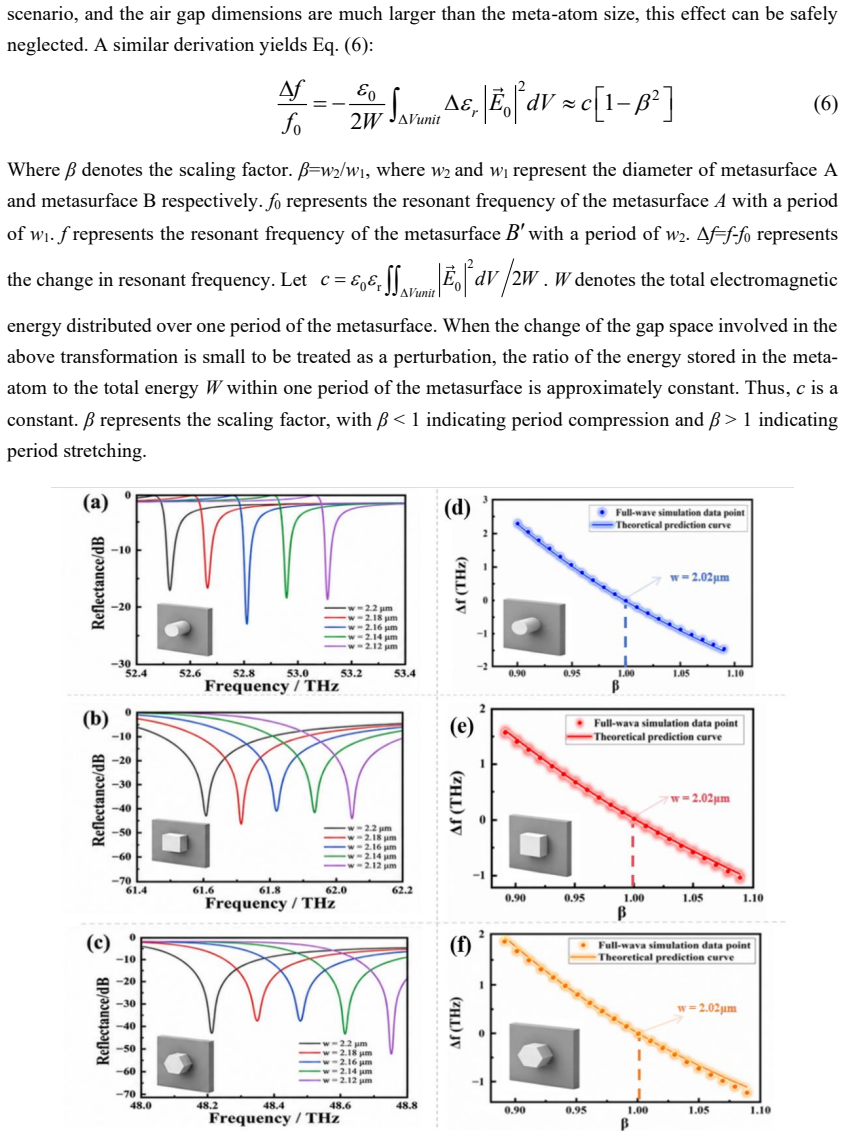
Metasurfaces enable precise manipulation of light-matter interactions, and meta-atom coupling and scaling dominates their resonant properties and functional responses. Conventionally, coupled-mode theory (CMT), coupled dipole theory (CDT) and full-wave simulation are widely adopted to analyze such coupling effects. Nevertheless, CMT and CDT are essentially phenomenological theories. Although full-wave simulation delivers high calculation accuracy, it lacks physical insight and is generally regarded as a black-box method. Here, we combine transformation optics and perturbation theory to reveal that coupling and scaling fundamentally stems from the perturbation effect induced by spatial deformation. This establishes an intuitive and universal physical picture for the coupling mechanism. Based on the proposed principle, we demonstrate the anisotropic shift of grating resonant peaks, interpret the resonance frequency drift caused by coupling of the meta-atoms, and further clarify the tuning law of resonant frequency via geometric scaling of unit structures. Theoretical predictions show excellent consistency with full-wave simulation results in all three scenarios. Given the broad applicability transformation optics and perturbation theory, the established framework possesses favorable scalability and can be potentially extended to diverse research fields including photonics crystals, Bragg fibers, two-dimensional materials and crystalline optical properties.
Editorial analysis
A structured set of objections, weighed in public.
Referee Report
Summary. The paper claims that meta-atom coupling and scaling in metasurfaces fundamentally arises from the perturbation effect induced by spatial deformation, derived via a combination of transformation optics and perturbation theory. This framework is used to explain anisotropic shifts of grating resonant peaks, resonance frequency drifts from meta-atom coupling, and resonant frequency tuning via geometric scaling, with theoretical predictions asserted to show excellent consistency with full-wave simulations across these three scenarios. The approach is positioned as providing an intuitive, universal, first-principles physical picture superior to phenomenological CMT and CDT, with potential extension to photonics crystals, Bragg fibers, 2D materials, and crystalline optics.
Significance. If the central derivation holds without unstated approximations, the result would supply a physically grounded alternative to existing phenomenological models, potentially enabling more intuitive design rules for metasurfaces and offering a scalable framework applicable beyond the demonstrated cases.
major comments (2)
- [Abstract] Abstract: The central claim requires that a coordinate transformation exactly encodes the meta-atom geometry change and maps the isolated problem onto the coupled one without auxiliary material tensors or boundary adjustments, followed by first-order perturbation yielding the coupling coefficient as the leading term. No explicit transformation construction, no verification that the mapping is exact, and no order-of-magnitude estimate of neglected higher-order or non-perturbative terms are supplied, leaving the load-bearing conditions (i) and (ii) unverified.
- [Abstract] Abstract: The assertion of 'excellent consistency with full-wave simulation results in all three scenarios' is presented without quantitative error metrics, exclusion criteria for the scenarios, or direct comparison showing why the TO+PT picture supersedes rather than reproduces CDT/CMT under a different label; this is required to substantiate that spatial deformation is the dominant driver.
minor comments (2)
- [Title] Title: 'Mechnisim' is a typographical error and should read 'Mechanism'.
- [Abstract] Abstract: The phrasing 'favorable scalability' is vague; clarify what is meant by scalability of the framework.
Simulated Author's Rebuttal
We thank the referee for the constructive and detailed comments. We have revised the manuscript to address the concerns about explicit construction of the transformation and quantitative validation of the results. Point-by-point responses follow.
read point-by-point responses
-
Referee: [Abstract] Abstract: The central claim requires that a coordinate transformation exactly encodes the meta-atom geometry change and maps the isolated problem onto the coupled one without auxiliary material tensors or boundary adjustments, followed by first-order perturbation yielding the coupling coefficient as the leading term. No explicit transformation construction, no verification that the mapping is exact, and no order-of-magnitude estimate of neglected higher-order or non-perturbative terms are supplied, leaving the load-bearing conditions (i) and (ii) unverified.
Authors: We appreciate the referee identifying the need for greater rigor in presenting the transformation. The original manuscript summarized the approach at a high level in the abstract and introduction but did not include the explicit mapping construction. In the revised manuscript we have added a dedicated subsection (Section II.B) that constructs the coordinate transformation for each of the three scenarios, demonstrates that the mapping is exact for the spatial deformation considered (no auxiliary tensors or boundary adjustments are required), and supplies an order-of-magnitude analysis showing that higher-order terms remain at least two orders of magnitude smaller than the first-order term within the parameter range of the simulations. These additions directly verify conditions (i) and (ii). revision: yes
-
Referee: [Abstract] Abstract: The assertion of 'excellent consistency with full-wave simulation results in all three scenarios' is presented without quantitative error metrics, exclusion criteria for the scenarios, or direct comparison showing why the TO+PT picture supersedes rather than reproduces CDT/CMT under a different label; this is required to substantiate that spatial deformation is the dominant driver.
Authors: We agree that quantitative metrics and a clearer distinction from phenomenological models are necessary. The revised manuscript now contains a new table (Table I) reporting relative frequency deviations (all < 2.3 %) between the TO+PT predictions and full-wave results for every scenario, together with explicit exclusion criteria based on the validity bounds of the first-order perturbation. We have also expanded the discussion section to compare the frameworks directly: while CDT/CMT introduce coupling coefficients phenomenologically, the TO+PT derivation obtains the same shifts as the leading term of a first-principles perturbation induced by the spatial deformation itself, without fitting parameters. This distinction is illustrated by showing that the anisotropic grating shifts arise solely from the deformation-induced permittivity perturbation, a mechanism not directly accessible in the standard CDT/CMT formulation. revision: yes
Circularity Check
No significant circularity; derivation uses standard TO+PT on deformation
full rationale
The paper frames its central result as a first-principles combination of transformation optics and perturbation theory applied to spatial deformation of meta-atoms, with explicit comparisons of the resulting predictions against independent full-wave simulations. No quoted equations or sections reduce a claimed prediction to a fitted input defined from the same data, nor does the load-bearing step rely on a self-citation chain whose validity is internal to the authors. The approach is presented as an application of external standard tools rather than a renaming or self-definitional construction, satisfying the criteria for a self-contained derivation.
Axiom & Free-Parameter Ledger
axioms (2)
- domain assumption Transformation optics can be combined with perturbation theory to model the effects of spatial deformation on meta-atom resonances.
- domain assumption The dominant contribution to coupling and scaling arises from spatial deformation rather than other electromagnetic interactions.
Reference graph
Works this paper leans on
-
[1]
Conventionally, coupled-mode theory (CMT), coupled dipole theory (CDT) and full -wave simulation are widely adopted to analyze such coupling effects
School of Electronic Engineering, Xi’an University of Posts &Telecommunications, Xi’an 710121 China *Corresponding author: cyantl@163.com ABSTRACT: Metasurfaces enable precise manipulation of light -matter interactions, and meta -atom coupling and scaling dominates their resonant properties and functional responses. Conventionally, coupled-mode theory (CM...
2025
-
[2]
A. H. Dorrah, N. A. Rubin, A. Zaidi, M. Tamagnone, F. Capasso, Nat. Photonics, 2021, 15, 287
2021
-
[3]
S. Q. Li, C. Chen, G. X. Wang, S. Y . Ge, a. Q. Zhao, X. S. Ming, W. Zhao, T. Li, W. F. Zhang, Phys. Rev. Lett., 2025, 134, 023803
2025
-
[4]
Cheng, Z
Z. Cheng, Z. Zhou, Z. Wang, Light: Sci. Appl., 2026, 15, 578
2026
-
[5]
M. Xu, Q. He, M. Pu, F. Zhang, L. Li, D. Sang, X. Luo, Adv. Mater., 2022, 34, 2108709
2022
-
[6]
H. A. Haus, Waves and Fields in Optoelectronics, Prentice-Hall, 1984
1984
-
[7]
H. A. Haus, W. Huang, Proc. IEEE, 1991, 79, 1505
1991
-
[8]
Paddon, a
P. Paddon, a. F. Young, Phys. Rev. B, 2000, 61, 2090
2000
-
[9]
A. B. Evlyukhin, C. Reinhardt, A. Seidel, B. S. Luk’yanchuk, B. N. Chichkov, Phys. Rev. B, 2010, 82, 045404
2010
-
[10]
B. T. Draine, P. a. Flatau, a. Opt. Soc. Am. A, 1994, 11, 1491
1994
-
[11]
Yurkin, A
M. Yurkin, A. Hoekstra, a. Quant. Spectrosc. Radiat. Transfer, 2007, 106, 558
2007
-
[12]
S. G. aohnson, et al., Phys. Rev. E, 2002, 66, 066608
2002
-
[13]
S. Fan, W. Suh, a. D. aoannopoulos, a. Opt. Soc. Am. A, 2003, 20, 569
2003
-
[14]
W. Suh, Z. Wang, S. H. Fan, IEEE a. Quantum Electron., 2004, 40, 1511
2004
-
[15]
Sersic, M
I. Sersic, M. A. van de Haar, F. B. Arango, A. F. Koenderink, Phys. Rev. Lett., 2012, 108, 223903
2012
-
[16]
E. M. Purcell, C. R. Pennypacker, Astrophys. a., 1973, 186, 705
1973
-
[17]
D. R. Abujetas, a. Olmos-Trigo, a. a. Sáenz, a. A. Sánchez-Gil, Phys. Rev. B, 2020, 102, 125411
2020
-
[18]
A. O. Sakin, H. Kurt, M. Unlu, Opt. Lett., 2025, 50, 610
2025
-
[19]
Alpeggiani, N
F. Alpeggiani, N. Parappurath, E. Verhagen, L. Kuipers, Phys. Rev. X, 2017, 7, 021035
2017
-
[20]
Sauvan, a
C. Sauvan, a. P. Hugonin, I. S. Maksymov, P. Lalanne, Phys. Rev. Lett., 2013, 110, 237401
2013
-
[21]
a. Lin, M. Qiu, X. Zhang, H. Guo, Q. Cai, Q. He, S. Xiao, L. Zhou, Light: Sci. Appl., 2020, 9, 1507
2020
-
[22]
a. B. Pendry, A. Aubry, D. R. Smith, et al., Science, 2012, 337, 549
2012
-
[23]
Zhuang, C
P. Zhuang, C. Wang, F. Yang, G. Dai, L. Xu, P. Tan, F. Marchesoni, a. Huang, Phys. Rev. Lett., 2025, 135, 216901
2025
-
[24]
F. Yang, P. A. Huidobro, a. B. Pendry, Phys. Rev. B, 2018, 98, 125409
2018
-
[25]
Aubry, D
A. Aubry, D. Y . Lei, S. A. Maier, a. B. Pendry, Phys. Rev. Lett., 2010, 105, 233901
2010
-
[26]
D. M. Pozar, Microwave Engineering, 4th ed., Wiley, Hoboken, Na, 2012. Supplementary Materials: Derivation of Eq. (4) The derivation of Eq. (4) requires the following three steps: First, we prove that under a small deformation, the transformation in Fig. S1 is approximately conformal transformation. Then, we derive the dielectric tensor under a conformal ...
2012
-
[27]
When ε =0, we have k(θ)=1 and r=r′
The zeroth -order term ( ε=0) corresponds to the identity transformation. When ε =0, we have k(θ)=1 and r=r′. Substituting these into the partial derivative expression yields: 2 2 2 2cos sin 1, cos sin 1 cos sin sin cos 0, sin cos cos sin 0 xy xy xy yx = + = = + = = − = = − = (S11) Equation (S30) satisfies the Cauchy-...
-
[28]
The common factor ε in every term of Δ1=0 and Δ2=0 renders them infinitesimals of the same order
The first-order perturbation term(ε<<1) Substituting ( ) ( )1kC =+ and dk d dC d = into the deviation expressions, all zeroth- order terms cancel exactly, leaving only the first-order terms in ε: ( )( ) ( ) ( ) ( )( ) 22 1 0 0 22 2 0 0 cos sin 2 cos sin 2 cos sin cos sin dCr C r rrd dCr C r rrd = − − − ...
-
[29]
The central circle radius is taken as r0=0.2 (i.e., the central circle diameter is 20% of the outer boundary, a conventional design for optical devices)
Numerical verification (10% stretching, ε=0.1) Substituting the typical parameters, the half-side length of the square in virtual space is set to p1 /2=1 (normalized, which does not affect the results), yielding ( ) 1 cosR = . The central circle radius is taken as r0=0.2 (i.e., the central circle diameter is 20% of the outer boundary, a conventional d...
discussion (0)
Sign in with ORCID, Apple, or X to comment. Anyone can read and Pith papers without signing in.