Reconfigurable Single-Ring Photonic Molecule on Lithium Niobate
Pith reviewed 2026-06-27 23:34 UTC · model grok-4.3
The pith
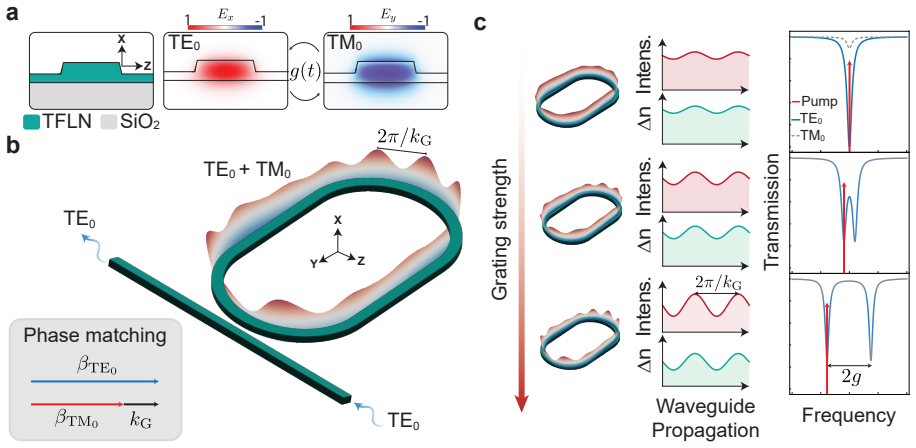
A photorefractive grating written inside one lithium niobate racetrack resonator creates a reconfigurable photonic molecule with tunable hybrid resonances.
A machine-rendered reading of the paper's core claim, the machinery that carries it, and where it could break.
Core claim
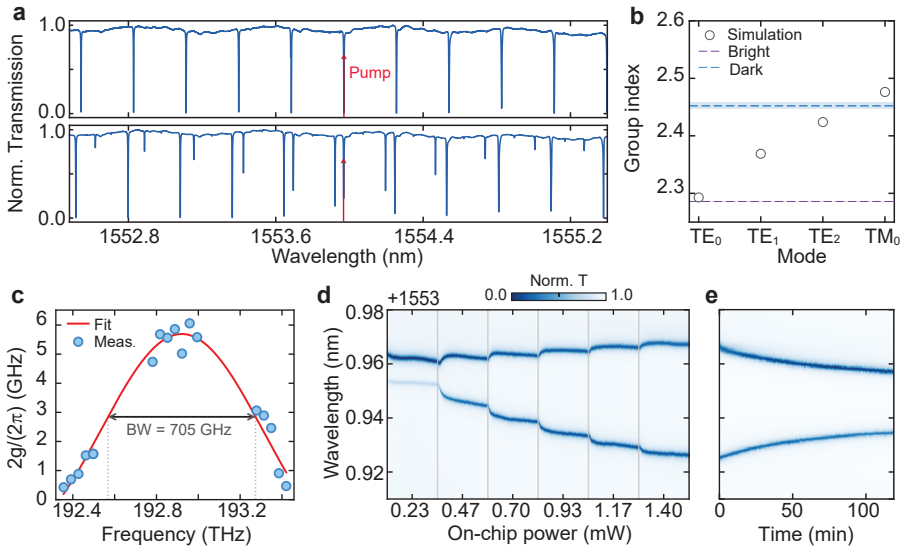
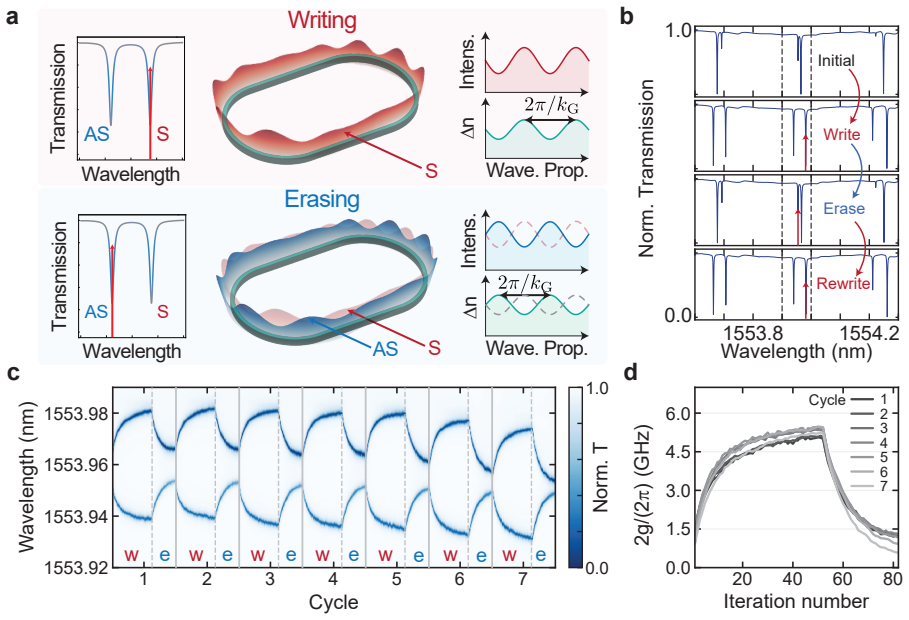
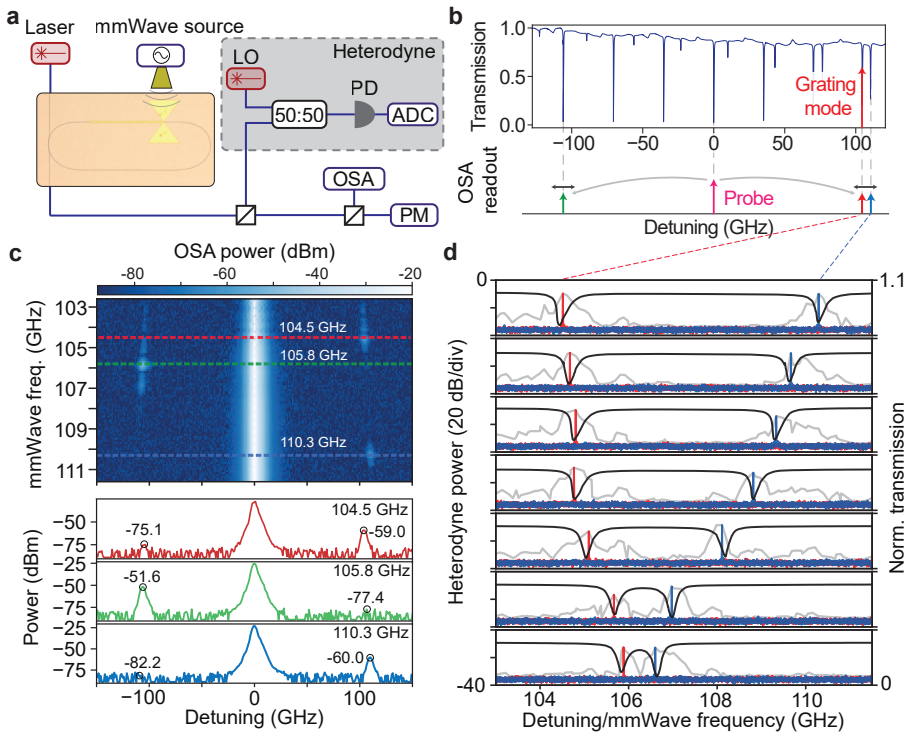
Interference between co-propagating dark and bright transverse modes inside a single TFLN racetrack resonator induces a long-lasting photorefractive grating. This grating hybridizes the modes into a photonic molecule whose splitting reaches GHz scales over a 700 GHz optical bandwidth and persists for hours. The coupling is programmed by the optical pump that writes the grating. Selective pumping of orthogonal hybrid modes produces multiple reversible all-optical write-erase-rewrite cycles. The device is finally shown to perform single-sideband mmWave transduction around 107 GHz with 5 GHz of tuning bandwidth.
What carries the argument
The photorefractive grating formed by interference of dark and bright transverse modes, which hybridizes them into a single-ring photonic molecule whose coupling is set by the writing pump.
If this is right
- Coupling strength between the hybrid modes is set by the optical pump intensity used to write the grating.
- Multiple reversible all-optical write-erase-rewrite cycles are achieved by pumping orthogonal hybrid modes.
- The same structure realizes single-sideband mmWave transduction near 107 GHz with a 5 GHz tuning bandwidth.
- Photorefraction supplies a bias-free route to reconfigurable resonances inside a single resonator footprint.
Where Pith is reading between the lines
- One resonator per molecule could reduce the physical space needed for arrays of tunable filters or modulators.
- Long grating lifetime combined with optical control may support light-addressable photonic memory elements that hold state without power.
- The demonstrated tuning range suggests the same grating method could be tested for dynamic channel selection in wavelength-division multiplexing systems.
Load-bearing premise
The grating written by the interfering modes stays stable for hours and can be erased by pumping orthogonal modes without adding loss or damaging the resonator.
What would settle it
Direct observation that the hybrid-mode splitting collapses or resonator loss rises permanently within minutes after writing, or that attempted erasure increases optical loss without restoring the original spectrum.
Figures
read the original abstract
Resonant photonic structures enable optical enhancement and spectral filtering and are essential for lasers, quantum emitters, transducers, or modulators. Photonic molecules, formed by mode hybridisation in two coupled resonators, break the equidistant frequency spacing of zero-dispersion resonators and provide control over their spectrum. Reconfigurability over these devices is a key asset, allowing to align photonic resonances to target frequencies on-demand. While electro-optic materials such as thin-film lithium niobate (TFLN) have enabled frequency tuning beyond traditional thermo-optic effects, they require continuous bias, posing challenges to scalability. Here we demonstrate an optically programmable, erasable, and rewritable photonic molecule realized within a single TFLN racetrack resonator. A long-lasting photorefractive grating induced through interference of co-propagating dark and bright transverse modes promotes their hybridisation, forming a single-ring photonic molecule. We observe GHz-scale hybrid-mode splitting over a 700 GHz-wide optical bandwidth and hour-long lifetimes, and show that their coupling strength can be programmed by the optical pump used to write the grating. By selectively pumping orthogonal hybridised modes, we further demonstrate multiple reversible all-optical write-erase-rewrite cycles of these gratings. Finally, we use this technique to realize single-sideband mmWave transduction around 107 GHz with a 5 GHz tuning bandwidth. These results establish photorefraction as a reliable mechanism for reconfigurable resonances in TFLN, and suggest a route towards tunable microwave-optical functionalities within a reduced footprint.
Editorial analysis
A structured set of objections, weighed in public.
Referee Report
Summary. The paper claims to demonstrate an optically programmable, erasable, and rewritable photonic molecule realized within a single TFLN racetrack resonator. A photorefractive grating induced by interference of co-propagating dark and bright transverse modes promotes mode hybridisation, yielding GHz-scale splitting over a 700 GHz optical bandwidth with hour-long lifetimes. Coupling strength is programmable via the writing pump, multiple reversible all-optical write-erase-rewrite cycles are shown by selective pumping of orthogonal hybrid modes, and the approach is used for single-sideband mmWave transduction near 107 GHz with 5 GHz tuning bandwidth.
Significance. If the reported grating stability, reversibility without degradation, and resulting transduction performance hold under detailed scrutiny, the work provides a notable route to all-optical reconfiguration of photonic resonances in TFLN that avoids continuous electrical bias, with potential for compact tunable microwave-optical devices.
major comments (1)
- [Abstract] Abstract, paragraph describing grating induction and write-erase cycles: the load-bearing claim that the photorefractive grating 'remains stable for hours' and can be 'selectively erased by pumping orthogonal hybridised modes' without degrading the underlying resonator or introducing uncontrolled loss is asserted but not supported by any referenced quantitative metrics (e.g., resonator Q or loss before/after multiple cycles); this directly underpins the reported hour-long lifetimes, multiple cycles, and the 107 GHz transduction result.
Simulated Author's Rebuttal
We thank the referee for their careful reading of the manuscript and for identifying this important point regarding the abstract. We address the comment below.
read point-by-point responses
-
Referee: [Abstract] Abstract, paragraph describing grating induction and write-erase cycles: the load-bearing claim that the photorefractive grating 'remains stable for hours' and can be 'selectively erased by pumping orthogonal hybridised modes' without degrading the underlying resonator or introducing uncontrolled loss is asserted but not supported by any referenced quantitative metrics (e.g., resonator Q or loss before/after multiple cycles); this directly underpins the reported hour-long lifetimes, multiple cycles, and the 107 GHz transduction result.
Authors: We agree that the abstract would be strengthened by explicit reference to the supporting quantitative data already present in the main text. The manuscript reports resonator Q-factor and loss measurements before and after multiple write-erase cycles (Section on all-optical cycling and associated figures), confirming no measurable degradation or added loss. The hour-scale stability is quantified via time-dependent spectra. In the revised version we will update the abstract to include a concise reference to these metrics while preserving brevity. revision: yes
Circularity Check
No circularity: experimental demonstration only
full rationale
The paper is an experimental report of fabricating, writing, erasing, and using photorefractive gratings inside a single TFLN racetrack resonator to create hybrid-mode splitting and mmWave transduction. No derivation chain, equations, or predictions are present that reduce by construction to fitted parameters, self-definitions, or self-citation load-bearing premises. All central claims (GHz-scale splitting over 700 GHz bandwidth, hour-long lifetimes, multiple write-erase cycles, 107 GHz transduction with 5 GHz tuning) are stated as direct observations from optical measurements. The weakest assumption (grating stability and selective erasure without degradation) is an empirical claim about material response, not a mathematical reduction. This is the normal case of a self-contained experimental paper whose results stand or fall on external reproducibility rather than internal definitional equivalence.
Axiom & Free-Parameter Ledger
Reference graph
Works this paper leans on
-
[1]
Roadmapping the next generation of silicon photonics
S. Shekhar, W. Bogaerts, L. Chrostowski, J. E. Bowers, M. Hochberg, R. Soref, and B. J. Shastri. “Roadmapping the next generation of silicon photonics.” Nature Communications,15(1):751 (2024)
2024
-
[2]
Programmable photonic circuits
W. Bogaerts, D. Pérez, J. Capmany, D. A. B. Miller, J. Poon, D. Englund, F. Morichetti, and A. Mel- loni. “Programmable photonic circuits.” Nature,586(7828):207–216 (2020)
2020
-
[3]
Multipurpose self-configuration of programmable photonic circuits
D. Pérez-López, A. López, P. DasMahapatra, and J. Capmany. “Multipurpose self-configuration of programmable photonic circuits.” Nature Communications,11(1):6359 (2020)
2020
-
[4]
A heterogeneously integrated lithium niobate-on-silicon nitride photonic platform
M. Churaev, R. N. Wang, A. Riedhauser, V. Snigirev, T. Blésin, C. Möhl, M. H. Anderson, A. Sid- dharth, Y. Popoff, U. Drechsler, D. Caimi, S. Hönl, J. Riemensberger, J. Liu, P. Seidler, and T. J. Kippenberg. “A heterogeneously integrated lithium niobate-on-silicon nitride photonic platform.” Na- ture Communications,14(1):3499 (2023)
2023
-
[5]
High density lithium niobate photonic integrated circuits
Z. Li, R. N. Wang, G. Lihachev, J. Zhang, Z. Tan, M. Churaev, N. Kuznetsov, A. Siddharth, M. J. Bereyhi, J. Riemensberger, and T. J. Kippenberg. “High density lithium niobate photonic integrated circuits.” Nature Communications,14(1):4856 (2023)
2023
-
[6]
Integrated photonics on thin-film lithium niobate
D. Zhu, L. Shao, M. Yu, R. Cheng, B. Desiatov, C. J. Xin, Y. Hu, J. Holzgrafe, S. Ghosh, A. Shams- Ansari, E. Puma, N. Sinclair, C. Reimer, M. Zhang, and M. Lončar. “Integrated photonics on thin-film lithium niobate.” Adv. Opt. Photon.,13(2):242–352 (2021)
2021
-
[7]
Breaking thebandwidthlimitofahigh-quality-factorringmodulatorbasedonthin-filmlithiumniobate
Y. Xue, R. Gan, K. Chen, G. Chen, Z. Ruan, J. Zhang, J. Liu, D. Dai, C. Guo, and L. Liu. “Breaking thebandwidthlimitofahigh-quality-factorringmodulatorbasedonthin-filmlithiumniobate.” Optica, 9(10):1131–1137 (2022)
2022
-
[8]
Monolithic ultra-high-Q lithium niobate microring resonator
M. Zhang, C. Wang, R. Cheng, A. Shams-Ansari, and M. Lončar. “Monolithic ultra-high-Q lithium niobate microring resonator.” Optica,4(12):1536–1537 (2017)
2017
-
[9]
Silicon microring resonators
W. Bogaerts, P. De Heyn, T. Van Vaerenbergh, K. De Vos, S. Kumar Selvaraja, T. Claes, P. Dumon, P. Bienstman, D. Van Thourhout, and R. Baets. “Silicon microring resonators.” Laser & Photonics Reviews,6(1):47–73 (2012)
2012
-
[10]
Integrated millimeter-wave cavity electro-optic transduction
K. K. S. Multani, J. F. Herrmann, E. A. Nanni, and A. H. Safavi-Naeini. “Integrated millimeter-wave cavity electro-optic transduction.” Nature Communications,17(1):1166 (2026)
2026
-
[11]
Cryogenic microwave-to-optical conversion using a triply resonant lithium-niobate-on-sapphire transducer
T. P. McKenna, J. D. Witmer, R. N. Patel, W. Jiang, R. V. Laer, P. Arrangoiz-Arriola, E. A. Wollack, J. F. Herrmann, and A. H. Safavi-Naeini. “Cryogenic microwave-to-optical conversion using a triply resonant lithium-niobate-on-sapphire transducer.” Optica,7(12):1737–1745 (2020)
2020
-
[12]
Coherent control of a superconducting qubit using light
H. K. Warner, J. Holzgrafe, B. Yankelevich, D. Barton, S. Poletto, C. J. Xin, N. Sinclair, D. Zhu, 31 E. Sete, B. Langley, E. Batson, M. Colangelo, A. Shams-Ansari, G. Joe, K. K. Berggren, L. Jiang, M. J. Reagor, and M. Lončar. “Coherent control of a superconducting qubit using light.” Nature Physics,21(5):831–838 (2025)
2025
-
[13]
Sensitivity limits of millimeter-wave photonic radiometers based on efficient electro-optic upconverters
G. S. Botello, F. Sedlmeir, A. Rueda, K. A. Abdalmalak, E. R. Brown, G. Leuchs, S. Preu, D. Segovia- Vargas, D. V. Strekalov, L. E. G. Muñoz, and H. G. L. Schwefel. “Sensitivity limits of millimeter-wave photonic radiometers based on efficient electro-optic upconverters.” Optica,5(10):1210–1219 (2018)
2018
-
[14]
On-chip wavelength division multi- plexingfiltersusingextremelyefficientgate-drivensiliconmicroringresonatorarray
W.-C. Hsu, N. Nujhat, B. Kupp, J. F. Conley, and A. X. Wang. “On-chip wavelength division multi- plexingfiltersusingextremelyefficientgate-drivensiliconmicroringresonatorarray.” ScientificReports, 13(1):5269 (2023)
2023
-
[15]
Long Low-Loss-Litium Niobate on Insulator Waveguides with Sub-Nanometer Surface Roughness
R. Wu, M. Wang, J. Xu, J. Qi, W. Chu, Z. Fang, J. Zhang, J. Zhou, L. Qiao, Z. Chai, J. Lin, and Y. Cheng. “Long Low-Loss-Litium Niobate on Insulator Waveguides with Sub-Nanometer Surface Roughness.” Nanomaterials,8(11):910 (2018)
2018
-
[16]
Twenty-nine million intrinsic Q-factor monolithic microresonators on thin-film lithium niobate
X. Zhu, Y. Hu, S. Lu, H. K. Warner, X. Li, Y. Song, L. M. aes, A. Shams-Ansari, A. Cordaro, N. Sinclair, and M. Lončar. “Twenty-nine million intrinsic Q-factor monolithic microresonators on thin-film lithium niobate.” Photon. Res.,12(8):A63–A68 (2024)
2024
-
[17]
Roughness-Limited Performance in Ultra-Low-Loss Lithium Niobate Cavities
A. Khalatpour, L. Qi, M. M. Fejer, and A. H. Safavi-Naeini. “Roughness-Limited Performance in Ultra-Low-Loss Lithium Niobate Cavities.” Advanced Optical Materials,14(8):e02355 (2026)
2026
-
[18]
Integrated lithium niobate electro-optic modulators operating at CMOS-compatible volt- ages
C. Wang, M. Zhang, X. Chen, M. Bertrand, A. Shams-Ansari, S. Chandrasekhar, P. Winzer, and M. Lončar. “Integrated lithium niobate electro-optic modulators operating at CMOS-compatible volt- ages.” Nature,562(7725):101–104 (2018)
2018
-
[19]
Spectral control of nonclassical light pulses using an integrated thin-film lithium niobate modulator
D. Zhu, C. Chen, M. Yu, L. Shao, Y. Hu, C. Xin, M. Yeh, S. Ghosh, L. He, C. Reimer, et al. “Spectral control of nonclassical light pulses using an integrated thin-film lithium niobate modulator.” Light: Science & Applications,11(1):327 (2022)
2022
-
[20]
Broadband electro-optic frequency comb generation in a lithium niobate microring resonator
M. Zhang, B. Buscaino, C. Wang, A. Shams-Ansari, C. Reimer, R. Zhu, J. M. Kahn, and M. Lončar. “Broadband electro-optic frequency comb generation in a lithium niobate microring resonator.” Nature, 568(7752):373–377 (2019)
2019
-
[21]
High-efficiency and broadband on-chip electro-optic frequency comb generators
Y. Hu, M. Yu, B. Buscaino, N. Sinclair, D. Zhu, R. Cheng, A. Shams-Ansari, L. Shao, M. Zhang, J. M. Kahn, and M. Lončar. “High-efficiency and broadband on-chip electro-optic frequency comb generators.” Nature Photonics,16(10):679–685 (2022)
2022
-
[22]
Hybrid Kerr-electro-optic frequency combs on thin-film lithium niobate
Y. Song, Y. Hu, M. Lončar, and K. Yang. “Hybrid Kerr-electro-optic frequency combs on thin-film lithium niobate.” Light: Science & Applications,14(1):270 (2025)
2025
-
[23]
All-optical superconducting qubit readout
G. Arnold, T. Werner, R. Sahu, L. N. Kapoor, L. Qiu, and J. M. Fink. “All-optical superconducting qubit readout.” Nature Physics,21(3):393–400 (2025)
2025
-
[24]
Quan- 32 tum frequency conversion and single-photon detection with lithium niobate nanophotonic chips
X. Wang, X. Jiao, B. Wang, Y. Liu, X.-P. Xie, M.-Y. Zheng, Q. Zhang, and J.-W. Pan. “Quan- 32 tum frequency conversion and single-photon detection with lithium niobate nanophotonic chips.” npj Quantum Information,9(1):38 (2023)
2023
-
[25]
Electro–optically tunable microring resonators in lithium niobate
A. Guarino, G. Poberaj, D. Rezzonico, R. Degl’Innocenti, and P. Günter. “Electro–optically tunable microring resonators in lithium niobate.” Nature Photonics,1(7):407–410 (2007)
2007
-
[26]
Highly efficient thermo-optic tunable micro-ring resonator based on an LNOI platform
X. Liu, P. Ying, X. Zhong, J. Xu, Y. Han, S. Yu, and X. Cai. “Highly efficient thermo-optic tunable micro-ring resonator based on an LNOI platform.” Opt. Lett.,45(22):6318–6321 (2020)
2020
-
[27]
Optical Modes in Photonic Molecules
M. Bayer, T. Gutbrod, J. P. Reithmaier, A. Forchel, T. L. Reinecke, P. A. Knipp, A. A. Dremin, and V. D. Kulakovskii. “Optical Modes in Photonic Molecules.” Phys. Rev. Lett.,81:2582–2585 (1998)
1998
-
[28]
Photonic atoms and molecules
Y. P. Rakovich and J. F. Donegan. “Photonic atoms and molecules.” Laser & Photonics Reviews, 4(2):179–191 (2010)
2010
-
[29]
Electronically programmable photonic molecule
M. Zhang, C. Wang, Y. Hu, A. Shams-Ansari, T. Ren, S. Fan, and M. Lončar. “Electronically programmable photonic molecule.” Nature Photonics,13(1):36–40 (2019)
2019
-
[30]
Photonic molecules formed by coupled hybrid resonators
B. Peng, Şahin Kaya Özdemir, J. Zhu, and L. Yang. “Photonic molecules formed by coupled hybrid resonators.” Opt. Lett.,37(16):3435–3437 (2012)
2012
-
[31]
Efficient quantum microwave- to-optical conversion using electro-optic nanophotonic coupled resonators
M. Soltani, M. Zhang, C. Ryan, G. J. Ribeill, C. Wang, and M. Loncar. “Efficient quantum microwave- to-optical conversion using electro-optic nanophotonic coupled resonators.” Phys. Rev. A,96:043808 (2017)
2017
-
[32]
Electromagnetically-induced-transparency-like ground-state cooling in a double-cavity optomechanical system
Y. Guo, K. Li, W. Nie, and Y. Li. “Electromagnetically-induced-transparency-like ground-state cooling in a double-cavity optomechanical system.” Phys. Rev. A,90:053841 (2014)
2014
-
[33]
Strong dispersive coupling of a high-finesse cavity to a micromechanical membrane
J. D. Thompson, B. M. Zwickl, A. M. Jayich, F. Marquardt, S. M. Girvin, and J. G. E. Harris. “Strong dispersive coupling of a high-finesse cavity to a micromechanical membrane.” Nature,452(7183):72–75 (2008)
2008
-
[34]
Surpassing the nonlinear conversion efficiency of soliton microcombs
Ó. B. Helgason, M. Girardi, Z. Ye, F. Lei, J. Schröder, and V. Torres-Company. “Surpassing the nonlinear conversion efficiency of soliton microcombs.” Nature Photonics,17(11):992–999 (2023)
2023
-
[35]
On-chip electro-optic frequency shifters and beam splitters
Y. Hu, M. Yu, D. Zhu, N. Sinclair, A. Shams-Ansari, L. Shao, J. Holzgrafe, E. Puma, M. Zhang, and M. Lončar. “On-chip electro-optic frequency shifters and beam splitters.” Nature,599(7886):587–593 (2021)
2021
-
[36]
Exceptional points in optics and photonics
M.-A. Miri and A. Alù. “Exceptional points in optics and photonics.” Science,363(6422):eaar7709 (2019)
2019
-
[37]
Multimode Single-Ring Photonic Molecule
J. Lu, I.-C. Benea-Chelmus, V. Ginis, M. Ossiander, D. Shchepanovich, and F. Capasso. “Multimode Single-Ring Photonic Molecule.” Phys. Rev. Lett.,136:103803 (2026)
2026
-
[38]
Versatile photonic molecule switch in multimode microresonators
Z. Tao, B. Shen, W. Li, L. Xing, H. Wang, Y. Wu, Y. Tao, Y. Zhou, Y. He, C. Peng, H. Shu, and X. Wang. “Versatile photonic molecule switch in multimode microresonators.” Light: Science & Applications,13(1):51 (2024). 33
2024
-
[39]
Reconfigurable Frequency-Selective Resonance Splitting in Chalcogenide Microring Res- onators
B. Shen, H. Lin, S. Sharif Azadeh, J. Nojic, M. Kang, F. Merget, K. A. Richardson, J. Hu, and J. Witzens. “Reconfigurable Frequency-Selective Resonance Splitting in Chalcogenide Microring Res- onators.” ACS Photonics,7(2):499–511 (2020)
2020
-
[40]
Reconfigurable chalcogenide integrated nonlinear photonics
D. Xia, L. Luo, L. Wang, X. Zhao, Z. Yang, J. Wu, Q.-F. Yang, Z. Li, and B. Zhang. “Reconfigurable chalcogenide integrated nonlinear photonics.” Nature Communications,16:10133 (2025)
2025
-
[41]
Lithiumniobate: Summaryofphysicalpropertiesandcrystalstructure
R.S.WeisandT.K.Gaylord. “Lithiumniobate: Summaryofphysicalpropertiesandcrystalstructure.” Applied Physics A: Materials Science & Processing,37(4):191–203 (1985)
1985
-
[42]
Electro-OpticPropertiesofLiNbO3
G.Peterson, A.Ballman, P.Lenzo, andP.Bridenbaugh. “Electro-OpticPropertiesofLiNbO3.” Applied Physics Letters,5(3):62–64 (1964)
1964
-
[43]
Fast response of photorefraction in lithium niobate microresonators
H. Jiang, R. Luo, H. Liang, X. Chen, Y. Chen, and Q. Lin. “Fast response of photorefraction in lithium niobate microresonators.” Opt. Lett.,42(17):3267–3270 (2017)
2017
-
[44]
Photorefraction-induced Bragg scattering in cryogenic lithium niobate ring resonators
Y. Xu, A. A. Sayem, C.-L. Zou, L. Fan, R. Cheng, and H. X. Tang. “Photorefraction-induced Bragg scattering in cryogenic lithium niobate ring resonators.” Opt. Lett.,46(2):432–435 (2021)
2021
-
[45]
Resonant Stimulated Photorefractive Scattering
J. Liu, T. Stace, J. Dai, K. Xu, A. Luiten, and F. Baynes. “Resonant Stimulated Photorefractive Scattering.” Phys. Rev. Lett.,127:033902 (2021)
2021
-
[46]
Subwavelength Photorefractive Grating in a Thin-Film Lithium Niobate Microcavity
J. Hou, J. Zhu, R. Ma, B. Xue, Y. Zhu, J. Lin, X. Jiang, X. Chen, Y. Cheng, L. Ge, Y. Zheng, and W. Wan. “Subwavelength Photorefractive Grating in a Thin-Film Lithium Niobate Microcavity.” Laser & Photonics Reviews,18(8):2301351 (2024)
2024
-
[47]
Wireless millimeter-wave electro-optics on thin-film lithium niobate
A. Gaier, K. Mamian, S. Rajabali, Y. Lampert, J. Liu, L. Magalhaes, A. Shams-Ansari, M. Lon- car, and I.-C. Benea-Chelmus. “Wireless millimeter-wave electro-optics on thin-film lithium niobate.” arXiv:2505.04585 (2025)
-
[48]
Photonics-integrated terahertz transmission lines
Y. Lampert, A. Shams-Ansari, A. Gaier, A. Tomasino, X. Cao, L. Magalhaes, S. Rajabali, M. Lončar, and I.-C. Benea-Chelmus. “Photonics-integrated terahertz transmission lines.” Nature Communica- tions,16(1):7004 (2025)
2025
-
[49]
Down-converted photon pairs in a high-Q silicon nitride microresonator
B. Li, Z. Yuan, J. Williams, W. Jin, A. Beckert, T. Xie, J. Guo, A. Feshali, M. Paniccia, A. Faraon, J. Bowers, A. Marandi, and K. Vahala. “Down-converted photon pairs in a high-Q silicon nitride microresonator.” Nature,639(8056):922–927 (2025)
2025
-
[50]
Self-organized spa- tiotemporal quasi-phase-matching in microresonators
J. Zhou, J. Hu, M. Clementi, O. Yakar, E. Nitiss, A. Stroganov, and C.-S. Brès. “Self-organized spa- tiotemporal quasi-phase-matching in microresonators.” Nature Communications,16(1):4083 (2025)
2025
-
[51]
Optically reconfigurable quasi-phase-matching in silicon nitride microresonators
E. Nitiss, J. Hu, A. Stroganov, and C.-S. Brès. “Optically reconfigurable quasi-phase-matching in silicon nitride microresonators.” Nature Photonics,16(2):134–141 (2022)
2022
-
[52]
Programmable integrated quantum photonics
I. Aharonovich, K. B. Crozier, and D. Neshev. “Programmable integrated quantum photonics.” Nature Photonics,20(3):254–265 (2026)
2026
-
[53]
One-dimensional polarization-hybrid photonic crystal molecules
T. Li and K. Gallo. “One-dimensional polarization-hybrid photonic crystal molecules.” 34 arXiv:2605.03899 (2026)
work page internal anchor Pith review Pith/arXiv arXiv 2026
-
[54]
Light-induced charge transport in LiNbO3:Fe at high light intensities
F. Jermann and J. Otten. “Light-induced charge transport in LiNbO3:Fe at high light intensities.” J. Opt. Soc. Am. B,10(11):2085–2092 (1993)
2085
-
[55]
Light-induced chargetransport in LiNbO3 crystals
B. Sturman, M.Carrascosa, and F. Agullo-Lopez. “Light-induced chargetransport in LiNbO3 crystals.” Phys. Rev. B,78:245114 (2008)
2008
-
[56]
Generalized Model of Anisotropic Thermo-Optic Response on Thin-Film Lithium Niobate Platform
J. Shim, S. Kim, S. Lu, J. Yang, S. Jeon, S. Kim, M. Lončar, and Y.-I. Sohn. “Generalized Model of Anisotropic Thermo-Optic Response on Thin-Film Lithium Niobate Platform.” ACS Photonics, 13(9):2586–2596 (2026). 35
2026
discussion (0)
Sign in with ORCID, Apple, or X to comment. Anyone can read and Pith papers without signing in.