LHAASO J1849-0002: A Hybrid Lepto-Hadronic Interpretation of PeV Gamma-Ray Emission
Pith reviewed 2026-06-27 21:19 UTC · model grok-4.3
The pith
A hybrid lepto-hadronic model explains the full spectrum of PeV gamma rays from pulsar wind nebula J1849-0001.
A machine-rendered reading of the paper's core claim, the machinery that carries it, and where it could break.
Core claim
Neither the pure leptonic nor the hadronic-dominated scenario reproduces the entire multiwavelength spectral energy distribution, particularly the PeV tail, but the hybrid lepto-hadronic model that pairs inverse Compton emission from PWN electrons with hadronic interactions between escaped cosmic rays and a nearby molecular cloud succeeds when a suppressed diffusion coefficient of roughly 1 percent of the Galactic average is adopted.
What carries the argument
Hybrid lepto-hadronic emission scenario that superposes inverse Compton radiation from pulsar wind nebula electrons onto proton-proton collisions of escaped cosmic rays with an adjacent molecular cloud, made viable by a diffusion coefficient suppressed to approximately 1 percent of the Galactic average.
If this is right
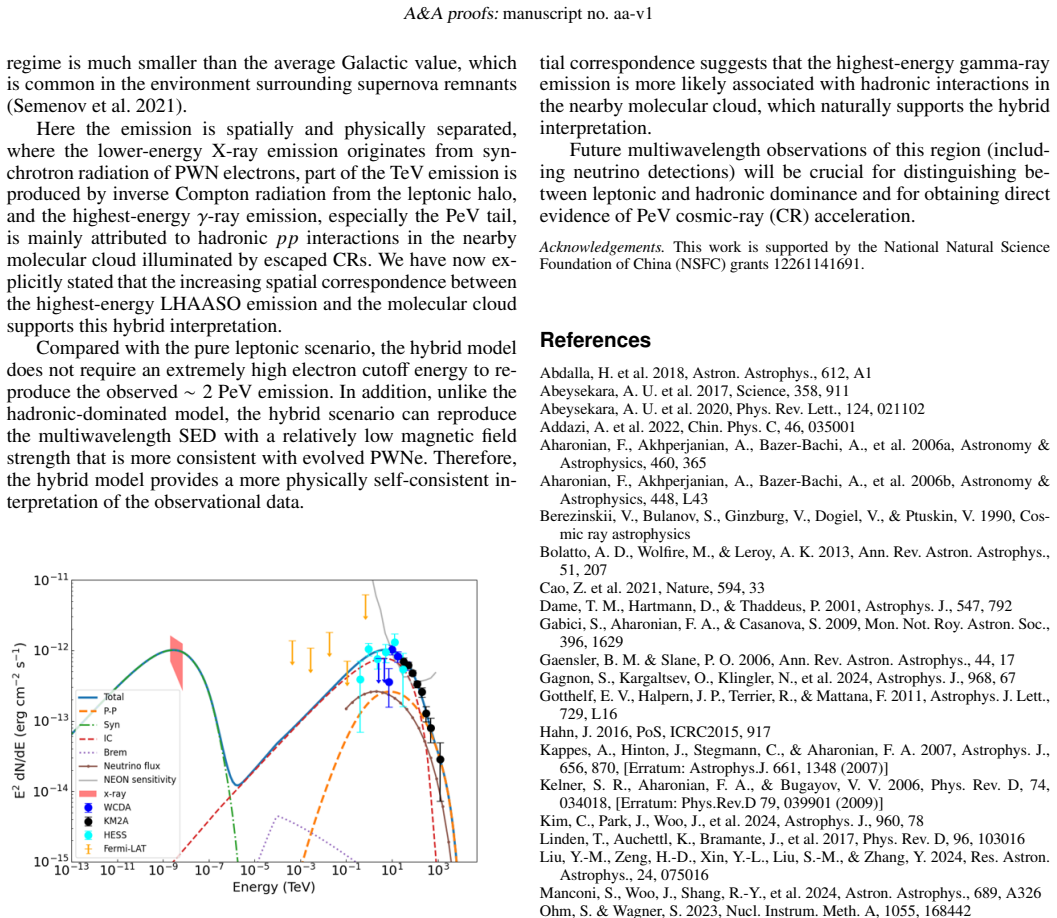
- The full spectral energy distribution from radio through approximately 2 PeV is reproduced by the single hybrid framework.
- A calculable neutrino flux is produced whose detection prospects with NEON can be quantified.
- Evolved pulsar wind nebulae located in complex environments containing molecular clouds can function as Galactic PeVatrons.
Where Pith is reading between the lines
- Similar hybrid signatures may appear in other pulsar wind nebulae that lie close to molecular clouds.
- Reduced diffusion coefficients could prove common around such nebulae and alter standard cosmic-ray transport calculations.
- Neutrino observations would provide an independent test separating the leptonic and hadronic contributions.
Load-bearing premise
The diffusion coefficient near the source must be suppressed to roughly 1 percent of the Galactic average to confine PeV particles long enough for them to interact with the molecular cloud.
What would settle it
A measured neutrino flux from the source that differs substantially from the value calculated in the hybrid model would indicate that the hadronic component or the diffusion suppression is not operating as assumed.
Figures
read the original abstract
Recently, LHAASO detected gamma-ray emission from the pulsar wind nebula (PWN) J1849-0001 extending up to approximately 2 PeV, providing strong evidence for PeV particle acceleration. To explain the origin of this ultra-high-energy emission, we investigate three physical scenarios: a pure leptonic model, a hadronic-dominated model, and a hybrid lepto-hadronic model. We show that while both pure leptonic and hadronic-dominated models can reproduce parts of the multiwavelength spectral energy distribution (SED), neither can simultaneously explain the entire dataset, particularly the PeV tail. The leptonic scenario requires an unrealistically high electron cutoff energy, while the hadronic model underpredicts the highest-energy emission. We therefore propose a hybrid model that combines inverse Compton emission from PWN electrons with hadronic interactions between escaped cosmic rays and a nearby molecular cloud. In this framework, a suppressed diffusion coefficient ($\sim 1\%$ of the Galactic average) is required to confine PeV particles in the source vicinity. This model successfully reproduces the full SED, including the approximately 2 PeV emission. We further calculate the associated neutrino flux, and show the sensitivity of NEON to this source. Our results support the interpretation that evolved PWNe embedded in complex environments can act as Galactic PeVatrons.
Editorial analysis
A structured set of objections, weighed in public.
Referee Report
Summary. The paper claims that neither pure leptonic nor hadronic models can reproduce the full multiwavelength SED of LHAASO J1849-0002, particularly the ~2 PeV tail, but a hybrid lepto-hadronic scenario combining inverse Compton emission from PWN electrons with hadronic interactions of escaped cosmic rays on a nearby molecular cloud succeeds when a diffusion coefficient suppressed to ~1% of the Galactic average is adopted to confine PeV particles.
Significance. If the central claim holds after addressing the parameter justification, the work would strengthen the case that evolved PWNe embedded in complex environments can serve as Galactic PeVatrons and would supply a concrete neutrino flux prediction testable by NEON.
major comments (2)
- [Abstract and modeling sections] Abstract and hybrid-model description: the assertion that the hybrid model reproduces the entire SED (including the PeV tail) while pure leptonic and hadronic models fail is presented without any reported fit statistics, chi-squared values, degrees of freedom, or tabulated model parameters and residuals; this absence prevents quantitative assessment of whether the hybrid scenario is statistically preferred.
- [Hybrid-model section] Hybrid-model section: the diffusion coefficient is fixed at ~1% of the Galactic average specifically so that escaped PeV protons remain confined long enough to interact with the molecular cloud and produce the observed tail; the text supplies no independent constraint (e.g., from the cloud's angular size, line-width turbulence spectrum, or comparison with diffusion inferred in other PWNe) that would make this value a prediction rather than a tuned free parameter.
minor comments (1)
- [Figures and text] Figure captions and text would benefit from explicit statement of the exact functional form and normalization used for the suppressed diffusion coefficient.
Simulated Author's Rebuttal
We thank the referee for the constructive comments on our manuscript. We address each major point below and indicate the revisions we will implement.
read point-by-point responses
-
Referee: [Abstract and modeling sections] Abstract and hybrid-model description: the assertion that the hybrid model reproduces the entire SED (including the PeV tail) while pure leptonic and hadronic models fail is presented without any reported fit statistics, chi-squared values, degrees of freedom, or tabulated model parameters and residuals; this absence prevents quantitative assessment of whether the hybrid scenario is statistically preferred.
Authors: We agree that explicit fit statistics are needed for quantitative evaluation. The revised manuscript will include a table of best-fit parameters, residuals, and chi-squared per degree of freedom for the pure leptonic, hadronic, and hybrid models. Although the models incorporate physical constraints that preclude a purely statistical minimization, these metrics will allow readers to assess the hybrid scenario's preference. revision: yes
-
Referee: [Hybrid-model section] Hybrid-model section: the diffusion coefficient is fixed at ~1% of the Galactic average specifically so that escaped PeV protons remain confined long enough to interact with the molecular cloud and produce the observed tail; the text supplies no independent constraint (e.g., from the cloud's angular size, line-width turbulence spectrum, or comparison with diffusion inferred in other PWNe) that would make this value a prediction rather than a tuned free parameter.
Authors: The diffusion coefficient is selected to enable sufficient proton confinement and interaction with the cloud to match the PeV tail. We will expand the text to compare this value with diffusion coefficients reported for other PWNe in the literature and, where feasible, relate it to the molecular cloud's angular size or turbulence indicators. We will explicitly note that the parameter is tuned to the gamma-ray data while highlighting the model's independent predictions, such as the neutrino flux. revision: partial
Circularity Check
Diffusion coefficient tuned to ~1% Galactic average to fit PeV tail in hybrid model
specific steps
-
fitted input called prediction
[Abstract]
"In this framework, a suppressed diffusion coefficient ($\\$sim 1\\%$ of the Galactic average) is required to confine PeV particles in the source vicinity. This model successfully reproduces the full SED, including the approximately 2 PeV emission."
The diffusion coefficient is adjusted to the specific low value needed for PeV protons to remain confined long enough for hadronic interactions to produce the observed tail; the claimed successful reproduction of the entire SED (including that tail) is achieved by this choice of input rather than by an independent calculation or external constraint.
full rationale
The paper shows pure leptonic and hadronic models cannot explain the full SED (especially the ~2 PeV tail) while the hybrid model can, but only after setting the diffusion coefficient to ~1% of the Galactic average specifically to confine escaped PeV particles near the molecular cloud. This value is described as 'required' for the hadronic component to match the tail, with the model then stated to 'successfully reproduce' the SED. No independent derivation or external constraint for the suppression factor is quoted in the provided text; the reproduction therefore depends on fitting this parameter to the target data. This matches the 'fitted_input_called_prediction' pattern but is limited to one load-bearing assumption rather than a full self-definition or self-citation chain, yielding partial circularity.
Axiom & Free-Parameter Ledger
free parameters (2)
- diffusion suppression factor =
~0.01
- electron and proton spectral parameters
axioms (3)
- standard math Gamma rays are produced by inverse Compton scattering of relativistic electrons
- standard math Gamma rays are produced by neutral pion decay following cosmic-ray proton interactions with gas
- domain assumption A molecular cloud lies near the source and escaped cosmic rays interact with it
Forward citations
Cited by 1 Pith paper
-
Electron stability constrains neutrino time delays
Electron stability observations rule out the subluminal LIV parameters previously used to explain high-energy neutrino time delays.
Reference graph
Works this paper leans on
-
[1]
Abdalla, H. et al. 2018, Astron. Astrophys., 612, A1
2018
-
[2]
Abeysekara, A. U. et al. 2017, Science, 358, 911
2017
-
[3]
Abeysekara, A. U. et al. 2020, Phys. Rev. Lett., 124, 021102
2020
-
[4]
Addazi, A. et al. 2022, Chin. Phys. C, 46, 035001
2022
-
[5]
1990, Cos- mic ray astrophysics
Berezinskii, V ., Bulanov, S., Ginzburg, V ., Dogiel, V ., & Ptuskin, V . 1990, Cos- mic ray astrophysics
1990
-
[6]
D., Wolfire, M., & Leroy, A
Bolatto, A. D., Wolfire, M., & Leroy, A. K. 2013, Ann. Rev. Astron. Astrophys., 51, 207
2013
-
[7]
Cao, Z. et al. 2021, Nature, 594, 33
2021
-
[8]
M., Hartmann, D., & Thaddeus, P
Dame, T. M., Hartmann, D., & Thaddeus, P. 2001, Astrophys. J., 547, 792
2001
-
[9]
A., & Casanova, S
Gabici, S., Aharonian, F. A., & Casanova, S. 2009, Mon. Not. Roy. Astron. Soc., 396, 1629
2009
-
[10]
Gaensler, B. M. & Slane, P. O. 2006, Ann. Rev. Astron. Astrophys., 44, 17
2006
-
[11]
2024, Astrophys
Gagnon, S., Kargaltsev, O., Klingler, N., et al. 2024, Astrophys. J., 968, 67
2024
-
[12]
V ., Halpern, J
Gotthelf, E. V ., Halpern, J. P., Terrier, R., & Mattana, F. 2011, Astrophys. J. Lett., 729, L16
2011
-
[13]
2016, PoS, ICRC2015, 917
Hahn, J. 2016, PoS, ICRC2015, 917
2016
-
[14]
Kappes, A., Hinton, J., Stegmann, C., & Aharonian, F. A. 2007, Astrophys. J., 656, 870, [Erratum: Astrophys.J. 661, 1348 (2007)]
2007
-
[15]
R., Aharonian, F
Kelner, S. R., Aharonian, F. A., & Bugayov, V . V . 2006, Phys. Rev. D, 74, 034018, [Erratum: Phys.Rev.D 79, 039901 (2009)]
2006
-
[16]
2024, Astrophys
Kim, C., Park, J., Woo, J., et al. 2024, Astrophys. J., 960, 78
2024
-
[17]
2017, Phys
Linden, T., Auchettl, K., Bramante, J., et al. 2017, Phys. Rev. D, 96, 103016
2017
-
[18]
2024, Res
Liu, Y .-M., Zeng, H.-D., Xin, Y .-L., Liu, S.-M., & Zhang, Y . 2024, Res. Astron. Astrophys., 24, 075016
2024
-
[19]
2024, Astron
Manconi, S., Woo, J., Shang, R.-Y ., et al. 2024, Astron. Astrophys., 689, A326
2024
-
[20]
& Wagner, S
Ohm, S. & Wagner, S. 2023, Nucl. Instrum. Meth. A, 1055, 168442
2023
-
[21]
C., Yang, R., Tuffs, R
Popescu, C. C., Yang, R., Tuffs, R. J., et al. 2017, MNRAS, 470, 2539
2017
-
[22]
Ptuskin, V . 2006, J. Phys. Conf. Ser., 47, 113
2006
-
[23]
A., Kravtsov, A
Semenov, V . A., Kravtsov, A. V ., & Caprioli, D. 2021, Astrophys. J., 910, 126
2021
-
[24]
2009, AIP Conf
Terrier, R., Mattana, F., Djannati-Atai, A., et al. 2009, AIP Conf. Proc., 1085, 312 The LHAASO Collaboration. 2026, Nat. Astron
2009
-
[25]
2025, Astropart
Zhang, H., Cui, Y ., Huang, Y ., et al. 2025, Astropart. Phys., 171, 103123
2025
-
[26]
Zhen, C. et al. 2019, Chin. Astron. Astrophys., 43, 457 Article number, page 6
2019
discussion (0)
Sign in with ORCID, Apple, or X to comment. Anyone can read and Pith papers without signing in.