Predictive Autoscaling in Cloud-Native and Federated Cloud-Edge Computing Environments: A Taxonomy and Future Directions
Pith reviewed 2026-06-27 21:04 UTC · model grok-4.3
The pith
A taxonomy of predictive autoscaling techniques based on triggers, targets, models and metrics organizes advances for proactive scaling in cloud-edge systems.
A machine-rendered reading of the paper's core claim, the machinery that carries it, and where it could break.
Core claim
The paper establishes that recent advances in predictive models, Kubernetes CRDs, MAPE-based control loops and federated learning have enabled proactive and autonomous autoscaling, and that a taxonomy organised by triggers, targets, prediction models and evaluation metrics supplies the foundation for next-generation intelligent predictive autoscaling in cloud-edge environments.
What carries the argument
The taxonomy of autoscaling techniques organised by triggers, targets, prediction models and evaluation metrics, which classifies existing approaches and highlights opportunities for proactive and privacy-aware mechanisms.
If this is right
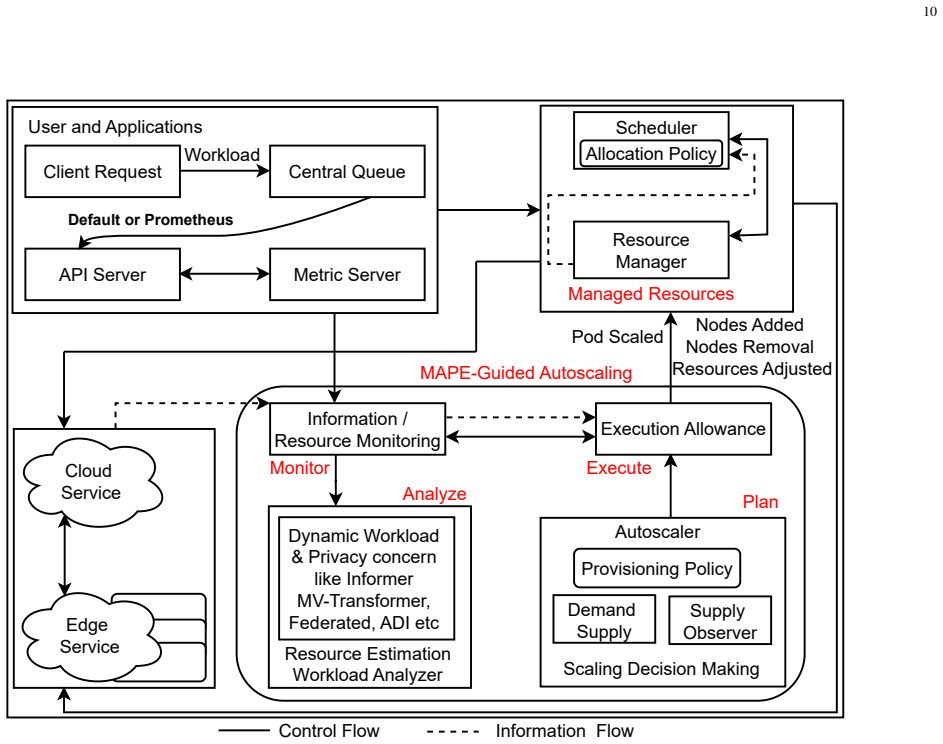
- Predictive models combined with MAPE loops shift scaling from reactive threshold responses to proactive adjustments that reduce resource imbalance.
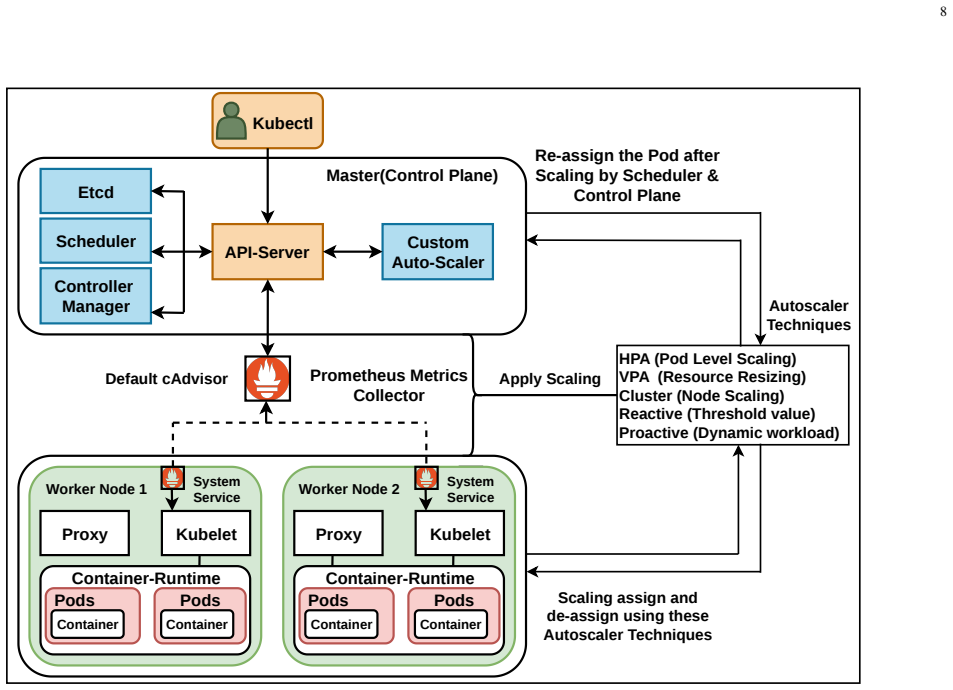
- CRD-based Kubernetes operators and reconciliation workflows allow custom, environment-specific autoscaling logic beyond default mechanisms.
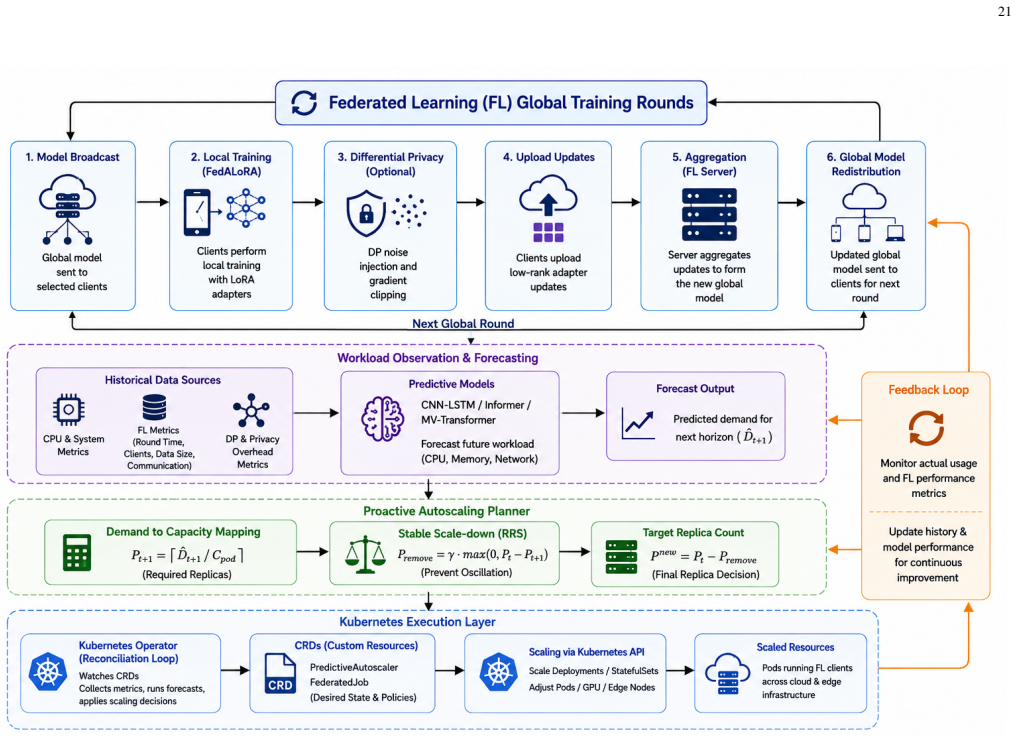
- Federated learning strategies enable scaling decisions while applying privacy-preserving techniques and container-level isolation.
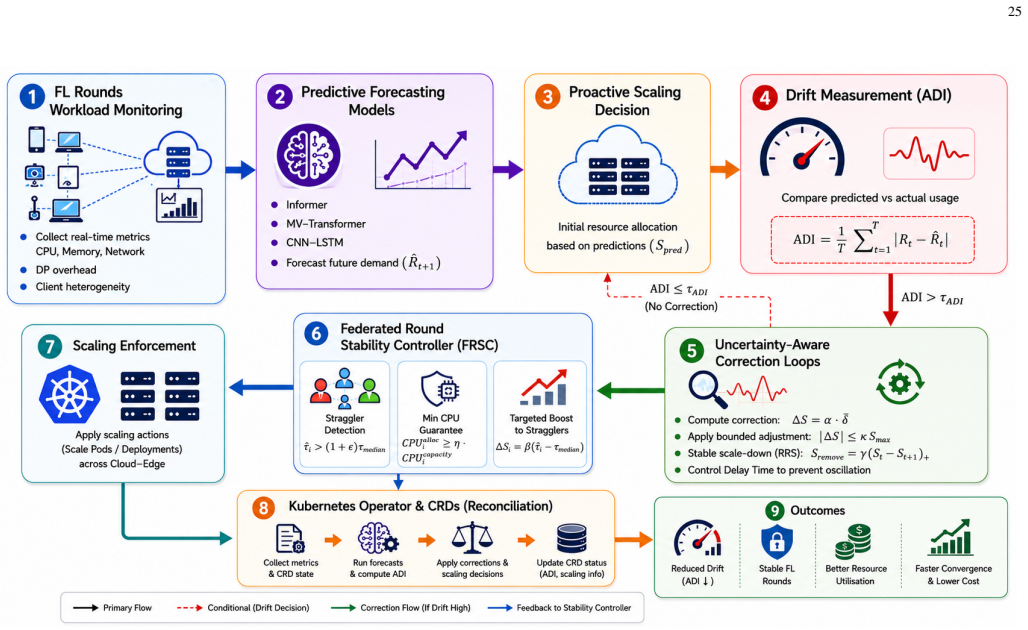
- Drift-aware methods that incorporate the Autoscaling Drift Index and feedback-driven correction improve stability under heterogeneous or changing workloads.
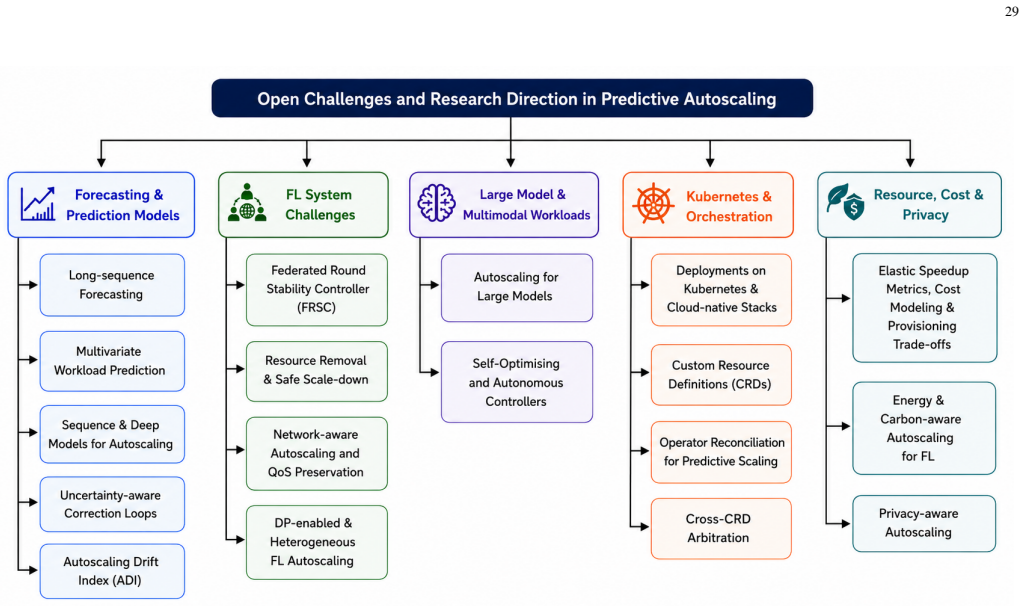
- The outlined open challenges direct attention toward uncertainty-aware and fully autonomous scaling systems in federated cloud-edge settings.
Where Pith is reading between the lines
- The taxonomy categories could serve as a starting point for creating cross-platform benchmarks that compare scaling performance under controlled workload drifts.
- Extending the dimensions to include energy-consumption metrics would connect the framework to sustainability goals in large-scale deployments.
- Application of the same trigger-and-model classification to non-container orchestration systems might reveal whether the taxonomy generalises beyond Kubernetes-centric environments.
Load-bearing premise
The literature selected for the taxonomy and the chosen categorization dimensions accurately and comprehensively represent the current state of predictive autoscaling research and practice.
What would settle it
A new survey that identifies a large set of high-impact predictive autoscaling papers or deployments that fall outside the taxonomy categories would indicate that the classification does not provide a complete foundation.
Figures







read the original abstract
Autoscaling is a key capability in cloud-native systems, where dynamic workloads, heterogeneous environments, and latency-sensitive applications require efficient and adaptive resource management. Traditional reactive approaches based on fixed thresholds often respond too late, leading to resource imbalance, performance degradation, and unstable scaling behavior. Recent advances in predictive models, Kubernetes Custom Resource Definitions (CRDs), Monitor-Analyse-Plan-Execute (MAPE) based control loops, and federated learning (FL) have enabled more proactive and autonomous autoscaling strategies. This paper presents a structured review of these developments. It first introduces a taxonomy of autoscaling techniques based on triggers, targets, prediction models, and evaluation metrics. It then examines predictive autoscaling approaches and CRD-based mechanisms, including Kubernetes operators and reconciliation workflows. Further, it analyses autoscaling in federated learning environments, highlighting reactive and proactive strategies alongside privacy-preserving techniques and container-level isolation. The paper also discusses drift-aware and uncertainty-aware autoscaling, incorporating concepts such as the Autoscaling Drift Index (ADI), feedback-driven correction, and stability control for heterogeneous workloads. Finally, it outlines open challenges and future research directions, providing a foundation for next-generation intelligent predictive autoscaling in cloud-edge environments.
Editorial analysis
A structured set of objections, weighed in public.
Referee Report
Summary. The manuscript is a structured literature survey that introduces a taxonomy of predictive autoscaling techniques in cloud-native and federated cloud-edge settings, organized along the dimensions of triggers, targets, prediction models, and evaluation metrics. It reviews predictive approaches, Kubernetes CRD-based mechanisms and reconciliation loops, MAPE control loops, federated-learning-aware autoscaling (including privacy and container isolation), and drift/uncertainty-aware methods that incorporate the Autoscaling Drift Index (ADI). The paper concludes by identifying open challenges and future directions for proactive, autonomous autoscaling.
Significance. A well-executed taxonomy in this area could help researchers navigate the intersection of predictive modeling, control theory, and federated systems for resource management. The explicit treatment of MAPE loops, CRDs, and drift detection is timely given the shift toward proactive strategies in heterogeneous environments. However, the significance is conditional on the taxonomy being grounded in a representative and reproducible selection of the literature.
major comments (2)
- [Introduction / Taxonomy construction] The manuscript provides no description of the literature-review methodology (search strings, databases, time window, or inclusion/exclusion criteria). Because the central claim is that the taxonomy supplies a foundation for next-generation work, the absence of selection criteria is load-bearing; without it, readers cannot judge whether the chosen dimensions and cited works accurately reflect the state of the art.
- [Drift-aware and uncertainty-aware autoscaling] In the drift-aware section the Autoscaling Drift Index (ADI) is introduced as a stability-control concept, yet no formal definition, formula, or worked example is supplied. This prevents assessment of whether ADI adds a falsifiable or operational contribution beyond existing drift-detection literature.
minor comments (2)
- [Taxonomy figures/tables] Figure captions and table headers could more explicitly link each entry to the taxonomy dimensions (triggers/targets/models/metrics) to improve traceability.
- [Related-work and taxonomy sections] Several citations appear only in passing; a consolidated summary table mapping each reference to the taxonomy categories would strengthen the synthesis.
Simulated Author's Rebuttal
We thank the referee for the constructive feedback. We address each major comment below and will incorporate revisions to strengthen the manuscript's methodological transparency and the formalization of ADI.
read point-by-point responses
-
Referee: [Introduction / Taxonomy construction] The manuscript provides no description of the literature-review methodology (search strings, databases, time window, or inclusion/exclusion criteria). Because the central claim is that the taxonomy supplies a foundation for next-generation work, the absence of selection criteria is load-bearing; without it, readers cannot judge whether the chosen dimensions and cited works accurately reflect the state of the art.
Authors: We agree that explicit documentation of the review methodology is required for a taxonomy paper. In the revised manuscript we will add a dedicated subsection (likely in Section 2 or the Introduction) that specifies the databases queried (IEEE Xplore, ACM Digital Library, SpringerLink, arXiv), the search strings, the time window, and the inclusion/exclusion criteria used to select the cited works. This addition will allow readers to assess the representativeness of the taxonomy. revision: yes
-
Referee: [Drift-aware and uncertainty-aware autoscaling] In the drift-aware section the Autoscaling Drift Index (ADI) is introduced as a stability-control concept, yet no formal definition, formula, or worked example is supplied. This prevents assessment of whether ADI adds a falsifiable or operational contribution beyond existing drift-detection literature.
Authors: We acknowledge the omission. The revised version will expand the drift-aware section with (i) a formal definition of ADI, (ii) its mathematical formula, and (iii) a concrete worked example showing its computation and application to a heterogeneous workload scenario. This will clarify its operational value relative to prior drift-detection techniques. revision: yes
Circularity Check
No significant circularity
full rationale
This is a literature survey paper that presents a taxonomy of existing predictive autoscaling techniques organized by triggers, targets, prediction models, and metrics, along with reviews of Kubernetes CRDs, MAPE loops, federated learning applications, and drift-aware methods. No new derivations, equations, fitted parameters, predictions, or uniqueness theorems are introduced; the central claim is that recent advances enable proactive strategies and the taxonomy provides a foundation, which rests on the representativeness of selected literature rather than any internal reduction to fitted inputs or self-citations. The work contains no load-bearing steps that equate outputs to inputs by construction, making the derivation chain self-contained as a review.
Axiom & Free-Parameter Ledger
axioms (1)
- domain assumption Dynamic workloads, heterogeneous environments, and latency-sensitive applications in cloud-native systems require adaptive rather than purely reactive resource management.
Reference graph
Works this paper leans on
-
[1]
Auto-scaling mechanisms in serverless computing: A comprehensive review,
M. Tari, M. Ghobaei-Arani, J. Pouramini, and M. Ghorbian, “Auto-scaling mechanisms in serverless computing: A comprehensive review,”Computer Science Review, vol. 53, p. 100650, 2024. [Online]. Available: https://www.sciencedirect.com/science/article/pii/ S1574013724000340
2024
-
[2]
The comput- ing continuum: Past, present, and future,
L. F. Bittencourt, R. Rodrigues-Filho, J. Spillner, F. De Turck, J. Santos, N. L. da Fonseca, O. Rana, M. Parashar, and I. Foster, “The comput- ing continuum: Past, present, and future,”Computer Science Review, vol. 58, p. 100782, 2025
2025
-
[3]
Con- tainerized microservices: A survey of resource management frame- works,
L. M. Al Qassem, T. Stouraitis, E. Damiani, and I. M. Elfadel, “Con- tainerized microservices: A survey of resource management frame- works,”IEEE Transactions on Network and Service Management, vol. 21, no. 4, pp. 3775–3796, 2024
2024
-
[5]
Migrating towards mi- croservice architectures: an industrial survey,
P. Di Francesco, P. Lago, and I. Malavolta, “Migrating towards mi- croservice architectures: an industrial survey,” in2018 IEEE interna- tional conference on software architecture (ICSA). IEEE, 2018, pp. 29–2909
2018
-
[6]
Cloud-native computing: A survey from the perspective of services,
S. Deng, H. Zhao, B. Huang, C. Zhang, F. Chen, Y . Deng, J. Yin, S. Dustdar, and A. Y . Zomaya, “Cloud-native computing: A survey from the perspective of services,”Proceedings of the IEEE, vol. 112, no. 1, pp. 12–46, 2024
2024
-
[7]
Overview — kubernetes.io,
Kubernetes-Authors, “Overview — kubernetes.io,” https://kubernetes. io/docs/concepts/overview/, [Accessed 09-12-2025]
2025
-
[8]
Critical insights into runtime scheduling, image, storage, and networking challenges in modern ku- bernetes environments,
B. Kumar, A. Verma, and P. Verma, “Critical insights into runtime scheduling, image, storage, and networking challenges in modern ku- bernetes environments,”Computer Science Review, vol. 59, p. 100851, 2026
2026
-
[9]
Autoscaling techniques in cloud-native com- puting: A comprehensive survey,
B. Jeong and Y .-S. Jeong, “Autoscaling techniques in cloud-native com- puting: A comprehensive survey,”Computer Science Review, vol. 58, p. 100791, 2025
2025
-
[10]
Tools for Monitoring Resources — kubernetes.io,
Kubernetes-Authors, “Tools for Monitoring Resources — kubernetes.io,” https://kubernetes.io/docs/tasks/debug/debug-cluster/ resource-usage-monitoring/, [Accessed 09-12-2025]. 36
2025
-
[11]
Offloading using traditional optimization and machine learning in federated cloud–edge–fog sys- tems: A survey,
B. Kar, W. Yahya, Y .-D. Lin, and A. Ali, “Offloading using traditional optimization and machine learning in federated cloud–edge–fog sys- tems: A survey,”IEEE Communications Surveys & Tutorials, vol. 25, no. 2, pp. 1199–1226, 2023
2023
-
[12]
Ai-empowered fog/edge resource management for iot applications: A comprehensive review, research challenges, and future perspectives,
G. K. Walia, M. Kumar, and S. S. Gill, “Ai-empowered fog/edge resource management for iot applications: A comprehensive review, research challenges, and future perspectives,”IEEE Communications Surveys & Tutorials, vol. 26, no. 1, pp. 619–669, 2024
2024
-
[13]
Energy-efficient and latency-aware task offloading for industrial cloud-edge systems with heterogeneous cpus and gpus,
J. Zhai, J. Bi, H. Yuan, J. Zhang, and R. Buyya, “Energy-efficient and latency-aware task offloading for industrial cloud-edge systems with heterogeneous cpus and gpus,”IEEE Internet of Things Journal, 2025
2025
-
[14]
Efficient orchestration of distributed workloads in multi-region kubernetes cluster,
R. Furnadzhiev, M. Shopov, and N. Kakanakov, “Efficient orchestration of distributed workloads in multi-region kubernetes cluster,”Comput- ers, vol. 14, no. 4, p. 114, 2025
2025
-
[15]
Autoscaling Workloads — kubernetes.io,
Kubernetes-Authors, “Autoscaling Workloads — kubernetes.io,” https: //kubernetes.io/docs/concepts/workloads/autoscaling/, [Accessed 09- 12-2025]
2025
-
[16]
Optimizing resource allocation using proactive scaling with predictive models and custom resources,
B. Kumar, A. Verma, and P. Verma, “Optimizing resource allocation using proactive scaling with predictive models and custom resources,” Computers and Electrical Engineering, vol. 118, p. 109419, 2024
2024
-
[17]
Optimizing resource allocation in cloud-native applications through proactive autoscaling with the informerautoscale model,
B. Kumar, A. Verma, P. Verma, and A. Bennour, “Optimizing resource allocation in cloud-native applications through proactive autoscaling with the informerautoscale model,”The Journal of Supercomputing, vol. 81, no. 9, p. 1077, 2025
2025
-
[18]
Properties of horizontal pod autoscaling algorithms and application for scaling cloud-native network functions,
T. Van Do, N. H. Do, C. Rotter, T. Lakshman, C. Biro, and T. B ´erczes, “Properties of horizontal pod autoscaling algorithms and application for scaling cloud-native network functions,”IEEE Transactions on Network and Service Management, 2025
2025
-
[19]
Horizontal pod autoscaler documentation,
Kubernetes-Authors, “Horizontal pod autoscaler documentation,” https: //kubernetes.io/docs/tasks/run-application/horizontal-pod-autoscale/, 2023, accessed: 2023-11-20
2023
-
[20]
Elastic federated learning with kubernetes vertical pod autoscaler for edge computing,
K. Q. Pham and T. Kim, “Elastic federated learning with kubernetes vertical pod autoscaler for edge computing,”Future Generation Com- puter Systems, vol. 158, pp. 501–515, 2024
2024
-
[21]
Kubernetes scheduling: Taxonomy, ongoing issues and challenges,
C. Carri ´on, “Kubernetes scheduling: Taxonomy, ongoing issues and challenges,”ACM Computing Surveys, vol. 55, no. 7, pp. 1–37, 2022
2022
-
[22]
Edge resource autoscaling for hierarchical federated learning over public edge platforms,
M. Zhao, K. Zhao, Z. Zhou, and X. Chen, “Edge resource autoscaling for hierarchical federated learning over public edge platforms,” in2022 IEEE Smartworld, Ubiquitous Intelligence & Computing, Scalable Computing & Communications, Digital Twin, Privacy Computing, Metaverse, Autonomous & Trusted Vehicles (SmartWorld/UIC/Scal- Com/DigitalTwin/PriComp/Meta). ...
2022
-
[23]
Federated learning in mobile edge networks: A comprehensive survey,
W. Y . B. Lim, N. C. Luong, D. T. Hoang, Y . Jiao, Y .-C. Liang, Q. Yang, D. Niyato, and C. Miao, “Federated learning in mobile edge networks: A comprehensive survey,”IEEE Communications Surveys & Tutorials, vol. 22, no. 3, pp. 2031–2063, 2020
2031
-
[24]
Data- driven participant selection and bandwidth allocation for heterogeneous federated edge learning,
A. Albaseer, M. Abdallah, A. Al-Fuqaha, and A. Erbad, “Data- driven participant selection and bandwidth allocation for heterogeneous federated edge learning,”IEEE Transactions on Systems, Man, and Cybernetics: Systems, vol. 53, no. 9, pp. 5848–5860, 2023
2023
-
[25]
Fedalora: Adaptive local lora aggregation for personalized federated learning in llm,
X. Yi, C. Hu, and B. Cai, “Fedalora: Adaptive local lora aggregation for personalized federated learning in llm,” inInternational Conference on Wireless Artificial Intelligent Computing Systems and Applications. Springer, 2025, pp. 86–95
2025
-
[26]
Fedinv: A semi-asynchronous federated learning framework with dynamic aggregation for privacy-preserving industrial energy forecasting,
B. Liu, P. Xia, and S. Xu, “Fedinv: A semi-asynchronous federated learning framework with dynamic aggregation for privacy-preserving industrial energy forecasting,” in2025 IEEE/CIC International Con- ference on Communications in China (ICCC). IEEE, 2025, pp. 1–6
2025
-
[27]
Proactive auto-scaling technique for web applications in container-based edge computing using federated learning model,
J. Dogani and F. Khunjush, “Proactive auto-scaling technique for web applications in container-based edge computing using federated learning model,”Journal of Parallel and Distributed Computing, vol. 187, p. 104837, 2024
2024
-
[28]
Openfedllm: Training large language models on decentral- ized private data via federated learning,
R. Ye, W. Wang, J. Chai, D. Li, Z. Li, Y . Xu, Y . Du, Y . Wang, and S. Chen, “Openfedllm: Training large language models on decentral- ized private data via federated learning,” inProceedings of the 30th ACM SIGKDD conference on knowledge discovery and data mining, 2024, pp. 6137–6147
2024
-
[29]
A multivariate transformer- based monitor-analyze-plan-execute (mape) autoscaling framework for dynamic resource allocation in cloud environment,
B. Kumar, A. Verma, and P. Verma, “A multivariate transformer- based monitor-analyze-plan-execute (mape) autoscaling framework for dynamic resource allocation in cloud environment,”Computing, vol. 107, no. 3, p. 69, 2025
2025
-
[30]
Edge-cloud collaborative com- puting on distributed intelligence and model optimization: A survey,
J. Liu, Y . Du, K. Yang, J. Wu, Y . Wang, X. Hu, Z. Wang, Y . Liu, P. Sun, A. Boukerche, and V . C. M. Leung, “Edge-cloud collaborative com- puting on distributed intelligence and model optimization: A survey,” IEEE Communications Surveys & Tutorials, vol. 28, pp. 5049–5080, 2026
2026
-
[31]
A survey on approximate edge ai for energy efficient autonomous driving services,
D. Katare, D. Perino, J. Nurmi, M. Warnier, M. Janssen, and A. Y . Ding, “A survey on approximate edge ai for energy efficient autonomous driving services,”IEEE Communications Surveys & Tutorials, vol. 25, no. 4, pp. 2714–2754, 2023
2023
-
[32]
Auto-scaling web applications in clouds: A taxonomy and survey,
C. Qu, R. N. Calheiros, and R. Buyya, “Auto-scaling web applications in clouds: A taxonomy and survey,”ACM Computing Surveys (CSUR), vol. 51, no. 4, pp. 1–33, 2018
2018
-
[33]
Reinforcement learning-based application autoscaling in the cloud: A survey,
Y . Gar ´ı, D. A. Monge, E. Pacini, C. Mateos, and C. G. Garino, “Reinforcement learning-based application autoscaling in the cloud: A survey,”Engineering Applications of Artificial Intelligence, vol. 102, p. 104288, 2021
2021
-
[34]
Prediction-based scheduling techniques for cloud data center’s workload: a systematic review,
S. Kashyap and A. Singh, “Prediction-based scheduling techniques for cloud data center’s workload: a systematic review,”Cluster Computing, vol. 26, no. 5, pp. 3209–3235, 2023
2023
-
[35]
Deep learning and feedback control based container auto-scaling for cloud native micro- services,
Z. Cai, H. Wu, X. Jiang, X. Li, and R. Buyya, “Deep learning and feedback control based container auto-scaling for cloud native micro- services,”IEEE Transactions on Services Computing, 2025
2025
-
[36]
Catscaler: A convolution-augmented transformer scaling framework for cloud-native applications,
F. Meng, H. Dai, G. Cong, B. Zhu, and H. Zhao, “Catscaler: A convolution-augmented transformer scaling framework for cloud-native applications,”IEEE Transactions on Services Computing, 2025
2025
-
[37]
Auto-scaling techniques for iot-based cloud applications: a review,
S. Verma and A. Bala, “Auto-scaling techniques for iot-based cloud applications: a review,”Cluster Computing, vol. 24, no. 3, pp. 2425– 2459, 2021
2021
-
[38]
K-agrued: A container autoscaling technique for cloud-based web applications in kubernetes using attention-based gru encoder-decoder,
J. Dogani, F. Khunjush, and M. Seydali, “K-agrued: A container autoscaling technique for cloud-based web applications in kubernetes using attention-based gru encoder-decoder,”Journal of Grid Comput- ing, vol. 20, no. 4, p. 40, 2022
2022
-
[39]
A holistic view on re- source management in serverless computing environments: Taxonomy and future directions,
A. Mampage, S. Karunasekera, and R. Buyya, “A holistic view on re- source management in serverless computing environments: Taxonomy and future directions,”ACM Computing Surveys (CSUR), vol. 54, no. 11s, pp. 1–36, 2022
2022
-
[40]
Auto- scaling mechanisms in serverless computing: A comprehensive review,
M. Tari, M. Ghobaei-Arani, J. Pouramini, and M. Ghorbian, “Auto- scaling mechanisms in serverless computing: A comprehensive review,” Computer Science Review, vol. 53, p. 100650, 2024
2024
-
[41]
Predictive dynamic virtual machine scaling for federated learning over edge-cloud interworking,
S. Patni, S. Woo, and J. Lee, “Predictive dynamic virtual machine scaling for federated learning over edge-cloud interworking,”IT Pro- fessional, vol. 26, no. 6, pp. 35–44, 2025
2025
-
[42]
Federated learning in cloud-edge-fog architectures: Enhancing privacy, efficiency, and scalability,
Z. J. KhalilAbadi, N. Mansouri, and M. M. Javidi, “Federated learning in cloud-edge-fog architectures: Enhancing privacy, efficiency, and scalability,”Computer Science Review, vol. 60, p. 100917, 2026
2026
-
[43]
Decentralized federated learning with non-iid data: Challenges, trends, and future opportunities,
W.-C. Chung, C.-A. Lo, Y .-H. Lin, Z.-H. Chen, and C.-L. Hung, “Decentralized federated learning with non-iid data: Challenges, trends, and future opportunities,”ACM Computing Surveys, vol. 58, no. 8, pp. 1–41, 2026
2026
-
[44]
Federated learning in iot environments: Examining the three-way see-saw for privacy, model-performance, and network-efficiency,
R. Laidi, N. Merabtine, D. Djenouri, S. Latif, H. A. Qadir, Y . Dje- nouri, and I. Balasingham, “Federated learning in iot environments: Examining the three-way see-saw for privacy, model-performance, and network-efficiency,”IEEE Communications Surveys & Tutorials, vol. 28, pp. 1025–1058, 2026
2026
-
[45]
Advances and open challenges in federated foundation models,
C. Ren, H. Yu, H. Peng, X. Tang, B. Zhao, L. Yi, A. Z. Tan, Y . Gao, A. Li, X. Li, Z. Li, and Q. Yang, “Advances and open challenges in federated foundation models,”IEEE Communications Surveys & Tutorials, vol. 28, pp. 2087–2126, 2026
2087
-
[46]
A survey on federated analytics: Taxonomy, enabling techniques, applications and open issues,
Z. Wang, H. Ji, Y . Zhu, D. Wang, and Z. Han, “A survey on federated analytics: Taxonomy, enabling techniques, applications and open issues,”IEEE Communications Surveys & Tutorials, vol. 28, pp. 2457–2496, 2026
2026
-
[47]
A survey on the placement of virtual re- sources and virtual network functions,
A. Laghrissi and T. Taleb, “A survey on the placement of virtual re- sources and virtual network functions,”IEEE Communications Surveys & Tutorials, vol. 21, no. 2, pp. 1409–1434, 2019
2019
-
[48]
Cloud-native applications,
D. Gannon, R. Barga, and N. Sundaresan, “Cloud-native applications,” IEEE Cloud Computing, vol. 4, no. 5, pp. 16–21, 2017
2017
-
[49]
Self-adaptive trade-off decision making for autoscaling cloud-based services,
T. Chen and R. Bahsoon, “Self-adaptive trade-off decision making for autoscaling cloud-based services,”IEEE Transactions on Services Computing, vol. 10, no. 4, pp. 618–632, 2015
2015
-
[50]
Optimal cloudlet selection in edge computing for resource allocation,
B. Kumar, M. Singh, A. Verma, and P. Verma, “Optimal cloudlet selection in edge computing for resource allocation,”SN Computer Science, vol. 4, no. 6, p. 745, 2023
2023
-
[51]
Borg, omega, and kubernetes,
B. Burns, B. Grant, D. Oppenheimer, E. Brewer, and J. Wilkes, “Borg, omega, and kubernetes,”Communications of the ACM, vol. 59, no. 5, pp. 50–57, 2016
2016
-
[52]
Containers and cloud: From lxc to docker to kubernetes,
D. Bernstein, “Containers and cloud: From lxc to docker to kubernetes,” IEEE Cloud Computing, vol. 1, no. 3, pp. 81–84, 2014
2014
-
[53]
Kubernetes architecture documentation,
Kubernetes-Authors, “Kubernetes architecture documentation,” https: //kubernetes.io/docs/concepts/, 2024, accessed: 2024-12-01. 37
2024
-
[54]
Kubernetes scaling: A com- prehensive review of scalability in kubernetes,
T. S. Wijesekera and D. R. Wijendra, “Kubernetes scaling: A com- prehensive review of scalability in kubernetes,” inInternational Con- ference on ICT for Sustainable Development. Springer, 2025, pp. 187–201
2025
-
[55]
Kcss: Kubernetes container scheduling strategy
T. Menouer, “Kcss: Kubernetes container scheduling strategy.”Journal of Supercomputing, vol. 77, no. 5, 2021
2021
-
[56]
A formal model of the kubernetes container framework,
G. Turin, A. Borgarelli, S. Donetti, E. B. Johnsen, S. L. Tapia Tar- ifa, and F. Damiani, “A formal model of the kubernetes container framework,” inInternational Symposium on Leveraging Applications of Formal Methods. Springer, 2020, pp. 558–577
2020
-
[57]
Large-scale cluster management at google with borg,
A. Verma, L. Pedrosa, M. R. Korupolu, D. Oppenheimer, E. Tune, and J. Wilkes, “Large-scale cluster management at google with borg,” in Proceedings of the 10th European Conference on Computer Systems (EuroSys). ACM, 2015, pp. 1–17
2015
-
[58]
Hightower, B
K. Hightower, B. Burns, and J. Beda,Kubernetes: Up and Running. O’Reilly Media, 2017
2017
-
[59]
Kubernetes api concepts and object documen- tation,
Kubernetes-Authors, “Kubernetes api concepts and object documen- tation,” https://kubernetes.io/docs/reference/, 2023, accessed: 2023-11- 20
2023
-
[60]
Horizontal pod autoscaling in kubernetes for elastic container orchestration,
T.-T. Nguyen, Y .-J. Yeom, T. Kim, D.-H. Park, and S. Kim, “Horizontal pod autoscaling in kubernetes for elastic container orchestration,” Sensors, vol. 20, no. 16, p. 4621, 2020
2020
-
[61]
Vertical pod autoscaler documentation,
Kubernetes-Authors, “Vertical pod autoscaler documentation,” https: //github.com/kubernetes/autoscaler/tree/master/vertical-pod-autoscaler, 2023, accessed: 2023-11-20
2023
-
[62]
Kubernetes cluster autoscaler documentation,
KubernetesAuthors, “Kubernetes cluster autoscaler documentation,” https://github.com/kubernetes/autoscaler/tree/master/cluster-autoscaler, 2023, accessed: 2023-11-20
2023
-
[63]
Maestro: An autonomic controller for cloud resource management,
D. Villegas, G. Casaleet al., “Maestro: An autonomic controller for cloud resource management,” inIEEE/ACM CCGrid, 2012
2012
-
[64]
A review of auto-scaling techniques for elastic applications in cloud environments,
T. Lorido-Botranet al., “A review of auto-scaling techniques for elastic applications in cloud environments,”Journal of Grid Computing, vol. 12, no. 4, pp. 559–592, 2014
2014
-
[65]
Machine learning-based resource manage- ment for cloud computing environments,
M. Ghobaei-Araniet al., “Machine learning-based resource manage- ment for cloud computing environments,”Journal of Network and Computer Applications, 2020
2020
-
[66]
Intelligent auto- scaling in hybrid and multi-cloud architectures using reinforcement learning,
A. Kakkad, C. Shinadiya, M. Singh, and N. S. Kumar, “Intelligent auto- scaling in hybrid and multi-cloud architectures using reinforcement learning,” in2025 Seventh International Conference on Computational Intelligence andCommunication Technologies (CCICT). IEEE, 2025, pp. 776–781
2025
-
[67]
Predictive hybrid autoscaling for containerized applications,
D.-D. Vu, M.-N. Tran, and Y . Kim, “Predictive hybrid autoscaling for containerized applications,”IEEE Access, vol. 10, pp. 109 768–109 778, 2022
2022
-
[68]
An optimal three-tier prioritization- based multiflow scheduling in cloud-assisted smart healthcare,
Sarthak, A. Verma, and P. Verma, “An optimal three-tier prioritization- based multiflow scheduling in cloud-assisted smart healthcare,”Journal of Network and Computer Applications, vol. 238, p. 104143, 2025
2025
-
[69]
Autoscaling of microservice resources based on dense connectivity spatio-temporal gnn and q- learning,
P. Liang, Y . Xun, J. Cai, and H. Yang, “Autoscaling of microservice resources based on dense connectivity spatio-temporal gnn and q- learning,”Future Generation Computer Systems, vol. 174, p. 107909, 2026
2026
-
[70]
Auto-scaling techniques in cloud computing: Issues and research directions,
S. Alharthi, A. Alshamsi, A. Alseiari, and A. Alwarafy, “Auto-scaling techniques in cloud computing: Issues and research directions,”Sen- sors, vol. 24, no. 17, p. 5551, 2024
2024
-
[71]
Global microservice autoscaling over heterogeneous edge environments for in- ternet applications: A reinforcement learning approach,
K. Peng, J. Rao, H. Li, Y . Hu, B. Jin, T. Zheng, and M. Hu, “Global microservice autoscaling over heterogeneous edge environments for in- ternet applications: A reinforcement learning approach,”IEEE Internet of Things Journal, 2025
2025
-
[72]
Kubernetes advanced auto scaling techniques,
R. Molleti, “Kubernetes advanced auto scaling techniques,”Journal of Mathematical & Computer Applications, vol. 1, no. 4, pp. 1–7, 2022
2022
-
[73]
A comprehensive review on automatic fruit sorting and grading techniques with emphasis on weight-based classification,
D. Waghmare, A. Mulani, S. Takale, V . Godase, and A. Mulani, “A comprehensive review on automatic fruit sorting and grading techniques with emphasis on weight-based classification,”Research & Review: Electronics and Communication Engineering, vol. 2, no. 3, pp. 1–10, 2025
2025
-
[74]
As-threshold method to perform horizontal auto-scaling in a cloud computing environment,
A. Archana and N. Kumar, “As-threshold method to perform horizontal auto-scaling in a cloud computing environment,”Concurrency and Computation: Practice and Experience, vol. 37, no. 12-14, p. e70135, 2025
2025
-
[75]
Investigation into auto-scaling mechanisms in cloud computing,
X. Li, J. Dong, W. Xiang, D. Zhao, L. Xu, and F. Tong, “Investigation into auto-scaling mechanisms in cloud computing,” inInternational Conference on Knowledge Science, Engineering and Management. Springer, 2025, pp. 198–209
2025
-
[76]
Serverless event-driven architecture for enterprise test automation vamsi krishna gattupall
V . K. Gattupalli, “Serverless event-driven architecture for enterprise test automation vamsi krishna gattupall.”Journal of Computational Analysis & Applications, vol. 34, no. 11, 2025
2025
-
[77]
Enhancing cloud resource utilization with predictive autoscaling using transformer models,
R. Shrestha and F. T. Sabiha, “Enhancing cloud resource utilization with predictive autoscaling using transformer models,” in2025 9th In- ternational Conference on Cloud and Big Data Computing (ICCBDC). IEEE, 2025, pp. 24–29
2025
-
[78]
An efficient multivariate autoscaling framework using bi-lstm for cloud computing,
N.-M. Dang-Quang and M. Yoo, “An efficient multivariate autoscaling framework using bi-lstm for cloud computing,”Applied sciences, vol. 12, no. 7, p. 3523, 2022
2022
-
[79]
A review on prediction based autoscaling techniques for heterogeneous applications in cloud environ- ment,
E. Radhika and G. S. Sadasivam, “A review on prediction based autoscaling techniques for heterogeneous applications in cloud environ- ment,”Materials Today: Proceedings, vol. 45, pp. 2793–2800, 2021
2021
-
[80]
Intelligent autoscaling of microservices in the cloud for real-time applications,
A. A. Khaleq and I. Ra, “Intelligent autoscaling of microservices in the cloud for real-time applications,”IEEE access, vol. 9, pp. 35 464– 35 476, 2021
2021
-
[81]
Comparing neural and statistical time-series models for proactive auto-scaling in kubernetes,
J. W. Fog, J. J. T. Møller, T. M. Jensen, D. Taibi, and M. Albano, “Comparing neural and statistical time-series models for proactive auto-scaling in kubernetes,” in2025 IEEE International Conference on Service-Oriented System Engineering (SOSE). IEEE, 2025, pp. 151–161
2025
discussion (0)
Sign in with ORCID, Apple, or X to comment. Anyone can read and Pith papers without signing in.