Implementation and Calibration of 3GPP-Compliant ISAC Channel Simulator
Pith reviewed 2026-06-27 21:09 UTC · model grok-4.3
The pith
The implemented 3GPP ISAC channel simulator produces results consistent with company reference calibrations.
A machine-rendered reading of the paper's core claim, the machinery that carries it, and where it could break.
Core claim
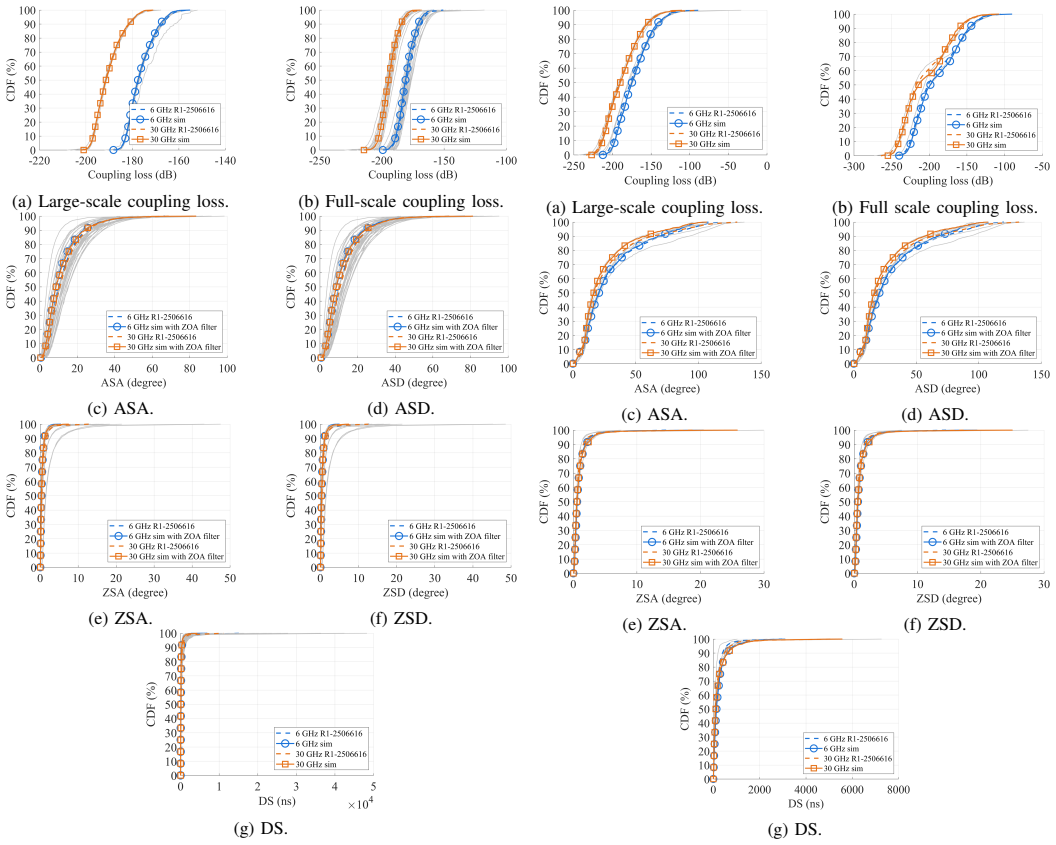
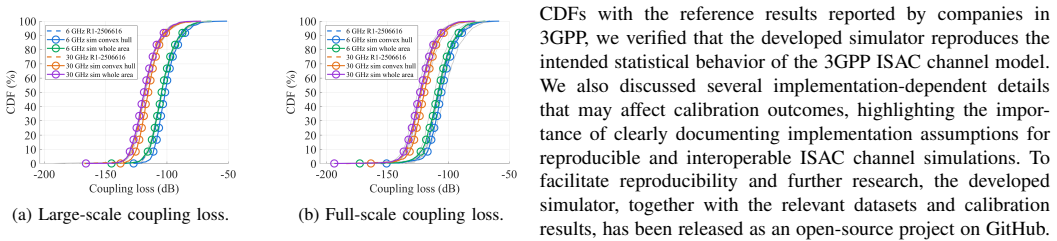
The simulator, after following the 3GPP calibration procedure, generates channel realizations whose statistics align with the reference results reported by companies in 3GPP.
What carries the argument
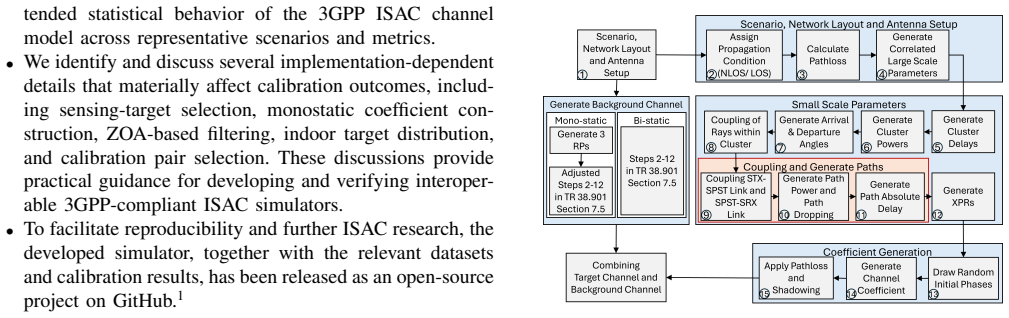
The 3GPP ISAC channel model simulator specified in TR 38.901 together with its calibration procedure against company reference results.
If this is right
- Developers obtain a verified baseline for consistent ISAC performance evaluation.
- Clarified implementation details reduce divergence among future simulators.
- Open-source release supports direct reproducibility checks by other groups.
- The calibrated tool can be used to benchmark new ISAC algorithms against the standard model.
Where Pith is reading between the lines
- Widespread adoption of this reference implementation could reduce the need for repeated inter-company calibration rounds.
- The same methodology might be applied to future extensions of the ISAC model beyond the current TR 38.901 scenarios.
- Community contributions to the open-source code could surface additional edge cases not covered in the original calibration.
- The work implies that standards with complex geometry-based modeling benefit from public reference code rather than text alone.
Load-bearing premise
The 3GPP TR 38.901 report plus the company reference results together define a unique, unambiguous implementation target that any correct simulator must match.
What would settle it
Running an independent implementation that strictly follows the same TR 38.901 rules and calibration steps yet produces outputs outside the tolerance bands of the company reference results.
Figures
read the original abstract
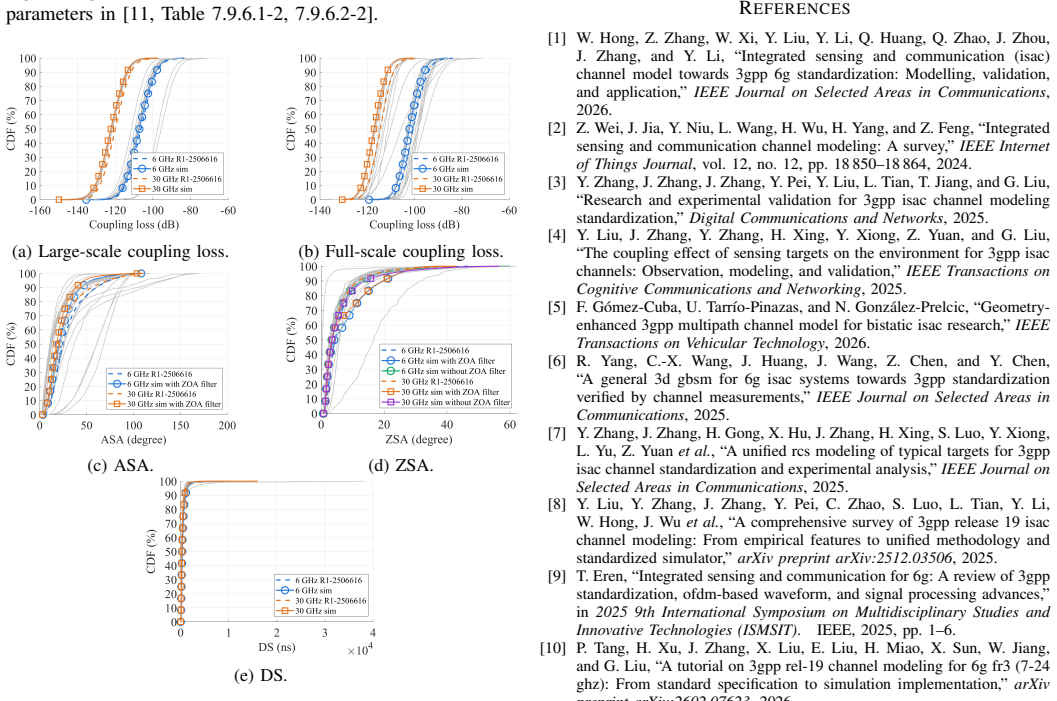
Integrated sensing and communication (ISAC) has emerged as a key technology for 6G systems. To support the development of ISAC systems, accurate channel modeling and simulation for performance evaluation is essential. Recently, 3GPP introduced a standardized ISAC channel model and its associated calibration procedure for this purpose. However, due to the complexity of the modeling methodology and the lack of fully explicit implementation details in the 3GPP reports, different implementations may lead to inconsistent or unsynchronized simulation results. To address this issue, in this work, we implement the 3GPP ISAC channel model simulator specified in TR 38.901 and conduct a comprehensive calibration analysis. We compare the simulation results with the reference results reported by companies in 3GPP and discuss several key implementation details to provide insights into the implementation and calibration of the simulator. To facilitate reproducibility and further research, the developed simulator, together with the relevant datasets and calibration results, has been released as an open-source project on GitHub.
Editorial analysis
A structured set of objections, weighed in public.
Referee Report
Summary. The paper implements the 3GPP ISAC channel model from TR 38.901, performs calibration against reference results reported by companies participating in 3GPP, discusses key implementation details to address ambiguities in the standard, and releases the simulator, datasets, and calibration scripts as open-source on GitHub.
Significance. If the reported calibration holds, the work supplies a reproducible, open-source ISAC channel simulator that directly supports 6G system evaluation. The explicit treatment of implementation choices and the multi-company matching, together with the public release of code and data, constitute a concrete contribution to standardization and reproducibility in the field.
minor comments (1)
- The manuscript would benefit from a short table or appendix listing the exact parameter settings (e.g., carrier frequency, bandwidth, antenna configurations) used for each calibration scenario referenced in the comparison with company results.
Simulated Author's Rebuttal
We thank the referee for their positive assessment of the manuscript, the recognition of its contribution to reproducibility in ISAC channel modeling, and the recommendation to accept.
Circularity Check
No significant circularity
full rationale
The paper's central claim is that an open-source implementation of the 3GPP TR 38.901 ISAC channel model produces outputs matching independent reference results reported by multiple companies. This rests on an external specification plus externally generated calibration targets, with released code and datasets enabling direct reproduction; no derivation step reduces by construction to the paper's own fitted values, self-citations, or ansatzes.
Axiom & Free-Parameter Ledger
Reference graph
Works this paper leans on
-
[1]
Integrated sensing and communication (isac) channel model towards 3gpp 6g standardization: Modelling, validation, and application,
W. Hong, Z. Zhang, W. Xi, Y . Liu, Y . Li, Q. Huang, Q. Zhao, J. Zhou, J. Zhang, and Y . Li, “Integrated sensing and communication (isac) channel model towards 3gpp 6g standardization: Modelling, validation, and application,”IEEE Journal on Selected Areas in Communications, 2026
2026
-
[2]
Integrated sensing and communication channel modeling: A survey,
Z. Wei, J. Jia, Y . Niu, L. Wang, H. Wu, H. Yang, and Z. Feng, “Integrated sensing and communication channel modeling: A survey,”IEEE Internet of Things Journal, vol. 12, no. 12, pp. 18 850–18 864, 2024
2024
-
[3]
Research and experimental validation for 3gpp isac channel modeling standardization,
Y . Zhang, J. Zhang, J. Zhang, Y . Pei, Y . Liu, L. Tian, T. Jiang, and G. Liu, “Research and experimental validation for 3gpp isac channel modeling standardization,”Digital Communications and Networks, 2025
2025
-
[4]
The coupling effect of sensing targets on the environment for 3gpp isac channels: Observation, modeling, and validation,
Y . Liu, J. Zhang, Y . Zhang, H. Xing, Y . Xiong, Z. Yuan, and G. Liu, “The coupling effect of sensing targets on the environment for 3gpp isac channels: Observation, modeling, and validation,”IEEE Transactions on Cognitive Communications and Networking, 2025
2025
-
[5]
Geometry- enhanced 3gpp multipath channel model for bistatic isac research,
F. G ´omez-Cuba, U. Tarr´ıo-Pinazas, and N. Gonz´alez-Prelcic, “Geometry- enhanced 3gpp multipath channel model for bistatic isac research,”IEEE Transactions on V ehicular Technology, 2026
2026
-
[6]
A general 3d gbsm for 6g isac systems towards 3gpp standardization verified by channel measurements,
R. Yang, C.-X. Wang, J. Huang, J. Wang, Z. Chen, and Y . Chen, “A general 3d gbsm for 6g isac systems towards 3gpp standardization verified by channel measurements,”IEEE Journal on Selected Areas in Communications, 2025
2025
-
[7]
A unified rcs modeling of typical targets for 3gpp isac channel standardization and experimental analysis,
Y . Zhang, J. Zhang, H. Gong, X. Hu, J. Zhang, H. Xing, S. Luo, Y . Xiong, L. Yu, Z. Yuanet al., “A unified rcs modeling of typical targets for 3gpp isac channel standardization and experimental analysis,”IEEE Journal on Selected Areas in Communications, 2025
2025
-
[8]
Y . Liu, Y . Zhang, J. Zhang, Y . Pei, C. Zhao, S. Luo, L. Tian, Y . Li, W. Hong, J. Wuet al., “A comprehensive survey of 3gpp release 19 isac channel modeling: From empirical features to unified methodology and standardized simulator,”arXiv preprint arXiv:2512.03506, 2025
arXiv 2025
-
[9]
Integrated sensing and communication for 6g: A review of 3gpp standardization, ofdm-based waveform, and signal processing advances,
T. Eren, “Integrated sensing and communication for 6g: A review of 3gpp standardization, ofdm-based waveform, and signal processing advances,” in2025 9th International Symposium on Multidisciplinary Studies and Innovative Technologies (ISMSIT). IEEE, 2025, pp. 1–6
2025
-
[10]
P. Tang, H. Xu, J. Zhang, X. Liu, E. Liu, H. Miao, X. Sun, W. Jiang, and G. Liu, “A tutorial on 3gpp rel-19 channel modeling for 6g fr3 (7-24 ghz): From standard specification to simulation implementation,”arXiv preprint arXiv:2602.07623, 2026
arXiv 2026
-
[11]
Study on channel model for frequencies from 0.5 to 100 GHz,
3rd Generation Partnership Project (3GPP), “Study on channel model for frequencies from 0.5 to 100 GHz,” 3GPP, Tech. Rep. TR 38.901 V19.1.0,
-
[12]
Available: https://www.3gpp.org/dynareport/38901.htm
[Online]. Available: https://www.3gpp.org/dynareport/38901.htm
-
[13]
Flexible 3gpp mimo channel modeling and calibration with spatial consistency,
H. Huang, K. Wang, P. Wu, J. Zhang, and M. Xia, “Flexible 3gpp mimo channel modeling and calibration with spatial consistency,”IEEE Access, vol. 11, pp. 85 137–85 154, 2023
2023
-
[14]
Study on evaluation methodology of new Vehicle-to-Everything (V2X) use cases for LTE and NR,
3rd Generation Partnership Project (3GPP), “Study on evaluation methodology of new Vehicle-to-Everything (V2X) use cases for LTE and NR,” 3GPP, Tech. Rep. TR 37.885 V15.3.0, Jun. 2019. [Online]. Available: https://www.3gpp.org
2019
-
[15]
Study on Enhanced LTE Support for Aerial Vehicles,
——, “Study on Enhanced LTE Support for Aerial Vehicles,” 3GPP, Tech. Rep. TR 36.777 V15.0.0, Dec. 2017. [Online]. Available: https://www.3gpp.org
2017
-
[16]
E-mail isac channel model calibration results,
Moderator (AT&T), “E-mail isac channel model calibration results,” 3GPP, RAN1 122, Tech. Rep. R1-2506616, Aug 2025
2025
discussion (0)
Sign in with ORCID, Apple, or X to comment. Anyone can read and Pith papers without signing in.