Cascades in the Kinetic Equation for the Majda-McLaughlin-Tabak model
Pith reviewed 2026-06-27 20:44 UTC · model grok-4.3
The pith
Numerical solutions of the wave kinetic equation for the MMT model confirm wave turbulence predictions and identify a new stable stationary state.
A machine-rendered reading of the paper's core claim, the machinery that carries it, and where it could break.
Core claim
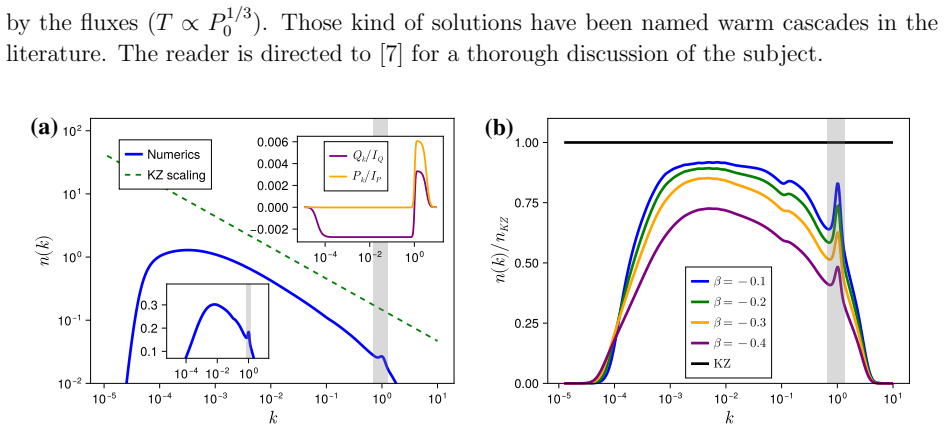
Numerical simulations of the wave kinetic equation associated with the MMT model confirm the cascade solutions predicted by wave turbulence theory in both the rigorously well-posed parameter region and beyond it. A previously unknown stable stationary state is observed in a region where no such cascades are expected. Analysis of higher-order corrections to the wave kinetic equation reveals incurable divergences for the one-dimensional MMT model and for higher-dimensional systems with concave power-law dispersion relations.
What carries the argument
The wave kinetic equation (WKE) for the MMT model, which describes the time evolution of the wave-action spectrum under resonant wave interactions.
If this is right
- The predicted power-law cascades are realized in direct numerical solutions of the WKE where the equation is known to be well posed.
- Cascade solutions continue to appear in regions outside the proven well-posedness domain.
- A new type of stable stationary spectrum exists in parameter space without expected cascades.
- Next-to-leading-order terms in the kinetic equation produce divergences that cannot be removed when the dispersion relation is concave.
Where Pith is reading between the lines
- The confirmation outside the well-posed region suggests that the mathematical conditions for well-posedness may not be necessary for the physical validity of the theory.
- The new stationary state could represent a different balance between nonlinear interactions that might be observable in direct simulations of the underlying MMT equations.
- Incurrable divergences indicate that perturbative expansions beyond leading order fail for these dispersion relations, potentially requiring non-perturbative methods.
Load-bearing premise
The finite-resolution numerical scheme used to solve the wave kinetic equation faithfully reproduces the behavior of the continuous equation without significant truncation errors.
What would settle it
If increasing the spectral resolution or changing the numerical method causes the observed cascades or the new stationary state to disappear or change form, that would falsify the numerical confirmation of the theory.
Figures




read the original abstract
The Majda-McLaughlin-Tabak (MMT) family of models has proven to be an efficient ground for benchmarking wave turbulence theory, thanks to the low computational cost required to test theoretical ideas and the possibility of tuning nonlinearity and dispersive properties of the equations. Here, we study numerically the wave kinetic equation (WKE) associated with the MMT model and perform simulations to study turbulent cascades. We confirm numerically the predictions of wave turbulence theory, both in the parameter space region where the wave kinetic equation was proven to be well posed and outside of it. We also observe a new stable stationary state in a region where no cascade solutions are expected, a region that, to the best of our knowledge, has not been explored before. Moreover, following recent work, we study next-to-leading-order corrections to the wave kinetic equation; we uncover incurable divergences in the one-dimensional MMT model and, more generally, in higher-dimensional systems with concave power-law dispersion relations.
Editorial analysis
A structured set of objections, weighed in public.
Referee Report
Summary. The manuscript numerically integrates the wave kinetic equation (WKE) associated with the Majda-McLaughlin-Tabak (MMT) family of models to investigate turbulent cascades. It reports numerical confirmation of wave-turbulence-theory predictions both inside and outside the rigorously proven well-posed region of parameter space, the discovery of a previously unreported stable stationary state in a regime where no cascade solutions are expected, and the appearance of incurable divergences when next-to-leading-order corrections to the WKE are examined for the one-dimensional MMT model and, more generally, for higher-dimensional systems possessing concave power-law dispersion relations.
Significance. If the numerical results are shown to be faithful to the continuous WKE, the work would supply useful validation of wave-turbulence theory across a wider parameter domain than previously accessible and would identify concrete limitations of perturbative expansions, thereby informing the construction of improved kinetic descriptions.
major comments (3)
- [§3] §3 (Numerical method): no information is supplied on the discretization of the collision integral, the momentum-space grid, time-stepping scheme, or any discrete conservation properties. Because every central claim—confirmation inside/outside the well-posed region, identification of the new stationary state, and detection of NLO divergences—rests on the discrete solver faithfully reproducing the continuous integro-differential equation, this omission is load-bearing.
- [§4.2] §4.2 (new stationary state): the reported state is identified solely from long-time integration; without resolution or truncation studies, it is impossible to exclude the possibility that the state is an artifact of ultraviolet cutoff or grid truncation, especially in regimes where power-law solutions are known to be sensitive to such cutoffs.
- [§5] §5 (NLO corrections): the claim of 'incurable divergences' is asserted on the basis of the numerical solver; the same lack of documented discretization and convergence tests that affects the leading-order results also undermines the reliability of the divergence diagnosis.
minor comments (2)
- The abstract states that the work follows 'recent work' on NLO corrections but the manuscript does not supply the corresponding citations in the text or reference list.
- Figure captions and axis labels in the cascade plots should explicitly state the resolution and time-stepping parameters used for each run.
Simulated Author's Rebuttal
We thank the referee for the careful reading and constructive comments. We agree that additional documentation of the numerical methods is necessary to support the central claims. We address each major comment below and will revise the manuscript accordingly.
read point-by-point responses
-
Referee: §3 (Numerical method): no information is supplied on the discretization of the collision integral, the momentum-space grid, time-stepping scheme, or any discrete conservation properties. Because every central claim—confirmation inside/outside the well-posed region, identification of the new stationary state, and detection of NLO divergences—rests on the discrete solver faithfully reproducing the continuous integro-differential equation, this omission is load-bearing.
Authors: We agree that a detailed description of the numerical scheme is essential. In the revised manuscript we will expand §3 to specify: the quadrature rule and discretization of the collision integral, the momentum-space grid (number of modes, spacing, infrared and ultraviolet cutoffs), the time-stepping scheme (integrator type and adaptive step-size control), and explicit checks of discrete conservation of wave action and energy. These details were implemented in the original computations and will now be reported. revision: yes
-
Referee: §4.2 (new stationary state): the reported state is identified solely from long-time integration; without resolution or truncation studies, it is impossible to exclude the possibility that the state is an artifact of ultraviolet cutoff or grid truncation, especially in regimes where power-law solutions are known to be sensitive to such cutoffs.
Authors: We performed auxiliary runs at doubled and halved resolution and with varied ultraviolet cutoffs; the stationary state remained unchanged within statistical fluctuations. These tests were not included in the original submission. In the revision we will add a dedicated paragraph in §4.2 presenting the resolution and truncation study, together with quantitative measures of convergence of the stationary spectrum. revision: yes
-
Referee: §5 (NLO corrections): the claim of 'incurable divergences' is asserted on the basis of the numerical solver; the same lack of documented discretization and convergence tests that affects the leading-order results also undermines the reliability of the divergence diagnosis.
Authors: The NLO integrals were evaluated with the same solver whose discretization will now be documented in the revised §3. We will extend the convergence tests to the NLO computations and include a short subsection in §5 showing that the diagnosed non-integrable singularities persist under grid refinement, thereby supporting the claim of incurable divergences. revision: yes
Circularity Check
No circularity: numerical confirmation of external WKE predictions
full rationale
The paper performs direct numerical simulations of the wave kinetic equation to test predictions from wave turbulence theory and to explore new regimes. No derivation chain is claimed that reduces by construction to fitted parameters, self-definitions, or self-citation load-bearing steps. The central results are observational (confirmation inside/outside well-posed regions, discovery of a new stationary state, and identification of divergences at NLO), resting on the fidelity of the numerical solver rather than any logical reduction of outputs to inputs. This matches the default expectation of no significant circularity for a simulation-based study.
Axiom & Free-Parameter Ledger
Reference graph
Works this paper leans on
-
[1]
To numerically solve it, the two Dirac delta functions are eliminated, reducing the problem to a one dimensional integral
The collision term in the WKE is a three-dimensional integral. To numerically solve it, the two Dirac delta functions are eliminated, reducing the problem to a one dimensional integral. One needs to find solutions to the following set of equations that define the resonant manifold: k+k 1 −k 2 −k 3 = 0,(13)p |k|+ p |k1| − p |k2| − p |k3|= 0.(14) Expressing...
2000
-
[2]
Rosenhaus and M
V. Rosenhaus and M. Smolkin, Physical Review E109, 064127 (2024)
2024
-
[3]
Boltzmann, inKinetische Theorie II: Irreversible Prozesse Einf¨ uhrung und Originaltexte (Springer, 1970) pp
L. Boltzmann, inKinetische Theorie II: Irreversible Prozesse Einf¨ uhrung und Originaltexte (Springer, 1970) pp. 115–225
1970
-
[4]
R. E. Peierls,Zur kinetischen theorie der w¨ armeleitung in kristallen(JA Barth, 1929)
1929
-
[5]
Hasselmann, Journal of Fluid Mechanics12, 481 (1962)
K. Hasselmann, Journal of Fluid Mechanics12, 481 (1962)
1962
-
[6]
V. E. Zakharov, Journal of Applied Mechanics and Technical Physics6, 22–24 (1965)
1965
-
[7]
Zakharov, V
V. Zakharov, V. Lvov, and G. Falkovich,Kolmogorov-Zakharov Spectra of Turbulence: Wave Turbulence(Springer Nature, 2025)
2025
-
[8]
Nazarenko,Wave Turbulence(Springer Berlin Heidelberg, 2011)
S. Nazarenko,Wave Turbulence(Springer Berlin Heidelberg, 2011)
2011
-
[9]
Deng and Z
Y. Deng and Z. Hani, Inventiones mathematicae233, 543 (2023). 17
2023
-
[10]
A. J. Majda, D. W. McLaughlin, and E. Tabak, Journal of Nonlinear Science7, 9 (1997)
1997
-
[11]
Zakharov, F
V. Zakharov, F. Dias, and A. Pushkarev, Physics Reports398, 1–65 (2004)
2004
-
[12]
Chibbaro, F
S. Chibbaro, F. De Lillo, and M. Onorato, Physical Review Fluids2, 052603 (2017)
2017
-
[13]
Simonis and Y
A. Simonis and Y. Pan, Physical Review E110, 024202 (2024)
2024
-
[14]
D. Cai, A. J. Majda, D. W. McLaughlin, and E. G. Tabak, Physica D: Nonlinear Phenomena 152, 551 (2001)
2001
-
[15]
Hrabski and Y
A. Hrabski and Y. Pan, Physical Review Research6, 023184 (2024)
2024
-
[16]
Zakharov, P
V. Zakharov, P. Guyenne, A. Pushkarev, and F. Dias, Physica D: Nonlinear Phenomena152, 573 (2001)
2001
-
[17]
Pushkarev and V
A. Pushkarev and V. Zakharov, Physica D: Nonlinear Phenomena248, 55 (2013)
2013
-
[18]
R. S. D` u and O. B¨ uhler, Journal of Nonlinear Science33, 81 (2023)
2023
-
[19]
Rumpf and L
B. Rumpf and L. Biven, Physica D: Nonlinear Phenomena204, 188 (2005)
2005
-
[20]
K. D. Vassilev, Communications in Mathematical Physics406, 293 (2025)
2025
-
[21]
Germain, J
P. Germain, J. La, and K. Z. Zhang, Communications in Mathematical Physics406, 18 (2025)
2025
-
[22]
V. Rosenhaus and G. Falkovich, Phys. Rev. Lett.133, 244002 (2024), arXiv:2308.00033 [hep- th]
-
[23]
D. Schubring, V. Rosenhaus, and S. Thalabard, arXiv preprint arXiv:2509.23199 (2025)
-
[24]
Balk, Physica D: Nonlinear Phenomena139, 137–157 (2000)
A. Balk, Physica D: Nonlinear Phenomena139, 137–157 (2000)
2000
-
[25]
G. Costa, G. Krstulovic, and S. Nazarenko, Physical Review E113, 10.1103/j1hs-b71h (2026)
-
[26]
V. Labarre, G. Krstulovic, and S. Nazarenko, Wave-kinetic dynamics of forced-dissipated turbulent internal gravity waves (2024), arXiv:2407.11469 [physics.flu-dyn]
-
[27]
Y. Zhu, G. Krstulovic, and S. Nazarenko, Turbulence and far-from-equilibrium equation of state of bogoliubov waves in bose-einstein condensates (2024), arXiv:2408.15163 [cond- mat.quant-gas]
work page internal anchor Pith review Pith/arXiv arXiv 2024
-
[28]
V. E. Zakharov and V. Lvov, Radiofizika18, 1470 (1975)
1975
-
[29]
Probability Density, Diagrammatic Technique, and Epsilon Expansion in the Theory of Wave Turbulence
V. Gurarie, Nucl. Phys. B441, 569 (1995), arXiv:hep-th/9405077
work page internal anchor Pith review Pith/arXiv arXiv 1995
-
[30]
V. Rosenhaus and M. Smolkin, Journal of High Energy Physics2023, 10.1007/jhep01(2023)142 (2023)
-
[31]
V. Rosenhaus, D. Schubring, M. S. J. Shuvo, and M. Smolkin, JHEP06, 025, arXiv:2308.00740 [hep-th]
-
[32]
R. H. Kraichnan, Journal of Fluid Mechanics5, 497–543 (1959)
1959
-
[33]
D. F. DuBois and H. A. Rose, Physical Review A24, 1476–1504 (1981)
1981
-
[34]
Pavez and G
I. Pavez and G. D¨ uring, Chaos, Solitons andran Fractals166, 112911 (2023)
2023
-
[35]
Rosenhaus and D
V. Rosenhaus and D. Schubring, Strong wave turbulence in strongly local largentheories (2024). 18
2024
discussion (0)
Sign in with ORCID, Apple, or X to comment. Anyone can read and Pith papers without signing in.