MetaboliSim: a Python implementation of the Mader model for dynamic and steady-state simulation of muscular energy metabolism
Pith reviewed 2026-06-27 18:29 UTC · model grok-4.3
The pith
An open Python implementation of the Mader model reproduces published reference outputs for both dynamic ODE and steady-state muscular energy metabolism simulations.
A machine-rendered reading of the paper's core claim, the machinery that carries it, and where it could break.
Core claim
MetaboliSim implements the Mader model as an open-source Python package that solves the five-variable ODE system (phosphate potential, VO2, muscle lactate, blood lactate, glycogen) for dynamic cases and solves the algebraic steady-state equations for MLSS power in one- and two-compartment forms; both versions reproduce the published reference outputs within stated tolerances, remain numerically stable, and yield congruent MLSS estimates without protocol-specific parameter adjustments.
What carries the argument
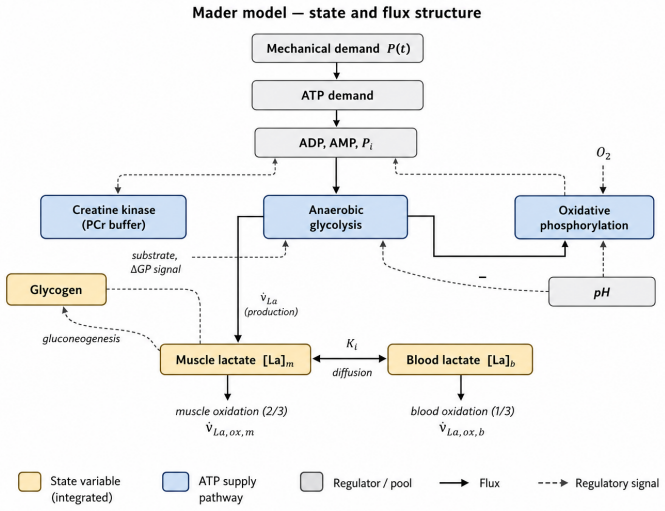
The five-variable ODE system for time evolution of phosphate potential, oxygen uptake, muscle and blood lactate, and glycogen, integrated by fourth-order Runge-Kutta, together with the corresponding algebraic steady-state equations that locate the power at which lactate production equals clearance.
If this is right
- Independent groups can now reproduce any prior Mader-based lactate diagnostic or training prescription result.
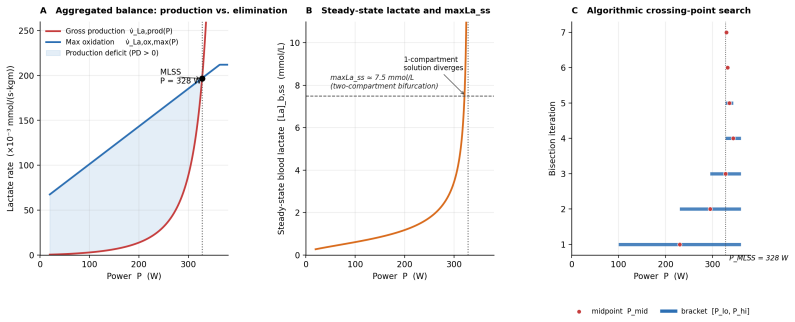
- MLSS power varies approximately linearly with VO2max and nonlinearly with maximum lactate production rate.
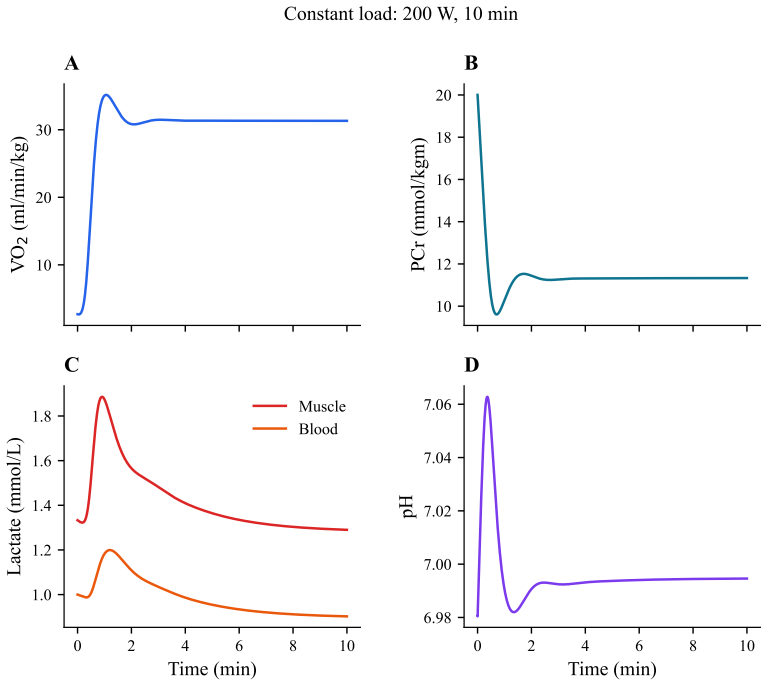
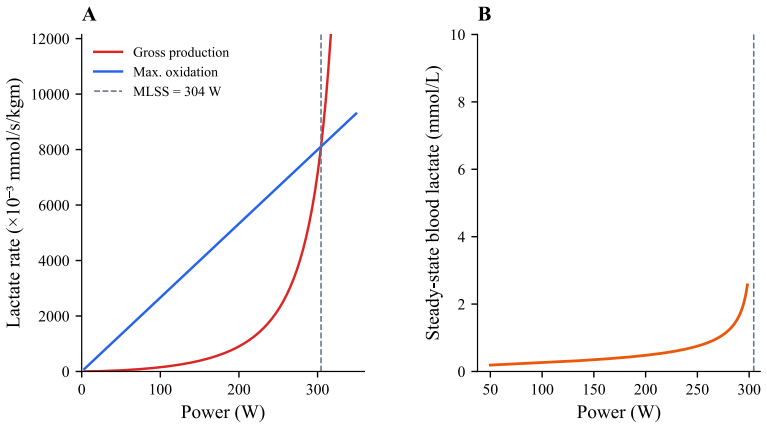
- Key behaviors such as VO2 on-kinetics, lactate accumulation, and the distinction between sub- and supra-MLSS conditions arise directly from the model equations.
- Both the dynamic integration and the steady-state solver produce the same MLSS power estimate on the same inputs.
Where Pith is reading between the lines
- The open code lowers the barrier for comparing the Mader framework against other energy-metabolism models using identical protocols.
- Numerical stability under step-size halving suggests the implementation can support longer or higher-resolution simulations without instability artifacts.
- Sensitivity results imply that measured VO2max values can be used to scale predicted MLSS power with limited additional calibration.
Load-bearing premise
The reference values and equation forms taken from earlier Mader literature correctly represent the intended model behavior.
What would settle it
Executing the code on the exact constant-load or step-test inputs used in the original reference tables and obtaining blood-lactate values that differ by more than the stated tolerance would show the implementation does not reproduce the model.
Figures




read the original abstract
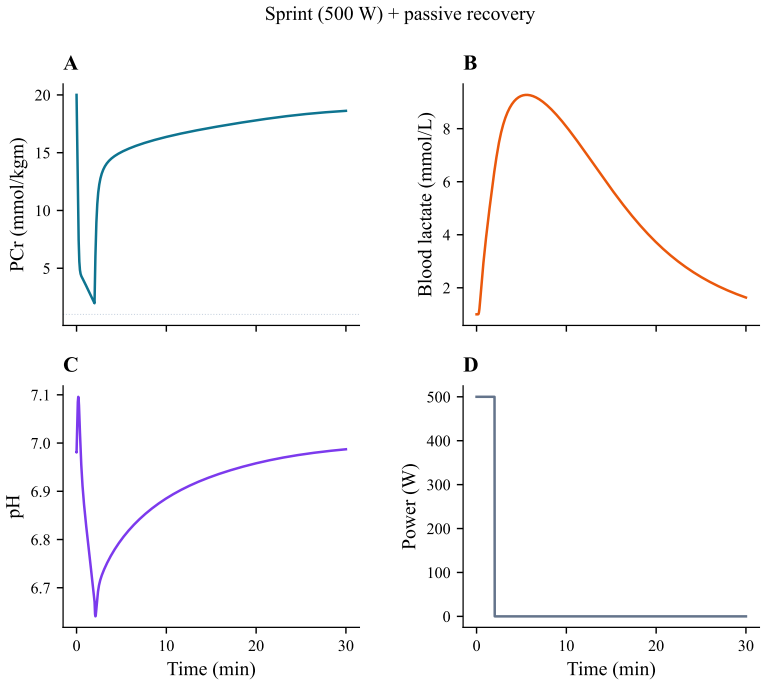
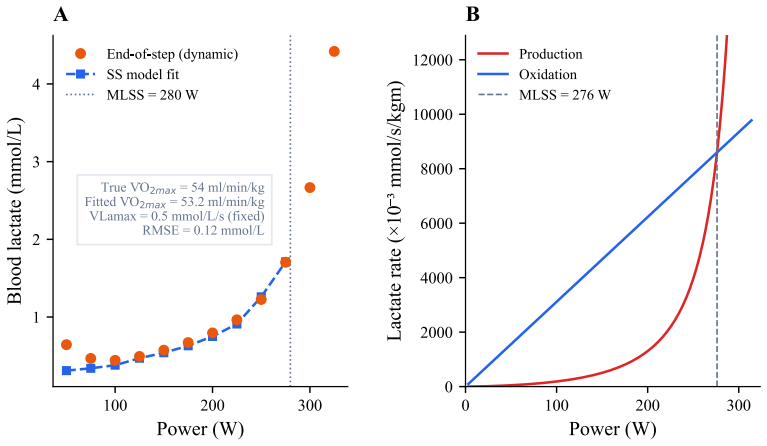
The Mader model is the most widely used mathematical framework for muscular energy metabolism in German-language sport science, underpinning lactate diagnostics, maximal lactate steady state (MLSS) estimation and training prescription. Despite decades of use, neither its dynamic ODE formulation nor its steady-state equations have been available as open code, leaving results based on the model impossible to reproduce independently. We close this gap with MetaboliSim, an open-source Python implementation of both formulations: a dynamic model that integrates the five-variable ODE system (phosphate potential, $\dot{V}\mathrm{O}_2$, muscle and blood lactate, and glycogen) with a fourth-order Runge-Kutta scheme, and a steady-state model that computes MLSS power and the lactate-power relationship in one- and two-compartment variants. We verified implementation correctness against published reference values and assessed physiological plausibility across constant-load, step-test, sprint and running protocols. The implementation reproduces the published reference output within stated tolerances and remains numerically stable throughout (halving the time step changes blood lactate by less than 0.01 mmol/L), with both formulations yielding congruent MLSS estimates. Key physiological behaviour ($\dot{V}\mathrm{O}_2$ on-kinetics, lactate accumulation, PCr dynamics and the sub/supra-MLSS separation) emerges directly from the model equations without protocol-specific tuning, and a sensitivity analysis shows MLSS power varying approximately linearly with $\dot{V}\mathrm{O}_{2\max}$ and nonlinearly with $\dot{V}\mathrm{La}_{\max}$. As the first openly available implementation of the complete Mader model (AGPL-3.0), MetaboliSim lets independent groups reproduce, verify and build on published model-based results. Source code: https://codeberg.org/3phos/metabolisim; Platform: https://metabolisim.org
Editorial analysis
A structured set of objections, weighed in public.
Referee Report
Summary. The manuscript presents MetaboliSim, an open-source Python implementation of the Mader model for muscular energy metabolism. It implements both a dynamic formulation (five-variable ODE system for phosphate potential, VO2, muscle and blood lactate, and glycogen, integrated via fourth-order Runge-Kutta) and steady-state equations for MLSS power and lactate-power relationships in one- and two-compartment variants. The authors verify the code against published reference values, demonstrate numerical stability (e.g., halving the time step changes blood lactate by <0.01 mmol/L), show congruence between dynamic and steady-state MLSS outputs, and report that key physiological behaviors emerge without protocol-specific tuning; source code and a web platform are provided under AGPL-3.0.
Significance. If the implementation faithfully reproduces the referenced Mader model, the work fills a clear reproducibility gap in sport science by supplying the first publicly available code for a widely used framework in lactate diagnostics and training prescription. Explicit strengths include the open repository and platform link, direct verification against published outputs, numerical stability tests, congruence between formulations, and a sensitivity analysis showing linear dependence of MLSS power on VO2max and nonlinear dependence on VLa_max; these elements support independent reproduction and extension without internal fitting or post-hoc adjustments.
minor comments (2)
- [Abstract] The abstract states verification 'within stated tolerances' but does not name the specific reference values or tolerances; adding a short parenthetical or cross-reference to the results section would improve immediate clarity for readers.
- A side-by-side table of MLSS estimates from the dynamic ODE runs versus the steady-state equations across the tested protocols (constant-load, step-test, sprint, running) would make the congruence claim easier to inspect at a glance.
Simulated Author's Rebuttal
We thank the referee for their positive assessment of the manuscript, the recognition of its contribution to reproducibility in sport science, and the recommendation to accept.
Circularity Check
No significant circularity detected
full rationale
The manuscript is an open-source implementation and verification of the pre-existing Mader model drawn from external prior literature. Its central claims concern faithful reproduction of published reference outputs, numerical stability under time-step halving, and congruence between dynamic and steady-state formulations. These are tested against externally supplied reference values rather than derived from any equations or parameters introduced or fitted inside this work. No load-bearing step reduces by construction to a quantity defined in terms of the paper's own inputs, and no self-citation chain is invoked to justify uniqueness or ansatz choices. The result is therefore self-contained against external benchmarks.
Axiom & Free-Parameter Ledger
axioms (1)
- domain assumption The Mader model equations (five-variable ODE system and steady-state MLSS relations) and reference output values match the original published literature exactly.
Reference graph
Works this paper leans on
-
[1]
and Somero, George N
Castellini, Michael A. and Somero, George N. , title =. Journal of Comparative Physiology B , year =
-
[2]
, title =
Drescher, Uwe and Koenigstein, Karsten and Hanssen, Henner and Coyle, Edward F. , title =. Respiratory Physiology & Neurobiology , year =
-
[3]
Heck, Hermann and Mader, Alois and Hess, G. and M. Justification of the 4-mmol/l lactate threshold , journal =. 1985 , volume =
1985
-
[4]
2022 , publisher =
Heck, Hermann and Bartmus, Ulrich and Grabow, Verena , title =. 2022 , publisher =
2022
-
[5]
, title =
Hinkle, Peter C. , title =. Biochimica et Biophysica Acta (BBA) - Bioenergetics , year =
-
[6]
European Journal of Applied Physiology , year =
Lazzer, Stefano and Plaino, Luca and Antonutto, Guglielmo , title =. European Journal of Applied Physiology , year =
-
[7]
European Journal of Applied Physiology , year =
Mader, Alois , title =. European Journal of Applied Physiology , year =
-
[8]
International Journal of Sports Medicine , year =
Mader, Alois and Heck, Hermann , title =. International Journal of Sports Medicine , year =
-
[9]
Brennpunkte der Sportwissenschaft , editor =
Mader, Alois and Heck, Hermann , title =. Brennpunkte der Sportwissenschaft , editor =. 1994 , publisher =
1994
-
[10]
and Gonzalez, Maria Cristina and Varanoske, Alyssa N
McCarthy, Cassidy and Schoeller, Dale and Brown, Justin C. and Gonzalez, Maria Cristina and Varanoske, Alyssa N. and Cataldi, Dana and Bennett, Jonathan P. and Wong, Michael C. and Liu, Yong En and Pagano, Anthony P. and Espinosa, Joel and Heymsfield, Steven B. and Shepherd, John A. , title =. Journal of Cachexia, Sarcopenia and Muscle , year =
-
[11]
and Hafen, Paul S
Miller, Spencer G. and Hafen, Paul S. and Brault, Jeffrey J. , title =. International Journal of Molecular Sciences , year =
-
[12]
, title =
Roache, Patrick J. , title =. 1998 , publisher =
1998
-
[13]
Extra- and intracellular water spaces in muscles of man at rest and with dynamic exercise , journal =
Sj. Extra- and intracellular water spaces in muscles of man at rest and with dynamic exercise , journal =. 1982 , volume =
1982
-
[14]
Acta Physiologica Scandinavica , year =
Tonkonogi, Michail and Sahlin, Kent , title =. Acta Physiologica Scandinavica , year =
-
[15]
and Lawson, J
Veech, Richard L. and Lawson, J. W. R. and Cornell, Neil W. and Krebs, Hans A. , title =. Journal of Biological Chemistry , year =
-
[16]
and Wasserman, Karlman , title =
Whipp, Brian J. and Wasserman, Karlman , title =. Journal of Applied Physiology , year =
discussion (0)
Sign in with ORCID, Apple, or X to comment. Anyone can read and Pith papers without signing in.