Active Learning with Bayesian Reasoning: A POGIL-Based Pedagogy in Introductory Statistics
Pith reviewed 2026-06-27 17:42 UTC · model grok-4.3
The pith
A POGIL-style activity teaches Bayesian reasoning in introductory statistics with performance similar to lectures.
A machine-rendered reading of the paper's core claim, the machinery that carries it, and where it could break.
Core claim
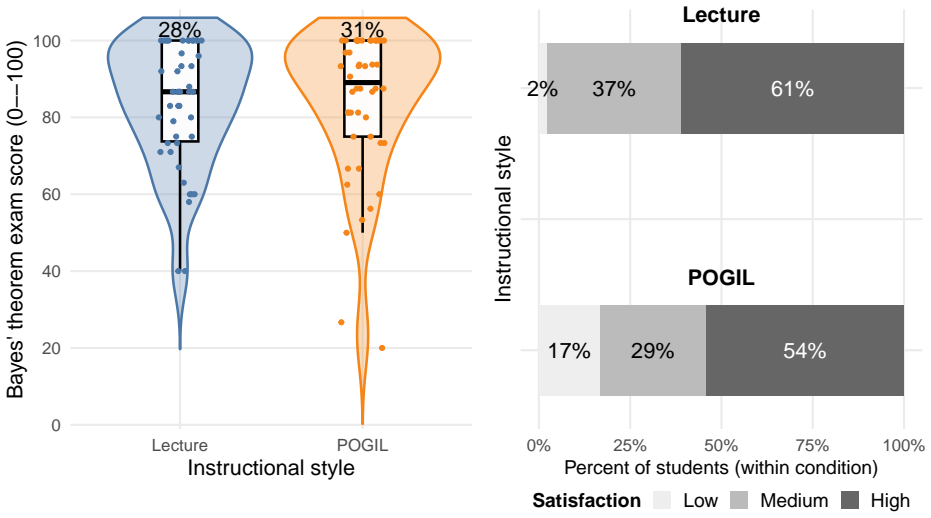
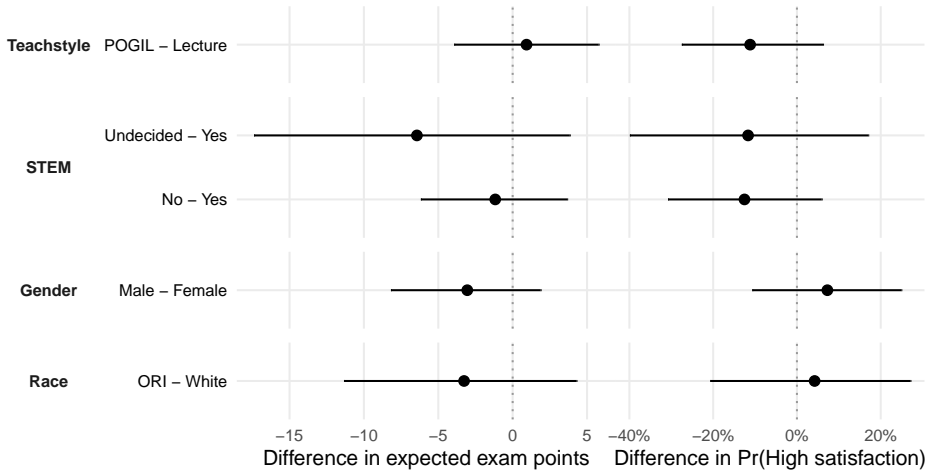
The POGIL-style activity performed comparably to lecture-based instruction for the Bayes theorem unit, producing similar exam performance and similar probabilities of high satisfaction across instructional styles and demographic groups, with considerable uncertainty and no clear evidence of meaningful differences.
What carries the argument
The POGIL-style activity using structured team roles and two-way tables for hand-computable probabilities to introduce Bayes theorem and belief updating.
If this is right
- Instructors gain a self-contained, adaptable set of materials for adding Bayesian reasoning to introductory statistics without advanced computation.
- The activity supports feasible inclusion of Bayes theorem in standard intro courses through active team-based work.
- The Bayesian bivariate generalized linear model provides a reproducible framework for comparing active learning approaches while accounting for demographics.
- Similar performance across demographic groups suggests the activity does not introduce new inequities in outcomes for this unit.
Where Pith is reading between the lines
- The same team-role and table-based structure could be adapted to teach other probability topics in intro stats.
- Future work could examine longer-term retention or transfer of Bayesian reasoning skills beyond the immediate exam questions.
- The reported uncertainty leaves room for detecting small practical differences in larger samples or different course contexts.
- This approach may reduce reliance on technology in probability instruction while maintaining active engagement.
Load-bearing premise
The quasi-experimental comparison assumes the Bayesian model adequately controls for all relevant differences between sections beyond the measured factors of major, gender, and race.
What would settle it
A randomized trial across multiple institutions that finds significantly different exam scores or satisfaction rates between the POGIL activity and lecture instruction would falsify the comparability result.
Figures
read the original abstract
We introduce a Process Oriented Guided Inquiry Learning (POGIL)-style activity for teaching Bayesian reasoning in introductory statistics through conditional probability, Bayes' theorem, and belief updating. The activity is self-contained, uses hand-computable probabilities organized in two-way tables, and engages students in structured team roles. We evaluated the activity in four sections of an undergraduate introductory statistics course using a quasi-experimental comparison of POGIL-style and lecture-based instruction for a Bayes' theorem unit. Outcomes included student performance on Bayes' theorem final exam questions and satisfaction with instruction. We used a Bayesian bivariate generalized linear model to compare the two approaches while accounting for major type, gender, and race. The results indicated similar exam performance and similar probabilities of high satisfaction across instructional styles and demographic groups, with considerable uncertainty and no clear evidence of meaningful differences. These findings suggest that the POGIL-style activity performed comparably to lecture-based instruction for this unit while offering an active and classroom-ready way to introduce Bayesian reasoning without requiring difficult computation or simulation. We provide adaptable instructional materials and a reproducible Bayesian analytic framework for evaluating active learning innovations in introductory statistics. Our study supports the feasible inclusion of Bayesian reasoning in introductory courses and may help instructors considering active learning.
Editorial analysis
A structured set of objections, weighed in public.
Referee Report
Summary. The paper introduces a POGIL-style activity for teaching Bayesian reasoning via conditional probability and Bayes' theorem using hand-computable two-way tables and structured team roles. It reports a quasi-experimental evaluation across four sections of an introductory statistics course, comparing POGIL to lecture-based instruction on final-exam Bayes' theorem performance and instructional satisfaction. A Bayesian bivariate generalized linear model is used to compare outcomes while conditioning on major type, gender, and race; results indicate similar performance and satisfaction probabilities across styles with considerable uncertainty and no clear differences. The authors conclude the activity is a viable, classroom-ready alternative and provide adaptable materials plus reproducible analysis code.
Significance. If the equivalence result holds after addressing design limitations, the work supplies a concrete, low-computation active-learning module for introducing Bayesian updating in service courses, together with open materials and a reproducible Bayesian evaluation framework. These elements directly support the feasible inclusion of Bayesian reasoning in introductory statistics and offer a template for assessing other pedagogical interventions.
major comments (1)
- [Methods (statistical analysis)] Methods (statistical model description): The Bayesian bivariate GLM conditions only on major type, gender, and race. In a quasi-experimental section comparison this leaves open confounding paths from unmeasured section-level factors (instructor fixed effects, time-of-day, differential attrition, or prior probability exposure) that could also affect both exam scores and satisfaction; the central claim of comparable performance therefore rests on an untested no-confounding assumption that is not load-bearing only if the design were randomized.
minor comments (2)
- [Abstract] Abstract: reports 'similar performance' and 'considerable uncertainty' but omits sample sizes per section, exact link functions and priors in the bivariate GLM, and any effect-size or posterior-probability summaries, making it difficult to gauge the precision of the equivalence conclusion.
- [Results] Results: the manuscript should report the effective sample size after any data exclusion, the full posterior summaries (means, 95% credible intervals) for the instructional-style coefficients on both outcomes, and a sensitivity analysis that adds plausible unmeasured confounders.
Simulated Author's Rebuttal
We thank the referee for their constructive comments on our manuscript. The major comment identifies a key limitation of the quasi-experimental design, which we address below by expanding the discussion of assumptions and potential confounders while preserving the reported findings as preliminary evidence.
read point-by-point responses
-
Referee: The Bayesian bivariate GLM conditions only on major type, gender, and race. In a quasi-experimental section comparison this leaves open confounding paths from unmeasured section-level factors (instructor fixed effects, time-of-day, differential attrition, or prior probability exposure) that could also affect both exam scores and satisfaction; the central claim of comparable performance therefore rests on an untested no-confounding assumption that is not load-bearing only if the design were randomized.
Authors: We agree that the study is quasi-experimental and that unmeasured section-level factors (instructor, time-of-day, attrition, prior exposure) could confound results; the no-confounding assumption is not guaranteed by randomization. With only four sections it is not statistically feasible to add instructor fixed effects without severe overfitting or loss of identifiability. We have revised the Methods and Discussion sections to state this assumption explicitly, to enumerate the unmeasured factors, and to frame conclusions as absence of clear evidence of difference rather than proven equivalence. The Bayesian model already reports substantial posterior uncertainty, which we now highlight as reflecting both sample size and design limitations. These changes constitute a partial revision; the core data and model remain unchanged because the design cannot be altered retrospectively. revision: partial
Circularity Check
No circularity: empirical comparison rests on observed data and standard statistical adjustment.
full rationale
The paper reports a quasi-experimental evaluation of POGIL vs. lecture using a Bayesian bivariate GLM fitted to exam and survey outcomes while conditioning on observed covariates (major, gender, race). No derivation, prediction, or uniqueness claim reduces to its own inputs by construction; the central result is a direct model-based comparison of real student data. No self-citations are invoked as load-bearing mathematical facts. The analysis is therefore self-contained against external benchmarks.
Axiom & Free-Parameter Ledger
Reference graph
Works this paper leans on
-
[1]
Journal of Statistics Education , volume=
Conditional Probability and Education Reform: Are They Compatible? , author=. Journal of Statistics Education , volume=. 1995 , doi=
1995
-
[2]
Journal of Statistics Education , volume=
Student-Centered Instruction in a Theoretical Statistics Course , author=. Journal of Statistics Education , volume=. 2009 , doi=
2009
-
[3]
Journal of Statistics and Data Science Education , volume=
A Systematic Literature Review of Undergraduate Data Science Education Research , author=. Journal of Statistics and Data Science Education , volume=. 2025 , doi=
2025
-
[4]
, journal=
Dogucu, Mine and Kazak, Sibel and Rosenberg, Joshua M. , journal=. The Design and Implementation of a. 2025 , doi=
2025
-
[5]
Journal of Statistics Education , volume=
What Might a Twenty-Year-Old Conference Tell Us About the Future of Our Profession? , author=. Journal of Statistics Education , volume=. 2013 , doi=
2013
-
[6]
Introducing
Eadie, Gwendolyn and Huppenkothen, Daniela and Springford, Aaron and McCormick, Tyler , journal=. Introducing. 2019 , doi=
2019
-
[7]
Scandinavian Journal of Statistics , volume=
A Historical Overview of Textbook Presentations of Statistical Science , author=. Scandinavian Journal of Statistics , volume=. 2023 , doi=
2023
-
[8]
Technology Innovations in Statistics Education , volume=
The Introductory Statistics Course: A Ptolemaic Curriculum , author=. Technology Innovations in Statistics Education , volume=. 2007 , url=
2007
-
[9]
2016 , institution=
Guidelines for Assessment and Instruction in Statistics Education College Report 2016 , author=. 2016 , institution=
2016
-
[10]
2005 , address =
Guidelines for Assessment and Instruction in Statistics Education College Report 2005 , institution =. 2005 , address =
2005
-
[11]
Computational Statistics & Data Analysis , volume=
A general class of zero-or-one inflated beta regression models , author=. Computational Statistics & Data Analysis , volume=. 2012 , doi=
2012
-
[12]
Psychological Methods , volume=
Beta regression for modeling proportions , author=. Psychological Methods , volume=. 2006 , doi=
2006
-
[13]
Journal of Applied Statistics , year =
Beta Regression for Modelling Rates and Proportions , author =. Journal of Applied Statistics , year =
-
[14]
Journal of the Royal Statistical Society: Series B , volume=
Regression models for ordinal data , author=. Journal of the Royal Statistical Society: Series B , volume=. 1980 , publisher=
1980
-
[15]
2010 , publisher=
Analysis of Ordinal Categorical Data , author=. 2010 , publisher=
2010
-
[16]
Practical
Vehtari, Aki and Gelman, Andrew and Gabry, Jonah , journal=. Practical. 2017 , doi=
2017
-
[17]
loo: Efficient Leave-One-Out Cross-Validation and WAIC for
Vehtari, Aki and Gelman, Andrew and Simpson, Daniel and Carpenter, Bob and Bürkner, Paul-Christian , year =. loo: Efficient Leave-One-Out Cross-Validation and WAIC for
-
[18]
brms: An R Package for
B. brms: An R Package for. Journal of Statistical Software , volume=. 2017 , doi=
2017
-
[19]
The brms Book: Applied
B. The brms Book: Applied. 2025 , note=
2025
-
[20]
Understanding predictive information criteria for
Gelman, Andrew and Hwang, Jessica and Vehtari, Aki , journal=. Understanding predictive information criteria for. 2014 , doi=
2014
-
[21]
and Stern, Hal S
Gelman, Andrew and Carlin, John B. and Stern, Hal S. and Dunson, David and Vehtari, Aki and Rubin, Donald B. , edition=. 2013 , publisher=
2013
-
[22]
2006 , doi=
Prior distributions for variance parameters in hierarchical models , author=. 2006 , doi=
2006
-
[23]
Advanced
B. Advanced. The R Journal , volume=. 2018 , doi=
2018
-
[24]
Journal of Machine Learning Research , volume=
The No-U-Turn Sampler: Adaptively Setting Path Lengths in Hamiltonian Monte Carlo , author=. Journal of Machine Learning Research , volume=
-
[25]
2024 , note=
Stan Modeling Language Users Guide and Reference Manual , author=. 2024 , note=
2024
-
[26]
Statistical Science , volume=
Inference from iterative simulation using multiple sequences , author=. Statistical Science , volume=. 1992 , doi=
1992
-
[27]
2021 , doi=
Rank-normalization, folding, and localization: An improved R-hat for assessing convergence of MCMC , author=. 2021 , doi=
2021
-
[28]
Statistica Sinica , volume=
Posterior predictive assessment of model fitness via realized discrepancies , author=. Statistica Sinica , volume=
-
[29]
Andrew Gelman and Aki Vehtari , title =. Journal of the American Statistical Association , volume =. 2021 , publisher =. doi:10.1080/01621459.2021.1938081 , URL =
-
[30]
Four transformations on the Catalan triangle
Karl W. Broman and Kara H. Woo , title =. The American Statistician , volume =. 2018 , publisher =. doi:10.1080/00031305.2017.1375989 , URL =
work page internal anchor Pith review Pith/arXiv arXiv doi:10.1080/00031305.2017.1375989 2018
-
[31]
Bishop, Yvonne M. M. and Fienberg, Stephen E. and Holland, Paul W. , title =. 1975 , pages =
1975
-
[32]
and Ott, Miles Q
Johnson, Alicia A. and Ott, Miles Q. and Dogucu, Mine , year=
-
[33]
Journal for Research in Mathematics Education , year =
Garfield, Joan and Ahlgren, Andrew , title =. Journal for Research in Mathematics Education , year =
-
[34]
Developing a Statistically Literate Society
Kvatinsky, Tova and Even, Ruhama , title =. Developing a Statistically Literate Society. Proceedings of the Sixth International Conference on Teaching Statistics (ICOTS 6) , editor =. 2002 , pages =
2002
-
[35]
Empirical Research in Understanding Probability , booktitle =
Borovcnik, Manfred and Bentz, Hans-J. Empirical Research in Understanding Probability , booktitle =. 1991 , pages =
1991
-
[36]
Vision , year =
Cui, Lucy and Lo, Stephanie and Liu, Zili , title =. Vision , year =
-
[37]
Journal of Statistics Education , year =
Keeler, Carolyn and Steinhorst, Kirk , title =. Journal of Statistics Education , year =
-
[38]
Garfield, Joan B. and Ben-Zvi, Dani , title =. 2008 , address =. doi:10.1007/978-1-4020-8383-9 , isbn =
-
[39]
Nature , year =
Ghahramani, Zoubin , title =. Nature , year =
-
[40]
, title =
Murphy, Kevin P. , title =. 2022 , address =
2022
-
[41]
and Lock, Patti Frazer and Lock Morgan, Kari and Lock, Eric and Lock, Dennis F
Lock, Robin H. and Lock, Patti Frazer and Lock Morgan, Kari and Lock, Eric and Lock, Dennis F. , title =. 2021 , address =
2021
-
[42]
2016 , address =
Tintle, Nathan and Chance, Beth and Cobb, George and Rossman, Allan and Roy, Soma and Swanson, Todd and VanderStoep, Jill , title =. 2016 , address =
2016
-
[43]
Annual Review of Biomedical Data Science , year =
Probabilistic Machine Learning for Healthcare , author =. Annual Review of Biomedical Data Science , year =
-
[44]
International Journal of Forecasting , volume =. 2024 , issn =. doi:https://doi.org/10.1016/j.ijforecast.2023.05.002 , author =
-
[45]
and Madigan, David and Hoeting, Jennifer A
Raftery, Adrian E. and Madigan, David and Hoeting, Jennifer A. , title =. Journal of the American Statistical Association , year =
-
[46]
Handbook of Economic Forecasting , editor =
Geweke, John and Whiteman, Charles , title =. Handbook of Economic Forecasting , editor =
-
[47]
A Comparative Study of
Yu, Cheng. A Comparative Study of. Statistics and Data Science in Imaging , year =
-
[48]
Proceedings of the 31st International Conference on Neural Information Processing Systems , pages =
Kendall, Alex and Gal, Yarin , title =. Proceedings of the 31st International Conference on Neural Information Processing Systems , pages =. 2017 , isbn =
2017
-
[49]
British Journal of Mathematical and Statistical Psychology , year =
Andrews, Mark and Baguley, Thom , title =. British Journal of Mathematical and Statistical Psychology , year =
-
[50]
, title =
Lynch, Scott M. , title =. Annual Review of Sociology , year =
-
[51]
Journal of Statistics Education , year =
Hoegh, Andrew , title =. Journal of Statistics Education , year =
-
[52]
Mueller, P. M. and Torres-Espín, Abel and Vonder Haar, Cole , title =. Neurotrauma Report , year =
-
[53]
Proceedings of the Third Annual Applied Statistics Education and Research Collaboration (ASEARC) Conference , year =
Baglin, James and Da Costa, Christopher , title =. Proceedings of the Third Annual Applied Statistics Education and Research Collaboration (ASEARC) Conference , year =
-
[54]
The American Statistician , year =
Dogucu, Mine and Hu, Jingchen , title =. The American Statistician , year =
-
[55]
What is POGIL? , year =
-
[56]
Biochemistry and Molecular Biology Education , year =
Minderhout, Vicki and Loertscher, Jennifer , title =. Biochemistry and Molecular Biology Education , year =
-
[57]
Proceedings of the 43rd ACM Technical Symposium on Computer Science Education , pages =
Kussmaul, Clifton , title =. Proceedings of the 43rd ACM Technical Symposium on Computer Science Education , pages =. 2012 , isbn =. doi:10.1145/2157136.2157246 , abstract =
-
[58]
Brown, Patricia J. P. , title =. Advances in Physiology Education , year =
-
[59]
, title =
Rossman, Allan J. , title =
-
[60]
Education Finance and Policy , volume =
Effects of Flipped Classroom Instruction: Evidence from a Randomized Trial , author =. Education Finance and Policy , volume =. 2021 , doi =
2021
-
[61]
International Journal of Educational Technology in Higher Education , volume =
Investigating Effects of Teachers in Flipped Classroom: A Randomized Controlled Trial Study of Classroom Level Heterogeneity , author =. International Journal of Educational Technology in Higher Education , volume =. 2023 , doi =
2023
-
[62]
Journal of Statistics Education , volume =
A Meta-Analytic Review of Studies of the Effectiveness of Small-Group Learning Methods on Statistics Achievement , author =. Journal of Statistics Education , volume =. 2014 , doi =
2014
-
[63]
Academic Medicine , volume =
Problem-based Learning: A Review of Literature on Its Outcomes and Implementation Issues , author =. Academic Medicine , volume =. 1993 , doi =
1993
-
[64]
Proceedings of the National Academy of Sciences , volume =
Active Learning Increases Student Performance in Science, Engineering, and Mathematics , author =. Proceedings of the National Academy of Sciences , volume =. 2014 , doi =
2014
-
[65]
American Journal of Pharmaceutical Education , volume =
A Meta-Analysis of Outcomes Comparing Flipped Classroom and Lecture , author =. American Journal of Pharmaceutical Education , volume =. 2018 , doi =
2018
-
[66]
Journal of Statistics and Data Science Education , year =
Cooperative Learning in Introductory Statistics: Assessing Student Perceptions, Performance, and Learning in Heterogeneous and Homogeneous Groups , author =. Journal of Statistics and Data Science Education , year =
-
[67]
Educational Psychologist , volume =
Why Minimal Guidance During Instruction Does Not Work: An Analysis of the Failure of Constructivist, Discovery, Problem-Based, Experiential, and Inquiry-Based Teaching , author =. Educational Psychologist , volume =. 2006 , doi =
2006
-
[68]
Learning and Instruction , volume =
Effects of problem-based learning: A meta-analysis , author =. Learning and Instruction , volume =. 2003 , url =
2003
-
[69]
Teaching Statistics and Data Science Collaboration via a Community of Practice,
The Design and Implementation of a Bayesian Data Analysis Lesson for Pre-Service Mathematics and Science Teachers , author =. Journal of Statistics and Data Science Education , year =. doi:10.1080/26939169.2024.2362148 , note =
-
[70]
Thinking, fast and slow , year =
Kahneman, Daniel , biburl =. Thinking, fast and slow , year =
-
[71]
Journal of Statistics Education , year =
Albert, Jim , title =. Journal of Statistics Education , year =
-
[72]
and Rossman, Allan J
Albert, Jim H. and Rossman, Allan J. , title =. 2001 , url =
2001
-
[73]
2019 , doi =
Albert, Jim and Hu, Jingchen , title =. 2019 , doi =
2019
-
[74]
Journal of Statistics Education , year =
Albert, Jim and Hu, Jingchen , title =. Journal of Statistics Education , year =
-
[75]
and Ott, Miles Q
Johnson, Alicia A. and Ott, Miles Q. and Dogucu, Mine , title =. 2022 , doi =
2022
-
[76]
, title =
Moore, David S. , title =. The American Statistician , year =
-
[77]
, title =
Rossman, Allan J. , title =. 2019 , month = sep, day =
2019
discussion (0)
Sign in with ORCID, Apple, or X to comment. Anyone can read and Pith papers without signing in.