REVIEW 1 major objections 1 minor 35 references
Simultaneous recovery of multiple parameters in nonlocal diffusion equations from internal measurements
T0 review · 1 major / 1 minor · reviewed 2026-06-27 · grok-4.3
Pith's one-line read Multiple parameters in nonlocal diffusion equations can be simultaneously and uniquely recovered from internal measurements.
desk verdict This paper extends uniqueness results to simultaneous recovery of multiple parameters in nonlocal diffusion equations from internal measurements, using standard analytic tools, and pairs it with a conventional numerical scheme that works on examples. read the letter →
The pith
A machine-rendered reading of the paper's core claim, the machinery that carries it, and where it could break.
The reading
What carries the argument
The combination of asymptotic analysis of solutions, analytic continuation, and the Laplace transform applied to internal measurements to separate and identify multiple unknown parameters.
What would settle it
Exhibiting two distinct sets of parameters that produce identical internal measurement data for the same initial conditions and all observation times would disprove the uniqueness claim.
Extended reading notes
Core claim
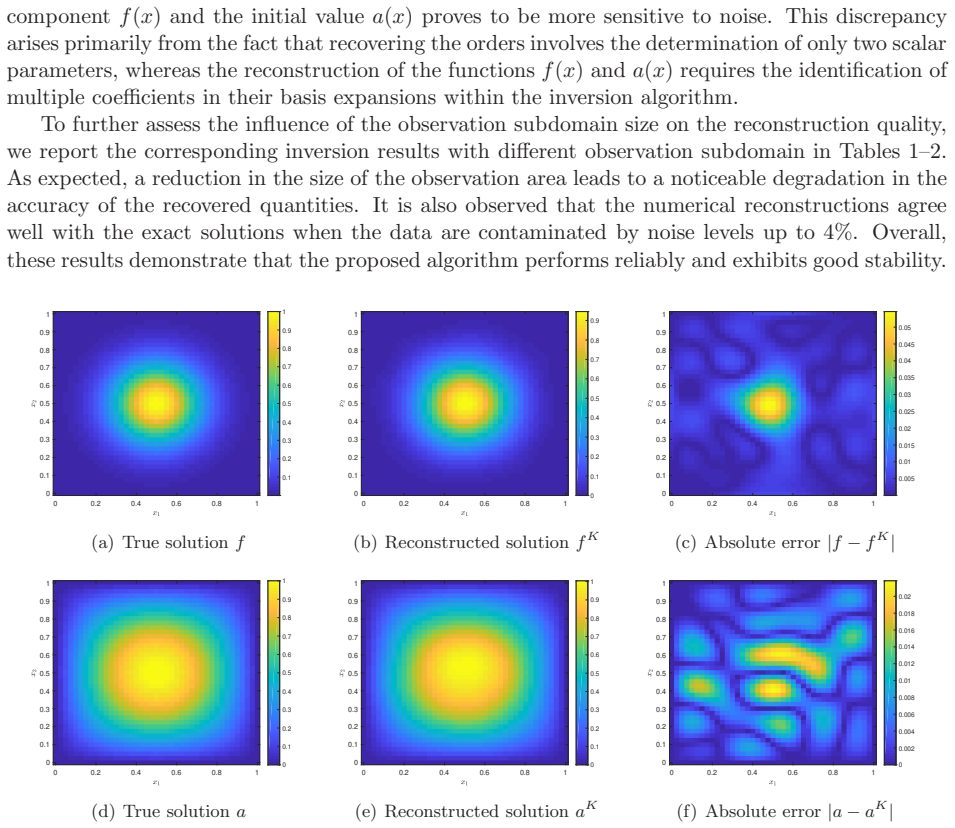
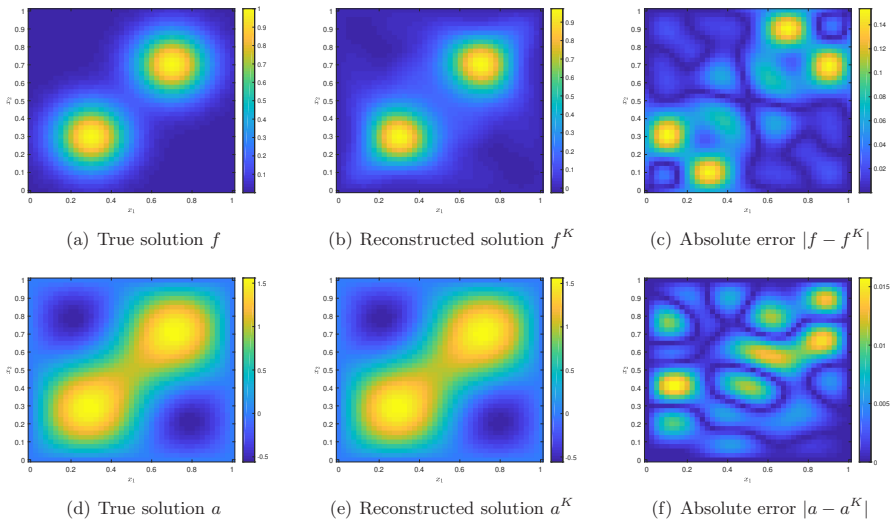
The uniqueness of simultaneously recovering multiple parameters in nonlocal diffusion equations is established by employing the asymptotic behavior of solutions, analytic continuation, the Laplace transform, and properties of analytic functions. For numerical reconstruction, the Levenberg-Marquardt method is applied to obtain a stable approximate solution of the inverse problem, and numerical examples demonstrate the efficiency of the algorithm while validating the theoretical findings.
Load-bearing premise
The internal measurements must be rich enough to support analytic continuation and Laplace transform arguments that separate the multiple unknown parameters, with the nonlocal kernel and domain satisfying the necessary regularity for these tools to apply.
Editorial extensions
If this is right
- Uniqueness holds for the inverse problem of recovering multiple parameters simultaneously from internal data.
- The Levenberg-Marquardt method yields stable numerical approximations to the parameters.
- Numerical examples confirm both the theoretical uniqueness and the practical performance of the reconstruction algorithm.
Reading between the lines
- The reliance on Laplace transforms and analytic continuation suggests the result may extend to related nonlocal operators whose solutions share similar analytic properties.
- If internal measurements can be taken at discrete locations rather than continuously, the same separation technique might still apply provided the data remain dense enough in time.
- The framework could connect to inverse problems for integral equations outside diffusion, where multiple coefficients must be disentangled from limited observations.
Editorial analysis
A structured set of objections, weighed in public.
Referee Report
Summary. The manuscript addresses the simultaneous recovery of multiple parameters in nonlocal diffusion equations from internal measurements. Uniqueness of the inverse problem is claimed via the asymptotic behavior of solutions, analytic continuation, the Laplace transform, and properties of analytic functions. Numerical reconstruction employs the Levenberg-Marquardt method, with examples provided to illustrate efficiency and validate the theoretical results.
Significance. If the uniqueness result holds under suitable regularity assumptions on the kernel and domain, the work would add to the literature on inverse problems for nonlocal models. The analytic tools cited are standard for time-dependent data admitting holomorphic extensions, and the choice of Levenberg-Marquardt is conventional for nonlinear least-squares. Numerical validation is a positive feature, though the absence of explicit assumptions or error bounds in the abstract limits assessment of robustness.
major comments (1)
- [Abstract] Abstract: the uniqueness claim is asserted by listing analytic tools (asymptotic behavior, analytic continuation, Laplace transform, analytic-function properties) but supplies no proof details, assumptions on the nonlocal kernel/domain, or error analysis, so the support for the central claim cannot be verified from the given information.
minor comments (1)
- The weakest assumption (richness of internal measurements to support analytic continuation and Laplace-transform separation of parameters) is stated only implicitly; an explicit statement of the required regularity would strengthen the presentation.
Simulated Author's Rebuttal
We thank the referee for their review. We respond to the major comment below.
read point-by-point responses
-
Referee: [Abstract] Abstract: the uniqueness claim is asserted by listing analytic tools (asymptotic behavior, analytic continuation, Laplace transform, analytic-function properties) but supplies no proof details, assumptions on the nonlocal kernel/domain, or error analysis, so the support for the central claim cannot be verified from the given information.
Authors: The abstract is a concise summary that identifies the principal analytic tools used to establish uniqueness. The complete proof, including the precise regularity assumptions on the nonlocal kernel and the domain, the application of asymptotic behavior, analytic continuation, the Laplace transform, and properties of analytic functions, is developed rigorously in Sections 2--3 of the manuscript. The Levenberg-Marquardt algorithm and its associated error analysis appear in Section 4, with supporting numerical examples in Section 5. This structure follows standard practice for mathematical papers, where abstracts outline methods while the body supplies the detailed arguments and assumptions. revision: no
Circularity Check
No significant circularity; uniqueness via external analytic tools
full rationale
The paper establishes uniqueness for the inverse problem using asymptotic behavior of solutions, analytic continuation, the Laplace transform, and properties of analytic functions. These are standard external mathematical techniques applied to the nonlocal diffusion model under stated regularity assumptions on the kernel and domain. The numerical reconstruction employs the conventional Levenberg-Marquardt method for nonlinear least-squares. No derivation step reduces by construction to fitted parameters, self-definitions, or load-bearing self-citations; the central claim remains independent of the paper's own inputs.
Assumptions & free parameters
Cite this review
Pith. "Pith review of Simultaneous recovery of multiple parameters in nonlocal diffusion equations from internal measurements." pith.science (2026). https://pith.science/paper/MJ7DGGPP
@misc{pith2026260608699,
  author       = {Pith},
  title        = {Pith review of: Simultaneous recovery of multiple parameters in nonlocal diffusion equations from internal measurements},
  year         = {2026},
  howpublished = {\url{https://pith.science/paper/MJ7DGGPP}},
  note         = {Machine review of arXiv:2606.08699}
}
read the original abstract
This paper is devoted to simultaneously recovering multiple parameters from internal measurements for nonlocal diffusion equations. The uniqueness of the inverse problem is established by employing the asymptotic behavior of solutions, analytic continuation, the Laplace transform, and properties of analytic functions. For numerical reconstruction, we apply the Levenberg-Marquardt method to obtain a stable approximate solution of the inverse problem. Numerical examples are provided to demonstrate the efficiency of the proposed algorithm and to validate our theoretical findings.
Figures
Reference graph
Works this paper leans on
-
[1]
Adams, Sobolev Spaces, Academic Press, New York (1975)
R.A. Adams, Sobolev Spaces, Academic Press, New York (1975)
1975
-
[2]
M. Ali, S. Aziz, S. Malik, Inverse source problem for a spa ce-time fractional diffusion equation, Fract. Calc. Appl. Anal. , 21(3) (2018): 844–863
2018
-
[3]
S. Cen, B. Jin, Y. Liu, Z. Zhou, Recovery of multiple param eters in subdiffusion from one lateral boundary measurement, Inverse Problems , 39(10) (2023): 104001
2023
-
[4]
G. B. Folland, Introduction to Partial Differential Equations , Princeton University Press, 1995
1995
-
[5]
Ghosh, M
T. Ghosh, M. Salo, G. Uhlmann, The Calder´ on problem for the fractional Schr¨ odinger equation, Anal. & PDE , 13(2) (2020): 455–475
2020
-
[6]
Gorenflo, Y
R. Gorenflo, Y. Luchko, M. Yamamoto, Time-fractional diffu sion equation in the fractional Sobolev spaces, Fract. Calc. Appl. Anal. , 18(3) (2015): 799–820
2015
-
[7]
Guerngar, E
N. Guerngar, E. Nane, R. Tinaztepe, S. Ulusoy, H.W. Van Wy k, Simultaneous inversion for the fractional exponents in the space-time fractional diffus ion equation ∂ β tu = − (−△ )α/ 2u − (−△ )γ/ 2u, Fract. Calc. Appl. Anal. , 24(3) (2021): 818–847
2021
-
[8]
Helin, M
T. Helin, M. Lassas, L. Ylinen, Z. Zhang, Inverse problem s for heat equation and space–time fractional diffusion equation with one measurement, J. Differential Equations , 269 (9) (2020): 7498–7528
2020
Show all 35 references
-
[9]
Janno, Determination of time-dependent sources and p arameters of nonlocal diffusion and wave equations from final data, Fract
J. Janno, Determination of time-dependent sources and p arameters of nonlocal diffusion and wave equations from final data, Fract. Calc. Appl. Anal. , 23(6) (2020): 1678–1701. 16
2020
-
[10]
J. Jia, J. Peng, J. Gao, Y. Li, Backward problem for a time -space fractional diffusion equation, Inverse Probl. Imaging , 12 (3) (2018): 773—799
2018
-
[11]
J. Jia, J. Peng, J. Yang, Harnack’s inequality for a spac e–time fractional diffusion equation and applications to an inverse source problem, J. Differential Equations , 262(8) (2017): 4415–4450
2017
-
[12]
Y. Kian, Z. Li, Y. Liu, M. Yamamoto, The uniqueness of inv erse problems for a fractional equation with a single measurement, Math. Ann. , 380(3) (2021): 1465–1495
2021
-
[13]
Kilbas, H.M
A.A. Kilbas, H.M. Srivastava, J.J. Trujillo, Theory and Applications of Fractional Differential Equations, Elsevier, Amsterdam (2006)
2006
-
[14]
R. Lai, Y. Lin, A. R¨ uland, The Calder´ on problem for a space-time fractional parabolic equation, SIAM J. Math. Anal. , 52(3) (2020): 2655–2688
2020
-
[15]
Y. Li, T. Wei, An inverse time-dependent source problem for a time–space fractional diffusion equation, Appl. Math. Comput. , 336 (2018): 257–271
2018
-
[16]
Z. Li, Y. Liu, M. Yamamoto, Inverse problems of determin ing parameters of the fractional partial differential equations, Handbook of Fractional Calculus with Applications, Volume 2 : Fractional Differential Equations , De Gruyter, Berlin (2019): 431–442
2019
-
[17]
Z. Li, M. Yamamoto, Inverse problems of determining coe fficients of the fractional partial differential equations, Handbook of Fractional Calculus with Applications, Volume 2 : Fractional Differential Equations , De Gruyter, Berlin (2019): 443–464
2019
-
[18]
Y. Liu, Z. Li, M. Yamamoto, Inverse problems of determin ing sources of the fractional partial differential equations, Handbook of Fractional Calculus with Applications, Volume 2 : Fractional Differential Equations , De Gruyter, Berlin (2019): 411–430
2019
-
[19]
Y. Liu, M. Yamamoto, Uniqueness of orders and parameter s in multi-term time-fractional diffusion equations by short-time behavior, Inverse Problems , 39(2) (2022): 024003
2022
-
[20]
Rodino, Linear Partial Differential Operators in Gevrey Spaces , World Scientific, Singapore, 1993
L. Rodino, Linear Partial Differential Operators in Gevrey Spaces , World Scientific, Singapore, 1993
1993
-
[21]
K. Lyu, H. Cheng, Recovering a space-dependent source t erm for distributed order time-space fractional diffusion equation, Numer. Algorithms , 99 (2024): 1317—1342
2024
-
[22]
Malik, A
S. Malik, A. Ilyas, A. Samreen, Simultaneous determina tion of a source term and diffusion concentration for a multi-term space-time fractional diffus ion equation, Math. Model. Anal. , 26(3) (2021): 411–431
2021
-
[23]
Metzler J
R. Metzler J. Klafter, The random walk’s guide to anomal ous diffusion: a fractional dynamics approach, Phys. Rep. , 339(1) (2000): 1–77
2000
-
[24]
Podlubny, Fractional Differential Equations , Academic Press, San Diego (1999)
I. Podlubny, Fractional Differential Equations , Academic Press, San Diego (1999)
1999
-
[25]
Raberto, E
M. Raberto, E. Scalas, F. Mainardi, Waiting-times and r eturns in high-frequency financial data: an empirical study, Phys. A , 314(1–4) (2002): 749–755
2002
-
[26]
Restrepo, D
J. Restrepo, D. Suragan, Direct and inverse Cauchy prob lems for generalized space-time frac- tional differential equations, Adv. Differential Equations , 26(7–8) (2021): 305–339. 17
2021
-
[27]
Sakamoto, M
K. Sakamoto, M. Yamamoto, Initial value/boundary valu e problems for fractional diffusion- wave equations and applications to some inverse problems, J. Math. Anal. Appl. , 382(1) (2011): 426–447
2011
-
[28]
L. Sun, Y. Li, Y. Zhang, Simultaneous inversion of the po tential term and the fractional orders in a multi-term time-fractional diffusion equation, Inverse Problems, 37(5) (2021): 055007
2021
-
[29]
Tatar, R
S. Tatar, R. Tınaztepe, S. Ulusoy, Simultaneous invers ion for the exponents of the fractional time and space derivatives in the space-time fractional diffu sion equation, Appl. Anal. , 95 (1) (2016): 1–23
2016
-
[30]
Tatar, S
S. Tatar, S. Ulusoy, An inverse source problem for a one- dimensional space–time fractional diffusion equation, Appl. Anal. , 94(11) (2015): 2233–2244
2015
-
[31]
Duc, N.V
N.V. Duc, N.V. Thang, N.T. Th` anh, The quasi-reversibi lity method for an inverse source problem for time-space fractional parabolic equations, J. Differential Equations , 344 (2023): 102–130
2023
-
[32]
F. Yang, Q. Wang, X. Li, Unknown source identification pr oblem for space-time fractional diffusion equation: optimal error bound analysis and regular ization method, Inverse Probl. Sci. Eng. , 29(12) (2021): 2040–2084
2021
-
[33]
K. Yu, Z. Li, Y. Liu, Inverse source problem with a poster iori interior measurements for space- time fractional diffusion equations, Comput. Math. Appl. , 200 (2025): 305–314
2025
-
[34]
Yuste, K
S. Yuste, K. Lindenberg, Subdiffusion-limited reaction s, Chem. Phys. , 284(1–2) (2002): 169– 180
2002
-
[35]
Zhang, J
Y. Zhang, J. Jia, L. Yan, Bayesian approach to a nonlinea r inverse problem for a time-space fractional diffusion equation, Inverse Problems , 34(12) (2018): 125002. 18
2018
Reviewed June 27, 2026 · model on record in the stance chip above.
Discussion (0). Sign in to comment.