Design of a multifunctional Doppler backscattering diagnostic for the Pegasus-III Experiment
Pith reviewed 2026-06-27 15:03 UTC · model grok-4.3
The pith
Designed Doppler backscattering system measures ion-scale density fluctuations from outer core to beyond last-closed flux surface in Pegasus-III.
A machine-rendered reading of the paper's core claim, the machinery that carries it, and where it could break.
Core claim
The DBS system is capable of measuring ion-scale density fluctuations 1≤k⊥,c≤8 cm^{-1} at normalized radial coordinates from the outer core (ρ∼0.65) to just beyond the last-closed flux surface when using poloidal launch angles 8° to 18° and toroidal launch angles 0° to 3° for maximal backscattered power, with additional toroidal steering capability to resolve the toroidal response for magnetic pitch angle measurements.
What carries the argument
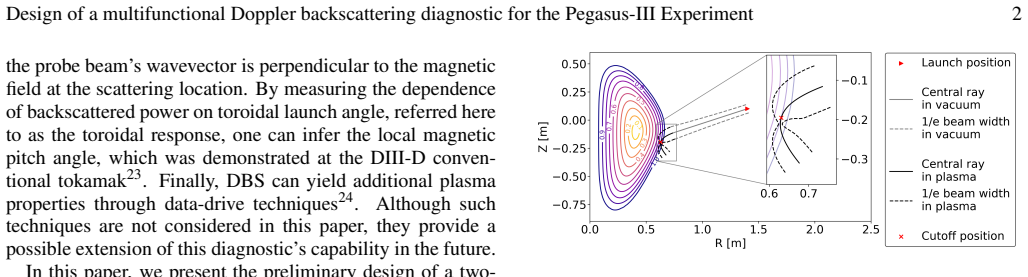
Scotty beam-tracing code, used to simulate beam paths and identify launch angles that maximize backscattered power while determining the accessible fluctuation wavenumbers and locations.
If this is right
- Advances diagnostic science through better understanding of DBS functions and data-driven plasma property inference.
- Constrains magnetic equilibrium via pitch angle measurements.
- Supports solenoid-free plasma initiation studies by providing density fluctuation data.
- Informs O-X-B mode conversion efficiency and window location for heating and current drive.
- Provides coverage across outer core to scrape-off layer regions with adjustable steering.
Where Pith is reading between the lines
- The flexible 2D steering and polarization selection may allow the system to adapt to a wide range of plasma conditions beyond the simulated cases.
- Measurements near and beyond the last-closed flux surface could contribute to understanding edge turbulence effects on confinement.
- Combining DBS data with other diagnostics might improve overall equilibrium reconstruction accuracy.
- Similar beam-tracing approaches could optimize DBS designs for other fusion devices with complex geometries.
Load-bearing premise
The plasma equilibrium, density profile, and magnetic geometry assumed in the beam-tracing calculations represent the actual Pegasus-III plasmas.
What would settle it
Experimental measurements of backscattered power or inferred fluctuation locations that fall outside the predicted radial and wavenumber ranges for the specified launch angles would indicate the coverage claim does not hold.
Figures


read the original abstract
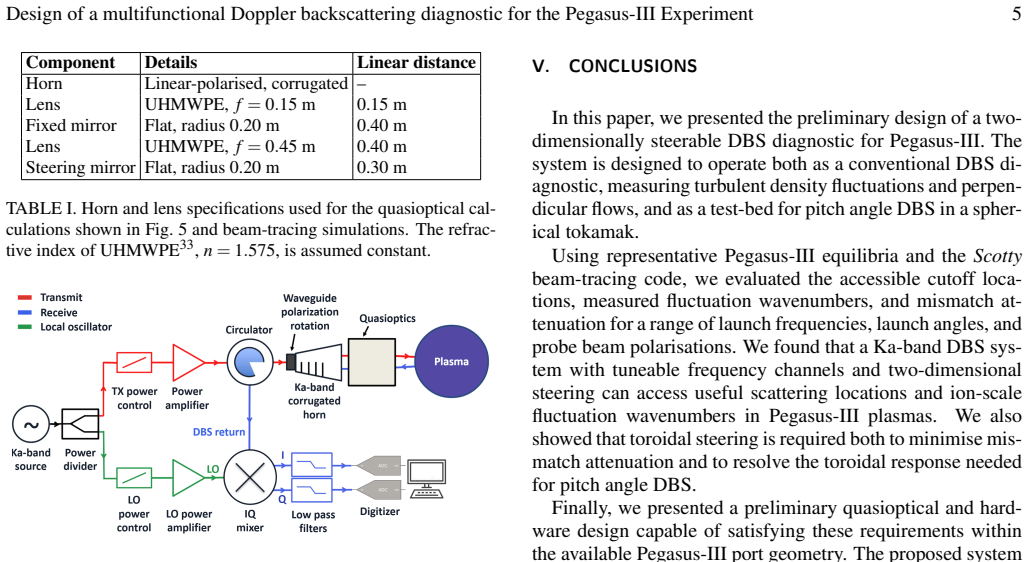
The Doppler backscattering (DBS) diagnostic measures flows and electron density fluctuations. Recent work indicates that DBS can also infer the magnetic pitch angle (Yeoh et al., NF 2026). We present the preliminary design of a DBS for the Pegasus-III Experiment. This DBS will serve two objectives. First, it will advance diagnostic science, by supporting understanding of the DBS instrumentation functions, using DBS to constrain the magnetic equilibrium, and data-driven inference of plasma properties from DBS signals. Secondly, it will support Pegasus-IIIs research directions, such as solenoid-free plasma initiation and O-X-B mode conversion for heating and current drive, since density fluctuations affect mode conversion efficiency and pitch angle measurements can be used to locate the mode conversion window. This ex-vacuum DBS system uses a single channel, tuneable Ka-band source, a corrugated horn antenna, and a homodyne I/Q receiver with baseband digitization. For greater flexibility, which is especially important for pitch angle measurements, the quasioptical elements include a rotatable spinner for O- and X-mode selection and a mirror with 2D steering. Using the \textit{Scotty} beam-tracing code, for a range of poloidal launch angles $8^\circ$ to $18^\circ$ and a corresponding toroidal launch angle between $0^\circ$ to $3^\circ$ for maximal backscattered DBS power, we find that the DBS system is capable of measuring ion-scale density fluctuations $1\leq k_{\perp,c} \leq8 \text{ cm}^{-1}$ at a range of normalized radial coordinates from the outer core ($\rho \sim 0.65$) to just beyond the last-closed flux surface (LCFS), where $\rho=0$ corresponds to the magnetic axis and $\rho=1$ the LCFS. The system is also designed with additional toroidal steering capability, $-4^\circ$ to $8^\circ$, to resolve the toroidal response needed for magnetic pitch angle measurements.
Editorial analysis
A structured set of objections, weighed in public.
Referee Report
Summary. The manuscript presents the preliminary design of a single-channel, tunable Ka-band Doppler backscattering (DBS) system for the Pegasus-III experiment. The hardware includes a corrugated horn, homodyne I/Q receiver with baseband digitization, a rotatable spinner for O/X-mode selection, and a 2D-steerable mirror. Forward modeling with the Scotty beam-tracing code for poloidal launch angles 8°–18° and toroidal angles 0°–3° (plus additional toroidal steering −4° to 8°) is used to claim access to ion-scale density fluctuations with 1 ≤ k⊥,c ≤ 8 cm⁻¹ from ρ ≈ 0.65 to beyond the LCFS, together with pitch-angle measurement capability to support O-X-B studies.
Significance. If the reported performance holds, the instrument would provide a flexible diagnostic for density fluctuations, flows, and magnetic pitch angle on Pegasus-III, directly supporting both diagnostic-development goals and the experiment’s solenoid-free startup and O-X-B heating programs. The hardware description is internally consistent and the choice of Scotty for launch-angle optimization is a clear methodological strength.
major comments (1)
- [Abstract / beam-tracing analysis] Abstract and beam-tracing results section: the quantitative claim that the system measures 1 ≤ k⊥,c ≤ 8 cm⁻¹ from ρ ∼ 0.65 to beyond the LCFS is obtained directly from Scotty runs; the manuscript supplies neither the specific equilibrium, density profile, or magnetic geometry used as input nor any sensitivity scan showing how the quoted k⊥,c and ρ intervals change when those inputs are varied within experimental uncertainty.
Simulated Author's Rebuttal
We thank the referee for their thoughtful review and positive assessment of the manuscript's significance. We address the single major comment below and will revise the manuscript to incorporate the requested details.
read point-by-point responses
-
Referee: Abstract / beam-tracing analysis] Abstract and beam-tracing results section: the quantitative claim that the system measures 1 ≤ k⊥,c ≤ 8 cm⁻¹ from ρ ∼ 0.65 to beyond the LCFS is obtained directly from Scotty runs; the manuscript supplies neither the specific equilibrium, density profile, or magnetic geometry used as input nor any sensitivity scan showing how the quoted k⊥,c and ρ intervals change when those inputs are varied within experimental uncertainty.
Authors: We agree that the manuscript does not specify the exact equilibrium, density profile, or magnetic geometry used as input to Scotty, nor does it include a sensitivity scan. The quoted ranges were obtained from representative Pegasus-III equilibria and density profiles consistent with the experiment's target operating space for solenoid-free startup studies. In the revised manuscript we will explicitly state the input profiles (including the specific q-profile, density scale length, and magnetic geometry parameters) and add a short paragraph discussing how the reported k⊥,c and ρ intervals vary when those inputs are perturbed within the range of experimental uncertainty. A comprehensive sensitivity study is outside the scope of this preliminary-design paper but will be noted as planned future work. revision: yes
Circularity Check
No circularity: forward simulation of diagnostic capabilities from external code and assumed profiles.
full rationale
The paper's central claim is a forward-model result obtained by running the Scotty beam-tracing code over a grid of launch angles with fixed (assumed) equilibrium, density, and magnetic geometry inputs. This produces reported ranges for k⊥,c and ρ as direct outputs of the simulation; no step fits parameters to data, renames a known result, or reduces a prediction to a self-citation or self-definition. The cited Yeoh et al. reference is external and not load-bearing for the design claim. The derivation chain is therefore self-contained against external benchmarks and receives the default non-circularity finding.
Axiom & Free-Parameter Ledger
free parameters (2)
- poloidal launch angle range
- toroidal launch angle range
axioms (2)
- domain assumption Scotty beam-tracing code accurately predicts DBS scattering locations and wavenumbers for the Pegasus-III geometry
- domain assumption Plasma density and magnetic equilibrium profiles used in the scan are representative of future Pegasus-III discharges
Reference graph
Works this paper leans on
-
[1]
Yeoh, A.K. and Hall-Chen, V.H. and Pratt, Q.T. and Victor, B.S. and Damba, J. and Rhodes, T.L. and Crocker, N.A. and Fong, K.R. and Hillesheim, J.C. and Parra, F.I. and Ruiz Ruiz, J. , title =. 2025 , month =. doi:10.1088/1741-4326/ae1518 , url =
-
[2]
Hall-Chen, Valerian H and Parra, Felix I and Hillesheim, Jon C , title =. 2022 , month =. doi:10.1088/1361-6587/ac57a1 , url =
-
[3]
Teo, N. Q. X. and Hall-Chen, V. H. and Barada, K. and Ng, R. J. H. and Gu, L. and Yeoh, A. K. and Pratt, Q. T. and Garbet, X. and Rhodes, T. L. , title =. Review of Scientific Instruments , volume =. 2024 , month =. doi:10.1063/5.0215748 , url =
-
[4]
and Bongard, Michael W
Sontag, Aaron C. and Bongard, Michael W. and Borchardt, Michael T. and Diem, Stephanie J. and Fonck, Raymond J. and Keyhani, Armand K. and Kujak-Ford, Benjamin A. and Lewicki, Benjamin T. and Nornberg, Mark D. and Palmer, Alan C. and Pierren, Christopher and Reusch, Joshua A. and Rhodes, Alexander T. and Richner, Nathan J. and Rodriguez-Sanchez, Cuauhtemo...
2022
-
[5]
2016 , publisher=
Schlossberg, David J and Bodner, Grant M and Bongard, Michael W and Fonck, Raymond J and Reusch, Joshua A and Rodriguez Sanchez, Cuauhtemoc , journal=. 2016 , publisher=
2016
-
[6]
2011 , publisher=
Barnes, M and Parra, FI and Schekochihin, AA , journal=. 2011 , publisher=
2011
-
[7]
2025 , publisher=
Ruiz, J Ruiz and Parra, Felix I and Hall-Chen, Valerian H and Belrhali, Nathan and Giroud, Carine and Hillesheim, Jon C and Lopez, Nicolas A and others , journal=. 2025 , publisher=
2025
-
[8]
2024 , publisher=
Pratt, Quinn and Hall-Chen, V and Neiser, TF and Hong, R and Damba, J and Rhodes, TL and Thome, KE and Yang, J and Haskey, SR and Cote, T and others , journal=. 2024 , publisher=
2024
-
[9]
Damba, J. and Pratt, Q. and Hall-Chen, V. H. and Hong, R. and Lantsov, R. and Ellis, R. and Rhodes, T. L. , title =. Review of Scientific Instruments , volume =. 2022 , month =. doi:10.1063/5.0101864 , url =
-
[10]
J.C. Hillesheim and N.A. Crocker and W.A. Peebles and H. Meyer and A. Meakins and A.R. Field and D. Dunai and M. Carr and N. Hawkes and the MAST Team , title =. Nuclear Fusion , abstract =. 2015 , month =. doi:10.1088/0029-5515/55/7/073024 , url =
-
[11]
2022 , publisher=
Richner, NJ and Bodner, GM and Bongard, MW and Fonck, RJ and Nornberg, MD and Reusch, JA , journal=. 2022 , publisher=
2022
-
[12]
2025 , publisher=
Weberski, Justin D and Aslin, Mary W and Bongard, Michael W and Goetz, John A and Nornberg, Mark D and Peery, Jilliann K and Redd, Sophie and Reusch, Joshua A and Rodriguez Sanchez, Cuauhtemoc and Schaefer, Carolyn E and others , journal=. 2025 , publisher=
2025
-
[13]
2024 , publisher=
Weberski, Justin D and Bongard, Michael W and Diem, Stephanie J and Fonck, Raymond J and Goetz, John A and Nornberg, Mark D and Reusch, Joshua A and Schaefer, Carolyn E and Sontag, Aaron C , journal=. 2024 , publisher=
2024
-
[14]
2026 , publisher=
Goetz, John A and Bongard, Michael W and Diem, Stephanie J and Peery, Jilliann K , journal=. 2026 , publisher=
2026
-
[15]
2013 , publisher=
Freethy, Simon James and Huang, Billy K and Shevchenko, VF and Vann, RGL , journal=. 2013 , publisher=
2013
-
[16]
2016 , publisher=
Thomas, DA and Brunner, KJ and Freethy, SJ and Huang, BK and Shevchenko, VF and Vann, RGL , journal=. 2016 , publisher=
2016
-
[17]
2024 , publisher=
Peery, Jilliann and Bongard, Michael and Diem, Stephanie and Goetz, John and Reusch, Joshua and Sontag, Aaron and Bigelow, Tim and Biewer, Theodore and Harvey, Robert and Petrov, Yuri and others , journal=. 2024 , publisher=
2024
-
[18]
2026 , publisher=
Schaefer, CE and Sontag, AC and Ferraro, NM and Weberski, JD and Diem, SJ , journal=. 2026 , publisher=
2026
-
[19]
2022 , publisher=
Pratt, Quinn and Rhodes, T and Chrystal, C and Carter, T , journal=. 2022 , publisher=
2022
-
[20]
2025 , publisher=
Shi, WX and Zhou, C and Liu, AD and Zhuang, G and Zhang, SB and Li, X and Wang, SX and Liu, HQ and Zhang, J and Zhong, XM and others , journal=. 2025 , publisher=
2025
-
[21]
Tong, Ruihai and Zhou, Yu and Zhong, Wulyu and Wen, Jie and Shi, Zhongbing and Zou, Xiaolan and Liang, Anshu and Yang, Zengchen and Jiang, Min and Yu, Xin and others , journal=
-
[22]
2024 , publisher=
Macwan, T and Barada, K and Kubota, S and Lantsov, R and Bradley, L and Pratt, Q and Hong, R and Michael, CA and Hall-Chen, V and Wisniewski, J and others , journal=. 2024 , publisher=
2024
-
[23]
2023 , publisher=
Chowdhury, Satyajit and Crocker, NA and Peebles, WA and Rhodes, TL and Zeng, L and Lantsov, R and Van Compernolle, B and Brookman, M and Pinsker, RI and Lau, C , journal=. 2023 , publisher=
2023
-
[24]
2026 , publisher=
Liang, Ying Hao Matthew and Hall-Chen, Valerian and Rhodes, Terry and Wang, Yumin and Zhao, Yihang , journal=. 2026 , publisher=
2026
-
[25]
Nuclear fusion , volume=
Hennequin, P and Honor. Nuclear fusion , volume=
-
[26]
2009 , publisher=
Happel, T and Estrada, T and Blanco, E and Tribaldos, V and Cappa, A and Bustos, A , journal=. 2009 , publisher=
2009
-
[27]
2023 , publisher=
Shi, P and Scannell, R and Wen, J and Shi, ZB and Michael, C and Rhodes, T and Hall-Chen, VH and Yang, ZC and Jiang, M and Zhong, WL , journal=. 2023 , publisher=
2023
-
[28]
2022 , publisher=
Rhodes, TL and Michael, CA and Shi, P and Scannell, R and Storment, S and Pratt, Q and Lantsov, R and Fitzgerald, I and Hall-Chen, VH and Crocker, NA and others , journal=. 2022 , publisher=
2022
-
[29]
Goldsmith, PF , title =
-
[30]
X.L. Xie and J. Zhou and Y. Zhu and X.M. Pan and H. Zhou and G. Yu and N.C. Luhmann and G. Zhuang and Z.J. Yang , keywords =. Fusion Engineering and Design , volume =. 2020 , issn =. doi:https://doi.org/10.1016/j.fusengdes.2020.111636 , url =
-
[31]
2022 , publisher=
Hall-Chen, Valerian Hongjie and Damba, Julius and Parra, Felix I and Pratt, Quinn T and Michael, Clive A and Peng, Shi and Rhodes, Terry L and Crocker, Neal A and Hillesheim, Jon C and Hong, Rongjie and others , journal=. 2022 , publisher=
2022
-
[32]
2025 , publisher=
Tokuzawa, Tokihiko and Nasu, Tatsuhiro and Nishimura, Daiki and Inagaki, Shigeru and Ejiri, Akira and Ida, Katsumi and Yoshinuma, Mikirou and Kobayashi, Tatsuya and Tanaka, Kenji and Fujisawa, Akihide and others , journal=. 2025 , publisher=
2025
-
[33]
Thomas, Matthew , year=
discussion (0)
Sign in with ORCID, Apple, or X to comment. Anyone can read and Pith papers without signing in.