A Hybrid Generative Reduced-Order Model for the Minimal Flow Unit
Pith reviewed 2026-06-27 15:20 UTC · model grok-4.3
The pith
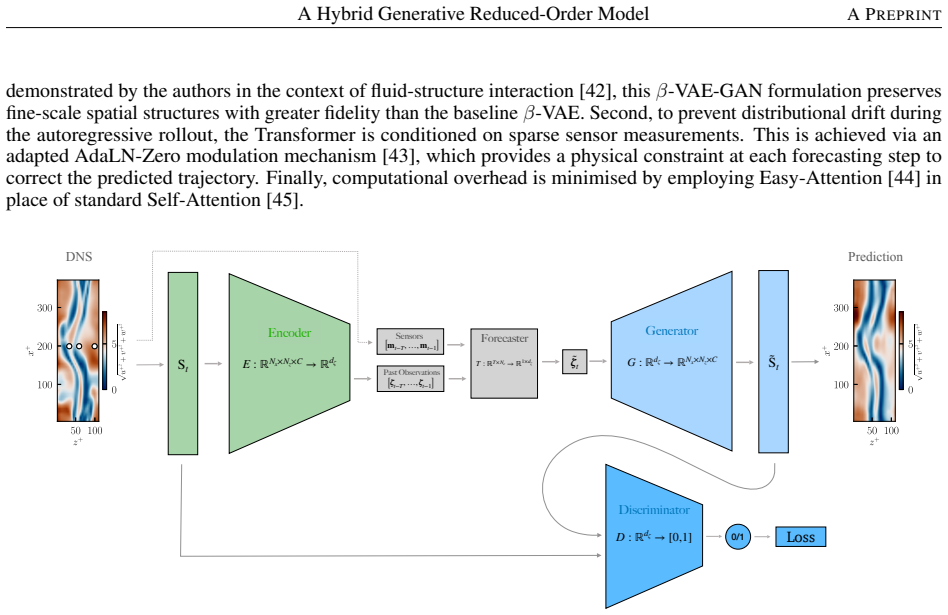
A hybrid β-VAE-GAN and sensor-conditioned Transformer compresses wall-bounded turbulence into four latent dimensions that recover 87 percent of turbulent kinetic energy and forecast intermittent dynamics from sparse sensors.
A machine-rendered reading of the paper's core claim, the machinery that carries it, and where it could break.
Core claim
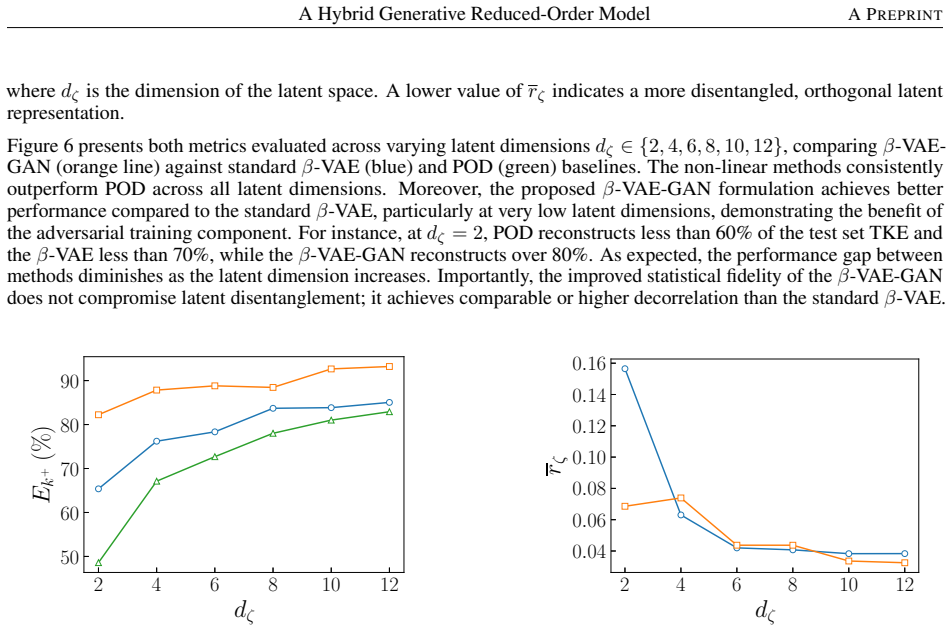
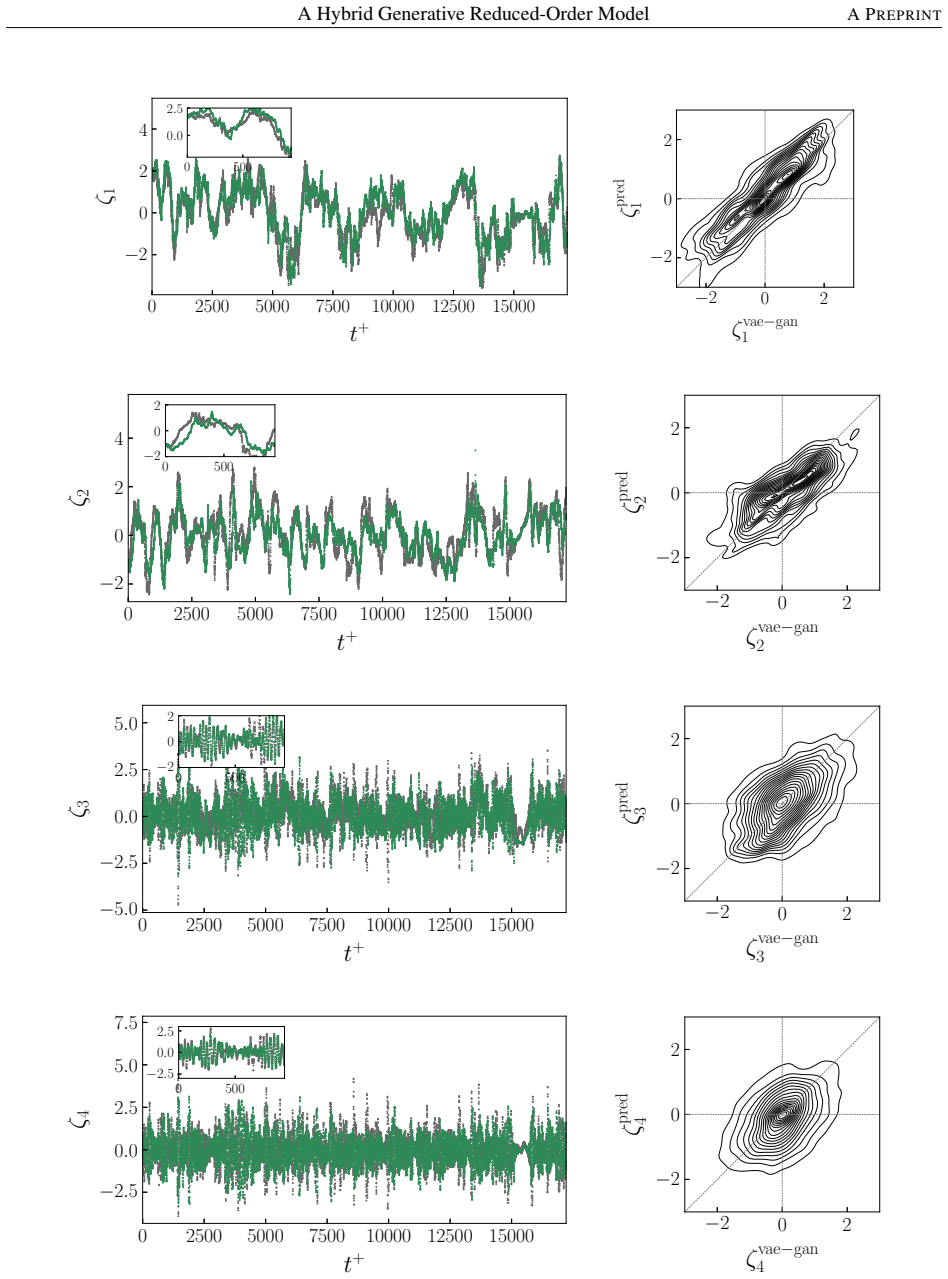
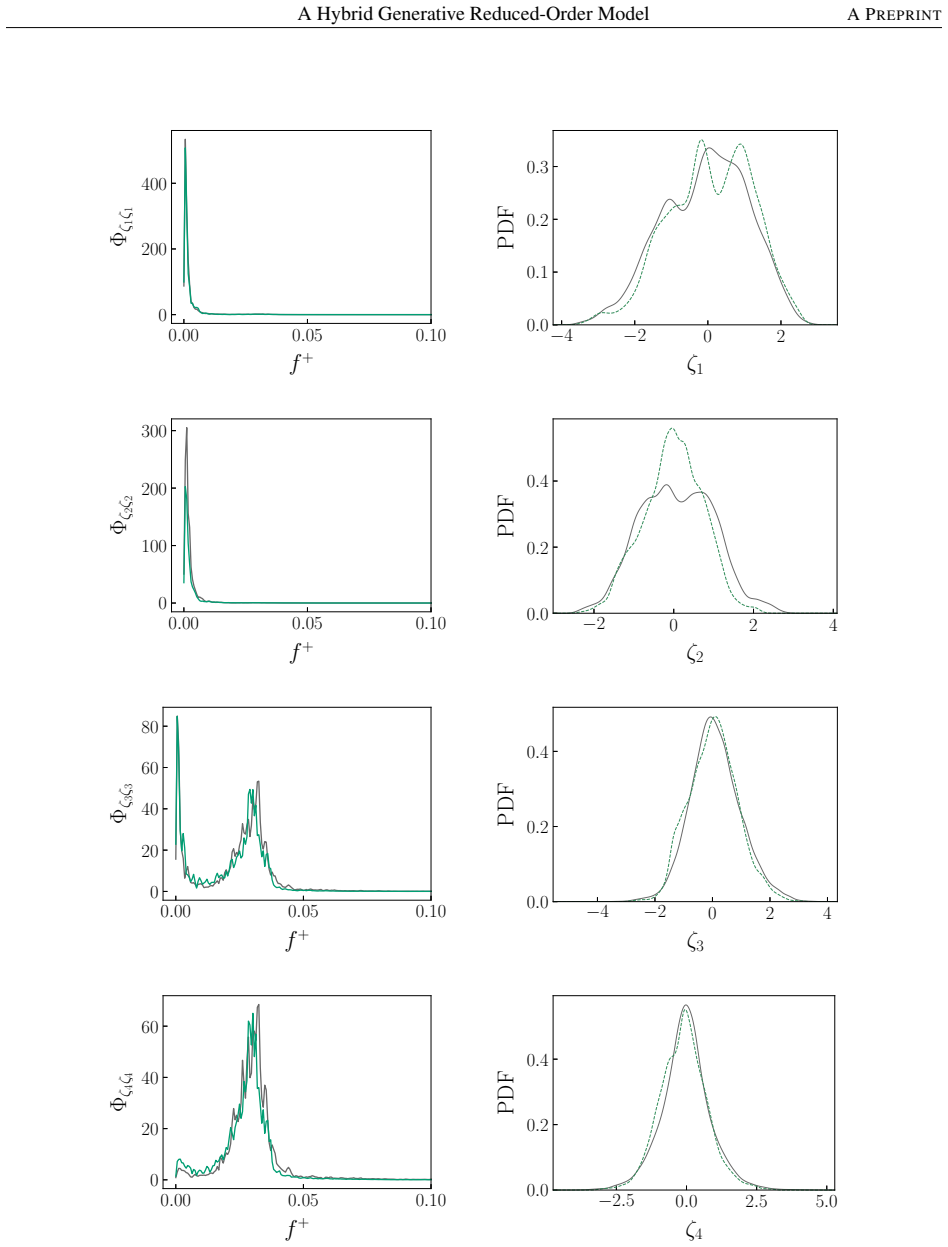
The hybrid framework compresses the Minimal Flow Unit flow at Reτ = 200 and y+ = 14 into a four-dimensional latent space recovering 87 percent of the turbulent kinetic energy, exceeding a standard β-VAE baseline by more than 10 percent. The latent coordinates autonomously encode the characteristic timescales of the flow, with specific dimensions capturing the low-frequency signature of the near-wall regeneration cycle at T+ ≈ 1724. The sensor-conditioned Transformer using Easy Attention and AdaLN-Zero maintains accurate forecasts over 17,288 t+ from an initialisation window of only 128 t+, while end-to-end inference reconstructs 82 percent of the turbulent kinetic energy and reproduces the a
What carries the argument
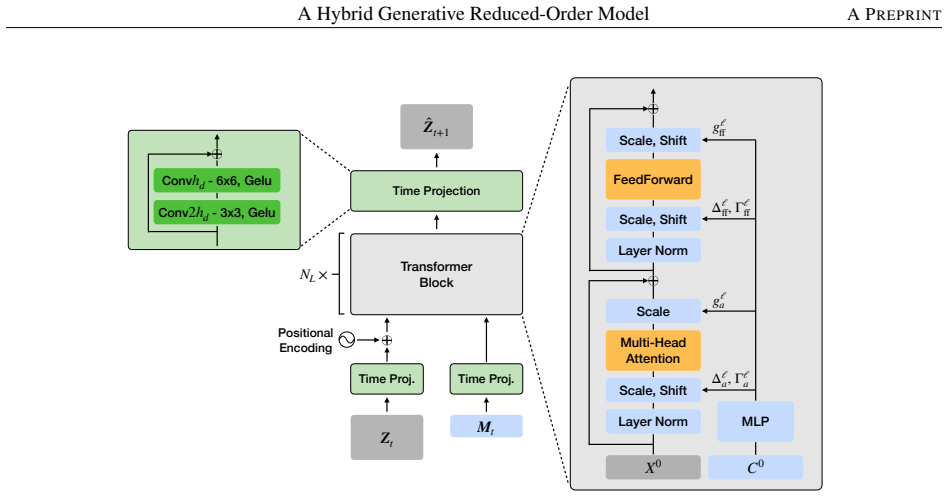
The β-VAE-GAN compression stage paired with a sensor-conditioned Transformer that replaces standard self-attention with Easy Attention and applies AdaLN-Zero modulation for sensor conditioning.
If this is right
- The four latent dimensions autonomously encode the low-frequency signature of the near-wall regeneration cycle at T+ ≈ 1724.
- Forecasts remain accurate for 17,288 time units when initialised from only 128 time units of sensor data.
- End-to-end inference from the full pipeline reconstructs 82 percent of the turbulent kinetic energy.
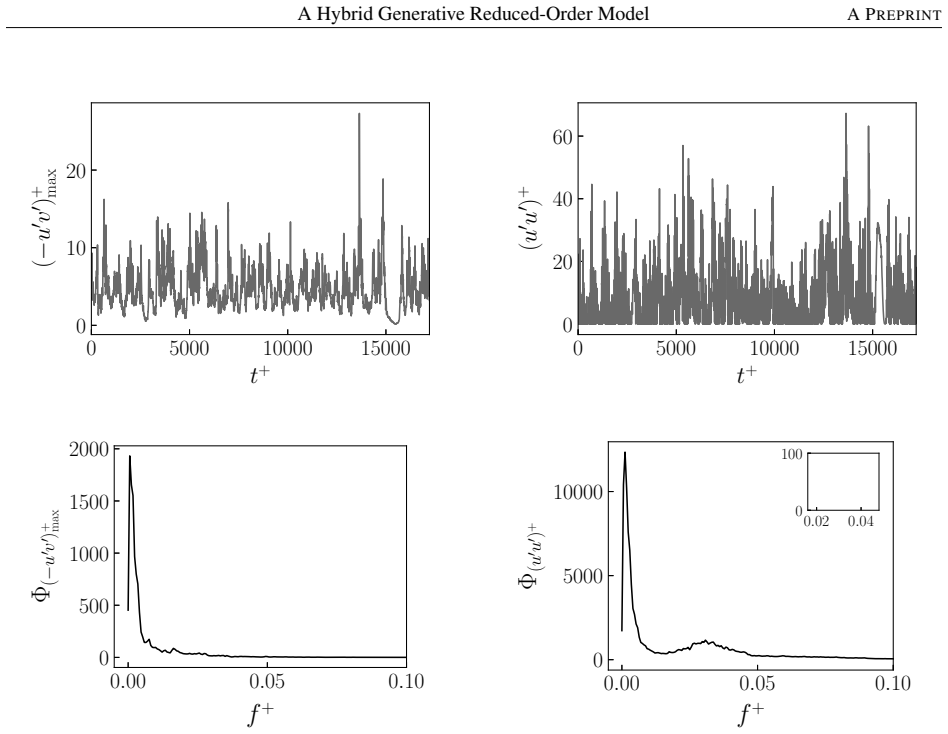
- The model reproduces the intermittent active and quiescent phases of the regeneration cycle despite attenuating rare extreme events.
Where Pith is reading between the lines
- The approach could reduce the computational cost of simulating wall-bounded turbulence in engineering design by replacing full direct numerical simulations with latent-space evolution.
- Testing the same architecture on minimal flow units at higher Reynolds numbers would reveal whether the four-dimensional bottleneck remains sufficient.
- The autonomous encoding of specific timescales suggests the latent space might be used to isolate and study other hidden periodicities in turbulent data.
Load-bearing premise
The encoder's focus on statistically recurrent flow states does not prevent accurate reproduction of the alternating active and quiescent phases of the regeneration cycle.
What would settle it
A direct numerical simulation of the minimal flow unit at the same Reynolds number and wall location, followed by comparison of the model's predicted regeneration-cycle period against the simulation's measured period; a large mismatch would falsify the claim of suitability as a surrogate.
Figures
read the original abstract
A data-driven reduced-order modelling framework is proposed for wall-bounded turbulent flows to forecast the intermittent near-wall dynamics over extended time horizons from sparse sensor measurements. The approach combines a $\beta$-VAE-GAN, which compresses high-dimensional flow fields into a low-dimensional latent space, with a sensor-conditioned Transformer that forecasts the evolution of the latent variables. The temporal module employs Easy Attention, a static time-mixing operator that replaces the learnable query-key mechanism of standard self-attention at reduced computational cost, combined with an adapted AdaLN-Zero modulation mechanism for sensor-based conditioning. Evaluated on the Minimal Flow Unit ($Re_\tau = 200$) at $y^+ = 14$, the compression stage recovers $87\%$ of the turbulent kinetic energy within a four-dimensional latent space, exceeding the standard $\beta$-VAE baseline by more than $10\%$. The latent dimensions autonomously encode the characteristic timescales of the flow, with specific coordinates capturing the low-frequency signature of the near-wall regeneration cycle ($T^+ \approx 1724$), establishing the physical interpretability of the learnt representation. The sensor-conditioned Transformer maintains accurate forecasts over $17{,}288\,t^+$ from an initialisation window of only $128\,t^+$, whilst end-to-end inference reconstructs $82\%$ of the turbulent kinetic energy. The principal limitation is the attenuation of rare, extreme-amplitude events, a consequence of the encoder prioritising the most statistically recurrent flow states within the low-dimensional bottleneck. Nevertheless, the framework accurately reproduces the alternating active and quiescent phases of the regeneration cycle, demonstrating its suitability as a surrogate model for the intermittent dynamics of wall-bounded turbulence.
Editorial analysis
A structured set of objections, weighed in public.
Referee Report
Summary. The manuscript proposes a hybrid generative reduced-order model for wall-bounded turbulence in the Minimal Flow Unit (Re_τ=200, y+=14), combining a β-VAE-GAN to compress flow fields into a 4D latent space (recovering 87% TKE, >10% above standard β-VAE) with a sensor-conditioned Transformer using Easy Attention and AdaLN-Zero for forecasting latent dynamics from sparse sensors. It claims accurate forecasts over 17,288 t+ from a 128 t+ window, end-to-end reconstruction of 82% TKE, autonomous encoding of flow timescales including the near-wall regeneration cycle (T+≈1724), and suitability as a surrogate despite attenuating rare extreme events while reproducing active/quiescent phases.
Significance. If the performance metrics and surrogate suitability hold under scrutiny, the work demonstrates a computationally efficient data-driven framework for long-horizon forecasting of intermittent near-wall turbulence from limited sensors, with notable physical interpretability arising from the latent space autonomously capturing characteristic timescales.
major comments (2)
- [Abstract] Abstract: The central claim of suitability as a surrogate model for intermittent near-wall dynamics rests on the assertion that reproduction of alternating active and quiescent phases (with T+≈1724 signature) is sufficient despite acknowledged attenuation of rare extreme-amplitude events. However, the regeneration cycle is defined by the statistics of those extremes; no quantitative evidence (e.g., duty cycle, transition probabilities, or conditional spectra) is provided to confirm that phase alternation alone preserves the cycle's defining properties without bias from the encoder's prioritization of recurrent states.
- [Abstract] Abstract: The concrete performance claims (87% TKE recovery in 4D latent space, 17,288 t+ forecast horizon, 82% end-to-end TKE) are presented without reference to training details, validation splits, error bars, ablation studies, or sensitivity to the free parameters (latent dimension, β, Transformer hyperparameters), rendering the metrics unverifiable and the robustness of the compression and forecasting stages unassessed.
minor comments (2)
- [Abstract] Abstract: Inconsistent comma formatting in large numbers (17,288 vs 17{,}288) should be standardized for clarity.
- The description of 'Easy Attention' as a static time-mixing operator replacing learnable query-key mechanisms would benefit from a brief equation or pseudocode reference to distinguish it from standard self-attention.
Simulated Author's Rebuttal
We thank the referee for the constructive comments, which help clarify the presentation and strengthen the claims regarding surrogate suitability and metric robustness. We address each point below.
read point-by-point responses
-
Referee: [Abstract] Abstract: The central claim of suitability as a surrogate model for intermittent near-wall dynamics rests on the assertion that reproduction of alternating active and quiescent phases (with T+≈1724 signature) is sufficient despite acknowledged attenuation of rare extreme-amplitude events. However, the regeneration cycle is defined by the statistics of those extremes; no quantitative evidence (e.g., duty cycle, transition probabilities, or conditional spectra) is provided to confirm that phase alternation alone preserves the cycle's defining properties without bias from the encoder's prioritization of recurrent states.
Authors: We agree that the current evidence for surrogate suitability relies primarily on the observed reproduction of active/quiescent alternation and the autonomous capture of the T+≈1724 timescale in the latent space. While the manuscript notes the attenuation of extremes as a limitation, it does not provide the requested quantitative metrics such as duty cycle, transition probabilities, or conditional spectra. In the revised manuscript we will add these analyses (computed from the latent trajectories and reconstructed fields) to demonstrate that the phase statistics remain unbiased relative to the full DNS. revision: yes
-
Referee: [Abstract] Abstract: The concrete performance claims (87% TKE recovery in 4D latent space, 17,288 t+ forecast horizon, 82% end-to-end TKE) are presented without reference to training details, validation splits, error bars, ablation studies, or sensitivity to the free parameters (latent dimension, β, Transformer hyperparameters), rendering the metrics unverifiable and the robustness of the compression and forecasting stages unassessed.
Authors: We acknowledge that the abstract states the headline metrics without accompanying methodological qualifiers. The full manuscript contains training protocols, data splits, and some hyperparameter choices in the Methods section, but lacks error bars, systematic ablations, and sensitivity sweeps. The revised manuscript will expand the abstract (or add a short “Performance Summary” paragraph) to reference these details, include error bars from multiple random seeds, and report ablation results on latent dimension, β, and key Transformer hyperparameters. revision: yes
Circularity Check
No significant circularity; purely empirical evaluation on held-out data
full rationale
The paper describes a data-driven pipeline (β-VAE-GAN compression followed by sensor-conditioned Transformer forecasting) whose performance metrics (87% TKE recovery in 4D latent space, 82% end-to-end reconstruction, forecasts to 17,288 t+) are obtained by training networks on simulation snapshots and evaluating on held-out data. No load-bearing step reduces by the paper's own equations or self-citations to a fitted parameter renamed as a prediction; the latent-space interpretability claims are post-hoc observations rather than derivations. The framework is therefore self-contained against external benchmarks with no circular reduction.
Axiom & Free-Parameter Ledger
free parameters (3)
- latent dimension
- β in β-VAE
- Transformer hyperparameters
axioms (2)
- domain assumption The training and test snapshots are statistically representative of the Minimal Flow Unit dynamics at y+ = 14.
- ad hoc to paper The low-dimensional bottleneck preserves the essential intermittent structure even while attenuating extremes.
Reference graph
Works this paper leans on
-
[1]
Near-wall turbulence.Physics of Fluids, 25(10), 2013
Javier Jiménez. Near-wall turbulence.Physics of Fluids, 25(10), 2013
2013
-
[2]
On the influence of outer large-scale structures on near-wall turbulence in channel flow.Physics of Fluids, 26(7), 2014
L Agostini and MA Leschziner. On the influence of outer large-scale structures on near-wall turbulence in channel flow.Physics of Fluids, 26(7), 2014
2014
-
[3]
The local structure of turbulence in incompressible viscous fluid for very large reynolds.Numbers
Andrey Nikolaevich Kolmogorov. The local structure of turbulence in incompressible viscous fluid for very large reynolds.Numbers. In Dokl. Akad. Nauk SSSR, 30:301, 1941
1941
-
[4]
Springer Berlin Heidelberg, Berlin, Heidelberg, 2003
Luca Biferale, Guido Boffetta, and Bernard Castaing.Fully Developed Turbulence, pages 149–172. Springer Berlin Heidelberg, Berlin, Heidelberg, 2003
2003
-
[5]
Coherent motions in the turbulent boundary layer.Annual review of fluid mechanics, 23(1): 601–639, 1991
Stephenk Robinson. Coherent motions in the turbulent boundary layer.Annual review of fluid mechanics, 23(1): 601–639, 1991
1991
-
[6]
Large-scale amplitude modulation of the small-scale structures in turbulent boundary layers.Journal of Fluid Mechanics, 628:311–337, 2009
Romain Mathis, Nicholas Hutchins, and Ivan Marusic. Large-scale amplitude modulation of the small-scale structures in turbulent boundary layers.Journal of Fluid Mechanics, 628:311–337, 2009
2009
-
[7]
High reynolds number effects in wall turbulence.Interna- tional Journal of Heat and Fluid Flow, 31(3):418–428, 2010
Ivan Marusic, Romain Mathis, and Nicholas Hutchins. High reynolds number effects in wall turbulence.Interna- tional Journal of Heat and Fluid Flow, 31(3):418–428, 2010
2010
-
[8]
Predictive model for wall-bounded turbulent flow.Science, 329(5988):193–196, 2010
Ivan Marusic, Romain Mathis, and Nicholas Hutchins. Predictive model for wall-bounded turbulent flow.Science, 329(5988):193–196, 2010
2010
-
[9]
On the nature of turbulence.Les rencontres physiciens-mathématiciens de Strasbourg-RCP25, 12:1–44, 1971
David Ruelle and Floris Takens. On the nature of turbulence.Les rencontres physiciens-mathématiciens de Strasbourg-RCP25, 12:1–44, 1971
1971
-
[10]
Self-sustaining mechanisms of wall turbulence-a review
Ronald Panton. Self-sustaining mechanisms of wall turbulence-a review. In37th Aerospace Sciences Meeting and Exhibit, page 552, 1999
1999
-
[11]
Regeneration mechanisms of near-wall turbulence structures
James M Hamilton, John Kim, and Fabian Waleffe. Regeneration mechanisms of near-wall turbulence structures. Journal of Fluid Mechanics, 287:317–348, 1995
1995
-
[12]
On a self-sustaining process in shear flows.Physics of Fluids, 9(4):883–900, 1997
Fabian Waleffe. On a self-sustaining process in shear flows.Physics of Fluids, 9(4):883–900, 1997. 24 A Hybrid Generative Reduced-Order ModelA PREPRINT
1997
-
[13]
How streamwise rolls and streaks self-sustain in a shear flow
Fabian Waleffe and John Kim. How streamwise rolls and streaks self-sustain in a shear flow. ii. In29th AIAA, Fluid Dynamics Conference, page 2997, 1998
1998
-
[14]
A low-dimensional model for turbulent shear flows.New Journal of Physics, 6(1):56, 2004
Jeff Moehlis, Holger Faisst, and Bruno Eckhardt. A low-dimensional model for turbulent shear flows.New Journal of Physics, 6(1):56, 2004
2004
-
[15]
Genesis and dynamics of coherent structures in near-wall turbulence: a new look.Self-sustaining Mechanisms of wall Turbulence, 1997
Wade Schoppa. Genesis and dynamics of coherent structures in near-wall turbulence: a new look.Self-sustaining Mechanisms of wall Turbulence, 1997
1997
-
[16]
J. L. Lumley. The structure of inhomogeneous turbulent flows. In A. M. Yaglom and V . I. Tartarsky, editors, Atmospheric Turbulence and Radio Wave Propagation, pages 166–177. Nauka, 1967
1967
-
[17]
Probability theory: foundations, random sequences.(No Title), 1955
Michel Loève. Probability theory: foundations, random sequences.(No Title), 1955
1955
-
[18]
Laurent Cordier and Michel Bergmann. Proper orthogonal decomposition: an overview.Lecture series 2002-04, 2003-03 and 2008-01 on post-processing of experimental and numerical data, Von Karman Institute for Fluid Dynamics, 2008., pages 46–pages, 2008
2002
-
[19]
Lumley, Gahl Berkooz, and Clarence W
Philip Holmes, John L. Lumley, Gahl Berkooz, and Clarence W. Rowley.Turbulence, Coherent Structures, Dynamical Systems and Symmetry. Cambridge Monographs on Mechanics. Cambridge University Press, 2 edition, 2012
2012
-
[20]
Turbulence and the dynamics of coherent structures
Lawrence Sirovich. Turbulence and the dynamics of coherent structures. i. coherent structures.Quarterly of applied mathematics, 45(3):561–571, 1987
1987
-
[21]
L Cordier and Michel Bergmann. Two typical applications of pod: coherent structures eduction and reduced order modelling.Lecture series 2002-04, 2003-03 and 2008-01 on post-processing of experimental and numerical data, Von Karman Institute for Fluid Dynamics, 2008., pages 60–pages, 2008
2002
-
[22]
The dynamics of coherent structures in the wall region of a turbulent boundary layer.Journal of fluid Mechanics, 192:115–173, 1988
Nadine Aubry, Philip Holmes, John L Lumley, and Emily Stone. The dynamics of coherent structures in the wall region of a turbulent boundary layer.Journal of fluid Mechanics, 192:115–173, 1988
1988
-
[23]
A low-dimensional approach for the minimal flow unit.Journal of Fluid Mechanics, 362:121–155, 1998
Bérengère Podvin and John Lumley. A low-dimensional approach for the minimal flow unit.Journal of Fluid Mechanics, 362:121–155, 1998
1998
-
[24]
Coherence and chaos in a model of turbulent boundary layer.Physics of Fluids A: Fluid Dynamics, 4(12):2855–2874, 1992
Xiang Zhou and L Sirovich. Coherence and chaos in a model of turbulent boundary layer.Physics of Fluids A: Fluid Dynamics, 4(12):2855–2874, 1992
1992
-
[25]
Mario Ohlberger and Stephan Rave. Reduced basis methods: Success, limitations and future challenges.arXiv preprint arXiv:1511.02021, 2015
Pith/arXiv arXiv 2015
-
[26]
Decay of the kolmogorov n-width for wave problems.Applied Mathematics Letters, 96:216–222, 2019
Constantin Greif and Karsten Urban. Decay of the kolmogorov n-width for wave problems.Applied Mathematics Letters, 96:216–222, 2019
2019
-
[27]
Breaking the kolmogorov barrier in model reduction of fluid flows.Fluids, 5(1): 26, 2020
Shady E Ahmed and Omer San. Breaking the kolmogorov barrier in model reduction of fluid flows.Fluids, 5(1): 26, 2020
2020
-
[28]
Breaking the kolmogorov barrier with nonlinear model reduction.Notices of the American Mathematical Society, 69(5):725–733, 2022
Benjamin Peherstorfer. Breaking the kolmogorov barrier with nonlinear model reduction.Notices of the American Mathematical Society, 69(5):725–733, 2022
2022
-
[29]
MIT press Cambridge, 2016
Ian Goodfellow, Yoshua Bengio, Aaron Courville, and Yoshua Bengio.Deep learning, volume 1. MIT press Cambridge, 2016
2016
-
[30]
Coding theorems for a discrete source with a fidelity criterion.IRE Nat
Claude E Shannon et al. Coding theorems for a discrete source with a fidelity criterion.IRE Nat. Conv. Rec, 4 (142-163):1, 1959
1959
-
[31]
Luca Magri and Anh Khoa Doan. On interpretability and proper latent decomposition of autoencoders.arXiv preprint arXiv:2211.08345, 2022
arXiv 2022
-
[32]
Machine learning for fluid mechanics.Annual review of fluid mechanics, 52(1):477–508, 2020
Steven L Brunton, Bernd R Noack, and Petros Koumoutsakos. Machine learning for fluid mechanics.Annual review of fluid mechanics, 52(1):477–508, 2020
2020
-
[33]
Exploration and prediction of fluid dynamical systems using auto-encoder technology.Physics of Fluids, 32(6), 2020
Lionel Agostini. Exploration and prediction of fluid dynamical systems using auto-encoder technology.Physics of Fluids, 32(6), 2020
2020
-
[34]
Enhancing computational fluid dynamics with machine learning.Nature Computational Science, 2(6):358–366, 2022
Ricardo Vinuesa and Steven L Brunton. Enhancing computational fluid dynamics with machine learning.Nature Computational Science, 2(6):358–366, 2022
2022
-
[35]
Perspectives on predicting and controlling turbulent flows through deep learning.Physics of Fluids, 36(3), 2024
Ricardo Vinuesa. Perspectives on predicting and controlling turbulent flows through deep learning.Physics of Fluids, 36(3), 2024
2024
-
[36]
Lionel Agostini and Michael Leschziner. Auto-encoder-assisted analysis of amplitude and wavelength modulation of near-wall turbulence by outer large-scale structures in channel flow at friction reynolds number of 5200.Physics of Fluids, 34(11), 2022. 25 A Hybrid Generative Reduced-Order ModelA PREPRINT
2022
-
[37]
Predicting the wall-shear stress and wall pressure through convolutional neural networks.International Journal of Heat and Fluid Flow, 103:109200, 2023
Arivazhagan G Balasubramanian, Luca Guastoni, Philipp Schlatter, Hossein Azizpour, and Ricardo Vinuesa. Predicting the wall-shear stress and wall pressure through convolutional neural networks.International Journal of Heat and Fluid Flow, 103:109200, 2023
2023
-
[38]
Dynamics of a data-driven low-dimensional model of turbulent minimal couette flow.Journal of Fluid Mechanics, 973:A42, 2023
Alec J Linot and Michael D Graham. Dynamics of a data-driven low-dimensional model of turbulent minimal couette flow.Journal of Fluid Mechanics, 973:A42, 2023
2023
-
[39]
Alberto Solera-Rico, Carlos Sanmiguel Vila, Miguel Gómez-López, Yuning Wang, Abdulrahman Almashjary, Scott TM Dawson, and Ricardo Vinuesa.β-variational autoencoders and transformers for reduced-order modelling of fluid flows.Nature Communications, 15(1):1361, 2024
2024
-
[40]
beta-V AE: Learning basic visual concepts with a constrained variational framework
Irina Higgins, Loic Matthey, Arka Pal, Christopher Burgess, Xavier Glorot, Matthew Botvinick, Shakir Mohamed, and Alexander Lerchner. beta-V AE: Learning basic visual concepts with a constrained variational framework. In International Conference on Learning Representations, 2017
2017
-
[41]
Generative adversarial nets.Advances in neural information processing systems, 27, 2014
Ian J Goodfellow, Jean Pouget-Abadie, Mehdi Mirza, Bing Xu, David Warde-Farley, Sherjil Ozair, Aaron Courville, and Yoshua Bengio. Generative adversarial nets.Advances in neural information processing systems, 27, 2014
2014
-
[42]
Vivaldy: A hybrid generative reduced-order model for turbulent flows, applied to vortex-induced vibrations.Physical Review Fluids,
Niccolò Tonioni, Lionel Agostini, Franck Kerhervé, Laurent Cordier, and Ricardo Vinuesa. Vivaldy: A hybrid generative reduced-order model for turbulent flows, applied to vortex-induced vibrations.Physical Review Fluids,
-
[43]
Accepted for publication
-
[44]
Scalable diffusion models with transformers
William Peebles and Saining Xie. Scalable diffusion models with transformers. InProceedings of the IEEE/CVF International Conference on Computer Vision (ICCV), pages 4195–4205, October 2023
2023
-
[45]
Easy attention: A simple attention mechanism for temporal predictions with transformers.APL Computational Physics, 1(1):016104, 2025
Marcial Sanchis-Agudo, Yuning Wang, Roger Arnau, Luca Guastoni, Jasmin Lim, Karthik Duraisamy, and Ricardo Vinuesa. Easy attention: A simple attention mechanism for temporal predictions with transformers.APL Computational Physics, 1(1):016104, 2025
2025
-
[46]
Gomez, Lukasz Kaiser, and Illia Polosukhin
Ashish Vaswani, Noam Shazeer, Niki Parmar, Jakob Uszkoreit, Llion Jones, Aidan N. Gomez, Lukasz Kaiser, and Illia Polosukhin. Attention is all you need, 2023. URLhttps://arxiv.org/abs/1706.03762
Pith/arXiv arXiv 2023
-
[47]
The minimal flow unit in near-wall turbulence.Journal of Fluid Mechanics, 225: 213–240, 1991
Javier Jiménez and Parviz Moin. The minimal flow unit in near-wall turbulence.Journal of Fluid Mechanics, 225: 213–240, 1991
1991
-
[48]
Eddies, streams, and convergence zones in turbulent flows
Julian CR Hunt, Alan A Wray, and Parviz Moin. Eddies, streams, and convergence zones in turbulent flows. Studying turbulence using numerical simulation databases, 2. Proceedings of the 1988 summer program, 1988
1988
-
[49]
Sod2d: A gpu-enabled spectral finite elements method for compressible scale-resolving simulations.Computer Physics Communications, 297:109067, 2024
Lucas Gasparino, Filippo Spiga, and Oriol Lehmkuhl. Sod2d: A gpu-enabled spectral finite elements method for compressible scale-resolving simulations.Computer Physics Communications, 297:109067, 2024
2024
-
[50]
Turbulence statistics in fully developed channel flow at low reynolds number.Journal of fluid mechanics, 177:133–166, 1987
John Kim, Parviz Moin, and Robert Moser. Turbulence statistics in fully developed channel flow at low reynolds number.Journal of fluid mechanics, 177:133–166, 1987
1987
-
[51]
Spatiotemporal analysis of complex signals: theory and applications.Journal of Statistical Physics, 64(3):683–739, 1991
Nadine Aubry, Régis Guyonnet, and Ricardo Lima. Spatiotemporal analysis of complex signals: theory and applications.Journal of Statistical Physics, 64(3):683–739, 1991
1991
-
[52]
Deep generative models for distribution-preserving lossy compression.Advances in neural information processing systems, 31, 2018
Michael Tschannen, Eirikur Agustsson, and Mario Lucic. Deep generative models for distribution-preserving lossy compression.Advances in neural information processing systems, 31, 2018
2018
-
[53]
Generative adversarial networks for extreme learned image compression
Eirikur Agustsson, Michael Tschannen, Fabian Mentzer, Radu Timofte, and Luc Van Gool. Generative adversarial networks for extreme learned image compression. InProceedings of the IEEE/CVF International Conference on Computer Vision, pages 221–231, 2019
2019
-
[54]
High-fidelity generative image compression.Advances in Neural Information Processing Systems, 33:11913–11924, 2020
Fabian Mentzer, George D Toderici, Michael Tschannen, and Eirikur Agustsson. High-fidelity generative image compression.Advances in Neural Information Processing Systems, 33:11913–11924, 2020
2020
-
[55]
Auto-encoding variational bayes.arXiv preprint arXiv:1312.6114, 2013
Diederik P Kingma and Max Welling. Auto-encoding variational bayes.arXiv preprint arXiv:1312.6114, 2013
Pith/arXiv arXiv 2013
-
[56]
Understanding disentangling inβ-vae.arXiv preprint arXiv:1804.03599, 2018
Christopher P Burgess, Irina Higgins, Arka Pal, Loic Matthey, Nick Watters, Guillaume Desjardins, and Alexander Lerchner. Understanding disentangling inβ-vae.arXiv preprint arXiv:1804.03599, 2018
Pith/arXiv arXiv 2018
-
[57]
Disentangling generative factors of physical fields using variational autoencoders.Frontiers in Physics, 10:890910, 2022
Christian Jacobsen and Karthik Duraisamy. Disentangling generative factors of physical fields using variational autoencoders.Frontiers in Physics, 10:890910, 2022
2022
-
[58]
Deconvolution and checkerboard artifacts.Distill, 2016
Augustus Odena, Vincent Dumoulin, and Chris Olah. Deconvolution and checkerboard artifacts.Distill, 2016. doi:10.23915/distill.00003. URLhttp://distill.pub/2016/deconv-checkerboard
-
[59]
Spectral normalization for generative adversarial networks.arXiv preprint arXiv:1802.05957, 2018
Takeru Miyato, Toshiki Kataoka, Masanori Koyama, and Yuichi Yoshida. Spectral normalization for generative adversarial networks.arXiv preprint arXiv:1802.05957, 2018. 26 A Hybrid Generative Reduced-Order ModelA PREPRINT
Pith/arXiv arXiv 2018
-
[60]
Image-to-image translation with conditional adversarial networks
Phillip Isola, Jun-Yan Zhu, Tinghui Zhou, and Alexei A Efros. Image-to-image translation with conditional adversarial networks. InProceedings of the IEEE conference on computer vision and pattern recognition, pages 1125–1134, 2017
2017
-
[61]
Adam: A method for stochastic optimization.arXiv preprint arXiv:1412.6980, 2014
Diederik P Kingma. Adam: A method for stochastic optimization.arXiv preprint arXiv:1412.6980, 2014
Pith/arXiv arXiv 2014
-
[62]
Hao Fu, Chunyuan Li, Xiaodong Liu, Jianfeng Gao, Asli Celikyilmaz, and Lawrence Carin. Cyclical annealing schedule: A simple approach to mitigating kl vanishing.arXiv preprint arXiv:1903.10145, 2019
Pith/arXiv arXiv 1903
-
[63]
Benet Eiximeno, Marcial Sanchis-Agudo, Arnau Miró, Ivette Rodriguez, Ricardo Vinuesa, and Oriol Lehmkuhl. On deep-learning-based closures for algebraic surrogate models of turbulent flows.Journal of Fluid Mechanics, 1020:A36, 2025. doi:10.1017/jfm.2025.10610
-
[64]
Accurate, large minibatch sgd: Training imagenet in 1 hour.arXiv preprint arXiv:1706.02677, 2017
Priya Goyal, Piotr Dollár, Ross Girshick, Pieter Noordhuis, Lukasz Wesolowski, Aapo Kyrola, Andrew Tulloch, Yangqing Jia, and Kaiming He. Accurate, large minibatch sgd: Training imagenet in 1 hour.arXiv preprint arXiv:1706.02677, 2017
Pith/arXiv arXiv 2017
-
[65]
Scheduled sampling for sequence prediction with recurrent neural networks
Samy Bengio, Oriol Vinyals, Navdeep Jaitly, and Noam Shazeer. Scheduled sampling for sequence prediction with recurrent neural networks. In C. Cortes, N. Lawrence, D. Lee, M. Sugiyama, and R. Garnett, editors,Advances in Neural Information Processing Systems (NIPS), volume 28. Curran Associates, Inc., 2015
2015
-
[66]
Importance weighted autoencoders.arXiv preprint arXiv:1509.00519, 2015
Yuri Burda, Roger Grosse, and Ruslan Salakhutdinov. Importance weighted autoencoders.arXiv preprint arXiv:1509.00519, 2015
Pith/arXiv arXiv 2015
-
[67]
Quadrant analysis in turbulence research: history and evolution.Annual Review of Fluid Mechanics, 48(1):131–158, 2016
James M Wallace. Quadrant analysis in turbulence research: history and evolution.Annual Review of Fluid Mechanics, 48(1):131–158, 2016
2016
-
[68]
Structure of the reynolds stress near the wall.Journal of Fluid Mechanics, 55(1): 65–92, 1972
WW Willmarth and SS Lu. Structure of the reynolds stress near the wall.Journal of Fluid Mechanics, 55(1): 65–92, 1972. 27
1972
discussion (0)
Sign in with ORCID, Apple, or X to comment. Anyone can read and Pith papers without signing in.