Characterizing and modeling the patterns of vehicle movement on road networks
Pith reviewed 2026-06-27 14:40 UTC · model grok-4.3
The pith
Vehicles on real road networks follow three movement phases because they concentrate on high-level roads to minimize travel time rather than distance.
A machine-rendered reading of the paper's core claim, the machinery that carries it, and where it could break.
Core claim
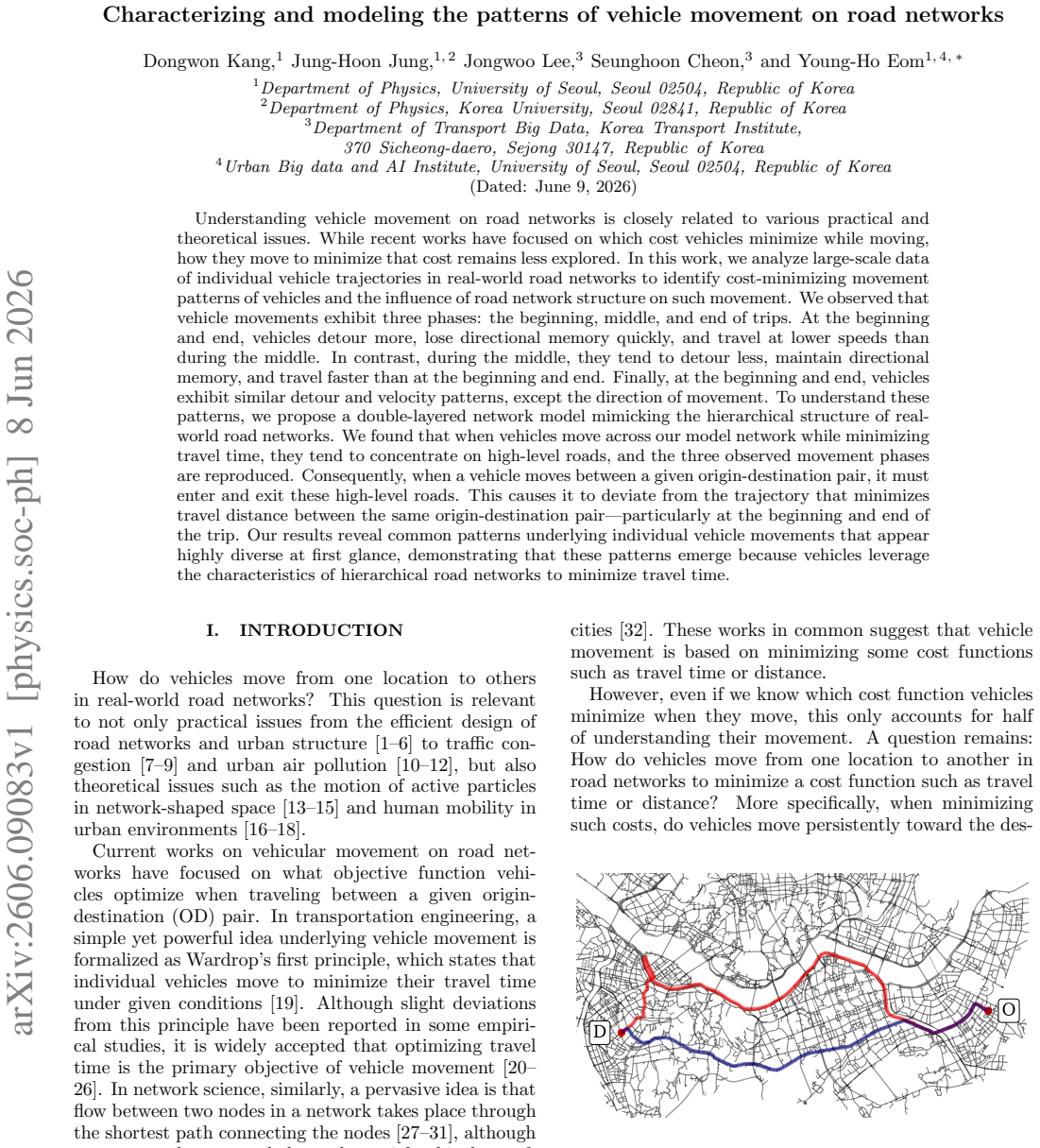
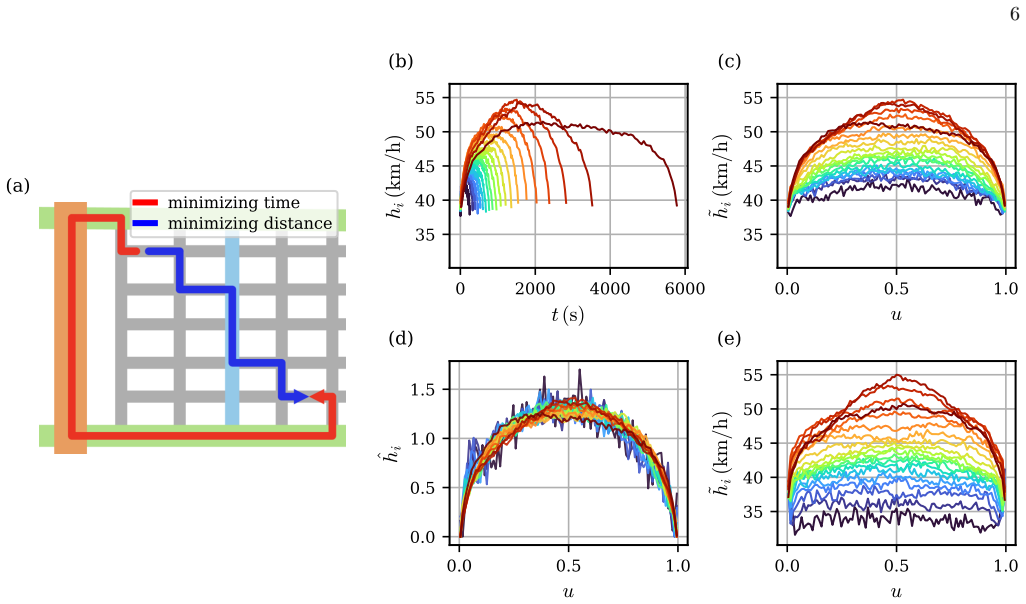
When vehicles move between an origin-destination pair while minimizing travel time on a hierarchical road network, they must enter and exit high-level roads; this forces greater deviation from the shortest-distance path at the beginning and end of each trip while the middle segment follows the high-level roads more closely.
What carries the argument
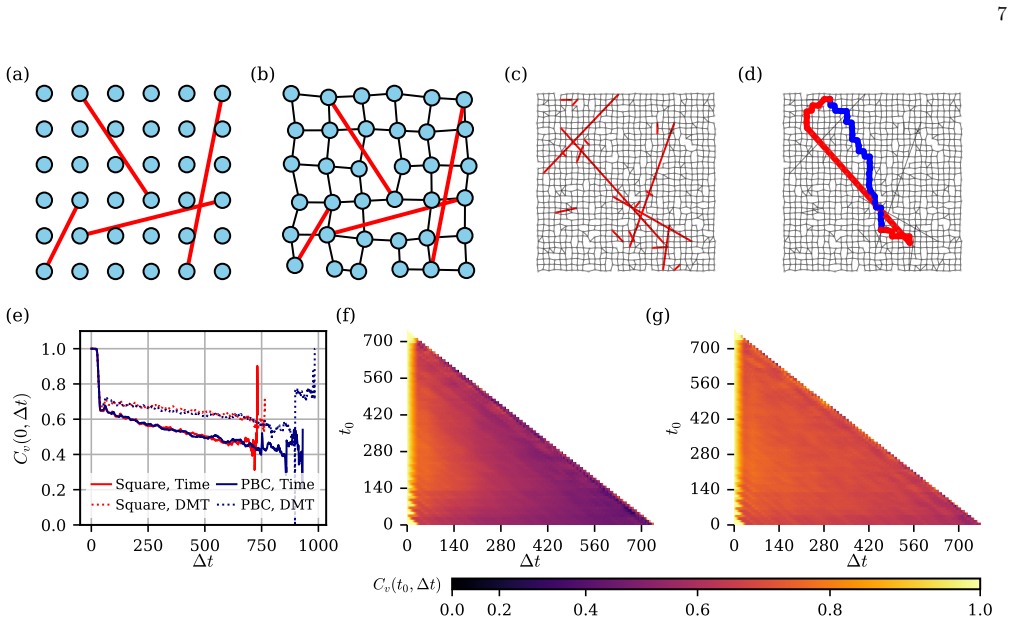
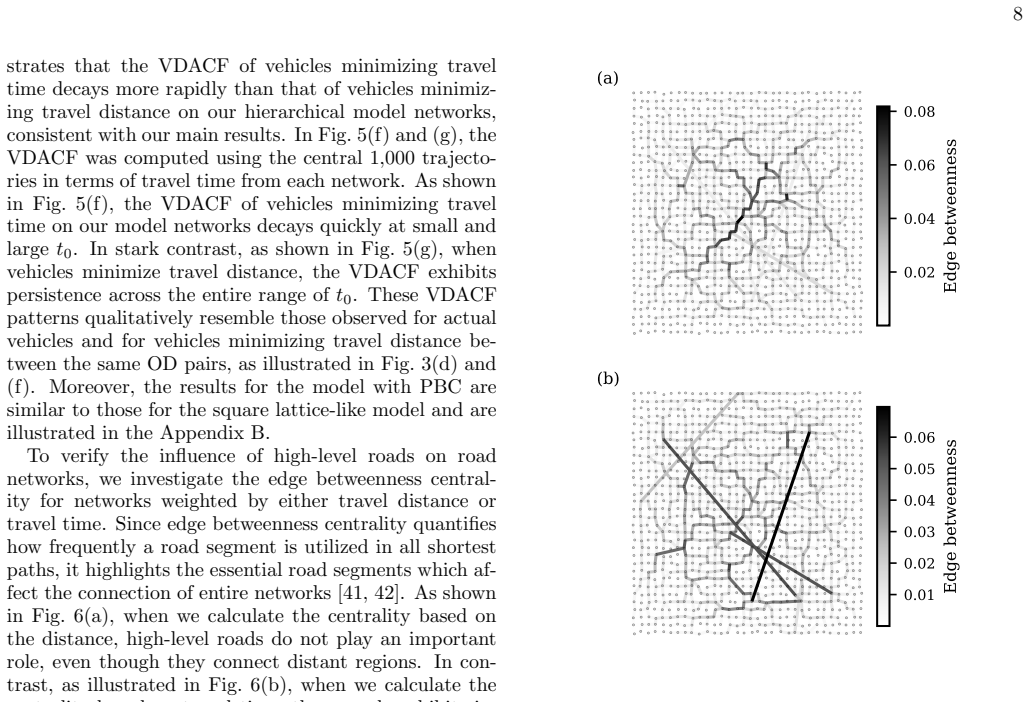
The double-layered network model that mimics the hierarchical structure of real road networks, with high-level roads that vehicles preferentially use when minimizing travel time.
If this is right
- Vehicles systematically deviate from distance-minimizing trajectories at the start and end of trips.
- Beginning and end phases exhibit similar detour and speed patterns but opposite directions.
- Time-minimizing behavior concentrates vehicle flow onto high-level roads during the middle phase.
- The three phases arise directly from the need to enter and exit the high-level layer.
Where Pith is reading between the lines
- Traffic models that ignore hierarchy will under-predict early and late trip detours.
- The same phase structure may appear in other systems whose users optimize over layered networks, such as packet routing in the internet.
- City planners could test whether adding or removing high-level corridors measurably alters the length of the detour-heavy phases.
- The model suggests a simple way to generate realistic synthetic trajectories without fitting many parameters to each origin-destination pair.
Load-bearing premise
The double-layered network model sufficiently captures the hierarchical structure of real-world road networks such that time-minimizing movement on it reproduces the three observed movement phases.
What would settle it
If the three distinct movement phases disappear in trajectory data collected on a flat, non-hierarchical road network or when drivers are constrained to minimize distance instead of time, the proposed explanation would be falsified.
Figures
read the original abstract
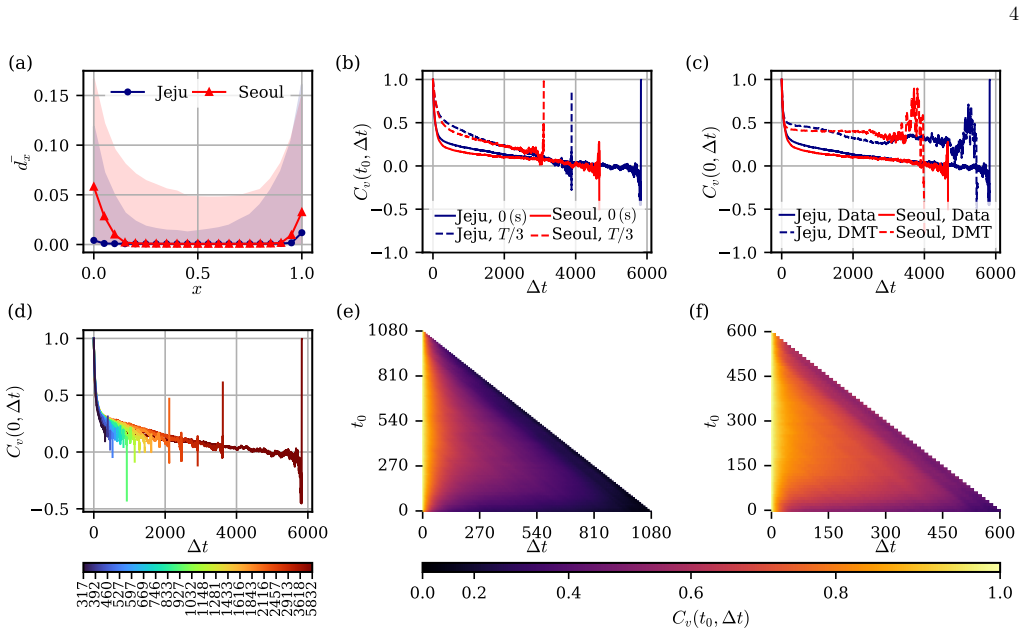
Understanding vehicle movement on road networks is closely related to various practical and theoretical issues. While recent works have focused on which cost vehicles minimize while moving, how they move to minimize that cost remains less explored. In this work, we analyze large-scale data of individual vehicle trajectories in real-world road networks to identify cost-minimizing movement patterns of vehicles and the influence of road network structure on such movement. We observed that vehicle movements exhibit three phases: the beginning, middle, and end of trips. At the beginning and end, vehicles detour more, lose directional memory quickly, and travel at lower speeds than during the middle. In contrast, during the middle, they tend to detour less, maintain directional memory, and travel faster than at the beginning and end. Finally, at the beginning and end, vehicles exhibit similar detour and velocity patterns, except the direction of movement. To understand these patterns, we propose a double-layered network model mimicking the hierarchical structure of real-world road networks. We found that when vehicles move across our model network while minimizing travel time, they tend to concentrate on high-level roads, and the three observed movement phases are reproduced. Consequently, when a vehicle moves between a given origin-destination pair, it must enter and exit these high-level roads. This causes it to deviate from the trajectory that minimizes travel distance between the same origin-destination pair -- particularly at the beginning and end of the trip. Our results reveal common patterns underlying individual vehicle movements that appear highly diverse at first glance, demonstrating that these patterns emerge because vehicles leverage the characteristics of hierarchical road networks to minimize travel time.
Editorial analysis
A structured set of objections, weighed in public.
Referee Report
Summary. The paper analyzes large-scale vehicle trajectory data on real road networks and identifies three phases in individual trips (beginning, middle, end) distinguished by higher detour, faster directional memory loss, and lower speeds at the start and end versus the middle. It introduces a double-layered network model constructed to mimic the hierarchical structure of real roads and reports that time-minimizing paths on this model reproduce the three phases, because vehicles concentrate on high-level roads and must enter/exit them, producing deviations from distance-minimizing trajectories especially at trip beginnings and ends.
Significance. If the reproduction is shown to be independent of the model's artificial construction, the work would supply a mechanistic account of movement patterns grounded in network hierarchy and time minimization, with possible applications to traffic modeling. The use of empirical trajectories is a positive feature, but the absence of quantitative validation details reduces the assessed significance.
major comments (3)
- [Abstract] Abstract: the statement that 'the three observed movement phases are reproduced' provides no quantitative metrics, statistical tests, parameter choices, or validation procedures, which is load-bearing for the central claim that the model explains the data patterns.
- [Model] Model description: the double-layered network is explicitly built to mimic hierarchy and then shown to reproduce the phases under time minimization; no comparison is given to empirical road-network statistics (e.g., betweenness centrality distributions or speed-limit gradients), so it is unclear whether the discrete two-layer boundary is responsible for the phases rather than a general property of hierarchical networks.
- [Data analysis] Data analysis section: no details are supplied on trajectory segmentation into phases, quantification of detour and directional memory, or robustness checks, preventing evaluation of whether the three-phase claim is supported by the underlying data.
minor comments (1)
- [Abstract] The abstract's phrasing of the strongest claim ('Consequently, when a vehicle moves between a given origin-destination pair...') could be clarified by specifying the exact deviation metric used.
Simulated Author's Rebuttal
We thank the referee for the constructive comments on our manuscript. We address each of the major comments below and plan to incorporate revisions to enhance the clarity and rigor of the presentation.
read point-by-point responses
-
Referee: [Abstract] Abstract: the statement that 'the three observed movement phases are reproduced' provides no quantitative metrics, statistical tests, parameter choices, or validation procedures, which is load-bearing for the central claim that the model explains the data patterns.
Authors: We agree that additional quantitative support in the abstract would strengthen the central claim. In the revised version, we will include key quantitative metrics comparing the phases in the empirical data and the model, such as average values for detour ratios, directional memory loss, and speeds, along with notes on the statistical tests and parameter choices used for time minimization. revision: yes
-
Referee: [Model] Model description: the double-layered network is explicitly built to mimic hierarchy and then shown to reproduce the phases under time minimization; no comparison is given to empirical road-network statistics (e.g., betweenness centrality distributions or speed-limit gradients), so it is unclear whether the discrete two-layer boundary is responsible for the phases rather than a general property of hierarchical networks.
Authors: The model uses a discrete two-layer structure as a simplified representation to highlight the role of hierarchy in time-minimizing paths. To address the concern, we will add comparisons of network statistics, including betweenness centrality distributions and speed-limit gradients, between the model and real road networks in the revised manuscript to show that the observed phases are a general consequence of hierarchical structure. revision: yes
-
Referee: [Data analysis] Data analysis section: no details are supplied on trajectory segmentation into phases, quantification of detour and directional memory, or robustness checks, preventing evaluation of whether the three-phase claim is supported by the underlying data.
Authors: We agree that the data analysis section lacks sufficient details on these aspects. In the revision, we will add a detailed description of the trajectory segmentation method, the exact quantification procedures for detour and directional memory, and results from robustness checks to support the three-phase claim. revision: yes
Circularity Check
No significant circularity; model is an independent explanatory hypothesis
full rationale
The paper first extracts three movement phases directly from empirical vehicle trajectory data. It then introduces a double-layered network as an explicit simplification of known road hierarchy and runs time-minimization simulations on that network to test whether the phases emerge. The reproduction occurs via shortest-time path computation on the constructed graph, not by defining the model parameters or layer rules in terms of the target phases themselves. No self-citation chain, fitted-input prediction, or self-definitional step is present; the central claim is that the interaction of time minimization with hierarchy produces the observed patterns, which is a standard non-circular modeling workflow.
Axiom & Free-Parameter Ledger
Reference graph
Works this paper leans on
-
[1]
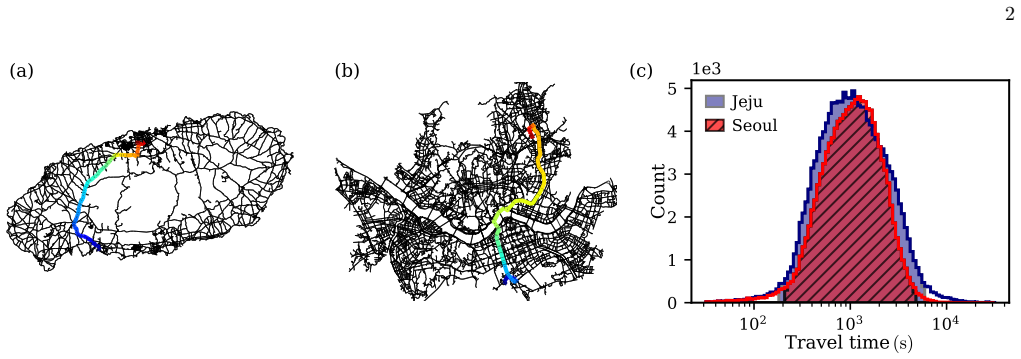
Figure 2(a) and 2(b) illus- trate examples of vehicle trajectories, starting from the blue point to the red point, in Jeju and Seoul, respec- tively
For the sake of simplicity, we focus on Jeju—an island which is not connected to the mainland by bridges or tunnels with a population of roughly 700,000—during January 2019, and on Seoul, the capital of Korea and a megacity with a population of roughly 9,600,000, from January 1 to January 7, 2019. Figure 2(a) and 2(b) illus- trate examples of vehicle traj...
2019
-
[2]
Barth´ elemy and A
M. Barth´ elemy and A. Flammini, Modeling Urban Street Patterns, Phys. Rev. Lett.100, 138702 (2008)
2008
-
[3]
Clark, Urban Population Densities, Journal of the Royal Statistical Society
C. Clark, Urban Population Densities, Journal of the Royal Statistical Society. Series A (General)114, 490 (1951), 10.2307/2981088
-
[4]
Louf and M
R. Louf and M. Barthelemy, Modeling the Polycentric Transition of Cities, Phys. Rev. Lett.111, 198702 (2013). 11
2013
-
[5]
M. Lee, H. Barbosa, H. Youn, P. Holme, and G. Ghoshal, Morphology of travel routes and the organization of cities, Nat Commun8, 2229 (2017)
2017
-
[6]
X. Liu, L. Gong, Y. Gong, and Y. Liu, Revealing travel patterns and city structure with taxi trip data, Journal of Transport Geography43, 78 (2015)
2015
-
[7]
Zheng, D
L. Zheng, D. Xia, X. Zhao, L. Tan, H. Li, L. Chen, and W. Liu, Spatial–temporal travel pattern mining us- ing massive taxi trajectory data, Physica A: Statistical Mechanics and its Applications501, 24 (2018)
2018
-
[8]
Jung and Y.-H
J.-H. Jung and Y.-H. Eom, Empirical analysis of con- gestion spreading in Seoul traffic network, Phys. Rev. E 108, 054312 (2023)
2023
-
[9]
C ¸ olak, A
S. C ¸ olak, A. Lima, and M. C. Gonz´ alez, Understanding congested travel in urban areas, Nature Communications 7, 10793 (2016)
2016
-
[10]
De Martino, L
D. De Martino, L. Dall’Asta, G. Bianconi, and M. Mar- sili, Congestion phenomena on complex networks, Phys. Rev. E79, 015101 (2009)
2009
-
[11]
Rosenlund, F
M. Rosenlund, F. Forastiere, M. Stafoggia, D. Porta, M. Perucci, A. Ranzi, F. Nussio, and C. A. Perucci, Com- parison of regression models with land-use and emissions data to predict the spatial distribution of traffic-related air pollution in Rome, Journal of Exposure Science & Environmental Epidemiology18, 192 (2008)
2008
-
[12]
Zhang and S
K. Zhang and S. Batterman, Air pollution and health risks due to vehicle traffic, Science of The Total Environ- ment450–451, 307 (2013)
2013
-
[13]
Gasana, D
J. Gasana, D. Dillikar, A. Mendy, E. Forno, and E. Ramos Vieira, Motor vehicle air pollution and asthma in children: A meta-analysis, Environmental Research 117, 36 (2012)
2012
-
[14]
Chowdhury, Statistical physics of vehicular traffic and some related systems, Physics Reports329, 199 (2000)
D. Chowdhury, Statistical physics of vehicular traffic and some related systems, Physics Reports329, 199 (2000)
2000
-
[15]
Helbing, Traffic and related self-driven many-particle systems, Rev
D. Helbing, Traffic and related self-driven many-particle systems, Rev. Mod. Phys.73, 1067 (2001)
2001
-
[16]
Bechinger, R
C. Bechinger, R. Di Leonardo, H. L¨ owen, C. Reichhardt, G. Volpe, and G. Volpe, Active Particles in Complex and Crowded Environments, Rev. Mod. Phys.88, 045006 (2016)
2016
-
[17]
Pappalardo, F
L. Pappalardo, F. Simini, S. Rinzivillo, D. Pedreschi, F. Giannotti, and A.-L. Barab´ asi, Returners and explor- ers dichotomy in human mobility, Nat Commun6, 8166 (2015)
2015
-
[18]
J. Tang, F. Liu, Y. Wang, and H. Wang, Uncovering urban human mobility from large scale taxi GPS data, Physica A: Statistical Mechanics and its Applications 438, 140 (2015)
2015
-
[19]
C. Peng, X. Jin, K.-C. Wong, M. Shi, and P. Li` o, Col- lective human mobility pattern from taxi trips in urban area, PLOS ONE7, 1 (2012)
2012
-
[20]
J. G. Wardrop, Road paper. Some theoretical aspects of road traffic research, Proceedings of the Institution of Civil Engineers1, 325 (1952)
1952
-
[21]
Tang and D
W. Tang and D. M. Levinson, Deviation between Ac- tual and Shortest Travel Time Paths for Commuters, J. Transp. Eng., Part A: Systems144, 04018042 (2018)
2018
-
[22]
Wardman, Public transport values of time, Transport Policy11, 363 (2004)
M. Wardman, Public transport values of time, Transport Policy11, 363 (2004)
2004
-
[23]
Zhu and D
S. Zhu and D. Levinson, Do People Use the Shortest Path? An Empirical Test of Wardrop’s First Principle, PLoS ONE10, e0134322 (2015)
2015
-
[24]
Papinski and D
D. Papinski and D. M. Scott, Route Choice Efficiency: An Investigation of Home-To-Work Trips Using GPS Data, Environ Plan A45, 263 (2013)
2013
-
[25]
L. Li, S. Wang, and F.-Y. Wang, An Analysis of Taxi Driver’s Route Choice Behavior Using the Trace Records, IEEE Trans. Comput. Soc. Syst.5, 576 (2018)
2018
-
[26]
W. Yang, H. Chen, and W. Wang, The path and time efficiency of residents’ trips of different purposes with dif- ferent travel modes: An empirical study in Guangzhou, China, Journal of Transport Geography88, 102829 (2020)
2020
-
[27]
Bekhor, M
S. Bekhor, M. E. Ben-Akiva, and M. S. Ramming, Evalu- ation of choice set generation algorithms for route choice models, Ann Oper Res144, 235 (2006)
2006
-
[28]
M. E. J. Newman, The structure and function of complex networks, SIAM Review45, 167 (2003), https://doi.org/10.1137/S003614450342480
-
[29]
Boccaletti, V
S. Boccaletti, V. Latora, Y. Moreno, M. Chavez, and D.- U. Hwang, Complex networks: Structure and dynamics, Physics Reports424, 175 (2006)
2006
-
[30]
Barth´ elemy, Spatial networks, Physics Reports499, 1 (2011)
M. Barth´ elemy, Spatial networks, Physics Reports499, 1 (2011)
2011
-
[31]
Jeong, B
H. Jeong, B. Tombor, R. Albert, Z. N. Oltvai, and A.- L. Barab´ asi, The large-scale organization of metabolic networks, Nature407, 651 (2000)
2000
-
[32]
Bullmore and O
E. Bullmore and O. Sporns, Complex brain networks: Graph theoretical analysis of structural and functional systems, Nat Rev Neurosci10, 186 (2009)
2009
-
[33]
Akbarzadeh and E
M. Akbarzadeh and E. Estrada, Communicability geom- etry captures traffic flows in cities, Nat Hum Behav2, 645 (2018)
2018
-
[34]
K. M. Mittal, M. Timme, and M. Schr¨ oder, Efficient self- organization of informal public transport networks, Nat Commun15, 4910 (2024)
2024
-
[35]
Bogu˜ n´ a, D
M. Bogu˜ n´ a, D. Krioukov, and K. C. Claffy, Navigability of complex networks, Nature Phys5, 74 (2009)
2009
-
[36]
H. Youn, M. T. Gastner, and H. Jeong, Price of Anarchy in Transportation Networks: Efficiency and Optimality Control, Phys. Rev. Lett.101, 128701 (2008)
2008
-
[37]
L. A. Braunstein, S. V. Buldyrev, R. Cohen, S. Havlin, and H. E. Stanley, Optimal Paths in Disordered Complex Networks, Phys. Rev. Lett.91, 168701 (2003)
2003
-
[38]
d’Alessandro, L
J. d’Alessandro, L. Mas, L. Aubry, J.-P. Rieu, C. Rivi` ere, and C. Anjard, Collective regulation of cell motility using an accurate density-sensing system, J. R. Soc. Interface. 15, 20180006 (2018)
2018
-
[39]
Rehfeldt and M
F. Rehfeldt and M. Weiss, The random walker’s toolbox for analyzing single-particle tracking data, Soft Matter 19, 5206 (2023)
2023
-
[40]
Guly´ as, J
A. Guly´ as, J. B´ ır´ o, G. R´ etv´ ari, M. Nov´ ak, A. K˝ or¨ osi, M. Sl´ ız, and Z. Heszberger, The role of detours in indi- vidual human navigation patterns of complex networks, Sci Rep10, 1098 (2020)
2020
-
[41]
G. Li, S. D. S. Reis, A. A. Moreira, S. Havlin, H. E. Stanley, and J. S. Andrade, Towards Design Principles for Optimal Transport Networks, Phys. Rev. Lett.104, 018701 (2010)
2010
-
[42]
Kwon, J.-H
Y. Kwon, J.-H. Jung, and Y.-H. Eom, Global effi- ciency and network structure of urban traffic flows: A percolation-based empirical analysis, Chaos: An Interdis- ciplinary Journal of Nonlinear Science33, 113104 (2023)
2023
-
[43]
Akbarzadeh, S
M. Akbarzadeh, S. Memarmontazerin, S. Derrible, and S. F. Salehi Reihani, The role of travel demand and net- work centrality on the connectivity and resilience of an urban street system, Transportation46, 1127 (2019). 12
2019
-
[44]
P. Wang, T. Hunter, A. M. Bayen, K. Schechtner, and M. C. Gonz´ alez, Understanding Road Usage Patterns in Urban Areas, Sci Rep2, 1001 (2012)
2012
-
[45]
D. J. Watts and S. H. Strogatz, Collective dynamics of ‘small-world’ networks, Nature393, 440 (1998)
1998
-
[46]
Latora and M
V. Latora and M. Marchiori, Efficient behavior of small- world networks, Phys. Rev. Lett.87, 198701 (2001)
2001
-
[47]
M. T. Goodrich and E. Ozel, Modeling the small- world phenomenon with road networks, inProceedings of the 30th International Conference on Advances in Ge- ographic Information Systems, SIGSPATIAL ’22 (Asso- ciation for Computing Machinery, New York, NY, USA, 2022)
2022
-
[48]
C. Liu, C. Zhang, B. Wang, Z. Tang, and Z. Xie, Dig- ital twin of highway entrances and exits: A traffic risk identification method, IEEE Journal of Radio Frequency Identification6, 934 (2022)
2022
-
[49]
Zhang, F
L. Zhang, F. Xie, and D. Levinson, Illusion of Mo- tion: Variation in Value of Travel Time Under Different Freeway Driving Conditions, Transportation Research Record: Journal of the Transportation Research Board 2135, 34 (2009)
2009
-
[50]
Levinson and S
D. Levinson and S. Zhu, A portfolio theory of route choice, Transportation Research Part C: Emerging Tech- nologies35, 232 (2013)
2013
-
[51]
Parthasarathi, D
P. Parthasarathi, D. Levinson, and H. Hochmair, Net- work Structure and Travel Time Perception, PLoS ONE 8, e77718 (2013)
2013
-
[52]
A. Lima, R. Stanojevic, D. Papagiannaki, P. Rodriguez, and M. C. Gonz´ alez, Understanding individual routing behaviour, J. R. Soc. Interface.13, 20160021 (2016)
2016
discussion (0)
Sign in with ORCID, Apple, or X to comment. Anyone can read and Pith papers without signing in.