Chimera: Protocol-Aware Recovery for Confidential BFT Consensus
Pith reviewed 2026-06-27 15:05 UTC · model grok-4.3
The pith
CHIMERA recovers confidential BFT consensus by applying distinct mechanisms to metadata and logs based on their protocol properties.
A machine-rendered reading of the paper's core claim, the machinery that carries it, and where it could break.
Core claim
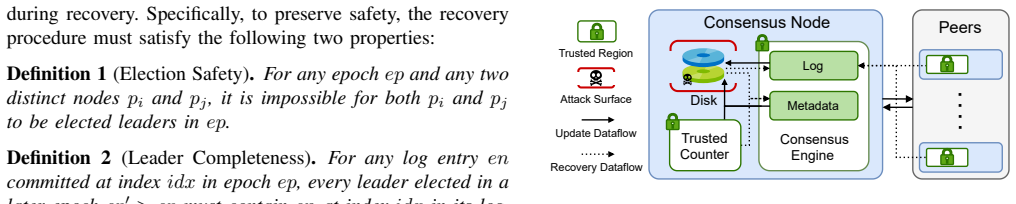
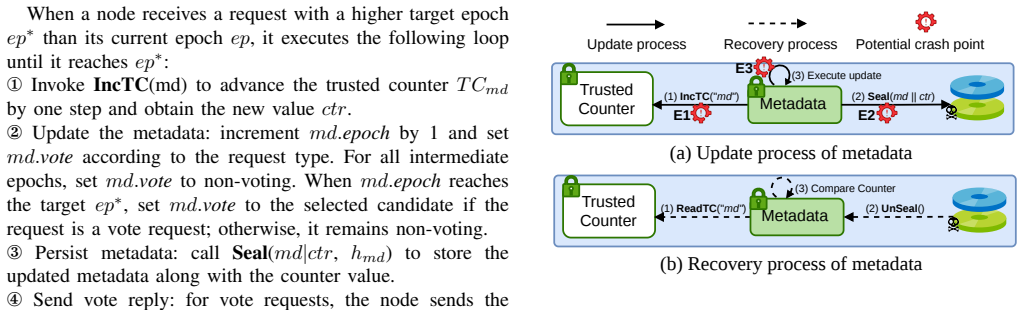
CHIMERA is a protocol-aware recovery framework that separates persistent state into metadata and logs according to their differing state distribution, update behavior, and representation form, then applies distinct recovery mechanisms to each type, thereby breaking the tradeoff between overhead on the critical path and prolonged recovery delays while preserving safety and liveness.
What carries the argument
Separation of persistent state into metadata and logs, with distinct recovery mechanisms applied according to protocol-level properties of distribution, update behavior, and representation.
If this is right
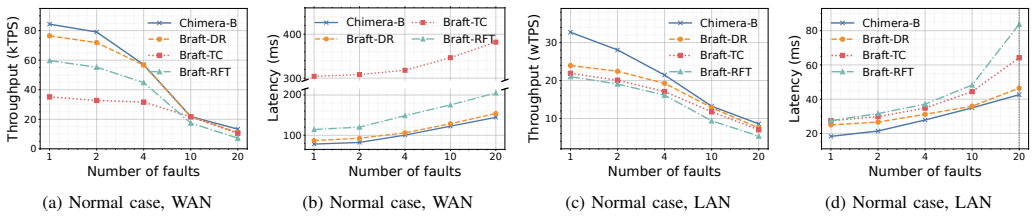
- Throughput on the critical consensus path increases because only metadata receives the heavier protection.
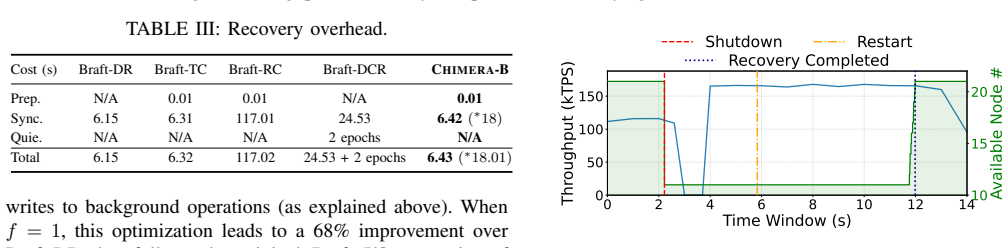
- Recovery latency after enclave crashes decreases because logs use a lighter mechanism.
- Availability improves because the system returns to operation faster without sacrificing safety or liveness.
- The same separation principle applies across different consensus libraries once states are classified by protocol properties.
Where Pith is reading between the lines
- The classification of states by distribution and update frequency may apply to other TEE-protected distributed protocols beyond BFT consensus.
- Implementations could test whether the metadata-log split remains valid when new consensus features such as dynamic membership are added.
- If the separation holds, similar differentiated recovery could reduce overhead in non-TEE settings where partial state persistence is also a concern.
Load-bearing premise
Persistent states in confidential BFT consensus can be cleanly separated into metadata and logs whose differing properties allow distinct recovery mechanisms without introducing new safety violations.
What would settle it
A concrete rollback attack that succeeds on the separated states and violates consensus safety, or a performance measurement in the evaluated Braft and ZooKeeper implementations showing no improvement in throughput or recovery latency over the uniform baselines.
Figures
read the original abstract
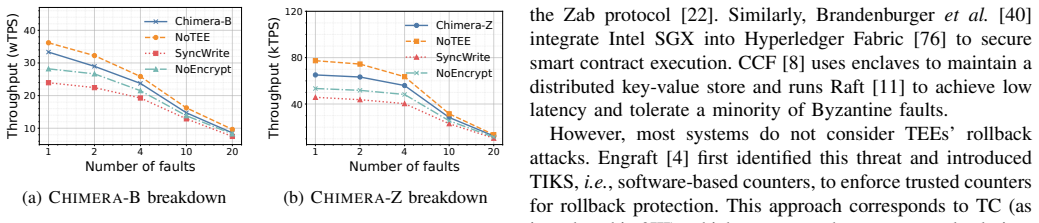
Trusted Execution Environments (TEEs) have enabled confidential Byzantine Fault-Tolerant (BFT) consensus systems with confidentiality and improved scalability. However, TEEs do not provide state continuity: during recovery, a compromised host can roll back a crashed enclave to a stale persistent state, significantly threatening both safety and availability. Existing defenses face a fundamental tradeoff: they either impose substantial overhead on critical consensus paths, reducing throughput and increasing latency, or incur prolonged recovery delays, hurting availability. We present the first systematic taxonomy of rollback-resilient recovery for confidential BFT consensus, distilling prior approaches into four categories. We further expose their inherent limitations. Guided by this detailed analysis, we design CHIMERA, a protocol-aware recovery framework that breaks this tradeoff. Our key insight is that rollback protection in consensus systems should not be uniform. Different types of persistent states differ fundamentally in their state distribution, update behavior, and representation form. CHIMERA separates persistent state into metadata and logs according to these protocol-level properties and applies distinct recovery mechanisms to each type. We formally model CHIMERA in Maude and verify its safety and liveness properties. We implement it on Braft and ZooKeeper using Intel TDX, and evaluate it in both LAN and WAN settings. Results show that CHIMERA achieves higher throughput, lower recovery latency, and better availability than state-of-the-art rollback-resilient baselines.
Editorial analysis
A structured set of objections, weighed in public.
Referee Report
Summary. The paper presents the first systematic taxonomy of rollback-resilient recovery mechanisms for confidential BFT consensus under TEEs, categorizing prior work into four types and exposing their tradeoffs between critical-path overhead and recovery latency. It introduces Chimera, which separates persistent state into metadata and logs according to differences in distribution, update behavior, and representation, applying distinct recovery mechanisms to each; the design is formally modeled in Maude to verify safety and liveness, implemented on Braft and ZooKeeper with Intel TDX, and evaluated in LAN/WAN settings to claim higher throughput, lower recovery latency, and improved availability versus state-of-the-art baselines.
Significance. If the separability assumption holds without introducing new safety violations, Chimera would meaningfully advance confidential BFT by resolving the overhead-availability tradeoff. The formal Maude modeling for safety/liveness and the concrete implementation/evaluation on production systems (Braft, ZooKeeper, TDX) are clear strengths that would support adoption if the cross-dependency concern is resolved.
major comments (2)
- [Design section] Design section (and Maude model): the central claim that metadata/logs can be recovered independently without new safety violations rests on clean separability; if the model encodes them as independent modules without explicit rules capturing protocol-level references (e.g., log entries depending on metadata versions or quorum states), a host rollback of one type could produce inconsistent states accepted by the other path, undermining the "no new violations" guarantee.
- [Evaluation section] Evaluation section: performance claims (higher throughput, lower latency, better availability) are load-bearing for the practical contribution, yet the abstract and reported results provide no details on experimental setup, exact baselines, number of runs, or error bars, preventing verification that gains are not due to unstated implementation choices.
minor comments (2)
- The taxonomy could include a table summarizing the four categories with their overhead and latency characteristics for easier comparison.
- Notation for state types (metadata vs. logs) should be defined once early and used consistently in the model description.
Simulated Author's Rebuttal
We thank the referee for the constructive feedback. We address each major comment below, providing clarifications on the design and committing to improvements in the evaluation.
read point-by-point responses
-
Referee: [Design section] Design section (and Maude model): the central claim that metadata/logs can be recovered independently without new safety violations rests on clean separability; if the model encodes them as independent modules without explicit rules capturing protocol-level references (e.g., log entries depending on metadata versions or quorum states), a host rollback of one type could produce inconsistent states accepted by the other path, undermining the "no new violations" guarantee.
Authors: Our Maude model explicitly encodes protocol-level dependencies rather than treating metadata and logs as fully independent modules. Transition rules capture references such as log entries depending on metadata versions, quorum state consistency, and cross-component checks during recovery. The verified safety and liveness properties therefore account for these interactions, ensuring that a rollback on one path cannot produce states accepted by the other. We will add a dedicated subsection in the revised manuscript excerpting the relevant Maude rules to make these dependencies more prominent. revision: partial
-
Referee: [Evaluation section] Evaluation section: performance claims (higher throughput, lower latency, better availability) are load-bearing for the practical contribution, yet the abstract and reported results provide no details on experimental setup, exact baselines, number of runs, or error bars, preventing verification that gains are not due to unstated implementation choices.
Authors: We agree that the current manuscript lacks sufficient experimental details. In the revised version we will expand the Evaluation section with: (1) complete hardware and network specifications for both LAN and WAN settings, (2) precise descriptions and versions of all baselines, (3) the number of runs per experiment, and (4) error bars or standard deviations for all throughput, latency, and availability metrics. revision: yes
Circularity Check
No circularity: claims rest on independent taxonomy, Maude verification, and empirical evaluation
full rationale
The provided abstract and description contain no equations, fitted parameters presented as predictions, or self-citations that bear the central load. The taxonomy is explicitly 'distilled' from prior approaches; the CHIMERA design is motivated by stated protocol-level differences in state properties; safety/liveness is verified via external Maude modeling (not shown to encode the target result by construction); and performance results are measured against baselines. No step reduces the claimed separation, recovery mechanisms, or guarantees to inputs by definition or self-reference. This is the expected non-finding for a design+verification+evaluation paper whose core argument is not tautological.
Axiom & Free-Parameter Ledger
Reference graph
Works this paper leans on
-
[1]
LSKV: A confidential distributed datastore to protect critical data in the cloud,
A. Jeffery, J. Maffre, H. Howard, and R. Mortier, “LSKV: A confidential distributed datastore to protect critical data in the cloud,”arXiv preprint, 2024
2024
-
[2]
SecureKeeper: Confidential ZooKeeper using Intel SGX,
S. Brenner, C. Wulf, D. Goltzsche, N. Weichbrodt, M. Lorenz, C. Fetzer, P. Pietzuch, and R. Kapitza, “SecureKeeper: Confidential ZooKeeper using Intel SGX,” inProc. of Middleware, 2016
2016
-
[3]
Secret key recovery in a global-scale end-to-end encryption system,
G. Connell, V . Fang, R. Schmidt, E. Dauterman, and R. A. Popa, “Secret key recovery in a global-scale end-to-end encryption system,” inProc. of OSDI, 2024
2024
-
[4]
Engraft: Enclave-guarded raft on Byzantine faulty nodes,
W. Wang, S. Deng, J. Niu, M. K. Reiter, and Y . Zhang, “Engraft: Enclave-guarded raft on Byzantine faulty nodes,” inProc. of CCS, 2022
2022
-
[5]
Confidentiality support over financial grade consortium blockchain,
Y . Yan, C. Wei, X. Guo, X. Lu, X. Zheng, Q. Liu, C. Zhou, X. Song, B. Zhao, H. Zhanget al., “Confidentiality support over financial grade consortium blockchain,” inProc. of ACM SIGMOD, 2020
2020
-
[6]
The oasis blockchain platform,
“The oasis blockchain platform,” https://assets.website-files.com/ 5f59478e350b91447863f593/628ba74a9aee37587419cf65 20200623% 20The%20Oasis%20Blockchain%20Platform.pdf, retrieved September 2025
2025
-
[7]
CCF: A framework for building confidential verifiable replicated services,
M. Russinovich, E. Ashton, C. Avanessians, M. Castro, A. Chamayou, S. Clebsch, M. Costa, C. Fournet, M. Kerner, S. Krishnaet al., “CCF: A framework for building confidential verifiable replicated services,” Microsoft Research and Microsoft Azure, Tech. Rep., 2019
2019
-
[8]
Con- fidential consortium framework: Secure multiparty applications with confidentiality, integrity, and high availability,
H. Howard, F. Alder, E. Ashton, A. Chamayou, S. Clebsch, M. Costa, A. Delignat-Lavaud, C. Fournet, A. Jeffery, M. Kerner, F. Kounelis, M. A. Kuppe, J. Maffre, M. Russinovich, and C. M. Wintersteiger, “Con- fidential consortium framework: Secure multiparty applications with confidentiality, integrity, and high availability,”Proc. VLDB Endow., vol. 17, no. ...
2023
-
[9]
Smart casual verification of the confidential consortium framework,
H. Howard, M. A. Kuppe, E. Ashton, A. Chamayou, and N. Crooks, “Smart casual verification of the confidential consortium framework,” inProc. of NSDI, 2025
2025
-
[10]
TEEKAP: Self-expiring data capsule using Trusted Execution Environment,
M. Gao, H. Dang, and E.-C. Chang, “TEEKAP: Self-expiring data capsule using Trusted Execution Environment,” inProc. of ACSAC, 2021
2021
-
[11]
In search of an understandable consensus algorithm,
D. Ongaro and J. Ousterhout, “In search of an understandable consensus algorithm,” inProc. of ATC, 2014
2014
-
[12]
ROTE: Rollback protection for trusted execution,
S. Matetic, M. Ahmed, K. Kostiainen, A. Dhar, D. Sommer, A. Gervais, A. Juels, and S. Capkun, “ROTE: Rollback protection for trusted execution,” inProc. of USENIX Security, 2017
2017
-
[13]
Narrator: Secure and practical state continuity for trusted execution in the cloud,
J. Niu, W. Peng, X. Zhang, and Y . Zhang, “Narrator: Secure and practical state continuity for trusted execution in the cloud,” inProc. of CCS, 2022
2022
-
[14]
Ariadne: A minimal approach to state continuity,
R. Strackx and F. Piessens, “Ariadne: A minimal approach to state continuity,” inProc. of USENIX Security, 2016
2016
-
[15]
Memoir: Practical state continuity for protected modules,
B. Parno, J. R. Lorch, J. R. Douceur, J. Mickens, and J. M. McCune, “Memoir: Practical state continuity for protected modules,” inProc. of S&P, 2011
2011
-
[16]
Dis- secting BFT consensus: In trusted components we trust!
S. Gupta, S. Rahnama, S. Pandey, N. Crooks, and M. Sadoghi, “Dis- secting BFT consensus: In trusted components we trust!” inProc. of EuroSys, 2023
2023
-
[17]
RR: A fault model for efficient TEE replication,
B. Dinis, P. Druschel, and R. Rodrigues, “RR: A fault model for efficient TEE replication,” inProc. of NDSS, 2023
2023
-
[18]
Achilles: Efficient TEE-assisted BFT consensus via rollback resilient recovery,
J. Niu, X. Wen, G. Wu, S. Liu, J. Yu, and Y . Zhang, “Achilles: Efficient TEE-assisted BFT consensus via rollback resilient recovery,” inProc. of EuroSys, 2025
2025
-
[19]
Nimble: Rollback protection for confidential cloud services,
S. Angel, A. Basu, W. Cui, T. Jaeger, S. Lau, S. Setty, and S. Singana- malla, “Nimble: Rollback protection for confidential cloud services,” in Proc. of OSDI, 2023
2023
-
[20]
“Braft,” https://github.com/baidu/braft, retrieved September 2025
2025
-
[21]
ZooKeeper: Wait-free coordination for internet-scale systems,
P. Hunt, M. Konar, F. P. Junqueira, and B. Reed, “ZooKeeper: Wait-free coordination for internet-scale systems,” inProc. of ATC, 2010
2010
-
[22]
Zab: High-performance broadcast for primary-backup systems,
F. P. Junqueira, B. C. Reed, and M. Serafini, “Zab: High-performance broadcast for primary-backup systems,” inProc. of DSN, 2011
2011
-
[23]
Intel Trust Domain Extensions,
“Intel Trust Domain Extensions,” https://www.intel.com/content/ dam/develop/external/us/en/documents/tdx-whitepaper-final9-17.pdf, retrieved September 2025
2025
-
[24]
Using innovative instructions to create trustworthy software solutions,
M. Hoekstra, R. Lal, P. Pappachan, V . Phegade, and J. Del Cuvillo, “Using innovative instructions to create trustworthy software solutions,” inProc. of HASP, 2013
2013
-
[25]
AMD SEV-SNP: Strengthening VM isolation with integrity protection and more,
D. Kaplan, J. Powell, and T. Woller, “AMD SEV-SNP: Strengthening VM isolation with integrity protection and more,” AMD, Tech. Rep.,
-
[26]
Available: https://www.amd.com/system/files/TechDocs/ SEV-SNP-strengthening-vm-isolation-with-integrity-protection.pdf
[Online]. Available: https://www.amd.com/system/files/TechDocs/ SEV-SNP-strengthening-vm-isolation-with-integrity-protection.pdf
-
[27]
Building a secure system using TrustZone technology,
“Building a secure system using TrustZone technology,” https:// documentation-service.arm.com/static/5f212796500e883ab8e74531, re- trieved September 2025
2025
-
[28]
Ekiden: A platform for confidentiality- preserving, trustworthy, and performant smart contracts,
R. Cheng, F. Zhang, J. Kos, W. He, N. Hynes, N. Johnson, A. Juels, A. Miller, and D. Song, “Ekiden: A platform for confidentiality- preserving, trustworthy, and performant smart contracts,” inProc. of EuroS&P, 2019
2019
-
[29]
Teechain: A secure payment network with asynchronous blockchain access,
J. Lind, O. Naor, I. Eyal, F. Kelbert, E. G. Sirer, and P. Pietzuch, “Teechain: A secure payment network with asynchronous blockchain access,” inProc. of SOSP, 2019
2019
-
[30]
TeeRollup: Efficient rollup design using heterogeneous TEE,
X. Wen, Q. Feng, H. Lyu, J. Niu, Y . Zhang, and C. Feng, “TeeRollup: Efficient rollup design using heterogeneous TEE,” inIEEE Transactions on Computers, 2025
2025
-
[31]
Mercury: Practical cross-chain exchange via trusted hardware,
X. Wen, Q. Feng, J. Niu, Y . Zhang, and C. Feng, “Mercury: Practical cross-chain exchange via trusted hardware,”IEEE Transactions on Dependable and Secure Computing, vol. 23, no. 2, pp. 2949–2961, 2026
2026
-
[32]
Fides: Scalable censorship-resistant DAG consensus via trusted components
S. Xie, D. Kang, H. Lyu, J. Niu, and M. Sadoghi, “Fides: Scalable censorship-resistant DAG consensus via trusted components.”
-
[33]
Integrity checking in cryptographic file systems with constant trusted storage
A. Oprea and M. K. Reiter, “Integrity checking in cryptographic file systems with constant trusted storage.” inProc. of USENIX Security, 2007
2007
-
[34]
The google file system,
S. Ghemawat, H. Gobioff, and S.-T. Leung, “The google file system,” inProc. of SOSP, 2003
2003
-
[35]
On designing and deploying internet-scale services,
J. Hamilton, “On designing and deploying internet-scale services,” in Proc. of LISA, 2007
2007
-
[36]
Experience with grapevine: the growth of a distributed system,
M. D. Schroeder, A. D. Birrell, and R. M. Needham, “Experience with grapevine: the growth of a distributed system,”ACM Trans. Comput. Syst., vol. 2, no. 1, p. 3–23, 1984
1984
-
[37]
EnclaveDB: A secure database using SGX,
C. Priebe, K. Vaswani, and M. Costa, “EnclaveDB: A secure database using SGX,” inProc. of S&P. IEEE, 2018
2018
-
[38]
The forking way: When tees meet consensus,
A. Wilde, T. N. Gruel, C. Soriente, and G. Karame, “The forking way: When tees meet consensus,”arXiv preprint, 2024
2024
-
[39]
Signal Secure Value Recovery,
“Signal Secure Value Recovery,” https://signal.org/blog/ secure-value-recovery, retrieved September 2025
2025
-
[40]
Confidential consortium framework,
M. Azure., “Confidential consortium framework,” https://www.microsoft.com/en-us/research/project/ confidential-consortium-framework/, retrieved September 2025
2025
-
[41]
Trusted computing meets blockchain: Rollback attacks and a solution for Hy- perledger Fabric,
M. Brandenburger, C. Cachin, R. Kapitza, and A. Sorniotti, “Trusted computing meets blockchain: Rollback attacks and a solution for Hy- perledger Fabric,” inProc. of SRDS, 2019
2019
-
[42]
Virtual monotonic counters and count-limited objects using a TPM without a trusted OS,
L. F. G. Sarmenta, M. van Dijk, C. W. O’Donnell, J. Rhodes, and S. Devadas, “Virtual monotonic counters and count-limited objects using a TPM without a trusted OS,” inProc. of STC, 2006
2006
-
[43]
Trusted time and monotonic counters with intel software guard extensions platform services,
“Trusted time and monotonic counters with intel software guard extensions platform services,” https: //www.intel.com/content/www/us/en/content-details/671564/ trusted-time-and-/monotonic-counters-with-intel-software-/ guard-extensions-platform-services.html, retrieved September 2025
2025
-
[44]
Ensuring state continuity for confidential computing: A blockchain-based approach,
W. Peng, X. Li, J. Niu, X. Zhang, and Y . Zhang, “Ensuring state continuity for confidential computing: A blockchain-based approach,” IEEE Trans. Dependable Secure Comput., vol. 21, no. 6, pp. 5635–5649, 2024
2024
-
[45]
Providing stable storage for the diskless crash-recovery failure model,
E. Michael, D. R. K. Ports, N. K. Sharma, and A. Szekeres, “Providing stable storage for the diskless crash-recovery failure model,” University of Washington, Tech. Rep. UW-CSE-16-08-02, 2016
2016
-
[46]
Viewstamped replication revisited,
B. Liskov and J. Cowling, “Viewstamped replication revisited,” MIT CSAIL, Tech. Rep. MIT-CSAIL-TR-2012-021, 2012
2012
-
[47]
Paxos made live: An engineering perspective,
T. D. Chandra, R. Griesemer, and J. Redstone, “Paxos made live: An engineering perspective,” inProc. of PODC, 2007
2007
-
[48]
Jpaxos: State machine replication based on the paxos 14 protocol,
J. Ko ´nczak, N. Santos, T. ˙Zurkowski, P. T. Wojciechowski, and A. Schiper, “Jpaxos: State machine replication based on the paxos 14 protocol,” EPFL, Tech. Rep. 167765, 2011. [Online]. Available: https://infoscience.epfl.ch/handle/20.500.14299/69874
2011
-
[49]
Vivisecting the dissection: On the role of trusted components in BFT protocols,
A. Bessani, M. Correia, T. Distler, R. Kapitza, P. Esteves-Verissimo, and J. Yu, “Vivisecting the dissection: On the role of trusted components in BFT protocols,”arXiv preprint arXiv:2312.05714, 2023
arXiv 2023
-
[50]
On the (limited) power of non-equivocation,
A. Clement, F. Junqueira, A. Kate, and R. Rodrigues, “On the (limited) power of non-equivocation,” inProc. of PODC, 2012
2012
-
[51]
Recipe: Hardware-accelerated replication protocols,
D. Giantsidi, E. Giortamis, J. Pritzi, M. Bailleu, M. Kapritsos, and P. Bhatotia, “Recipe: Hardware-accelerated replication protocols,”arXiv preprint, 2025
2025
-
[52]
Ethanos: efficient bootstrapping for full nodes on account-based blockchain,
J.-Y . Kim, J. Lee, Y . Koo, S. Park, and S.-M. Moon, “Ethanos: efficient bootstrapping for full nodes on account-based blockchain,” inProc. of EuroSys, 2021
2021
-
[53]
Sli- mArchive: A lightweight architecture for ethereum archive nodes,
H. Feng, Y . Hu, Y . Kou, R. Li, J. Zhu, L. Wu, and Y . Zhou, “Sli- mArchive: A lightweight architecture for ethereum archive nodes,” in Proc. of USENIX ATC, 2024
2024
-
[54]
Offline un- trusted storage with immediate detection of forking and replay attacks,
M. van Dijk, J. Rhodes, L. F. G. Sarmenta, and S. Devadas, “Offline un- trusted storage with immediate detection of forking and replay attacks,” inProc. of STC, 2007
2007
-
[55]
ICE: A passive, high-speed, state-continuity scheme,
R. Strackx, B. Jacobs, and F. Piessens, “ICE: A passive, high-speed, state-continuity scheme,” inProc. of ACSAC, 2014
2014
-
[56]
ZombieLoad: Cross-privilege-boundary data sampling,
M. Schwarz, M. Lipp, D. Moghimi, J. Van Bulck, J. Stecklina, T. Prescher, and D. Gruss, “ZombieLoad: Cross-privilege-boundary data sampling,” inProc. of CCS, 2019
2019
-
[57]
RIDL: Rogue in-flight data load,
S. Van Schaik, A. Milburn, S. ¨Osterlund, P. Frigo, G. Maisuradze, K. Razavi, H. Bos, and C. Giuffrida, “RIDL: Rogue in-flight data load,” inProc. of S&P. IEEE, 2019
2019
-
[58]
Sgxpectre: Stealing Intel secrets from SGX enclaves via speculative execution,
G. Chen, S. Chen, Y . Xiao, Y . Zhang, Z. Lin, and T. H. Lai, “Sgxpectre: Stealing Intel secrets from SGX enclaves via speculative execution,” in Proc. of EuroS&P, 2019
2019
-
[59]
T-sgx: Eradicating controlled-channel attacks against enclave programs,
M.-W. Shih, S. Lee, T. Kim, and M. Peinado, “T-sgx: Eradicating controlled-channel attacks against enclave programs,” inProc. of NDSS, 2017
2017
-
[60]
Varys: Protecting SGX enclaves from practical Side-Channel attacks,
O. Oleksenko, B. Trach, R. Krahn, M. Silberstein, and C. Fetzer, “Varys: Protecting SGX enclaves from practical Side-Channel attacks,” inProc. of USENIX ATC, 2018
2018
-
[61]
Consensus in the presence of partial synchrony,
C. Dwork, N. Lynch, and L. Stockmeyer, “Consensus in the presence of partial synchrony,”J. ACM, vol. 35, no. 2, pp. 288–323, 1988
1988
-
[63]
HotStuff: BFT consensus with linearity and responsiveness,
M. Yin, D. Malkhi, M. K. Reiter, G. G. Gueta, and I. Abraham, “HotStuff: BFT consensus with linearity and responsiveness,” inProc. of PODC, 2019
2019
-
[64]
Fast-HotStuff: A fast and robust BFT protocol for blockchains,
M. M. Jalalzai, J. Niu, C. Feng, and F. Gai, “Fast-HotStuff: A fast and robust BFT protocol for blockchains,”IEEE Trans. Dependable Secure Comput., vol. 21, no. 4, pp. 2478–2493, 2024
2024
-
[65]
Scaling blockchain consensus via a robust shared mempool,
F. Gai, J. Niu, I. Beschastnikh, C. Feng, and S. Wang, “Scaling blockchain consensus via a robust shared mempool,” inProc. of ICDE, 2023
2023
-
[66]
Practical Byzantine fault tolerance,
M. Castro and B. Liskov, “Practical Byzantine fault tolerance,” inProc. of OSDI, 1999
1999
-
[67]
Clavel, F
M. Clavel, F. Dur ´an, S. Eker, P. Lincoln, N. Mart´ı-Oliet, J. Meseguer, and C. Talcott,All About Maude: A High-Performance Logical Framework: How to Specify, Program and Verify Systems in Rewriting Logic. Springer, 2007
2007
-
[68]
Survivability: design, formal modeling, and validation of cloud storage systems using maude,
R. Bobba, J. Grov, I. Gupta, S. Liu, J. Meseguer, P. C. ¨Olveczky, and S. Skeirik, “Survivability: design, formal modeling, and validation of cloud storage systems using maude,”Assured cloud computing, pp. 10– 48, 2018
2018
-
[69]
A formal framework for end-to-end dns resolution,
S. Liu, H. Duan, L. Heimes, M. Bearzi, J. Vieli, D. Basin, and A. Perrig, “A formal framework for end-to-end dns resolution,” inSIGCOMM ’23. ACM, 2023, p. 932–949
2023
-
[70]
Chuat, M
L. Chuat, M. Legner, D. A. Basin, D. Hausheer, S. Hitz, P. M ¨uller, and A. Perrig,The Complete Guide to SCION - From Design Principles to Formal Verification, ser. Information Security and Cryptography. Springer, 2022
2022
-
[71]
Bridg- ing the semantic gap between qualitative and quantitative models of distributed systems,
S. Liu, J. Meseguer, P. C. ¨Olveczky, M. Zhang, and D. A. Basin, “Bridg- ing the semantic gap between qualitative and quantitative models of distributed systems,”Proc. ACM Program. Lang., vol. 6, no. OOPSLA2, pp. 315–344, 2022
2022
-
[72]
Apache ZooKeeper,
“Apache ZooKeeper,” https://zookeeper.apache.org/, retrieved Septem- ber 2025
2025
-
[73]
SGX data center attestation primitives,
“SGX data center attestation primitives,” https://github.com/intel/ SGXDataCenterAttestationPrimitives, retrieved September 2025
2025
-
[74]
Dissecting the performance of chained-BFT,
F. Gai, A. Farahbakhsh, J. Niu, C. Feng, I. Beschastnikh, and H. Duan, “Dissecting the performance of chained-BFT,” inProc. of ICDCS, 2021
2021
-
[75]
Bitcoin: A peer-to-peer electronic cash system,
S. Nakamoto, “Bitcoin: A peer-to-peer electronic cash system,”Working Paper, 2008
2008
-
[76]
Microsoft azure confidential ledger,
“Microsoft azure confidential ledger,” https://learn.microsoft.com/en-us/ azure/confidential-ledger/overview, retrieved September 2025
2025
-
[77]
Hyperledger Fabric: A distributed operating system for permissioned blockchains,
E. Androulaki, A. Barger, V . Bortnikov, C. Cachin, K. Christidis, A. D. Caro, D. Enyeart, C. Ferris, G. Laventman, Y . Manevich, S. Mu- ralidharan, C. Murthy, B. Nguyen, M. Sethi, G. Singh, K. Smith, A. Sorniotti, C. Stathakopoulou, M. Vukolic, S. W. Cocco, and J. Yellick, “Hyperledger Fabric: A distributed operating system for permissioned blockchains,”...
2018
-
[78]
Hybrids on Steroids: SGX-based high performance BFT,
J. Behl, T. Distler, and R. Kapitza, “Hybrids on Steroids: SGX-based high performance BFT,” inProc. of EuroSys, 2017
2017
-
[79]
Scalable Byzantine consensus via hardware-assisted secret sharing,
J. Liu, W. Li, G. O. Karame, and N. Asokan, “Scalable Byzantine consensus via hardware-assisted secret sharing,”IEEE Transactions on Computers, vol. 68, pp. 139–151, 2019
2019
-
[80]
TBFT: Efficient Byzantine fault tolerance using Trusted Execution Environment,
J. Zhang, J. Gao, K. Wang, Z. Wu, Y . Li, Z. Guan, and Z. Chen, “TBFT: Efficient Byzantine fault tolerance using Trusted Execution Environment,” inProc. of ICC, 2022
2022
-
[81]
Damysus: Streamlined BFT consensus leveraging trusted components,
J. Decouchant, D. Kozhaya, V . Rahli, and J. Yu, “Damysus: Streamlined BFT consensus leveraging trusted components,” inProc. of EuroSys, 2022
2022
discussion (0)
Sign in with ORCID, Apple, or X to comment. Anyone can read and Pith papers without signing in.