Low-Rank Acceleration of the Operator Fourier Transform
Pith reviewed 2026-06-27 15:42 UTC · model grok-4.3
The pith
Low-rank Cross-DEIM accelerates the Operator Fourier Transform for the Helmholtz equation by cutting the cost of Schrödinger solves when low-rank structure is present.
A machine-rendered reading of the paper's core claim, the machinery that carries it, and where it could break.
Core claim
We develop a numerical algorithm for the efficient solution or approximation of solutions to the Helmholtz equation on a structured grid in two dimensions. We make use of the Operator Fourier Transform and a low-rank cross approximation scheme (Cross-DEIM) to decompose the problem into an integral over a pseudo-time of solutions to the Schrödinger equation. The main computational cost in the OFT is the solution to the Schrödinger equation, especially when the dimension or mesh resolution is high. In this work, we alleviate this cost by utilizing a low-rank method. We show that the combination of these two approaches can have large cost reductions for certain classes of problems.
What carries the argument
The Cross-DEIM low-rank cross approximation scheme applied inside the Operator Fourier Transform framework to the family of Schrödinger solutions that arise from the pseudo-time integral representation of the Helmholtz problem.
If this is right
- The same low-rank acceleration applies to other operator equations that the OFT framework can treat, such as fractional Laplacian problems written in similar form.
- Computational cost scales better with mesh resolution or spatial dimension for Helmholtz problems that possess the required low-rank structure in their Schrödinger solutions.
- The method remains accurate on structured 2D grids for the classes of problems where the low-rank property holds.
- The decomposition into an integral of Schrödinger solutions remains valid, so the low-rank step only approximates the inner solves without changing the outer OFT representation.
Where Pith is reading between the lines
- The approach could be tested on time-harmonic scattering problems or waveguide modes to see whether the low-rank structure persists outside simple constant-coefficient cases.
- If the Schrödinger solutions lose low-rank structure under strong heterogeneity or high frequency, an adaptive rank or hybrid solver would be needed to retain the savings.
- Extending the pseudo-time integral and Cross-DEIM step to three dimensions would be a direct next test of whether the cost reduction generalizes beyond 2D grids.
Load-bearing premise
Low-rank structures are present in the Schrödinger solutions for the target Helmholtz problems, allowing the Cross-DEIM scheme to deliver substantial savings without losing accuracy.
What would settle it
Running the combined OFT plus Cross-DEIM method on a standard 2D Helmholtz test problem with known exact solution and finding that the low-rank step produces no significant reduction in wall-clock time or memory while the error remains comparable to the full OFT solution would falsify the central claim.
Figures
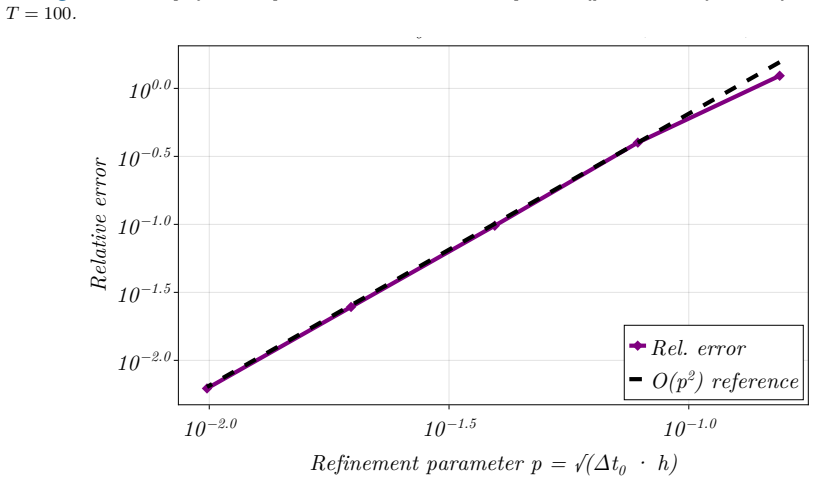
read the original abstract
We develop a numerical algorithm for the efficient solution or approximation of solutions to the Helmholtz equation on a structured grid in two dimensions. We make use of the Operator Fourier Transform (OFT) and a low-rank cross approximation scheme (Cross-DEIM) to decompose the problem into an integral over a pseudo-time of solutions to the Schr\"odinger equation. The OFT is a framework for solving operator equations like fractional Laplacian equations or the Helmholtz equation, when the latter is written as a product of two paraxial operators. The main computational cost in the OFT is the solution to the Schr\"odinger equation, especially when the dimension or mesh resolution is high. In this work, we alleviate this cost by utilizing a low-rank method. Such methods aim to beat the curse of dimensionality when low-rank structures are present in the solution. We show that the combination of these two approaches can have large cost reductions for certain classes of problems.
Editorial analysis
A structured set of objections, weighed in public.
Referee Report
Summary. The manuscript develops a numerical algorithm for solving or approximating solutions to the 2D Helmholtz equation on structured grids. It combines the Operator Fourier Transform (OFT), which reduces the Helmholtz problem to a pseudo-time integral of Schrödinger equation solutions, with a low-rank Cross-DEIM approximation scheme to reduce the dominant computational cost of the Schrödinger solves when low-rank structure is present in the solutions. The central claim is that this combination yields large cost reductions for certain qualified classes of problems.
Significance. If the supporting derivations, error bounds, and numerical evidence hold, the work provides a targeted acceleration technique for OFT-based Helmholtz solvers by exploiting low-rank structure to mitigate costs in high-resolution or higher-dimensional settings. The explicit qualification to problems where such structure appears is appropriate and avoids overclaiming generality. Strengths include the decomposition strategy and the use of established low-rank tools in a new context.
minor comments (3)
- The notation for the pseudo-time variable and the precise limits of the integral in the OFT decomposition should be stated explicitly in the main text (near the first appearance of the integral representation) to avoid ambiguity for readers unfamiliar with the OFT framework.
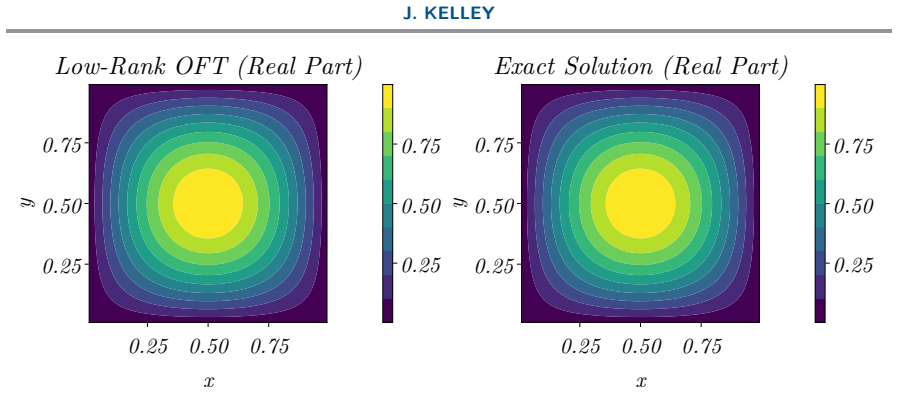
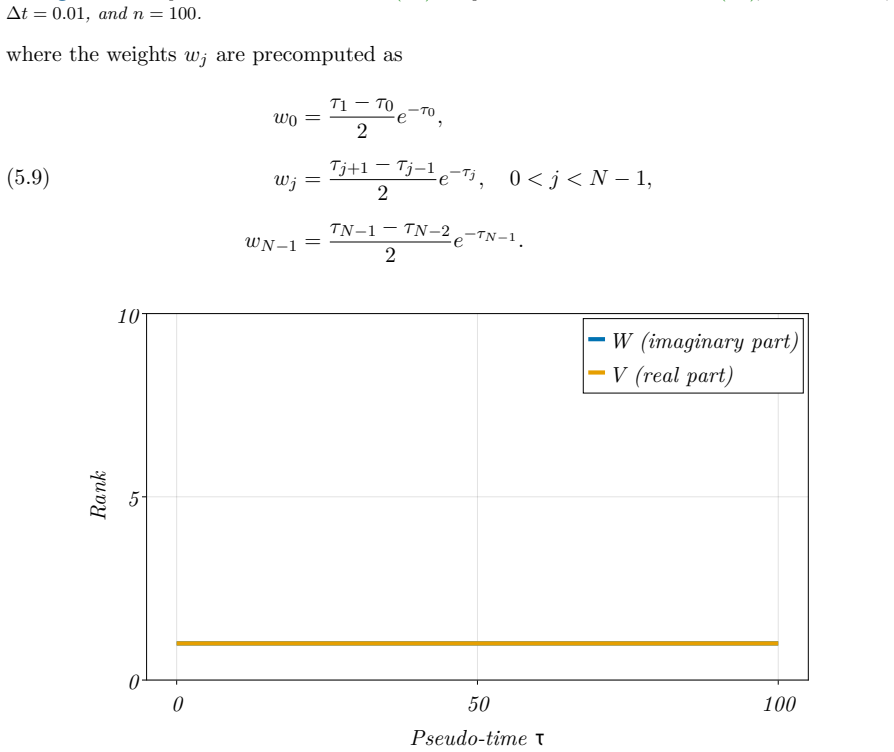
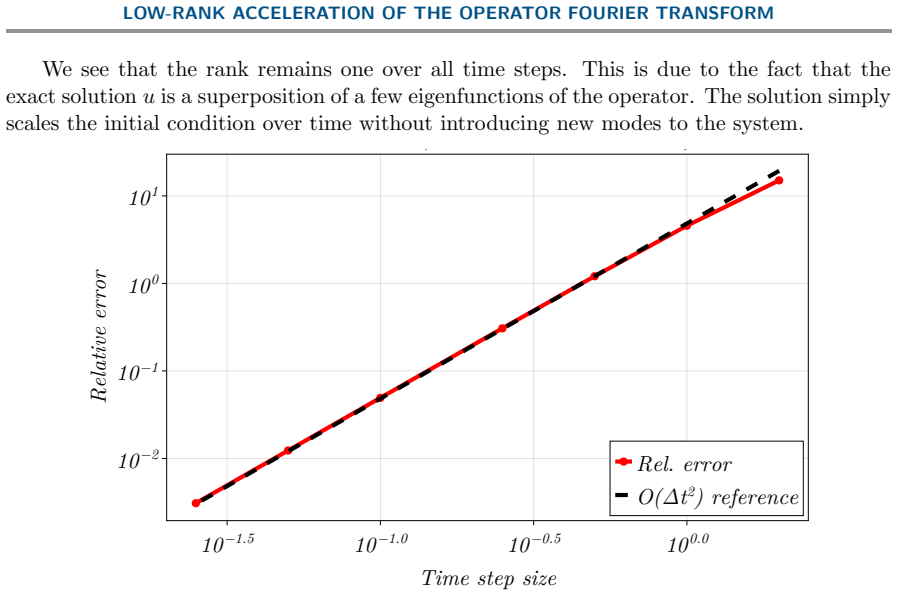
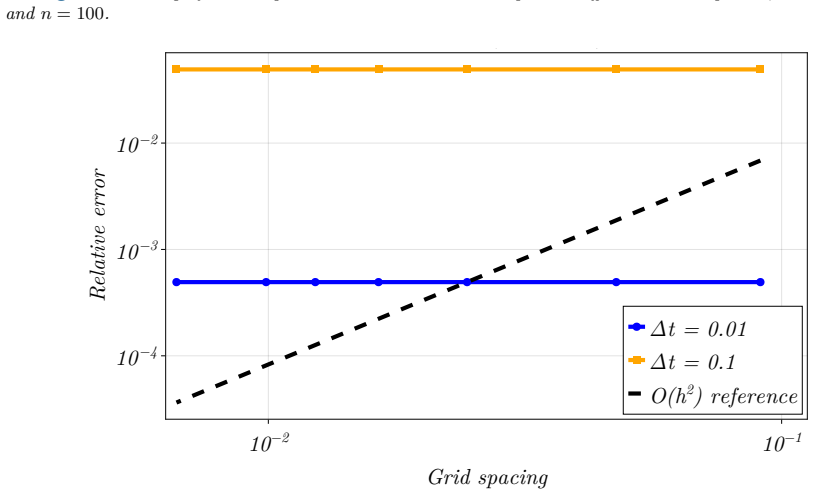
- Figure captions for the numerical examples should include the specific mesh sizes, frequency values, and observed ranks used in the Cross-DEIM step so that the reported speedups can be reproduced from the text alone.
- A brief remark on the storage and arithmetic complexity of the Cross-DEIM step relative to a direct Schrödinger solve would help readers assess the break-even point for the claimed savings.
Simulated Author's Rebuttal
We thank the referee for their positive summary, recognition of the targeted nature of the acceleration technique, and recommendation of minor revision. No specific major comments appear in the provided report.
Circularity Check
No significant circularity
full rationale
The provided abstract and description contain no derivations, equations, fitted parameters, or predictions. The central claim is a qualified statement about cost reductions for certain problem classes via combination of OFT and Cross-DEIM, with no self-definitional steps, fitted-input predictions, or load-bearing self-citations visible. The algorithm is presented as a direct construction without reduction to its own inputs.
Axiom & Free-Parameter Ledger
Reference graph
Works this paper leans on
-
[1]
Appel\" o and Y
D. Appel\" o and Y. Cheng , lrAA : L ow- R ank A nderson A cceleration , SISC (in-revision), (2025)
2025
-
[2]
D. Appel\" o and Y. Cheng , A new cross approximation for T ucker tensors and its application in T ucker- A nderson acceleration , Submitted (arXiv:2509.18554), (2025)
arXiv 2025
-
[3]
Appel\" o , F
D. Appel\" o , F. Garcia, and O. Runborg , Wave H oltz: I terative solution of the H elmholtz equation via the wave equation , SIAM Journal on Scientific Computing, 42 (2020), pp. A1950--A1983
2020
-
[4]
Cubillos and E
M. Cubillos and E. Jimenez , A novel direct H elmholtz solver in inhomogeneous media based on the operator F ourier transform functional calculus , Journal of Computational Physics, 527 (2025), p. 113808
2025
-
[5]
J. W. Demmel , Applied Numerical Linear Algebra , Society for Industrial and Applied Mathematics, 1997, https://doi.org/10.1137/1.9781611971446, https://epubs.siam.org/doi/abs/10.1137/1.9781611971446, https://arxiv.org/abs/https://epubs.siam.org/doi/pdf/10.1137/1.9781611971446
-
[6]
P. A. M. Dirac , Note on exchange phenomena in the thomas atom , Mathematical Proceedings of the Cambridge Philosophical Society, 26 (1930), p. 376–385, https://doi.org/10.1017/S0305004100016108
-
[7]
Donello, G
M. Donello, G. Palkar, M. Naderi, D. Del Rey Fern \'a ndez, and H. Babaee , Oblique projection for scalable rank-adaptive reduced-order modelling of nonlinear stochastic partial differential equations with time-dependent bases , Proceedings of the Royal Society A, 479 (2023), p. 20230320
2023
-
[8]
Drmac and S
Z. Drmac and S. Gugercin , A new selection operator for the discrete empirical interpolation method---improved a priori error bound and extensions , SIAM Journal on Scientific Computing, 38 (2016), pp. A631--A648
2016
-
[9]
S. A. Goreinov, E. E. Tyrtyshnikov, and N. L. Zamarashkin , A theory of pseudoskeleton approximations , Linear algebra and its applications, 261 (1997), pp. 1--21
1997
-
[10]
A. Granath, D. Appelö, and S. Wang , LR - W ave H oltz: A low-rank helmholtz solver , 2025, https://arxiv.org/abs/2510.09352, https://arxiv.org/abs/2510.09352
arXiv 2025
-
[11]
Dynamical low-rank approximation,
O. Koch and C. Lubich , Dynamical low‐rank approximation , SIAM Journal on Matrix Analysis and Applications, 29 (2007), pp. 434--454, https://doi.org/10.1137/050639703, https://doi.org/10.1137/050639703, https://arxiv.org/abs/https://doi.org/10.1137/050639703
-
[12]
C. Lubich , From Quantum to Classical Molecular Dynamics: Reduced Models and Numerical Analysis , Zurich Lectures in Advanced Mathematics, European Mathematical Society, Zürich, 2008, https://doi.org/10.4171/067
work page doi:10.4171/067 2008
-
[13]
M. W. Mahoney and P. Drineas , CUR matrix decompositions for improved data analysis , Proceedings of the National Academy of Sciences, 106 (2009), pp. 697--702
2009
-
[14]
I. V. Oseledets, D. Savostianov, and E. E. Tyrtyshnikov , Tucker dimensionality reduction of three-dimensional arrays in linear time , SIAM Journal on Matrix Analysis and Applications, 30 (2008), pp. 939--956
2008
-
[15]
D. C. Sorensen and M. Embree , A DEIM induced cur factorization , SIAM Journal on Scientific Computing, 38 (2016), pp. A1454--A1482, https://doi.org/10.1137/140978430
discussion (0)
Sign in with ORCID, Apple, or X to comment. Anyone can read and Pith papers without signing in.