Long-term laser frequency stabilization with an FPGA-controlled scanning cavity
Pith reviewed 2026-06-27 14:13 UTC · model grok-4.3
The pith
An FPGA-controlled scanning Fabry-Perot cavity stabilizes multiple lasers to one reference laser with sub-MHz stability over hours.
A machine-rendered reading of the paper's core claim, the machinery that carries it, and where it could break.
Core claim
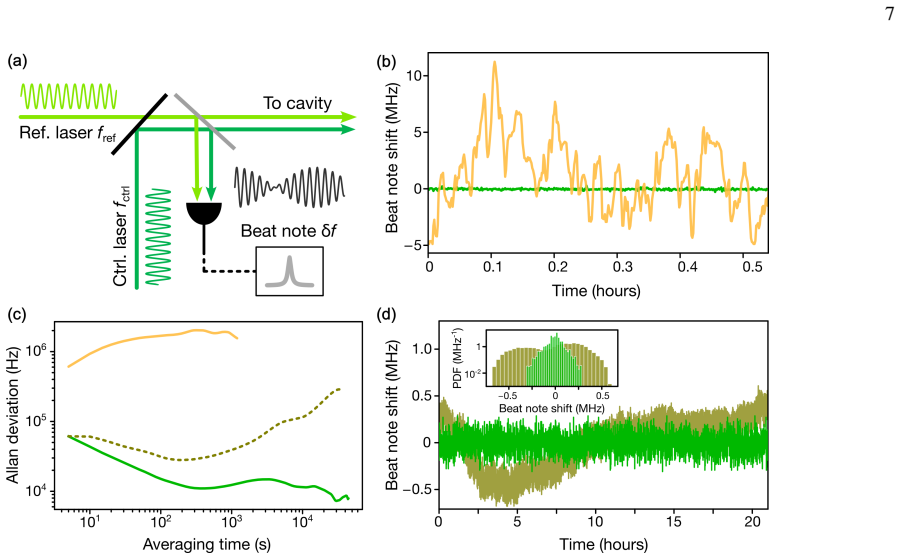
The central claim is that the FPGA implementation of the scanning transfer cavity lock achieves simultaneous stabilization of multiple lasers to one reference laser, with end-to-end performance validated through atomic spectroscopy of ytterbium atoms in a magneto-optical trap demonstrating sub-MHz absolute frequency stability over several hours for stability transfer across ∼150 nm, and that the AOM-based fast-scanning approach reaches sub-100 kHz long-term stability while offering perspectives for laser-line narrowing.
What carries the argument
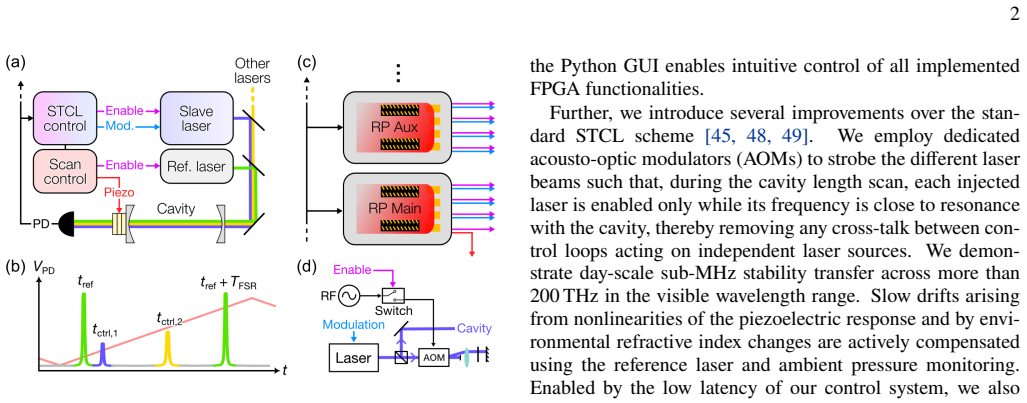
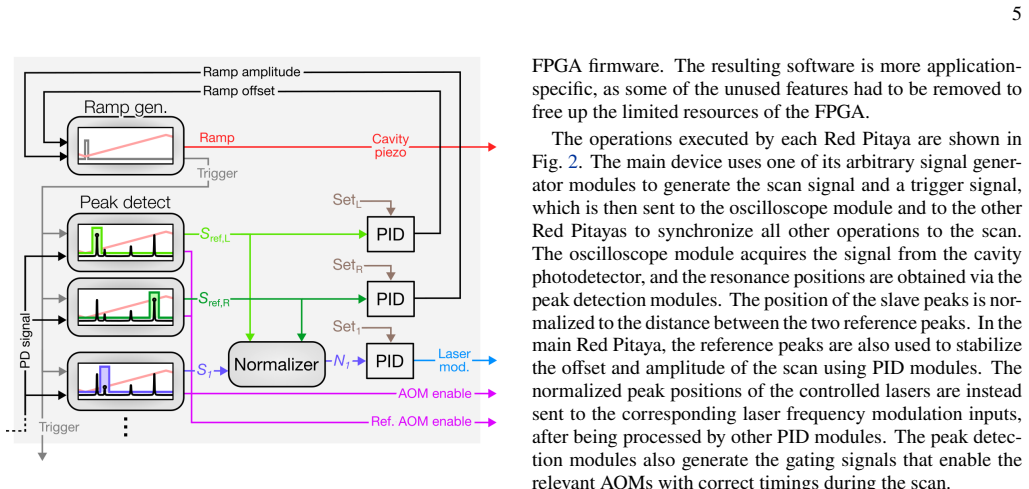
The FPGA architecture that simultaneously performs cavity scanning, peak detection, and feedback actuation to support independent control loops for several lasers.
Load-bearing premise
The reference laser stays sufficiently stable over twenty-hour timescales and the cavity mode structure plus AOM modulation introduce no unaccounted systematic frequency shifts.
What would settle it
A heterodyne or MOT spectroscopy measurement showing absolute frequency deviations larger than one megahertz over several hours would disprove the long-term stability transfer claim.
Figures
read the original abstract
We present an FPGA-based implementation of a scanning transfer cavity lock (STCL) for laser frequency stabilization, allowing for the simultaneous stabilization of multiple laser sources with respect to a single reference laser by means of a continuously scanned Fabry-Perot cavity. By exploiting the FPGA architecture to simultaneously perform cavity scanning, peak detection, and feedback actuation, we minimize latency and allow independent control loops for several lasers within a single device, offering direct scalability. The system performance is analyzed through heterodyne measurements from short ($<1\,$s) to long ($\sim20\,$hours) timescales. The end-to-end locking performance is validated through atomic spectroscopy of ytterbium atoms in a magneto-optical trap, demonstrating sub-MHz absolute frequency stability over several hours for the stability transfer across $\sim 150\,$nm in the visible-wavelength range. Importantly, we demonstrate a novel fast-scanning approach based on acousto-optic modulator (AOM) frequency modulation, enabled by the low detection latency of our FPGA implementation. This increases significantly the effective locking bandwidth and reduces the intrinsic noise of the system with respect to standard piezo-actuated scanning of the cavity length, allowing to reach sub-$100\,$kHz long-term stability and offering perspectives for laser-line narrowing. Owing to its modularity, low cost and ease of implementation within the open-source PyRPL firmware package for the STEMlab Red Pitaya platform, our architecture offers a compact and flexible alternative to existing STCL and locked-cavity implementations, providing a practical approach to the operation of a state-of-the-art cold-atom experiment without relying on any atomic references for laser stabilization.
Editorial analysis
A structured set of objections, weighed in public.
Referee Report
Summary. The manuscript describes an FPGA-based implementation of a scanning transfer cavity lock (STCL) that stabilizes multiple lasers to a single reference via continuous scanning of a Fabry-Perot cavity. Heterodyne beat measurements characterize short- to long-term (~20 h) performance, while ytterbium MOT spectroscopy validates end-to-end absolute frequency stability, claiming sub-MHz transfer across ~150 nm and sub-100 kHz long-term stability using a novel AOM-based fast-scanning method. The system is presented as modular, low-cost, and implemented in open-source PyRPL firmware for the Red Pitaya platform.
Significance. If the stability claims hold after addressing the error budget, the work provides a practical, scalable alternative to existing STCL and locked-cavity systems for cold-atom experiments, eliminating the need for atomic references while improving locking bandwidth. The open-source aspect and simultaneous multi-laser control are clear strengths for experimental reproducibility.
major comments (2)
- [Results on heterodyne measurements and MOT validation] The long-term stability claims (sub-MHz over hours, sub-100 kHz with AOM) rest on heterodyne and MOT data, but the manuscript provides no independent characterization of the reference laser (e.g., against a frequency comb) on ~20-hour timescales. Without this, the MOT spectroscopy cannot unambiguously isolate the STCL transfer performance from reference drift.
- [Performance analysis and validation sections] No quantitative error budget is presented that separates contributions from cavity mode structure, AOM frequency modulation, and potential differential shifts. This is load-bearing for the absolute stability claims in the abstract and MOT section.
minor comments (2)
- [MOT validation paragraph] Clarify the exact definition of 'absolute frequency stability' in the MOT spectroscopy context and how it accounts for any residual reference drift.
- [Abstract and results] The abstract mentions 'several hours' while the text references '~20 hours'; ensure consistent reporting of timescales across figures and text.
Simulated Author's Rebuttal
We thank the referee for their careful reading and constructive comments, which help clarify the presentation of our results. We address the major comments point by point below.
read point-by-point responses
-
Referee: The long-term stability claims (sub-MHz over hours, sub-100 kHz with AOM) rest on heterodyne and MOT data, but the manuscript provides no independent characterization of the reference laser (e.g., against a frequency comb) on ~20-hour timescales. Without this, the MOT spectroscopy cannot unambiguously isolate the STCL transfer performance from reference drift.
Authors: We agree that an independent long-term characterization of the reference laser (e.g., via frequency comb) would allow clearer separation of transfer-cavity performance from reference drift. The Yb MOT spectroscopy provides an absolute frequency anchor independent of the cavity, and the heterodyne data quantify the relative transfer between reference and locked lasers. The reported sub-MHz absolute stability is therefore an end-to-end system result. To address the concern, we will add explicit discussion in the revised manuscript clarifying the assumptions about reference-laser stability and the role of the MOT as the absolute reference. revision: partial
-
Referee: No quantitative error budget is presented that separates contributions from cavity mode structure, AOM frequency modulation, and potential differential shifts. This is load-bearing for the absolute stability claims in the abstract and MOT section.
Authors: We acknowledge that a quantitative error budget would strengthen the absolute-stability claims. In the revised manuscript we will insert a dedicated error-budget subsection that estimates the individual contributions from cavity mode structure, AOM frequency modulation, and differential shifts, drawing on the existing heterodyne and MOT datasets together with simple analytic estimates. revision: yes
Circularity Check
No circularity: experimental validation rests on independent measurements
full rationale
The paper describes an FPGA-based STCL implementation and reports performance via heterodyne beats (short to ~20 h timescales) plus Yb MOT spectroscopy for absolute stability across ~150 nm. These are direct experimental readouts, not model predictions, fitted parameters renamed as forecasts, or self-referential definitions. No equations or claims reduce by construction to inputs; no load-bearing self-citations or uniqueness theorems appear. The derivation chain is absent because the work is hardware-plus-measurement, self-contained against external benchmarks.
Axiom & Free-Parameter Ledger
axioms (1)
- domain assumption Reference laser frequency remains stable enough over multi-hour timescales to serve as absolute anchor for transferred stability.
Reference graph
Works this paper leans on
-
[1]
C. E. Wieman and L. Hollberg,Using diode lasers for atomic physics, Rev. Sci. Instr.62, 1 (1991)
1991
-
[2]
W.G.Nagourney,Quantumelectronicsforatomicphysics(Ox- ford University Press, 2010)
2010
-
[3]
C.WiemanandT.W.Hänsch,Doppler-FreeLaserPolarization Spectroscopy, Phys. Rev. Lett.36, 1170 (1976)
1976
-
[4]
J. L. Hall, L. Hollberg, T. Baer, and H. G. Robinson,Optical heterodyne saturation spectroscopy, Appl. Phys. Lett.39, 680 (1981)
1981
-
[5]
G. C. Bjorklund, M. Levenson, W. Lenth, and C. Ortiz,Fre- quency modulation (FM) spectroscopy: theory of lineshapes and signal-to-noise analysis, Appl. Phys. B32, 145 (1983)
1983
-
[6]
R. W. Drever, J. L. Hall, F. V. Kowalski, J. Hough, G. Ford, A. Munley, and H. Ward,Laser phase and frequency stabiliza- tion using an optical resonator, Appl. Phys. B31, 97 (1983)
1983
-
[7]
E. D. Black,An introduction to Pound–Drever–Hall laser fre- quencystabilization,AmericanJournalofPhysics69,79(2001)
2001
-
[8]
McCarron, S
D. McCarron, S. King, and S. Cornish,Modulation trans- fer spectroscopy in atomic rubidium, Meas. Sci. Technol.19, 105601 (2008)
2008
-
[9]
L.Couturier,I.Nosske,F.Hu,C.Tan,C.Qiao,Y.Jiang,P.Chen, andM.Weidemüller,Laserfrequencystabilizationusingacom- mercial wavelength meter, Rev. Sci. Instr.89(2018)
2018
-
[10]
Guttridge, S
A. Guttridge, S. Hopkins, S. Kemp, D. Boddy, R. Freytag, M.Jones, M.Tarbutt,E.Hinds, andS.Cornish,Directloading of a large Yb MOT on the1S0 → 3P1 transition, J. Phys. B49, 145006 (2016)
2016
-
[11]
P. E. Atkinson, J. S. Schelfhout, and J. J. McFerran,Hyperfine constants and line separations for the1S0 –3P1 intercombina- tionlineinneutralytterbiumwithsub-Dopplerresolution,Phys. Rev. A100, 042505 (2019)
2019
-
[12]
Salomon, D
C. Salomon, D. Hils, and J. L. Hall,Laser stabilization at the millihertz level, J. Opt. Soc. Am. B5, 1576 (1988)
1988
-
[13]
A.D.Ludlow,X.Huang,M.Notcutt,T.Zanon-Willette,S.Fore- man, M. Boyd, S. Blatt, and J. Ye,Compact, thermal-noise- limited optical cavity for diode laser stabilization at1×10−15, Opt. Lett.32, 641 (2007)
2007
-
[14]
J.Alnis,A.Matveev,N.Kolachevsky,T.Udem, andT.W.Hän- sch,Subhertz linewidth diode lasers by stabilization to vibra- tionally and thermally compensated ultralow-expansion glass Fabry-Perot cavities, Phys. Rev. A77, 053809 (2008)
2008
-
[15]
Milani, B
G. Milani, B. Rauf, P. Barbieri, F. Bregolin, M. Pizzocaro, P. Thoumany, F. Levi, and D. Calonico,Multiple wavelength stabilization on a single optical cavity using the offset sideband locking technique, Opt. Lett.42, 1970 (2017)
1970
-
[16]
P.Bohlouli-Zanjani,K.Afrousheh, andJ.D.D.Martin,Optical transfer cavity stabilization using current-modulated injection- locked diode lasers, Rev. Sci. Instr.77, 093105 (2006)
2006
-
[17]
A.A.Tonyushkin,A.D.Light, andM.D.DiRosa,Phase-locked scanning interferometer for frequency stabilization of multiple lasers, Rev. Sci. Instrum.78(2007)
2007
-
[18]
McClelland, andD.A.Shaddock,DigitalLaserFrequencySta- bilization Using an Optical Cavity, IEEE J
T.T.-Y.Lam,B.J.J.Slagmolen,J.H.Chow,I.C.M.Littler,D.E. McClelland, andD.A.Shaddock,DigitalLaserFrequencySta- bilization Using an Optical Cavity, IEEE J. Quantum Electron. 46, 1178 (2010)
2010
-
[19]
Biesheuvel, D
J. Biesheuvel, D. W. E. Noom, E. J. Salumbides, K. T. Sheri- dan, W. Ubachs, and J. C. J. Koelemeij,Widely tunable laser frequency offset lock with 30 GHz range and 5 THz offset, Opt. Express21, 14008 (2013)
2013
-
[20]
Leopold, L
T. Leopold, L. Schmöger, S. Feuchtenbeiner, C. Grebing, P. Micke, N. Scharnhorst, I. D. Leroux, J. R. C. López-Urrutia, and P. O. Schmidt,A tunable low-drift laser stabilized to an atomic reference, Appl. Phys. B122, 236 (2016)
2016
-
[21]
Zeng, K.-P
Y. Zeng, K.-P. Wang, Y.-Y. Liu, X.-D. He, M. Liu, P. Xu, J. Wang, and M.-S. Zhan,Stabilizing dual laser with a tunable high-finesse transfer cavity for single-atom Rydberg excitation, J. Opt. Soc. Am. B35, 454 (2018)
2018
-
[22]
Hagemann, C
C. Hagemann, C. Grebing, T. Kessler, S. Falke, N. Lemke, C. Lisdat, H. Schnatz, F. Riehle, and U. Sterr,Providing10−16 Short-TermStabilityofa1.5-𝜇mLasertoOpticalClocks,IEEE Trans. Instrum. Meas.62, 1556 (2013)
2013
-
[23]
Le Coq,Spectral purity transfer between optical wave- lengths at the 10−18 level, Nat
D.Nicolodi,B.Argence,W.Zhang,R.LeTargat,G.Santarelli, and Y. Le Coq,Spectral purity transfer between optical wave- lengths at the 10−18 level, Nat. Photonics8, 219 (2014)
2014
-
[24]
Barbieri, C
P. Barbieri, C. Clivati, M. Pizzocaro, F. Levi, and D. Calonico, Spectral purity transfer with5×10 −17 instability at 1 s using a multibranch Er:fiber frequency comb, Metrologia56, 045008 (2019)
2019
-
[25]
Savio, I
P. Savio, I. Goti, M. Pizzocaro, F. Levi, D. Calonico, and C. Clivati,Optical-Comb-Based Frequency Stability Transfer Across the Spectrum With a Multichannel FPGA, IEEE Trans. Ultrason. Ferroelectr. Freq. Control72, 397 (2025)
2025
-
[26]
Katori, T
H. Katori, T. Ido, Y. Isoya, and M. Kuwata-Gonokami, Magneto-Optical Trapping and Cooling of Strontium Atoms down to the Photon Recoil Temperature, Phys. Rev. Lett.82, 1116 (1999)
1999
-
[27]
Kuwamoto, K
T. Kuwamoto, K. Honda, Y. Takahashi, and T. Yabuzaki, Magneto-optical trapping of Yb atoms using an intercombina- tion transition, Phys. Rev. A60, R745(R) (1999)
1999
-
[28]
A. J. Berglund, J. L. Hanssen, and J. J. McClelland,Narrow- Line Magneto-Optical Cooling and Trapping of Strongly Mag- netic Atoms, Phys. Rev. Lett.100, 113002 (2008)
2008
-
[29]
A.Frisch,K.Aikawa,M.Mark,A.Rietzler,J.Schindler,E.Zu- panič,R.Grimm, andF.Ferlaino,Narrow-linemagneto-optical trap for erbium, Phys. Rev. A85, 051401(R) (2012)
2012
-
[30]
A.Bell,J.Stuhler,S.Locher,S.Hensler,J.Mlynek, andT.Pfau, A magneto-optical trap for chromium with population repump- ing via intercombination lines, EPL45, 156 (1999)
1999
-
[31]
Uhlenberg, J
G. Uhlenberg, J. Dirscherl, and H. Walther,Magneto-optical trapping of silver atoms, Phys. Rev. A62, 063404 (2000)
2000
-
[32]
Sukachev, A
D. Sukachev, A. Sokolov, K. Chebakov, A. Akimov, S.Kanorsky,N.Kolachevsky, andV.Sorokin,Magneto-optical trap for thulium atoms, Phys. Rev. A82, 011405(R) (2010)
2010
-
[33]
X. Yu, J. Mo, T. Lu, T. Y. Tan, and T. L. Nicholson,Magneto- opticaltrappingofagroup-IIIatom,Phys.Rev.A105,L061101 (2022)
2022
-
[34]
Eustice, J
S. Eustice, J. Schrott, A. Stöltzel, J. Wolf, D. Novoa, K. Cas- sella, and D. M. Stamper-Kurn,Magneto-optical trap of tita- nium atoms, Phys. Rev. Res.7, 023025 (2025)
2025
-
[35]
J.Barry,D.McCarron,E.Norrgard,M.Steinecker, andD.De- Mille,Magneto-opticaltrappingofadiatomicmolecule,Nature 512, 286 (2014)
2014
-
[36]
M. R. Tarbutt,Laser cooling of molecules, Cont. Phys.59, 356 (2018)
2018
-
[37]
N. B. Vilas, C. Hallas, L. Anderegg, P. Robichaud, A. Win- nicki,D.Mitra, andJ.M.Doyle,Magneto-opticaltrappingand sub-Doppler cooling of a polyatomic molecule, Nature606, 70 (2022)
2022
-
[38]
H.Hara,Y.Takasu,Y.Yamaoka,J.M.Doyle, andY.Takahashi, Quantum Degenerate Mixtures of Alkali and Alkaline-Earth- Like Atoms, Phys. Rev. Lett.106, 205304 (2011). 12
2011
-
[39]
A. H. Hansen, A. Y. Khramov, W. H. Dowd, A. O. Jamison, B. Plotkin-Swing, R. J. Roy, and S. Gupta,Production of quantum-degeneratemixturesofytterbiumandlithiumwithcon- trollable interspecies overlap, Phys. Rev. A87, 013615 (2013)
2013
-
[40]
Ilzhöfer, G
P. Ilzhöfer, G. Durastante, A. Patscheider, A. Trautmann, M. J. Mark, and F. Ferlaino,Two-species five-beam magneto-optical trapforerbiumanddysprosium,Phys.Rev.A97,023633(2018)
2018
-
[41]
E. Neri, A. Ciamei, C. Simonelli, I. Goti, M. Inguscio, A.Trenkwalder, andM.Zaccanti,Realizationofacoldmixture of fermionic chromium and lithium atoms, Phys. Rev. A101, 063602 (2020)
2020
-
[42]
Ravensbergen, E
C. Ravensbergen, E. Soave, V. Corre, M. Kreyer, B. Huang, E.Kirilov, andR.Grimm,ResonantlyInteractingFermi-Fermi Mixtureof 161Dyand 40K,Phys.Rev.Lett.124,203402(2020)
2020
-
[43]
De Martino, F
A. De Martino, F. Kiesel, J. Auch, K. Karpov, and C. Gross, Dissipationlesstune-outtrappingforalanthanide–alkali-metal quantum gas mixture, Phys. Rev. A112, L051304 (2025)
2025
-
[44]
W. Z. Zhao, J. E. Simsarian, L. A. Orozco, and G. D. Sprouse, A computer-based digital feedback control of frequency drift of multiple lasers, Rev. Sci. Instrum.69, 3737 (1998)
1998
-
[45]
Sackett,Compact implementation of a scanning transfer cavity lock, Rev
J.H.T.Burke,O.Garcia,K.J.Hughes,B.Livedalen, andC.A. Sackett,Compact implementation of a scanning transfer cavity lock, Rev. Sci. Instrum.76, 116105 (2005)
2005
-
[46]
Uetake, K
S. Uetake, K. Matsubara, H. Ito, K. Hayasaka, and M. Hosokawa,Frequency stability measurement of a transfer- cavity-stabilizeddiodelaserbyusinganopticalfrequencycomb, Appl. Phys. B97, 413 (2009)
2009
-
[47]
Seymour-Smith, P
N. Seymour-Smith, P. Blythe, M. Keller, and W. Lange,Fast scanningcavityoffsetlockforlaserfrequencydriftstabilization, Rev. Sci. Instrum.81, 075109 (2010)
2010
-
[48]
Subhankar, A
S. Subhankar, A. Restelli, Y. Wang, S. L. Rolston, and J. V. Porto,Microcontroller based scanning transfer cavity lock for long-term laser frequency stabilization, Rev. Sci. Instrum.90, 043115 (2019)
2019
-
[49]
Pultinevicius, M
E. Pultinevicius, M. Rockenhäuser, F. Kogel, P. Groß, T. Garg, O. E. Prochnow, and T. Langen,A scalable scanning trans- fer cavity laser stabilization scheme based on the Red Pitaya STEMlab platform, Rev. Sci. Instrum.94, 103004 (2023)
2023
-
[50]
Neuhaus, R
L. Neuhaus, R. Metzdorff, S. Chua, T. Jacqmin, T. Briant, A.Heidmann,P.-F.Cohadon, andS.Deléglise,PyRPL(Python Red Pitaya Lockbox) - an open-source software package for FPGA-controlled quantum optics experiments, inEuropean Conference on Lasers and Electro-Optics and European Quan- tum Electronics Conference (2017), p. EA_P_8
2017
-
[51]
Journeaux, A
L.Neuhaus,M.Croquette,R.Metzdorff,S.Chua,P.-E.Jacquet, A. Journeaux, A. Heidmann, T. Briant, T. Jacqmin, P.-F. Co- hadon, andS.Deléglise,PythonRedPitayaLockbox(PyRPL): An open source software package for digital feedback control in quantum optics experiments, Rev. Sci. Instrum.95, 033003 (2024)
2024
-
[52]
S. M. Kay,Fundamentals of statistical signal processing: esti- mation theory(Prentice Hall, 1993)
1993
-
[53]
M.J.Lawrence,B.Willke,M.E.Husman,E.K.Gustafson, and R. L. Byer,Dynamic response of a Fabry–Perot interferometer, J. Opt. Soc. Am. B16, 523 (1999)
1999
-
[54]
J. C. Owens,Optical Refractive Index of Air: Dependence on Pressure, Temperature and Composition, Appl. Opt.6, 51 (1967)
1967
-
[55]
J.W.Kirchner,Aliasingin1/𝑓 𝛼 noisespectra: Origins,conse- quences, and remedies, Phys. Rev. E71, 066110 (2005)
2005
-
[56]
Neuhaus,Red Pitaya DAC performance,https: //ln1985blog.wordpress.com/2016/02/07/ red-pitaya-dac-performance/
L. Neuhaus,Red Pitaya DAC performance,https: //ln1985blog.wordpress.com/2016/02/07/ red-pitaya-dac-performance/
2016
-
[57]
Some of the default PyRPL modules, such as the IQ and filter modules, were removed to free up space for the peak detection modules and one extra PID module
ThecurrentFPGAfirmwareuses84%oftheavailableLookUp- Tables(LUT),26%ofFlip-Flops,47%ofBlockRAM(BRAM), and14%of Digital Signal Processing (DSP) blocks. Some of the default PyRPL modules, such as the IQ and filter modules, were removed to free up space for the peak detection modules and one extra PID module
-
[58]
Allan,Statistics of atomic frequency standards, Proc
D. Allan,Statistics of atomic frequency standards, Proc. IEEE 54, 221 (1966)
1966
discussion (0)
Sign in with ORCID, Apple, or X to comment. Anyone can read and Pith papers without signing in.