Profiling a Rydberg-Atom Electric Field Sensor for Off-Resonant Detection of Sub-100 MHz RF Signals
Pith reviewed 2026-06-27 13:54 UTC · model grok-4.3
The pith
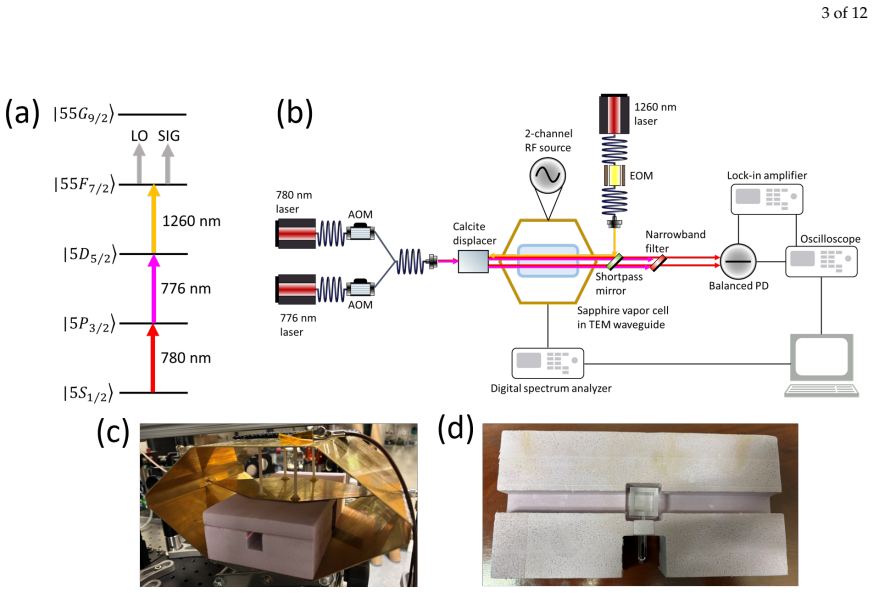
A sapphire vapor cell allows Rydberg atoms to detect sub-100 MHz RF signals through AC Stark shifts where glass cells screen the fields.
A machine-rendered reading of the paper's core claim, the machinery that carries it, and where it could break.
Core claim
The central claim is that off-resonant sub-100 MHz RF fields produce measurable AC Stark shifts in a Rydberg-atom vapor when the cell is fabricated from sapphire, which transmits those frequencies without the screening that occurs in glass or quartz cells, and that this shift can be calibrated to incident field strength at multiple ISM-band carriers.
What carries the argument
The sapphire vapor cell that transmits sub-100 MHz RF fields without screening, combined with observation of the resulting AC Stark shifts in the atomic levels.
If this is right
- Detection becomes possible at any chosen carrier below 100 MHz by repeating the same off-resonant Stark-shift measurement.
- The reported sensitivity and dynamic-range values at ISM frequencies supply concrete benchmarks for receiver design in that band.
- The supplied parameter-tuning routine can be applied without modification at additional carrier frequencies.
Where Pith is reading between the lines
- The same cell geometry could be tested at still lower frequencies to map the practical lower limit set by screening.
- Integration with existing RF hardware would require only the addition of the atomic readout path rather than a resonant antenna element.
- Calibration curves obtained at one ISM frequency may transfer to nearby frequencies if the Stark-shift response remains linear.
Load-bearing premise
The sapphire cell lets the sub-100 MHz RF field reach the atoms without being screened, so that the AC Stark shift can be observed and scaled to the incident field strength.
What would settle it
A direct measurement showing that an applied sub-100 MHz field produces no detectable AC Stark shift inside the sapphire cell while the same field is screened inside a glass cell of identical geometry.
Figures
read the original abstract
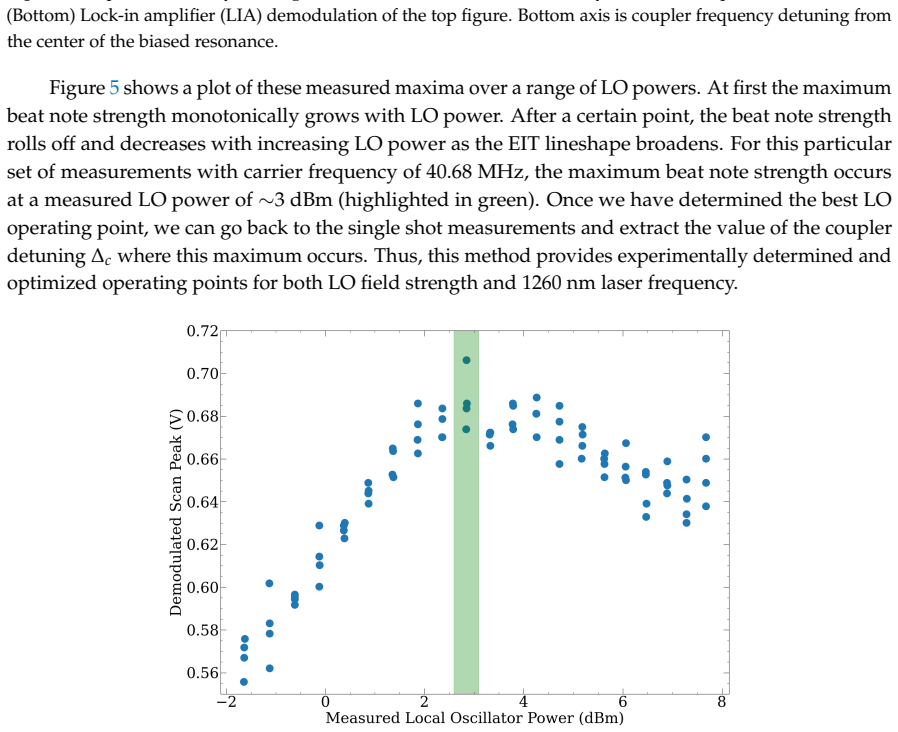
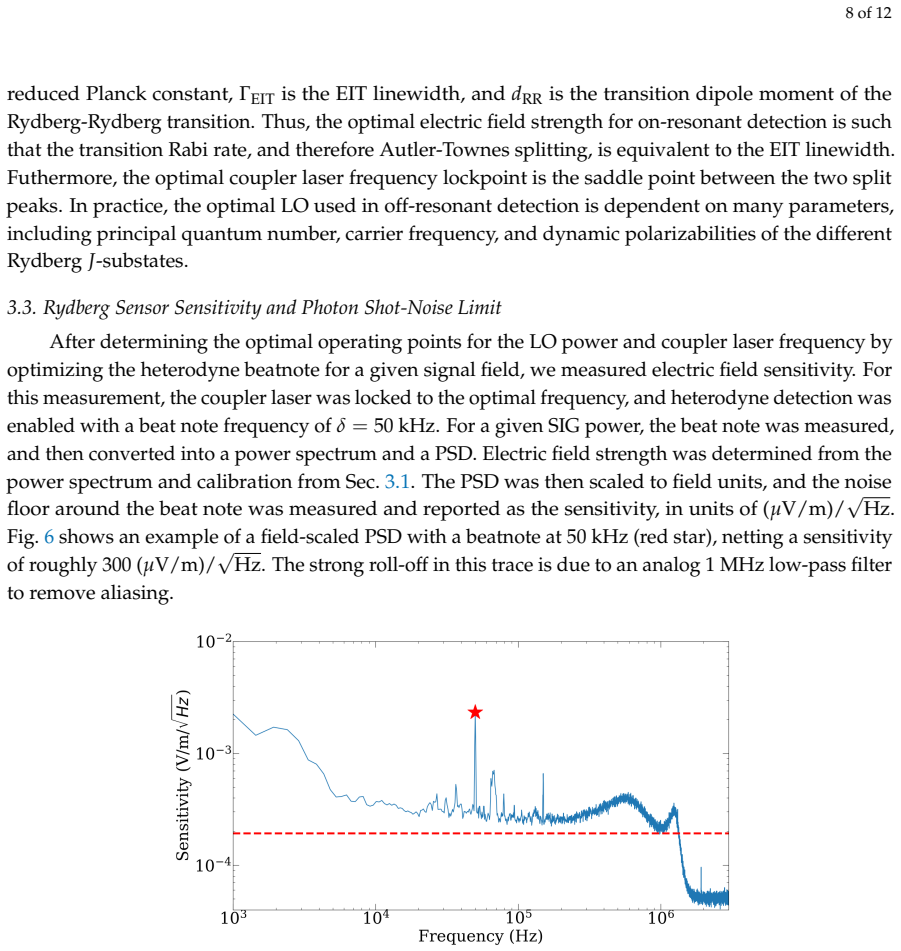
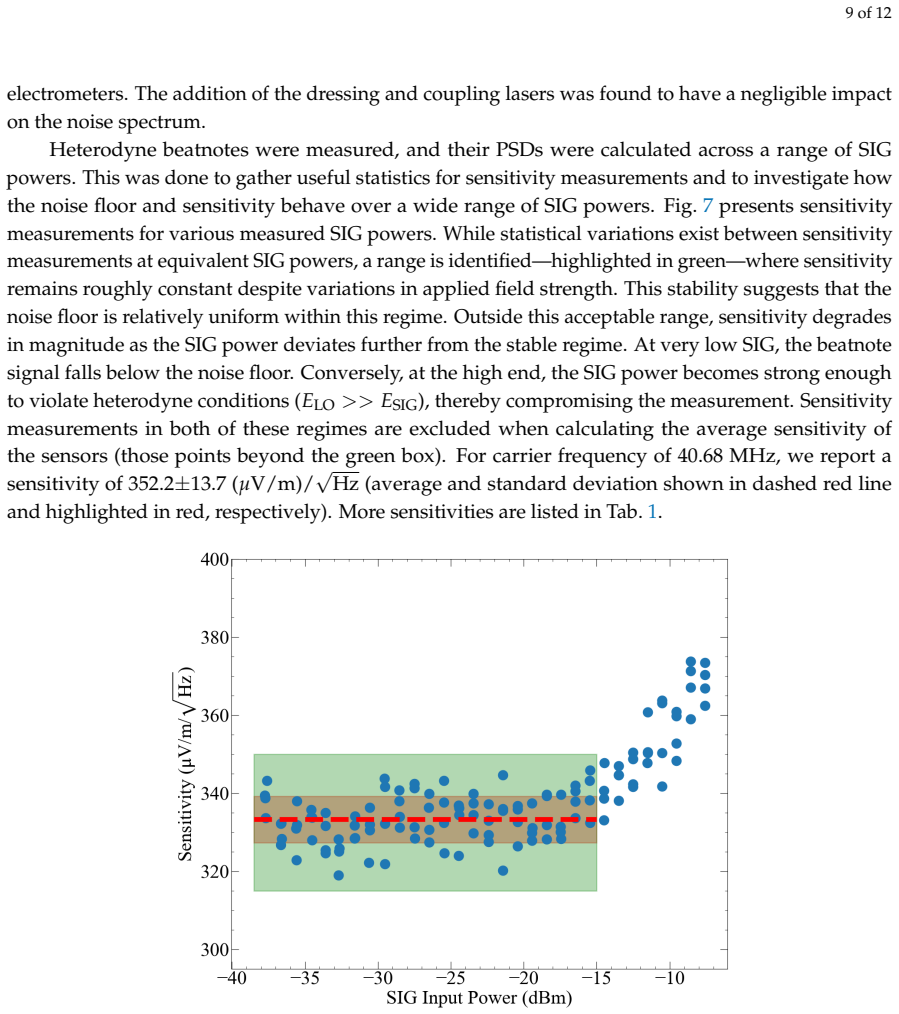
We present a Rydberg-Atom electric field sensor optimized to detect signals at sub-100 MHz carrier frequencies. The sensing setup employs a sapphire vapor cell that allows for detection of signals below 100~MHz -- typical vapor cells made of glass or quartz demonstrate strong screening of radio frequency (RF) signals in this frequency regime. Applied signals are detected by observing AC Stark shifts in the atomic vapor energy levels. As a test case for the commercial utility of this receiver, we perform our tests at several carrier frequencies in the Industrial, Scientific, and Medical (ISM) band. At each carrier frequency, we report sensitivity, minimum detectable field, and detectable electric-field dynamic range. We also present a routine for optimizing off-resonant signal detection by tuning experimental parameters such as Rydberg coupler laser detuning and RF local oscillator strength. This Python-based optimization routine, which can be used at any off-resonant carrier frequency, is shared on Github for others to use in their own investigations.
Editorial analysis
A structured set of objections, weighed in public.
Referee Report
Summary. The manuscript presents a Rydberg-atom electric field sensor that uses a sapphire vapor cell to detect sub-100 MHz RF signals (including ISM-band carriers) by measuring AC Stark shifts in atomic energy levels. It reports sensitivity, minimum detectable field, and dynamic range at multiple carrier frequencies, describes a parameter-optimization routine for off-resonant detection, and shares the associated Python code on GitHub.
Significance. If the central calibration holds, the work would demonstrate a practical route to extend Rydberg sensors into a frequency regime where glass/quartz cells screen signals, with direct relevance to commercial ISM-band applications. The shared, reusable optimization code is a clear reproducibility strength.
major comments (1)
- [Experimental Setup / Results] Experimental Setup / Results sections: the conversion of observed AC Stark shifts into incident E-field values (and therefore all quoted sensitivities, minimum detectable fields, and dynamic ranges) rests on the unverified premise that the sapphire cell transmits sub-100 MHz fields with negligible attenuation or inhomogeneity. No reference-probe measurement inside/outside the cell, no dielectric modeling at 10–100 MHz, and no comparison to a screened cell under identical conditions are provided to substantiate this assumption.
minor comments (2)
- [Abstract] Abstract: reported performance metrics are given without error bars, number of repetitions, or uncertainty estimates; these should be added for quantitative clarity.
- [Optimization Routine] The optimization routine is described as parameter-free in parts of the text, yet the free parameters listed (Rydberg coupler detuning, RF LO strength) are explicitly tuned; the wording should be reconciled with the actual procedure.
Simulated Author's Rebuttal
We thank the referee for their careful reading and for highlighting the need to substantiate the RF transmission properties of the sapphire cell. We agree that the conversion from observed AC Stark shifts to incident field values relies on this assumption and that additional evidence would strengthen the manuscript. We address the comment below and will revise accordingly.
read point-by-point responses
-
Referee: Experimental Setup / Results sections: the conversion of observed AC Stark shifts into incident E-field values (and therefore all quoted sensitivities, minimum detectable fields, and dynamic ranges) rests on the unverified premise that the sapphire cell transmits sub-100 MHz fields with negligible attenuation or inhomogeneity. No reference-probe measurement inside/outside the cell, no dielectric modeling at 10–100 MHz, and no comparison to a screened cell under identical conditions are provided to substantiate this assumption.
Authors: We agree that the manuscript does not include direct experimental verification (reference-probe measurements inside/outside the cell or comparisons to a screened cell) or dielectric modeling at 10–100 MHz. The claim that sapphire enables transmission rests on the known lower dielectric constant and loss tangent of sapphire relative to glass/quartz at these frequencies, together with the observation that signals are detected only with the sapphire cell. In the revised manuscript we will add a dedicated paragraph in the Experimental Setup section that (i) cites literature values for the complex permittivity of sapphire in the 10–100 MHz range, (ii) presents a simple finite-element model estimating field attenuation through the cell walls, and (iii) explicitly states the assumption and its limitations. We will also qualify all quoted sensitivities, minimum detectable fields, and dynamic ranges as “inferred under the assumption of negligible cell attenuation.” If space permits, we will note that a full calibration with an internal reference probe is planned for future work. revision: yes
Circularity Check
No circularity: all reported metrics are direct experimental measurements
full rationale
The paper reports measured performance quantities (sensitivity, minimum detectable field, dynamic range) at specific ISM-band carrier frequencies via observed AC Stark shifts. No derivations, predictions, or fitted parameters are presented that reduce to inputs by construction. No self-citations are load-bearing for any central claim, and the sapphire-cell transmission is treated as an enabling experimental condition rather than a derived result. The work is self-contained as empirical characterization.
Axiom & Free-Parameter Ledger
free parameters (2)
- Rydberg coupler laser detuning
- RF local oscillator strength
axioms (2)
- domain assumption AC Stark shift is linearly proportional to the square of the applied RF electric field amplitude in the weak-field regime.
- domain assumption Sapphire cell transmits sub-100 MHz RF fields with negligible attenuation compared with glass or quartz.
Reference graph
Works this paper leans on
-
[1]
Gallagher, T.F.Rydberg Atoms; Cambridge University Press: Cambridge, 1994
1994
-
[2]
Nonlinear optical processes using electromagnetically induced transparency.Phys
Harris, S.E.; Field, J.E.; Imamo˘ glu, A. Nonlinear optical processes using electromagnetically induced transparency.Phys. Rev. Lett.1990,64, 1107–1110. https://doi.org/10.1103/PhysRevLett.64.1107
-
[3]
Observation of electromagnetically induced transparency.Physical Review Letters1991,66, 2593
Boller, K.J.; Imamo˘ glu, A.; Harris, S.E. Observation of electromagnetically induced transparency.Physical Review Letters1991,66, 2593
-
[4]
11 of 12
Boyd, R.W.Nonlinear Optics; Academic Press: London, 1992. 11 of 12
1992
-
[5]
Holloway, C.L.; Gordon, J.A.; Jefferts, S.; Schwarzkopf, A.; Anderson, D.A.; Miller, S.A.; Thaicharoen, N.; Raithel, G. Broadband Rydberg Atom-Based Electric-Field Probe for SI-Traceable, Self-Calibrated Measurements.IEEE Transactions on Antennas and Propagation2014,62, 6169–6182. https://doi.org/10.1109/ TAP .2014.2360208
arXiv 2014
-
[6]
Holloway, C.L.; Simons, M.T.; Gordon, J.A.; Wilson, P .F.; Cooke, C.M.; Anderson, D.A.; Raithel, G. Atom- based RF electric field metrology: from self-calibrated measurements to subwavelength and near-field imaging.IEEE Transactions on Electromagnetic Compatibility2017,59, 717–728
-
[7]
Microwave electrometry with Rydberg atoms in a vapour cell using bright atomic resonances.Nat
Sedlacek, J.A.; Schwettmann, A.; Kübler, H.; Löw, R.; Pfau, T.; Shaffer, J.P . Microwave electrometry with Rydberg atoms in a vapour cell using bright atomic resonances.Nat. Phys.2012,8, 819–824
2012
-
[8]
Simons, M.T.; Haddab, A.H.; Gordon, J.A.; Holloway, C.L. A Rydberg atom-based mixer: Measuring the phase of a radio frequency wave.Applied Physics Letters2019,114, 114101. https://doi.org/10.1063/1.5088 821
-
[9]
Atom-based vector microwave electrometry using rubidium Rydberg atoms in a vapor cell.Physical review letters2013,111, 063001
Sedlacek, J.; Schwettmann, A.; Kübler, H.; Shaffer, J. Atom-based vector microwave electrometry using rubidium Rydberg atoms in a vapor cell.Physical review letters2013,111, 063001
-
[10]
Measurement of dc and ac Electric Fields inside an Atomic Vapor Cell with Wall-Integrated Electrodes.Phys
Ma, L.; Viray, M.A.; Anderson, D.A.; Raithel, G. Measurement of dc and ac Electric Fields inside an Atomic Vapor Cell with Wall-Integrated Electrodes.Phys. Rev. Appl.2022,18, 024001. https://doi.org/10.1103/ PhysRevApplied.18.024001
2022
-
[11]
Jing, M.; Hu, Y.; Ma, J.; Zhang, H.; Zhang, L.; Xiao, L.; Jia, S. Atomic superheterodyne receiver based on microwave-dressed Rydberg spectroscopy.Nature Physics2020,16, 911–915. https://doi.org/10.1038/s415 67-020-0918-5
-
[12]
Determining the angle-of-arrival of a radio-frequency source with a Rydberg atom-based sensor.Applied Physics Letters2021,118
Robinson, A.K.; Prajapati, N.; Senic, D.; Simons, M.T.; Holloway, C.L. Determining the angle-of-arrival of a radio-frequency source with a Rydberg atom-based sensor.Applied Physics Letters2021,118
-
[13]
DC electric fields in electrode-free glass vapor cell by photoillumination
Ma, L.; Paradis, E.; Raithel, G. DC electric fields in electrode-free glass vapor cell by photoillumination. Optics Express2020,28, 3676–3685
-
[14]
Anderson, D.A.; Raithel, G.; Simons, M.; Holloway, C.L. Quantum-optical spectroscopy for plasma electric field measurements and diagnostics, 2017, [arXiv:physics.atom-ph/1712.08717]
Pith/arXiv arXiv 2017
-
[15]
Three-photon electromagnetically induced transparency using Rydberg states.Opt
Carr, C.; Tanasittikosol, M.; Sargsyan, A.; Sarkisyan, D.; Adams, C.S.; Weatherill, K.J. Three-photon electromagnetically induced transparency using Rydberg states.Opt. Lett.2012,37, 3858–3860. https: //doi.org/10.1364/OL.37.003858
-
[16]
Electromagnetically induced transparency, absorption, and microwave-field sensing in a Rb vapor cell with a three-color all-infrared laser system.Physical Review A2019,100, 063427
Thaicharoen, N.; Moore, K.; Anderson, D.; Powel, R.; Peterson, E.; Raithel, G. Electromagnetically induced transparency, absorption, and microwave-field sensing in a Rb vapor cell with a three-color all-infrared laser system.Physical Review A2019,100, 063427
-
[17]
Duspayev, A.; Cardman, R.; Anderson, D.A.; Raithel, G. High-angular-momentum Rydberg states in a room-temperature vapor cell for dc electric-field sensing.Phys. Rev. Res.2024,6, 023138. https: //doi.org/10.1103/PhysRevResearch.6.023138
-
[18]
Prajapati, N.; Bhusal, N.; Rotunno, A.P .; Berweger, S.; Simons, M.T.; Artusio-Glimpse, A.B.; Ju Wang, Y.; Bottomley, E.; Fan, H.; Holloway, C.L. Sensitivity comparison of two-photon vs three-photon Rydberg electrometry.Journal of Applied Physics2023,134, 023101. https://doi.org/10.1063/5.0147827
-
[19]
Three-photon Rydberg atom electrometry with enhanced sensitivity
Venu, V .; Bohaichuk, S.M.; Christaller, F.; Schmidt, M.; Kübler, H.; Shaffer, J.P . Three-photon Rydberg atom electrometry with enhanced sensitivity. In Proceedings of the Quantum Sensing, Imaging, and Precision Metrology III; Shahriar, S.M., Ed. International Society for Optics and Photonics, SPIE, 2025, Vol. 13392, p. 1339216. https://doi.org/10.1117/1...
-
[20]
Prajapati, N.; Berweger, S.; Rotunno, A.P .; Artusio-Glimpse, A.B.; Schlossberger, N.; Shylla, D.; Watterson, W.J.; Simons, M.T.; La Mantia, D.; Norrgard, E.B.; et al. Investigation of fluorescence versus transmission readout for three-photon Rydberg excitation used in electrometry.AVS Quantum Science2024,6, 034401. https://doi.org/10.1116/5.0201928
-
[21]
Very-high-and ultrahigh-frequency electric-field detection using high angular momentum Rydberg states.Physical Review A2023,107, 052605
Brown, R.C.; Kayim, B.; Viray, M.A.; Perry, A.R.; Sawyer, B.C.; Wyllie, R. Very-high-and ultrahigh-frequency electric-field detection using high angular momentum Rydberg states.Physical Review A2023,107, 052605
-
[22]
Rotunno, A.P .; Holloway, C.L.; Prajapati, N.; Berweger, S.; Artusio-Glimpse, A.B.; Brown, R.; Simons, M.; Robinson, A.K.; Kayim, B.N.; Viray, M.A.; et al. Investigating electromagnetically induced transparency spectral lineshape distortion due to non-uniform fields in Rydberg-atom electrometry.Journal of Applied Physics2023,134, 084401. https://doi.org/1...
-
[23]
Kayim, B.; Viray, M.A.; Mantia, D.S.L.; Richardson, D.; Dee, J.; Westafer, R.S.; Sawyer, B.C.; Wyllie, R. Calibration of electric fields in low-frequency off-resonant Rydberg receivers, 2026, [arXiv:physics.atom- ph/2603.10898]. 12 of 12
arXiv 2026
-
[24]
Vapor-cell-based atomic electrometry for detection frequencies below 1 kHz.Physical Review Applied2020,13, 054034
Jau, Y.Y.; Carter, T. Vapor-cell-based atomic electrometry for detection frequencies below 1 kHz.Physical Review Applied2020,13, 054034
-
[25]
Richardson, D.; Dee, J.; Yaeger, J.; Viray, M.A.; Marsh, J.; Sawyer, B.C.; Mantia, D.S.L.; Wyllie, R.; Westafer, R.S. Extraction of Effective Electromagnetic Material Properties for Rydberg Electrometer Vapor Cells from 10-300 MHz, 2026, [arXiv:physics.atom-ph/2604.11785]
Pith/arXiv arXiv 2026
-
[26]
FCC Online Table of Frequency Allocations
Federal Communications Commission. FCC Online Table of Frequency Allocations. https://www.fcc.gov/ sites/default/files/fcctable.pdf, 2025
2025
-
[27]
ARC: An open-source library for calculating properties of alkali Rydberg atoms.Computer Physics Communications2017,220, 319–331
Šibali´ c, N.; Pritchard, J.D.; Adams, C.S.; Weatherill, K.J. ARC: An open-source library for calculating properties of alkali Rydberg atoms.Computer Physics Communications2017,220, 319–331
-
[28]
Saleh, B.E.A.; Teich, M.C.Fundamentals of photonics; Wiley series in pure and applied optics, Wiley: New York, NY, 2007
2007
-
[29]
Starkey, P .T.; Billington, C.J.; Johnstone, S.P .; Jasperse, M.; Helmerson, K.; Turner, L.D.; Anderson, R.P . A scripted control system for autonomous hardware-timed experiments.Review of Scientific Instruments2013, 84, 085111. https://doi.org/10.1063/1.4817213
-
[30]
Observing random walks of atoms in buffer gas through resonant light absorption.Phys
Aoki, K.; Mitsui, T. Observing random walks of atoms in buffer gas through resonant light absorption.Phys. Rev. A2016,94, 012703. https://doi.org/10.1103/PhysRevA.94.012703. Disclaimer/Publisher’s Note:The statements, opinions and data contained in all publications are solely those of the individual author(s) and contributor(s) and not of MDPI and/or the ...
discussion (0)
Sign in with ORCID, Apple, or X to comment. Anyone can read and Pith papers without signing in.