Quantum study of ultracold atom-ion excitation exchange
Pith reviewed 2026-06-27 11:09 UTC · model grok-4.3
The pith
Quantum dynamics of ultracold Rb-Sr+ collisions shows excitation exchange rate matching experiment and fine-structure quenching rate depending on reactant polarization.
A machine-rendered reading of the paper's core claim, the machinery that carries it, and where it could break.
Core claim
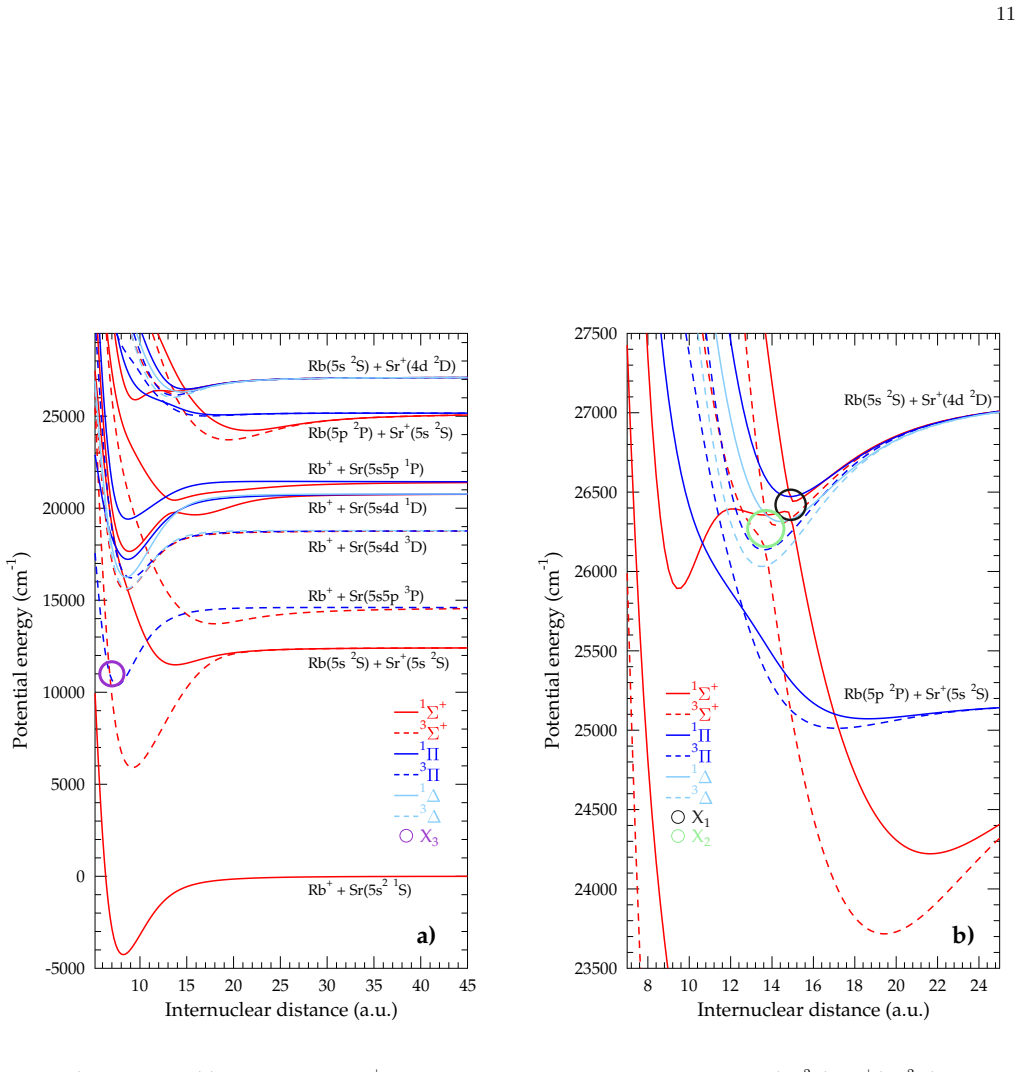
The quantum dynamics of ultracold collisions between rubidium atoms and excited metastable strontium ions is treated in the laboratory frame, enlightening the importance of the coupling between internal angular momenta of the particles and their mutual rotation. The study reveals a subtle competition between electronic excitation exchange and fine structure quenching, with no charge exchange, which is found to be very sensitive to the details of ion-atom interactions. The rate constant for electronic excitation exchange is found in agreement with the experimental results, while the rate for fine structure quenching is predicted to strongly depend on the initial polarization of the reactants.
What carries the argument
Laboratory-frame quantum dynamics treatment that includes coupling of internal angular momenta to mutual rotation, applied to ion-atom interaction potentials.
If this is right
- Excitation exchange proceeds at a rate consistent with measured values.
- Fine-structure quenching can be tuned by preparing specific polarization states of the reactants.
- Charge exchange remains negligible under the conditions examined.
- The outcome of the competition between the two processes is sensitive to the precise shape of the ion-atom potential curves.
Where Pith is reading between the lines
- The same framework could be used to scan other atom-ion combinations for regimes where one process dominates.
- Experiments that prepare aligned hyperfine states would provide a direct test of the predicted polarization dependence.
- Accurate ab initio potentials are required before the method can reliably guide control protocols in ion-atom quantum simulators.
Load-bearing premise
The laboratory-frame quantum dynamics treatment together with the chosen ion-atom interaction potentials is accurate enough to determine the competition between excitation exchange and fine structure quenching.
What would settle it
An experimental measurement of the fine-structure quenching rate constant in polarized versus unpolarized ultracold Rb and Sr+ reactants that deviates substantially from the predicted polarization dependence.
Figures
read the original abstract
The quantum dynamics of ultracold collisions between rubidium atoms and excited metastable strontium ions is treated in the laboratory frame, enlightening the importance of the coupling between internal angular momenta of the particles and their mutual rotation. The study reveals a subtle competition between electronic excitation exchange and fine structure quenching, with no charge exchange, which is found to be very sensitive to the details of ion-atom interactions. The rate constant for electronic excitation exchange is found in agreement with the experimental results of Ben-Shlomi \textit{et al.} (Phys. Rev. A \textbf{102}, 031301(R) (2020)), while the rate for fine structure quenching is predicted to strongly depend on the initial polarization of the reactants.
Editorial analysis
A structured set of objections, weighed in public.
Referee Report
Summary. The manuscript presents a laboratory-frame quantum dynamical study of ultracold Rb atom collisions with excited metastable Sr+ ions. It emphasizes the coupling of internal angular momenta to mutual rotation and identifies a competition between electronic excitation exchange and fine-structure quenching (with no charge exchange) that is highly sensitive to the details of the ion-atom interaction potentials. The calculated rate constant for excitation exchange is reported to agree with the Ben-Shlomi et al. experiment, while the quenching rate is predicted to depend strongly on reactant polarization.
Significance. If the results hold, the work provides a concrete quantum treatment of a reactive ultracold ion-atom system that matches an independent measurement for one channel and supplies a falsifiable polarization-dependent prediction for another. The explicit demonstration of sensitivity to potential details is a useful cautionary result for the field. The external experimental anchor for the exchange rate supplies grounding that is often missing in purely theoretical ultracold collision studies.
major comments (2)
- [potentials section] § on ion-atom potentials (near the description of the laboratory-frame coupled-channels calculation): the headline agreement with Ben-Shlomi et al. and the predicted strong polarization dependence of quenching both rest on the specific potential surfaces adopted. No comparison to independent benchmarks (spectroscopic constants, ab-initio curves from other groups, or known low-energy scattering lengths) is presented to establish that the surfaces are accurate at the level needed to resolve the subtle competition between channels. Because the text itself states that the competition 'is found to be very sensitive to the details of ion-atom interactions,' this validation gap is load-bearing for the central claims.
- [dynamics section] § describing the laboratory-frame treatment: the manuscript asserts that coupling internal angular momenta to mutual rotation is important, yet no quantitative comparison (e.g., rate constants or cross sections) is shown between the full lab-frame calculation and a body-fixed or uncoupled approximation. Without this, it is difficult to assess how much the reported polarization dependence and channel competition arise from the frame choice versus the potentials themselves.
minor comments (2)
- [abstract/intro] The abstract and introduction would benefit from a brief statement of the basis-set size and number of channels retained in the coupled-channels expansion to allow readers to gauge convergence.
- [figures] Figure captions should explicitly state the collision energy or temperature range over which the rates are computed and whether thermal averaging is performed.
Simulated Author's Rebuttal
We thank the referee for their careful reading of the manuscript and for highlighting these important points. We address the major comments point by point below.
read point-by-point responses
-
Referee: the headline agreement with Ben-Shlomi et al. and the predicted strong polarization dependence of quenching both rest on the specific potential surfaces adopted. No comparison to independent benchmarks (spectroscopic constants, ab-initio curves from other groups, or known low-energy scattering lengths) is presented to establish that the surfaces are accurate at the level needed to resolve the subtle competition between channels. Because the text itself states that the competition 'is found to be very sensitive to the details of ion-atom interactions,' this validation gap is load-bearing for the central claims.
Authors: We note that the agreement of the calculated excitation exchange rate with the experimental value of Ben-Shlomi et al. provides a key external validation for the potentials in the energy regime of interest. The manuscript already stresses the sensitivity to potential details as a cautionary result. While additional benchmarks could be desirable, they are not available in the literature for this specific system at the required precision, and the experimental anchor grounds the central claims. revision: no
-
Referee: the manuscript asserts that coupling internal angular momenta to mutual rotation is important, yet no quantitative comparison (e.g., rate constants or cross sections) is shown between the full lab-frame calculation and a body-fixed or uncoupled approximation. Without this, it is difficult to assess how much the reported polarization dependence and channel competition arise from the frame choice versus the potentials themselves.
Authors: The strong polarization dependence of the fine-structure quenching rate is a direct consequence of the angular momentum coupling included in the laboratory-frame treatment; such dependence would not appear in an uncoupled or body-fixed approximation without proper frame transformation. The channel competition is resolved only when this coupling is accounted for. A full quantitative comparison would require separate calculations in different frames, which is computationally demanding and outside the scope of this study focused on the full quantum treatment. revision: no
Circularity Check
No circularity detected; derivation self-contained with external experimental anchor
full rationale
The paper computes ultracold Rb-Sr+ collision dynamics in the laboratory frame via coupled-channels methods on chosen ion-atom potentials, reporting a computed rate constant for excitation exchange that matches an independent experiment (Ben-Shlomi et al. 2020) while predicting polarization dependence for quenching. No quoted equations, self-citations, or steps reduce any output to an input by construction, fit a parameter then relabel it a prediction, or rely on an unverified author theorem. The sensitivity to potentials is a standard modeling choice, not a circular reduction, and the external experimental agreement supplies independent grounding.
Axiom & Free-Parameter Ledger
Reference graph
Works this paper leans on
-
[1]
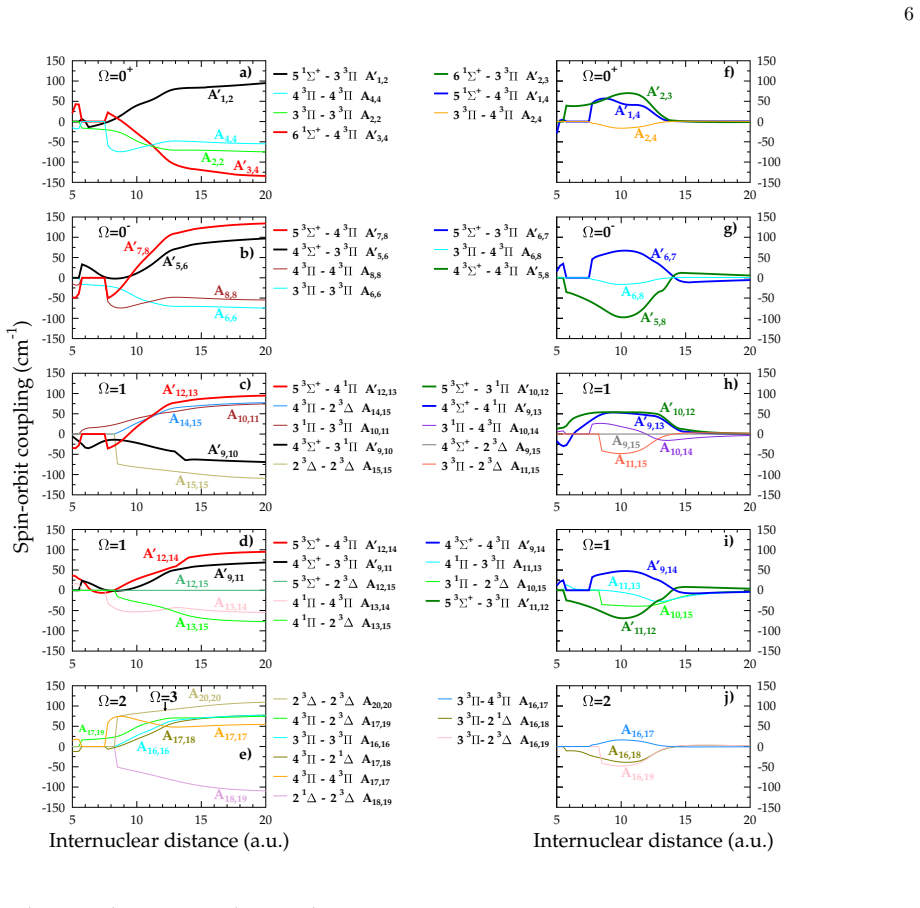
Asymptote S + P 5 1Σ+ 3 3Π+ wso Ω=0+ = 0 B@ 0 AP√ 2 AP√ 2 − AP 2 1 CA 5 1Σ+ 3 3Π+ (B1) 4 3Σ+ 3 3Π+ wso Ω=0− = 0 B@ 0 AP√ 2 AP√ 2 − AP 2 1 CA 4 3Σ+ 3 3Π+ (B2) 4 3Σ+ 3 1Π 3 3Π wso Ω=1 = 0 BBBB@ 0 − AP 2 AP 2 − AP 2 0 AP 2AP 2 AP 2 0 1 CCCCA 4 3Σ+ 3 1Π 3 3Π (B3) 3 3Π wso Ω=2 = AP 2 3 3Π (B4)
-
[2]
[ 34] we have ex- trapolated our calculated SOCs from 45 a.u
Asymptote S + D 6 1Σ+ 4 3Π wso Ω=0+ = 0 @ 0 −AD q 3 2 −AD q 3 2 − AD 2 1 A 6 1Σ+ 4 3Π (B5) 5 3Σ+ 4 3Π wso Ω=0− = 0 @ 0 AD q 3 2 AD q 3 2 − AD 2 1 A 5 3Σ+ 4 3Π (B6) 5 3Σ+ 4 1Π 4 3Π 2 3∆ wso Ω=1 = 0 BBBB@ 0 AD √ 3 2 AD √ 3 2 0 AD √ 3 2 0 − AD 2 − AD√ 2 AD √ 3 2 − AD 2 0 AD√ 2 0 − AD√ 2 AD√ 2 −AD 1 CCCCA 5 3Σ+ 4 1Π 4 3Π 2 3∆ (B7) 4 3Π 2 1∆ 2 3∆ wso Ω=2 = 0 B...
-
[3]
W. D. Phillips, Rev. Mod. Phys. 70, 721 (1998)
1998
-
[4]
C. N. Cohen-Tannoudji, Rev. Mod. Phys. 70, 707 (1998)
1998
-
[5]
Chu, Rev
S. Chu, Rev. Mod. Phys. 70, 685 (1998)
1998
-
[6]
D. J. Wineland, Rev. Mod. Phys. 85, 1103 (2013)
2013
-
[7]
E. A. Cornell and C. E. Wieman, Rev. Mod. Phys. 74, 875 (2002)
2002
-
[8]
Ketterle, Rev
W. Ketterle, Rev. Mod. Phys. 74 (2002)
2002
-
[9]
O. P. Makarov, R. Côté, H. Michels, and W. W. Smith, Phys. Rev. A 67, 042705 (2003)
2003
-
[10]
Tomza, K
M. Tomza, K. Jachymski, R. Gerritsma, A. Negretti, T. Calarco, Z. Idziaszek, and P. S. Julienne, Rev. Mod. Phys. 91, 035001 (2019)
2019
-
[11]
Karpa and O
L. Karpa and O. Dulieu, Phys. Rev. Res. 7, 021002 (2025)
2025
-
[12]
da Silva Jr, M
H. da Silva Jr, M. Raoult, M. Aymar, and O. Dulieu, New J. Phys. 17, 045015 (2015)
2015
-
[13]
F. H. J. Hall, M. Aymar, N. Bouloufa, O. Dulieu, and S. Willitsch, Phys. Rev. Lett. 107, 243202 (2011)
2011
-
[14]
F. H. Hall, P. Eberle, G. Hegi, M. Raoult, M. Aymar, O. Dulieu, and S. Willitsch, Molec. Phys. 111, 2020 (2013)
2020
-
[15]
Ben-shlomi, R
R. Ben-shlomi, R. Vexiau, Z. Meir, T. Sikorsky, N. Ak- erman, M. Pinkas, O. Dulieu, and R. Ozeri, Phys. Rev. A 102, 031301 (2020)
2020
-
[16]
F. H. Hall, M. Aymar, M. Raoult, O. Dulieu, and S. Willitsch, Molec. Phys. 111, 1683 (2013)
2013
-
[17]
Mohammadi, A
A. Mohammadi, A. Krükow, A. Mahdian, M. Deiß, J. Pérez-Ríos, H. da Silva, M. Raoult, O. Dulieu, and J. Hecker Denschlag, Phys. Rev. Research 3, 013196 (2021)
2021
-
[18]
Ratschbacher, C
L. Ratschbacher, C. Zipkes, C. Sias, and M. Köhl, Nature Phys. 8, 649 (2012)
2012
-
[19]
S. Haze, R. Saito, M. Fujinaga, and T. Mukaiyama, Phys. Rev. A 91, 032709 (2015)
2015
-
[20]
Saito, S
R. Saito, S. Haze, M. Sasakawa, R. Nakai, M. Raoult, H. Da Silva, O. Dulieu, and T. Mukaiyama, Phys. Rev. A 95, 032709 (2017)
2017
-
[21]
X. Xing, P. Weckesser, F. Thielemann, T. Jónás, R. Vex- iau, N. Bouloufa-Maafa, E. Luc-Koenig, K. Madison, A. Orbán, T. Xie, T. Schaetz, and O. Dulieu, J. Phys. B 57, 245201 (2024)
2024
-
[22]
Joger, H
J. Joger, H. Fürst, N. Ewald, T. Feldker, M. Tomza, and R. Gerritsma, Phys. Rev. A 96, 030703 (2017)
2017
-
[23]
Sikorsky, R
T. Sikorsky, R. B.-s. Ziv Meir, N. Akerman, and R. Oz- eri, Nat. Commun. 9, 920 (2018)
2018
-
[24]
Aymar, R
M. Aymar, R. Guérout, and O. Dulieu, J. Chem. Phys. 135, 064305 (2011)
2011
-
[25]
Farjallah, H
M. Farjallah, H. Ladjimi, W. Zrafi, and H. Berriche, Atoms 13 (2025)
2025
-
[26]
Śmiałkowski and M
M. Śmiałkowski and M. Tomza, Phys. Rev. A 101, 012501 (2020)
2020
-
[27]
M. Z. Walewski, M. D. Frye, O. Katz, M. Pinkas, R. Oz- eri, and M. Tomza, Science Advances 11, eadr8256 (2025)
2025
-
[28]
Weckesser, F
P. Weckesser, F. Thielemann, D. Wiater, A. Wo- jciechowska, L. Karpa, K. Jachymski, M. Tomza, T. Walker, and T. Schaetz, Nature 600, 429 (2021)
2021
-
[29]
Deiglmayr, M
J. Deiglmayr, M. Aymar, R. Wester, M. Weidemüller, and O. Dulieu, J. Chem. Phys. 129, 064309 (2008)
2008
-
[30]
Cold chemistry: Molecular scattering and reactivity near absolute zero,
M. Lepers and O. Dulieu, “Cold chemistry: Molecular scattering and reactivity near absolute zero,” (The Royal Society of Chemistry, 2018) Chap. 4, pp. 150–202
2018
-
[31]
M. S. Safronova and U. I. Safronova, Phys. Rev. A 83, 052508 (2011)
2011
-
[32]
Cimiraglia, J
R. Cimiraglia, J. P. Malrieu, M. Persico, and F. Spiegel- mann, J. Phys. B 18, 3073 (1985)
1985
-
[33]
X. Xing, H. da Silva Jr., R. Vexiau, N. Bouloufa-Maafa, S. Willitsch, and O. Dulieu, Phys. Rev. A 106, 062609 (2022)
2022
-
[34]
Szczepkowski, A
J. Szczepkowski, A. Grochola, W. Jastrzebski, P. Kowal- czyk, R. Vexiau, N. Bouloufa-Maafa, and O. Dulieu, J. Quant. Spectrosc. Radiat. Transf. 291, 108330 (2022)
2022
-
[35]
Kramida, Yu
A. Kramida, Yu. Ralchenko, J. Reader, and and NIST ASD Team, NIST Atomic Spectra Database (ver. 5.9), [Online]. A vailable: https://physics.nist.gov/asd [Aug. 24, 2022]. National Institute of Standards and Technology, Gaithersburg, MD. (2021)
2022
-
[36]
E. A. Bormotova, S. V. Kozlov, E. A. Pazyuk, A. V. Stol- yarov, W. Skomorowski, I. Majewska, and R. Moszynski, Sci. Adv 11, eadr8256 (2019)
2019
-
[37]
S. J. Singer and K. F. Freed, J. Chem. Phys 79, 6060 (1983)
1983
-
[38]
Johnson, J
B. Johnson, J. Comp. Phys. 13, 445 (1973)
1973
-
[39]
M. H. Alexander and D. E. Manolopoulos, J. Chem. Phys. 86, 2044 (1987)
2044
-
[40]
Côté and A
R. Côté and A. Dalgarno, Phys. Rev. A 62, 012709 (2000)
2000
discussion (0)
Sign in with ORCID, Apple, or X to comment. Anyone can read and Pith papers without signing in.