Reconstructing OPC UA Address Spaces from Time-Series Databases
Pith reviewed 2026-06-27 11:12 UTC · model grok-4.3
The pith
A lifecycle-stable join key lets time-series databases store and reconstruct full OPC UA address spaces.
A machine-rendered reading of the paper's core claim, the machinery that carries it, and where it could break.
Core claim
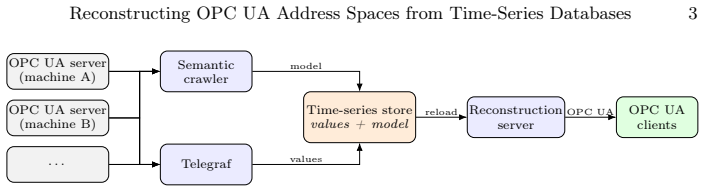
The paper presents opcua-ts, an architecture that persists OPC UA semantic information alongside its telemetry in a time-series database under a lifecycle-stable join key and reconstructs the source address space as a live OPC UA endpoint. It characterizes the conditions under which this reconstruction remains sound across multi-source deployments and validates the approach through a NodeSet2 XML round-trip against the source server, with initial boiler-simulator results indicating feasibility.
What carries the argument
The opcua-ts architecture, which attaches semantic metadata to telemetry records via a lifecycle-stable join key to enable reconstruction of the full OPC UA address space.
If this is right
- Reconstruction succeeds when the join key remains invariant across server restarts and across separate source servers.
- A NodeSet2 XML export from the reconstructed endpoint matches the original source under the characterized conditions.
- Multi-source deployments avoid collisions provided the join key scheme is applied consistently.
- Telemetry retains its original semantic context for live OPC UA queries after archiving.
Where Pith is reading between the lines
- The same join-key approach could be applied to other protocols that separate telemetry from metadata.
- Analytics tools could query historical values while still using the full reconstructed type and hierarchy information.
- Performance limits would appear first in very large multi-source setups where join-key uniqueness must be maintained.
- Existing time-series databases could adopt the scheme without changing their core storage format.
Load-bearing premise
Semantic metadata can be captured at the source and linked to telemetry via a lifecycle-stable join key without identifier collisions or instability across restarts and multi-source deployments.
What would settle it
Run the NodeSet2 XML round-trip on the reconstructed endpoint and observe any mismatch in node hierarchy, engineering units, or type definitions compared to the original source server.
Figures
read the original abstract
OPC UA has become the dominant open protocol in operational technology. Time-series databases routinely archive OPC UA telemetry but discard the semantic metadata (node hierarchy, engineering units, and type definitions) which gives sensor values their meaning. Recovering this information from a time-series database is non-trivial: namespace indices recorded at the source are session-local and unstable across restarts, and naive merging across multiple source servers results in identifier collisions. We present opcua-ts, an implemented architecture that persists this semantic information alongside its telemetry in a general-purpose time-series database under a lifecycle-stable join key, and that reconstructs the source address space as a live OPC UA endpoint. We characterize the conditions under which the reconstruction is sound across multi-source deployments and validate the approach with a NodeSet2 XML round-trip against the source server. Initial results from a boiler-simulator round-trip indicate that the approach is feasible.
Editorial analysis
A structured set of objections, weighed in public.
Referee Report
Summary. The paper presents opcua-ts, an implemented architecture for persisting OPC UA semantic metadata (node hierarchy, engineering units, type definitions) alongside telemetry in a general-purpose time-series database under a lifecycle-stable join key. This enables reconstruction of the source address space as a live OPC UA endpoint. The authors characterize conditions for sound reconstruction across multi-source deployments and report validation via NodeSet2 XML round-trip against the source plus initial boiler-simulator results.
Significance. If the join-key scheme proves stable and collision-free, the work would address a practical gap in OT data management by allowing semantic context to be retained when archiving OPC UA telemetry in standard TSDBs. The implemented architecture and round-trip validation approach constitute a concrete engineering contribution, though the absence of quantitative metrics limits assessment of its robustness.
major comments (2)
- [Abstract] Abstract: the validation is described only as 'NodeSet2 XML round-trip' and 'initial results from a boiler-simulator round-trip' with no quantitative error rates, success metrics, or full methods provided, so the central feasibility claim cannot be evaluated from the text.
- [Soundness characterization] The section characterizing conditions for soundness: the claim that the lifecycle-stable join key avoids identifier collisions across restarts and multi-source deployments rests on informal conditions without a formal injectivity argument or exhaustive enumeration of edge cases (simultaneous restarts, pre-assignment overlapping node IDs), leaving collision avoidance as an assumption rather than a demonstrated property.
minor comments (1)
- [Abstract] The abstract refers to 'conditions under which the reconstruction is sound' but does not indicate whether these conditions are stated as theorems, lemmas, or informal lists.
Simulated Author's Rebuttal
We thank the referee for the constructive comments on our manuscript. We address each major comment below and indicate the revisions we will make.
read point-by-point responses
-
Referee: [Abstract] Abstract: the validation is described only as 'NodeSet2 XML round-trip' and 'initial results from a boiler-simulator round-trip' with no quantitative error rates, success metrics, or full methods provided, so the central feasibility claim cannot be evaluated from the text.
Authors: We agree that the abstract provides insufficient quantitative detail on the validation results. In the revised version we will expand the abstract to report specific metrics from the NodeSet2 round-trip (e.g., node reconstruction success rate and any observed discrepancies) and will add a brief reference to the validation methodology. Corresponding quantitative results and methods details will also be strengthened in the main text. revision: yes
-
Referee: [Soundness characterization] The section characterizing conditions for soundness: the claim that the lifecycle-stable join key avoids identifier collisions across restarts and multi-source deployments rests on informal conditions without a formal injectivity argument or exhaustive enumeration of edge cases (simultaneous restarts, pre-assignment overlapping node IDs), leaving collision avoidance as an assumption rather than a demonstrated property.
Authors: The soundness section presents practical conditions derived from OPC UA namespace behavior and our implementation. We acknowledge the absence of a formal injectivity proof or exhaustive edge-case analysis. In revision we will add an explicit discussion of the listed edge cases (simultaneous restarts, pre-assigned overlapping IDs) and explain how the join-key construction addresses them; a full formal proof is outside the paper's scope but we will clarify that collision avoidance is conditional on the stated assumptions rather than unconditionally demonstrated. revision: partial
Circularity Check
No circularity; claims rest on implementation description and external round-trip validation
full rationale
The paper describes an implemented architecture (opcua-ts) for persisting semantic metadata with telemetry under a lifecycle-stable join key and reconstructing the address space. Validation is performed via NodeSet2 XML round-trip against the source server and boiler-simulator results. No equations, fitted parameters, self-definitional reductions, or load-bearing self-citations appear in the provided text. The soundness characterization is presented as part of the contribution rather than derived from prior self-referential steps. This is a standard non-circular implementation paper.
Axiom & Free-Parameter Ledger
axioms (2)
- domain assumption Namespace indices recorded at the source are session-local and unstable across restarts
- domain assumption Naive merging across multiple source servers results in identifier collisions
Reference graph
Works this paper leans on
-
[1]
https://github.com/influxdata/telegraf/tree/master/plugins/inputs/opcua (2024)
InfluxData : Telegraf OPC UA Input Plugin . https://github.com/influxdata/telegraf/tree/master/plugins/inputs/opcua (2024)
2024
-
[2]
Specification Release 1.05, OPC Foundation (2023)
OPC Foundation : OPC UA Specification, Part 11 (Historical Access) . Specification Release 1.05, OPC Foundation (2023)
2023
-
[3]
Specification Release 1.05, OPC Foundation (2023)
OPC Foundation : OPC UA Specification, Parts 1 (Overview) and 6 (Mappings) . Specification Release 1.05, OPC Foundation (2023)
2023
-
[4]
https://github.com/node-opcua/node-opcua (2024)
Rossignol, E.: node-opcua --- OPC UA stack for Node.js . https://github.com/node-opcua/node-opcua (2024)
2024
-
[5]
Rossignol, Etienne , title =
discussion (0)
Sign in with ORCID, Apple, or X to comment. Anyone can read and Pith papers without signing in.