A Multiwavelength Interpretation of HESS J1857+026 Emission Using the Fermi-LAT, VERITAS, and HAWC Observatories
Pith reviewed 2026-06-27 12:22 UTC · model grok-4.3
The pith
Multi-instrument observations identify HESS J1857+026 as a pulsar wind nebula powered by PSR J1856+0245 with emission from inverse Compton scattering.
A machine-rendered reading of the paper's core claim, the machinery that carries it, and where it could break.
Core claim
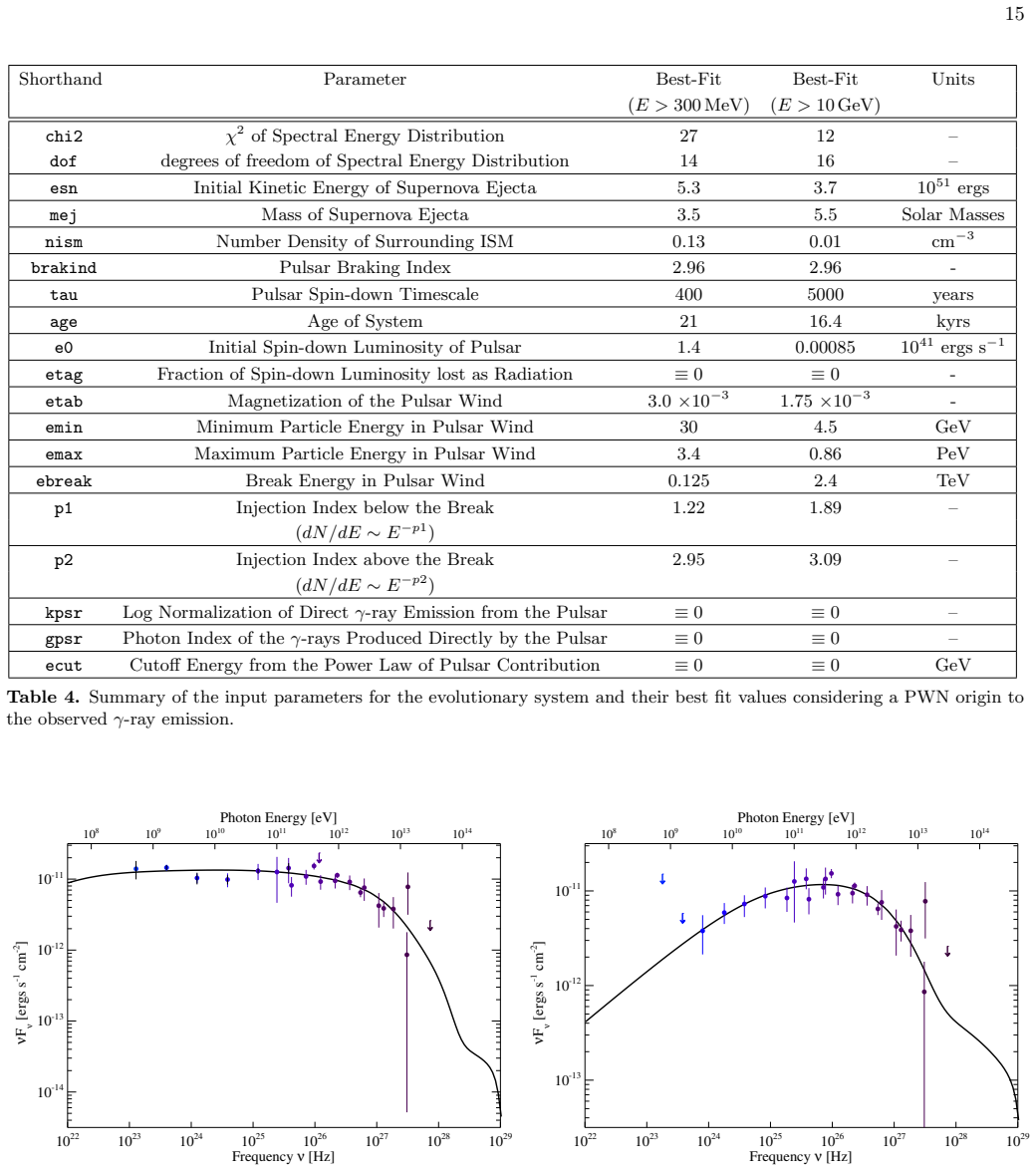
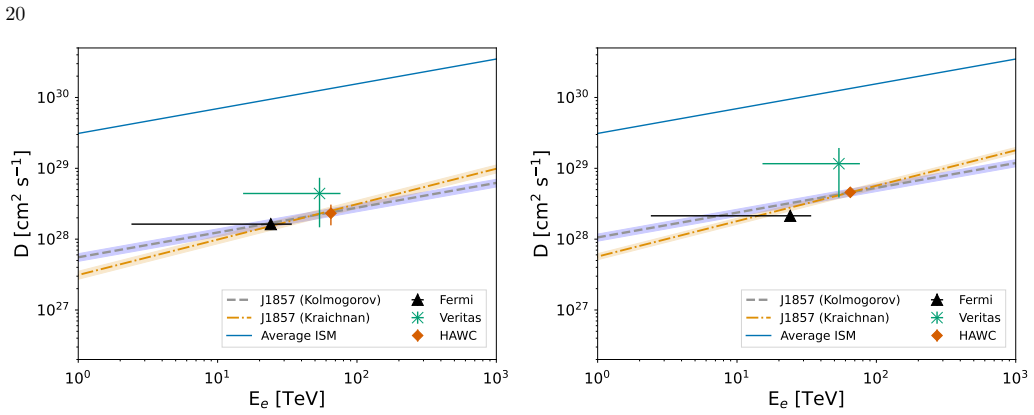
The likely dominant gamma-ray origin of HESS J1857+026 is a pulsar wind nebula powered by PSR J1856+0245. Basic evolutionary radiative modeling assuming a PWN origin constrains the system age to 16-21 kyr and magnetic field to 0.4-1.6 μG. The gamma-ray emission is generated by relativistic electrons via inverse Compton scattering off local photon fields, though the low-energy spectral component below 10 GeV could be dominated by hadronic emission from a supernova remnant. For the PWN component above 10 GeV the local diffusion coefficient at 50 TeV is around 10^28 cm² s⁻¹, suppressed compared to the interstellar medium value.
What carries the argument
PWN evolutionary radiative modeling combined with multi-instrument spatial and spectral analysis of the MeV-TeV emission and radial surface brightness profiles.
Load-bearing premise
The observed MeV-TeV spectrum and radial profiles can be accurately reproduced by PWN evolutionary radiative modeling with only minor hadronic contribution below 10 GeV.
What would settle it
A radial surface brightness profile across energies that deviates from the diffusion length predicted by the PWN model, or a combined spectrum that cannot be fit by the inverse Compton component plus a minor low-energy hadronic term.
Figures
read the original abstract
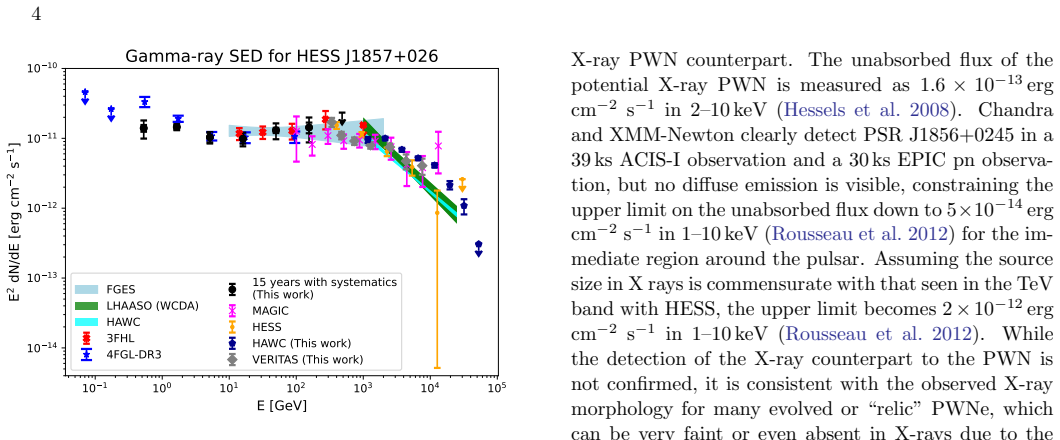
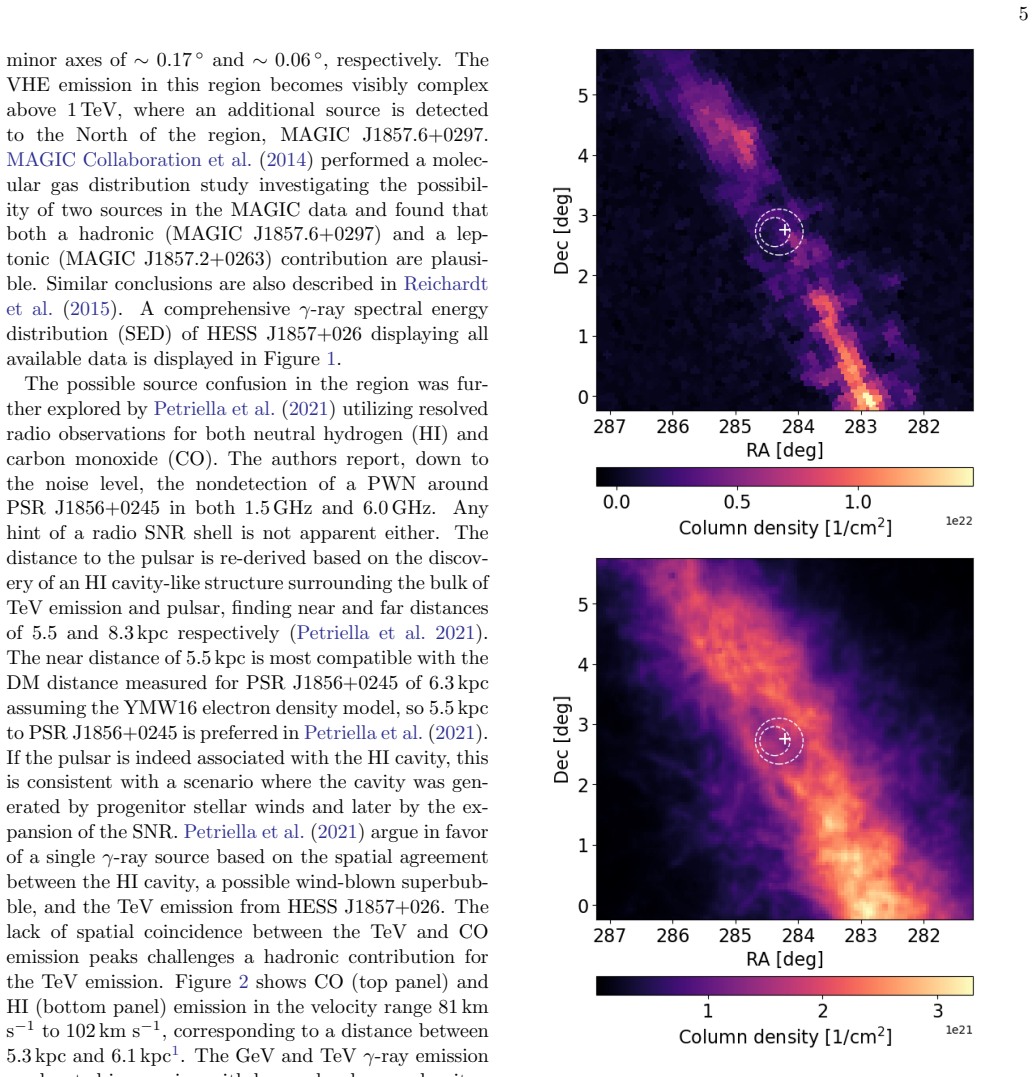
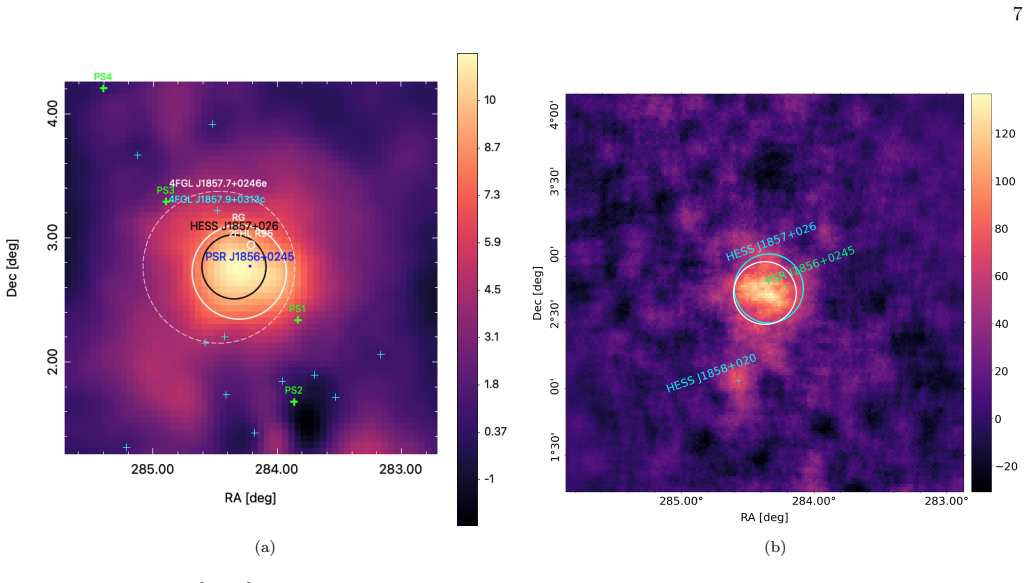
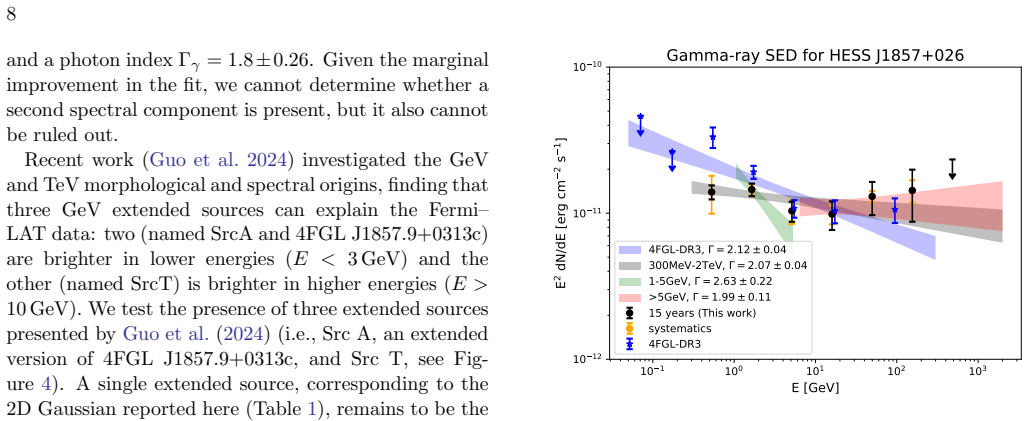
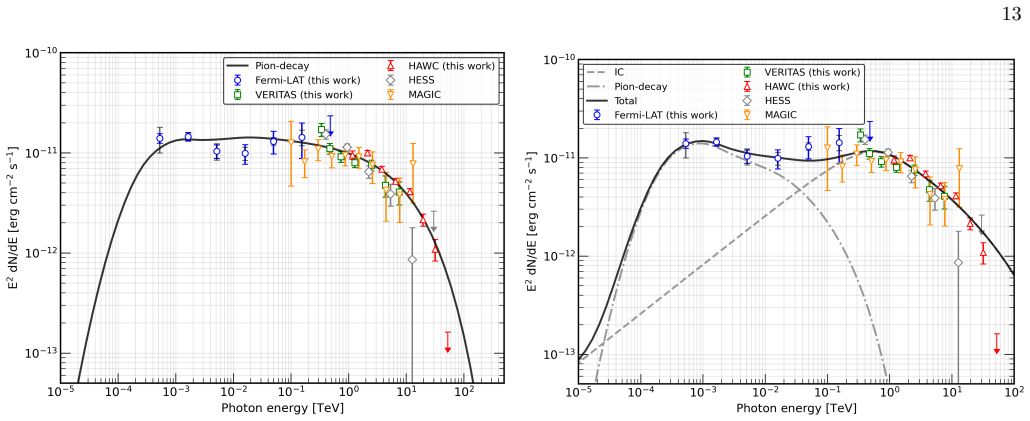
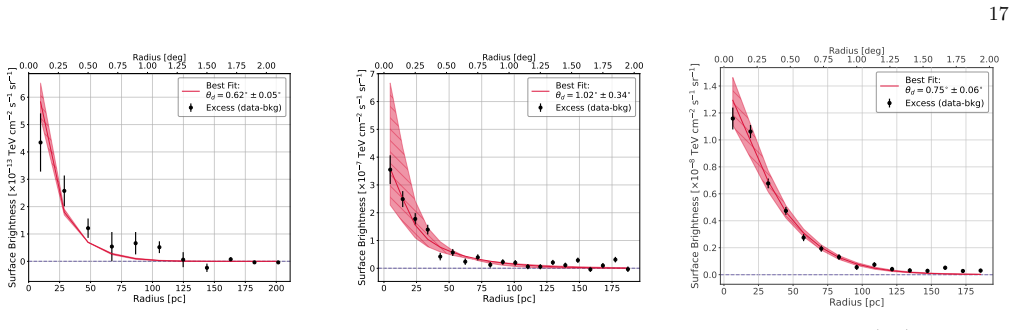
We present a new study on the MeV-TeV gamma-ray origin of HESS J1857+026 using data collected from the Fermi-LAT, VERITAS, and HAWC observatories. A spatial and spectral study of HESS J1857+026 including radiative modeling of the MeV-TeV spectrum determines the likely dominant gamma-ray origin as a pulsar wind nebula (PWN) powered by the energetic pulsar PSR J1856+0245. The MeV-TeV spectrum is further characterized through basic evolutionary radiative modeling assuming a PWN origin to constrain the physical properties of the system such as the magnetic field strength and PWN age. The results of the PWN evolutionary model are consistent with the observational constraints of the system, finding an age of the system between t = [16,21]kyr and a magnetic field strength between B = [0.4,1.6]muG. These estimates support an evolved PWN scenario where the observed gamma-ray emission is generated by the relativistic electrons inverse Compton scattering (ICS) off local photon fields, however the low-energy (E < 10GeV) spectral component could be dominated by hadronic emission originating from a supernova remnant (SNR). For a PWN component above 10GeV, we measure the conditions for particle diffusion, finding that the local diffusion (D(50TeV) ~ $10^{28}cm^{-2}s^{-1}$) is suppressed compared to the interstellar medium (ISM) value, in agreement with similar TeV PWNe. By measuring the radial surface brightness profiles of the gamma-ray source across multiple instruments, we demonstrate that the combined MeV-TeV spatial information is a powerful tool to constrain particle diffusion properties.
Editorial analysis
A structured set of objections, weighed in public.
Referee Report
Summary. The manuscript presents a multi-instrument study of HESS J1857+026 combining Fermi-LAT, VERITAS, and HAWC data. It concludes that the MeV-TeV emission is dominated by a pulsar wind nebula (PWN) powered by PSR J1856+0245. Basic evolutionary radiative modeling assuming a PWN origin is used to derive an age of 16-21 kyr and magnetic field strength of 0.4-1.6 μG, attributing the spectrum above ~10 GeV to inverse Compton scattering while allowing a possible hadronic SNR contribution below 10 GeV. Radial surface brightness profiles across instruments are analyzed to constrain particle diffusion, yielding D(50 TeV) ~ 10^{28} cm² s^{-1} suppressed relative to the ISM.
Significance. If the modeling and data combination are shown to be robust, the work would contribute constraints on an evolved PWN system and diffusion properties in the TeV regime, consistent with other sources. The multiwavelength spatial-spectral approach is a potential strength for constraining diffusion.
major comments (3)
- [PWN evolutionary modeling description] The radiative modeling section provides no details on fitting procedures, optimization method, error propagation, data exclusion criteria, or cross-instrument calibration for deriving the age t = [16,21] kyr and B = [0.4,1.6] μG. This prevents evaluation of whether the 10 GeV break partition is unique or statistically preferred.
- [Abstract and spectral component discussion] The assumption that the 10 GeV break cleanly separates leptonic PWN (ICS) and hadronic SNR components is not tested against alternatives such as a single-component PWN model with adjusted injection index or cutoff; this partition is load-bearing for the reported age, B, and D(50 TeV) values.
- [Diffusion coefficient and multi-instrument fit] The joint spectral and radial-profile analysis across three instruments does not specify inclusion of a covariance matrix for cross-calibration systematics; treating errors as independent statistical uncertainties undermines the claimed robustness of the diffusion coefficient and its suppression relative to ISM.
minor comments (1)
- [Abstract] Notation in the abstract (e.g., 'muG', 'cm^{-2}s^{-1}') should be standardized to conventional symbols (μG, cm² s^{-1}) for consistency.
Simulated Author's Rebuttal
Thank you for the opportunity to respond to the referee's comments on our manuscript. We address each major comment point by point below, providing the strongest honest defense of our work while acknowledging where revisions are warranted.
read point-by-point responses
-
Referee: The radiative modeling section provides no details on fitting procedures, optimization method, error propagation, data exclusion criteria, or cross-instrument calibration for deriving the age t = [16,21] kyr and B = [0.4,1.6] μG. This prevents evaluation of whether the 10 GeV break partition is unique or statistically preferred.
Authors: We agree that the original manuscript provided insufficient detail on the modeling procedure. The revised manuscript now includes an expanded section describing the approach: a grid-based exploration of parameter space (age, B-field, injection spectrum) constrained by matching the observed MeV-TeV spectrum to the PWN evolutionary model while remaining consistent with the pulsar's spin-down luminosity and characteristic age. Acceptable ranges for t and B are those yielding model spectra within the data uncertainties; no data points were excluded beyond instrument sensitivity thresholds, and standard instrument responses were used without additional cross-calibration factors. This makes the derivation reproducible and shows the reported ranges are the envelope of viable solutions. revision: yes
-
Referee: The assumption that the 10 GeV break cleanly separates leptonic PWN (ICS) and hadronic SNR components is not tested against alternatives such as a single-component PWN model with adjusted injection index or cutoff; this partition is load-bearing for the reported age, B, and D(50 TeV) values.
Authors: The two-component interpretation is motivated by the spectral hardening below 10 GeV combined with the more compact morphology at TeV energies versus the extended low-energy emission. We have added text in the revised manuscript explaining why a single leptonic PWN component would require an unusually hard injection index or cutoff that conflicts with typical PWN spectra and the pulsar's properties. A full quantitative comparison to alternative single-component fits lies outside the scope of the current analysis, which focuses on the multi-instrument PWN interpretation supported by the data. revision: partial
-
Referee: The joint spectral and radial-profile analysis across three instruments does not specify inclusion of a covariance matrix for cross-calibration systematics; treating errors as independent statistical uncertainties undermines the claimed robustness of the diffusion coefficient and its suppression relative to ISM.
Authors: We acknowledge this limitation. The radial brightness profile analysis used statistical uncertainties only, as a covariance matrix for cross-calibration systematics among Fermi-LAT, VERITAS, and HAWC is not available in the literature for this source combination. The revised manuscript now explicitly states this caveat and notes that the derived D(50 TeV) ~ 10^28 cm² s⁻¹ remains suppressed relative to typical ISM values even when allowing for plausible additional systematics. The multi-instrument spatial consistency still supports the diffusion constraint. revision: partial
Circularity Check
No significant circularity; modeling yields fitted parameters presented as constraints
full rationale
The paper performs standard evolutionary radiative modeling (ICS) to fit the observed MeV-TeV spectrum under a PWN assumption, deriving age and B ranges that are then noted as consistent with independent observational constraints on the pulsar and system. This is ordinary parameter estimation from data, not a self-referential loop in which outputs are redefined as inputs or predictions. No quoted step reduces a claimed prediction to the fit by construction, and the multi-instrument spatial/spectral analysis plus diffusion measurement rest on direct data rather than self-citation chains. The partition into leptonic/hadronic components is an assumption, but does not create definitional circularity.
Axiom & Free-Parameter Ledger
free parameters (2)
- PWN age =
[16,21] kyr
- Magnetic field strength =
[0.4,1.6] μG
axioms (1)
- domain assumption Gamma-ray emission above 10 GeV is dominated by inverse Compton scattering of relativistic electrons in a PWN
Reference graph
Works this paper leans on
-
[1]
Abdelmaguid, M., Gelfand, J. D., Gotthelf, E., & Straal, S. 2023, ApJ, 946, 40, doi: 10.3847/1538-4357/acbd30
-
[2]
Abdollahi, S., Acero, F., Ackermann, M., et al. 2020, ApJS, 247, 33, doi: 10.3847/1538-4365/ab6bcb
-
[3]
Abdollahi, S., Acero, F., Baldini, L., et al. 2022, ApJS, 260, 53, doi: 10.3847/1538-4365/ac6751
-
[4]
2017, Science, 358, 911
Abeysekara, A., Albert, A., Alfaro, R., et al. 2017, Science, 358, 911
2017
-
[5]
U., Albert, A., Alfaro, R., et al
Abeysekara, A. U., Albert, A., Alfaro, R., et al. 2017, ApJ, 843, 39, doi: 10.3847/1538-4357/aa7555
-
[6]
doi:10.1126/science.aan4880 , eprint =
Abeysekara, A. U., Albert, A., Alfaro, R., et al. 2017, Science, 358, 911, doi: 10.1126/science.aan4880
-
[7]
U., Albert, A., Alfaro, R., et al
Abeysekara, A. U., Albert, A., Alfaro, R., et al. 2019, ApJ, 881, 134, doi: 10.3847/1538-4357/ab2f7d
-
[8]
Abeysekara, A. U., Albert, A., Alfaro, R. J., et al. 2022, in Proceedings of 37th International Cosmic Ray Conference — PoS(ICRC2021), Vol. 395 (SISSA Medialab), 828, doi: 10.22323/1.395.0828
-
[9]
2013, ApJ, 773, 77, doi: 10.1088/0004-637X/773/1/77
Acero, F., Ackermann, M., Ajello, M., et al. 2013, ApJ, 773, 77, doi: 10.1088/0004-637X/773/1/77
-
[10]
2016, ApJS, 223, 26, doi: 10.3847/0067-0049/223/2/26
Acero, F., Ackermann, M., Ajello, M., et al. 2016, ApJS, 223, 26, doi: 10.3847/0067-0049/223/2/26
-
[11]
2025, Gammapy: Python toolbox for gamma-ray astronomy, v1.3, Zenodo, doi: 10.5281/zenodo.14760974
Acero, F., Aguasca-Cabot, A., Bernete, J., et al. 2025, Gammapy: Python toolbox for gamma-ray astronomy, v1.3, Zenodo, doi: 10.5281/zenodo.14760974
-
[12]
Acharyya, A., Adams, C. B., Bangale, P., et al. 2024, ApJ, 974, 61, doi: 10.3847/1538-4357/ad698d
-
[13]
Ackermann, M., Ajello, M., Atwood, W. B., et al. 2016, ApJS, 222, 5, doi: 10.3847/0067-0049/222/1/5
-
[14]
2017, ApJ, 843, 139, doi: 10.3847/1538-4357/aa775a
Ackermann, M., Ajello, M., Baldini, L., et al. 2017, ApJ, 843, 139, doi: 10.3847/1538-4357/aa775a
-
[15]
G., Barres de Almeida, U., et al
Aharonian, F., Akhperjanian, A. G., Barres de Almeida, U., et al. 2008, A&A, 477, 353, doi: 10.1051/0004-6361:20078516
-
[16]
Aharonian, F. A. 2004, Very high energy cosmic gamma radiation : a crucial window on the extreme Universe (World Scientific Connect), doi: 10.1142/4657
-
[17]
A., Atoyan, A
Aharonian, F. A., Atoyan, A. M., & Voelk, H. J. 1995, A&A, 294, L41
1995
-
[18]
Ajello, M., Atwood, W. B., Baldini, L., et al. 2017, ApJS, 232, 18, doi: 10.3847/1538-4365/aa8221
-
[19]
2020, ApJ, 905, 76, doi: 10.3847/1538-4357/abc2d8
Albert, A., Alfaro, R., Alvarez, C., et al. 2020, ApJ, 905, 76, doi: 10.3847/1538-4357/abc2d8
-
[20]
Albert, A., Alfaro, R. J., Alvarez, C., et al. 2023, in Proceedings of 38th International Cosmic Ray Conference — PoS(ICRC2023) (Nagoya, Japan: Sissa Medialab), 759, doi: 10.22323/1.444.0759
-
[21]
Albert, A., Alfaro, R., Alvarez, C., et al. 2024a, The Astrophysical Journal, 972, 144, doi: 10.3847/1538-4357/ad5f2d —. 2024b, The Astrophysical Journal, 974, 246, doi: 10.3847/1538-4357/ad738e
-
[22]
Alfaro, R., Alvarez, C., Andr´ es, A., et al. 2025, HAWC Performance Enhanced by Machine Learning in Gamma-Hadron Separation, arXiv, doi: 10.48550/arXiv.2506.18277
-
[23]
2013, arXiv e-prints, arXiv:1303.3514
Atwood, W., Albert, A., Baldini, L., et al. 2013, arXiv e-prints, arXiv:1303.3514. https://arxiv.org/abs/1303.3514
arXiv 2013
-
[24]
B., et al., 2009, @doi [ ] 10.1088/0004-637x/697/2/1071 , 697, 1071–1102
Atwood, W. B., Abdo, A. A., Ackermann, M., et al. 2009, ApJ, 697, 1071, doi: 10.1088/0004-637X/697/2/1071
-
[25]
2007, Astronomy & Astrophysics, 466, 1219, doi: 10.1051/0004-6361:20066674
Berge, D., Funk, S., & Hinton, J. 2007, Astronomy & Astrophysics, 466, 1219, doi: 10.1051/0004-6361:20066674
-
[26]
2023, V2DL3 - VERITAS (VEGAS and Eventdisplay) to DL3 Converter., 0.5.0, doi: 10.5281/zenodo.8306205
Bird, R., Lin, T., Hassan, T., et al. 2023, V2DL3 - VERITAS (VEGAS and Eventdisplay) to DL3 Converter., 0.5.0, doi: 10.5281/zenodo.8306205
-
[27]
Bozdogan, H. 1987, Psychometrika, 52, 345, doi: 10.1007/BF02294361
-
[28]
Bruel, P., Burnett, T. H., Digel, S. W., et al. 2018, arXiv e-prints, arXiv:1810.11394. https://arxiv.org/abs/1810.11394
Pith/arXiv arXiv 2018
-
[29]
Bucciantini, N., Arons, J., & Amato, E. 2011, MNRAS, 410, 381, doi: 10.1111/j.1365-2966.2010.17449.x
-
[30]
2021, Nature, 594, 33
Cao, Z., Aharonian, F., An, Q., et al. 2021, Nature, 594, 33
2021
-
[31]
The First LHAASO Catalog of Gamma-Ray Sources.Astron
Cao, Z., Aharonian, F., An, Q., et al. 2024, ApJS, 271, 25, doi: 10.3847/1538-4365/acfd29
-
[32]
2020, A&A, 642, A123, doi: 10.1051/0004-6361/202038883
Cerutti, B., & Giacinti, G. 2020, A&A, 642, A123, doi: 10.1051/0004-6361/202038883
-
[33]
M., Hartmann, D., & Thaddeus, P
Dame, T. M., Hartmann, D., & Thaddeus, P. 2001, The Astrophysical Journal, 547, 792 Di Mauro, M., et al. 2020, Physical Review D, 101, 103035
2001
-
[34]
Donath, A., Terrier, R., Remy, Q., et al. 2023, A&A, 678, A157, doi: 10.1051/0004-6361/202346488
-
[35]
2021, A&A, 653, A18, doi: 10.1051/0004-6361/202140801
Dundovic, A., Evoli, C., Gaggero, D., & Grasso, D. 2021, A&A, 653, A18, doi: 10.1051/0004-6361/202140801
-
[36]
2022, ApJ, 940, 143, doi: 10.3847/1538-4357/ac9eb4
Eagle, J., Castro, D., Temim, T., et al. 2022, ApJ, 940, 143, doi: 10.3847/1538-4357/ac9eb4
-
[37]
2023, ApJ, 945, 4, doi:10.3847/1538-4357/acb8b1
Eagle, J., Castro, D., Mahhov, P., et al. 2023, ApJ, 945, 4, doi: 10.3847/1538-4357/acb8b1 Fermi-LAT Collaboration, Acharyya, A., Adelfio, A., et al. 2025, ApJ, 989, 110, doi: 10.3847/1538-4357/ade8f0 Fermi Science Support Development Team. 2019, Fermitools: Fermi Science Tools, Astrophysics Source Code Library, record ascl:1905.011. http://ascl.net/1905.011 23
-
[38]
Measuring Average Treatment Effect from Heavy-tailed Data
Gaensler, B. M., & Slane, P. O. 2006, ARA&A, 44, 17, doi: 10.1146/annurev.astro.44.051905.092528
work page internal anchor Pith review Pith/arXiv arXiv doi:10.1146/annurev.astro.44.051905.092528 2006
-
[39]
Gelfand, J. D., Slane, P. O., & Temim, T. 2015, ApJ, 807, 30, doi: 10.1088/0004-637X/807/1/30
-
[40]
D., Slane, P
Gelfand, J. D., Slane, P. O., & Zhang, W. 2009, The Astrophysical Journal, 703, 2051
2009
-
[41]
2019, Physical Review D, 99, 123028
Genolini, Y., et al. 2019, Physical Review D, 99, 123028
2019
-
[42]
2020, Astronomy & Astrophysics, 636, A113
Giacinti, G., Mitchell, A., L´ opez-Coto, R., et al. 2020, Astronomy & Astrophysics, 636, A113
2020
-
[43]
2026, MNRAS, 547, stag403, doi: 10.1093/mnras/stag403
Gong, Y., Zhou, L., Xia, Q., Zhang, L., & Fang, J. 2026, MNRAS, 547, stag403, doi: 10.1093/mnras/stag403
-
[44]
Gotthelf, E. V., Safi-Harb, S., Straal, S. M., & Gelfand, J. D. 2021, ApJ, 908, 212, doi: 10.3847/1538-4357/abd32b
-
[45]
2024, The Astrophysical Journal, 961, 213, doi: 10.3847/1538-4357/ad168f H
Guo, X., Liu, X., & Xin, Y. 2024, The Astrophysical Journal, 961, 213, doi: 10.3847/1538-4357/ad168f H. E. S. S. Collaboration, Abramowski, A., Acero, F., et al. 2012, A&A, 548, A46, doi: 10.1051/0004-6361/201219814 H. E. S. S. Collaboration, Abdalla, H., Abramowski, A., et al. 2018, A&A, 612, A1, doi: 10.1051/0004-6361/201732098
-
[46]
Hessels, J. W. T., Nice, D. J., Gaensler, B. M., et al. 2008, ApJL, 682, L41, doi: 10.1086/590908
-
[47]
Hinton, J. A., Funk, S., Parsons, R. D., & Ohm, S. 2011, ApJL, 743, L7, doi: 10.1088/2041-8205/743/1/L7
-
[48]
John, I., & Linden, T. 2023, Phys. Rev. D, 108, 103022, doi: 10.1103/PhysRevD.108.103022 J´ ohannesson, G., Porter, T. A., & Moskalenko, I. V. 2019, The Astrophysical Journal, 879, 91, doi: 10.3847/1538-4357/ab258e
-
[49]
Gamma-ray and X-ray Properties of Pulsar Wind Nebulae and Unidentified Galactic TeV Sources
Kargaltsev, O., Rangelov, B., & Pavlov, G. 2013, in The Universe Evolution: Astrophysical and Nuclear Aspects. Edited by I. Strakovsky and L. Blokhintsev. Nova Science Publishers, 359–406, doi: 10.48550/arXiv.1305.2552
work page internal anchor Pith review Pith/arXiv arXiv doi:10.48550/arxiv.1305.2552 2013
-
[50]
Kass, R. E., & Raftery, A. E. 1995, Journal of the American Statistical Association, 90, 773, doi: 10.1080/01621459.1995.10476572
-
[51]
2019, in International Cosmic Ray Conference, Vol
Kheirandish, A., & Wood, J. 2019, in International Cosmic Ray Conference, Vol. 36, 36th International Cosmic Ray Conference (ICRC2019), 932, doi: 10.22323/1.358.0932
-
[52]
2017, Astroparticle Physics, 89, 1, doi: https://doi.org/10.1016/j.astropartphys.2017.01.004
Krause, M., Pueschel, E., & Maier, G. 2017, Astroparticle Physics, 89, 1, doi: https://doi.org/10.1016/j.astropartphys.2017.01.004
-
[53]
Liddle, A. R. 2007, Monthly Notices of the Royal Astronomical Society: Letters, 377, L74, doi: 10.1111/j.1745-3933.2007.00306.x
-
[54]
Luo, J., Ransom, S., Demorest, P., et al. 2021, ApJ, 911, 45, doi: 10.3847/1538-4357/abe62f MAGIC Collaboration, Aleksi´ c, J., Ansoldi, S., et al. 2014, A&A, 571, A96, doi: 10.1051/0004-6361/201423517
-
[55]
2017, PoS, ICRC2017, 747, doi: 10.22323/1.301.0747
Maier, G., & Holder, J. 2017, PoS, ICRC2017, 747, doi: 10.22323/1.301.0747
-
[56]
Maier, G., Holder, J., McCann, A., et al. 2024, Eventdisplay: An Analysis and Reconstruction Package for Ground-based Gamma-ray Astronomy, 5.14.0, doi: 10.5281/zenodo.3559075
-
[57]
2021, ApJ, 912, 158, doi: 10.3847/1538-4357/abef62
Mares, A., Lemoine-Goumard, M., Acero, F., et al. 2021, ApJ, 912, 158, doi: 10.3847/1538-4357/abef62
-
[58]
Mattox, J. R., Bertsch, D. L., Chiang, J., et al. 1996, ApJ, 461, 396, doi: 10.1086/177068
-
[59]
2017, Astroparticle Physics, 90, 75, doi: 10.1016/j.astropartphys.2017.02.007
Merten, L., Becker Tjus, J., Eichmann, B., & Dettmar, R.-J. 2017, Astroparticle Physics, 90, 75, doi: 10.1016/j.astropartphys.2017.02.007
-
[60]
doi:10.1111/j.1365-2966.2005.08938.x , Eprint =
Moderski, R., Sikora, M., Coppi, P. S., & Aharonian, F. 2005, Monthly Notices of the Royal Astronomical Society, 363, 954, doi: 10.1111/j.1365-2966.2005.09494.x
-
[61]
2019, in International Cosmic Ray Conference, Vol
Moskalenko, I., Johannesson, G., & Porter, T. 2019, in International Cosmic Ray Conference, Vol. 36, 36th International Cosmic Ray Conference (ICRC2019), 111, doi: 10.22323/1.358.0111
-
[62]
J., Altiere, E., Bogdanov, S., et al
Nice, D. J., Altiere, E., Bogdanov, S., et al. 2013, ApJ, 772, 50, doi: 10.1088/0004-637X/772/1/50
-
[63]
2021, PhRvD, 103, 103020, doi: 10.1103/PhysRevD.103.103020
Niro, V. 2021, PhRvD, 103, 103020, doi: 10.1103/PhysRevD.103.103020
-
[64]
2010, A&A, 513, A17, doi: 10.1051/0004-6361/200913495
Ohira, Y., Murase, K., & Yamazaki, R. 2010, A&A, 513, A17, doi: 10.1051/0004-6361/200913495
-
[65]
1973, ApJ, 186, 249, doi: 10.1086/152495
Pacini, F., & Salvati, M. 1973, ApJ, 186, 249, doi: 10.1086/152495
-
[66]
L., Zheng, Y., et al
Peek, J., Babler, B. L., Zheng, Y., et al. 2017, The Astrophysical Journal Supplement Series, 234, 2
2017
-
[67]
2021, A&A, 652, A142, doi: 10.1051/0004-6361/202141254
Petriella, A., Duvidovich, L., & Giacani, E. 2021, A&A, 652, A142, doi: 10.1051/0004-6361/202141254
-
[68]
Porter, T. A., Moskalenko, I. V., Strong, A. W., Orlando, E., & Bouchet, L. 2008, ApJ, 682, 400, doi: 10.1086/589615
-
[69]
Principe, G., Mitchell, A. M. W., Caroff, S., et al. 2020, A&A, 640, A76, doi: 10.1051/0004-6361/202038375
-
[70]
Reichardt, I., Carmona, E., Gozzini, S. R., et al. 2015, in European Physical Journal Web of Conferences, Vol. 105, European Physical Journal Web of Conferences, 04003, doi: 10.1051/epjconf/201510504003
-
[71]
Reynolds, S. P., & Chevalier, R. A. 1984, ApJ, 278, 630, doi: 10.1086/161831
-
[72]
Rousseau, R., Grondin, M. H., Van Etten, A., et al. 2012, A&A, 544, A3, doi: 10.1051/0004-6361/201118685
-
[73]
2011, ApJ, 741, 39, doi: 10.1088/0004-637X/741/1/39
Sironi, L., & Spitkovsky, A. 2011, ApJ, 741, 39, doi: 10.1088/0004-637X/741/1/39
-
[74]
2018, ApJ, 865, 86, doi: 10.3847/1538-4357/aada12 24
Slane, P., Lovchinsky, I., Kolb, C., et al. 2018, ApJ, 865, 86, doi: 10.3847/1538-4357/aada12 24
-
[75]
Straal, S. M., Gelfand, J. D., & Eagle, J. L. 2023, ApJ, 942, 103, doi: 10.3847/1538-4357/aca1a9
-
[76]
Strong, A. W., Moskalenko, I. V., Porter, T. A., et al. 2009, The GALPROP Cosmic-Ray Propagation Code. https://arxiv.org/abs/0907.0559
Pith/arXiv arXiv 2009
-
[77]
Sudoh, T., Linden, T., & Beacom, J. F. 2019, Physical Review D, 100, 043016
2019
-
[78]
P., Bucciantini N., 2015, @doi [ ] 10.1088/0004-637x/808/1/100 , 808, 100
Temim, T., Slane, P., Kolb, C., et al. 2015, ApJ, 808, 100, doi: 10.1088/0004-637X/808/1/100
-
[79]
F., Cillis, A., Mart´ ın, J., & de O˜ na Wilhelmi, E
Torres, D. F., Cillis, A., Mart´ ın, J., & de O˜ na Wilhelmi, E. 2014, Journal of High Energy Astrophysics, 1, 31, doi: 10.1016/j.jheap.2014.02.001
-
[80]
Torres, D. F., Romero, G. E., Dame, T. M., Combi, J. A., & Butt, Y. M. 2003, PhR, 382, 303, doi: 10.1016/S0370-1573(03)00201-1
discussion (0)
Sign in with ORCID, Apple, or X to comment. Anyone can read and Pith papers without signing in.