Fermi-LAT Gamma-ray Emission Discovered from the Composite Supernova Remnant B0453-685 in the Large Magellanic Cloud
Pith reviewed 2026-06-27 12:19 UTC · model grok-4.3
The pith
Fermi-LAT gamma-ray emission from composite SNR B0453-685 originates in an evolved pulsar wind nebula rather than the remnant itself.
A machine-rendered reading of the paper's core claim, the machinery that carries it, and where it could break.
Core claim
Observational evidence and physical modeling do not support an SNR gamma-ray origin for the detected emission. The data instead favor an evolved PWN that has interacted with the SNR reverse shock, possibly with a substantial pulsar component below 5 GeV.
What carries the argument
Semi-analytic radiative evolutionary models of an aged PWN interacting with the returning SNR reverse shock.
If this is right
- Particle acceleration efficiency in this system constrains the contribution of PWNe to cosmic-ray production.
- A possible pulsar component below 5 GeV is required in the model to match the lowest-energy data.
- Further observations are needed to pin down the synchrotron cut-off and thereby fix the underlying particle spectrum.
Where Pith is reading between the lines
- Composite SNRs in other nearby galaxies may host similarly detectable evolved PWNe once reverse-shock interaction begins.
- Higher-resolution gamma-ray spectra could separate the pulsar and nebula contributions below 5 GeV.
Load-bearing premise
The semi-analytic models and multi-wavelength data can distinguish PWN from SNR emission origins without large degeneracies or unaccounted systematic uncertainties in source detection.
What would settle it
A measured synchrotron cut-off energy or spectral shape that lies outside the range allowed by the 14,000-year PWN evolutionary tracks would contradict the favored interpretation.
Figures
read the original abstract
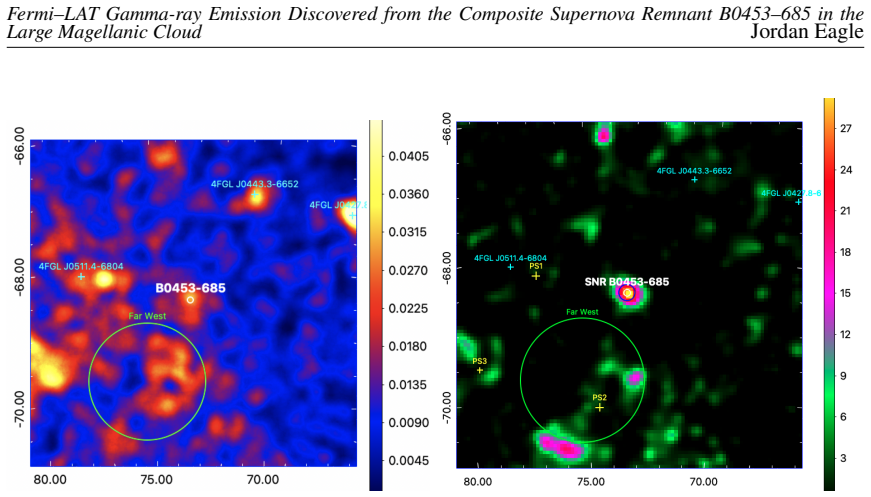
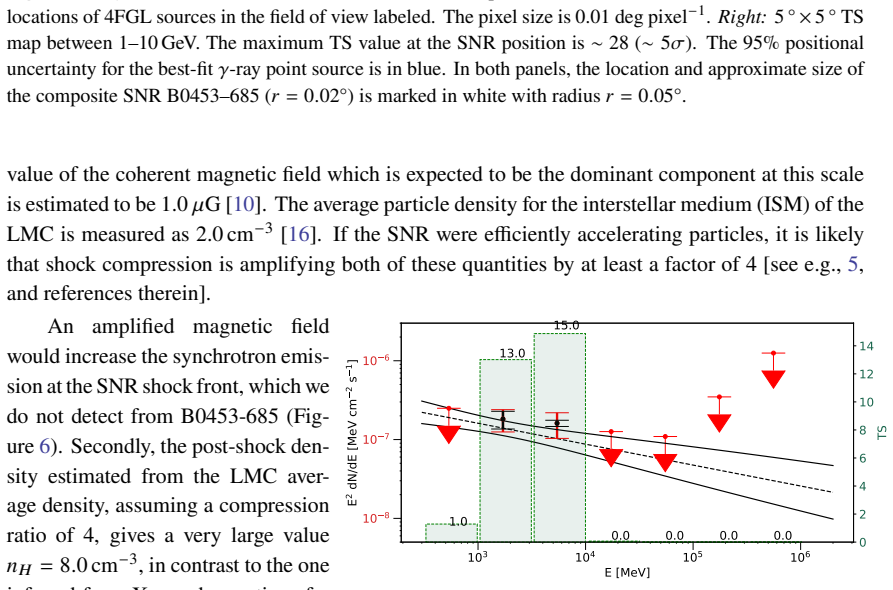
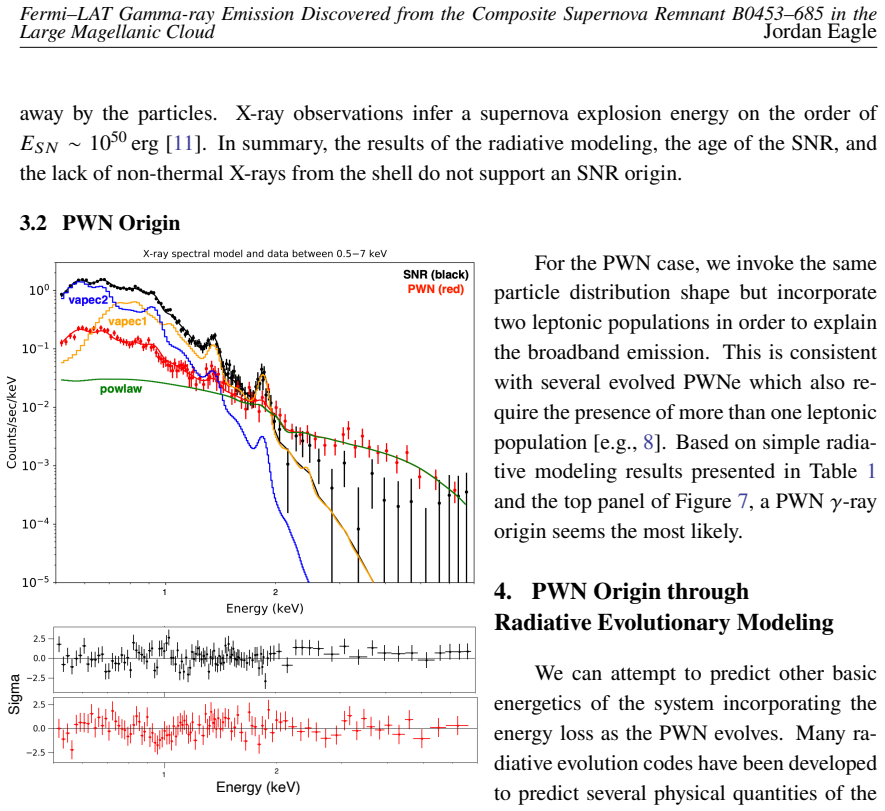
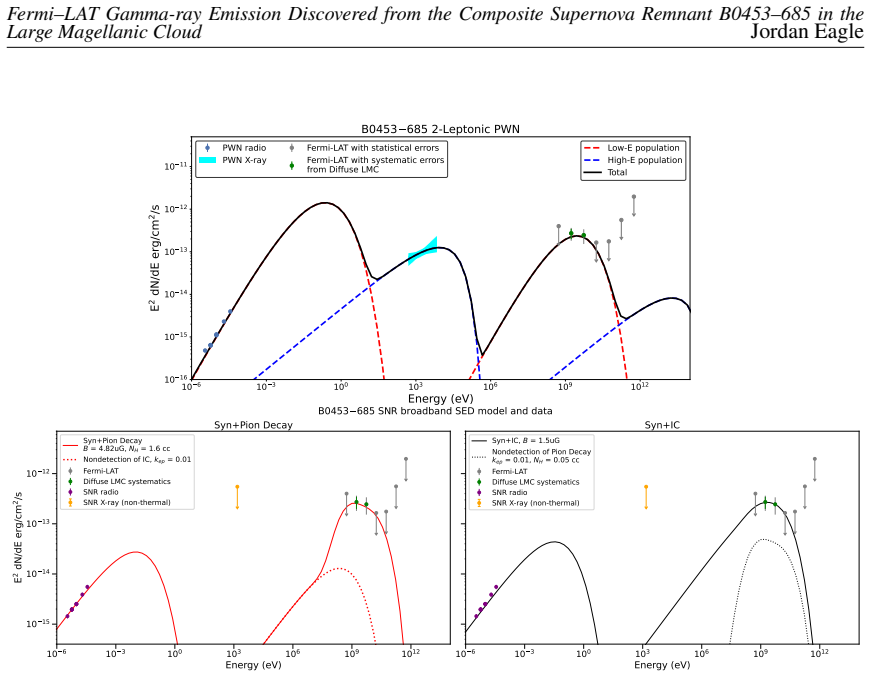
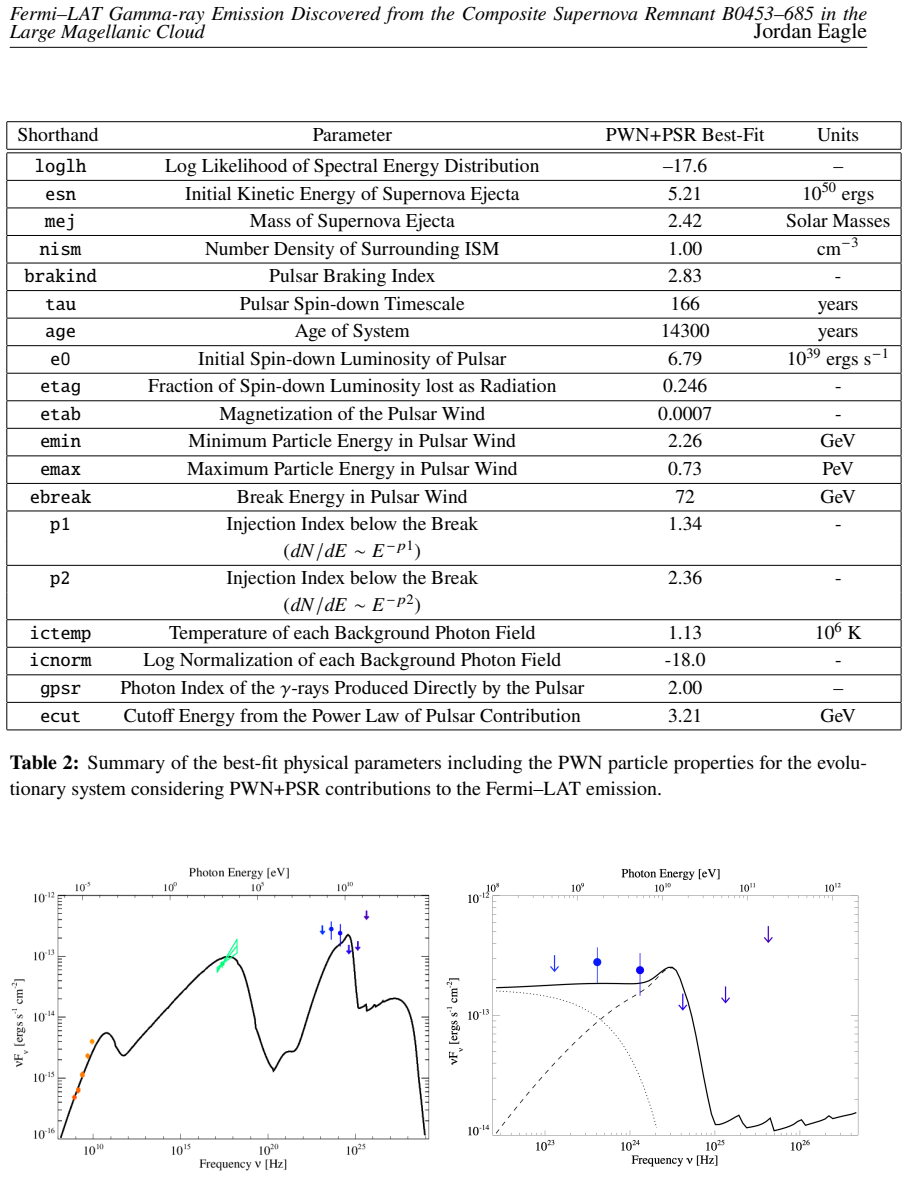
A second extragalactic pulsar wind nebula (PWN) is discovered in the MeV-GeV band using the Fermi-LAT. Faint, point-like gamma-ray emission is detected at the location of the composite supernova remnant (SNR) B0453-685 from energies 300MeV-2TeV. The Fermi-LAT data analysis of the new gamma-ray source is presented together with a detailed multi-wavelength investigation to understand the nature of the observed emission. The observational evidence and physical implications from broadband modeling do not support an SNR gamma-ray origin. Semi-analytic radiative evolutionary models are explored to understand the potential for any pulsar or PWN component responsible for the observed gamma-ray emission. The modeling results favor an evolved PWN ($\tau\sim 14,000$ years) that has been impacted by the return of the SNR reverse shock with a possible substantial pulsar component below $5$GeV. The particle acceleration mechanisms and their efficiency within B0453-685 have important implications for the role PWNe play in generating Cosmic Rays (CRs), but constraints on the synchrotron cut-off are required to accurately characterize the underlying particle properties.
Editorial analysis
A structured set of objections, weighed in public.
Referee Report
Summary. The manuscript reports the detection of faint, point-like gamma-ray emission (300 MeV–2 TeV) from the composite SNR B0453-685 in the LMC with Fermi-LAT. Multi-wavelength data and semi-analytic radiative evolutionary models are used to argue that an SNR origin is not supported; instead the emission is attributed to an evolved PWN (age ~14,000 yr) impacted by the returning reverse shock, with a possible pulsar contribution below 5 GeV. Implications for particle acceleration and cosmic-ray production in PWNe are discussed.
Significance. If the modeling successfully excludes an SNR origin and uniquely identifies the PWN component, the result would constitute the second extragalactic PWN detected in the MeV–GeV band and would constrain the efficiency of particle acceleration in evolved PWNe. The work correctly notes that synchrotron cut-off measurements are needed to pin down the underlying particle spectrum.
major comments (2)
- [Modeling and broadband SED section (referenced in abstract)] The central claim that the data 'do not support an SNR gamma-ray origin' and instead favor a specific PWN age of ~14,000 yr rests on semi-analytic modeling whose quantitative results (fit statistics, likelihood ratios, or parameter posterior distributions) are not reported. Without these, it is impossible to evaluate whether alternative SNR or mixed models are excluded at a statistically meaningful level or whether degeneracies exist between age, magnetic field, and particle injection parameters.
- [Semi-analytic radiative evolutionary models] The assumption that the semi-analytic models can reliably distinguish PWN from SNR emission without significant degeneracies is load-bearing for the rejection of an SNR origin. No explicit tests (e.g., alternative model fits, systematic variations in reverse-shock timing, or Monte Carlo explorations of parameter space) are described to demonstrate uniqueness of the ~14,000 yr PWN solution.
minor comments (2)
- [Abstract and data analysis] The abstract states detection 'from energies 300MeV-2TeV' but does not specify the precise energy binning, effective exposure, or background model used for the Fermi-LAT analysis; these details should be added for reproducibility.
- [Modeling results] Notation for the PWN age (τ∼14,000 years) should be clarified as to whether it is the spin-down age, the dynamical age from the model, or a fitted parameter.
Simulated Author's Rebuttal
We thank the referee for their constructive and detailed review. We address each major comment below and agree that additional quantitative details on the modeling will strengthen the manuscript.
read point-by-point responses
-
Referee: [Modeling and broadband SED section (referenced in abstract)] The central claim that the data 'do not support an SNR gamma-ray origin' and instead favor a specific PWN age of ~14,000 yr rests on semi-analytic modeling whose quantitative results (fit statistics, likelihood ratios, or parameter posterior distributions) are not reported. Without these, it is impossible to evaluate whether alternative SNR or mixed models are excluded at a statistically meaningful level or whether degeneracies exist between age, magnetic field, and particle injection parameters.
Authors: We agree that the manuscript does not report formal fit statistics or likelihood ratios for the model comparisons. The semi-analytic modeling was performed to assess physical consistency with the observed spectrum and multi-wavelength data rather than to conduct statistical model selection. In the revised version we will add a dedicated subsection reporting reduced chi-squared values (or equivalent metrics) for the explored PWN and SNR scenarios, along with a brief discussion of the parameter ranges tested and any evident degeneracies between age, magnetic field, and injection parameters. revision: yes
-
Referee: [Semi-analytic radiative evolutionary models] The assumption that the semi-analytic models can reliably distinguish PWN from SNR emission without significant degeneracies is load-bearing for the rejection of an SNR origin. No explicit tests (e.g., alternative model fits, systematic variations in reverse-shock timing, or Monte Carlo explorations of parameter space) are described to demonstrate uniqueness of the ~14,000 yr PWN solution.
Authors: The referee correctly notes the absence of systematic tests for uniqueness and degeneracy. Our original analysis involved manual variation of key parameters (age, B-field, reverse-shock epoch) to identify viable solutions, but these explorations were not documented quantitatively. We will revise the modeling section to include results from additional runs with varied reverse-shock timing and a summary of how the ~14,000 yr PWN solution remains preferred under the observational constraints. We will also note the limitations of the semi-analytic approach regarding full Monte Carlo sampling. revision: yes
Circularity Check
No significant circularity detected
full rationale
The paper reports a Fermi-LAT detection and performs multi-wavelength analysis plus semi-analytic modeling to interpret the emission origin as favoring an evolved PWN. This is standard data-driven interpretation via parameter fitting rather than a claimed first-principles derivation whose output reduces to its inputs by construction. No self-definitional steps, fitted inputs renamed as predictions, or load-bearing self-citations are exhibited in the abstract or description that would collapse the central claim. The modeling is presented as exploratory fitting to match the observed SED, which does not meet the criteria for circularity under the enumerated patterns.
Axiom & Free-Parameter Ledger
Reference graph
Works this paper leans on
-
[1]
Abdo, A. A., Ajello, M., Allafort, A., et al. 2013, ApJS, 208, 17, doi:10.1088/0067-0049/ 208/2/17
-
[2]
2016, ApJS, 224, 8, doi:10.3847/0067-0049/ 224/1/8
Acero, F., Ackermann, M., Ajello, M., et al. 2016, ApJS, 224, 8, doi:10.3847/0067-0049/ 224/1/8
-
[3]
B., et al
Ackermann, M., Albert, A., Atwood, W. B., et al. 2016, A&A, 586, A71, doi:10.1051/ 0004-6361/201526920
2016
-
[4]
Ballet, J., Burnett, T. H., Digel, S. W., & Lott, B. 2020, arXiv e-prints, arXiv:2005.11208. https://arxiv.org/abs/2005.11208 10 Fermi–LAT Gamma-ray Emission Discovered from the Composite Supernova Remnant B0453–685 in the Large Magellanic CloudJordan Eagle
arXiv 2020
-
[5]
J., & Ellison, D
Castro, D., Slane, P., Patnaude, D. J., & Ellison, D. C. 2011, ApJ, 734, 85, doi:10.1088/ 0004-637X/734/2/85
2011
-
[6]
2003, AJ, 125, 1309, doi:10.1086/367773
Clementini, G., Gratton, R., Bragaglia, A., et al. 2003, AJ, 125, 1309, doi:10.1086/367773
-
[7]
J., Johannesson, G., & Tibaldo, L
de Palma, F., Brandt, T. J., Johannesson, G., & Tibaldo, L. 2013, arXiv e-prints, arXiv:1304.1395.https://arxiv.org/abs/1304.1395
arXiv 2013
-
[8]
Eagle,J.,Castro,D.,Temim,T.,etal.2022,ApJ,940,143,doi:10.3847/1538-4357/ac9eb4
-
[9]
2023, ApJ, 945, 4, doi:10.3847/1538-4357/acb8b1
Eagle, J., Castro, D., Mahhov, P., et al. 2023, ApJ, 945, 4, doi:10.3847/1538-4357/acb8b1
-
[10]
2005, in The Magnetized Plasma in Galaxy Evolution, ed
Gaensler, B., Haverkorn, M., Staveley-Smith, L., et al. 2005, in The Magnetized Plasma in Galaxy Evolution, ed. K. T. Chyzy, K. Otmianowska-Mazur, M. Soida, & R.-J. Dettmar, 209–216.https://arxiv.org/abs/astro-ph/0503371
Pith/arXiv arXiv 2005
-
[11]
Gaensler,B.M., Hendrick,S.P.,Reynolds,S.P.,&Borkowski,K.J.2003,ApJL,594,L111, doi:10.1086/378687
-
[12]
E., Rosing, W., McCullough, P., & Van Buren, D
Gaustad, J. E., Rosing, W., McCullough, P., & Van Buren, D. 2001, in Astronomical Society of the Pacific Conference Series, Vol. 246, IAU Colloq. 183: Small Telescope Astronomy on Global Scales, ed. B. Paczynski, W.-P. Chen, & C. Lemme, 75
2001
-
[13]
Gelfand, J. D., Slane, P. O., & Zhang, W. 2009, ApJ, 703, 2051, doi:10.1088/0004-637X/ 703/2/2051
-
[14]
H. E. S. S. Collaboration, Abramowski, A., Acero, F., et al. 2012, A&A, 545, L2, doi:10. 1051/0004-6361/201219906
2012
-
[15]
D., Bozzetto, L
Haberl, F., Filipović, M. D., Bozzetto, L. M., et al. 2012, A&A, 543, A154, doi:10.1051/ 0004-6361/201218971
2012
-
[16]
Kim,S.,Staveley-Smith,L.,Dopita,M.A.,etal.2003,ApJS,148,473,doi:10.1086/376980
-
[17]
2019, MNRAS, 489, 2403, doi:10.1093/ mnras/stz2023
Lyutikov, M., Temim, T., Komissarov, S., et al. 2019, MNRAS, 489, 2403, doi:10.1093/ mnras/stz2023
2019
-
[18]
Manchester, R. N., Fan, G., Lyne, A. G., Kaspi, V. M., & Crawford, F. 2006, ApJ, 649, 235, doi:10.1086/505461
-
[19]
Manchester,R.N.,Hobbs,G.B.,Teoh,A.,&Hobbs,M.2005,AJ,129,1993,doi:10.1086/ 428488
2005
-
[20]
Mattox, J. R., Bertsch, D. L., Chiang, J., et al. 1996, ApJ, 461, 396, doi:10.1086/177068
-
[21]
2011, ApJ, 726, 75, doi:10.1088/0004-637X/726/2/75
Sironi, L., & Spitkovsky, A. 2011, ApJ, 726, 75, doi:10.1088/0004-637X/726/2/75
-
[22]
2015, Proc
Zabalza, V. 2015, Proc. of International Cosmic Ray Conference 2015, 922 11
2015
discussion (0)
Sign in with ORCID, Apple, or X to comment. Anyone can read and Pith papers without signing in.