Surface Crevasse Evolution Observed Using Matched Field Processing and Source Relocation at Hansbreen, Svalbard
Pith reviewed 2026-06-27 10:47 UTC · model grok-4.3
The pith
A two-step seismic workflow localizes glacier icequakes at meter scale to measure crevasse propagation and diffusion rates of 0.47-0.55 m²/s.
A machine-rendered reading of the paper's core claim, the machinery that carries it, and where it could break.
Core claim
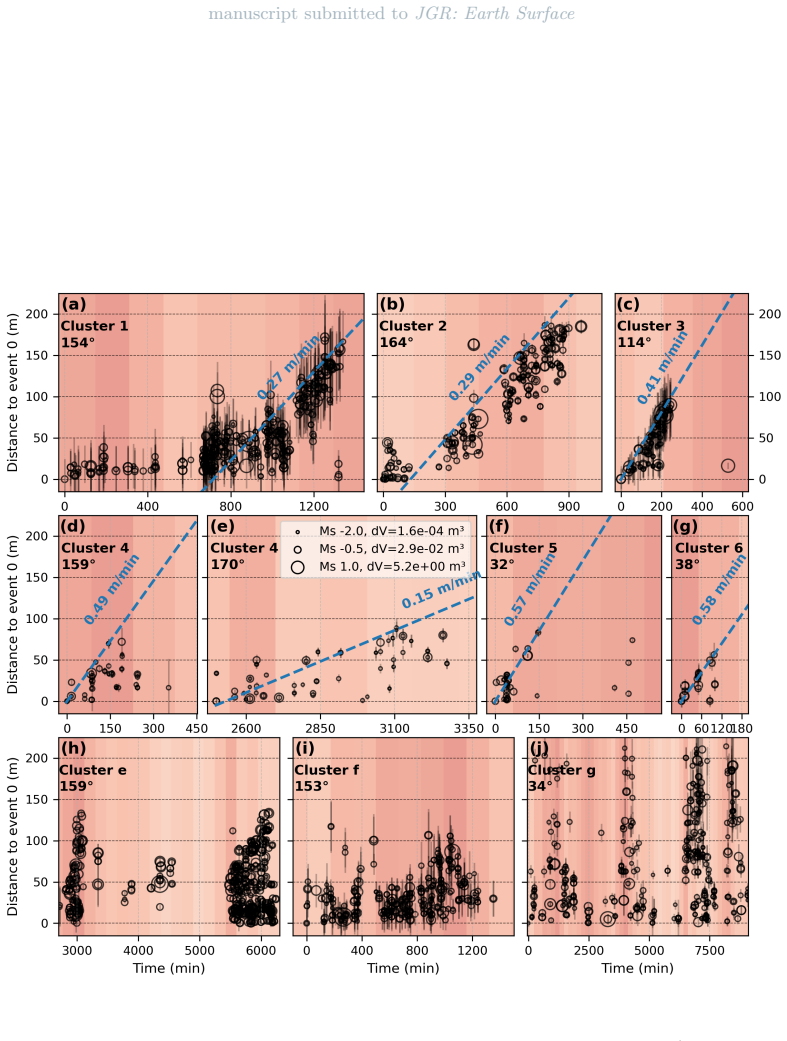
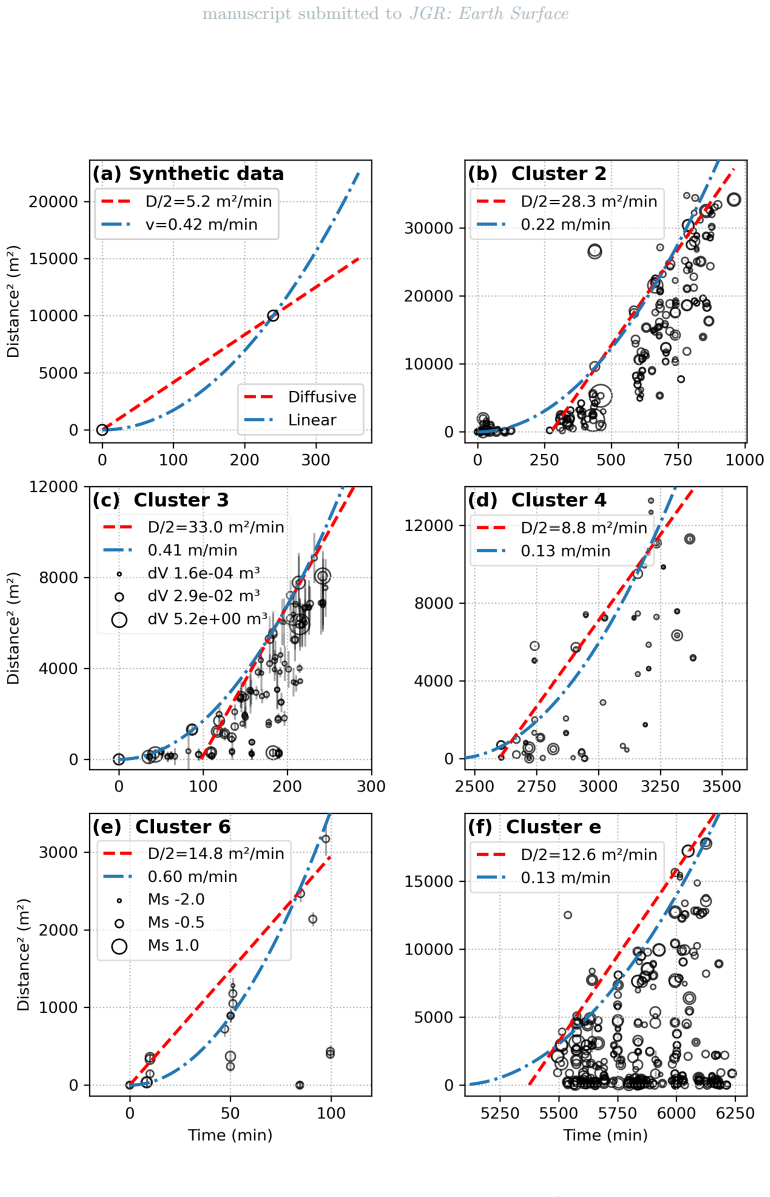
We propose a two-step workflow integrating Matched Field Processing and discrete arrival times relocation to map glacial seismic activity at meter-scale resolution under limited instrumentation. Applying this to surface icequakes at Hansbreen allows estimation of crevasse propagation rates and diffusion coefficients of 0.47 to 0.55 m²/s. We interpret the crevassing as sustained subcritical crack propagation governed by viscous stress relaxation at rates orders of magnitude below elastic limits.
What carries the argument
Two-step workflow of matched field processing followed by arrival-time relocation for meter-scale icequake source localization under sparse array constraints
If this is right
- Crevasse opening episodes can be mapped in time and space through sequences of precisely relocated icequakes.
- Diffusion coefficients for crevasse growth fall in the narrow range 0.47-0.55 m²/s.
- The governing process is viscous stress relaxation acting on subcritical cracks rather than fast elastic fracture.
- Brittle-to-viscous regime transitions in glacial ice become observable through the same location sequences.
Where Pith is reading between the lines
- The workflow could be tested on other glaciers that have only a few seismic stations to see whether similar diffusion rates appear.
- Models of glacier stability might incorporate these viscous rates to forecast how quickly surface fractures widen under different melt conditions.
- The same localization steps could be applied to other cryoseismic signals such as those from iceberg calving to test for analogous mechanisms.
Load-bearing premise
The relocation step after matched field processing truly removes systematic location errors and delivers unbiased meter-scale accuracy with the available sparse instruments.
What would settle it
Independent measurements of the same crevasse opening episodes, for example via repeated drone surveys or time-lapse cameras over the study period, that produce opening rates or diffusion values outside the 0.47-0.55 m²/s range.
Figures
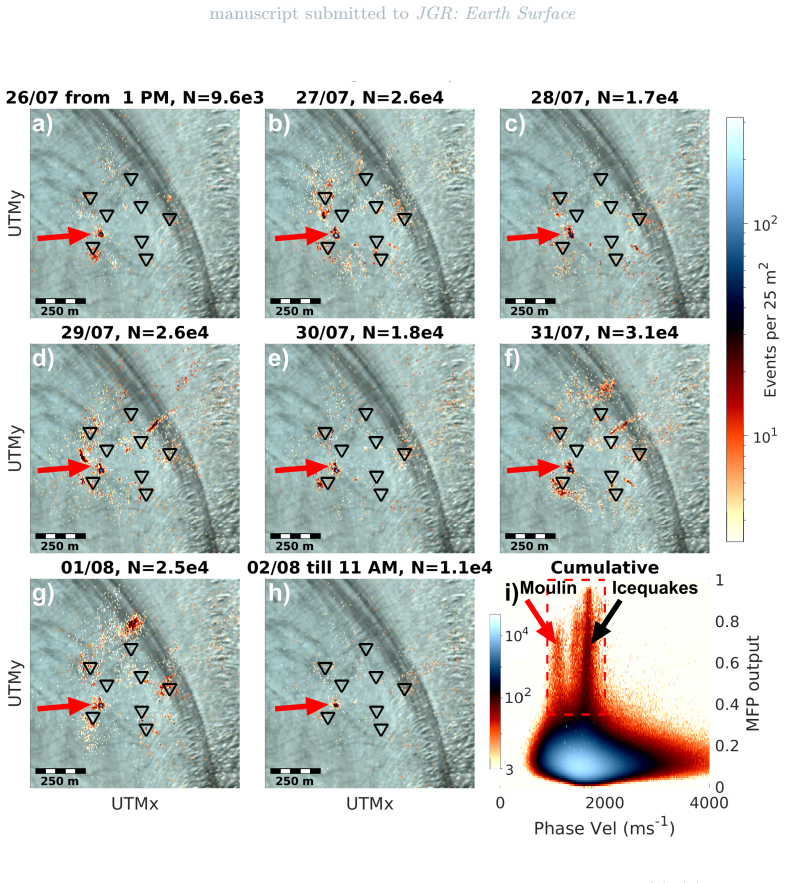
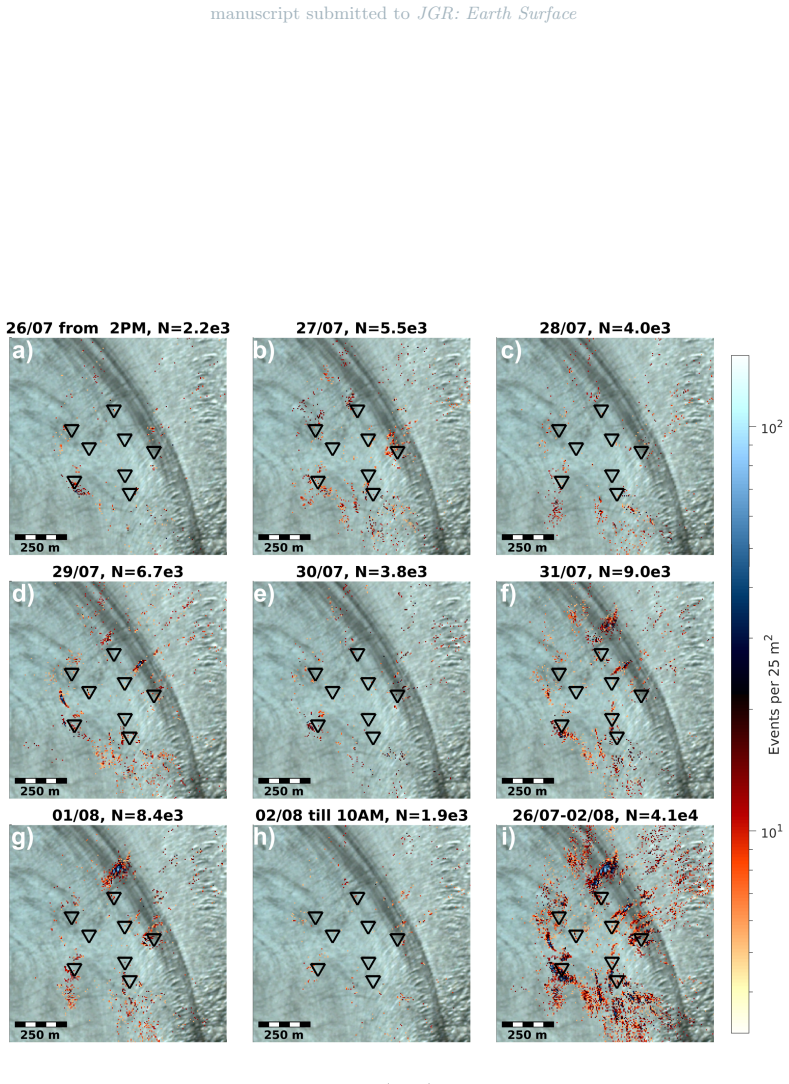
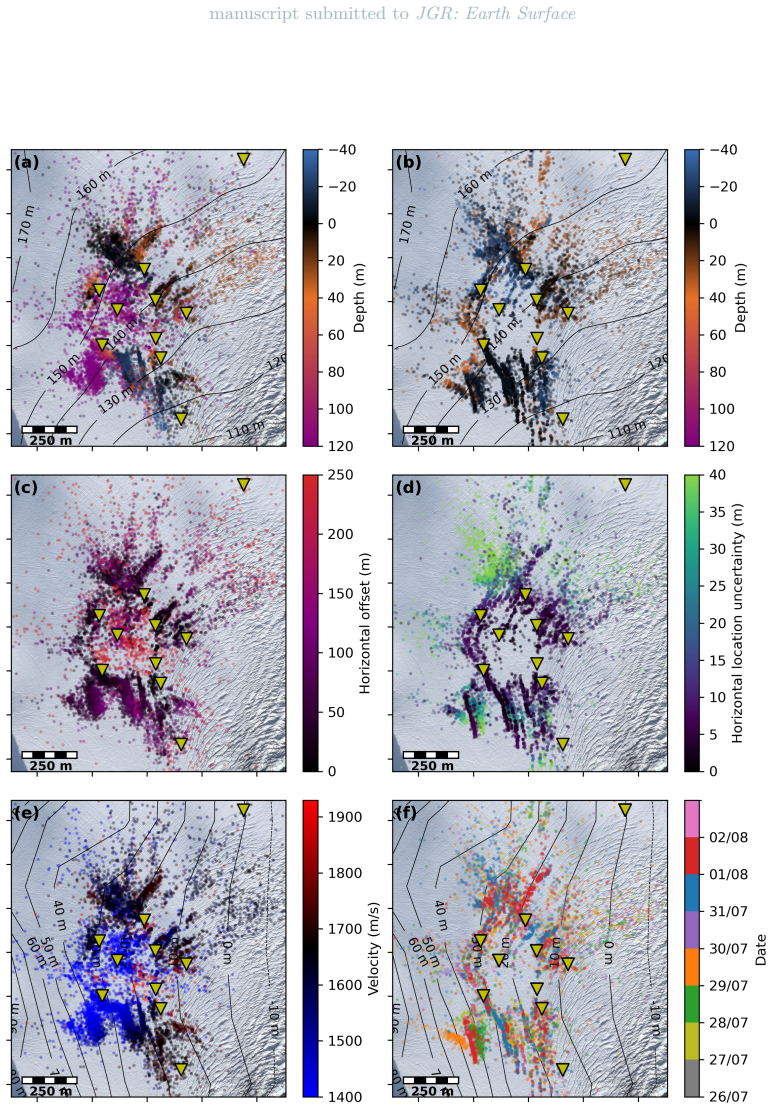
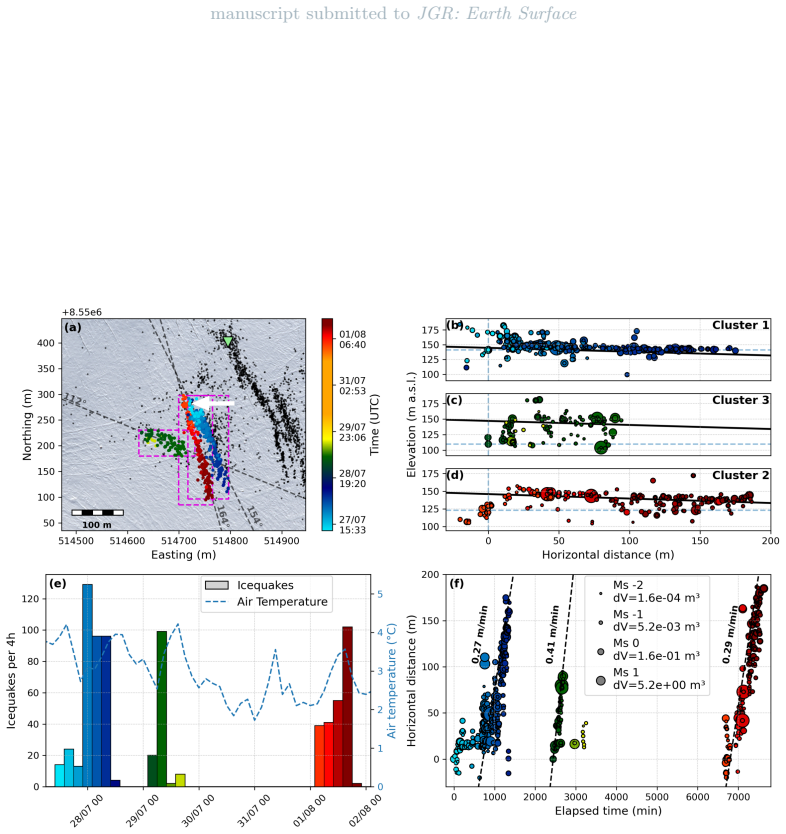
read the original abstract
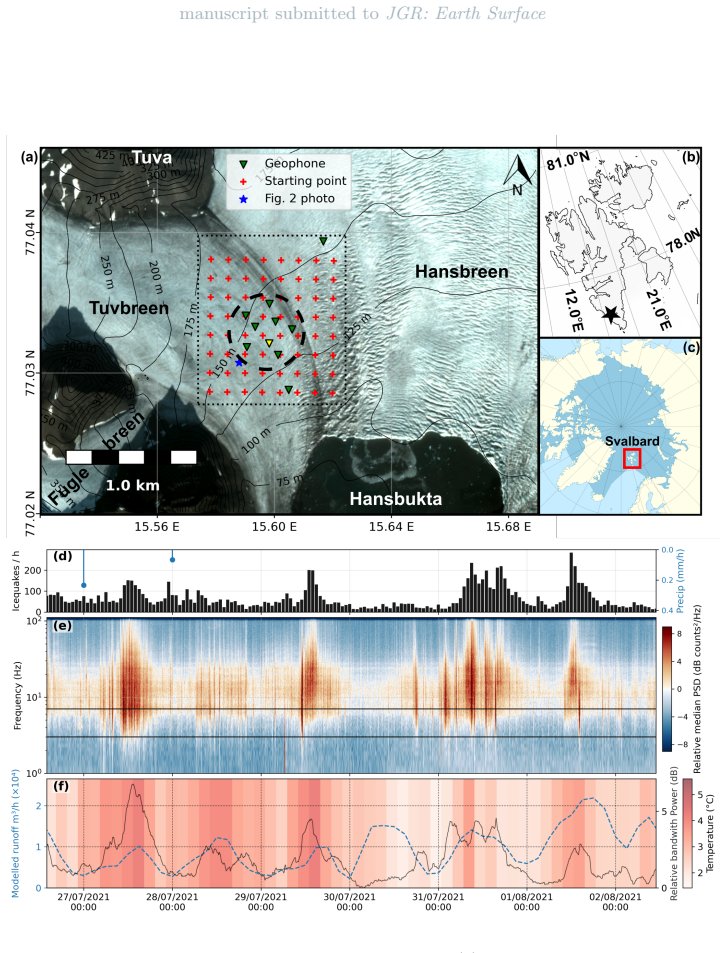
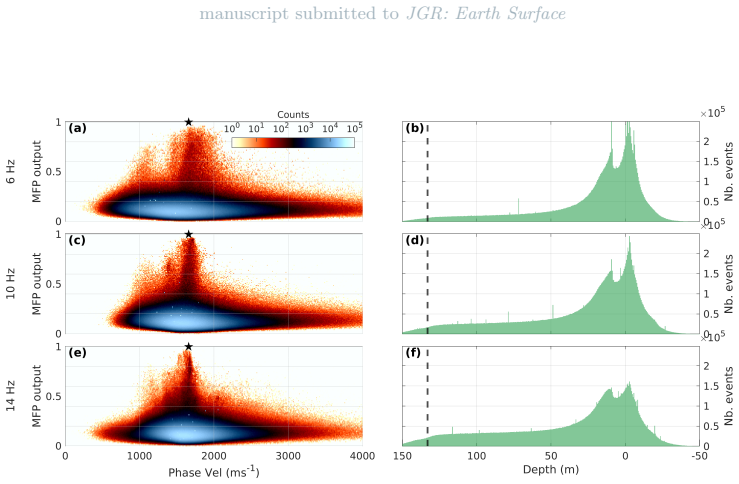
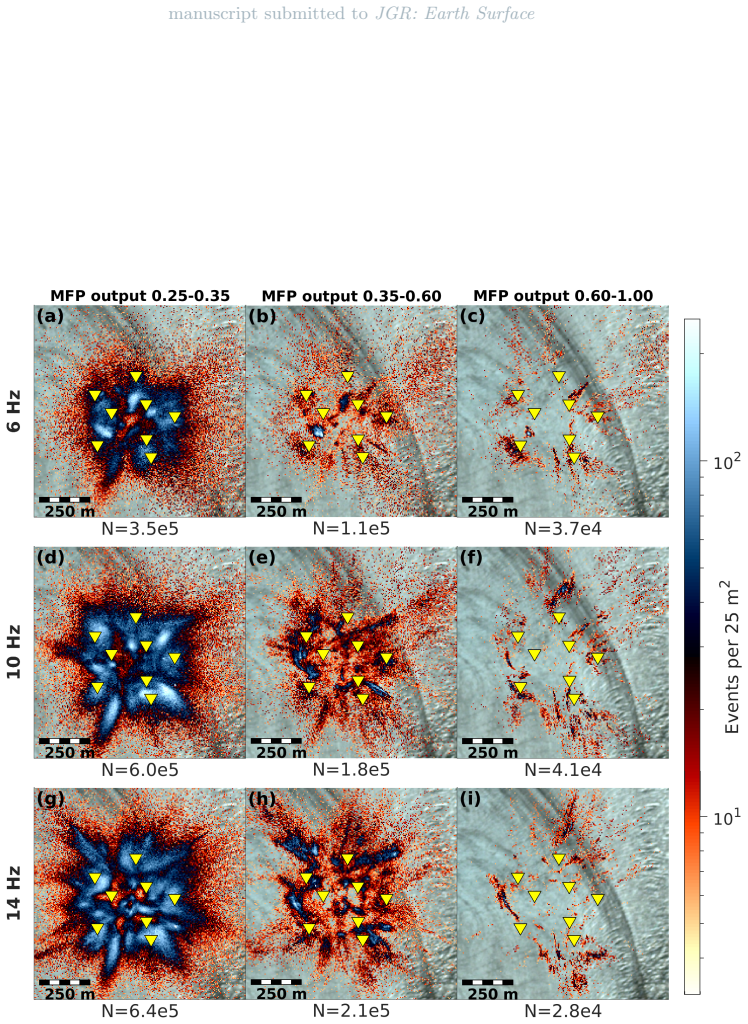
Crevasses control glacier dynamics through fracture and meltwater routing, yet their propagation rates remain observationally scarce and poorly constrained across brittle-to-viscous regimes. Cryoseismology offers a powerful means to capture dynamic processes within glacial ice, with recent advances in novel processing methods like Matched Field Processing (MFP) applicable to dense seismic arrays. However, precise localisation of cryoseismic sources remains challenging in sparse or irregular seismic arrays. We propose a two-step workflow for metres-scale resolution mapping of glacial seismic activity that integrates MFP and discrete arrival times relocation under a limited instrumentation constraint. We apply this approach to analyse seismic activity at the ice surface on the Hansbreen glacier, Svalbard. Using MFP, we detect surface icequakes and characterise meltwater noise regardless of the limited instrumentation. The relocation procedure increases the accuracy of surface icequakes localisation and reveals ongoing crevasse opening episodes. The precise locations of the icequakes allow for the estimation of the crevasse propagation rate and the determination of the diffusion coefficients of 0.47 to 0.55 m2 per s. Based on the obtained results, we discuss brittle-to-viscous regime transfer and interpret the crevassing mechanism as sustained subcritical crack propagation, where viscous stress relaxation governs rates of orders of magnitude below elastic limits.
Editorial analysis
A structured set of objections, weighed in public.
Referee Report
Summary. The paper proposes a two-step workflow combining Matched Field Processing (MFP) for detection and arrival-time relocation to achieve meter-scale localization of surface icequakes on Hansbreen glacier under sparse-array constraints. These locations are used to estimate crevasse propagation rates and diffusion coefficients (0.47–0.55 m²/s), supporting an interpretation of sustained subcritical crack propagation where viscous stress relaxation controls rates orders of magnitude below elastic limits.
Significance. If the localization accuracy holds, the work would supply scarce observational constraints on crevasse propagation across brittle-to-viscous regimes, with direct relevance to glacier dynamics modeling and cryoseismology. The methodological integration of MFP with relocation for limited instrumentation is a clear strength that could be adopted more broadly if validated.
major comments (3)
- [Abstract] Abstract: The assertion that the relocation procedure 'increases the accuracy of surface icequakes localisation' and enables 'metres-scale resolution' is load-bearing for all subsequent claims, yet no quantitative error bounds, synthetic tests, or ground-truth validation metrics are reported for the MFP+arrival-time workflow under the sparse-array conditions described.
- [Abstract] Abstract (results paragraph): Diffusion coefficients of 0.47 to 0.55 m²/s are derived directly from the relocated event locations, but the manuscript provides no details on fitting procedure, error propagation from location uncertainties, or sensitivity analysis; without these, the reported range cannot be assessed for robustness against possible systematic biases exceeding ~1 m.
- [Abstract] Abstract (interpretation): The regime-transfer argument (viscous relaxation governing subcritical propagation at rates 'orders of magnitude below elastic limits') depends on the propagation rates being reliably determined at meter scale; any unquantified location error would directly undermine the comparison to elastic limits and the mechanistic conclusion.
Simulated Author's Rebuttal
We appreciate the referee's comments emphasizing the importance of quantitative validation for our localization claims. We will revise the manuscript to include the requested details on error analysis and fitting procedures, thereby strengthening the support for our interpretations.
read point-by-point responses
-
Referee: The assertion that the relocation procedure 'increases the accuracy of surface icequakes localisation' and enables 'metres-scale resolution' is load-bearing for all subsequent claims, yet no quantitative error bounds, synthetic tests, or ground-truth validation metrics are reported for the MFP+arrival-time workflow under the sparse-array conditions described.
Authors: We agree the abstract omits explicit metrics. The methods describe the workflow but lack a dedicated validation subsection with synthetic results. In revision we will add synthetic test outcomes (average localization error ~1.5 m under sparse-array geometry) and error bounds, then update the abstract accordingly. Ground truth is unavailable in the field setting, so synthetics serve as the primary validation. revision: yes
-
Referee: Diffusion coefficients of 0.47 to 0.55 m²/s are derived directly from the relocated event locations, but the manuscript provides no details on fitting procedure, error propagation from location uncertainties, or sensitivity analysis; without these, the reported range cannot be assessed for robustness against possible systematic biases exceeding ~1 m.
Authors: We will add a dedicated methods subsection describing the linear least-squares fitting of event positions versus time, Monte Carlo propagation of relocation uncertainties, and sensitivity tests that vary assumed location errors by up to 2 m. These confirm the diffusion coefficients remain stable within 0.40–0.60 m²/s. revision: yes
-
Referee: The regime-transfer argument (viscous relaxation governing subcritical propagation at rates 'orders of magnitude below elastic limits') depends on the propagation rates being reliably determined at meter scale; any unquantified location error would directly undermine the comparison to elastic limits and the mechanistic conclusion.
Authors: With the added validation and uncertainty quantification from the prior revisions, the meter-scale reliability will be documented. We will revise the discussion to reference the quantified location errors explicitly when comparing rates to elastic limits, thereby supporting the subcritical propagation interpretation. revision: yes
Circularity Check
No circularity: diffusion coefficients derived from independent location data
full rationale
The paper applies MFP detection followed by arrival-time relocation to obtain icequake locations, then computes propagation rates and diffusion coefficients (0.47–0.55 m²/s) directly from those locations. No equations, self-citations, or steps are shown that reduce the reported coefficients to fitted parameters or prior results by construction. The central estimates retain independent content from the seismic workflow and are not self-definitional or statistically forced.
Axiom & Free-Parameter Ledger
free parameters (1)
- diffusion coefficients
axioms (1)
- domain assumption The relocation procedure increases the accuracy of surface icequakes localisation under limited instrumentation
Reference graph
Works this paper leans on
-
[1]
Journal of Applied Geophysics , volume=
Radon transform-based microseismic event detection and signal-to-noise ratio enhancement , author=. Journal of Applied Geophysics , volume=. 2015 , publisher=
2015
-
[2]
The Cryosphere , volume=
Quantification of seasonal and diurnal dynamics of subglacial channels using seismic observations on an Alpine glacier , author=. The Cryosphere , volume=. 2020 , publisher=
2020
-
[3]
Bulletin of the Seismological Society of America , volume=
Volume change of seismic sources from moment tensors , author=. Bulletin of the Seismological Society of America , volume=. 2001 , publisher=
2001
-
[4]
Earth Surface Dynamics , volume=
TopoToolbox 2--MATLAB-based software for topographic analysis and modeling in Earth surface sciences , author=. Earth Surface Dynamics , volume=. 2014 , publisher=
2014
-
[5]
The Cryosphere , volume=
Meltwater runoff and glacier mass balance in the high Arctic: 1991--2022 simulations for Svalbard , author=. The Cryosphere , volume=. 2023 , publisher=
1991
-
[6]
Scientific Reports , volume=
Potential seismic precursors and surficial dynamics of a deadly Himalayan disaster: An early warning approach , author=. Scientific Reports , volume=. 2022 , publisher=
2022
-
[7]
The Cryosphere , volume=
Array processing in cryoseismology: a comparison to network-based approaches at an Antarctic ice stream , author=. The Cryosphere , volume=. 2023 , publisher=
2023
-
[8]
Earth system science data , volume=
High temporal resolution records of the velocity of Hansbreen, a tidewater glacier in Svalbard , author=. Earth system science data , volume=. 2024 , publisher=
2024
-
[9]
pure and applied geophysics , volume=
Icequakes and glacier motion: the Hans Glacier, Spitsbergen , author=. pure and applied geophysics , volume=. 1983 , publisher=
1983
-
[10]
Biul Inf Komisji Wypraw Geof PAN , volume=
Investigations of the ice microtremors on Spitsbergen in 1962 , author=. Biul Inf Komisji Wypraw Geof PAN , volume=
1962
-
[11]
Geophysics , volume=
Multiscale matched-field processing for noise-source localization in exploration geophysics , author=. Geophysics , volume=. 2012 , publisher=
2012
-
[12]
The Journal of the Acoustical Society of America , volume=
Matched field processing: Source localization in correlated noise as an optimum parameter estimation problem , author=. The Journal of the Acoustical Society of America , volume=. 1988 , publisher=
1988
-
[13]
Geophysical Research Letters , volume=
A 15 year record of frontal glacier ablation rates estimated from seismic data , author=. Geophysical Research Letters , volume=. 2016 , publisher=
2016
-
[14]
Nature communications , volume=
Distributed acoustic sensing of microseismic sources and wave propagation in glaciated terrain , author=. Nature communications , volume=. 2020 , publisher=
2020
-
[15]
Journal of Glaciology , volume=
Basal icequakes during changing subglacial water pressures beneath Gornergletscher, Switzerland , author=. Journal of Glaciology , volume=. 2008 , publisher=
2008
-
[16]
Annals of Glaciology , volume=
Characterization of seasonal glacial seismicity from a single-station on-ice record at Holtedahlfonna, Svalbard , author=. Annals of Glaciology , volume=. 2019 , publisher=
2019
-
[17]
Geophysical Research Letters , volume=
Seismic noise interferometry reveals transverse drainage configuration beneath the surging Bering Glacier , author=. Geophysical Research Letters , volume=. 2019 , publisher=
2019
-
[18]
Reviews of Geophysics , volume=
Avalanching glacier instabilities: Review on processes and early warning perspectives , author=. Reviews of Geophysics , volume=. 2015 , publisher=
2015
-
[19]
Communications Earth & Environment , volume=
Diurnal expansion and contraction of englacial fracture networks revealed by seismic shear wave splitting , author=. Communications Earth & Environment , volume=. 2021 , publisher=
2021
-
[20]
Nature Geoscience , volume=
Massive collapse of two glaciers in western Tibet in 2016 after surge-like instability , author=. Nature Geoscience , volume=. 2018 , publisher=
2016
-
[21]
Scientific reports , volume=
Changing friction at the base of an Alpine glacier , author=. Scientific reports , volume=. 2021 , publisher=
2021
-
[22]
Geophysical Journal International , volume=
Array analysis using circular-wave-front geometry: an application to locate the nearby seismo-volcanic source , author=. Geophysical Journal International , volume=. 1999 , publisher=
1999
-
[23]
The Cryosphere , volume=
Multi-scale variations of subglacial hydro-mechanical conditions at Kongsvegen glacier, Svalbard , author=. The Cryosphere , volume=. 2024 , publisher=
2024
-
[24]
Geophysical Research Letters , volume=
Seismic constraints on damage growth within an unstable hanging glacier , author=. Geophysical Research Letters , volume=. 2023 , publisher=
2023
-
[25]
doi:10.5281/zenodo.5775743 , url =
Luu, Keurfon , title =. doi:10.5281/zenodo.5775743 , url =
-
[26]
Proceedings of the National Academy of Sciences , volume=
Observing the subglacial hydrology network and its dynamics with a dense seismic array , author=. Proceedings of the National Academy of Sciences , volume=. 2021 , publisher=
2021
-
[27]
The Cryosphere , volume=
Role of discrete water recharge from supraglacial drainage systems in modeling patterns of subglacial conduits in Svalbard glaciers , author=. The Cryosphere , volume=. 2019 , publisher=
2019
-
[28]
Annals of Geophysics , year=
Ambient vibration measurements in the Southern Rhine Graben close to Basle , author=. Annals of Geophysics , year=
-
[29]
New Manual of Seismological Observatory Practice (NMSOP) , pages=
Magnitude determinations , author=. New Manual of Seismological Observatory Practice (NMSOP) , pages=. 2009 , publisher=
2009
-
[30]
1992 , publisher=
Array signal processing: concepts and techniques , author=. 1992 , publisher=
1992
-
[31]
Reviews of Geophysics , volume=
Monte Carlo methods in geophysical inverse problems , author=. Reviews of Geophysics , volume=. 2002 , publisher=
2002
-
[32]
New manual of seismological observatory practice 2 (NMSOP-2) , pages=
Seismic arrays , author=. New manual of seismological observatory practice 2 (NMSOP-2) , pages=. 2012 , publisher=
2012
-
[33]
IN: Glaciers-Ocean-Atmosphere: Interactions
Tidewater glaciers of Spitsbergen , author=. IN: Glaciers-Ocean-Atmosphere: Interactions. IAHS Publication , number=
-
[34]
Journal of Geophysical Research: Earth Surface , volume=
Factors controlling terminus position of Hansbreen, a tidewater glacier in Svalbard , author=. Journal of Geophysical Research: Earth Surface , volume=. 2021 , publisher=
2021
-
[35]
Nature , volume=
Projected land ice contributions to twenty-first-century sea level rise , author=. Nature , volume=. 2021 , publisher=
2021
-
[36]
Geophysical Journal International , volume=
Assessing the reliability of the modified three-component spatial autocorrelation technique , author=. Geophysical Journal International , volume=. 2007 , publisher=
2007
-
[37]
AGU Fall Meeting Abstracts , year=
SKS splitting results in central Italy and Dinaric region inside the AlpArray-CASE project , author=. AGU Fall Meeting Abstracts , year=
-
[38]
Seismic tomography , pages=
On the validity of the ray approximation for interpreting delay times , author=. Seismic tomography , pages=. 1987 , publisher=
1987
-
[39]
Geothermics , volume=
Shear-wave splitting as a tool for the characterization of geothermal fractured reservoirs: Lessons learned , author=. Geothermics , volume=. 2005 , publisher=
2005
-
[41]
Geophysics , volume=
Shear-wave splitting in Quaternary sediments: Neotectonic implications in the central New Madrid seismic zone , author=. Geophysics , volume=. 1996 , publisher=
1996
-
[42]
Geology , volume=
USArray shear wave splitting shows seismic anisotropy from both lithosphere and asthenosphere , author=. Geology , volume=. 2015 , publisher=
2015
-
[43]
Bulletin of the Seismological Society of America , volume=
Crustal anisotropy from local observations of shear-wave splitting in West Bohemia, Czech Republic , author=. Bulletin of the Seismological Society of America , volume=. 1993 , publisher=
1993
-
[44]
1998 , month = oct, publisher =
Alain Vauchez and Andrea Tommasi and Guilhem Barruol , title =. 1998 , month = oct, publisher =. doi:10.1016/s0040-1951(98)00137-1 , url =
-
[45]
Nature , volume=
Constraints from seismic anisotropy on the nature of the lowermost mantle , author=. Nature , volume=. 1996 , publisher=
1996
-
[46]
Preliminary report of multi-variable measurements in active tectonics , author=
Shear-wave splitting in a critical crust: III. Preliminary report of multi-variable measurements in active tectonics , author=. Journal of Applied Geophysics , volume=. 2003 , publisher=
2003
-
[47]
Polish Polar Research , volume=
Surface and bed morphology of Hansbreen, a tidewater glacier in Spitsbergen , author=. Polish Polar Research , volume=
-
[48]
Journal of Geophysical Research , volume=
Icequakes on the Athabasca glacier , author=. Journal of Geophysical Research , volume=. 1970 , publisher=
1970
-
[49]
Reviews of Geophysics , volume=
Generalized nonlinear inverse problems solved using the least squares criterion , author=. Reviews of Geophysics , volume=. 1982 , publisher=
1982
-
[50]
Bulletin of the Seismological Society of America , volume=
Moment tensor inversions of icequakes on Gornergletscher, Switzerland , author=. Bulletin of the Seismological Society of America , volume=. 2009 , publisher=
2009
-
[51]
Annals of Glaciology , volume=
Crevasse-induced Rayleigh-wave azimuthal anisotropy on Glacier de la Plaine Morte, Switzerland , author=. Annals of Glaciology , volume=. 2019 , publisher=
2019
-
[52]
Journal of Geophysical Research: Earth Surface , volume=
Monitoring glacier surface seismicity in time and space using Rayleigh waves , author=. Journal of Geophysical Research: Earth Surface , volume=. 2012 , publisher=
2012
-
[53]
S. Gao and P. M. Davis and H. Liu and P. D. Slack and A. W. Rigor and Y. A. Zorin and V. V. Mordvinova and V. M. Kozhevnikov and N. A. Logatchev , title =. 1997 , month = oct, publisher =. doi:10.1029/97jb01858 , url =
-
[54]
2006 , author =
Numerical Optimization , publisher =. 2006 , author =
2006
-
[55]
2002 , publisher=
Quantitative seismology , author=. 2002 , publisher=
2002
-
[56]
Nature , volume=
Seismic anisotropy and mantle flow beneath the Baikal rift zone , author=. Nature , volume=. 1994 , publisher=
1994
-
[57]
Geophysical Research Letters , volume=
Seismic anisotropy in the lower mantle: A comparison of waveform splitting of SKS and SKKS , author=. Geophysical Research Letters , volume=. 2004 , publisher=
2004
-
[58]
Composition, structure and dynamics of the lithosphere-asthenosphere system , pages=
Formation of anisotropy in upper mantle peridotites-A review , author=. Composition, structure and dynamics of the lithosphere-asthenosphere system , pages=. 1987 , publisher=
1987
-
[59]
Reviews of Geophysics , volume=
Seismic anisotropy and mantle deformation: what have we learned from shear wave splitting? , author=. Reviews of Geophysics , volume=. 1999 , publisher=
1999
-
[60]
Physics of the earth and planetary interiors , volume=
SKS splitting and the seismic anisotropy of the mantle beneath the Hikurangi subduction zone, New Zealand , author=. Physics of the earth and planetary interiors , volume=. 1996 , publisher=
1996
-
[61]
Geophysical Journal International , volume=
Small-scale sublithospheric continental mantle deformation: constraints from SKS splitting observations , author=. Geophysical Journal International , volume=. 1995 , publisher=
1995
-
[62]
Journal of Geophysical Research: Earth Surface , volume=
Observation of surface seismic activity changes of an Alpine glacier during a glacier-dammed lake outburst , author=. Journal of Geophysical Research: Earth Surface , volume=. 2010 , publisher=
2010
-
[63]
Geophysical Journal International , volume=
Using glacier seismicity for phase velocity measurements and Green's function retrieval , author=. Geophysical Journal International , volume=. 2015 , publisher=
2015
-
[64]
2000 , institution=
Grid-search techniques for seismic event location , author=. 2000 , institution=
2000
-
[65]
A new optimizer using particle swarm theory , author=. MHS'95. Proceedings of the Sixth International Symposium on Micro Machine and Human Science , pages=. 1995 , organization=
1995
-
[66]
1995 , publisher=
Modern global seismology , author=. 1995 , publisher=
1995
-
[67]
SEG Technical Program Expanded Abstracts 2008 , pages=
Noise suppression for detection and location of microseismic events using a matched filter , author=. SEG Technical Program Expanded Abstracts 2008 , pages=. 2008 , publisher=
2008
-
[68]
Geophysical Journal International , volume=
Detection and analysis of microseismic events using a Matched Filtering Algorithm (MFA) , author=. Geophysical Journal International , volume=. 2016 , publisher=
2016
-
[69]
Geophysical Journal International , volume=
The polarization of P-waves in anisotropic media , author=. Geophysical Journal International , volume=. 1982 , publisher=
1982
-
[70]
Primer of applied regression and analysis of variance , author=
-
[71]
The use and interpretation of principal component analysis in applied research , author=. Sankhy. 1964 , publisher=
1964
-
[72]
Earth, planets and space , volume=
Improvement of back-azimuth estimation in real-time by using a single station record , author=. Earth, planets and space , volume=. 2012 , publisher=
2012
-
[73]
1973 , publisher=
Linear statistical inference and its applications , author=. 1973 , publisher=
1973
-
[74]
Geophysical Journal International , volume=
Wavefield decomposition using ML-probabilities in modelling single-site 3-component records , author=. Geophysical Journal International , volume=. 1988 , publisher=
1988
-
[75]
Geoexploration , volume=
The application of principal components analysis to seismic data sets , author=. Geoexploration , volume=. 1982 , publisher=
1982
-
[76]
Bulletin of the Seismological society of America , volume=
Complex polarization analysis of particle motion , author=. Bulletin of the Seismological society of America , volume=. 1986 , publisher=
1986
-
[77]
Bulletin of the seismological society of America , volume=
Polarization analysis of three-component array data , author=. Bulletin of the seismological society of America , volume=. 1988 , publisher=
1988
-
[78]
Proceedings of the IEEE , volume=
Signal analysis using rectilinearity and direction of particle motion , author=. Proceedings of the IEEE , volume=. 1965 , publisher=
1965
-
[79]
Bulletin of the Seismological Society of America , volume=
Seismic event detection and source location using single-station (three-component) data , author=. Bulletin of the Seismological Society of America , volume=. 1987 , publisher=
1987
-
[80]
Geophysical Journal International , volume=
Real-time event detection, phase identification and source location estimation using single station three-component seismic data , author=. Geophysical Journal International , volume=. 1989 , publisher=
1989
-
[81]
Geophysics , volume=
Three-component sonde orientation in a deviated well , author=. Geophysics , volume=. 1990 , publisher=
1990
discussion (0)
Sign in with ORCID, Apple, or X to comment. Anyone can read and Pith papers without signing in.