The Doppler effect of the Milky Way rotation on LISA
Pith reviewed 2026-06-27 12:37 UTC · model grok-4.3
The pith
Neglecting Milky Way rotation in LISA analysis produces observable biases in galactic gravitational wave background parameters.
A machine-rendered reading of the paper's core claim, the machinery that carries it, and where it could break.
Core claim
The galactic gravitational-wave background is anisotropic because of the spatial distribution and kinematics of its sources; when the Doppler shift produced by Milky Way rotation is included in the directional spectrum, a Fisher-matrix calculation shows that the resulting parameter biases for LISA are large enough to be detectable if the rotation is neglected in the inference model.
What carries the argument
Directional GW spectrum obtained from stellar density and velocity profiles, with Doppler shifts from galactic rotation and observer motion, evaluated through Fisher-matrix bias forecasting.
If this is right
- Omitting galactic rotation from the analysis template shifts the inferred parameters of the galactic background by amounts larger than the statistical uncertainties.
- LISA data will have sufficient information to distinguish a model that includes the kinematic Doppler effect from one that does not.
- The magnitude of the bias scales with the amplitude and angular dependence of the velocity-induced frequency shifts across the sky.
- Accurate recovery of the background requires that both the stellar density distribution and the velocity field be modeled jointly.
Where Pith is reading between the lines
- Data-analysis pipelines for LISA should embed a galactic-kinematics module as a standard component rather than an optional correction.
- The same modeling approach could be tested on simulated data from other proposed space-based detectors to check whether the bias persists at different frequencies or arm lengths.
- If independent stellar-kinematic surveys revise the Milky Way velocity field, the bias forecasts can be recomputed without changing the overall Fisher-matrix framework.
Load-bearing premise
The adopted stellar density and velocity profiles are accurate enough representations of the Milky Way that the computed Doppler shifts and resulting bias forecasts remain valid.
What would settle it
Run end-to-end LISA simulations with and without the galactic-rotation Doppler term in the signal model; the recovered parameters match the injected values to within statistical error only when the rotation term is retained.
Figures
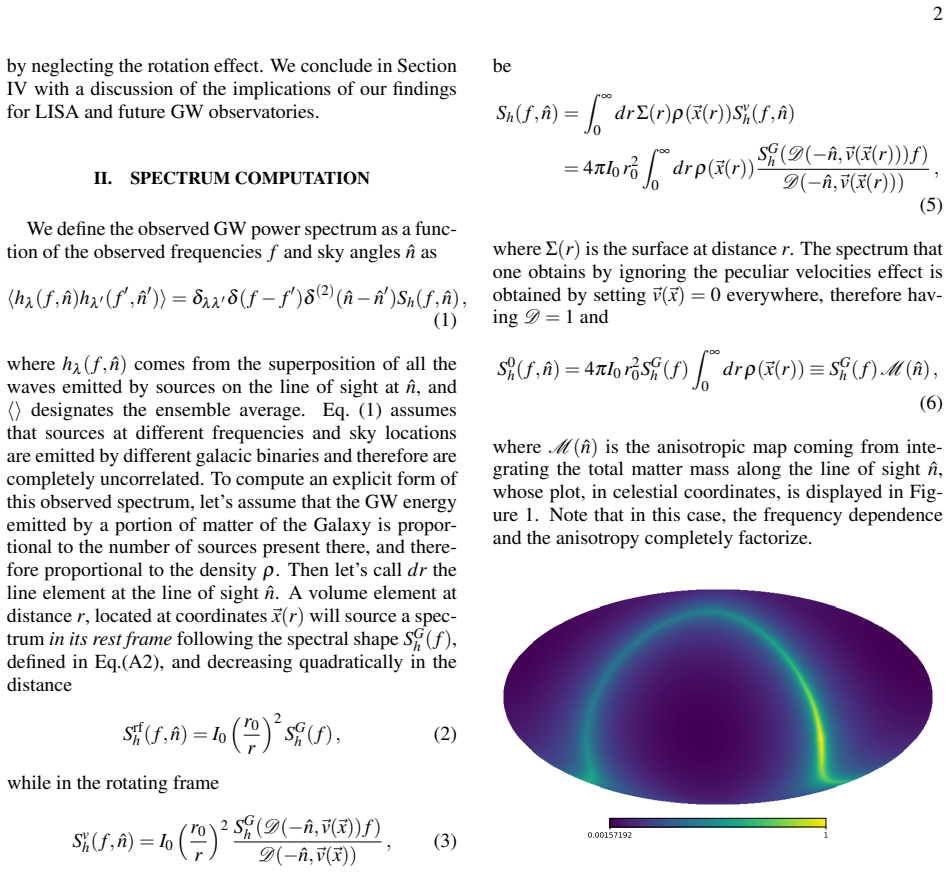
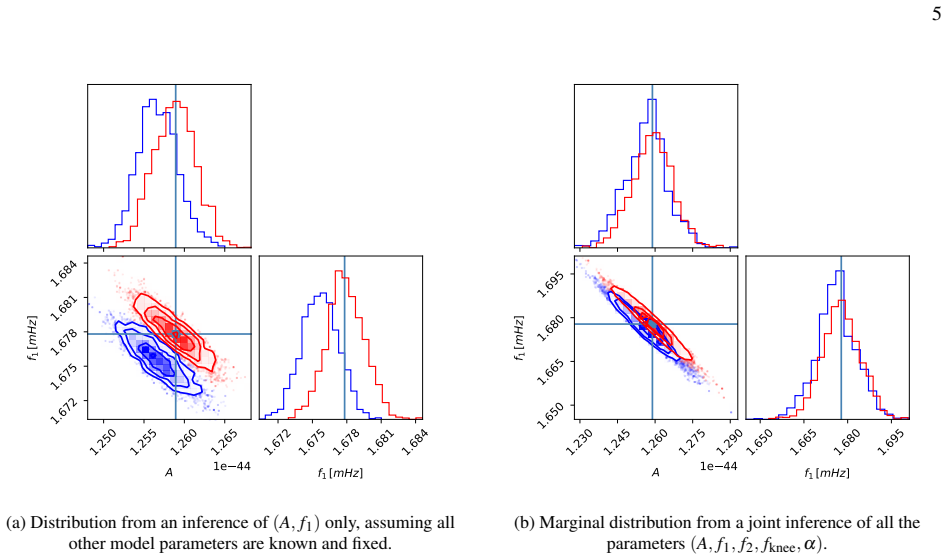
read the original abstract
The galactic background of gravitational waves (GWs) is expected to be anisotropic due to the spatial distribution and kinematics of sources in the Milky Way. In this work, we model the stellar density and velocity profiles of the Galaxy and compute the resulting GW spectrum as a function of direction. We account for the Doppler shift induced by the peculiar velocities of stars and the observer's motion. Using a Fisher matrix formalism, we forecast the ability of future detectors (e.g., LISA) to distinguish between models that include or neglect these kinematic effects. We find that if one does not take into account the rotation of the galaxy, the inference of the parameters describing the galactic background can suffer observable biases.
Editorial analysis
A structured set of objections, weighed in public.
Referee Report
Summary. The paper models the stellar density and velocity profiles of the Milky Way to compute the resulting anisotropic galactic gravitational-wave background spectrum as a function of direction. It incorporates Doppler shifts arising from stellar peculiar velocities and the observer's motion due to galactic rotation, then applies a Fisher-matrix formalism to forecast that LISA (and similar detectors) can distinguish models that include versus neglect these kinematic effects, concluding that neglecting galactic rotation produces observable biases in the inferred galactic-background parameters.
Significance. If the galactic profiles and Fisher-matrix forecasts hold, the result would be significant for LISA data analysis: it identifies a concrete systematic that must be included in foreground modeling to avoid biased parameter recovery for the galactic background itself and, potentially, for other signals. The forward-modeling approach from external galactic profiles is a strength.
major comments (3)
- [Abstract] Abstract: the claim that neglecting rotation produces 'observable biases' rests on unshown modeling choices; the abstract supplies no validation of the adopted stellar density/velocity profiles, no error-propagation details, and no demonstration that the Fisher-matrix approximation remains valid at the claimed bias levels.
- [Modeling section] The directional spectrum and Doppler-shift calculation (modeling section): the stellar density and velocity profiles are the least-secure inputs; no robustness tests against alternative Milky-Way models (bar, spiral arms, non-circular motions) are indicated, yet any mismatch directly changes the anisotropy and kinematic signature, invalidating the bias-magnitude forecast.
- [Fisher-matrix section] Fisher-matrix bias forecast (results section): without explicit checks on the validity of the linear approximation or on the impact of profile uncertainties, the quantitative claim that the bias is 'observable' cannot be assessed.
minor comments (1)
- [Abstract] The abstract could usefully specify the LISA sensitivity curve or frequency band adopted for the forecast.
Simulated Author's Rebuttal
We thank the referee for the constructive and detailed report. We address each major comment below and outline planned revisions to strengthen the manuscript.
read point-by-point responses
-
Referee: [Abstract] Abstract: the claim that neglecting rotation produces 'observable biases' rests on unshown modeling choices; the abstract supplies no validation of the adopted stellar density/velocity profiles, no error-propagation details, and no demonstration that the Fisher-matrix approximation remains valid at the claimed bias levels.
Authors: The abstract is intentionally concise. The stellar density and velocity profiles are specified in Section 2 with references to standard Milky Way models in the literature. We will revise the abstract to note the profile sources and the standard assumptions underlying the Fisher forecast. Detailed validation, including the regime of validity for the linear approximation, appears in the results and appendices; we will ensure cross-references make this clearer. revision: partial
-
Referee: [Modeling section] The directional spectrum and Doppler-shift calculation (modeling section): the stellar density and velocity profiles are the least-secure inputs; no robustness tests against alternative Milky-Way models (bar, spiral arms, non-circular motions) are indicated, yet any mismatch directly changes the anisotropy and kinematic signature, invalidating the bias-magnitude forecast.
Authors: We agree that the adopted profiles constitute a modeling choice whose impact should be quantified. The current work employs standard axisymmetric profiles; we will add a new subsection that estimates the effect of bar and spiral-arm perturbations as well as non-circular motions using published parameter ranges. This will include a brief assessment of how such variations propagate to the reported bias levels. revision: yes
-
Referee: [Fisher-matrix section] Fisher-matrix bias forecast (results section): without explicit checks on the validity of the linear approximation or on the impact of profile uncertainties, the quantitative claim that the bias is 'observable' cannot be assessed.
Authors: The Fisher-matrix results rest on the usual Gaussian-linear assumptions. We will augment the results section with (i) a direct comparison of Fisher-predicted biases against a limited set of full likelihood evaluations and (ii) a sensitivity study in which profile parameters are varied within literature uncertainties, showing the resulting range of bias magnitudes. These additions will allow readers to assess the robustness of the 'observable' claim. revision: yes
Circularity Check
No circularity: forward modeling from external profiles via standard Fisher forecast
full rationale
The paper adopts stellar density and velocity profiles as external inputs, computes the directional GW spectrum and Doppler shifts from them, and applies a Fisher-matrix formalism to forecast parameter biases when rotation is neglected. No equations reduce the bias prediction to a definition or fitted input by construction; the central claim is a forward simulation whose output depends on the adopted profiles rather than being equivalent to them. No self-citations, uniqueness theorems, or ansatzes from prior author work are invoked as load-bearing steps. The derivation is therefore self-contained against external benchmarks.
Axiom & Free-Parameter Ledger
free parameters (2)
- stellar density profile parameters
- velocity dispersion parameters
axioms (2)
- domain assumption The chosen stellar density and velocity profiles are representative of the real Milky Way.
- domain assumption Fisher matrix provides a reliable forecast of parameter bias magnitude.
Reference graph
Works this paper leans on
-
[1]
Parametrization of the star velocities The stars orbit the galaxy with a velocity that depends on the distancerwith respect to the galaxy center, which can be approximated by a smooth fit from data [13]. We neglect the individual stars’ peculiar velocities, as they are one order of magnitude or more below the leading rotational motion and they do not pres...
-
[2]
J. Bakeret al., The Laser Interferometer Space An- tenna: Unveiling the Millihertz Gravitational Wave Sky, - (2019), arXiv:1907.06482 [astro-ph.IM]
Pith/arXiv arXiv 2019
-
[3]
N. Karnesis, S. Babak, M. Pieroni, N. Cornish, and T. Littenberg, Characterization of the stochastic signal originating from compact binary populations as mea- sured by LISA, Phys. Rev. D104, 043019 (2021), arXiv:2103.14598 [astro-ph.IM]
arXiv 2021
- [4]
-
[5]
G. Boileau, T. Bruel, A. Toubiana, A. Lamberts, and N. Christensen, Gravitational-wave background from ex- tragalactic double white dwarfs for LISA, Astron. Astro- phys.702, A246 (2025), arXiv:2506.18390 [gr-qc]
arXiv 2025
-
[6]
Boileau, A
G. Boileau, A. Lamberts, N. Christensen, N. J. Cor- nish, and R. Meyer, Spectral separation of the stochastic gravitational-wave background for LISA in the context of a modulated Galactic foreground, Monthly Notices of the Royal Astronomical Society508, 803 (2021)
2021
-
[7]
G. Mentasti, C. R. Contaldi, and M. Peloso, Probing the galactic and extragalactic gravitational wave back- grounds with space-based interferometers, JCAP06(-), 055, arXiv:2312.10792 [gr-qc]
-
[8]
M. Hindmarsh, D. C. Hooper, T. Minkkinen, and D. J. Weir, Recovering a phase transition signal in simulated LISA data with a modulated galactic foreground (2024), arXiv:2406.04894 [astro-ph, physics:gr-qc]
arXiv 2024
-
[9]
F. Pozzoli, R. Buscicchio, A. Klein, V . Korol, A. Sesana, and F. Haardt, Cyclostationary signals in LISA: A practi- cal application to Milky Way satellites, Phys. Rev. D111, 063005 (2025), arXiv:2410.08274 [astro-ph.GA]
arXiv 2025
-
[10]
A. W. Criswell, S. Rieck, and V . Mandic, Templated Anisotropic Analyses of the LISA Galactic Foreground (2024), arXiv:2410.23260
arXiv 2024
-
[11]
R. Buscicchio, F. Pozzoli, D. Chirico, and A. Sesana, The first year of LISA Galactic foreground, - (2025), arXiv:2511.03604 [astro-ph.IM]
arXiv 2025
-
[12]
G. Nelemans, L. R. Yungelson, and S. F. Portegies Zwart, Short- period AM CVn systems as optical, x-ray and grav- itational wave sources, Mon. Not. Roy. Astron. Soc.349, 181 (2004), arXiv:astro-ph/0312193
Pith/arXiv arXiv 2004
-
[13]
M. R. Adams, N. J. Cornish, and T. B. Littenberg, Astro- physical model selection in gravitational wave astronomy, Phys. Rev. D86, 124032 (2012)
2012
-
[14]
S. S. McGaugh, A Precise Milky Way Rotation Curve Model for an Accurate Galactocentric Distance, Res. Notes AAS2, 156 (2018), arXiv:1808.09435 [astro- ph.GA]
Pith/arXiv arXiv 2018
-
[15]
L. Heisenberg, H. Inchauspé, and D. Maibach, Observing kinematic anisotropies of the stochastic background with LISA, JCAP01(-), 044, arXiv:2401.14849 [gr-qc]
-
[16]
J. Fumagalli, G. Cusin, C. Pitrou, and G. Tasinato, Prob- ing the Kinematic Dipole with LISA: an analytical treat- ment, - (2026), arXiv:2604.08968 [gr-qc]
Pith/arXiv arXiv 2026
-
[17]
N. Bartoloet al.(LISA Cosmology Working Group), Probing anisotropies of the Stochastic Gravitational Wave Background with LISA, JCAP11(-), 009, arXiv:2201.08782 [astro-ph.CO]
- [18]
-
[19]
Foreman-Mackey, D
D. Foreman-Mackey, D. W. Hogg, D. Lang, and J. Good- man, <tt>emcee</tt>: The mcmc hammer, Publications of the Astronomical Society of the Pacific125, 306–312 (2013)
2013
discussion (0)
Sign in with ORCID, Apple, or X to comment. Anyone can read and Pith papers without signing in.