Ring Position Angles and Spin in M87* and Sgr A*
Pith reviewed 2026-06-27 11:55 UTC · model grok-4.3
The pith
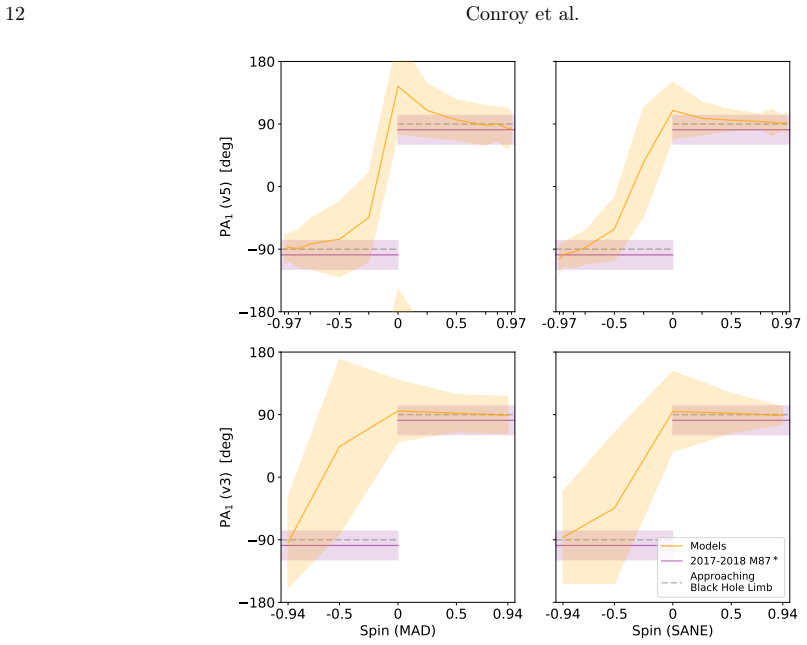
The position angle of peak brightness asymmetry in black hole rings aligns with the approaching limb for high spin magnitudes.
A machine-rendered reading of the paper's core claim, the machinery that carries it, and where it could break.
Core claim
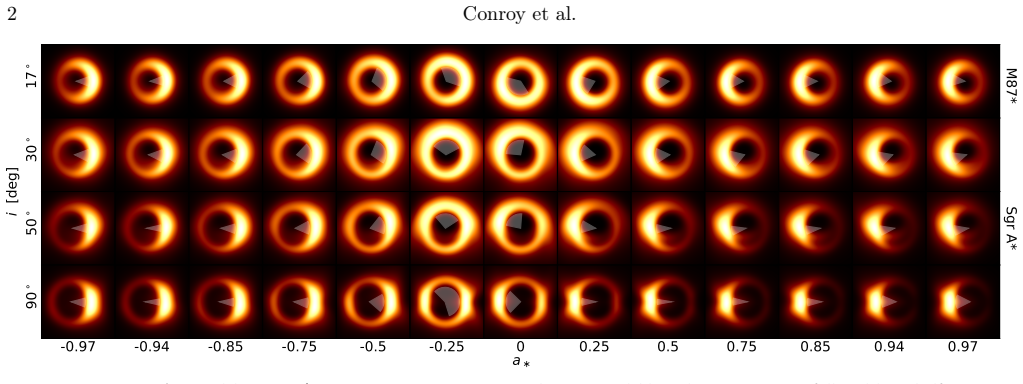
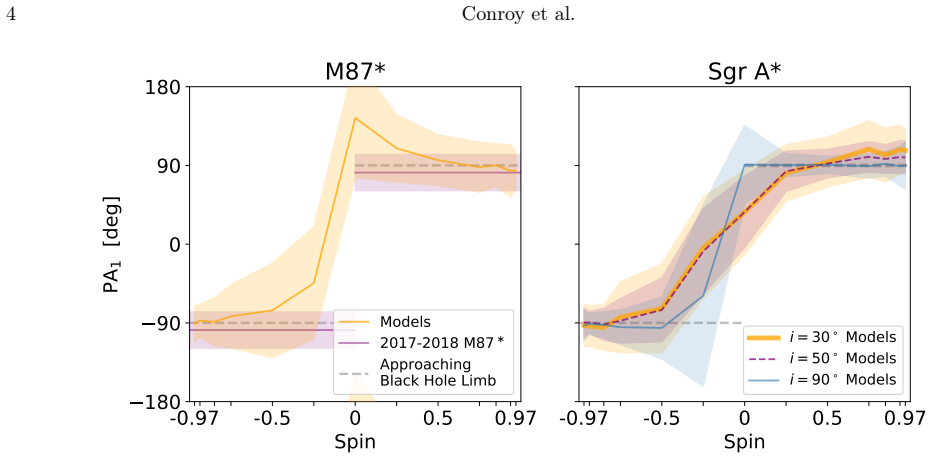
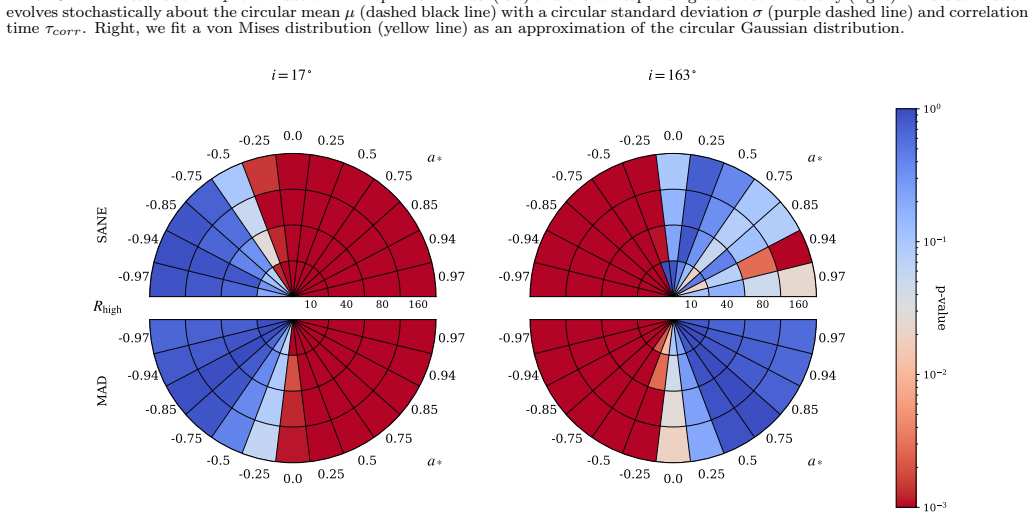
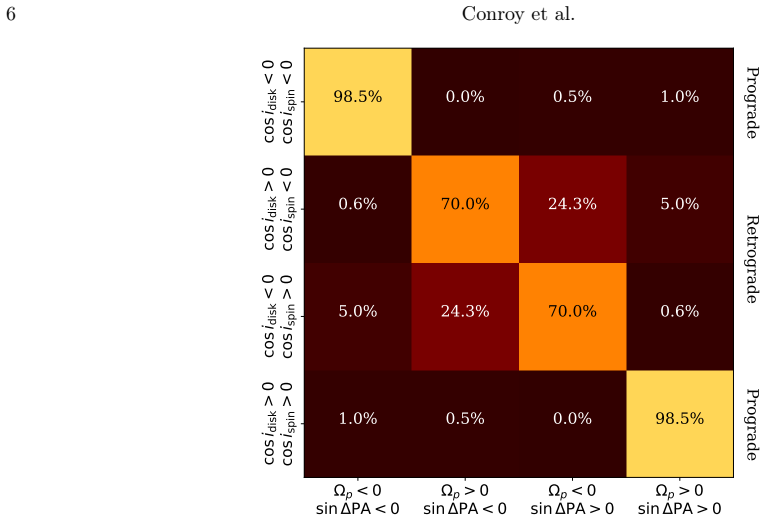
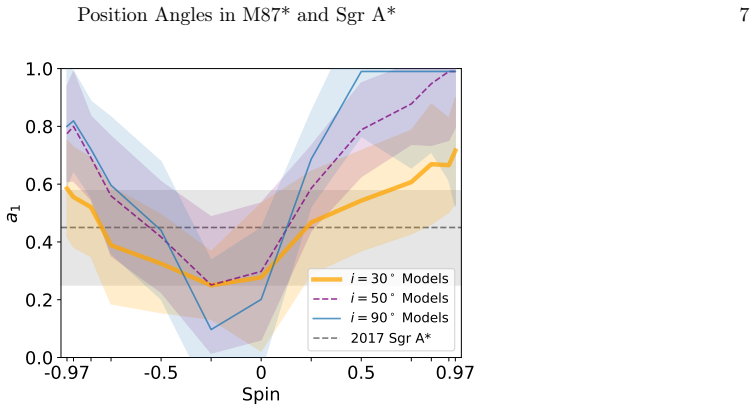
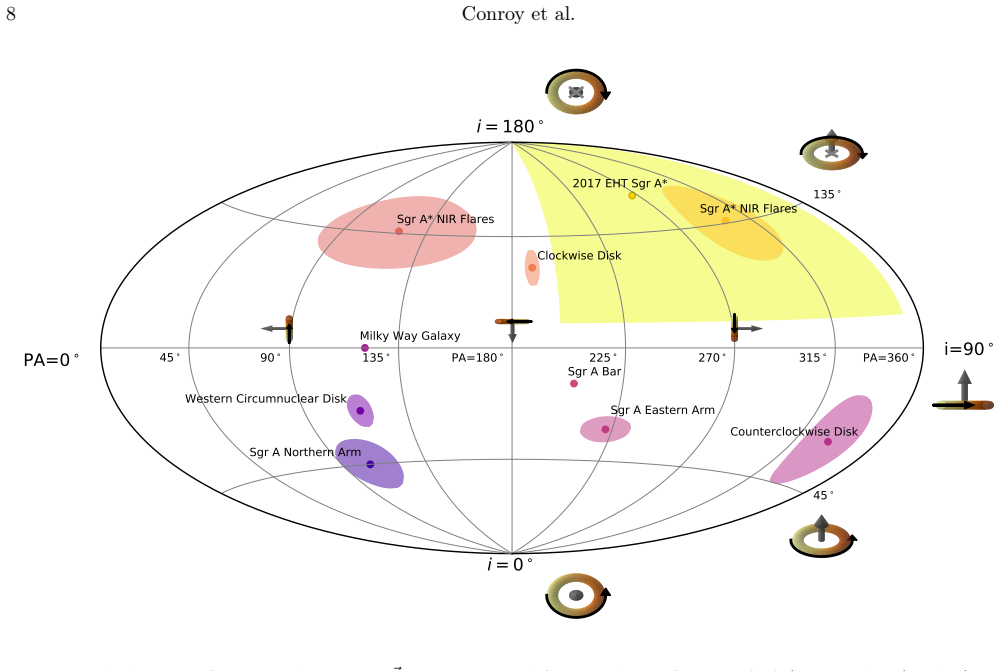
In GRMHD models, for black hole spins a* > 0 and a* ≲ -0.5 the mean PA1 falls within 1σ of the approaching limb independent of inclination, disk magnetization, or source. Direct comparison of the (a1, PA1) distribution measured in M87* images with these models mildly disfavors low-magnitude spins and strongly disfavors all spin vectors that point toward Earth. Alignment of PA1 with the large-scale jet axis suggests M87* lacks a large disk tilt, while PA1 combined with pattern speed could distinguish prograde from retrograde spin at roughly 84 percent accuracy; a future detection in Sgr A* would similarly constrain its spin magnitude and direction.
What carries the argument
The mean position angle PA1 of the peak brightness asymmetry, which tracks the approaching limb in high-spin models.
If this is right
- Alignment of PA1 with the jet axis implies M87* does not have a large disk tilt.
- PA1 together with pattern speed can distinguish prograde from retrograde spin in M87* at about 84 percent accuracy under 2026 video conditions.
- A detection of (a1, PA1) in Sgr A* would constrain both the magnitude and direction of its spin vector.
- With a larger sample of horizon-scale sources, the combination of ring diameter, asymmetry magnitude, and asymmetry angle could constrain mass, spin, and inclination.
Where Pith is reading between the lines
- The same PA1 observable could be applied to additional black holes once EHT arrays expand.
- If the alignment persists across varied models, PA1 offers a spin diagnostic that is relatively insensitive to exact disk magnetization.
- Repeated measurements over time could test whether spin vectors in active galactic nuclei show preferred orientations relative to their jets.
Load-bearing premise
The GRMHD models used are representative enough of real accretion flows that differences in observed (a1, PA1) can be attributed to spin rather than missing physics such as disk tilt or emission details.
What would settle it
A measured PA1 in M87* that lies outside the 1σ range of all high-spin model predictions would show that the claimed alignment does not hold under actual conditions.
Figures
read the original abstract
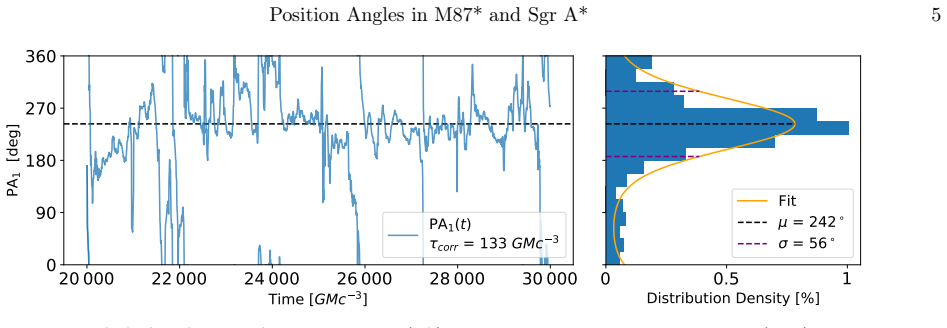
Event Horizon Telescope (EHT) images of black holes appear as rings with a brightness asymmetry. Here, we expand on our previous study of the asymmetry magnitude $a_1$ to study the position angle of the peak brightness asymmetry $\mathrm{PA}_1$ in general relativistic magnetohydrodynamic (GRMHD) models. For larger spin magnitudes ($a_{*}>0$ and $a_{*}\lesssim-0.5$), the mean $\mathrm{PA}_1$ falls within $1\sigma$ of the approaching limb of the black hole, regardless of viewing inclination, disk magnetization, or source. By comparing the $(a_1, \mathrm{PA}_1)$ distribution in M87* observations with models, we demonstrate that we can mildly disfavor low-magnitude spins and strongly disfavor all spin vectors that point toward Earth. The alignment of $\mathrm{PA}_1$ relative to the large-scale jet axis may suggest that M87*'s disk does not have a large tilt. By combining $\mathrm{PA}_1$ with the pattern speed measured in optimistic 2026 M87* video conditions, the EHT can constrain whether M87* is prograde or retrograde with $\sim 84\%$ accuracy. In Sgr A*, we show that a detection of $(a_1, \mathrm{PA}_1)$ could constrain the magnitude and direction of the galactic center spin vector. Finally, if future EHT expansions increase the sample of horizon-scale sources, a simple set of observables (ring diameter, asymmetry magnitude, and asymmetry angle) could enable robust constraints on black hole mass, spin, and inclination.
Editorial analysis
A structured set of objections, weighed in public.
Referee Report
Summary. The paper extends prior work on the brightness asymmetry magnitude a1 in EHT ring images to the position angle PA1 of the peak asymmetry in a library of GRMHD simulations. It reports that for |a*| ≳ 0.5 the mean PA1 lies within 1σ of the approaching limb independent of inclination, magnetization, and source; compares the observed (a1, PA1) distribution in M87* to the models to mildly disfavor low-magnitude spins and strongly disfavor Earth-pointing spin vectors; and argues that PA1 plus future pattern-speed measurements can distinguish prograde/retrograde rotation at ~84% accuracy while also offering constraints for Sgr A*.
Significance. If the sampled GRMHD library is representative, the result supplies a new, relatively simple observable (PA1) that can be combined with a1 and ring diameter to place statistical limits on black-hole spin vector orientation. The explicit comparison of simulated versus observed (a1, PA1) distributions and the forward-looking statements about 2026 video data constitute concrete, falsifiable predictions that strengthen the manuscript's utility for EHT analysis.
major comments (3)
- [Results section on PA1 alignment (likely §3–4)] The central claim that mean PA1 falls within 1σ of the approaching limb for a* > 0 and a* ≲ −0.5 (independent of inclination, magnetization, and source) is load-bearing for the subsequent statistical disfavoring of spin vectors. The manuscript does not appear to include tilted-disk GRMHD runs; a tilt ≳ 10° can rotate the effective Doppler pattern and shift the PA1 distribution by tens of degrees, directly eroding the claimed 1σ alignment and the exclusion of Earth-pointing spins.
- [Comparison with M87* observations (likely §5)] The statement that the (a1, PA1) distribution in M87* observations “mildly disfavors low-magnitude spins and strongly disfavors all spin vectors that point toward Earth” rests on a direct comparison whose statistical details (sample size per (a*, i, σ) bin, exact definition of the 1σ contour, treatment of observational uncertainties) are not provided in sufficient detail to verify the quoted confidence levels.
- [Discussion of future EHT video data] The ~84% accuracy claim for distinguishing prograde versus retrograde rotation when PA1 is combined with future pattern-speed measurements assumes that the optimistic 2026 video conditions will yield an independent pattern-speed measurement whose uncertainty does not correlate with the PA1 measurement; this joint-error budget is not quantified.
minor comments (2)
- [Introduction] Notation: the symbols a1 and PA1 are introduced without an explicit reminder of their definitions from the prior a1 paper; a one-sentence recap would aid readability.
- [Figure captions] Figure captions should state the number of GRMHD snapshots or runs contributing to each histogram so that the reader can judge the robustness of the reported means and 1σ intervals.
Simulated Author's Rebuttal
We thank the referee for their constructive and detailed comments, which have identified important areas for clarification and improvement. We respond to each major comment below.
read point-by-point responses
-
Referee: The central claim that mean PA1 falls within 1σ of the approaching limb for a* > 0 and a* ≲ −0.5 (independent of inclination, magnetization, and source) is load-bearing for the subsequent statistical disfavoring of spin vectors. The manuscript does not appear to include tilted-disk GRMHD runs; a tilt ≳ 10° can rotate the effective Doppler pattern and shift the PA1 distribution by tens of degrees, directly eroding the claimed 1σ alignment and the exclusion of Earth-pointing spins.
Authors: We agree that the GRMHD library used consists exclusively of untilted, aligned disks. The independence claimed is with respect to inclination, magnetization, and source within that library, but does not extend to tilted configurations. We will revise the manuscript to explicitly state this scope and to discuss tilted disks as a limitation that could affect PA1, with plans to address tilted models in future work. revision: yes
-
Referee: The statement that the (a1, PA1) distribution in M87* observations “mildly disfavors low-magnitude spins and strongly disfavors all spin vectors that point toward Earth” rests on a direct comparison whose statistical details (sample size per (a*, i, σ) bin, exact definition of the 1σ contour, treatment of observational uncertainties) are not provided in sufficient detail to verify the quoted confidence levels.
Authors: We acknowledge that additional statistical details are required for full verification. In the revised manuscript we will expand the relevant sections to report sample sizes per bin, the precise definition of the 1σ contours, and the treatment of EHT observational uncertainties in the comparison. revision: yes
-
Referee: The ~84% accuracy claim for distinguishing prograde versus retrograde rotation when PA1 is combined with future pattern-speed measurements assumes that the optimistic 2026 video conditions will yield an independent pattern-speed measurement whose uncertainty does not correlate with the PA1 measurement; this joint-error budget is not quantified.
Authors: The quoted accuracy is an estimate derived under the optimistic 2026 conditions with the assumption of independent measurements. We will revise the text to make this assumption explicit and to note that a complete joint-error analysis would require further modeling beyond the present scope. revision: partial
Circularity Check
Minor self-citation present but central comparison is independent
full rationale
The derivation compares simulated (a1, PA1) distributions from GRMHD models directly to M87* observations to constrain spin, with no reduction of predictions to fitted inputs or self-definitional loops. The abstract notes expansion on a prior study of a1, constituting one minor self-citation that is not load-bearing for the spin disfavoring claims. No uniqueness theorems, ansatzes smuggled via citation, or renaming of known results appear in the provided text. The result remains self-contained against external benchmarks.
Axiom & Free-Parameter Ledger
Reference graph
Works this paper leans on
-
[1]
2025, Living Reviews in Relativity, 28, 4, doi:10.1007/s41114-025-00057-0
Ayzenberg, D., Blackburn, L., Brito, R., et al. 2025, Living Reviews in Relativity, 28, 4, doi:10.1007/s41114-025-00057-0
-
[2]
Backes, M., Müller, C., Conway, J. E., et al. 2016, in The 4th Annual Conference on High Energy Astrophysics in Southern Africa (HEASA 2016), 29, doi:10.22323/1.275.0029
-
[3]
Bartko, H., Martins, F., Fritz, T. K., et al. 2009, ApJ, 697, 1741, doi:10.1088/0004-637X/697/2/1741
-
[4]
2010, ApJ, 708, 834, doi:10.1088/0004-637X/708/1/834
Bartko, H., Martins, F., Trippe, S., et al. 2010, ApJ, 708, 834, doi:10.1088/0004-637X/708/1/834
-
[5]
S., Dubois, Y., Volonteri, M., et al
Beckmann, R. S., Dubois, Y., Volonteri, M., et al. 2025, MNRAS, 536, 1838, doi:10.1093/mnras/stae2595
-
[6]
M., Levin, Y., Eisenhauer, F., et al
Beloborodov, A. M., Levin, Y., Eisenhauer, F., et al. 2006, ApJ, 648, 405, doi:10.1086/504279
-
[7]
Bernshteyn, V., Conroy, N. S., Bauböck, M., et al. 2026, arXiv e-prints, arXiv:2601.00394, doi:10.48550/arXiv.2601.00394
-
[8]
Bisnovatyi-Kogan, G. S., & Ruzmaikin, A. A. 1974, Ap&SS, 28, 45, doi:10.1007/BF00642237
-
[9]
Blandford, R. D., & Znajek, R. L. 1977, MNRAS, 179, 433, doi:10.1093/mnras/179.3.433
-
[10]
Broderick, A. E., Fish, V. L., Johnson, M. D., et al. 2016, ApJ, 820, 137, doi:10.3847/0004-637X/820/2/137
-
[11]
2025, MNRAS, 537, 2496, doi:10.1093/mnras/staf200
Chael, A. 2025, MNRAS, 537, 2496, doi:10.1093/mnras/staf200
-
[12]
Chael, A., Lupsasca, A., Wong, G. N., & Quataert, E. 2023, arXiv e-prints, arXiv:2307.06372, doi:10.48550/arXiv.2307.06372
-
[13]
Chael, A. A., Johnson, M. D., Bouman, K. L., et al. 2018, ApJ, 857, 23, doi:10.3847/1538-4357/aab6a8
-
[14]
2020, MNRAS, 499, 362, doi:10.1093/mnras/staa2718
Chatterjee, K., Younsi, Z., Liska, M., et al. 2020, MNRAS, 499, 362, doi:10.1093/mnras/staa2718
-
[15]
S., Bauböck, M., Dhruv, V., et al
Conroy, N. S., Bauböck, M., Dhruv, V., et al. 2025, arXiv e-prints, arXiv:2510.08848, doi:10.48550/arXiv.2510.08848
-
[16]
S., Bauböck, M., Dhruv, V., et al
Conroy, N. S., Bauböck, M., Dhruv, V., et al. 2023, The Astrophysical Journal, 951, 46, doi:10.3847/1538-4357/acd2c8
-
[17]
2023, Nature, 621, 711, doi:10.1038/s41586-023-06479-6
Cui, Y., Hada, K., Kawashima, T., et al. 2023, Nature, 621, 711, doi:10.1038/s41586-023-06479-6
-
[18]
Dhruv, V., Prather, B., Chandra, M., Joshi, A. V., & Gammie, C. F. 2025, ApJ, 993, L33, doi:10.3847/2041-8213/ae1236
-
[19]
Dhruv, V., Prather, B., Wong, G., & Gammie, C. F. 2024, arXiv e-prints, arXiv:2411.12647, doi:10.48550/arXiv.2411.12647 Position Angles in M87* and Sgr A* 13 TABLE 1 Circular Gaussian Fits to the Brightness Asymmetry Position AnglePA1 Source MAD/SANE Spin inclination [deg]R high Rlow µ[deg]σ[deg]M o[deg] M87* MAD−0.97 17All All269 20 270 M87* MAD−0.9375 1...
-
[20]
S., Barrett, J., Blackburn, L., et al
Doeleman, S. S., Barrett, J., Blackburn, L., et al. 2023, Galaxies, 11, 107, doi:10.3390/galaxies11050107
-
[21]
Eckart, A., Schödel, R., Meyer, L., et al. 2006, A&A, 455, 1, doi:10.1051/0004-6361:20064948 Event Horizon Telescope Collaboration, Akiyama, K., Alberdi, A., et al. 2019a, ApJ, 875, L1, doi:10.3847/2041-8213/ab0ec7 —. 2019b, ApJ, 875, L5, doi:10.3847/2041-8213/ab0f43 Event Horizon Telescope Collaboration, Akiyama, K., Algaba, J. C., et al. 2021, ApJ, 910,...
-
[22]
Fishbone, L. G., & Moncrief, V. 1976, ApJ, 207, 962, doi:10.1086/154565
-
[23]
2023, ApJ, 957, 103, doi:10.3847/1538-4357/acfa77 14 Conroy et al
Galishnikova, A., Philippov, A., & Quataert, E. 2023, ApJ, 957, 103, doi:10.3847/1538-4357/acfa77 14 Conroy et al
-
[24]
Gammie, C. F. 2025, ApJ, 980, 193, doi:10.3847/1538-4357/adaea3
-
[25]
Gammie, C. F., McKinney, J. C., & Tóth, G. 2003, ApJ, 589, 444, doi:10.1086/374594
-
[26]
2010, Reviews of Modern Physics, 82, 3121, doi: 10.1103/RevModPhys.82.3121
Genzel, R., Eisenhauer, F., & Gillessen, S. 2010, Reviews of Modern Physics, 82, 3121, doi:10.1103/RevModPhys.82.3121
-
[27]
Ginzburg, V. L., & Syrovatskii, S. I. 1965, ARA&A, 3, 297, doi:10.1146/annurev.aa.03.090165.001501 GRAVITY Collaboration, Abuter, R., Amorim, A., et al. 2018, A&A, 618, L10, doi:10.1051/0004-6361/201834294 GRAVITY Collaboration, Bauböck, M., Dexter, J., et al. 2020, A&A, 635, A143, doi:10.1051/0004-6361/201937233 Gravity Collaboration, Abuter, R., Aimar, ...
-
[28]
V., Narayan, R., & Abramowicz, M
Igumenshchev, I. V., Narayan, R., & Abramowicz, M. A. 2003, ApJ, 592, 1042, doi:10.1086/375769
-
[29]
Jackson, J. M., Geis, N., Genzel, R., et al. 1993, ApJ, 402, 173, doi:10.1086/172120
-
[30]
Jeter, B., & Broderick, A. E. 2021, ApJ, 908, 139, doi:10.3847/1538-4357/abda3d
-
[31]
Jiang, H.-X., Mizuno, Y., Fromm, C. M., & Nathanail, A. 2023, MNRAS, 522, 2307, doi:10.1093/mnras/stad1106
-
[32]
Johnson, M. D., Akiyama, K., Blackburn, L., et al. 2023a, Galaxies, 11, 61, doi:10.3390/galaxies11030061 —. 2023b, Galaxies, 11, 61, doi:10.3390/galaxies11030061
-
[33]
D., Akiyama, K., Baturin, R., et al
Johnson, M. D., Akiyama, K., Baturin, R., et al. 2024, arXiv e-prints, arXiv:2406.12917, doi:10.48550/arXiv.2406.12917 La Bella, N., Issaoun, S., Roelofs, F., Fromm, C., & Falcke, H. 2023, A&A, 672, A16, doi:10.1051/0004-6361/202245344
-
[34]
Lacy, J. H., Achtermann, J. M., & Serabyn, E. 1991, ApJ, 380, L71, doi:10.1086/186176
-
[35]
2024, ApJ, 975, 278, doi:10.3847/1538-4357/ad81f5
Levin, Y. 2024, ApJ, 975, 278, doi:10.3847/1538-4357/ad81f5
-
[36]
Levin, Y., & Beloborodov, A. M. 2003, ApJ, 590, L33, doi:10.1086/376675
-
[37]
Li, Z., Morris, M. R., & Baganoff, F. K. 2013, ApJ, 779, 154, doi:10.1088/0004-637X/779/2/154
-
[38]
Liska, M., Hesp, C., Tchekhovskoy, A., et al. 2017, Monthly Notices of the Royal Astronomical Society: Letters, 474, L81, doi:10.1093/mnrasl/slx174
-
[39]
Liszt, H. S. 2003, A&A, 408, 1009, doi:10.1051/0004-6361:20031033
-
[40]
Lu, J. R., Ghez, A. M., Hornstein, S. D., et al. 2009, ApJ, 690, 1463, doi:10.1088/0004-637X/690/2/1463
-
[41]
Mehlhaff, J. M., Chen, A. Y., Luepker, M., & Yuan, Y. 2026, arXiv e-prints, arXiv:2602.22168, doi:10.48550/arXiv.2602.22168 Mościbrodzka, M., Falcke, H., & Shiokawa, H. 2016, A&A, 586, A38, doi:10.1051/0004-6361/201526630 Mościbrodzka, M., & Gammie, C. F. 2018, MNRAS, 475, 43, doi:10.1093/mnras/stx3162
-
[42]
Starck, J. L. 2008, ApJ, 673, 251, doi:10.1086/521641 Mužić, K., Eckart, A., Schödel, R., et al. 2010, A&A, 521, A13, doi:10.1051/0004-6361/200913087 Mužić, K., Eckart, A., Schödel, R., Meyer, L., & Zensus, A. 2007, A&A, 469, 993, doi:10.1051/0004-6361:20066265
-
[43]
Narayan, R., Igumenshchev, I. V., & Abramowicz, M. A. 2003, PASJ, 55, L69, doi:10.1093/pasj/55.6.L69
-
[44]
Narayan, R., SÄ dowski, A., Penna, R. F., & Kulkarni, A. K. 2012, MNRAS, 426, 3241, doi:10.1111/j.1365-2966.2012.22002.x
-
[45]
Palumbo, D. C. M., Wong, G. N., & Prather, B. S. 2020, ApJ, 894, 156, doi:10.3847/1538-4357/ab86ac
-
[46]
2004, A&A, 426, 81, doi:10.1051/0004-6361:20034209
Paumard, T., Maillard, J.-P., & Morris, M. 2004, A&A, 426, 81, doi:10.1051/0004-6361:20034209
-
[47]
Pesce, D. W., Palumbo, D. C. M., Ricarte, A., et al. 2022, Galaxies, 10, 109, doi:10.3390/galaxies10060109
-
[48]
Prather, B. S. 2025, in New Frontiers in GRMHD Simulations, ed. C. Bambi, Y. Mizuno, S. Shashank, & F. Yuan, 167–201, doi:10.1007/978-981-97-8522-3_5
-
[49]
2023, Galaxies, 11, 15, doi:10.3390/galaxies11010015
Ramakrishnan, V., Nagar, N., Arratia, V., et al. 2023, Galaxies, 11, 15, doi:10.3390/galaxies11010015
-
[50]
Ressler, S. M., White, C. J., Quataert, E., & Stone, J. M. 2020, ApJ, 896, L6, doi:10.3847/2041-8213/ab9532
-
[51]
Ricarte, A., Conroy, N. S., Wielgus, M., et al. 2025, ApJ, 987, 152, doi:10.3847/1538-4357/add729
-
[52]
2024, A&A, 685, A92, doi:10.1051/0004-6361/202348925
Sala, L., Valentini, M., Biffi, V., & Dolag, K. 2024, A&A, 685, A92, doi:10.1051/0004-6361/202348925
-
[53]
Salas, L. D. S., Liska, M. T. P., Markoff, S. B., et al. 2025, MNRAS, 538, 698, doi:10.1093/mnras/staf240
-
[54]
Shapiro, S. L., Lightman, A. P., & Eardley, D. M. 1976, ApJ, 204, 187, doi:10.1086/154162 Sądowski, A., Narayan, R., Penna, R., & Zhu, Y. 2013, MNRAS, 436, 3856, doi:10.1093/mnras/stt1881
-
[55]
1989, ApJ, 341, L47, doi:10.1086/185454
Sofue, Y., Reich, W., & Reich, P. 1989, ApJ, 341, L47, doi:10.1086/185454
-
[56]
Su, M., & Finkbeiner, D. P. 2012, ApJ, 753, 61, doi:10.1088/0004-637X/753/1/61 The Event Horizon Telescope Collaboration. 2024, arXiv e-prints, arXiv:2410.02986, doi:10.48550/arXiv.2410.02986
-
[57]
Tiede, P. 2022, The Journal of Open Source Software, 7, 4457, doi:10.21105/joss.04457
-
[58]
Tiede, P., Broderick, A. E., & Palumbo, D. C. M. 2022, ApJ, 925, 122, doi:10.3847/1538-4357/ac3a6b von Fellenberg, S. D., Gillessen, S., Stadler, J., et al. 2022, ApJ, 932, L6, doi:10.3847/2041-8213/ac68ef
-
[59]
Walker, R. C., Hardee, P. E., Davies, F. B., Ly, C., & Junor, W. 2018, ApJ, 855, 128, doi:10.3847/1538-4357/aaafcc
-
[60]
2024, Nature Astronomy, 8, 1592, doi:10.1038/s41550-024-02358-w
Wang, Y., & Zhang, B. 2024, Nature Astronomy, 8, 1592, doi:10.1038/s41550-024-02358-w
-
[61]
1992, Nature, 357, 308, doi:10.1038/357308a0
Wardle, M., & Yusef-Zadeh, F. 1992, Nature, 357, 308, doi:10.1038/357308a0
-
[62]
2022, ApJ, 930, L19, doi:10.3847/2041-8213/ac6428
Wielgus, M., Marchili, N., Martí-Vidal, I., et al. 2022, ApJ, 930, L19, doi:10.3847/2041-8213/ac6428
-
[63]
Wong, G. N., Prather, B. S., Dhruv, V., et al. 2022, ApJS, 259, 64, doi:10.3847/1538-4365/ac582e
-
[64]
Yusef-Zadeh, F., Morris, M., Slee, O. B., & Nelson, G. J. 1986, ApJ, 300, L47, doi:10.1086/184600
-
[65]
2012, ApJ, 758, L11, doi:10.1088/2041-8205/758/1/L11
Yusef-Zadeh, F., Arendt, R., Bushouse, H., et al. 2012, ApJ, 758, L11, doi:10.1088/2041-8205/758/1/L11
-
[66]
Zhao, J.-H., Morris, M. R., Goss, W. M., & An, T. 2009, ApJ, 699, 186, doi:10.1088/0004-637X/699/1/186
discussion (0)
Sign in with ORCID, Apple, or X to comment. Anyone can read and Pith papers without signing in.