Querying Cohesive Subgraph regarding Span-Constrained Triangles on Temporal Graphs with Dynamic Index Maintenance
Pith reviewed 2026-06-27 07:57 UTC · model grok-4.3
The pith
Indexes built from the dual containment of (k,δ)-trusses compress temporal graph data losslessly and support optimal-time queries on time-bounded triangles.
A machine-rendered reading of the paper's core claim, the machinery that carries it, and where it could break.
Core claim
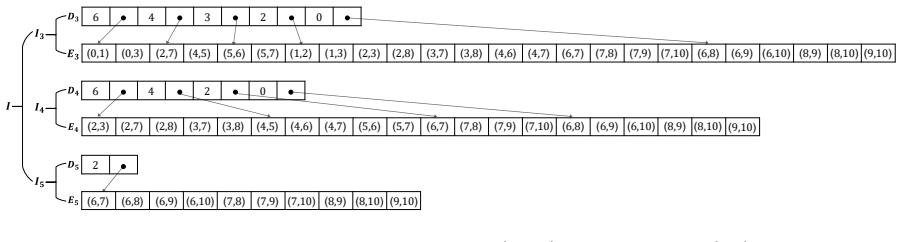
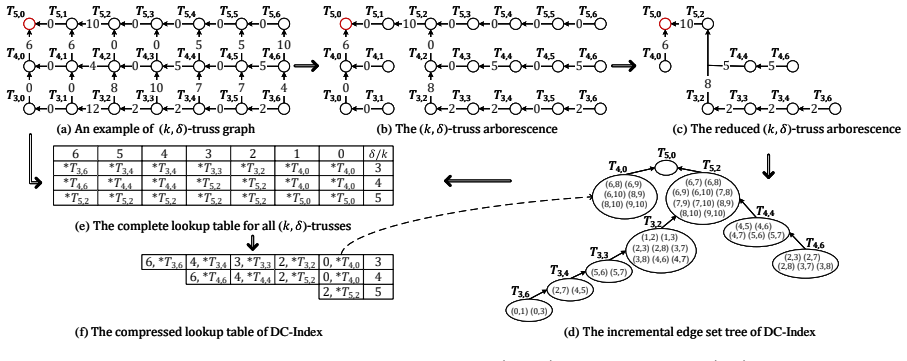
Utilizing the dual containment relation of (k,δ)-trusses, our indexes losslessly compress all (k,δ)-trusses into map or tree structures, significantly reducing space while enabling optimal-time retrieval.
What carries the argument
The dual containment relation of (k,δ)-trusses, which permits lossless compression of every truss instance into map or tree structures that still allow optimal-time retrieval.
If this is right
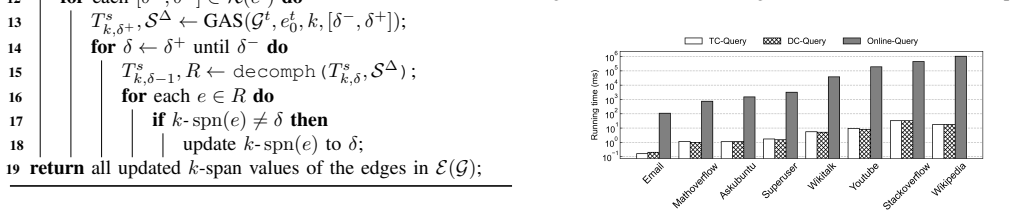
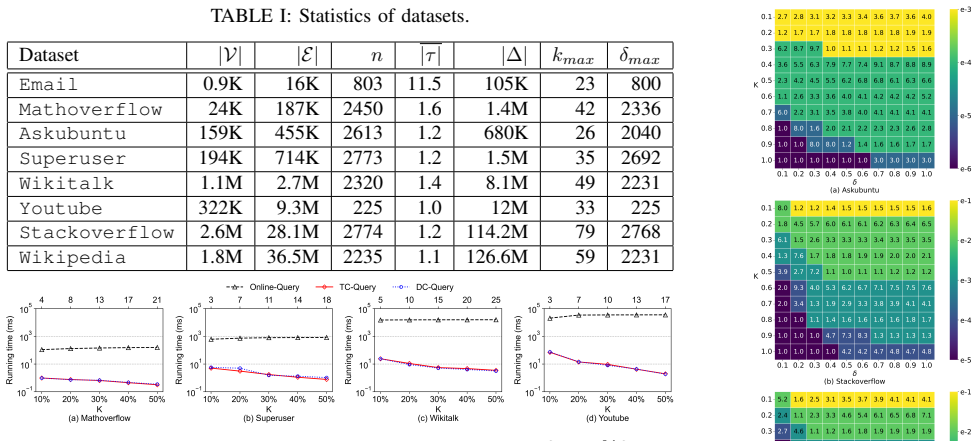
- Index-based approaches process queries in interactive time and outperform the index-free approach by 2 to 4 orders of magnitude.
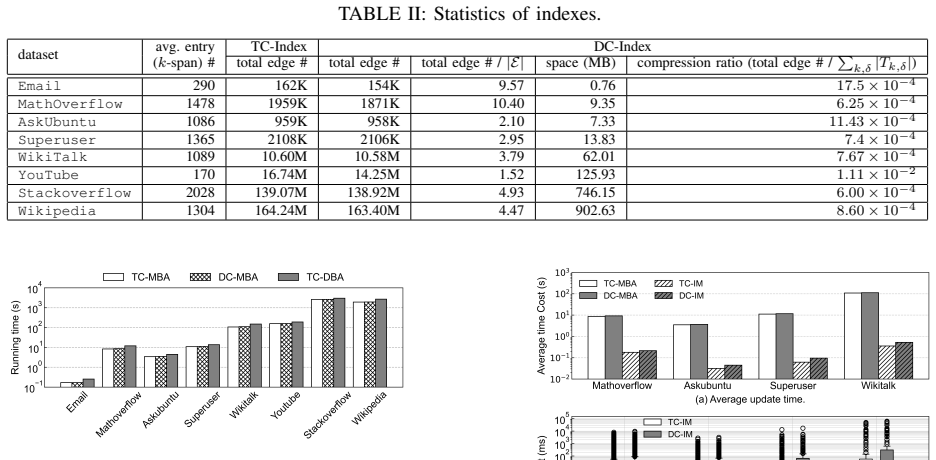
- The indexes achieve compression ratios of up to 10^{-4}.
- Two index construction algorithms based on truss decomposition and truss maintenance substantially reduce redundant computations.
- Dynamic maintenance routines update the indexes efficiently without rebuilding from scratch.
Where Pith is reading between the lines
- The same containment structure could be reused to index other temporal motifs such as 4-cycles or higher-order patterns.
- The maintenance routines suggest a natural extension to sliding-window or streaming temporal graphs where edges arrive continuously.
- In practice the indexes would let analysts run repeated community searches on social or transaction networks without waiting for full recomputation after each update.
Load-bearing premise
The dual containment relation of (k,δ)-trusses permits lossless compression into map or tree structures that still support optimal-time retrieval.
What would settle it
A concrete (k,δ)-truss instance that the compressed index either fails to return or returns in more than linear time relative to its size.
Figures

read the original abstract
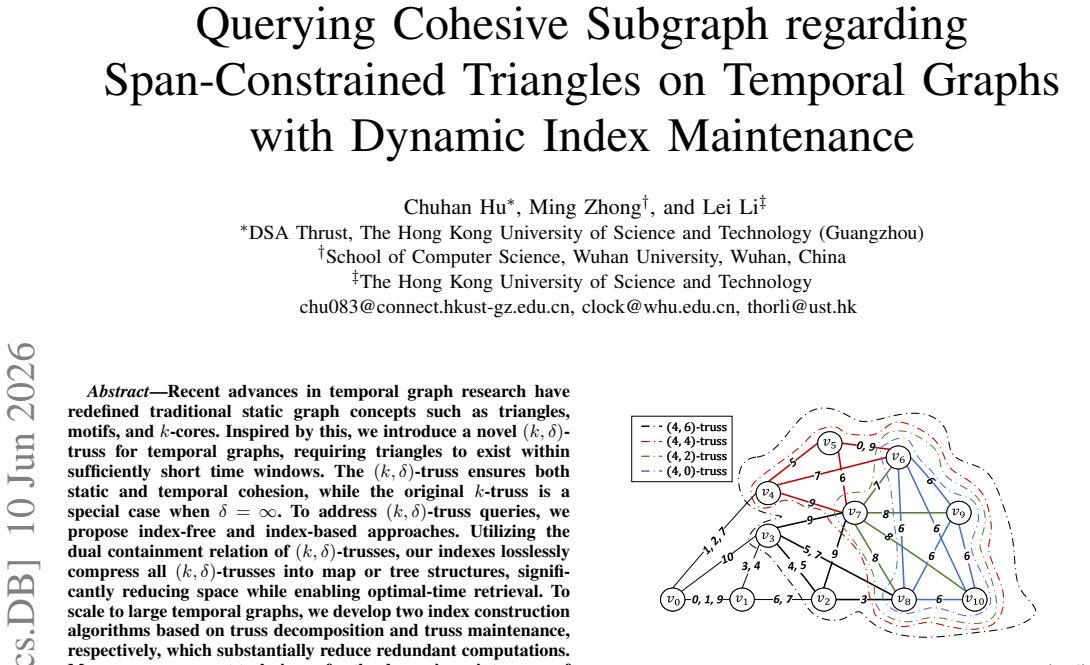
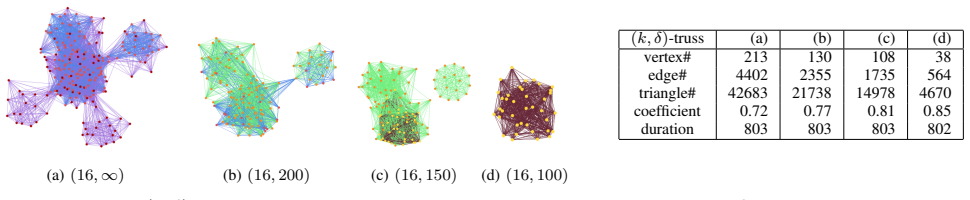
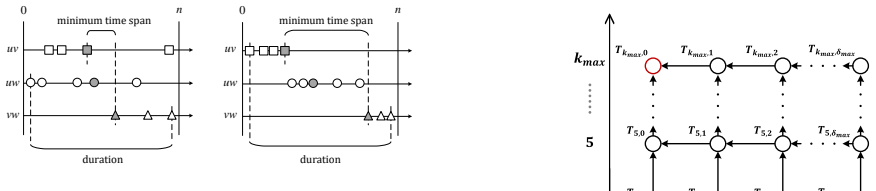
Recent advances in temporal graph research have redefined traditional static graph concepts such as triangles, motifs, and $k$-cores. Inspired by this, we introduce a novel $(k,\delta)$-truss for temporal graphs, requiring triangles to exist within sufficiently short time windows. The $(k,\delta)$-truss ensures both static and temporal cohesion, while the original $k$-truss is a special case when $\delta = \infty$. To address $(k,\delta)$-truss queries, we propose index-free and index-based approaches. Utilizing the dual containment relation of $(k,\delta)$-trusses, our indexes losslessly compress all $(k,\delta)$-trusses into map or tree structures, significantly reducing space while enabling optimal-time retrieval. To scale to large temporal graphs, we develop two index construction algorithms based on truss decomposition and truss maintenance, respectively, which substantially reduce redundant computations. Moreover, we present techniques for the dynamic maintenance of the proposed indexes. The experimental results demonstrate that index-based approaches process queries in interactive time and outperform the index-free approach by 2$\sim$4 orders of magnitude, while the indexes achieve compression ratios of up to $10^{-4}$ and can be updated efficiently without rebuilding from scratch.
Editorial analysis
A structured set of objections, weighed in public.
Referee Report
Summary. The paper introduces the (k,δ)-truss for temporal graphs, a generalization of the k-truss that requires triangles to exist within a time span of at most δ. It develops index-free and index-based query methods for retrieving such subgraphs; the index-based methods exploit a dual containment relation among (k,δ)-trusses to losslessly compress them into map or tree structures that support optimal-time retrieval. Two construction algorithms (based on truss decomposition and truss maintenance) are presented to reduce redundant work on large graphs, together with dynamic maintenance techniques that avoid full rebuilds. Experiments are reported to show that index-based queries run in interactive time, outperform the index-free baseline by 2–4 orders of magnitude, and achieve compression ratios up to 10^{-4}.
Significance. If the central claims hold, the work supplies a practical, space-efficient indexing scheme for span-constrained cohesive subgraphs on temporal graphs and demonstrates that the dual-containment property can be turned into lossless, query-efficient data structures with dynamic update support. These features address a concrete need in temporal graph databases and could be adopted in systems that must answer motif-style queries under temporal constraints without rebuilding indexes from scratch.
minor comments (3)
- [Abstract] Abstract: the reported compression ratio of 10^{-4} and the 2–4 order-of-magnitude speed-up are stated without naming the datasets, the size of the input graphs, or the competing baselines; a one-sentence summary of the experimental setting would improve readability.
- [Index construction] The definition of the dual containment relation (used to justify the map/tree compression) should be stated formally once, with a short proof sketch or reference to the section that shows it preserves all (k,δ)-trusses.
- [Query processing] Notation: the symbol δ is introduced as a time-span parameter but its units and comparison with edge timestamps are not restated in the query-processing sections; a brief reminder would help readers.
Simulated Author's Rebuttal
We thank the referee for the supportive summary, significance assessment, and recommendation of minor revision. No major comments were listed in the report.
Circularity Check
No significant circularity detected
full rationale
The paper defines the novel (k,δ)-truss concept directly from temporal triangle constraints and then constructs indexes by exploiting the dual containment relation among these trusses; both the definition and the containment property are introduced and justified inside the manuscript rather than presupposed by external self-citation or by any fitted parameter. Index construction algorithms (truss decomposition and maintenance) and dynamic update rules are presented as preserving the full set of trusses while enabling direct map/tree lookup, with no equation or claim reducing the reported compression ratios or query times back to quantities defined by the same indexes. Experimental speedups are measured outcomes, not quantities forced by the construction itself. No patterns of self-definitional loops, fitted-input predictions, or load-bearing self-citations appear.
Axiom & Free-Parameter Ledger
free parameters (2)
- k
- δ
axioms (1)
- standard math Standard definitions of temporal graphs, edges with timestamps, and triangles
invented entities (1)
-
(k,δ)-truss
no independent evidence
Reference graph
Works this paper leans on
-
[1]
A Guide to Temporal Networks,
N. Masuda, R. Lambiotte, “A Guide to Temporal Networks,” World Scientific Publishing Europe Ltd, 2016
2016
-
[2]
Temporal network,
P. Holme, J. SaramakiJari, “Temporal network,” Springer, 2012
2012
-
[3]
Empirical analysis of an evolving social network,
G. Kossinets, D. Watts, “Empirical analysis of an evolving social network,” science, 311(5757): pp. 88-90, 2006
2006
-
[4]
Dgraph: A large-scale financial dataset for graph anomaly detection,
X. Huang, Y . Yang, Y . Wang, et al, “Dgraph: A large-scale financial dataset for graph anomaly detection,” Advances in Neural Information Processing Systems, 35: pp. 22765-22777, 2022
2022
-
[5]
Spatio-Temporal Characterization of Stochastic Dynamic Transportation Networks,
M. Filipovska, H. Mahmassani, “Spatio-Temporal Characterization of Stochastic Dynamic Transportation Networks,” IEEE Transactions on Intelligent Transportation Systems, 24(9): pp. 9929-9939, 2023
2023
-
[6]
The dynamics of a mobile phone net- work,
C. Hidalgo, C. Rodr ´ıguez-Sickert, “The dynamics of a mobile phone net- work,” Physica A: Statistical Mechanics and its Applications, 387(12): pp. 3017-3024, 2008
2008
-
[7]
Spatio-temporal graph neural net- works for multi-site PV power forecasting,
J. Simeunovi ´c, B. Schubnel, et al, “Spatio-temporal graph neural net- works for multi-site PV power forecasting,” IEEE Transactions on Sustainable Energy, 13(2): pp. 1210-1220, 2021
2021
-
[8]
Introduction to temporal network epidemiology,
N. Masuda, P. Holme, “Introduction to temporal network epidemiology,” Springer Singapore, 2017
2017
-
[9]
Mining (maximal) span-cores from temporal networks,
E. Galimberti, A. Barrat, F. Bonchi, et al, “Mining (maximal) span-cores from temporal networks,” Proceedings of the 27th ACM international Conference on Information and Knowledge Management, pp. 107-116, 2018
2018
-
[10]
Core decomposition in large temporal graphs,
H. Wu, J. Cheng, et al, “Core decomposition in large temporal graphs,” 2015 IEEE International Conference on Big Data (Big Data), pp. 649–658, 2015
2015
-
[11]
Scalable time- range k-core query on temporal graphs,
J. Yang, M. Zhong, Y . Zhu, T. Qian, M. Liu, and J. Yu, “Scalable time- range k-core query on temporal graphs,” PVLDB, 16(5): pp. 1168–1180, 2023
2023
-
[12]
On querying historical k-cores,
M. Yu, D. Wen, L. Qin, et al, “On querying historical k-cores,” PVLDB, 14(11): pp. 2033–2045, 2021
2033
-
[13]
Z. Wang, M. Zhong, Y . Zhu, et al. “On More Efficiently and Versatilely Querying Historical k-Cores, “ PVLDB, 18(5): pp. 1335-1347, 2025
2025
-
[14]
A Unified and Scalable Algorithm Framework of User-Defined Temporal(k,X)-Core Query,
M. Zhong, J. Yang, Y . Zhu, T. Qian, M. Liu, J. Yu, “A Unified and Scalable Algorithm Framework of User-Defined Temporal(k,X)-Core Query,” IEEE Transactions on Knowledge and Data Engineering, 2024
2024
-
[15]
Efficient temporal core maintenance of massive graphs,
W. Bai, Y . Chen, and D. Wu, “Efficient temporal core maintenance of massive graphs,” Information Sciences, 513: pp. 324–340, 2020
2020
-
[16]
Z. Du, M. Zhong, Y . Zhu, et al. “Efficient Frequency-Aware k-Core Query on Temporal Graphs, “ ICDE, pp. 2366-2379, 2025
2025
-
[17]
Persistent community search in temporal networks,
R. Li, J. Su, L. Qin, J. Yu, and Q. Dai, “Persistent community search in temporal networks,” ICDE, pp. 797–808, 2018
2018
-
[18]
Online density bursting subgraph detection from temporal graphs,
L. Chu, Y . Zhang, Y . Yang, L. Wang, and J. Pei, “Online density bursting subgraph detection from temporal graphs,” PVLDB, 12(13): pp. 2353–2365, 2019
2019
-
[19]
Periodic communities mining in temporal networks: Concepts and algorithms,
H. Qin, R. Li, Y . Yuan, G. Wang, W. Yang, and L. Qin, “Periodic communities mining in temporal networks: Concepts and algorithms,” IEEE Transactions on Knowledge and Data Engineering, 34(8): pp. 3927-3945, 2020
2020
-
[20]
Efficient continual cohesive subgraph search in large temporal graphs,
Y . Li, J. Liu, H. Zhao, J. Sun, Y . Zhao, and G. Wang, “Efficient continual cohesive subgraph search in large temporal graphs,” World Wide Web, 24(5): pp. 1483–1509, 2021
2021
-
[21]
Reliable com- munity search in dynamic networks,
Y . Tang, J. Li, N. Haldar, Z. Guan, J. Xu, and C. Liu, “Reliable com- munity search in dynamic networks,” PVLDB, 15(11): pp. 2826–2838, 2022
2022
-
[22]
Efficient Algorithms to Mine Maximal Span- Trusses From Temporal Graphs,
Q. Lotito, A. Montresor, “Efficient Algorithms to Mine Maximal Span- Trusses From Temporal Graphs,” unpublished
-
[23]
Research on K-truss Community Search Algorithm for Temporal Networks,
L. Xu, R. Li, G. Wang, et al, “Research on K-truss Community Search Algorithm for Temporal Networks,” Journal of Frontiers of Computer Science and Technology, 14(9): pp. 1482-1489, 2020
2020
-
[24]
Faster and Generalized Temporal Triangle Counting, via Degeneracy Ordering,
N. Pashanasangi, and C. Seshadhri, “Faster and Generalized Temporal Triangle Counting, via Degeneracy Ordering,” KDD, pp. 1319–1328, 2021
2021
-
[25]
Efficient Sampling Algorithms for Approximate Temporal Motif Counting,
J. Wang, Y . Wang, W. Jiang, Y . Li, and K. Tan, “Efficient Sampling Algorithms for Approximate Temporal Motif Counting,” CIKM, pp. 1505–1514, 2020
2020
-
[26]
Motifs in Temporal Net- works,
A. Paranjape, A. Benson, and J. Leskovec, “Motifs in Temporal Net- works,” WSDM, pp. 601–610, 2017
2017
-
[27]
Sampling Methods for Counting Temporal Motifs,
P. Liu, A. Benson, and M. Charikar, “Sampling Methods for Counting Temporal Motifs,” WSDM, pp. 294–302, 2019
2019
-
[28]
Temporal Network Motifs: Models, Limitations, Evaluation,
P. Liu, V . Guarrasi, and A. Sarıyuce, “Temporal Network Motifs: Models, Limitations, Evaluation,” IEEE Transactions on Knowledge and Data Engineering, 35: pp. 945–957, 2023
2023
-
[29]
Kovanen, M
L. Kovanen, M. Karsai, K. Kaski, J. Kert ´esz, and J. Saram¨aki, “Temporal motifs in time-dependent networks,“ Journal of Statistical Mechanics: Theory and Experiment, P11005, 2011
2011
-
[30]
Graphs evolution: Densification and shrinking diameters
J. Leskovec, J. Kleinberg, C. Faloutsos, “Graphs evolution: Densification and shrinking diameters” ACM transactions on Knowledge Discovery from Data (TKDD), 1(1): pp. 2–42, 2007
2007
-
[31]
Truss decomposition in massive networks,
J. Wang, J. Cheng, “Truss decomposition in massive networks,” PVLDB, 5(9): pp. 812–823, 2012
2012
-
[32]
Distributed algorithms for k-truss decomposition,
P. Chen, C. Chou, and M. Chen, “Distributed algorithms for k-truss decomposition,” IEEE International Conference on Big Data (Big Data), pp. 471–480, 2014
2014
-
[33]
Accelerating truss decomposition on heterogeneous processors,
Y . Che, Z. Lai, S. Sun, Y . Wang, and Q. Luo, “Accelerating truss decomposition on heterogeneous processors,” Proceedings of the VLDB Endowment, 13(10): pp. 1751-1764, 2020
2020
-
[34]
Parallel k-truss decomposition on multicore systems,
H. Kabir, K. Madduri, “Parallel k-truss decomposition on multicore systems,” IEEE High Performance Extreme Computing Conference (HPEC), pp. 1-7, 2017
2017
-
[35]
Shared-memory graph truss decomposition,
H. Kabir, K. Madduri, “Shared-memory graph truss decomposition,” IEEE 24th International Conference on High Performance Computing (HiPC), pp. 13–22, 2017
2017
-
[36]
Querying k-truss community in large and dynamic graphs,
X. Huang, H. Cheng, L. Qin, et al, “Querying k-truss community in large and dynamic graphs,” Proceedings of the 2014 ACM SIGMOD international conference on Management of data, pp. 1311-1322, 2014
2014
-
[37]
Unboundedness and efficiency of truss maintenance in evolving graphs,
Y . Zhang, J. Yu, “Unboundedness and efficiency of truss maintenance in evolving graphs,” Proceedings of the 2019 International Conference on Management of Data, pp. 1024-1041, 2019
2019
-
[38]
Efficient truss maintenance in evolving networks,
R. Zhou, C. Liu, J. Yu, et al, “Efficient truss maintenance in evolving networks,” arXiv preprint arXiv:1402.2807, 2014
Pith/arXiv arXiv 2014
-
[39]
Batch processing for truss maintenance in large dynamic graphs,
Q. Luo, D. Yu, X. Cheng, et al, “Batch processing for truss maintenance in large dynamic graphs,” IEEE Transactions on Computational Social Systems, pp. 1435-1446, 2020
2020
-
[40]
Efficient Star-based Truss Maintenance on Dynamic Graphs,
Z. Sun, X. Huang, Q. Liu, et al, “Efficient Star-based Truss Maintenance on Dynamic Graphs,” Proceedings of the ACM on Management of Data, 1(2): pp. 1-26, 2023
2023
-
[41]
An o (m) algorithm for cores decompo- sition of networks,
V . Batagelj and M. Zaversnik, “An o (m) algorithm for cores decompo- sition of networks,” arXiv preprint cs/0310049, 2003
Pith/arXiv arXiv 2003
-
[42]
SNAP Datasets: Stanford large network dataset collection,
J. Leskovec, A. Krevl, “SNAP Datasets: Stanford large network dataset collection,” http://snap.stanford.edu/data, Jun. 2014
2014
-
[43]
Konect: the koblenz network collection,
J. Kunegis, “Konect: the koblenz network collection,” in Proceedings of the 22nd international conference on world wide web, pp. 1343–1350, 2013
2013
-
[44]
Efficient community search over large directed graphs: An augmented index-based approach,
Y . Chen, J. Zhang, Y . Fang, et al, “Efficient community search over large directed graphs: An augmented index-based approach,” Proceedings of the Twenty-Ninth International Conference on International Joint Conferences on Artificial Intelligence, pp. 3544-3550, 2021
2021
-
[45]
Exploring finer granularity within the cores: Efficient (k, p)-core computation,
C. Zhang, F. Zhang, W. Zhang, et al, “Exploring finer granularity within the cores: Efficient (k, p)-core computation,” ICDE, pp. 181-192, 2020
2020
-
[46]
C. Hu, M. Zhong, Y . Zhu, et al. “Querying cohesive subgraph regarding span-constrained triangles on temporal graphs,“ ICDE, pp. 3338-3350, 2024
2024
discussion (0)
Sign in with ORCID, Apple, or X to comment. Anyone can read and Pith papers without signing in.