Beyond Frequency Marching: Orbit Recovery in Dihedral and Projected Multireference Alignment
Pith reviewed 2026-06-27 08:22 UTC · model grok-4.3
The pith
The first polynomial-time algorithms recover signals from dihedral and projected multireference alignment using third moments.
A machine-rendered reading of the paper's core claim, the machinery that carries it, and where it could break.
Core claim
We give the first polynomial-time algorithm for recovering generic signals in both dihedral MRA and projected MRA from the third moment tensor. The method requires signal length to be a power of two and recursively subdivides into half-size problems. Success is proven conditional on a conjecture that a symbolic matrix of polynomials has full rank.
What carries the argument
Recursive subdivision into half-size subproblems for power-of-two signal lengths, applied to the third-moment inverse problem.
If this is right
- The algorithm solves dihedral MRA, allowing for signal reversals in addition to shifts.
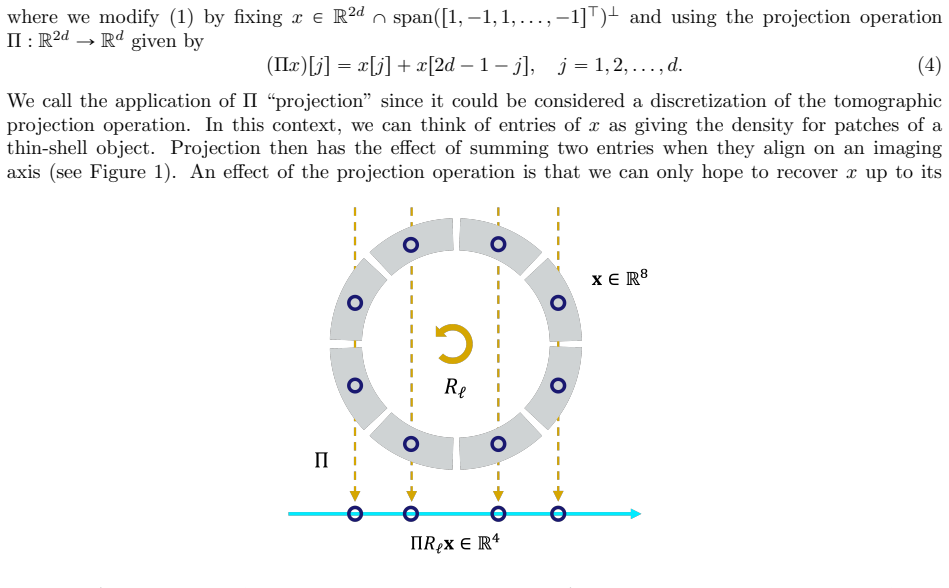
- It also solves projected MRA, incorporating a projection operator similar to tomographic projections.
- The method runs in polynomial time for generic signals when the rank conjecture holds.
- For any fixed size, the conjecture can be verified computationally to confirm applicability.
Where Pith is reading between the lines
- If the conjecture is true for all powers of two, this framework could extend to practical signal recovery in structural biology applications.
- The recursive structure suggests potential for divide-and-conquer approaches in other orbit recovery problems with larger groups.
- Computational verification of the rank condition provides a pathway to validate the algorithm for specific problem sizes encountered in experiments.
Load-bearing premise
The symbolic matrix of polynomials arising from the third-moment analysis has full rank.
What would settle it
Finding a power-of-two signal length where the symbolic matrix has rank less than expected, or exhibiting a generic signal for which the third moments do not uniquely determine the signal up to the group action.
Figures
read the original abstract
Multireference alignment (MRA) is the task of recovering a hidden "signal" vector, given many noisy copies that have been cyclically shifted by unknown offsets. This task belongs to the class of orbit recovery problems, in which the observed samples are affected by some group action. These problems have a variety of practical motivations, including the reconstruction of 3-dimensional molecular structure from cryogenic electron microscopy (cryo-EM) images. We consider two variants of MRA: dihedral MRA, where the cyclic group is replaced by the dihedral group, allowing for reversals of the vector in addition to shifts; and projected MRA, where the observations are passed through a projection operator akin to the tomographic projection present in cryo-EM. We apply the method of moments and aim to recover the signal from the third moment tensor of the samples. This inverse problem is well understood for basic MRA, but for the variants we consider there is no polynomial-time algorithm known to succeed for generic signals. We give the first such algorithm for both of these variants. Our method requires the signal length to be a power of two, and recursively subdivides the problem into smaller problems of half the size. The algorithm's success for generic signals is proven, conditional on a conjecture about the rank of a certain symbolic matrix of polynomials. For any given problem size, this conjecture can be verified on a computer.
Editorial analysis
A structured set of objections, weighed in public.
Referee Report
Summary. The paper presents the first polynomial-time algorithm for dihedral and projected multireference alignment (MRA) orbit recovery problems. It recovers a hidden signal from noisy observations under dihedral group actions or tomographic projections by applying the method of moments to the third-moment tensor. The approach requires signal length n to be a power of two and proceeds via recursive subdivision into half-size subproblems. Success for generic signals is proven conditionally on a conjecture that a certain symbolic matrix of polynomials (arising from the third-moment inverse problem) has full rank; the conjecture is stated to be computationally verifiable for any fixed n.
Significance. If the rank conjecture holds, the result supplies the first generic-signal algorithm for these MRA variants, extending moment-based orbit recovery beyond cyclic shifts to settings directly relevant to cryo-EM. The recursive reduction and explicit handling of reversals/projections constitute a technical advance over frequency-marching methods. The computational verifiability of the conjecture is a positive feature that could enable concrete checks, though the conditional status tempers immediate applicability.
major comments (2)
- [Abstract and main theorem section] Abstract and the section stating the main theorem (the generic-signal recovery result): the correctness claim for generic signals is conditional on the full-rank conjecture for the symbolic matrix in the third-moment analysis, yet the manuscript provides neither an explicit construction of this matrix nor any rank verification (even for the smallest power-of-two lengths such as n=4 or n=8), despite noting that verification is feasible on a computer. This leaves the central generic guarantee without supporting evidence.
- [Recursive algorithm description] The recursive subdivision procedure (the half-size reduction step): while the reduction to smaller dihedral/projected MRA instances is described, the base-case handling for the smallest n and the precise mapping of the third-moment tensor under subdivision are not shown to preserve the generic uniqueness property independently of the conjecture, making the inductive step load-bearing on the same unverified algebraic claim.
minor comments (1)
- [Preliminaries] Notation for the projection operator and dihedral action could be clarified with an explicit small-n example to aid readability.
Simulated Author's Rebuttal
We thank the referee for the careful reading and for highlighting the need for greater concreteness around the rank conjecture. We address each major comment below and will incorporate clarifications and explicit verifications in the revised manuscript.
read point-by-point responses
-
Referee: [Abstract and main theorem section] Abstract and the section stating the main theorem (the generic-signal recovery result): the correctness claim for generic signals is conditional on the full-rank conjecture for the symbolic matrix in the third-moment analysis, yet the manuscript provides neither an explicit construction of this matrix nor any rank verification (even for the smallest power-of-two lengths such as n=4 or n=8), despite noting that verification is feasible on a computer. This leaves the central generic guarantee without supporting evidence.
Authors: We agree that the absence of an explicit matrix construction and small-n verification weakens the presentation. The manuscript states that verification is computationally feasible but does not carry it out. In the revision we will add the explicit symbolic matrix for n=4 and n=8 (derived from the third-moment equations under the dihedral/projected actions), together with the results of a direct rank computation confirming that the matrix has full rank over the rationals for these sizes. This supplies the requested supporting evidence while preserving the conditional character of the generic-signal theorem. revision: yes
-
Referee: [Recursive algorithm description] The recursive subdivision procedure (the half-size reduction step): while the reduction to smaller dihedral/projected MRA instances is described, the base-case handling for the smallest n and the precise mapping of the third-moment tensor under subdivision are not shown to preserve the generic uniqueness property independently of the conjecture, making the inductive step load-bearing on the same unverified algebraic claim.
Authors: The base cases are precisely the small-n instances for which the rank conjecture can be (and, in the revision, will be) verified by direct computation; once the conjecture holds for those sizes, the generic uniqueness for the base cases follows from the same algebraic argument used in the inductive step. The tensor-mapping formulas under subdivision are constructed so that the third-moment equations for the half-size problem are algebraically equivalent (up to an invertible linear transformation on the moment space) to the corresponding equations for the original problem. Consequently the generic uniqueness property transfers directly once the rank condition is assumed at the smaller scale. We will expand the exposition of the base-case verification and the explicit tensor-mapping formulas to make this dependence transparent, but the overall proof remains conditional on the conjecture; it cannot be made independent of it without proving the conjecture itself. revision: partial
Circularity Check
No significant circularity; derivation is self-contained with conditional algebraic conjecture
full rationale
The paper describes a recursive subdivision algorithm for dihedral and projected MRA that reduces the problem to inverting the third-moment tensor. Success for generic signals is stated as conditional on a rank conjecture for a symbolic matrix of polynomials, which the abstract explicitly notes can be verified computationally for fixed sizes. No quoted step reduces a claimed prediction or uniqueness result to a fitted parameter, self-definition, or self-citation chain by construction. The central algorithm and proof structure remain independent of the inputs they process, satisfying the default expectation of no circularity.
Axiom & Free-Parameter Ledger
axioms (1)
- ad hoc to paper A certain symbolic matrix of polynomials has full rank (the conjecture required for the generic-signal recovery proof).
Reference graph
Works this paper leans on
-
[1]
SIAM Journal on Mathematics of Data Science , author =
The. SIAM Journal on Mathematics of Data Science , author =. 2019 , pages =. doi:10.1137/18M1214317 , abstract =
-
[2]
Information and Inference: A Journal of the IMA , author =
Super-resolution multi-reference alignment , volume =. Information and Inference: A Journal of the IMA , author =. 2022 , pages =. doi:10.1093/imaiai/iaab003 , abstract =
-
[3]
Journal of Theoretical Biology , author =
The. Journal of Theoretical Biology , author =. 1980 , pages =
1980
-
[4]
SIAM Journal on Imaging Sciences , author =
Three-. SIAM Journal on Imaging Sciences , author =. 2011 , pages =. doi:10.1137/090767777 , abstract =
-
[5]
IEEE Transactions on Signal Processing , author =
Fourth-. IEEE Transactions on Signal Processing , author =. 2007 , pages =. doi:10.1109/TSP.2007.893943 , abstract =
-
[6]
Numerical Linear Algebra with Applications , author =
Linear systems with a canonical polyadic decomposition constrained solution:. Numerical Linear Algebra with Applications , author =. 2018 , pages =. doi:10.1002/nla.2190 , abstract =
-
[7]
Algorithms from
Liu, Allen and Moitra, Ankur , month = may, year =. Algorithms from
-
[8]
Generalized single-particle cryo-. Microscopy , author =. 2016 , pages =. doi:10.1093/jmicro/dfv358 , abstract =
-
[9]
Linear Algebra and its Applications , author =
Three-way arrays: rank and uniqueness of trilinear decompositions, with application to arithmetic complexity and statistics , volume =. Linear Algebra and its Applications , author =. 1977 , pages =. doi:10.1016/0024-3795(77)90069-6 , language =
-
[10]
IEEE Transactions on Signal Processing , author =
Fundamental. IEEE Transactions on Signal Processing , author =. 2016 , pages =. doi:10.1109/TSP.2016.2600517 , abstract =
-
[11]
Polynomial-time
Ma, Tengyu and Shi, Jonathan and Steurer, David , month = oct, year =. Polynomial-time
-
[12]
Tensors, sparse problems and conditional hardness , abstract =
Persu, Elena-Madalina , year =. Tensors, sparse problems and conditional hardness , abstract =
-
[13]
Dastidar, Jeshu and Weicht, Tait and Wein, Alexander S. , month = apr, year =. Improving the. doi:10.48550/arXiv.2504.17947 , abstract =
-
[14]
IEEE Transactions on Signal Processing , author =
Bispectrum. IEEE Transactions on Signal Processing , author =. 2018 , note =. doi:10.1109/TSP.2017.2775591 , abstract =
-
[15]
X-arability of mixed quantum states , url =
Derksen, Harm and Johnston, Nathaniel and Lovitz, Benjamin , month = nov, year =. X-arability of mixed quantum states , url =. doi:10.48550/arXiv.2409.18948 , abstract =
-
[16]
Applied and Computational Harmonic Analysis , author =
Estimation under group actions: recovering orbits from invariants , volume =. Applied and Computational Harmonic Analysis , author =. 2023 , note =. doi:10.1016/j.acha.2023.06.001 , abstract =
-
[17]
IEEE Transactions on Signal Processing , author =
The generalized method of moments for multi-reference alignment , volume =. IEEE Transactions on Signal Processing , author =. 2022 , note =. doi:10.1109/TSP.2022.3157483 , abstract =
-
[18]
Xu, Sheng and Zhang, Anderson Ye and Singer, Amit , month = sep, year =. Misspecified. doi:10.48550/arXiv.2509.22945 , abstract =
-
[19]
Zhang, Liu and Mickelin, Oscar and Xu, Sheng and Singer, Amit , month = jul, year =. Diagonally-. doi:10.48550/arXiv.2507.20459 , abstract =
-
[20]
and Charikar, Moses and Singer, Amit and Zhu, Andy , month = jan, year =
Bandeira, Afonso S. and Charikar, Moses and Singer, Amit and Zhu, Andy , month = jan, year =. Multireference alignment using semidefinite programming , isbn =. Proceedings of the 5th conference on. doi:10.1145/2554797.2554839 , language =
-
[21]
Mathematical Statistics and Learning , author =
Optimal rates of estimation for multi-reference alignment , volume =. Mathematical Statistics and Learning , author =. 2020 , pages =. doi:10.4171/msl/11 , abstract =
-
[22]
Group-invariant moments under tomographic projections
Balanov, Amnon and Bendory, Tamir and Edidin, Dan , year =. Group-invariant moments under tomographic projections , copyright =. doi:10.48550/ARXIV.2604.08330 , abstract =
work page internal anchor Pith review Pith/arXiv arXiv doi:10.48550/arxiv.2604.08330
-
[23]
Mathematics for cryo-electron microscopy , isbn =
Singer, Amit , month = may, year =. Mathematics for cryo-electron microscopy , isbn =. Proceedings of the. doi:10.1142/9789813272880_0209 , language =
-
[24]
Journal of Structural Biology , author =
A. Journal of Structural Biology , author =. 1998 , pages =. doi:10.1006/jsbi.1998.4014 , language =
-
[25]
and Singer, Amit , month = jun, year =
Abbe, Emmanuel and Pereira, Joao M. and Singer, Amit , month = jun, year =. Sample complexity of the boolean multireference alignment problem , isbn =. 2017. doi:10.1109/ISIT.2017.8006742 , urldate =
-
[26]
Journal of the Optical Society of America A , author =
Signal reconstruction from multiple correlations: frequency- and time-domain approaches , volume =. Journal of the Optical Society of America A , author =. 1989 , pages =. doi:10.1364/JOSAA.6.000682 , language =
-
[27]
Proceedings of the IEEE , author =
Phase estimation using the bispectrum , volume =. Proceedings of the IEEE , author =. 1984 , pages =. doi:10.1109/PROC.1984.13027 , number =
-
[28]
Shitov, Yaroslav , year =. How hard is the tensor rank? , copyright =. doi:10.48550/ARXIV.1611.01559 , abstract =
work page internal anchor Pith review Pith/arXiv arXiv doi:10.48550/arxiv.1611.01559
-
[29]
and Moitra, Ankur and Wein, Alexander S
Kothari, Pravesh K. and Moitra, Ankur and Wein, Alexander S. , year =. Overcomplete. doi:10.48550/ARXIV.2411.14344 , abstract =
-
[30]
An efficient uniqueness theorem for overcomplete tensor decomposition , copyright =
Koiran, Pascal , year =. An efficient uniqueness theorem for overcomplete tensor decomposition , copyright =. doi:10.48550/ARXIV.2404.07801 , abstract =
-
[31]
Numerical. Mathematics of Computation , author =. 1973 , pages =. doi:10.2307/2005662 , number =
-
[32]
and Singer, Amit , month = mar, year =
Boumal, Nicolas and Bendory, Tamir and Lederman, Roy R. and Singer, Amit , month = mar, year =. Heterogeneous multireference alignment:. 2018 52nd. doi:10.1109/CISS.2018.8362313 , urldate =
-
[33]
Method of moments for. Inverse Problems , author =. 2020 , pages =. doi:10.1088/1361-6420/ab6139 , abstract =
-
[34]
Journal of Molecular Biology , author =
Methods for. Journal of Molecular Biology , author =. 2023 , pages =. doi:10.1016/j.jmb.2023.168020 , language =
-
[35]
Communications on Pure and Applied Mathematics , author =
Likelihood landscape and maximum likelihood estimation for the discrete orbit recovery model , volume =. Communications on Pure and Applied Mathematics , author =. 2023 , pages =. doi:10.1002/cpa.22032 , language =
-
[36]
Applied and Computational Harmonic Analysis , author =
Angular synchronization by eigenvectors and semidefinite programming , volume =. Applied and Computational Harmonic Analysis , author =. 2011 , pages =. doi:10.1016/j.acha.2010.02.001 , language =
-
[37]
Non-unique games over compact groups and orientation estimation in cryo-. Inverse Problems , author =. 2020 , pages =. doi:10.1088/1361-6420/ab7d2c , number =
-
[38]
Theoretical Computer Science , author =
Complete decomposition of symmetric tensors in linear time and polylogarithmic precision , volume =. Theoretical Computer Science , author =. 2025 , pages =. doi:10.1016/j.tcs.2025.115159 , language =
-
[39]
SIAM Journal on Computing , author =
Spectral. SIAM Journal on Computing , author =. 2023 , pages =. doi:10.1137/20M1311661 , language =
-
[40]
Near Optimal Memory-Regret Tradeoff for Online Learning
Johnston, Nathaniel and Lovitz, Benjamin and Vijayaraghavan, Aravindan , month = nov, year =. Computing linear sections of varieties: quantum entanglement, tensor decompositions and beyond , copyright =. 2023. doi:10.1109/FOCS57990.2023.00079 , urldate =
-
[41]
and Schramm, Tselil and Shi, Jonathan , editor =
Hopkins, Samuel B. and Schramm, Tselil and Shi, Jonathan , editor =. A. Proceedings of the. 2019 , pages =
2019
-
[42]
Foundations of Computational Mathematics , author =
Sparse. Foundations of Computational Mathematics , author =. 2023 , pages =. doi:10.1007/s10208-022-09584-6 , language =
-
[43]
The Annals of Statistics , author =
Maximum likelihood for high-noise group orbit estimation and single-particle cryo-. The Annals of Statistics , author =. 2024 , file =. doi:10.1214/23-AOS2292 , number =
-
[44]
Journal of Fourier Analysis and Applications , author =
The. Journal of Fourier Analysis and Applications , author =. 2026 , pages =. doi:10.1007/s00041-025-10209-z , language =
-
[45]
SIAM Journal on Mathematics of Data Science , author =
Overcomplete. SIAM Journal on Mathematics of Data Science , author =. 2022 , pages =. doi:10.1137/21M1399415 , language =
-
[46]
Bhaskara, Aditya and Evert, Eric and Srinivas, Vaidehi and Vijayaraghavan, Aravindan , month = jun, year =. New. Proceedings of the 56th. doi:10.1145/3618260.3649765 , language =
-
[47]
IEEE Transactions on Information Theory , author =
Dihedral. IEEE Transactions on Information Theory , author =. 2022 , pages =. doi:10.1109/TIT.2022.3146488 , number =
-
[48]
IEEE Transactions on Information Theory , author =
Multireference. IEEE Transactions on Information Theory , author =. 2019 , pages =. doi:10.1109/TIT.2018.2889674 , number =
-
[49]
arXiv preprint arXiv:2605.25533 , year=
Projected multi-reference alignment , author=. arXiv preprint arXiv:2605.25533 , year=
discussion (0)
Sign in with ORCID, Apple, or X to comment. Anyone can read and Pith papers without signing in.