An Exploration of Recombination of Uranium with application to Kilonovae Spectra
Pith reviewed 2026-06-27 09:03 UTC · model grok-4.3
The pith
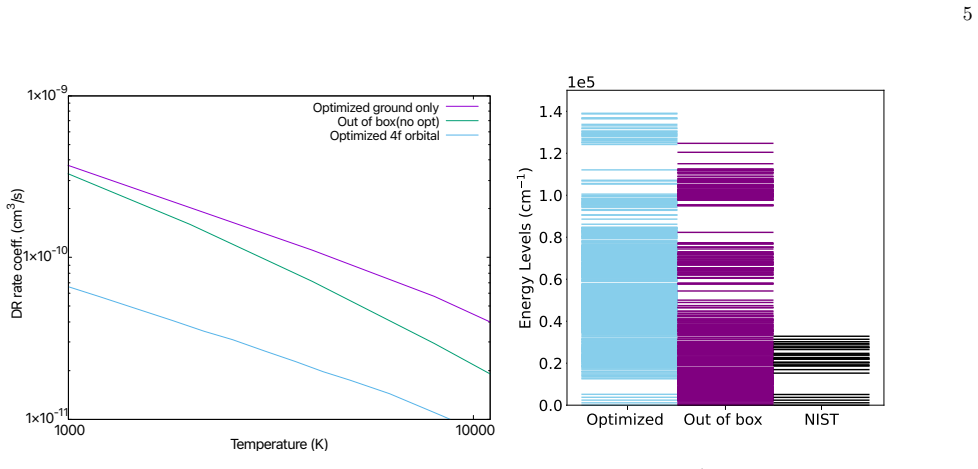
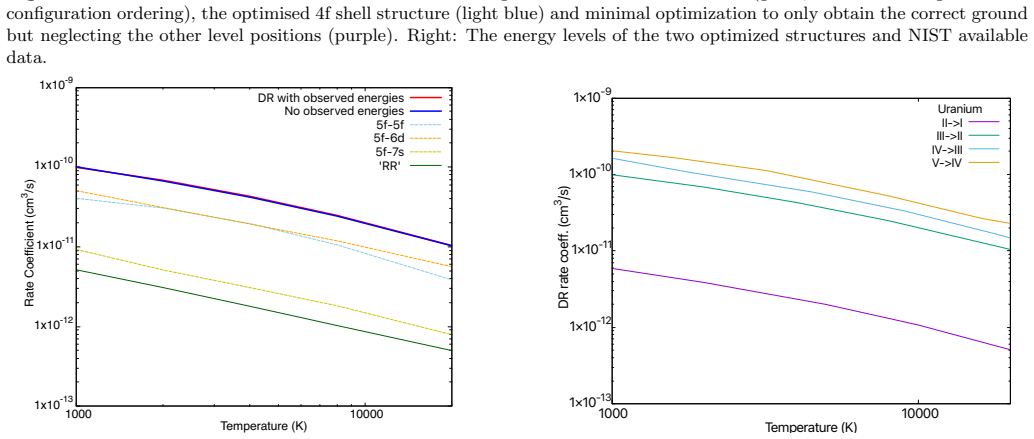
Optimization of AUTOSTRUCTURE yields dielectronic recombination rates for uranium ions U II-IV at 10^{-10}--10^{-12} cm^{3}s^{-1} for kilonova temperatures.
A machine-rendered reading of the paper's core claim, the machinery that carries it, and where it could break.
Core claim
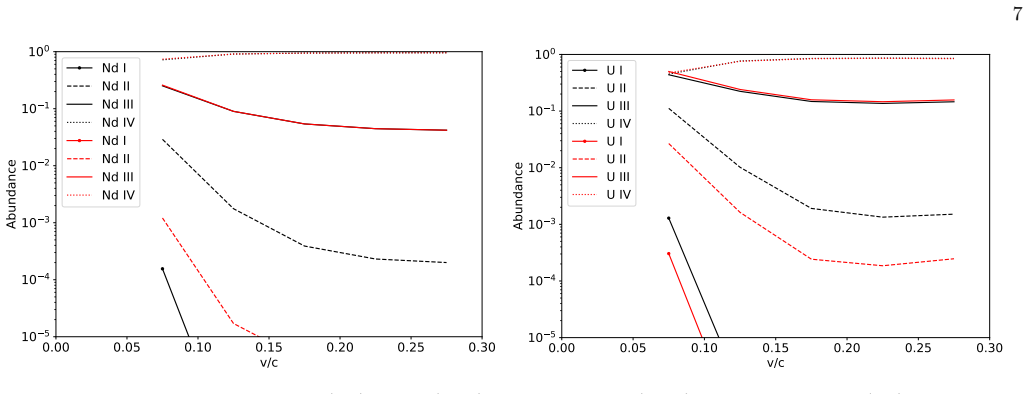
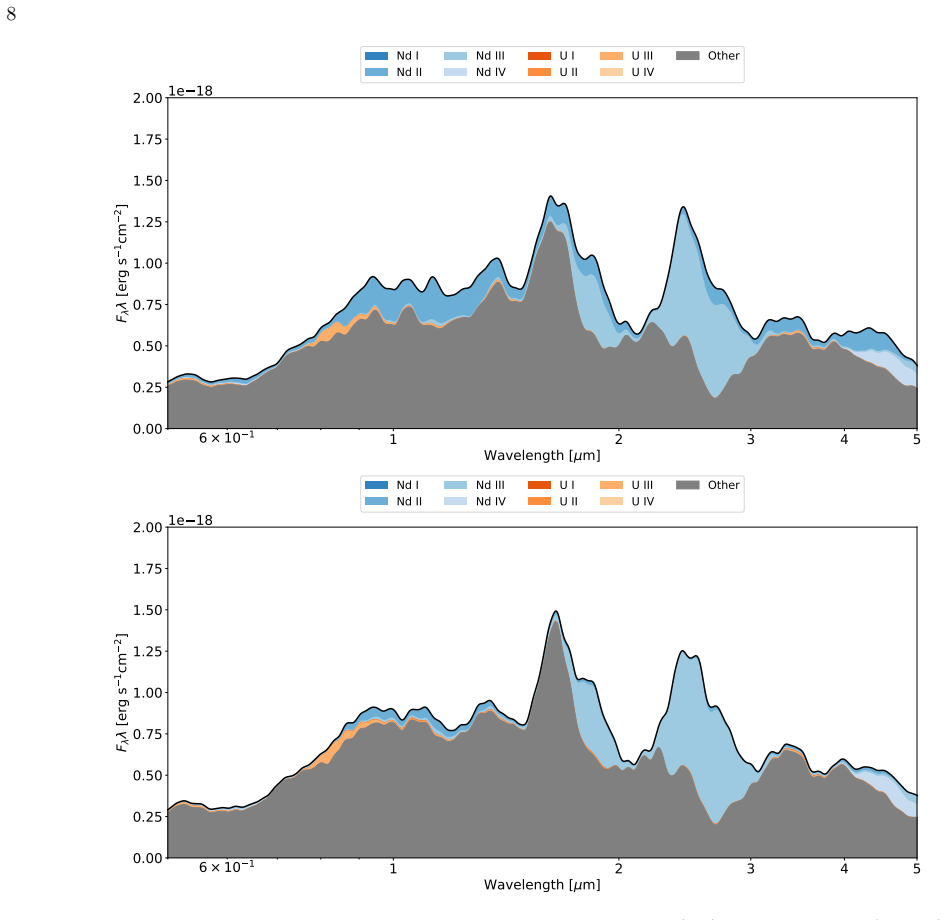
An optimization strategy for open f-shell ions using AUTOSTRUCTURE is presented for uranium ions U II--U IV relevant to kilonova ejecta. The resulting DR rate coefficients are of order 10^{-10}--10^{-12} cm^{3}s^{-1} over temperatures relevant to kilonova plasmas. The Nd III benchmark demonstrates that refinements to the atomic structure can produce measurable changes in spectral features. The optimized rates are intended for implementation in radiative-transfer calculations with SUMO to assess the sensitivity of kilonova spectra to improved recombination physics.
What carries the argument
Optimization strategy for open f-shell ions in AUTOSTRUCTURE, benchmarked on Nd III to validate the treatment of f-shell structure and its impact on DR.
Load-bearing premise
The optimization strategy for open f-shell ions in AUTOSTRUCTURE, validated on Nd III, will accurately capture the relevant structure and rates for the actinide ions U II--U IV.
What would settle it
Direct comparison of the computed DR rates or the resulting kilonova spectral features against laboratory measurements of uranium recombination or high-resolution observations of actual kilonova events would test whether the rates are accurate.
Figures
read the original abstract
Dielectronic recombination (DR) is expected to be the dominant recombination process during the non-local thermodynamic equilibrium (non-LTE) phase of kilonovae, yet reliable DR data remain unavailable for most heavy ions. Current spectral models therefore rely on simplified recombination prescriptions, introducing significant uncertainties into predicted spectra. We present an optimization strategy for open f-shell ions using \texttt{AUTOSTRUCTURE}, targeting uranium ions U II--U IV relevant to kilonova ejecta. As a benchmark case, calculations are performed for Nd III to validate the treatment of the f-shell structure and its impact on DR. The resulting DR rate coefficients are of order $10^{-10}$--$10^{-12}$ cm$^{3}$s$^{-1}$ over temperatures relevant to kilonova plasmas. The optimized rates are intended for implementation in radiative-transfer calculations with \texttt{SUMO} to assess the sensitivity of kilonova spectra to improved recombination physics. The Nd III benchmark demonstrates that refinements to the atomic structure can produce measurable changes in spectral features, motivating similar calculations for actinide ions.
Editorial analysis
A structured set of objections, weighed in public.
Referee Report
Summary. The paper presents an optimization strategy for AUTOSTRUCTURE calculations targeting dielectronic recombination (DR) in open f-shell ions, benchmarked on Nd III to validate f-shell structure treatment. It applies the approach to U II--U IV, reports DR rate coefficients of order 10^{-10}--10^{-12} cm³ s^{-1} at kilonova-relevant temperatures, and states the intent to implement the rates in SUMO for assessing impacts on kilonova spectra. The Nd III benchmark is used to show that atomic structure refinements can produce measurable changes in spectral features.
Significance. If the reported rates prove reliable and the optimization transfers to actinides, the work would address a key gap in recombination data for heavy ions in kilonova modeling, reducing uncertainties in non-LTE spectral predictions. The demonstration that structure changes affect spectra is a useful illustration, but the absence of detailed U results, error estimates, or transferability tests limits the current significance for the central deliverable.
major comments (2)
- [Abstract] Abstract: The headline DR rate coefficients for U II--U IV (order 10^{-10}--10^{-12} cm³ s^{-1}) are presented as the main result, yet the only explicit validation is the Nd III benchmark; no evidence is given that the same scaling and optimization choices remain accurate for Z=92 actinides with 5f configurations, which differ in nuclear charge, relativistic corrections, and open-shell complexity. This is load-bearing for the applicability claim.
- [Abstract] Abstract and benchmark discussion: The manuscript supplies order-of-magnitude rates and an intent to implement in SUMO but provides no actual computed values for U ions, no error estimates, no convergence tests, and no direct comparison to prior data or alternative methods, so the claim of measurable spectral changes rests on an unshown benchmark whose details are not presented.
minor comments (1)
- Notation for rate coefficients and temperature ranges could be clarified with explicit units and a table of sample values to aid reproducibility.
Simulated Author's Rebuttal
We thank the referee for their careful reading and constructive comments. We address each major comment below.
read point-by-point responses
-
Referee: [Abstract] Abstract: The headline DR rate coefficients for U II--U IV (order 10^{-10}--10^{-12} cm³ s^{-1}) are presented as the main result, yet the only explicit validation is the Nd III benchmark; no evidence is given that the same scaling and optimization choices remain accurate for Z=92 actinides with 5f configurations, which differ in nuclear charge, relativistic corrections, and open-shell complexity. This is load-bearing for the applicability claim.
Authors: We acknowledge that direct validation of transferability from the Nd III (4f) benchmark to U II--IV (5f) is not provided. The optimization targets general features of open f-shell structure in AUTOSTRUCTURE, and Nd III was selected as the closest available proxy with published data. In revision we will add explicit discussion of the expected similarities and differences (including relativistic scaling) and will qualify the applicability claim for actinides. revision: partial
-
Referee: [Abstract] Abstract and benchmark discussion: The manuscript supplies order-of-magnitude rates and an intent to implement in SUMO but provides no actual computed values for U ions, no error estimates, no convergence tests, and no direct comparison to prior data or alternative methods, so the claim of measurable spectral changes rests on an unshown benchmark whose details are not presented.
Authors: The manuscript reports rates at order-of-magnitude level because the focus is the optimization procedure itself rather than a full tabulation. We agree the presentation can be strengthened: the revised version will expand the Nd III benchmark section with additional figures and quantitative measures of spectral impact, and will include convergence tests and uncertainty estimates derived from the benchmark. Direct comparisons to other methods are limited by the absence of published DR data for these ions, which we will note. revision: yes
- Actual numerical DR rate coefficients for U II--IV (beyond the reported orders of magnitude) and direct comparisons to prior data or alternative calculations
Circularity Check
No circularity: computational rates are direct outputs of AUTOSTRUCTURE optimization, not reductions to inputs or self-citations
full rationale
The paper presents a forward computational workflow: an optimization strategy in AUTOSTRUCTURE is applied to open f-shell ions, benchmarked via explicit calculations on Nd III, and then used to generate DR rate coefficients for U II–U IV. These rates (order 10^{-10}–10^{-12} cm³ s^{-1}) are stated as direct numerical results over relevant temperatures, with no equations, fitted parameters, or predictions that reduce by construction to the benchmark data or to any self-citation. The Nd III benchmark is presented only as validation of the method, not as the source of the U rates themselves. No load-bearing self-citation, ansatz smuggling, or renaming of known results is described. The derivation chain is therefore self-contained as an independent atomic-structure calculation.
Axiom & Free-Parameter Ledger
Reference graph
Works this paper leans on
-
[1]
Badnell, N. R. 2006, The Astrophysical Journal Supplement Series, 167, 334, doi: 10.1086/508465 —. 2011, Computer Physics Communications, 182, 1528–1535, doi: 10.1016/j.cpc.2011.03.023
-
[2]
Badnell, N. R., O’Mullane, M. G., Summers, H. P., et al. 2003, Astronomy & Astrophysics, 406, 1151–1165, doi: 10.1051/0004-6361:20030816
-
[3]
2025, arXiv e-prints, arXiv:2501.18345, doi: 10.48550/arXiv.2501.18345
Banerjee, S., Jerkstrand, A., Badnell, N., et al. 2025, arXiv e-prints, arXiv:2501.18345, doi: 10.48550/arXiv.2501.18345
-
[4]
2024, The Astrophysical Journal, 968, 64, doi: 10.3847/1538-4357/ad4029
Banerjee, S., Tanaka, M., Kato, D., & Gaigalas, G. 2024, The Astrophysical Journal, 968, 64, doi: 10.3847/1538-4357/ad4029
-
[5]
2022, The Astrophysical Journal, 934, 117, doi: 10.3847/1538-4357/ac7565
Banerjee, S., Tanaka, M., Kato, D., et al. 2022, The Astrophysical Journal, 934, 117, doi: 10.3847/1538-4357/ac7565
-
[6]
2020, The Astrophysical Journal, 901, 29, doi: 10.3847/1538-4357/abae61
Gaigalas, G. 2020, The Astrophysical Journal, 901, 29, doi: 10.3847/1538-4357/abae61
-
[7]
Blaise, J., & Wyart, J. 1992, Selected constants energy levels and atomic spectra of actinides, Constantes selectionnees niveaux d’energie et spectres atomiques des actinides (France: Centre National de la Recherche Scientifique)
1992
-
[8]
1971, JOSA, 61, 1666–1682, doi: 10.1364/JOSA.61.001666
Brewer, L. 1971, JOSA, 61, 1666–1682, doi: 10.1364/JOSA.61.001666
-
[9]
1964, The Astrophysical Journal, 139, 776–780, doi: 10.1086/147813 Carvajal Gallego, H., Berengut, J
Burgess, A. 1964, The Astrophysical Journal, 139, 776–780, doi: 10.1086/147813 Carvajal Gallego, H., Berengut, J. C., Palmeri, P., &
-
[10]
2021, Monthly Notices of the Royal Astronomical Society, 509, 6138–6154, doi: 10.1093/mnras/stab3423
Quinet, P. 2021, Monthly Notices of the Royal Astronomical Society, 509, 6138–6154, doi: 10.1093/mnras/stab3423
-
[11]
Deprince, J., Wagle, G., Nasr, S. B., et al. 2025, Astronomy & Astrophysics, 696, A32, doi: 10.1051/0004-6361/202452967
-
[12]
Ding, M., Ryabtsev, A. N., Kononov, E. Y., et al. 2024, Astronomy & Astrophysics, 684, A149, doi: 10.1051/0004-6361/202348794
-
[13]
2003, Astronomy & Astrophysics, 409, 781–786, doi: 10.1051/0004-6361:20031100
Schuch, R. 2003, Astronomy & Astrophysics, 409, 781–786, doi: 10.1051/0004-6361:20031100
-
[14]
Fontes, C. J., Fryer, C. L., Hungerford, A. L., Wollaeger, R. T., & Korobkin, O. 2020, Monthly Notices of the Royal Astronomical Society, 493, 4143–4171, doi: 10.1093/mnras/staa485
-
[15]
Fontes, C. J., Fryer, C. L., Wollaeger, R. T., Mumpower, M. R., & Sprouse, T. M. 2023, Monthly Notices of the Royal Astronomical Society, 519, 2862–2878, doi: 10.1093/mnras/stac2792
-
[16]
Gillanders, J. H., & Smartt, S. J. 2025, Monthly Notices of the Royal Astronomical Society, 538, 1663–1689, doi: 10.1093/mnras/staf287
-
[17]
2021, Monthly Notices of the Royal Astronomical Society, 506, 5863–5877, doi: 10.1093/mnras/stab1975
Hotokezaka, K., Tanaka, M., Kato, D., & Gaigalas, G. 2021, Monthly Notices of the Royal Astronomical Society, 506, 5863–5877, doi: 10.1093/mnras/stab1975
-
[18]
2011a, A&A, 530, A45, doi: 10.1051/0004-6361/201015937 —
Jerkstrand, A., Fransson, C., & Kozma, C. 2011a, A&A, 530, A45, doi: 10.1051/0004-6361/201015937 —. 2011b, A&A, 530, A45, doi: 10.1051/0004-6361/201015937
-
[19]
2012, A&A, 546, A28, doi: 10.1051/0004-6361/201219528
Jerkstrand, A., Fransson, C., Maguire, K., et al. 2012, A&A, 546, A28, doi: 10.1051/0004-6361/201219528
-
[20]
2026, Monthly Notices of the Royal Astronomical Society, 548, stag733, doi: 10.1093/mnras/stag733
Jerkstrand, A., Pognan, Q., Banerjee, S., et al. 2026, Monthly Notices of the Royal Astronomical Society, 548, stag733, doi: 10.1093/mnras/stag733
-
[21]
Kasen, D., Badnell, N. R., & Barnes, J. 2013, The Astrophysical Journal, 774, 25, doi: 10.1088/0004-637X/774/1/25
-
[22]
2019, ApJ, 876, 128, doi: 10.3847/1538-4357/ab06c2
Kasen, D., & Barnes, J. 2019, ApJ, 876, 128, doi: 10.3847/1538-4357/ab06c2
-
[23]
2017, Nature, 551, 80–84, doi: 10.1038/nature24453 10
Ramirez-Ruiz, E. 2017, Nature, 551, 80–84, doi: 10.1038/nature24453 10
-
[24]
Martin, W. C., Zalubas, R., & Hagan, L. 1978, Atomic energy levels - the rare-earth elements: the spectra of lanthanum, cerium, praseodymium, neodymium, promethium, samarium, europium, gadolinium, terbium, dysprosium, holmium, erbium, thulium, ytterbium, and lutetitum (Gaithersburg, MD), doi: 10.6028/NBS.NSRDS.60
-
[25]
Ramsbottom, C. A. 2025, Monthly Notices of the Royal Astronomical Society, 540, 2923–2936, doi: 10.1093/mnras/staf866
-
[26]
Sneppen, A., & Sim, S. A. 2026, Monthly Notices of the Royal Astronomical Society, 546, stag237, doi: 10.1093/mnras/stag237
-
[28]
2023, MNRAS, 526, 5220, doi: 10.1093/mnras/stad3106
Pognan, Q., Grumer, J., Jerkstrand, A., & Wanajo, S. 2023, MNRAS, 526, 5220, doi: 10.1093/mnras/stad3106
-
[29]
2022, MNRAS, 510, 3806, doi: 10.1093/mnras/stab3674
Pognan, Q., Jerkstrand, A., & Grumer, J. 2022, MNRAS, 510, 3806, doi: 10.1093/mnras/stab3674
-
[30]
2025, Monthly Notices of the Royal Astronomical Society, 536, 2973–2992, doi: 10.1093/mnras/stae2778
Pognan, Q., Wu, M.-R., Mart´ ınez-Pinedo, G., et al. 2025, Monthly Notices of the Royal Astronomical Society, 536, 2973–2992, doi: 10.1093/mnras/stae2778
-
[31]
Singh, S., Harman, Z., & Keitel, C. H. 2025, doi: 10.48550/arXiv.2504.06639
-
[32]
Sterling, N. C. 2011, A&A, 533, A62, doi: 10.1051/0004-6361/201117471
-
[33]
Sterling, N. C., & Witthoeft, M. C. 2011, A&A, 529, A147, doi: 10.1051/0004-6361/201116718
-
[34]
2013, ApJ, 775, 113, doi: 10.1088/0004-637X/775/2/113
Tanaka, M., & Hotokezaka, K. 2013, ApJ, 775, 113, doi: 10.1088/0004-637X/775/2/113
-
[35]
2020, Monthly Notices of the Royal Astronomical Society, 496, 1369–1392, doi: 10.1093/mnras/staa1576
Tanaka, M., Kato, D., Gaigalas, G., & Kawaguchi, K. 2020, Monthly Notices of the Royal Astronomical Society, 496, 1369–1392, doi: 10.1093/mnras/staa1576
-
[36]
2018, The Astrophysical Journal, 868, 65, doi: 10.3847/1538-4357/aae0f2
Wanajo, S. 2018, The Astrophysical Journal, 868, 65, doi: 10.3847/1538-4357/aae0f2
-
[37]
2014, ApJL, 789, L39, doi: 10.1088/2041-8205/789/2/L39
Wanajo, S., Sekiguchi, Y., Nishimura, N., et al. 2014, ApJL, 789, L39, doi: 10.1088/2041-8205/789/2/L39
-
[38]
Wollaeger, R. T., Korobkin, O., Fontes, C. J., et al. 2018, MNRAS, 478, 3298, doi: 10.1093/mnras/sty1018
discussion (0)
Sign in with ORCID, Apple, or X to comment. Anyone can read and Pith papers without signing in.