Kinematic Probes of Type-II MMG: Pad\'e Cosmographic Analysis of VCDM
Pith reviewed 2026-06-27 10:50 UTC · model grok-4.3
The pith
VCDM reproduces the ΛCDM background expansion under Padé cosmographic reconstruction from current data.
A machine-rendered reading of the paper's core claim, the machinery that carries it, and where it could break.
Core claim
Within the VCDM framework, a Type-II MMG realization that preserves the successes of General Relativity while extending beyond constant vacuum energy through a minimal Hamiltonian modification without introducing additional degrees of freedom, the Padé P(2,1) cosmographic reconstruction of the expansion history from joint datasets yields parameters consistent with ΛCDM, with j0 ≈ 1 and no observed transition feature, indicating that such a feature is sensitive to parametrization choice rather than a robust data requirement.
What carries the argument
Padé P(2,1) approximation for the Hubble parameter and luminosity distance, which expresses cosmographic parameters directly in terms of VCDM model parameters for data-driven reconstruction of the expansion history.
If this is right
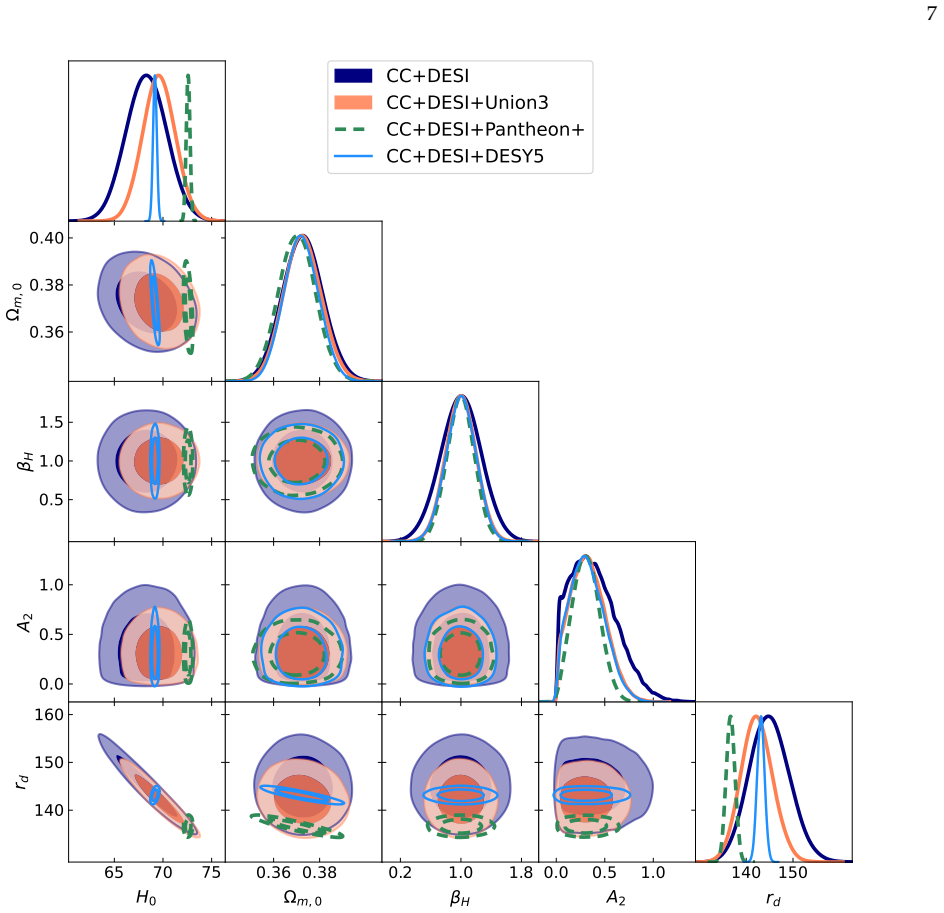
- The VCDM model parameters are tightly constrained and consistent across different dataset combinations.
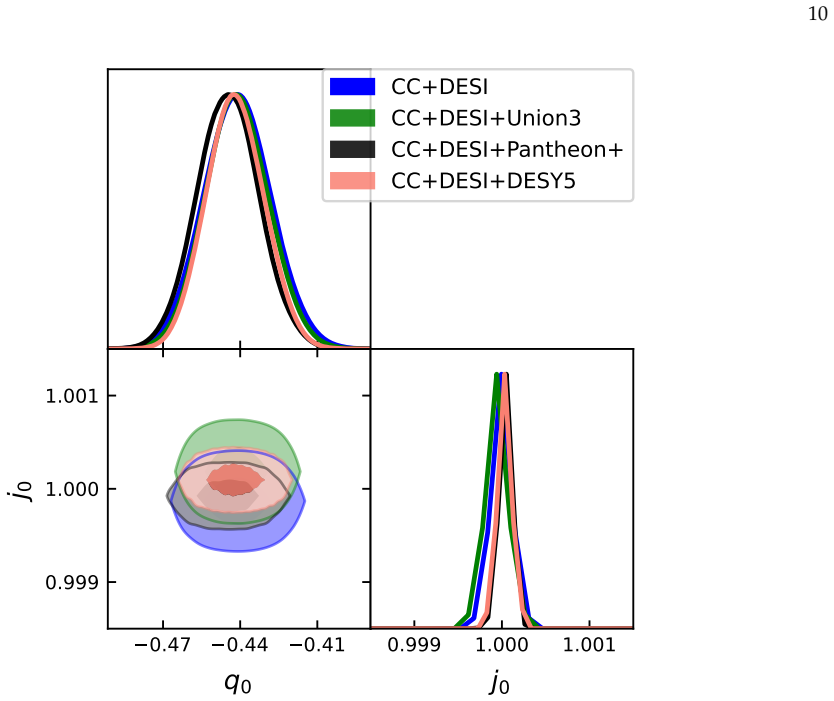
- The jerk parameter remains very close to its ΛCDM value, indicating no significant deviation at higher-order cosmography.
- The transition feature previously reported in VCDM is absent, showing it is not a robust requirement of current observational data.
- Model-independent reconstructions are important for assessing whether alternative cosmological scenarios differ from ΛCDM at the background level.
Where Pith is reading between the lines
- Other reconstruction methods or higher-order terms might reveal features that the P(2,1) choice suppresses.
- The same cosmographic approach could be applied to additional modified-gravity models to test for similar background-level mimicry.
- Future datasets with higher precision at intermediate redshifts could distinguish VCDM from ΛCDM even under this reconstruction.
Load-bearing premise
The Padé P(2,1) approximation for the Hubble parameter and luminosity distance is sufficient to reconstruct the expansion history without biasing against detection of the transition feature reported in prior VCDM work.
What would settle it
A clear transition feature appearing in the VCDM expansion history when the same datasets are analyzed with a different cosmographic parametrization or higher-order Padé approximant would falsify the claim that the feature is not robust.
Figures
read the original abstract
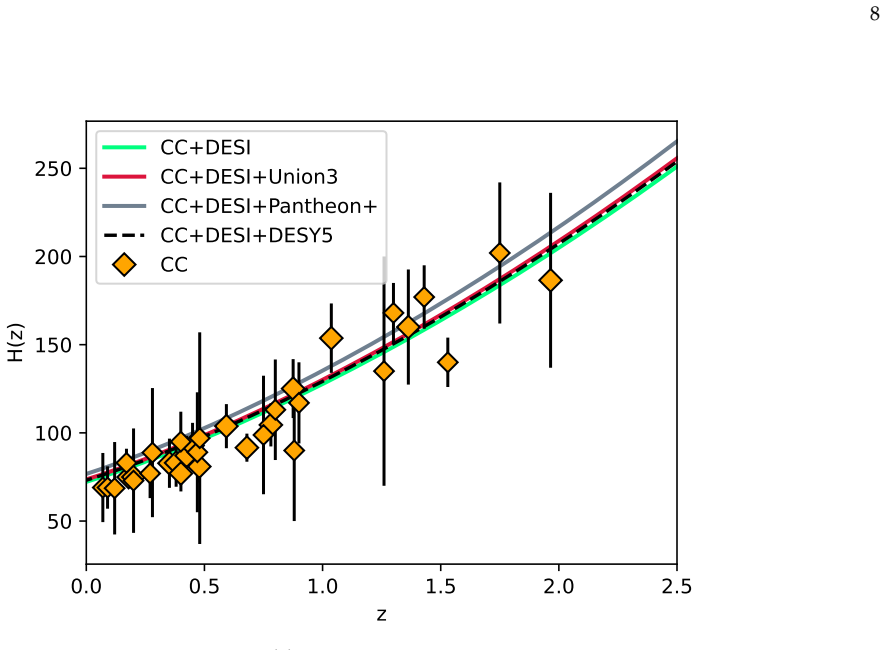
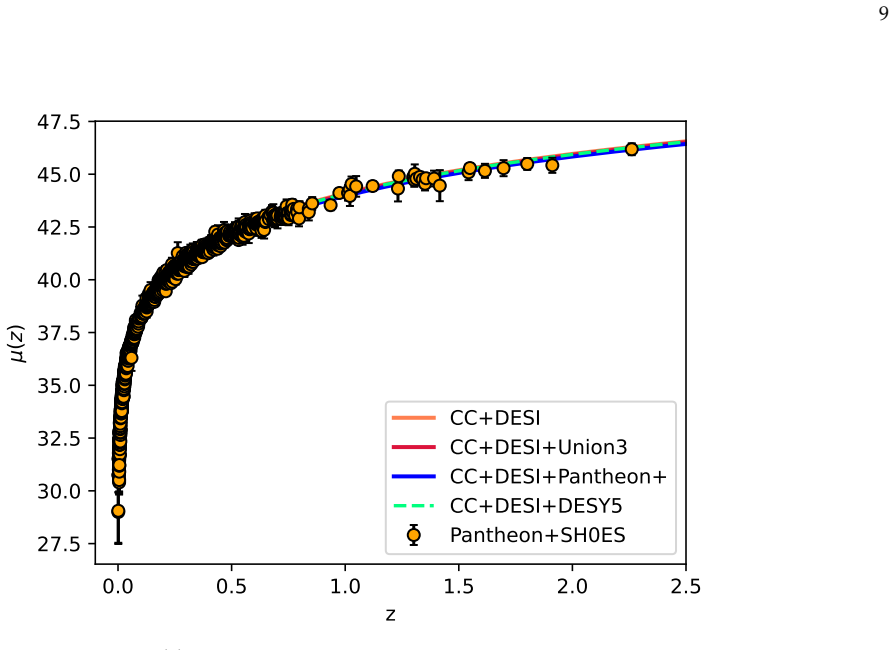
We study the late-time expansion history of the Universe within the VCDM model, a Type-II MMG realization that preserves the successes of General Relativity while extending beyond constant vacuum energy through a minimal Hamiltonian modification, generating a time-dependent vacuum sector without introducing additional degrees of freedom. We investigate this framework within a cosmographic approach by employing a Pad\'e $P_{(2,1)}$ approximation for the Hubble parameter and luminosity distance, allowing the cosmographic parameters to be expressed directly in terms of the underlying VCDM model parameters and enabling a data-driven reconstruction of the expansion history. The model is constrained within a Bayesian framework using the MCMC technique, implemented via the affine-invariant ensemble sampler, with a joint analysis of cosmic chronometers, DESI BAO, and Type Ia supernova datasets (Union3, Pantheon+, and DESY5). We find that the model parameters are tightly constrained and consistent across different dataset combinations, with the jerk parameter remaining very close to its $\Lambda$CDM value, $j_0 \simeq 1$, indicating no significant deviation at the level of higher-order cosmography. Furthermore, the transition feature previously reported in VCDM is not observed within the Pad\'e $P_{(2,1)}$ cosmographic reconstruction, suggesting that it is not a robust requirement of current observational data but is sensitive to the choice of parametrization. Overall, our results indicate that the VCDM model effectively mimics $\Lambda$CDM at the background level when constrained through a cosmographic approach, underscoring the importance of model-independent reconstructions in assessing alternative cosmological scenarios.
Editorial analysis
A structured set of objections, weighed in public.
Referee Report
Summary. The paper claims that a Padé P(2,1) cosmographic reconstruction of the Hubble parameter and luminosity distance in the VCDM (Type-II MMG) model, when constrained via MCMC on cosmic chronometers, DESI BAO, and Type Ia supernova datasets (Union3, Pantheon+, DESY5), yields tightly constrained parameters with jerk parameter j0 ≃ 1, shows no evidence for the transition feature reported in prior VCDM work, and indicates that VCDM effectively mimics ΛCDM at the background level; this is taken to imply that the transition is parametrization-sensitive rather than data-driven.
Significance. If the central claim holds, the work demonstrates the value of model-independent cosmographic methods for testing minimal modifications to GR that preserve background successes while altering the vacuum sector. Credit is due for the joint analysis across named datasets (cosmic chronometers + DESI BAO + three SN compilations) using an affine-invariant ensemble sampler, which supports the consistency conclusion at the level of current data.
major comments (2)
- [§3] §3 (Padé P(2,1) construction for H(z) and d_L(z)): the central claim that the transition feature 'is not a robust requirement of current observational data but is sensitive to the choice of parametrization' is load-bearing on the approximant being flexible enough to recover the feature if present. A (2,1) Padé has only three free coefficients after normalization; the manuscript should demonstrate, e.g., via mock-data injection of the prior-reported VCDM transition, that the form can accommodate it before concluding non-detection implies absence.
- [§4] §4 (MCMC implementation and priors): the abstract and results sections report tight constraints and consistency across dataset combinations, but no explicit statement of priors, convergence diagnostics (e.g., Gelman-Rubin statistic), or error propagation from the cosmographic coefficients to the VCDM parameters is provided; this limits verification that the posterior truly rules out the transition rather than being prior- or sampler-dominated.
minor comments (2)
- Abstract: the description of the MCMC setup omits priors and convergence checks; moving a brief statement of these to the abstract would improve reproducibility without lengthening the text.
- Notation: the subscript notation P_{(2,1)} is used inconsistently with standard P(2,1) in some equations; uniform adoption of one form would aid clarity.
Simulated Author's Rebuttal
Dear Editor, We thank the referee for the constructive and detailed report. The two major comments identify genuine gaps in the current manuscript that we will address through targeted revisions. Our point-by-point responses follow.
read point-by-point responses
-
Referee: [§3] §3 (Padé P(2,1) construction for H(z) and d_L(z)): the central claim that the transition feature 'is not a robust requirement of current observational data but is sensitive to the choice of parametrization' is load-bearing on the approximant being flexible enough to recover the feature if present. A (2,1) Padé has only three free coefficients after normalization; the manuscript should demonstrate, e.g., via mock-data injection of the prior-reported VCDM transition, that the form can accommodate it before concluding non-detection implies absence.
Authors: We agree that the flexibility of the P(2,1) approximant must be explicitly verified before interpreting the non-detection as evidence that the transition is parametrization-dependent rather than data-driven. In the revised manuscript we will add a dedicated mock-data section: we will generate synthetic datasets that include the transition feature reported in earlier VCDM analyses, with noise levels matching the real chronometer, DESI BAO and supernova compilations, and then demonstrate that the same P(2,1) reconstruction recovers the injected transition at high significance. This test will be presented alongside the real-data results to substantiate the claim. revision: yes
-
Referee: [§4] §4 (MCMC implementation and priors): the abstract and results sections report tight constraints and consistency across dataset combinations, but no explicit statement of priors, convergence diagnostics (e.g., Gelman-Rubin statistic), or error propagation from the cosmographic coefficients to the VCDM parameters is provided; this limits verification that the posterior truly rules out the transition rather than being prior- or sampler-dominated.
Authors: We acknowledge these omissions. The revised manuscript will include: (i) the full set of prior distributions adopted for the cosmographic coefficients and the derived VCDM parameters; (ii) Gelman–Rubin R-hat statistics (and any additional convergence checks) for all chains; and (iii) an explicit description of how uncertainties on the fitted Padé coefficients are propagated to the VCDM parameters. These additions will be placed in a new subsection of §4 and will be referenced in the abstract and results sections. revision: yes
Circularity Check
No significant circularity; constraints are data-driven with external datasets
full rationale
The paper's central results derive from MCMC constraints on VCDM parameters using independent observational datasets (cosmic chronometers, DESI BAO, Union3/Pantheon+/DESY5 SNIa). The Padé P(2,1) form is adopted as an approximation to express cosmographic quantities in terms of model parameters, but the posterior and the non-detection of the transition feature are outputs of the fit rather than reductions by construction. No self-citations are invoked as load-bearing uniqueness theorems, no fitted inputs are relabeled as predictions, and the derivation chain remains self-contained against external benchmarks without definitional loops.
Axiom & Free-Parameter Ledger
Reference graph
Works this paper leans on
-
[1]
in whichj 0 is introduced only as a free kinematic quantity. d.Physical Implications:The present results indicate that, at the background level, VCDM remains observa- tionally close toΛCDM, similar to other modified gravity scenarios constructed to mimic the concordance expansion history while modifying the underlying dynamics [60, 61]. This is not a weak...
-
[2]
A. G. Riesset al.(Supernova Search Team), Observational evidence from supernovae for an accelerating universe and a cosmological constant, Astron. J.116, 1009 (1998), arXiv:astro-ph/9805201
Pith/arXiv arXiv 1998
-
[3]
Perlmutteret al.(Supernova Cosmology Project), Cosmology from Type Ia supernovae, Bull
S. Perlmutteret al.(Supernova Cosmology Project), Cosmology from Type Ia supernovae, Bull. Am. Astron. Soc.29, 1351 (1997), arXiv:astro-ph/9812473
Pith/arXiv arXiv 1997
-
[4]
Collaboration, Planck 2018 results
P . Collaboration, Planck 2018 results. vi. cosmological parameters, A&A (2020), 1807.06209
Pith/arXiv arXiv 2018
-
[5]
Rosenberg,CMB analysis with ACT and Planck, Ph.D
E. Rosenberg,CMB analysis with ACT and Planck, Ph.D. thesis, Institute of Astronomy, Cambridge U. (2023)
2023
-
[6]
Bullet al., BeyondΛCDM: Problems, solutions, and the road ahead, Phys
P . Bullet al., BeyondΛCDM: Problems, solutions, and the road ahead, Phys. Dark Univ.12, 56 (2016), arXiv:1512.05356 [astro-ph.CO]
Pith/arXiv arXiv 2016
-
[7]
Weinberg, The Cosmological Constant Problem, Rev
S. Weinberg, The Cosmological Constant Problem, Rev. Mod. Phys.61, 1 (1989)
1989
-
[8]
Zlatev, L
I. Zlatev, L. Wang, and P . Steinhardt, Quintessence, cosmic coincidence, and the cosmological constant, Physical Review Letters82, 896 (1999)
1999
-
[9]
A. G. e. a. Riess, A comprehensive measurement of the local value of the hubble constant, ApJ Letters (2022), arXiv:2112.04510
Pith/arXiv arXiv 2022
-
[10]
L. Verde, T. Treu, and A. G. Riess, Tensions between the early and late universe, Nature Astronomy 10.1038/s41550-019-0902- 0 (2019)
-
[11]
E. Di Valentino, O. Mena, S. Pan, L. Visinelli, W. Yang, A. Melchiorri, D. F. Mota, A. G. Riess, and J. Silk, In the realm of the Hubble tension—a review of solutions, Class. Quant. Grav.38, 153001 (2021), arXiv:2103.01183 [astro-ph.CO]
Pith/arXiv arXiv 2021
-
[12]
N. S. Kavya, S. Swagat Mishra, and P . K. Sahoo, f(Q) gravity as a possible resolution of the H0 and S8 tensions with DESI DR2, Sci. Rep.15, 36504 (2025)
2025
-
[13]
T. Clifton, P . G. Ferreira, A. Padilla, and C. Skordis, Modified Gravity and Cosmology, Phys. Rept.513, 1 (2012), arXiv:1106.2476 [astro-ph.CO]
Pith/arXiv arXiv 2012
-
[14]
A. Joyce, B. Jain, J. Khoury, and M. Trodden, Beyond the Cosmological Standard Model, Phys. Rept.568, 1 (2015), arXiv:1407.0059 [astro-ph.CO]
Pith/arXiv arXiv 2015
-
[15]
J. Beltr ´an Jim ´enez, L. Heisenberg, and T. S. Koivisto, The Geometrical Trinity of Gravity, Universe5, 173 (2019), arXiv:1903.06830 [hep-th]
Pith/arXiv arXiv 2019
-
[16]
S. S. Mishra, S. Patel, and P . K. Sahoo, BBN to late-time acceleration in f(T,Lm) gravity, Phys. Lett. B872, 140098 (2026), arXiv:2603.11760 [gr-qc]
arXiv 2026
-
[17]
A. De Felice, A. Doll, and S. Mukohyama, A theory of type-II minimally modified gravity, JCAP09, 034, arXiv:2004.12549 [gr-qc]
arXiv 2004
- [18]
-
[19]
¨O. Akarsu, A. De Felice, E. Di Valentino, S. Kumar, R. C. Nunes, E.¨Oz ¨ulker, J. A. Vazquez, and A. Yadav,ΛsCDM cosmology from a type-II minimally modified gravity, Mon. Not. Roy. Astron. Soc.546, staf2276 (2026), arXiv:2402.07716 [astro-ph.CO]
Pith/arXiv arXiv 2026
- [20]
-
[21]
Weinberg,Gravitation and Cosmology: Principles and Applications of the General Theory of Relativity(John Wiley and Sons, New York, 1972)
S. Weinberg,Gravitation and Cosmology: Principles and Applications of the General Theory of Relativity(John Wiley and Sons, New York, 1972)
1972
-
[22]
Visser, Jerk, snap and the cosmological equation of state, Classical and Quantum Gravity21, 2603 (2004)
M. Visser, Jerk, snap and the cosmological equation of state, Classical and Quantum Gravity21, 2603 (2004)
2004
-
[23]
S. Capozziello, V . F. Cardone, H. Farajollahi, and A. Ravanpak, Cosmography in f(T)-gravity, Phys. Rev. D84, 043527 (2011), arXiv:1108.2789 [astro-ph.CO]
Pith/arXiv arXiv 2011
-
[24]
W. Zimdahl and D. Pavon, Statefinder parameters for interacting dark energy, Gen. Rel. Grav.36, 1483 (2004), arXiv:gr- qc/0311067
arXiv 2004
-
[25]
A. C. Alfano and O. Luongo, Cosmic distance duality after DESI 2024 data release and dark energy evolution, Phys. Dark Univ.51, 102205 (2026), arXiv:2501.15233 [astro-ph.CO]
arXiv 2024
-
[26]
S. S. Mishra, N. S. Kavya, P . K. Sahoo, and K. Bamba, DESI DR2 meets cosmography: a comparative study of Pad ´e, Cheby- shev, and Taylor expansions, Mon. Not. Roy. Astron. Soc.546, stag197 (2026)
2026
-
[27]
G. Rodrigues, R. de Souza, and J. Alcaniz, Cosmography with DESI DR2 and SN data, Phys. Rev. D112, 103519 (2025), arXiv:2506.22373 [astro-ph.CO]
arXiv 2025
-
[28]
S. S. Mishra, S. K. Bhoi, and P . K. Sahoo, Exploring late-time cosmic acceleration in VCDM cosmology, Eur. Phys. J. C86, 192 (2026), arXiv:2603.27178 [astro-ph.CO]. 12
arXiv 2026
-
[29]
C. Cattoen and M. Visser, The Hubble series: Convergence properties and redshift variables, Class. Quant. Grav.24, 5985 (2007), arXiv:0710.1887 [gr-qc]
Pith/arXiv arXiv 2007
-
[30]
V . Vitagliano, J.-Q. Xia, S. Liberati, and M. Viel, High-Redshift Cosmography, JCAP03, 005, arXiv:0911.1249 [astro-ph.CO]
-
[31]
Broutet al., The Pantheon+ Analysis: Cosmological Constraints, Astrophys
D. Broutet al., The Pantheon+ Analysis: Cosmological Constraints, Astrophys. J.938, 110 (2022), arXiv:2202.04077 [astro- ph.CO]
Pith/arXiv arXiv 2022
-
[32]
Scolnicet al., The Pantheon+ Analysis: The Full Data Set and Light-curve Release, Astrophys
D. Scolnicet al., The Pantheon+ Analysis: The Full Data Set and Light-curve Release, Astrophys. J.938, 113 (2022), arXiv:2112.03863 [astro-ph.CO]
Pith/arXiv arXiv 2022
-
[33]
C. Gruber and O. Luongo, Cosmographic analysis of the equation of state of the universe through Pad ´e approximations, Phys. Rev. D89, 103506 (2014), arXiv:1309.3215 [gr-qc]
Pith/arXiv arXiv 2014
-
[34]
H. Wei, X.-B. Zou, H.-Y. Li, and D.-Z. Xue, Cosmological Constant, Fine Structure Constant and Beyond, Eur. Phys. J. C77, 14 (2017), arXiv:1605.04571 [gr-qc]
Pith/arXiv arXiv 2017
-
[35]
J. P . Hu and F. Y. Wang, High-redshift cosmography: Application and comparison with different methods, Astron. Astrophys. 661, A71 (2022), arXiv:2202.09075 [astro-ph.CO]
arXiv 2022
-
[36]
S. S. Mishra, N. S. Kavya, P . K. Sahoo, and T. Harko, Pad´e cosmography and its insights into teleparallel gravity, Mon. Not. Roy. Astron. Soc.543, 2816 (2025)
2025
-
[37]
S. Capozziello, R. D’Agostino, and O. Luongo, Rational approximations off(R)cosmography through Pad ´e polynomials, JCAP05, 008, arXiv:1709.08407 [gr-qc]
-
[38]
M. Moresco, R. Jimenez, L. Verde, A. Cimatti, and L. Pozzetti, Setting the Stage for Cosmic Chronometers. II. Impact of Stellar Population Synthesis Models Systematics and Full Covariance Matrix, Astrophys. J.898, 82 (2020), arXiv:2003.07362 [astro-ph.GA]
arXiv 2020
-
[39]
A. G. Adameet al.(DESI), DESI 2024 VI: cosmological constraints from the measurements of baryon acoustic oscillations, JCAP02, 021, arXiv:2404.03002 [astro-ph.CO]
Pith/arXiv arXiv 2024
-
[40]
P . Shahet al.(DES), Constraints on compact objects from the Dark Energy Survey 5-yr supernova sample, Mon. Not. Roy. Astron. Soc.536, 946 (2024), arXiv:2410.07956 [astro-ph.CO]
arXiv 2024
-
[41]
D. Rubinet al., Union Through UNITY: Cosmology with 2,000 SNe Using a Unified Bayesian Framework, Astrophys. J.986, 231 (2025), arXiv:2311.12098 [astro-ph.CO]
Pith/arXiv arXiv 2025
-
[42]
R. L. Arnowitt, S. Deser, and C. W. Misner, The Dynamics of general relativity, Gen. Rel. Grav.40, 1997 (2008), arXiv:gr- qc/0405109
arXiv 1997
-
[43]
A. De Felice and S. Mukohyama, Weakening gravity for dark matter in a type-II minimally modified gravity, JCAP04, 018, arXiv:2011.04188 [astro-ph.CO]
arXiv 2011
-
[44]
A. De Felice, K.-i. Maeda, S. Mukohyama, and M. C. Pookkillath, Comparison of two theories of Type-IIa minimally modified gravity, Phys. Rev. D106, 024028 (2022), arXiv:2204.08294 [gr-qc]
arXiv 2022
-
[45]
A. De Felice, S. Mukohyama, and M. C. Pookkillath, AddressingH 0 tension by means of VCDM, Phys. Lett. B816, 136201 (2021), [Erratum: Phys.Lett.B 818, 136364 (2021)], arXiv:2009.08718 [astro-ph.CO]
arXiv 2021
-
[46]
A. Ganz, P . Martens, S. Mukohyama, and R. Namba, Bouncing cosmology in VCDM, JCAP04, 060, arXiv:2212.13561 [gr-qc]
-
[47]
Visser, Cosmography: Cosmology without the Einstein equations, Gen
M. Visser, Cosmography: Cosmology without the Einstein equations, Gen. Rel. Grav.37, 1541 (2005), arXiv:gr-qc/0411131
Pith/arXiv arXiv 2005
-
[48]
S. Capozziello, R. D’Agostino, and O. Luongo, High-redshift cosmography: auxiliary variables versus Pad ´e polynomials, Mon. Not. Roy. Astron. Soc.494, 2576 (2020), arXiv:2003.09341 [astro-ph.CO]
arXiv 2020
-
[49]
D. Foreman-Mackey, D. W. Hogg, D. Lang, and J. Goodman, emcee: The MCMC Hammer, Publ. Astron. Soc. Pac.125, 306 (2013), arXiv:1202.3665 [astro-ph.IM]
Pith/arXiv arXiv 2013
-
[50]
R. Jimenez and A. Loeb, Constraining cosmological parameters based on relative galaxy ages, Astrophys. J.573, 37 (2002), arXiv:astro-ph/0106145
Pith/arXiv arXiv 2002
-
[51]
M. Moresco, L. Pozzetti, A. Cimatti, R. Jimenez, C. Maraston, L. Verde, D. Thomas, A. Citro, R. Tojeiro, and D. Wilkinson, A 6% measurement of the Hubble parameter atz∼0.45: direct evidence of the epoch of cosmic re-acceleration, JCAP05, 014, arXiv:1601.01701 [astro-ph.CO]
-
[52]
Abdul Karimet al.(DESI), DESI DR2 results
M. Abdul Karimet al.(DESI), DESI DR2 results. II. Measurements of baryon acoustic oscillations and cosmological con- straints, Phys. Rev. D112, 083515 (2025), arXiv:2503.14738 [astro-ph.CO]
Pith/arXiv arXiv 2025
-
[53]
D. Rubinet al.(Supernova Cosmology Project), Unity: Confronting Supernova Cosmology’s Statistical and Systematic Un- certainties in a Unified Bayesian Framework, Astrophys. J.813, 137 (2015), arXiv:1507.01602 [astro-ph.CO]
Pith/arXiv arXiv 2015
-
[54]
M. Vincenziet al.(DES), Comparing the DES-SN5YR and Pantheon+ SN cosmology analyses: investigation based on ‘evolv- ing dark energy or supernovae systematics’?, Mon. Not. Roy. Astron. Soc.541, 2585 (2025), arXiv:2501.06664 [astro-ph.CO]
arXiv 2025
-
[55]
A. De Felice, S. Mukohyama, and M. C. Pookkillath, Static, spherically symmetric objects in type-II minimally modified gravity, Phys. Rev. D105, 104013 (2022), arXiv:2110.14496 [gr-qc]
arXiv 2022
-
[56]
A. De Felice, K.-i. Maeda, S. Mukohyama, and M. C. Pookkillath, Gravitational collapse and formation of a black hole in a type II minimally modified gravity theory, JCAP03, 030, arXiv:2211.14760 [gr-qc]
-
[57]
A. De Felice, A. Doll, F. Larrouturou, and S. Mukohyama, Black holes in a type-II minimally modified gravity, JCAP03, 004, arXiv:2010.13067 [gr-qc]. 13
arXiv 2010
-
[58]
A. F. Jalali, P . Martens, and S. Mukohyama, Spherical scalar collapse in a type-II minimally modified gravity, Phys. Rev. D 109, 044053 (2024), arXiv:2306.10672 [gr-qc]
arXiv 2024
-
[59]
A. Ganz, P . Martens, S. Mukohyama, and R. Namba, Bispectrum from inflation/bouncing Universe in VCDM, Int. J. Mod. Phys. A40, 2540007 (2025), arXiv:2407.02882 [gr-qc]
arXiv 2025
-
[60]
D. Rapetti, S. W. Allen, M. A. Amin, and R. D. Blandford, A kinematical approach to dark energy studies, Mon. Not. Roy. Astron. Soc.375, 1510 (2007), arXiv:astro-ph/0605683
Pith/arXiv arXiv 2007
-
[61]
Kolhatkar, P
A. Kolhatkar, P . Dalal, and P . K. Sahoo, Structural constraints on interacting dark sector inΛCDM-mimicking f(Q) gravity, Phys. Lett. B876, 140397 (2026)
2026
-
[62]
S. S. Mishra, A. Kolhatkar, and P . K. Sahoo, Big Bang Nucleosynthesis constraints on f(T,T) gravity, Phys. Lett. B848, 138391 (2024), arXiv:2312.07558 [astro-ph.CO]
arXiv 2024
-
[63]
Kolhatkar, S
A. Kolhatkar, S. S. Mishra, and P . K. Sahoo, Implications of cosmological perturbations of √Qin STEGR, Eur. Phys. J. C85, 656 (2025)
2025
-
[64]
A. Ladeira, R. C. Nunes, S. Pan, and W. Yang, Joint constraints on neutrinos and dynamical dark energy in minimally modified gravity, Phys. Rev. D113, 083503 (2026), arXiv:2601.02077 [astro-ph.CO]
Pith/arXiv arXiv 2026
-
[65]
L. Linke, Euclid – The Dark Universe detective, in58th Rencontres de Moriond on Cosmology(2024) arXiv:2405.01037 [astro- ph.CO]
arXiv 2024
-
[66]
N. E. Chisariet al.(LSST Dark Energy Science), Core Cosmology Library: Precision Cosmological Predictions for LSST, Astrophys. J. Suppl.242, 2 (2019), arXiv:1812.05995 [astro-ph.CO]
arXiv 2019
discussion (0)
Sign in with ORCID, Apple, or X to comment. Anyone can read and Pith papers without signing in.