Influence of the resonance ring gravity on the stellar velocity distribution near the OLR of the Galactic bar
Pith reviewed 2026-06-27 08:49 UTC · model grok-4.3
The pith
Gravity from resonance rings has little effect on stellar velocities near the galactic bar's outer Lindblad resonance.
A machine-rendered reading of the paper's core claim, the machinery that carries it, and where it could break.
Core claim
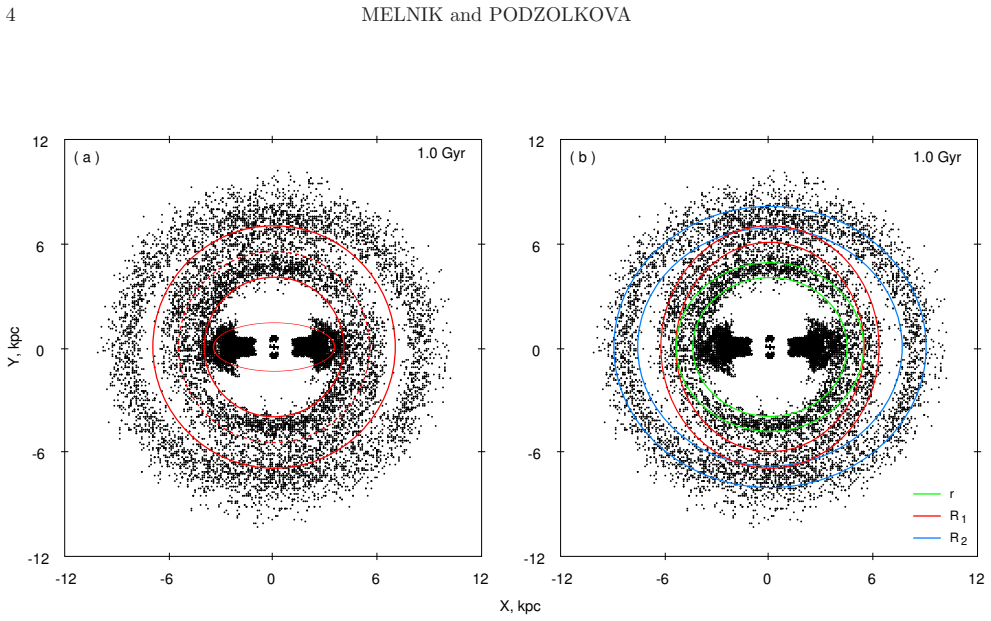
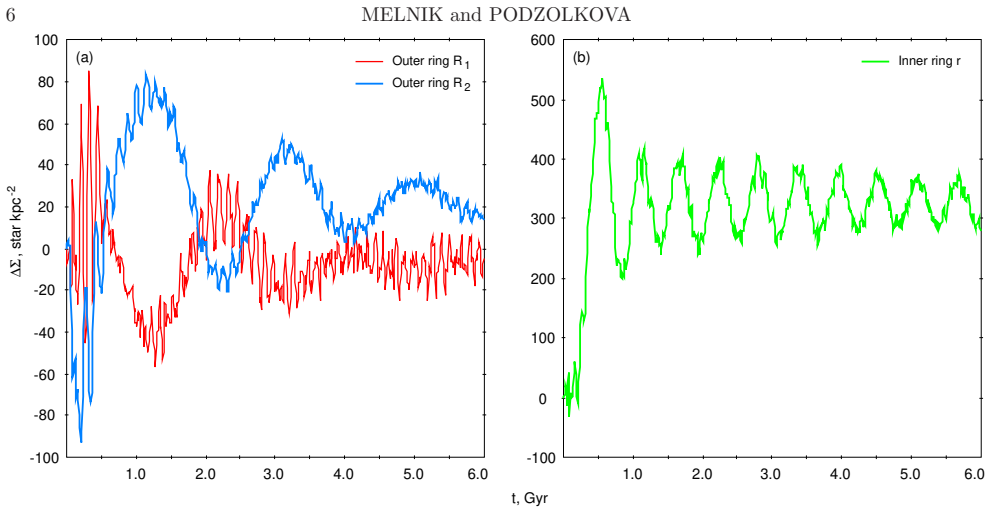
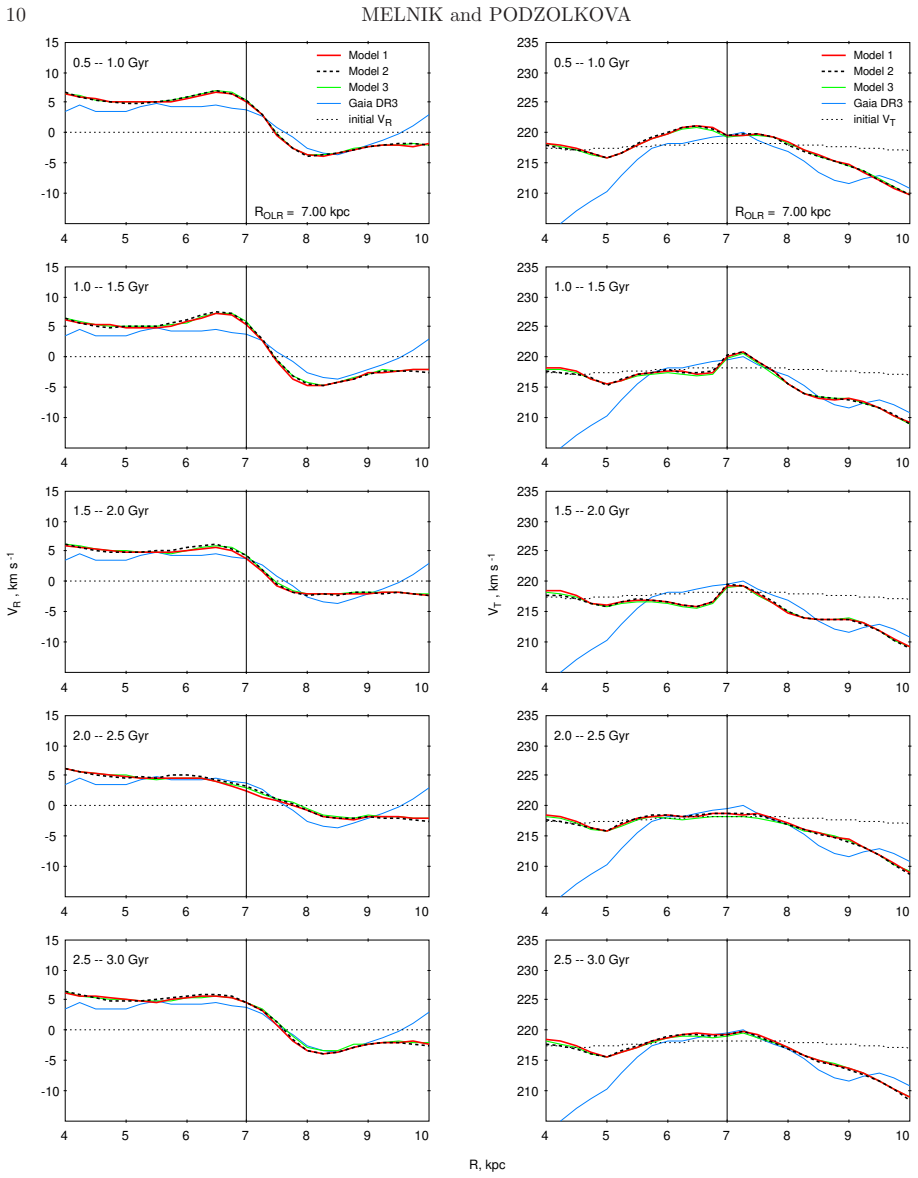
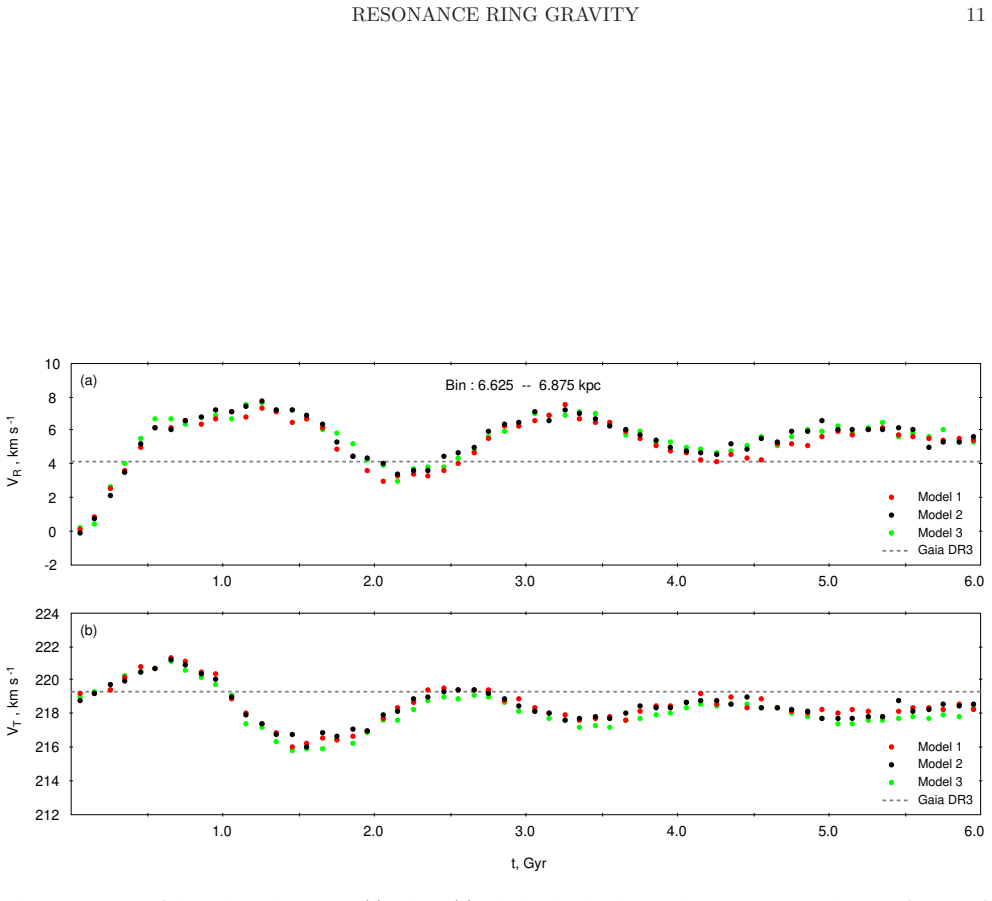
In general, the gravity of the elliptical rings has little effect on the process of adjustment of epicyclic motions near the OLR of the bar. The rings form self-consistently in the initial model, and their added perturbations, represented analytically at each angle theta using polynomials in powers of R/Re or Re/R, do not substantially modify the velocity distributions driven by the bar.
What carries the argument
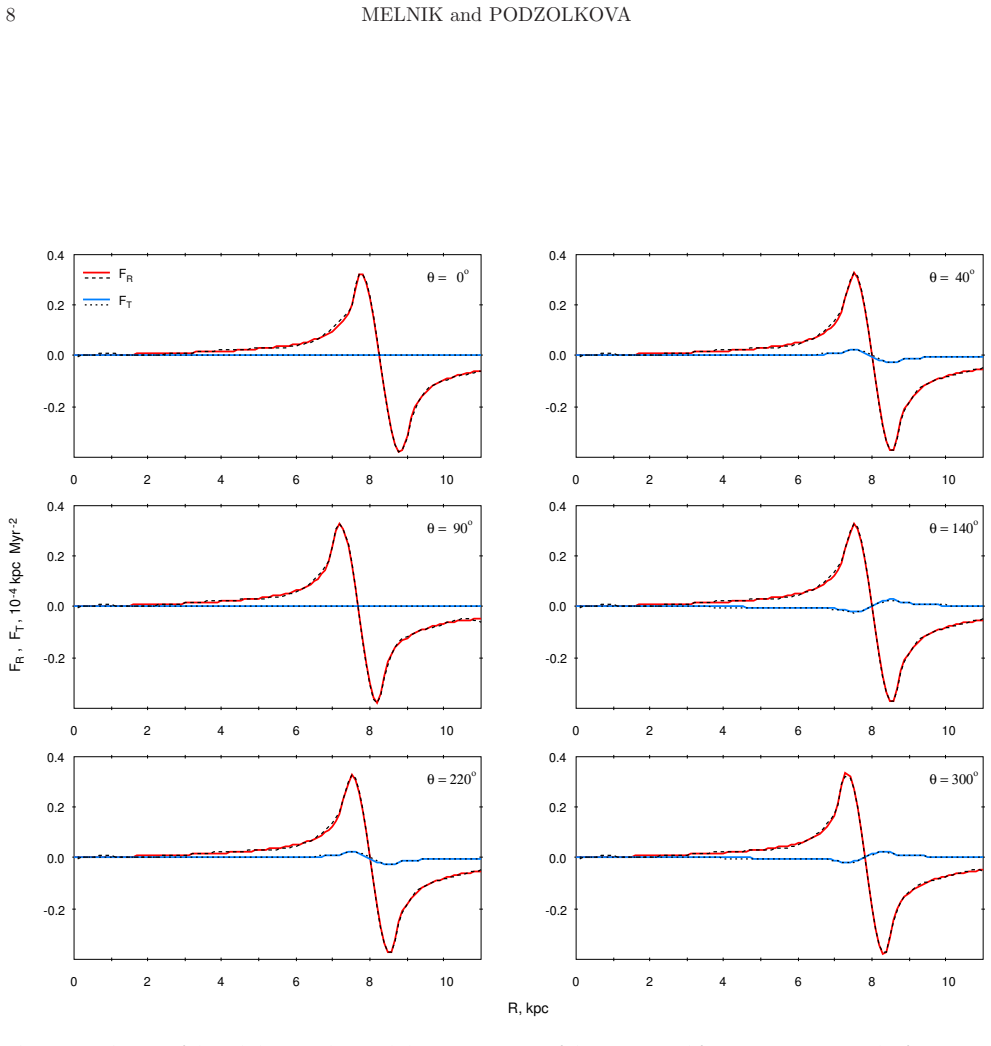
Polynomial representations of radial force F_R and azimuthal force F_T from the elliptical resonance rings, based on the midline distance Re at angle theta.
If this is right
- Stellar velocity distributions near the OLR remain dominated by the bar's gravitational influence.
- Analytical models omitting explicit ring gravity remain adequate for studying outer-disk resonance dynamics.
- The resonance rings act mainly as passive density features rather than active modifiers of epicyclic orbits.
Where Pith is reading between the lines
- This minimal influence implies that ring structures can often be treated as outcomes of bar-driven dynamics without feedback in simplified models.
- Three-dimensional extensions could test whether vertical motions or spiral arm interactions amplify the ring contribution.
- Direct comparison with Milky Way kinematic surveys near the OLR would provide an observational test of the negligible effect.
Load-bearing premise
The initial 2D analytical model accurately forms the resonance rings and the chosen polynomial force representation captures their gravitational influence on stellar motions.
What would settle it
A side-by-side comparison of stellar velocity histograms or radial velocity dispersions near the OLR in otherwise identical simulations run with and without the added ring forces.
Figures
read the original abstract
We constructed the 2D model of the Galaxy which initially includes an analytical bar, bulge, disk and halo. The model disk forms the outer elliptical resonance rings R1 and R2 located near the outer Lindblad resonance of the bar (OLR), as well as the inner resonance ring r located near the corotation radius (CR). As the density of stars in the elliptical rings increased, we introduced additional gravitational perturbations created by the rings. The radial component of gravitational perturbations from the elliptical rings, F_R, at a point with the Galactocentric coordinates (R, theta) was represented as a combination of three polynomials in powers R/Re or Re/R, where Re is the distance to the midline (middle) of the ring at a given angle theta. The azimuthal component of the disturbances, F_T, was calculated using the force F_R. The difference between the values of the force F_R (F_T) calculated using the numerical differentiation of the potential and using the analytical representation does not exceed 5.7% (1.3%) of the maximum value of the force F_R generated by the elliptical rings. In general, the gravity of the elliptical rings has little effect on the process of adjustment of epicyclic motions near the OLR of the bar.
Editorial analysis
A structured set of objections, weighed in public.
Referee Report
Summary. The manuscript constructs a 2D Galactic model consisting of an analytical bar, bulge, disk, and halo. The disk develops outer elliptical resonance rings R1 and R2 near the bar's outer Lindblad resonance (OLR) and an inner ring r near corotation. Gravitational perturbations from the rings are added via a polynomial representation of the radial force component F_R (three polynomials in R/Re or Re/R) with the azimuthal component F_T obtained from F_R. The representation is validated by showing that it differs from numerical differentiation of the ring potential by at most 5.7% (F_R) and 1.3% (F_T) of the maximum ring force. The central claim is that the gravity of these elliptical rings has little effect on the adjustment of epicyclic motions near the OLR.
Significance. If the central claim is substantiated with quantitative force ratios and velocity-distribution metrics, the result would support neglecting resonance-ring self-gravity in models of stellar kinematics near the Galactic bar OLR, thereby simplifying test-particle or N-body simulations of the Milky Way disk. The polynomial force representation itself is a technical contribution that could be reused, but the current evidential basis is limited by the absence of direct comparisons between ring and bar force amplitudes.
major comments (1)
- [Abstract / force representation section] Abstract and force-validation paragraph: The conclusion that ring gravity 'has little effect' on epicyclic adjustment near the OLR rests only on the reported 5.7%/1.3% representation errors relative to numerical differentiation. No value is given for max |F_R| / |F_bar| (or |F_T| / |F_bar|) at the OLR radius, nor is any quantitative metric reported for the change in the stellar velocity distribution when the ring forces are included versus omitted. Without these ratios or effect-size measurements, the dynamical negligibility of the perturbations cannot be established.
minor comments (2)
- [Results] The manuscript provides no error bars, confidence intervals, or sensitivity tests on the velocity-distribution results with respect to the polynomial coefficients or the adopted ring densities.
- [Model description] Parameter choices for the initial analytical bar, disk, and halo (e.g., pattern speed, masses, scale lengths) and any criteria for excluding particles or rings are not detailed, limiting reproducibility.
Simulated Author's Rebuttal
We thank the referee for the careful reading of the manuscript and the constructive feedback on the central claim. We address the major comment point by point below.
read point-by-point responses
-
Referee: [Abstract / force representation section] Abstract and force-validation paragraph: The conclusion that ring gravity 'has little effect' on epicyclic adjustment near the OLR rests only on the reported 5.7%/1.3% representation errors relative to numerical differentiation. No value is given for max |F_R| / |F_bar| (or |F_T| / |F_bar|) at the OLR radius, nor is any quantitative metric reported for the change in the stellar velocity distribution when the ring forces are included versus omitted. Without these ratios or effect-size measurements, the dynamical negligibility of the perturbations cannot be established.
Authors: We agree that the manuscript as submitted does not report the maximum force ratios |F_R|/|F_bar| or |F_T|/|F_bar| at the OLR, nor any direct metric quantifying the change in the stellar velocity distribution when ring forces are added or omitted. The statement that ring gravity 'has little effect' was drawn from the small representation errors combined with the model construction (rings formed self-consistently by the bar), but this is insufficient to demonstrate dynamical negligibility. In revision we will compute and report the requested force ratios evaluated at the OLR radius and will add a quantitative comparison of the velocity distributions (e.g., changes in the radial and tangential velocity dispersions or the shape of the velocity ellipsoid) between runs with and without the ring perturbations. revision: yes
Circularity Check
No significant circularity detected
full rationale
The paper builds an initial 2D galactic model with analytical components that self-consistently forms resonance rings, then adds ring perturbations via a polynomial representation of F_R (with F_T derived from it) whose accuracy is cross-validated solely against numerical differentiation of the ring potential (error ≤5.7%). The conclusion that ring gravity has little effect on epicyclic adjustment near the OLR follows from comparing model outcomes with and without these perturbations. No step reduces a prediction to a fitted input by construction, no self-citation chain supports a load-bearing uniqueness claim, and the force representation is not tuned using the velocity-distribution result itself. The derivation is therefore self-contained.
Axiom & Free-Parameter Ledger
free parameters (1)
- Polynomial coefficients in F_R representation
axioms (2)
- domain assumption The Galaxy can be adequately modeled in 2D using analytical potentials for bar, bulge, disk and halo that naturally form resonance rings R1, R2 and r.
- domain assumption The polynomial analytical representation of ring forces is a valid approximation when its difference from numerical differentiation is under 6%.
Reference graph
Works this paper leans on
-
[1]
Athanassoula, O
E. Athanassoula, O. Bienayme, L. Martinet, and D. Pfenniger, \ Astron. Astrophys. 127 , 349 (1983)
1983
-
[2]
R. A. Benjamin, E. Churchwell, B. L. Babler, et al., \ Astrophys. J. 630 , L149 (2005)
2005
-
[3]
E. Bica, C. Bonatto, B. Barbuy, and S. Ortolani, \ Astron. Astrophys. 450 , 105 (2006)
2006
-
[4]
Binney and S
J. Binney and S. Tremaine, Galactic Dynamics , (Princeton: Princeton Univ. Press, 2008)
2008
-
[5]
Boehle, A
A. Boehle, A. M. Ghez, R. Sch\"odel, et al., \ Astrophys. J. 830 , 17 (2016)
2016
-
[6]
R. L. Branham, \ Astrophys. Space Sci. 362 , 29 (2017)
2017
-
[7]
A. G. A. Brown et al. (Gaia Collab.), Astron. Astrophys. 649 , A1 (2021)
2021
-
[8]
Buta, \ Astrophys
R. Buta, \ Astrophys. J. Suppl. Ser. 96 , 39 (1995)
1995
-
[9]
Buta and F
R. Buta and F. Combes, \ Fund. Cosmic Physics 17 , 95 (1996)
1996
-
[10]
Buta and D
R. Buta and D. A. Crocker, \ Astron. J. 102 , 1715 (1991)
1991
-
[11]
G. Byrd, P. Rautiainen, H. Salo, R. Buta, and D. A. Crocker, \ Astron. J. 108 , 476 (1994)
1994
-
[12]
Cabrera-Lavers, P
A. Cabrera-Lavers, P. L. Hammersley, C. Gonz\'alez-Fern\'andez, et al., \ Astron. Astrophys. 465 , 825 (2007)
2007
-
[13]
Contopoulos and P
G. Contopoulos and P. Grosbol, \ Astron. Astrophys. Rev. 1 , 261 (1989)
1989
-
[14]
Contopoulos and Th
G. Contopoulos and Th. Papayannopoulos, \ Astron. Astrophys. 92 , 33 (1980)
1980
-
[15]
A. K. Dambis, L. N. Berdnikov, A. Y. Kniazev, et al., \ Mon. Not. R. Astron. Soc. 435 , 3206 (2013)
2013
-
[16]
Dehnen, \ Astron
W. Dehnen, \ Astron. J. 119 , 800 (2000)
2000
-
[17]
de Vaucouleurs and K
G. de Vaucouleurs and K. C. Freeman, \ Vis. in Astron., 14 , 163 (1972)
1972
-
[18]
E. Dwek, R. G. Arendt, M. G. Hauser, et al. \ Astrophys. J. 445 , 716 (1995)
1995
-
[19]
Eisenhauer, R
F. Eisenhauer, R. Genzel, T. Alexander, et al., \ Astrophys. J. 628 , 246 (2005)
2005
-
[20]
M. W. Feast, C. D. Laney, T. D. Kinman, F. van Leeuwen, and P. A. Whitelock, \ Mon. Not. R. Astron. Soc. 386 , 2115 (2008)
2008
-
[21]
Francis and E
Ch. Francis and E. Anderson, \ Mon. Not. R. Astron. Soc. 441 , 1105 (2014)
2014
-
[22]
Fux, \ Astron
R. Fux, \ Astron. Astrophys. 373 , 511 (2001)
2001
-
[23]
Gerhard, \ Mem
O. Gerhard, \ Mem. S. A. It. Suppl. 18 , 185 (2011)
2011
-
[24]
E. V. Glushkova, A. K. Dambis, A. M. Melnik, and A. S. Rastorguev, \ Astron. Astrophys. 329 , 514 (1998)
1998
-
[25]
M. A. T. Groenewegen, A. Udalski, and G. Bono, \ Astron. Astrophys. 481 , 441 (2008)
2008
-
[26]
Iwanek, R
P. Iwanek, R. Poleski, S. Kozlowski, et al., \ Astrophys. J. Suppl. Ser. 264 , 20 (2023)
2023
-
[27]
A. J. Kalnajs, \ ApJ 166 , 275 (1971)
1971
-
[28]
Katz et al
D. Katz et al. (Gaia Collab.), \ Astron. Astrophys. 616 , A11 (2018)
2018
-
[29]
P. S. Letelier, \ Mon. Not. R. Astron. Soc. 381 , 1031 (2007)
2007
-
[30]
Lindegren, S
L. Lindegren, S. A. Klioner, J. Hernandez, et al., \ Astron. Astrophys. 649 , A2 (2021)
2021
-
[31]
A. M. Melnik, \ Mon. Not. R. Astron. Soc. 485 , 2106 (2019)
2019
-
[32]
A. M. Melnik and A. K. Dambis, \ Astrophys. Space Sci. 365 , 112 (2020)
2020
-
[33]
A. M. Melnik, A. K. Dambis, E. N. Podzolkova, and L. N. Berdnikov, \ Mon. Not. R. Astron. Soc. 507 , 4409 (2021)
2021
-
[34]
A. M. Melnik and E. N. Podzolkova, \ Astron. Lett. 50 , 481 (2024)
2024
-
[35]
A. M. Melnik, E. N. Podzolkova, and A. K. Dambis, \ Mon. Not. R. Astron. Soc. 525 , 3287 (2023)
2023
-
[36]
A. M. Melnik and E. N. Podzolkova, \ Astrophys. Bul. 80 (2), 254 (2025)
2025
-
[37]
A. M. Melnik and P. Rautiainen, \ Astron. Lett., 35 , 609 (2009)
2009
-
[38]
A. M. Melnik, P. Rautiainen, L. N. Berdnikov, A. K. Dambis, A. S. Rastorguev, \ Astronomische Nachrichten 336 , 70 (2015)
2015
-
[39]
A. M. Melnik, P. Rautiainen, E. V. Glushkova, A. K. Dambis, \ Astrophys. and Space Science 361 , 60 (2016)
2016
-
[40]
A. M. Melnik and P. Rautiainen, \ Mon. Not. R. Astron. Soc. 418 , 2508 (2011)
2011
-
[41]
Monari, B
G. Monari, B. Famaey, and A. Siebert, \ Mon. Not. R. Astron. Soc. 457 , 2569 (2016)
2016
-
[42]
Monari, B
G. Monari, B. Famaey, A. Siebert, A. Duchateau, T. Lorscheider, and O. Bienayme, \ Mon. Not. R. Astron. Soc. 465 , 1443 (2017)
2017
-
[43]
Ness and D
M. Ness and D. Lang, \ Astron. J. 152 , 14 (2016)
2016
-
[44]
I. I. Nikiforov, \ ASP Conf. Ser. 316 , 199 (2004)
2004
-
[45]
Nishiyama, T
S. Nishiyama, T. Nagata, S. Sato, et al., \ Astrophys. J. 647 , 1093 (2006)
2006
-
[46]
Pfenniger, \ Astron
D. Pfenniger, \ Astron. Astrophys. 134 , 373 (1984)
1984
-
[47]
Prusti et al
T. Prusti et al. (Gaia Collab.), \ Astron. Astrophys. 595 , A1 (2016)
2016
-
[48]
Rautiainen and A
P. Rautiainen and A. M. Melnik, \ Astron. Astrophys. 519 , 70 (2010)
2010
-
[49]
Rautiainen and H
P. Rautiainen and H. Salo, Astron. Astrophys. 348, 737 (1999)
1999
-
[50]
Rautiainen and H
P. Rautiainen and H. Salo, \ Astron. Astrophys. 362 , 465 (2000)
2000
-
[51]
M. J. Reid, K. M. Menten, X. W. Zheng, A. Brunthaler, and Y. Xu, \ Astrophys. J. 705 , 1548 (2009)
2009
-
[52]
J. A. Sellwood and A. Wilkinson, \ Rep. on Prog. in Phys. 56 , 173 (1993)
1993
-
[53]
M. P. Schwarz, \ Astrophys. J. 247 , 77 (1981)
1981
-
[54]
Vallenari et al
A. Vallenari et al. (Gaia Collab.), \ Astron. Astrophys. 674 , A1 ( 2023)
2023
-
[55]
M. D. Weinberg, \ Astrophys. J. 420 , 597 (1994)
1994
-
[56]
B. P. Kondrat'ev, Teoriia potentsiala. Novye motody i zadachi s resheniiami. Moskva, Mir, 2007. ISBN 978-5-03-003798-1
2007
-
[57]
Andrae, et al., \ Astron
R. Andrae, et al., \ Astron. Astrophys. 616 , 8 (2018)
2018
-
[58]
Antoja, A
T. Antoja, A. Helmi, W. Dehnen, et al., \ Astron. Astrophys. 563 , 60 (2014)
2014
-
[59]
Athanassoula, O
E. Athanassoula, O. Bienayme, L. Martinet, D. Pfenniger, \ Astron. Astrophys. 127 , 349 (1983)
1983
-
[60]
Babusiaux et al
C. Babusiaux et al. (Gaia Collab.), \ Astron. Astrophys. 616 , 10 (2018)
2018
-
[61]
Bensby, M
T. Bensby, M. S. Oey, S. Feltzing, and B. Gustafsson, \ Astrophys. J. 655 , L89 (2007)
2007
-
[62]
Binney and S
J. Binney and S. Tremaine, Galactic Dynamics , 2nd ed. (Princeton Univ. Press, Princeton, NJ, 2008)
2008
-
[63]
Bland-Hawthorn and O
J. Bland-Hawthorn and O. Gerhard, \ Astron. Astrophys. Rev. 54 , 529 (2016)
2016
-
[64]
D. L. Block, I. Puerari, J. H. Knapen, et al., \ Astron. Astrophys. 375 , 761 (2001)
2001
-
[65]
Boubert and A
D. Boubert and A. Everall, \ Mon. Not. R. Astron. Soc. 497 , 4246 (2020)
2020
-
[66]
A. G. A. Brown et al. (Gaia Collab.), \ Astron. Astrophys. 649 , A1 (2021)
2021
-
[67]
R. Buta, E. Laurikainen, and H. Salo, \ Astron. J. 127 , 279 (2004)
2004
-
[68]
G. Byrd, P. Rautiainen, H. Salo, R. Buta, D. A. Crocker, \ Astron. J. 108 , 476 (1994)
1994
-
[69]
Castro-Ginard, A
A. Castro-Ginard, A. G. A. Brown, Z. Kostrzewa-Rutkowska, et al., \ Astron. Astrophys. 677 , 37 (2023)
2023
-
[70]
Chakrabarty and I
D. Chakrabarty and I. V. Sideris, \ Astron. Astrophys. 488 , 161 (2008)
2008
-
[71]
Chiappini, F
C. Chiappini, F. Matteucci, and D. Romano, \ Astrophys. J. 554 , 1044 (2001)
2001
-
[72]
Chiba, J
R. Chiba, J. Friske, and R. Sch\"onrich, \ Mon. Not. R. Astron. Soc. 500 , 4710 (2021)
2021
-
[73]
A. K. Dambis, L. N. Berdnikov, A. Y. Kniazev, et al. \ Mon. Not. R. Astron. Soc. 435 , 3206 (2013)
2013
-
[74]
Dehnen, \ Astron
W. Dehnen, \ Astron. J. 115 , 2384 (1998)
1998
-
[75]
de Vaucouleurs and K
G. de Vaucouleurs and K. C. Freeman, \ Vis. in Astron. 14 , 163 (1972)
1972
-
[76]
D \'i az-Garc \'i a, H
S. D \'i az-Garc \'i a, H. Salo, E. Laurikainen, and M. Herrera-Endoqui, \ Astron. Astrophys. 587 , 160 (2016)
2016
-
[77]
Drimmel, S
R. Drimmel, S. Khanna, E. D'Onghia, et al. \ Astron. Astrophys. 670 , 10 (2023)
2023
-
[78]
O. J. Eggen, \ Mon. Not. R. Astron. Soc. 118 , 154 (1958)
1958
-
[79]
Everall and D
A. Everall and D. Boubert, \ Mon. Not. R. Astron. Soc. 50 , 6205 (2022)
2022
-
[80]
Fragkoudi, D
F. Fragkoudi, D. Katz, W. Trick, et al. \ Mon. Not. R. Astron. Soc. 488 , 3324 (2019)
2019
discussion (0)
Sign in with ORCID, Apple, or X to comment. Anyone can read and Pith papers without signing in.