Modeling and Estimation of Solid Electrolyte Interphase during Formation in Battery Manufacturing
Pith reviewed 2026-06-27 08:16 UTC · model grok-4.3
The pith
A semi-empirical model with unscented Kalman filter estimates SEI thickness growth in real time from battery voltage and expansion data during formation.
A machine-rendered reading of the paper's core claim, the machinery that carries it, and where it could break.
Core claim
The paper claims that a control-oriented semi-empirical model of SEI growth, calibrated on cell formation data and combined with an unscented Kalman filter, can estimate the evolving SEI film thickness solely from in-operando terminal voltage and cell expansion measurements.
What carries the argument
Semi-empirical SEI growth model paired with unscented Kalman filter that fuses voltage and expansion measurements into real-time thickness estimates.
If this is right
- Real-time SEI thickness estimates become available during manufacturing without specialized direct-measurement hardware.
- Closed-loop adjustment of formation protocols based on estimated SEI growth rate becomes feasible.
- Formation times may be shortened while maintaining or improving SEI quality that affects subsequent battery lifetime.
Where Pith is reading between the lines
- The sensing fixture and filter could be retrofitted onto existing formation equipment with modest capital cost.
- The same measurement pair might later support online monitoring of SEI evolution in operating packs after they leave the factory.
- Extending the model to different electrode chemistries or formation temperatures would test how broadly the calibrated parameters apply.
Load-bearing premise
The semi-empirical model structure and its calibration on formation data are sufficient for the unscented Kalman filter to produce accurate real-time estimates of SEI thickness solely from terminal voltage and cell expansion, without requiring direct SEI measurements or additional unmodeled dynamics.
What would settle it
Post-formation comparison of the filter's estimated SEI thickness against independent direct measurements such as electrochemical impedance spectroscopy or cross-section microscopy on disassembled cells.
Figures
read the original abstract
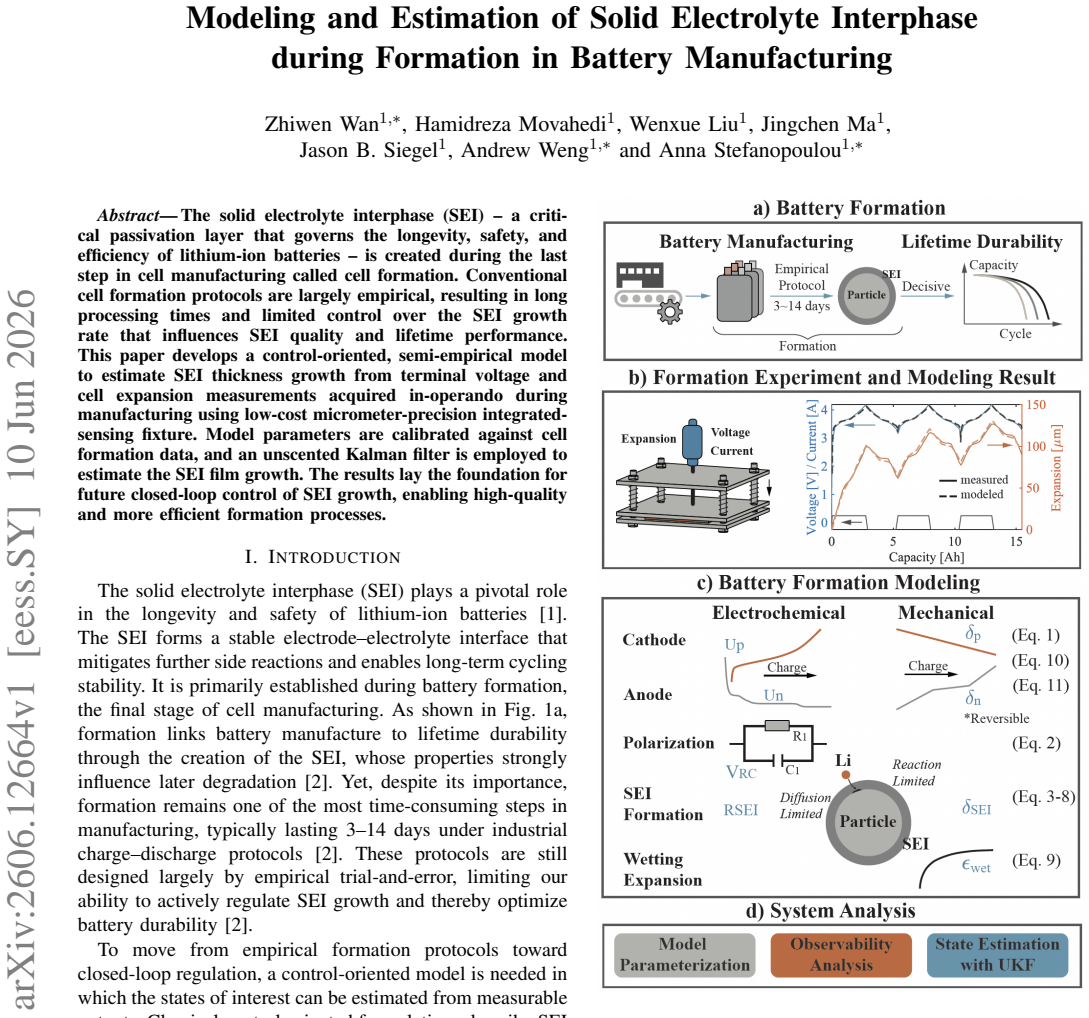
The solid electrolyte interphase (SEI) - a critical passivation layer that governs the longevity, safety, and efficiency of lithium-ion batteries - is created during the last step in cell manufacturing called cell formation. Conventional cell formation protocols are largely empirical, resulting in long processing times and limited control over the SEI growth rate that influences SEI quality and lifetime performance. This paper develops a control-oriented, semi-empirical model to estimate SEI thickness growth from terminal voltage and cell expansion measurements acquired in-operando during manufacturing using low-cost micrometer-precision integrated-sensing fixture. Model parameters are calibrated against cell formation data, and an unscented Kalman filter is employed to estimate the SEI film growth. The results lay the foundation for future closed-loop control of SEI growth, enabling high-quality and more efficient formation processes.
Editorial analysis
A structured set of objections, weighed in public.
Referee Report
Summary. The manuscript develops a control-oriented, semi-empirical model to estimate solid electrolyte interphase (SEI) thickness growth during lithium-ion battery cell formation. It uses in-operando terminal voltage and cell expansion measurements from a low-cost micrometer-precision integrated-sensing fixture. Model parameters are calibrated on cell formation data, and an unscented Kalman filter (UKF) is employed to produce real-time SEI estimates. The work positions this as a foundation for future closed-loop control of SEI growth to improve manufacturing efficiency and SEI quality.
Significance. If the central claims hold after proper validation, the approach could enable non-destructive, real-time monitoring of SEI formation using readily available signals, supporting more efficient and controlled battery manufacturing protocols. The combination of semi-empirical modeling with UKF and low-cost sensing hardware represents a practical step toward control-oriented battery process engineering.
major comments (1)
- [Abstract and model-validation sections] Abstract and model-validation sections: The central claim that the UKF yields accurate real-time SEI thickness estimates from voltage and expansion alone requires that the semi-empirical model isolates SEI growth from other contributors (electrolyte consumption, gas evolution, mechanical effects). No independent ground-truth SEI thickness measurements (post-formation disassembly, XPS, EIS, or similar) are described for either parameter calibration or hold-out validation of the UKF estimates. Without such data, it is impossible to determine whether reported estimation performance reflects true SEI prediction or simply reproduces the calibration signals.
Simulated Author's Rebuttal
We thank the referee for their constructive feedback. We respond to the major comment below and will revise the manuscript accordingly.
read point-by-point responses
-
Referee: [Abstract and model-validation sections] Abstract and model-validation sections: The central claim that the UKF yields accurate real-time SEI thickness estimates from voltage and expansion alone requires that the semi-empirical model isolates SEI growth from other contributors (electrolyte consumption, gas evolution, mechanical effects). No independent ground-truth SEI thickness measurements (post-formation disassembly, XPS, EIS, or similar) are described for either parameter calibration or hold-out validation of the UKF estimates. Without such data, it is impossible to determine whether reported estimation performance reflects true SEI prediction or simply reproduces the calibration signals.
Authors: We agree that the lack of independent ground-truth SEI thickness measurements (e.g., via XPS, EIS, or post-formation disassembly) is a genuine limitation. Our semi-empirical model parameters are calibrated directly to the observed in-operando voltage and expansion signals, and the UKF produces estimates consistent with that calibrated model. We do not have separate validation data to confirm that SEI growth has been isolated from other effects or that the estimates reflect true SEI thickness rather than the calibration signals. We will revise the abstract and model-validation sections to explicitly acknowledge this limitation, clarify the nature of the reported performance, and position the work as a proof-of-concept for the sensing and estimation framework rather than a fully validated SEI measurement method. Future work will incorporate direct SEI characterization. revision: yes
Circularity Check
No significant circularity detected
full rationale
The abstract and description outline a standard semi-empirical modeling workflow: parameters are calibrated to formation data, then an unscented Kalman filter is applied to estimate SEI growth from voltage and expansion signals. No equations, self-citations, or derivation steps are shown that reduce the claimed estimates to the inputs by construction. The model structure is presented as control-oriented and semi-empirical without evidence of self-definitional loops, fitted inputs renamed as predictions, or load-bearing self-citations. This is a normal, non-circular empirical modeling paper whose central claim rests on external data calibration and filter application rather than tautological reduction.
Axiom & Free-Parameter Ledger
Reference graph
Works this paper leans on
-
[1]
Lithium batteries and the solid electrolyte interphase (sei)—progress and outlook,
H. Adenusi, G. A. Chass, S. Passerini, K. V . Tian, and G. Chen, “Lithium batteries and the solid electrolyte interphase (sei)—progress and outlook,”Advanced Energy Materials, vol. 13, no. 10, p. 2203307, 2023
2023
-
[2]
Predicting the impact of formation protocols on battery lifetime immediately after manufacturing,
A. Weng, P. Mohtat, P. M. Attia, V . Sulzer, S. Lee, G. Less, and A. Stefanopoulou, “Predicting the impact of formation protocols on battery lifetime immediately after manufacturing,”Joule, vol. 5, no. 11, pp. 2971–2992, 2021
2021
-
[3]
Theory of sei formation in recharge- able batteries: capacity fade, accelerated aging and lifetime prediction,
M. B. Pinson and M. Z. Bazant, “Theory of sei formation in recharge- able batteries: capacity fade, accelerated aging and lifetime prediction,” Journal of the Electrochemical Society, vol. 160, no. 2, p. A243, 2012
2012
-
[4]
Battery state of health monitoring by estimation of side reaction current density via retrospective-cost subsystem identification,
X. Zhou, D. S. Bernstein, J. L. Stein, and T. Ersal, “Battery state of health monitoring by estimation of side reaction current density via retrospective-cost subsystem identification,”Journal of Dynamic Systems, Measurement, and Control, vol. 139, no. 9, p. 091007, 2017
2017
-
[5]
Mixed mode growth model for the solid electrolyte interface (sei),
N. Kamyab, J. W. Weidner, and R. E. White, “Mixed mode growth model for the solid electrolyte interface (sei),”Journal of The Elec- trochemical Society, vol. 166, no. 2, p. A334, 2019
2019
-
[6]
Low-cost inductive sensor and fixture kit for measuring battery cell thickness under constant pressure,
S. Pannala, A. Weng, I. Fischer, J. B. Siegel, and A. G. Stefanopoulou, “Low-cost inductive sensor and fixture kit for measuring battery cell thickness under constant pressure,”IF AC-PapersOnLine, vol. 55, no. 37, pp. 712–717, 2022
2022
-
[7]
A comparative study of commercial lithium ion battery cycle life in electrical vehicle: Aging mechanism identification,
X. Han, M. Ouyang, L. Lu, J. Li, Y . Zheng, and Z. Li, “A comparative study of commercial lithium ion battery cycle life in electrical vehicle: Aging mechanism identification,”Journal of power sources, vol. 251, pp. 38–54, 2014
2014
-
[8]
Filming mech- anism of lithium-carbon anodes in organic and inorganic electrolytes,
J. Besenhard, M. Winter, J. Yang, and W. Biberacher, “Filming mech- anism of lithium-carbon anodes in organic and inorganic electrolytes,” Journal of Power Sources, vol. 54, no. 2, pp. 228–231, 1995
1995
-
[9]
Mechanics-driven anode material failure in battery safety and capacity deterioration is- sues: a review,
X. Gao, Y . Jia, W. Zhang, C. Yuan, and J. Xu, “Mechanics-driven anode material failure in battery safety and capacity deterioration is- sues: a review,”Applied Mechanics Reviews, vol. 74, no. 6, p. 060801, 2022
2022
-
[10]
Degradation and expansion of lithium-ion batteries with silicon/graphite anodes: Impact of pretension, temperature, c- rate and state-of-charge window,
Z. Wan, S. Pannala, C. Solbrig, T. R. Garrick, A. G. Stefanopoulou, and J. B. Siegel, “Degradation and expansion of lithium-ion batteries with silicon/graphite anodes: Impact of pretension, temperature, c- rate and state-of-charge window,”eTransportation, vol. 24, p. 100416, 2025
2025
-
[11]
Modeling battery formation: Boosted sei growth, multi-species re- actions, and irreversible expansion,
A. Weng, E. Olide, I. Kovalchuk, J. B. Siegel, and A. Stefanopoulou, “Modeling battery formation: Boosted sei growth, multi-species re- actions, and irreversible expansion,”Journal of The Electrochemical Society, vol. 170, no. 9, p. 090523, 2023
2023
-
[12]
Nonlinear controllability and observabil- ity,
R. Hermann and A. Krener, “Nonlinear controllability and observabil- ity,”IEEE Transactions on automatic control, vol. 22, no. 5, pp. 728– 740, 1977
1977
-
[13]
Lithium-ion battery state of charge and critical surface charge estimation using an electrochemical model-based extended kalman filter,
D. Di Domenico, A. Stefanopoulou, and G. Fiengo, “Lithium-ion battery state of charge and critical surface charge estimation using an electrochemical model-based extended kalman filter,”Journal of Dynamic Systems, Measurement, and Control, vol. 132, p. 061302, 10 2010
2010
-
[14]
Electrode state of charge and state of health estimation with electrode- level equivalent-circuit models,
I. Lopetegi, S. Fernandez, G. L. Plett, M. S. Trimboli, and U. Iraola, “Electrode state of charge and state of health estimation with electrode- level equivalent-circuit models,”Journal of The Electrochemical So- ciety, 2025
2025
-
[15]
An interconnected observer for concurrent estimation of bulk and surface concentration in the cathode and anode of a lithium-ion battery,
A. Allam and S. Onori, “An interconnected observer for concurrent estimation of bulk and surface concentration in the cathode and anode of a lithium-ion battery,”IEEE Transactions on Industrial Electronics, vol. 65, no. 9, pp. 7311–7321, 2018
2018
-
[16]
New extension of the kalman filter to nonlinear systems,
S. J. Julier and J. K. Uhlmann, “New extension of the kalman filter to nonlinear systems,” inSignal processing, sensor fusion, and target recognition VI, vol. 3068, pp. 182–193, Spie, 1997
1997
discussion (0)
Sign in with ORCID, Apple, or X to comment. Anyone can read and Pith papers without signing in.