Fence Complexes and Toric Degenerations of Positroid Varieties
Pith reviewed 2026-06-27 06:07 UTC · model grok-4.3
The pith
Positroid varieties in the Grassmannian degenerate to reduced unions of toric varieties indexed by fence complexes under the Sturmfels-Gonciulea-Lakshmibai degeneration.
A machine-rendered reading of the paper's core claim, the machinery that carries it, and where it could break.
Core claim
Fence complexes are unions of faces of the Gelfand-Tsetlin polytope P_{k,n} associated to positroid varieties in Gr(k,n). These complexes are homeomorphic to closed balls, endow the polytope with a regular CW complex structure, and satisfy an Ehrhart-Hilbert polynomial equality with the positroid variety. Under the Sturmfels-Gonciulea-Lakshmibai degeneration of Gr(k,n) to the toric variety of the Gelfand-Tsetlin polytope, positroid varieties degenerate to the reduced union of toric varieties corresponding to their fence complexes.
What carries the argument
The fence complex, defined as a union of faces of the Gelfand-Tsetlin polytope P_{k,n} associated to a fundamental weight ω_k.
If this is right
- The Ehrhart polynomial of a fence complex equals the Hilbert polynomial of the associated positroid variety.
- Positroid varieties contained inside hook Schubert varieties are arithmetically Gorenstein precisely when their fence complexes satisfy a listed combinatorial condition.
- Cyclic Demazure modules admit a recursive character formula that is equivalent to the formula of Almousa, Gao and Huang.
- The Gelfand-Tsetlin polytope carries a regular CW complex structure induced by the fence complexes of all positroid varieties.
Where Pith is reading between the lines
- The degeneration supplies a combinatorial recipe for computing Hilbert series and other invariants of positroid varieties directly from polyhedral data.
- The ball topology on fence complexes may allow topological invariants of positroid varieties to be read off from the polytope without reference to the algebraic variety.
- The same fence-complex construction could be tested on other toric degenerations or on positroid varieties inside partial flag varieties.
Load-bearing premise
The fence complexes satisfy the homeomorphism to closed balls, the regular CW complex structure on the Gelfand-Tsetlin polytope, the equality between Ehrhart and Hilbert polynomials, and the stated degeneration property.
What would settle it
A positroid variety whose flat limit under the Sturmfels-Gonciulea-Lakshmibai degeneration fails to equal the reduced union of the toric varieties of its fence complex.
Figures


read the original abstract
We associate to each positroid variety in the Grassmannian $\mathrm{Gr}(k,n)$ a polyhedral complex, which we call a fence complex. Fence complexes consist of unions of faces of the Gelfand-Tsetlin polytope $P_{k,n}$ associated to a fundamental weight $\omega_k$. We show that these fence complexes are homeomorphic to closed balls. Furthermore, they endow the Gelfand-Tsetlin polytope with the structure of a regular CW complex, giving a polyhedral complex presentation of the regular CW complex structure on $\mathrm{Gr}(k,n)_{\geq 0}$. We also show that the Ehrhart polynomial of a fence complex equals the Hilbert polynomial of the associated positroid variety. We prove that under the Sturmfels-Gonciulea-Lakshmibai degeneration of $\mathrm{Gr}(k,n)$ to the toric variety of the Gelfand-Tsetlin polytope, positroid varieties degenerate to the reduced union of toric varieties corresponding to their fence complexes. As an application, we classify when positroid varieties contained inside hook Schubert varieties are arithmetically Gorenstein. We also derive a recursive character formula for cyclic Demazure modules, which we show is equivalent to a formula of Almousa, Gao and Huang.
Editorial analysis
A structured set of objections, weighed in public.
Referee Report
Summary. The paper associates to each positroid variety in Gr(k,n) a fence complex, defined as a union of faces of the Gelfand-Tsetlin polytope P_{k,n} for the fundamental weight ω_k. It proves that fence complexes are homeomorphic to closed balls, endow P_{k,n} with the structure of a regular CW complex that presents the CW structure on the non-negative Grassmannian, that the Ehrhart polynomial of each fence complex equals the Hilbert polynomial of the corresponding positroid variety, and that under the Sturmfels-Gonciulea-Lakshmibai degeneration positroid varieties degenerate to the reduced union of the toric varieties of their fence complexes. Applications include a classification of arithmetically Gorenstein positroid varieties inside hook Schubert varieties and a recursive character formula for cyclic Demazure modules shown equivalent to a formula of Almousa-Gao-Huang.
Significance. If the stated theorems hold, the work supplies a polyhedral model that realizes positroid varieties as reduced unions of toric varieties under a known degeneration, while also furnishing a CW-complex presentation of the non-negative Grassmannian and matching Ehrhart-Hilbert data. The Gorenstein classification and the Demazure-module character formula are concrete applications that connect the construction to existing results in the literature.
minor comments (2)
- [Abstract] The abstract packs several distinct theorems into a single paragraph; separating the statements of the homeomorphism, CW-structure, Ehrhart-Hilbert equality, and degeneration results would improve readability.
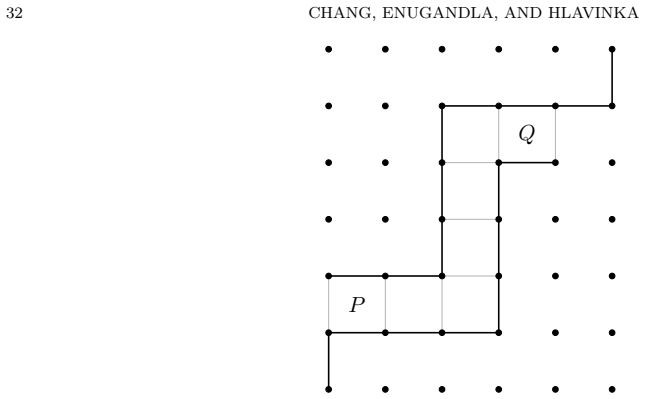
- Notation for positroid varieties, fence complexes, and the precise faces of P_{k,n} that constitute each complex should be introduced with a short table or diagram in the first section to aid readers unfamiliar with positroid combinatorics.
Simulated Author's Rebuttal
We thank the referee for their accurate summary of the manuscript and for recommending minor revision. The referee's assessment correctly identifies the main results on fence complexes, their topological and combinatorial properties, the toric degeneration, and the applications to Gorenstein positroid varieties and Demazure modules.
Circularity Check
No significant circularity detected
full rationale
The paper defines fence complexes as new polyhedral objects (unions of faces of the Gelfand-Tsetlin polytope associated to positroids) and proves their topological, combinatorial, Ehrhart, and degeneration properties via direct arguments that build on the external Sturmfels-Gonciulea-Lakshmibai degeneration and standard facts about positroid varieties and Gelfand-Tsetlin polytopes. No step reduces by definition or by self-citation to its own input; the central claims (homeomorphism to balls, CW structure, Ehrhart-Hilbert equality, toric degeneration) are established by theorems whose hypotheses are independent of the conclusions. The equivalence to the Almousa-Gao-Huang formula is shown by explicit recursion rather than by renaming or self-referential citation. The derivation chain is therefore self-contained against external benchmarks.
Axiom & Free-Parameter Ledger
Reference graph
Works this paper leans on
-
[1]
Ehrhart positivity and Demazure characters
Per Alexandersson and Elie Alhajjar. Ehrhart positivity and Demazure characters. InAlgebraic and geometric combinatorics on lattice polytopes, pages 56–71. World Sci. Publ., Hackensack, NJ, 2019
2019
-
[2]
Standard monomials for positroid varieties, 2024
Ayah Almousa, Shiliang Gao, and Daoji Huang. Standard monomials for positroid varieties, 2024. URL:https: //arxiv.org/abs/2309.15384,arXiv:2309.15384
Pith/arXiv arXiv 2024
-
[3]
Cambridge University Press, Cambridge, 2024
David Anderson and William Fulton.Equivariant cohomology in algebraic geometry, volume 210 ofCambridge Studies in Advanced Mathematics. Cambridge University Press, Cambridge, 2024
2024
-
[4]
Matthias Beck and Sinai Robins.Computing the continuous discretely. Undergraduate Texts in Mathematics. Springer, New York, second edition, 2015. Integer-point enumeration in polyhedra, With illustrations by David Austin.doi:10.1007/978-1-4939-2969-6
-
[5]
American Mathematical Society, Providence, RI, 2018
Matthias Beck and Raman Sanyal.Combinatorial reciprocity theorems, volume 195 ofGraduate Studies in Math- ematics. American Mathematical Society, Providence, RI, 2018. An invitation to enumerative geometric combi- natorics.doi:10.1090/gsm/195
-
[6]
Schubert polynomials, the Bruhat order, and the geometry of flag manifolds
Nantel Bergeron and Frank Sottile. Schubert polynomials, the Bruhat order, and the geometry of flag manifolds. Duke Math. J., 95(2):373–423, 1998.doi:10.1215/S0012-7094-98-09511-4
-
[7]
Springer, New York, 2005
Anders Björner and Francesco Brenti.Combinatorics of Coxeter groups, volume 231 ofGraduate Texts in Math- ematics. Springer, New York, 2005
2005
-
[8]
Birkhäuser Boston, Inc., Boston, MA, 2005
Michel Brion and Shrawan Kumar.Frobenius splitting methods in geometry and representation theory, volume 231 ofProgress in Mathematics. Birkhäuser Boston, Inc., Boston, MA, 2005
2005
-
[9]
Springer Monographs in Mathematics
Winfried Bruns and Joseph Gubeladze.Polytopes, rings, andK-theory. Springer Monographs in Mathematics. Springer, Dordrecht, 2009.doi:10.1007/b105283
-
[10]
Jürgen Herzog.Cohen-Macaulay Rings
Winfried Bruns and H. Jürgen Herzog.Cohen-Macaulay Rings. Cambridge Studies in Advanced Mathematics. Cambridge University Press, 2 edition, 1998
1998
-
[11]
David A. Cox, John B. Little, and Henry K. Schenck.Toric varieties, volume 124 ofGraduate Studies in Mathematics. American Mathematical Society, Providence, RI, 2011.doi:10.1090/gsm/124
-
[12]
Arithmetically Gorenstein and Gorenstein Richardson varieties in the Grassmannian
Chayapa Darayon. Arithmetically Gorenstein and Gorenstein Richardson varieties in the Grassmannian. (preprint), 2012
2012
-
[13]
de Concini, David Eisenbud, and C
C. de Concini, David Eisenbud, and C. Procesi. Young diagrams and determinantal varieties.Invent. Math., 56(2):129–165, 1980.doi:10.1007/BF01392548
-
[14]
Graduate texts in mathematics
David Eisenbud.Commutative algebra with a view toward algebraic geometry. Graduate texts in mathematics
-
[15]
Springer-Verlag, New York, 1995
1995
-
[16]
Binomial ideals.Duke Math
David Eisenbud and Bernd Sturmfels. Binomial ideals.Duke Math. J., 84(1):1–45, 1996.doi:10.1215/ S0012-7094-96-08401-X
1996
-
[17]
Symmetry of ascent and descent distributions on rectangular and staircase tableaux, 2025
Sergi Elizalde. Symmetry of ascent and descent distributions on rectangular and staircase tableaux, 2025. URL: https://arxiv.org/abs/2501.07573,arXiv:2501.07573
arXiv 2025
-
[18]
Francisco, Jeffrey Mermin, and Jay Schweig
Christopher A. Francisco, Jeffrey Mermin, and Jay Schweig. A survey of Stanley-Reisner theory. InConnections between algebra, combinatorics, and geometry, volume 76 ofSpringer Proc. Math. Stat., pages 209–234. Springer, FENCE COMPLEXES AND TORIC DEGENERATIONS OF POSITROID V ARIETIES 53 New York, 2014. URL:https://doi.org/10.1007/978-1-4939-0626-0_5,doi:10...
-
[19]
William Fulton.Introduction to toric varieties, volume 131 ofAnnals of Mathematics Studies. Princeton Univer- sity Press, Princeton, NJ, 1993. The William H. Roever Lectures in Geometry.doi:10.1515/9781400882526
-
[20]
Pavel Galashin, Steven N. Karp, and Thomas Lam. Regularity theorem for totally nonnegative flag varieties.J. Amer. Math. Soc., 35(2):513–579, 2022.doi:10.1090/jams/983
-
[21]
N. Gonciulea and V. Lakshmibai. Degenerations of flag and Schubert varieties to toric varieties.Transform. Groups, 1(3):215–248, 1996.doi:10.1007/BF02549207
-
[22]
52 ofGraduate Texts in Mathematics
Robin Hartshorne.Algebraic geometry, volume No. 52 ofGraduate Texts in Mathematics. Springer-Verlag, New York-Heidelberg, 1977
1977
-
[23]
Distributive lattices, affine semigroup rings and algebras with straightening laws
Takayuki Hibi. Distributive lattices, affine semigroup rings and algebras with straightening laws. InCommutative algebra and combinatorics (Kyoto, 1985), volume 11 ofAdv. Stud. Pure Math., pages 93–109. North-Holland, Amsterdam, 1987.doi:10.2969/aspm/01110093
-
[24]
W. V. D. Hodge. Some enumerative results in the theory of forms.Mathematical Proceedings of the Cambridge Philosophical Society, 39(1):22–30, 1943.doi:10.1017/S0305004100017631
-
[25]
PhD thesis, The University of Michigan, 2015
Giwan Kim.Richardson Varieties in a Toric Degeneration of the Flag Variety. PhD thesis, The University of Michigan, 2015
2015
-
[26]
Positroid varieties I: juggling and geometry, 2009
Allen Knutson, Thomas Lam, and David E Speyer. Positroid varieties I: juggling and geometry, 2009. URL: https://arxiv.org/abs/0903.3694,arXiv:0903.3694
Pith/arXiv arXiv 2009
-
[27]
Projections of Richardson varieties.Journal für die reine und angewandte Mathematik (Crelles Journal), 2014(687):133–157, 2012
Allen Knutson, Thomas Lam, and David E Speyer. Projections of Richardson varieties.Journal für die reine und angewandte Mathematik (Crelles Journal), 2014(687):133–157, 2012
2014
-
[28]
Positroid varieties: Juggling and geometry.Compositio Mathematica, 149(10):1710–1752, 2013
Allen Knutson, Thomas Lam, and David E Speyer. Positroid varieties: Juggling and geometry.Compositio Mathematica, 149(10):1710–1752, 2013
2013
-
[29]
Toric degeneration of Schubert varieties and Gelfand–Tsetlin polytopes
Mikhail Kogan and Ezra Miller. Toric degeneration of Schubert varieties and Gelfand–Tsetlin polytopes. Advances in Mathematics, 193(1):1–17, 2005. URL:https://www.sciencedirect.com/science/article/pii/ S000187080400129X,doi:10.1016/j.aim.2004.03.017
-
[30]
Thomas Lam. Cyclic Demazure modules and positroid varieties.The Electronic Journal of Combina- torics, 26(2):pp.2–28, May 2019. URL:https://www.combinatorics.org/ojs/index.php/eljc/article/view/ v26i2p28,doi:10.37236/8383
-
[31]
AK-theory version of Monk’s formula and some related multiplication formulas.J
Cristian Lenart. AK-theory version of Monk’s formula and some related multiplication formulas.J. Pure Appl. Algebra, 179(1-2):137–158, 2003.doi:10.1016/S0022-4049(02)00208-6
-
[32]
Frobenius splittings of toric varieties.Algebra Number Theory, 3(1):107–119, 2009.doi:10.2140/ ant.2009.3.107
Sam Payne. Frobenius splittings of toric varieties.Algebra Number Theory, 3(1):107–119, 2009.doi:10.2140/ ant.2009.3.107
2009
-
[33]
Total positivity, Grassmannians, and networks
Alexander Postnikov. Total positivity, Grassmannians, and networks. URL:https://math.mit.edu/âĹapost/ papers/tpgrass.pdf
-
[34]
Matching polytopes, toric geometry, and the totally non-negative Grassmannian.J
Alexander Postnikov, David Speyer, and Lauren Williams. Matching polytopes, toric geometry, and the totally non-negative Grassmannian.J. Algebraic Combin., 30(2):173–191, 2009.doi:10.1007/s10801-008-0160-1
-
[35]
Victor Reiner and Volkmar Welker. On the Charney–Davis and Neggers–Stanley conjectures.Journal of Com- binatorial Theory, Series A, 109(2):247–280, 2005. URL:https://www.sciencedirect.com/science/article/ pii/S0097316504001360,doi:10.1016/j.jcta.2004.09.003
-
[36]
Discrete Morse theory for totally non-negative flag varieties.Adv
Konstanze Rietsch and Lauren Williams. Discrete Morse theory for totally non-negative flag varieties.Adv. Math., 223(6):1855–1884, 2010.doi:10.1016/j.aim.2009.10.011
-
[37]
Richardson varieties, projected Richardson varieties and positroid varieties, 2024
David E Speyer. Richardson varieties, projected Richardson varieties and positroid varieties, 2024. URL:https: //arxiv.org/abs/2303.04831,arXiv:2303.04831
arXiv 2024
-
[38]
Hilbert functions of graded algebras.Advances in Mathematics, 28(1):57–83, 1978
Richard P Stanley. Hilbert functions of graded algebras.Advances in Mathematics, 28(1):57–83, 1978. URL: https://www.sciencedirect.com/science/article/pii/0001870878900452,doi:10.1016/0001-8708(78) 90045-2
-
[39]
Richard P. Stanley. Two poset polytopes.Discrete Comput. Geom., 1(1):9–23, 1986.doi:10.1007/BF02187680
-
[40]
Stanley.Enumerative Combinatorics
Richard P. Stanley.Enumerative Combinatorics. Volume 1, volume 49 ofCambridge Studies in Advanced Math- ematics. Cambridge University Press, Cambridge, second edition, 2012
2012
-
[41]
American Mathe- matical Society, Providence, RI, 1996.doi:10.1090/ulect/008
Bernd Sturmfels.Gröbner bases and convex polytopes, volume 8 ofUniversity Lecture Series. American Mathe- matical Society, Providence, RI, 1996.doi:10.1090/ulect/008
-
[42]
Gröbner bases and invariant theory.Adv
Bernd Sturmfels and Neil White. Gröbner bases and invariant theory.Adv. Math., 76(2):245–259, 1989.doi: 10.1016/0001-8708(89)90053-4. 54 CHANG, ENUGANDLA, AND HLA VINKA (Chang)Department of Mathematics, University of California, Berkeley, CA, United States of America Email address:changca@berkeley.edu (Enugandla)Department of Mathematics, University of Ca...
discussion (0)
Sign in with ORCID, Apple, or X to comment. Anyone can read and Pith papers without signing in.