Data-driven modeling of Galactic diffuse emission with multi-wavelength observations
Pith reviewed 2026-06-27 06:19 UTC · model grok-4.3
The pith
Multi-frequency radio maps encode enough information to reconstruct Galactic gamma-ray emission.
A machine-rendered reading of the paper's core claim, the machinery that carries it, and where it could break.
Core claim
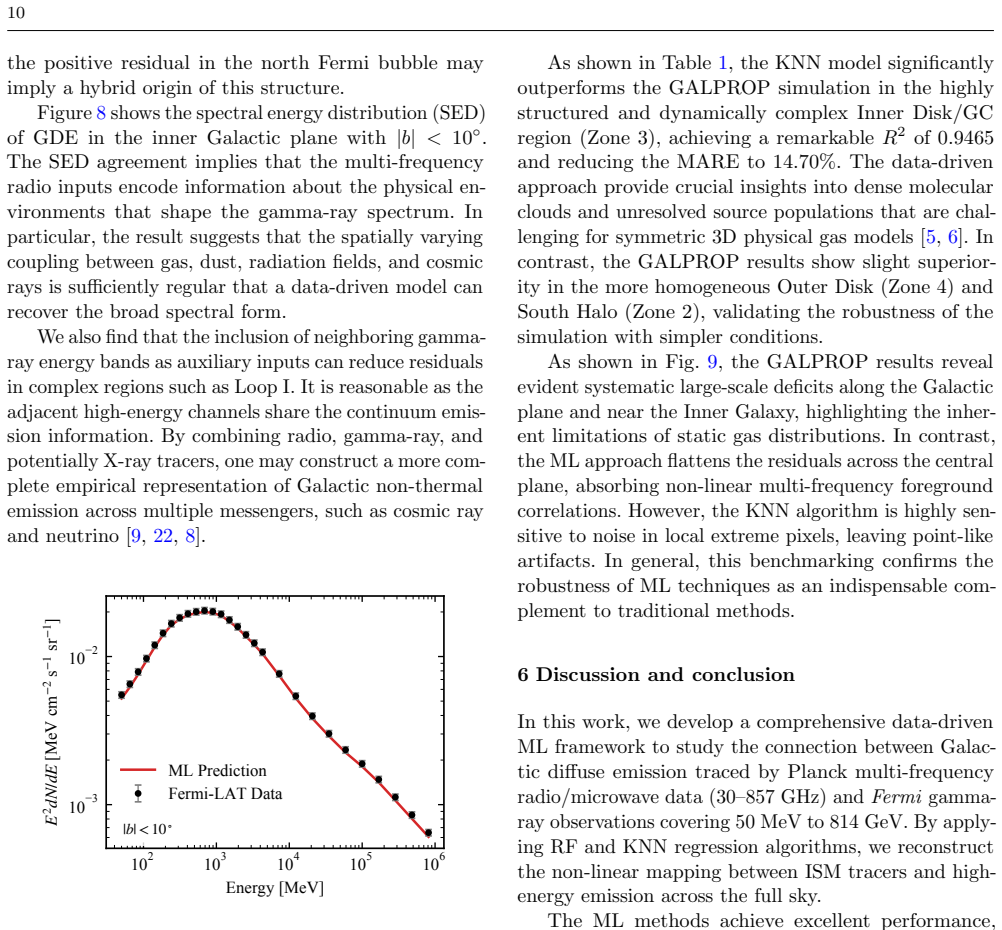
Multi-frequency radio observations from 30 to 857 GHz encode sufficient information to reconstruct both the spatial morphology and spectral properties of diffuse gamma-ray emission from 50 MeV to 814 GeV through a nonlinear supervised mapping, with high-frequency bands as the dominant predictor for the hadronic origin of 0.1-10 GeV gamma rays and low-frequency bands indicating leptonic origin above 10 GeV.
What carries the argument
The supervised machine learning model that constructs a nonlinear mapping between multi-frequency radio emission maps and gamma-ray intensity maps.
If this is right
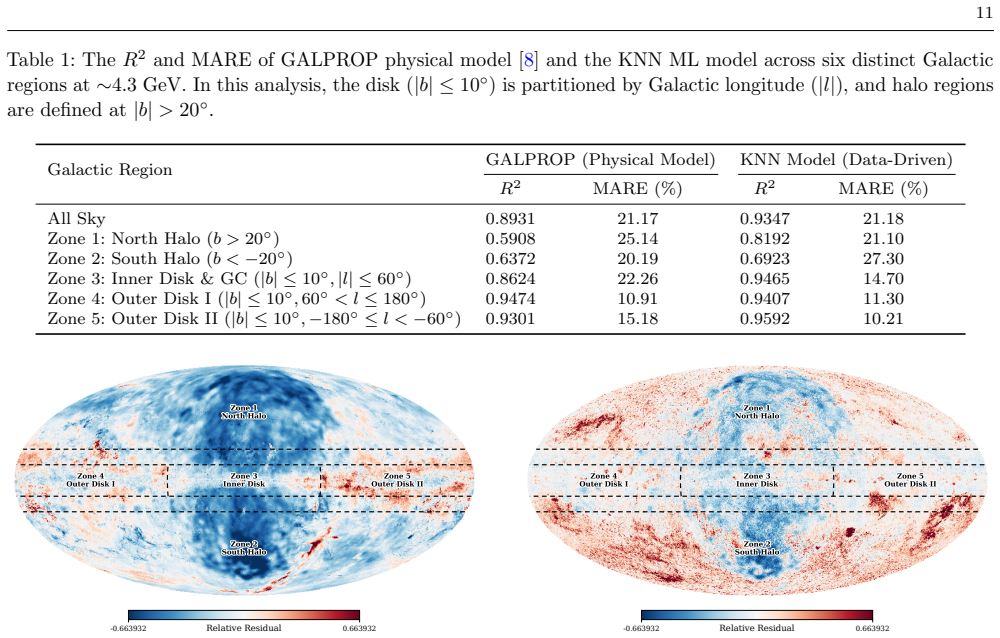
- The machine learning baseline yields R squared of 0.95 and mean absolute relative error of 14.7 percent in the inner Galactic disk and center, outperforming the GALPROP model.
- Coherent residuals in Loop I and III mark specific regions where standard interstellar emission models are incomplete or biased.
- The frequency-dependent predictors supply new empirical constraints on cosmic-ray propagation and interstellar medium structure.
- Machine learning provides a data-driven method to isolate non-standard emission components in multi-messenger data.
Where Pith is reading between the lines
- The same mapping technique could be applied to regions with sparse gamma-ray coverage to generate testable predictions for future observations.
- Targeted high-resolution radio surveys at the dominant frequencies could tighten constraints on hadronic versus leptonic contributions.
- If the learned relations prove stable, they offer a template for cross-checking emission models in external galaxies with comparable multi-wavelength data.
Load-bearing premise
The nonlinear mapping learned by the model captures a direct physical link between radio and gamma-ray processes instead of indirect correlations from large-scale structures or data selection effects.
What would settle it
Retraining the model after removing all high-frequency radio bands and checking whether accuracy drops sharply only for 0.1-10 GeV predictions while low-frequency removal affects only energies above 10 GeV would test the claimed frequency-specific physical connections.
Figures
read the original abstract
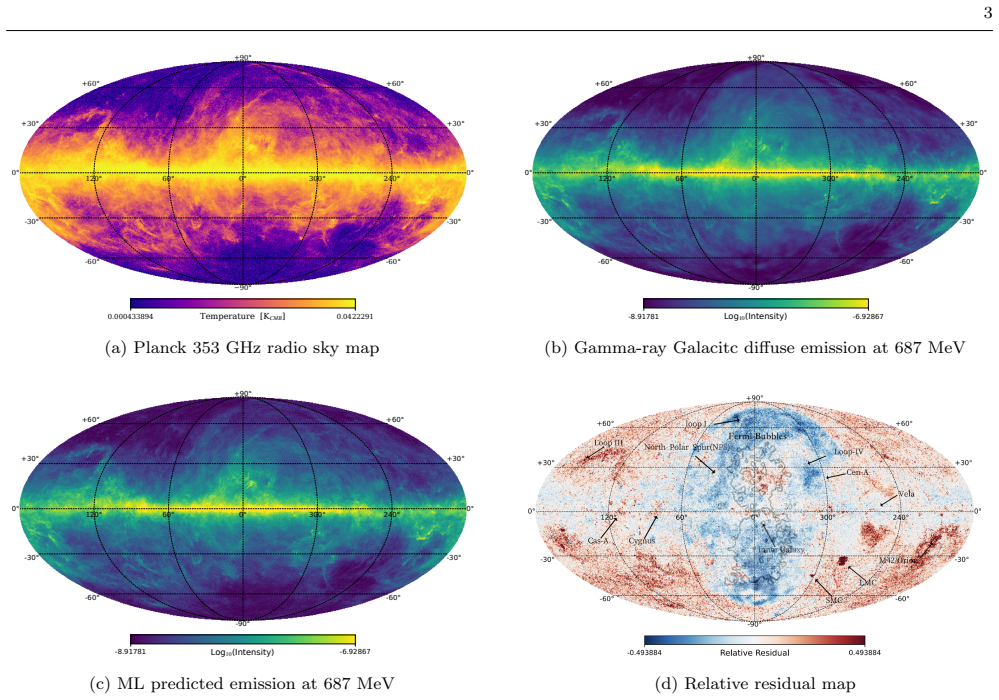
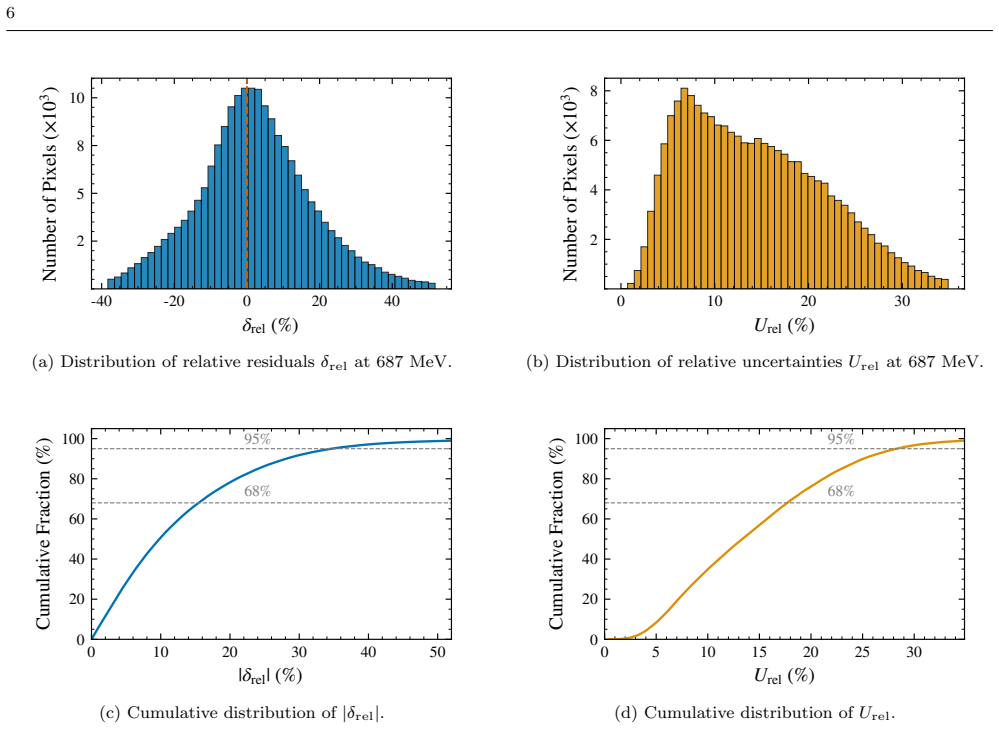
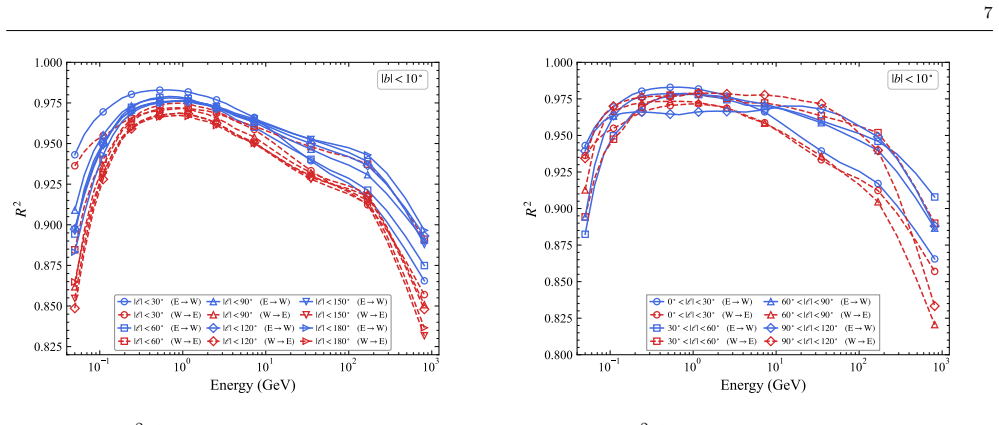
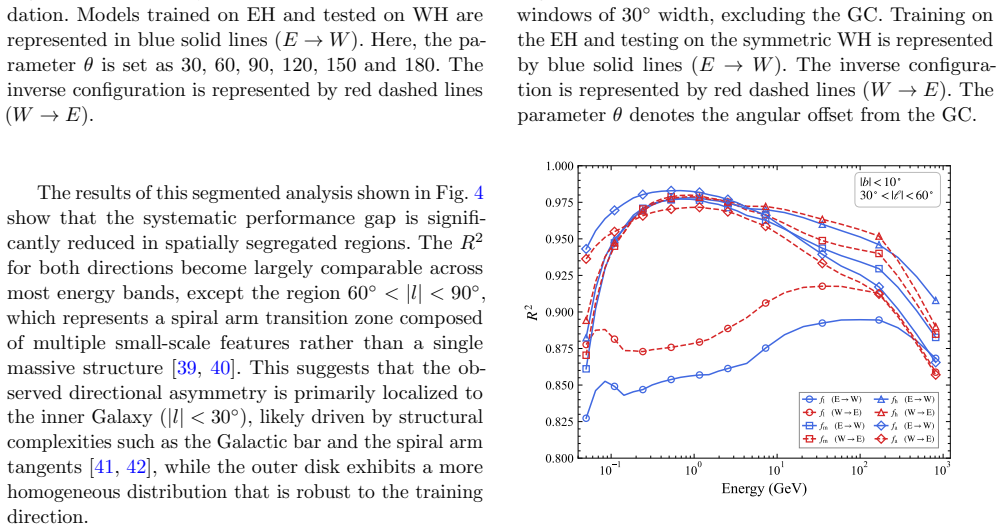
We present a data-driven investigation of Galactic diffuse emission. Using multi-frequency Planck radio/microwave maps (30-857 GHz) and Fermi-LAT gamma-ray data (50 MeV-814 GeV), we construct a nonlinear mapping between radio emission and gamma-ray intensity through supervised machine learning. Our models achieve high predictive accuracy (R^2 > 0.90 in the 0.1-10 GeV range), demonstrating that multi-frequency radio observations encode sufficient information to reconstruct both spatial morphology and spectral properties of diffuse gamma-ray emission. By analyzing model performance across different frequency bands and spatial regions, we identify high-frequency radio bands as the dominant predictor, providing direct empirical support for the hadronic origin of Galactic 0.1-10 GeV gamma rays, while low-frequency radio bands for the leptonic origin above 10 GeV. Residual maps reveal coherent large-scale structures, including Loop I and III, highlighting regions where standard interstellar emission models are incomplete or biased. Compared with the GALPROP model, our machine learning approach yields a higher R^2=0.95 and lower mean absolute relative error (14.7%) in the inner Galactic disk and the Galactic center region. Our results illustrate that machine learning serves as a physically interpretable tool for multi-messenger astrophysics, providing a data-driven baseline for separating non-standard emission components and deriving new constraints on cosmic-ray propagation and interstellar medium structure.
Editorial analysis
A structured set of objections, weighed in public.
Referee Report
Summary. The paper applies supervised machine learning to construct a nonlinear mapping from multi-frequency Planck radio/microwave maps (30-857 GHz) to Fermi-LAT gamma-ray intensity (50 MeV-814 GeV). It reports R² > 0.90 (peaking at 0.95 in the inner disk), identifies high-frequency bands as dominant predictors for 0.1-10 GeV emission (interpreted as hadronic) and low-frequency bands for >10 GeV (leptonic), shows coherent residuals including Loop I/III, and claims superior performance to GALPROP in the inner Galaxy.
Significance. If the frequency-specific attributions survive controls for shared morphology, the work would supply a reproducible, data-driven baseline for diffuse emission modeling that could tighten constraints on cosmic-ray propagation and highlight regions where standard interstellar emission models are incomplete. The explicit comparison to GALPROP and the residual maps are concrete strengths.
major comments (2)
- [Results (frequency importance and physical interpretation)] Results section on frequency-band analysis: the claim that high-frequency radio bands provide 'direct empirical support' for hadronic origin of 0.1-10 GeV gamma rays (and low-frequency for leptonic >10 GeV) is load-bearing for the central physical interpretation, yet the manuscript provides no spatial-only baseline, frequency-shuffled ablation, or morphology-matched control that would distinguish physical emission-mechanism links from the model simply learning the common large-scale Galactic disk, center, and Loop structures present in all input maps.
- [Methods] Methods section: no description is given of the training/validation split strategy, the precise feature-importance technique used to rank frequency bands, the spatial masking procedure, or how uncertainties are propagated from the radio maps into the gamma-ray predictions; without these, the reported R² values and band attributions cannot be assessed for robustness against overfitting or selection effects.
minor comments (1)
- [Abstract and Results] Abstract and results: the statement 'R²=0.95 and lower mean absolute relative error (14.7%) in the inner Galactic disk' should specify the exact spatial mask and energy bin used for this comparison to GALPROP.
Simulated Author's Rebuttal
We thank the referee for the constructive report and the recommendation for major revision. We agree that the physical interpretation requires stronger controls and that the Methods section must be expanded for reproducibility. We address each major comment below and will incorporate the requested additions in the revised manuscript.
read point-by-point responses
-
Referee: Results section on frequency-band analysis: the claim that high-frequency radio bands provide 'direct empirical support' for hadronic origin of 0.1-10 GeV gamma rays (and low-frequency for leptonic >10 GeV) is load-bearing for the central physical interpretation, yet the manuscript provides no spatial-only baseline, frequency-shuffled ablation, or morphology-matched control that would distinguish physical emission-mechanism links from the model simply learning the common large-scale Galactic disk, center, and Loop structures present in all input maps.
Authors: We agree that the current evidence for the frequency-specific physical attributions is not yet conclusive without controls that isolate frequency information from shared morphology. In the revised manuscript we will add (i) a spatial-only baseline that uses only Galactic coordinates as input, (ii) a frequency-shuffled ablation in which band labels are randomly permuted while preserving spatial structure, and (iii) a morphology-matched control constructed by matching the power spectrum and spatial correlation functions of the radio maps. These tests will quantify the incremental predictive power attributable to the actual frequency dependence and will either strengthen or qualify the hadronic/leptonic interpretation. revision: yes
-
Referee: Methods section: no description is given of the training/validation split strategy, the precise feature-importance technique used to rank frequency bands, the spatial masking procedure, or how uncertainties are propagated from the radio maps into the gamma-ray predictions; without these, the reported R² values and band attributions cannot be assessed for robustness against overfitting or selection effects.
Authors: We acknowledge the omission. The revised Methods section will explicitly describe: (1) the training/validation split (80/20 random spatial sampling with a 5° buffer to avoid leakage between adjacent pixels), (2) the feature-importance method (permutation importance computed on the held-out validation set, supplemented by SHAP values for the final model), (3) the spatial masking (removal of |b|<2° plane, known point sources from the 4FGL catalog, and pixels with radio S/N < 3), and (4) uncertainty propagation (Monte-Carlo sampling of the Planck map covariance matrices through the trained model to obtain prediction uncertainties). These details will allow quantitative assessment of overfitting and selection bias. revision: yes
Circularity Check
No significant circularity; derivation is self-contained
full rationale
The paper trains a supervised ML regressor on Planck radio maps (30-857 GHz) to predict Fermi-LAT gamma-ray intensity, reports independent performance metrics (R^2 > 0.90), and performs post-hoc analysis of band importance to interpret hadronic/leptonic origins. This chain does not reduce any claimed result to its inputs by construction: the predictive accuracy is evaluated separately from the frequency-ranking step, no equations equate a fitted quantity back to itself, and the provided text contains no self-citations, uniqueness theorems, or ansatzes that bear the central claim. The physical interpretation is an inference from model behavior rather than a tautological renaming or self-definition.
Axiom & Free-Parameter Ledger
axioms (1)
- domain assumption Radio synchrotron and gamma-ray emission are produced by the same cosmic-ray electron and proton populations interacting with the same interstellar medium.
Reference graph
Works this paper leans on
-
[1]
Planck Collaboration, R. Adam, P. A. R. Ade, et al. Planck 2015 results. X. Diffuse component separa- tion: Foreground maps.Astronomy & Astrophysics, 594:A10, 2016. doi: 10.1051/0004-6361/201525967
-
[2]
A. W. Strong, I. V. Moskalenko, and V. S. Ptuskin. Cosmic-ray propagation and interactions in the galaxy.Annual Review of Nuclear and Particle Science, 57:285–327, 2007. doi: 10.1146/annurev. nucl.57.090506.123011
-
[3]
2016, ApJS, 223, 26, doi: 10.3847/0067-0049/223/2/26
F. Acero, M. Ackermann, M. Ajello, et al. Devel- opment of the Model of Galactic Interstellar Emis- sion for Standard Point-Source Analysis of Fermi Large Area Telescope Data.The Astrophysical Journal Supplement Series, 223(2):26, 2016. doi: 10.3847/0067-0049/223/2/26
-
[4]
I. A. Grenier, J. H. Black, and A. W. Strong. The nine lives of cosmic rays in galaxies.Annual Review of Astronomy and Astrophysics, 53:199–246, 2015. doi: 10.1146/annurev-astro-082214-122457
-
[5]
Yi-Qing Guo and Qiang Yuan. Understanding the spectral hardenings and radial distribution of galactic cosmic rays and fermi diffuse γ-rays with spatially-dependent propagation.Physical Review D, 97:063008, 2018. doi: 10.1103/PhysRevD.97.063008
-
[6]
D. Gaggero, A. Urbano, M. Valli, and P. Ullio. Gamma-ray sky points to radial gradients in cosmic- ray transport.Physical Review D, 91:083012, 2015. doi: 10.1103/PhysRevD.91.083012
-
[7]
Orlando and A
E. Orlando and A. Strong. Galactic synchrotron emission with cosmic ray propagation models.As- tronomy & Astrophysics, 571:A51, 2013. doi: 10. 1051/0004-6361/201321697
2013
-
[8]
Multimes- senger study of the Galactic diffuse emission with LHAASO and IceCube observations.Phys
Chengyu Shao, Sujie Lin, and Lili Yang. Multimes- senger study of the Galactic diffuse emission with LHAASO and IceCube observations.Phys. Rev. D, 108(6):L061305, 2023. doi: 10.1103/PhysRevD.108. L061305
-
[9]
R. Abbasi et al. Observation of high-energy neu- trinos from the Galactic plane.Science, 380(6652): adc9818, 2023. doi: 10.1126/science.adc9818
-
[10]
E. D. Feigelson et al. Statistics and data min- ing in astronomy.Annual Review of Statistics and Its Application, 6:493–518, 2019. doi: 10.1146/ annurev-statistics-030718-105207
2019
-
[11]
K. M. Smith, T. Eifler, et al. Machine learning and the physical sciences.Reviews of Modern Physics, 92(4):045002, 2020. doi: 10.1103/RevModPhys.92. 045002
-
[12]
N. M. Ball and R. J. Brunner. Data mining and ma- chine learning in astronomy.International Journal of Modern Physics D, 19(7):1049–1106, 2010. doi: 10.1142/S0218271810017160
-
[13]
P. Dubath, L. Rimoldini, M. S¨ uveges, et al. Random forest-based supervised classification of hipparcos variable stars.Monthly Notices of the Royal As- tronomical Society, 414(3):2602–2617, 2011. doi: 10.1111/j.1365-2966.2011.18575.x
-
[14]
Hybrid deep learn- ing for blazar classification and correlation search with neutrinos.Mon
Jiacheng Ding, Yunlei Huang, Xiao-Dong Li, Xin Wang, Yang Wang, and Lili Yang. Hybrid deep learn- ing for blazar classification and correlation search with neutrinos.Mon. Not. Roy. Astron. Soc., 523 (3):4120–4135, 2023. doi: 10.1093/mnras/stad1683
-
[15]
Ntampaka et al
M. Ntampaka et al. Machine learning in astronomy: A practical overview.Bulletin of the AAS, 51(3),
-
[16]
doi: 10.48550/arXiv.1904.07248
work page internal anchor Pith review Pith/arXiv arXiv doi:10.48550/arxiv.1904.07248 1904
-
[17]
2020, , 641, A1, 10.1051/0004-6361/201833880
Planck Collaboration, N. Aghanim, Y. Akrami, et al. Planck 2018 results. I. Overview and the cosmolog- ical legacy of Planck.Astronomy & Astrophysics, 641:A1, 2020. doi: 10.1051/0004-6361/201833880
-
[18]
Leo Breiman. Random forests.Machine Learning, 45(1):5–32, 2001. doi: 10.1023/A:1010933404324
-
[19]
Nearest neigh- bor pattern classification.IEEE Transactions on Information Theory, 13(1):21–27, 1967
Thomas Cover and Peter Hart. Nearest neigh- bor pattern classification.IEEE Transactions on Information Theory, 13(1):21–27, 1967. doi: 10.1109/TIT.1967.1053964
-
[20]
J. T. VanderPlas et al. Astroml: Machine learning and data mining for astronomy.The Astrophysical Journal Supplement Series, 236(1):16, 2018. doi: 10.3847/1538-4365/aab76b
-
[21]
D. Baron. Machine learning in astronomy: a practi- cal overview.arXiv e-prints, 2019
2019
-
[23]
Zhen Cao et al. Measurement of Ultra-High- Energy Diffuse Gamma-Ray Emission of the Galac- tic Plane from 10 TeV to 1 PeV with LHAASO- KM2A.Phys. Rev. Lett., 131(15):151001, 2023. doi: 10.1103/PhysRevLett.131.151001
-
[24]
Galactic Interstel- lar Emission Model for the 4FGL Catalog Analysis
The Fermi-LAT Collaboration. Galactic Interstel- lar Emission Model for the 4FGL Catalog Analysis. 13 Fermi-lat technical note, NASA Fermi Science Sup- port Center, 2019. Access: 2026-01-05
2019
-
[25]
Planck Collaboration, R. Adam, P. A. R. Ade, et al. Planck 2015 results. VIII. High Frequency In- strument data processing: Calibration and maps. Astronomy & Astrophysics, 594:A8, 2016. doi: 10.1051/0004-6361/201525820
-
[26]
Aghanim, Y
Planck Collaboration, N. Aghanim, Y. Akrami, et al. Planck 2018 results. V. CMB power spectra and likelihoods.Astronomy & Astrophysics, 641:A5,
2018
-
[27]
doi: 10.1051/0004-6361/201936386
-
[28]
W. B. Atwood, A. A. Abdo, M. Ackermann, et al. The large area telescope on the fermi gamma-ray space telescope mission.The Astrophysical Journal, 697(2):1071–1102, 2009. doi: 10.1088/0004-637X/ 697/2/1071
-
[29]
Abdollahi, F
S. Abdollahi, F. Acero, M. Ackermann, et al. Fermi large area telescope fourth source catalog.The Astrophysical Journal Supplement Series, 247(1):33,
-
[30]
doi: 10.3847/1538-4365/ab6bcb
-
[31]
A. W. Strong, E. Orlando, and T. R. Jaffe. The interstellar cosmic-ray electron spectrum from syn- chrotron radiation and direct measurements.As- tronomy & Astrophysics, 534:A54, 2011
2011
-
[32]
M. Ackermann et al. The Fermi Galactic Center GeV Excess and Implications for Dark Matter.As- trophys. J., 840(1):43, 2017. doi: 10.3847/1538-4357/ aa6cab
-
[33]
Pedregosa, G
F. Pedregosa, G. Varoquaux, A. Gramfort, et al. Scikit-learn: Machine learning in python.Journal of Machine Learning Research, 12:2825–2830, 2011
2011
-
[34]
Ivezi´ c, A
ˇZ. Ivezi´ c, A. J. Connolly, J. T. VanderPlas, and A. Gray.Statistics, Data Mining, and Machine Learning in Astronomy. Princeton University Press, 2014
2014
-
[35]
Chai and R
T. Chai and R. R. Draxler. Root mean square error (rmse) or mean absolute error (mae)? – arguments against avoiding rmse in the literature.Geoscientific Model Development, 7(3):1247–1250, 2014. doi: 10. 5194/gmd-7-1247-2014
2014
-
[36]
C. J. Willmott and K. Matsuura. Advantages of the mean absolute error (mae) over the root mean square error (rmse) in assessing average model per- formance.Climate Research, 30(1):79–82, 2005. doi: 10.3354/cr030079
-
[37]
Springer, 2nd edition, 2009
Trevor Hastie, Robert Tibshirani, and Jerome Fried- man.The Elements of Statistical Learning: Data Mining, Inference, and Prediction. Springer, 2nd edition, 2009
2009
-
[38]
Blaauw, C
A. Blaauw, C. S. Gum, J. L. Pawsey, and G. Wester- hout. The new i.a.u. system of galactic coordinates (1958 revision).Monthly Notices of the Royal As- tronomical Society, 121(2):123–131, 1960. doi: 10. 1093/mnras/121.2.123. URL https://ui.adsabs. harvard.edu/abs/1960MNRAS.121..123B
1958
-
[39]
C. L. Carilli and S. Rawlings. Science with the square kilometre array.New Astronomy Reviews, 48:979–984, 2004. doi: 10.1016/j.newar.2004.09.001
-
[40]
A. A. Abdo et al. Fermi Large Area Telescope Measurements of the Diffuse Gamma-Ray Emission at Intermediate Galactic Latitudes.Phys. Rev. Lett., 103:251101, 2009. doi: 10.1103/PhysRevLett.103. 251101
-
[41]
M. Su, T. R. Slatyer, and D. P. Finkbeiner. Giant gamma-ray bubbles from fermi-lat: Active galactic nucleus activity or bipolar galactic wind?The As- trophysical Journal, 724(2):1044–1082, 2010. doi: 10.1088/0004-637X/724/2/1044
-
[42]
M. J. Reid et al. Trigonometric Parallaxes of High Mass Star Forming Regions: the Structure and Kine- matics of the Milky Way.Astrophys. J., 783:130,
-
[43]
doi: 10.1088/0004-637X/783/2/130
-
[44]
The Galaxy in Context: Structural, Kinematic, and Integrated Properties.Ann
Joss Bland-Hawthorn and Ortwin Gerhard. The Galaxy in Context: Structural, Kinematic, and Integrated Properties.Ann. Rev. Astron. As- trophys., 54(1):529–596, 2016. doi: 10.1146/ annurev-astro-081915-023441
2016
-
[45]
Robert A. Benjamin, E. Churchwell, Brian L. Babler, et al. First GLIMPSE Results on the Stellar Struc- ture of the Galaxy.The Astrophysical Journal Let- ters, 630(2):L149–L152, 2005. doi: 10.1086/491785
-
[46]
M. J. Reid, K. M. Menten, A. Brunthaler, et al. Trigonometric Parallaxes of High-mass Star-forming Regions: The Structure and Kinematics of the Milky Way.The Astrophysical Journal, 885(2):131, 2019. doi: 10.3847/1538-4357/ab4a11
-
[47]
Draine.Physics of the Interstellar and Intergalactic Medium
Bruce T. Draine.Physics of the Interstellar and Intergalactic Medium. Princeton University Press,
-
[48]
Comprehensive refer- ence on ISM physics
ISBN 978-0691122144. Comprehensive refer- ence on ISM physics
-
[49]
Ackermann, M
M. Ackermann, M. Ajello, L. Baldini, et al. The fermi galactic center gev excess and implications for dark matter.The Astrophysical Journal, 840(1):43,
-
[50]
doi: 10.3847/1538-4357/aa6cab
-
[51]
Large-Scale Features of the Radio Sky and a Model for Loop I.Galaxies, 6:56, 2018
Clive Dickinson. Large-Scale Features of the Radio Sky and a Model for Loop I.Galaxies, 6:56, 2018. doi: 10.3390/galaxies6020056
-
[52]
Lili Yang and Soebur Razzaque. Constraints on very high energy gamma-ray emission from the Fermi Bubbles with future ground-based experi- ments.Phys. Rev. D, 99(8):083007, 2019. doi: 10.1103/PhysRevD.99.083007
discussion (0)
Sign in with ORCID, Apple, or X to comment. Anyone can read and Pith papers without signing in.