Field line slippage rate signatures in nonlinear force-free field extrapolations
Pith reviewed 2026-06-27 06:05 UTC · model grok-4.3
The pith
In NLFFF extrapolations the resistivity-induced slippage rate is governed by cross-field gradients of field-aligned twist.
A machine-rendered reading of the paper's core claim, the machinery that carries it, and where it could break.
Core claim
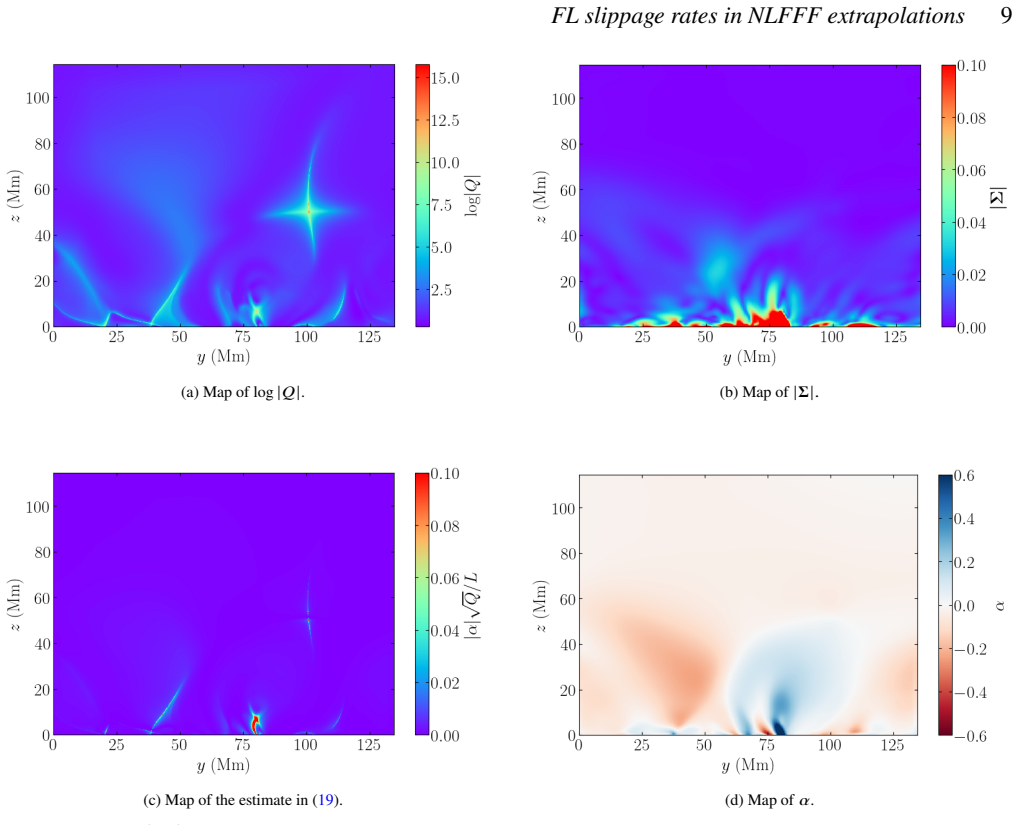
For NLFFFs, the resistivity-induced slippage rate is governed by cross-field gradients of the field-aligned twist, thus establishing a clear connection between current structure and reconnection signatures. By deriving a scaling estimate, we demonstrate that strong magnetic squashing amplifies slippage only insofar as it produces small transverse length scales; large values of Q alone do not guarantee significant reconnection.
What carries the argument
The field line slippage rate, computed from non-ideal terms in Ohm's law, serving as a physics-weighted proxy for three-dimensional reconnection.
If this is right
- Reconnection sites in coronal models can be located by mapping cross-field gradients of field-aligned twist within current-carrying regions.
- QSL analysis using the squashing factor must be supplemented by slippage-rate maps to separate geometric favorability from physically significant reconnection.
- Sequences of NLFFF extrapolations can track time-evolving reconnection activity linked to flare phases in active regions.
- The slippage rate supplies a direct link between observed current structure and the locations where non-ideal evolution is active.
Where Pith is reading between the lines
- The same twist-gradient relation could be tested in time-dependent MHD simulations to check whether the NLFFF assumption alters the scaling.
- Overlaying slippage-rate maps on observed flare ribbons or EUV brightenings might reveal which geometric QSLs actually participate in energy release.
- If the relation holds, twist-gradient maps could be computed from routine vector magnetograms to flag reconnection-prone volumes before flares occur.
Load-bearing premise
The NLFFF extrapolations accurately capture the cross-field gradients of twist that control the slippage rate, without significant contamination from the force-free assumption or the resistivity model.
What would settle it
A direct computation in an NLFFF model where regions of large cross-field twist gradients show no corresponding slippage rate, or where high slippage occurs without such gradients, would falsify the claimed governance.
Figures
read the original abstract
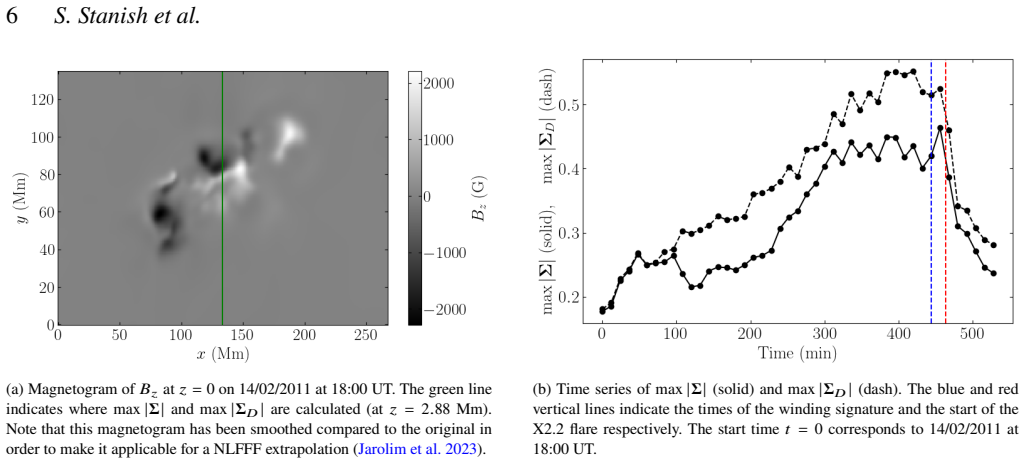
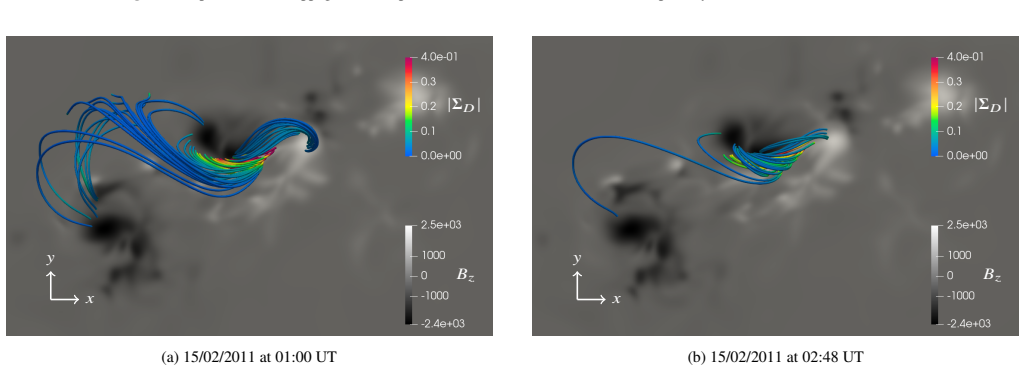
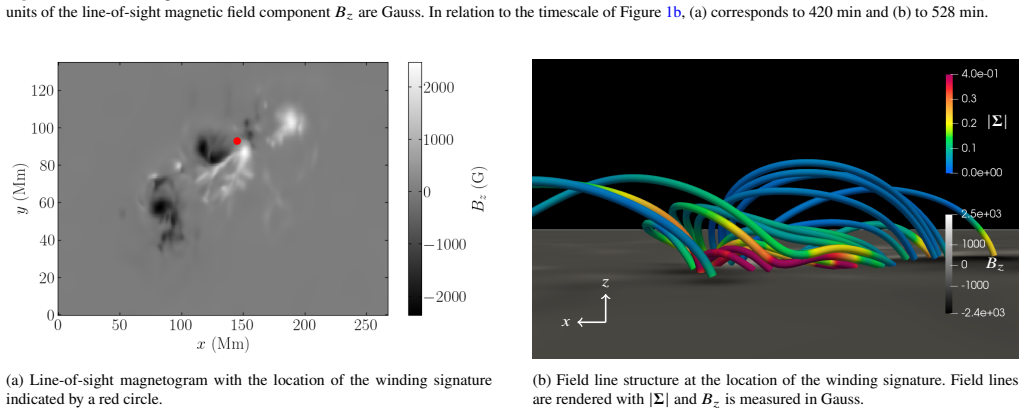
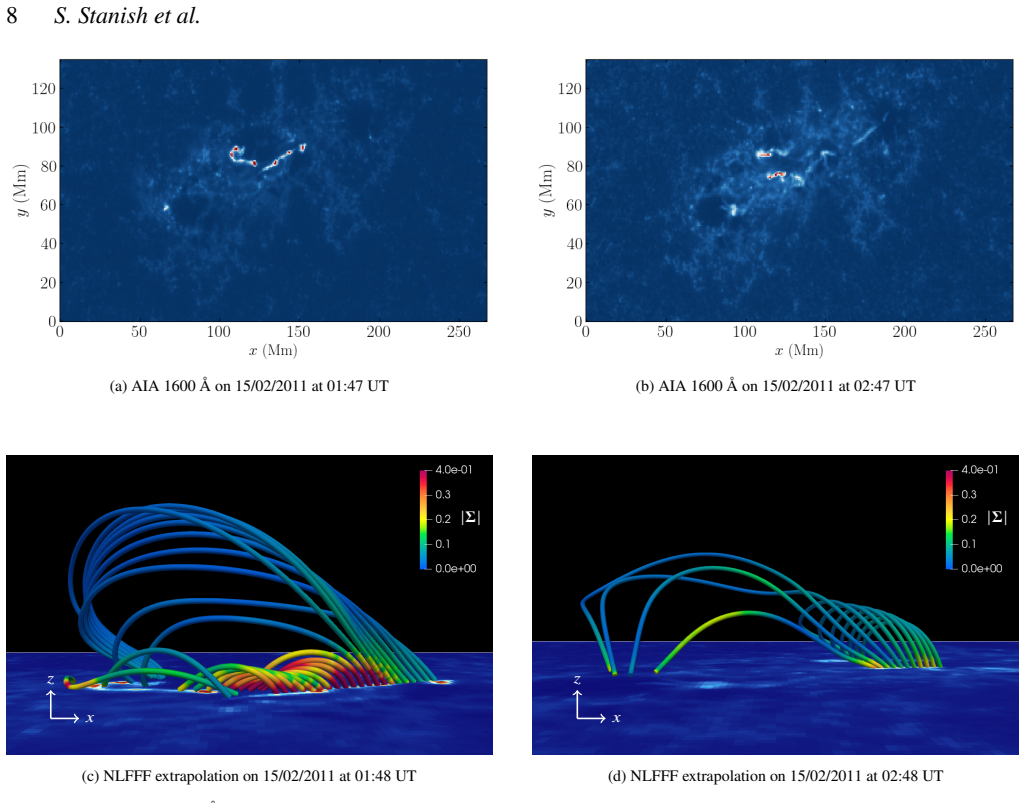
Magnetic reconnection plays a central role in solar flares and coronal mass ejections. Identifying where reconnection is physically active within coronal magnetic field models is a key part of magnetic field analysis. We investigate the field line slippage rate as a physics-weighted proxy for three-dimensional reconnection in nonlinear force-free field (NLFFF) extrapolations. The slippage rate measures the instantaneous deviation of magnetic field lines from ideal evolution, due to non-ideal terms in Ohm's law, providing a direct link between magnetic geometry and reconnection physics. For NLFFFs, we show that the resistivity-induced slippage rate is governed by cross-field gradients of the field-aligned twist, thus establishing a clear connection between current structure and reconnection signatures. We further examine its relationship to the squashing factor $Q$, used to identify quasi-separatrix layers (QSLs). By deriving a scaling estimate, we demonstrate that strong magnetic squashing amplifies slippage only insofar as it produces small transverse length scales; large values of $Q$ alone do not guarantee significant reconnection. We apply this framework to a sequence of NLFFF extrapolations of NOAA active region 11158 spanning the X2.2 flare of 15 February 2011. The slippage rate reveals enhanced reconnection signatures associated with distinct phases of the active region's evolution. In comparison with the squashing factor, we show that the field line slippage rate provides a physics-weighted complement to QSL analysis, distinguishing between regions that are geometrically favourable for reconnection and those where reconnection is physically significant.
Editorial analysis
A structured set of objections, weighed in public.
Referee Report
Summary. The manuscript derives that in nonlinear force-free field (NLFFF) extrapolations the resistivity-induced field line slippage rate is governed by cross-field gradients of the field-aligned twist. It presents a scaling estimate showing that the squashing factor Q amplifies the slippage rate only when it corresponds to sufficiently small transverse length scales. The framework is applied to a time series of NLFFF models of NOAA AR 11158 around the 15 February 2011 X2.2 flare, identifying enhanced reconnection signatures across distinct evolutionary phases and arguing that the slippage rate supplies a physics-weighted complement to QSL analysis.
Significance. If the derivation is rigorous and the NLFFF fields preserve the controlling gradients, the work supplies a direct physical proxy linking current structure to reconnection activity in coronal extrapolations. The scaling clarifies why large Q alone is insufficient for significant reconnection. The application to AR 11158 demonstrates utility for flare analysis. Credit is due for the explicit derivation and the scaling estimate that avoids over-interpreting geometric QSL diagnostics.
major comments (3)
- [§3] §3 (derivation of slippage rate): the central relation between resistivity-induced slippage and cross-field twist gradients is derived under the force-free assumption, but the manuscript does not quantify how the NLFFF optimization (minimization of ∫|J×B|^2 and |∇·B|^2 subject to photospheric boundaries) distorts or smooths those perpendicular gradients relative to a non-force-free field; this directly affects whether the proxy remains valid for the AR 11158 models.
- [§5] §5 (application to AR 11158): the reported enhancements in slippage rate during pre-flare, impulsive, and decay phases are presented without sensitivity tests to the resistivity model or to variations in the NLFFF boundary conditions and regularization; without such tests it is unclear whether the differences from Q are physically meaningful or arise from extrapolation artifacts.
- [Scaling estimate] Scaling estimate (near Eq. relating slippage to Q): the estimate is derived but not validated against an analytic reconnection solution or an MHD simulation with known reconnection rate; this leaves the regime of applicability and any proportionality constants untested, which is load-bearing for the claim that large Q does not guarantee significant reconnection.
minor comments (2)
- [Figures 5-7] Figure captions for the AR 11158 maps do not state the exact resistivity value or the normalization used for the slippage rate, hindering direct comparison with other studies.
- [§2] The notation for field-aligned twist is introduced without an explicit reference to its relation to the force-free parameter α = (∇×B)·B / B², which would aid readers familiar with standard NLFFF literature.
Simulated Author's Rebuttal
We thank the referee for the positive evaluation of our manuscript and for the constructive comments. We address each of the major comments below and indicate the revisions we plan to make.
read point-by-point responses
-
Referee: §3 (derivation of slippage rate): the central relation between resistivity-induced slippage and cross-field twist gradients is derived under the force-free assumption, but the manuscript does not quantify how the NLFFF optimization (minimization of ∫|J×B|^2 and |∇·B|^2 subject to photospheric boundaries) distorts or smooths those perpendicular gradients relative to a non-force-free field; this directly affects whether the proxy remains valid for the AR 11158 models.
Authors: The derivation is performed within the force-free framework, and since the NLFFF models are constructed to satisfy the force-free condition to a high degree, the relation holds for the extrapolated fields. The optimization does involve regularization that can affect small-scale gradients, but this is a general limitation of NLFFF methods rather than specific to our proxy. We will revise §3 to include a discussion of this point and note that the proxy is applicable to the extent that the NLFFF solution accurately represents the coronal field. revision: yes
-
Referee: §5 (application to AR 11158): the reported enhancements in slippage rate during pre-flare, impulsive, and decay phases are presented without sensitivity tests to the resistivity model or to variations in the NLFFF boundary conditions and regularization; without such tests it is unclear whether the differences from Q are physically meaningful or arise from extrapolation artifacts.
Authors: We agree that additional sensitivity tests would be beneficial. In the revised version, we will perform and report tests using different resistivity values and alternative NLFFF extrapolations with varied boundary conditions to confirm the robustness of the identified enhancements in slippage rate. revision: yes
-
Referee: Scaling estimate (near Eq. relating slippage to Q): the estimate is derived but not validated against an analytic reconnection solution or an MHD simulation with known reconnection rate; this leaves the regime of applicability and any proportionality constants untested, which is load-bearing for the claim that large Q does not guarantee significant reconnection.
Authors: The scaling estimate is derived from the slippage rate expression and the definition of Q, providing an analytic insight into the role of transverse scales. While direct validation against specific reconnection solutions is not included in the current work, the estimate is general and does not rely on untested assumptions beyond the derivations. We will add a statement clarifying the analytic nature of the estimate and suggesting numerical validation as future work. revision: partial
Circularity Check
Derivation of slippage rate from twist gradients is mathematically independent
full rationale
The central derivation states that the resistivity-induced slippage rate in NLFFFs is governed by cross-field gradients of field-aligned twist. This follows directly from the non-ideal Ohm's law and the definition of field-line slippage without any fitted parameters, self-referential definitions, or load-bearing self-citations. The subsequent scaling with Q is an estimate derived from transverse length scales, not a renaming or tautology. Application to AR 11158 uses the extrapolated fields as input but does not redefine or fit the slippage rate to match observed reconnection; the result remains a general relation applied to model output. No step reduces to its own inputs by construction.
Axiom & Free-Parameter Ledger
axioms (2)
- domain assumption The coronal magnetic field can be represented by a nonlinear force-free extrapolation that satisfies the force-free condition everywhere.
- domain assumption Resistivity is the dominant non-ideal term that produces field-line slippage in the corona.
Reference graph
Works this paper leans on
-
[1]
Living Reviews in Solar Physics , year =
Wiegelmann, Thomas and Sakurai, Takashi , title =. Living Reviews in Solar Physics , year =. doi:10.1007/s41116-020-00027-4 , url =
-
[2]
Wheatland, M. S. and Sturrock, P. A. and Roumeliotis, G. , title =. Astrophysical Journal , year =
-
[3]
, title =
Wiegelmann, T. , title =. Solar Physics , year =
-
[4]
and Magara, T
Inoue, S. and Magara, T. and Pandey, V. S. et al. , title =. Astrophysical Journal , year =
-
[5]
and Boulmezaoud, T
Amari, T. and Boulmezaoud, T. Z. and Aly, J. J. , title =. Astronomy and Astrophysics , year =
-
[6]
Valori, G. and Kliem, B. and Keppens, R. , title =. Astronomy and Astrophysics , year =. doi:10.1051/0004-6361:20066708 , adsurl =
-
[7]
Yan, Y. and Li, Z. , title =. Astrophysical Journal , year =. doi:10.1086/498673 , adsurl =
-
[8]
Jarolim, Robert and Thalmann, Julia K. and Veronig, Astrid M. and Podladchikova, Tatiana , title =. Nature Astronomy , year =. doi:10.1038/s41550-023-02030-9 , adsurl =
-
[9]
Priest, E. R. and Bungey, T. N. and Titov, V. S. , title =. Astrophysical Journal , year =. doi:10.1086/303530 , adsurl =
-
[10]
Longcope, D. W. , title =. Living Reviews in Solar Physics , year =. doi:10.12942/lrsp-2005-7 , adsurl =
-
[11]
Guo, J. and Wang, H. and Wang, J. and Zhu, X. and Dai, X. and Huang, X. and He, H. and Yan, Y. and Zhao, H. , title =. Astrophysical Journal , year =. doi:10.3847/1538-4357/ab0aed , adsurl =
-
[12]
Priest, E. R. and D. Three-dimensional magnetic reconnection without null points , journal =. 1995 , volume =
1995
-
[13]
Titov, V. S. and D. Quasi-separatrix layers: Refined theory and its application to solar flares , journal =. 1999 , volume =
1999
-
[14]
Titov, V. S. and Hornig, G. and D. Theory of magnetic connectivity in the solar corona , journal =. 2002 , volume =. doi:10.1029/2001JA000278 , adsurl =
-
[15]
Aulanier, G. and D. Equilibrium and dynamical properties of QSLs , journal =. 2005 , volume =
2005
-
[16]
Titov, V. S. and Forbes, T. G. and Priest, E. R. and Mikic, Z. and Linker, J. A. , title =. Astrophysical Journal , year =
-
[17]
Janvier, M. and D. From coronal QSLs to flare ribbons , journal =. 2013 , volume =
2013
-
[18]
Quasi-separatrix layers in solar flares: I
D. Quasi-separatrix layers in solar flares: I. Method , journal =. 1996 , volume =
1996
-
[19]
Masson, S. and Pariat, E. and Aulanier, G. and Schrijver, C. J. , title =. Astrophysical Journal , year =. doi:10.1088/0004-637X/700/1/559 , adsurl =
-
[20]
and van Ballegooijen, Adriaan A
Savcheva, Antonia and Green, Lucie M. and van Ballegooijen, Adriaan A. and DeLuca, Edward E. , title =. Astrophysical Journal , year =. doi:10.1088/0004-637X/759/2/105 , adsurl =
-
[21]
Berger, Mitchell A. and Prior, Chris , title =. Journal of Physics A: Mathematical and General , year =. doi:10.1088/0305-4470/39/26/005 , adsurl =
-
[22]
MacTaggart, David , title =. Solar Physics , year =. doi:10.1007/s11207-025-02462-8 , adsurl =
-
[23]
Eyink, Gregory L. , title =. Astrophysical Journal , year =. doi:10.1088/0004-637X/807/2/137 , adsurl =
-
[24]
Li, Ting and Priest, Eric R. and Guo, Ruilong , title =. Proceedings of the Royal Society A , year =. doi:10.1098/rspa.2020.0949 , adsurl =
-
[25]
Pontin, David I. and Priest, Eric R. , title =. Living Reviews in Solar Physics , year =. doi:10.1007/s41116-022-00032-9 , adsurl =
-
[26]
Axford, W. I. , title =. Magnetic Reconnection in Space and Laboratory Plasmas , editor =. 1984 , doi =
1984
-
[27]
Aslanyan, Valentin and Scott, Roger B. and Wilkins, Chloe P. and Meyer, Karen A. and Pontin, David I. and Yeates, Anthony R. , title =. Astrophysical Journal , year =. doi:10.3847/1538-4357/ad55ca , adsurl =
-
[28]
Titov, V. S. and D. Basic topology of twisted magnetic configurations in solar flares , journal =. 1999 , volume =
1999
-
[29]
The Astrophysical Journal , year =
Franci, Luca and Papini, Emanuele and Micera, Alfredo and Lapenta, Giovanni and Hellinger, Petr and Del Sarto, Daniele and Burgess, David and Landi, Simone , title =. The Astrophysical Journal , year =. doi:10.3847/1538-4357/ac7da6 , url =
-
[30]
Journal of Plasma Physics , year =
Stanish, Sage and MacTaggart, David , title =. Journal of Plasma Physics , year =. doi:10.1017/S0022377825000261 , publisher =
-
[31]
Agarwal, Satyam and Bhattacharyya, Ramit , title =. Physics of Plasmas , year =. doi:10.1063/5.0206697 , url =
-
[32]
Proceedings of the Royal Society A , year =
Prior, Christopher and MacTaggart, David , title =. Proceedings of the Royal Society A , year =
-
[33]
Slip-Running Reconnection in Quasi-Separatrix Layers , journal =
Aulanier, Guillaume and Pariat, Etienne and D. Slip-Running Reconnection in Quasi-Separatrix Layers , journal =. 2006 , volume =
2006
-
[34]
Slipping Magnetic Reconnection during an
Dud. Slipping Magnetic Reconnection during an. The Astrophysical Journal , year =
-
[35]
Observation of Super-Alfv
L. Observation of Super-Alfv. Nature Astronomy , year =
-
[36]
Extending the Concept of Separatrices to Quasi-Separatrix Layers for Magnetic Reconnection , journal =
D. Extending the Concept of Separatrices to Quasi-Separatrix Layers for Magnetic Reconnection , journal =. 2006 , volume =
2006
-
[37]
Titov, V. S. and Priest, E. R. and D. Conditions for the Appearance of ``Bald Patches'' at the Solar Surface , journal =. 1993 , volume =
1993
-
[38]
The Astrophysical Journal , year =
Zhao, Jie and Li, Hui and Pariat, Etienne and Schmieder, Brigitte and Guo, Yang and Wiegelmann, Thomas , title =. The Astrophysical Journal , year =
-
[39]
and Longcope, Dana W
Tarr, Lucas A. and Longcope, Dana W. and Millhouse, Margaret , title =. The Astrophysical Journal , year =
-
[40]
Research in Astronomy and Astrophysics , year =
Song, Qiao and Zhang, Jun and Yang, Shuhong and Liu, Yang , title =. Research in Astronomy and Astrophysics , year =
-
[41]
and Aulanier, Guillaume and Title, Alan M
Schrijver, Carolus J. and Aulanier, Guillaume and Title, Alan M. and Pariat, Etienne and Delann. A Characteristic Magnetic Field Pattern Associated with All Major Solar Flares , journal =. 2011 , volume =
2011
-
[42]
and Lynch, Benjamin J
Kazachenko, Maria D. and Lynch, Benjamin J. and Welsch, Brian T. and Sun, Xudong , title =. The Astrophysical Journal , year =
-
[43]
Aslam, O. P. M. and MacTaggart, David and Williams, Tom and Fletcher, Lyndsay and Romano, Paolo , title =. Monthly Notices of the Royal Astronomical Society , year =
-
[44]
Monthly Notices of the Royal Astronomical Society , year =
Duan, Aiying and Jiang, Chaowei and Feng, Xuesheng , title =. Monthly Notices of the Royal Astronomical Society , year =
-
[45]
Bobra, M. G. and Sun, X. and Hoeksema, J. T. and Turmon, M. and Liu, Y. and Hayashi, K. and Barnes, G. and Leka, K. D. , title =. Solar Physics , year =
-
[46]
The Astrophysical Journal Letters , year =
Wang, Haimin and Liu, Chang and Deng, Na and Wang, Huaning , title =. The Astrophysical Journal Letters , year =
-
[47]
Todd and Liu, Yang and Wiegelmann, Thomas and Hayashi, Keiji and Chen, Qiang and Thalmann, Julia , title =
Sun, Xudong and Hoeksema, J. Todd and Liu, Yang and Wiegelmann, Thomas and Hayashi, Keiji and Chen, Qiang and Thalmann, Julia , title =. The Astrophysical Journal , year =
-
[48]
Todd and Liu, Yang and Kazachenko, Maria and Fisher, George H
Sun, Xudong and Hoeksema, J. Todd and Liu, Yang and Kazachenko, Maria and Fisher, George H. and Welsch, Brian T. , title =. The Astrophysical Journal Letters , year =
-
[49]
and Inhester, Bernd , title =
Wiegelmann, Thomas and Thalmann, Julia K. and Inhester, Bernd , title =. Solar Physics , year =
-
[50]
Electric Currents in Flare Ribbons: Observations and Three-dimensional Standard Model , journal =
Janvier, Miho and Aulanier, Guillaume and Pariat, Etienne and D. Electric Currents in Flare Ribbons: Observations and Three-dimensional Standard Model , journal =. 2014 , volume =
2014
-
[51]
The Astrophysical Journal Letters , year =
Liu, Chang and Deng, Na and Liu, Rui and Wang, Haimin , title =. The Astrophysical Journal Letters , year =
-
[52]
and Title, Alan M
Lemen, James R. and Title, Alan M. and Akin, David J. and Boerner, Paul F. and Chou, Catherine and Drake, Jerry F. and Duncan, Dexter W. and Edwards, Christopher G. and Friedlaender, Frank M. and Heyman, Gary F. and Hurlburt, Neal E. and Katz, Noah L. and Kushner, Gary D. and Levay, Michael and Lindgren, Russell W. and Mathur, Dnyanesh P. and McFeaters, E...
-
[53]
and Dennis, B
Fletcher, L. and Dennis, B. R. and Hudson, H. S. and Krucker, S. and Phillips, K. and Veronig, A. and Battaglia, M. and Bone, L. and Caspi, A. and Chen, Q. and Gallagher, P. and Grigis, P. T. and Ji, H. and Liu, W. and Milligan, R. O. and Temmer, M. , title =. Space Science Reviews , year =
-
[54]
, title =
Newcomb, William A. , title =. Annals of Physics , volume =. 1958 , doi =
1958
-
[55]
MacTaggart, David and Williams, Thomas and Aslam, O. P. M. , title =. Journal of Geophysical Research: Space Physics , volume =. 2025 , doi =
2025
-
[56]
and Schindler, K
Hornig, G. and Schindler, K. , title =. Physics of Plasmas , volume =. 1996 , doi =
1996
-
[57]
1954 , series =
Clifford Truesdell , title =. 1954 , series =
1954
-
[58]
2006 , isbn =
Karl Schindler , title =. 2006 , isbn =
2006
-
[59]
ApJ , fjournal=
Fournier, Paul , title=. ApJ , fjournal=
-
[60]
An important paper , journal=
-
[61]
Another Unreal Paper , journal=
-
[62]
A Last Unreal Paper , journal=
discussion (0)
Sign in with ORCID, Apple, or X to comment. Anyone can read and Pith papers without signing in.