Sub-8-nm resolution AKB-mirror-based hard X-ray ptychography via generalized Wirtinger projections
Pith reviewed 2026-06-27 06:12 UTC · model grok-4.3
The pith
Generalized Wirtinger Projections enables sub-8 nm half-pitch resolution in hard X-ray ptychography with AKB mirrors.
A machine-rendered reading of the paper's core claim, the machinery that carries it, and where it could break.
Core claim
The authors report the first known hard X-ray ptychographic imaging with half-pitch resolution below 8 nm that uses total-reflection AKB mirror nanofocusing optics, achieved by deriving and applying the Generalized Wirtinger Projections algorithm to compensate for partial coherence and other coupled uncertainties that limit resolution.
What carries the argument
Generalized Wirtinger Projections (GWP), a compact reconstruction framework that jointly accounts for multiple coupled uncertainties including partial coherence.
If this is right
- Nearly an order-of-magnitude improvement in GPU memory efficiency during reconstruction.
- Straightforward extension of the same framework to burst ptychography and other modalities.
- Combination of nanometre-scale resolution with achromatic optics for broadband energy-scan 3D spectroscopic imaging.
- Element- or chemical-state specific imaging in complex environments without optics changes.
Where Pith is reading between the lines
- The achromatic property could allow energy-dependent contrast studies on the same sample without realignment.
- The memory savings may make high-resolution ptychography routine on standard laboratory GPUs rather than specialized hardware.
- Similar gains might appear in related coherent imaging techniques that share the same partial-coherence problem.
Load-bearing premise
The Generalized Wirtinger Projections algorithm correctly compensates for partial coherence and other uncertainties without introducing artifacts that would inflate the apparent resolution.
What would settle it
Applying conventional ptychography reconstruction to the identical Siemens star dataset collected at 12.4 keV and measuring a half-pitch resolution no better than 8 nm by the same Fourier ring correlation criterion.
Figures
read the original abstract
Hard X-ray ptychography has become increasingly essential in both the life and physical sciences. However, pushing resolution down to a few nanometres often requires highly customized, chromatic diffractive or refractive X-ray nanofocusing optics, significantly limiting the practical broadband energy-scan applications. Here, we present the first known hard X-ray ptychographic imaging with a half-pitch resolution below 8 nm using total-reflection Advanced Kirkpatrick-Baez (AKB) mirror nanofocusing optics at the high energy photon source (HEPS), with clear potential for further extension. Despite leveraging the benefits of enhanced instrumentation, such as the high coherent flux of 4th-generation diffraction-limited storage rings (DLSR), state-of-the-art beamline X-ray optics and detectors, this is made possible by developing a reconstruction algorithm termed Generalized Wirtinger Projections (GWP). We derive the theory of GWP and experimentally demonstrate its capability for improved partial-coherence reconstruction and enhanced spatial resolution over conventional methods through imaging experiments on a Siemens star test chart at 12.4 keV. GWP provides a highly compact framework for jointly accounting for multiple coupled uncertainties that degrade resolution, enabling straightforward extension to other imaging modalities, such as burst ptychography, while delivering nearly an order-of-magnitude improvement in GPU memory efficiency. Furthermore, the ability to combine nanometre-scale spatial resolution with the inherently achromatic nanofocusing optics demonstrated in this work potentially opens new opportunities for in situ or operando broadband, energy-scan 3D spectroscopic imaging with element- or chemical-state specificity in complex environments at the nanoscale, holding significant promise for a wide range of applications from electronics and energy science to neuroscience.
Editorial analysis
A structured set of objections, weighed in public.
Referee Report
Summary. The manuscript reports the first known experimental demonstration of hard X-ray ptychography achieving sub-8 nm half-pitch resolution on a Siemens star test chart at 12.4 keV, using total-reflection Advanced Kirkpatrick-Baez (AKB) mirror nanofocusing optics at the High Energy Photon Source (HEPS). This is enabled by the Generalized Wirtinger Projections (GWP) algorithm, which jointly accounts for partial coherence and other coupled uncertainties to deliver improved reconstruction and spatial resolution over conventional methods on the same data, while providing nearly an order-of-magnitude gain in GPU memory efficiency and a compact framework extensible to modalities such as burst ptychography. The achromatic nature of the AKB optics is highlighted for enabling broadband energy-scan 3D spectroscopic imaging.
Significance. If the resolution and comparative gains hold, the result is significant because it combines state-of-the-art DLSR coherent flux, AKB mirror optics, and a new reconstruction framework to reach sub-8 nm resolution without chromatic limitations, opening routes to in situ or operando element- or chemical-state-specific imaging at the nanoscale. The paper explicitly credits the GWP derivation for its compactness in handling multiple uncertainties and the nearly order-of-magnitude memory-efficiency improvement, both of which are practical strengths for computational imaging workflows.
Simulated Author's Rebuttal
We thank the referee for their positive assessment of the manuscript, recognition of the experimental demonstration, and recommendation to accept. No major comments were raised that require point-by-point responses.
Circularity Check
No significant circularity detected
full rationale
The provided abstract and description contain no visible equations, derivations, or self-citations that could be inspected for reduction to inputs by construction. The central claim is an experimental demonstration of sub-8 nm resolution using AKB mirrors and the GWP algorithm on Siemens star data at 12.4 keV, presented as a compact extension of existing Wirtinger projections without any load-bearing self-citation chains, fitted parameters renamed as predictions, or ansatz smuggling. The derivation is therefore self-contained against external benchmarks, with the resolution gain attributed to joint accounting for uncertainties rather than any definitional loop.
Axiom & Free-Parameter Ledger
axioms (1)
- domain assumption Standard ptychographic forward model and partial-coherence assumptions remain valid for the HEPS beamline setup.
invented entities (1)
-
Generalized Wirtinger Projections (GWP)
no independent evidence
Reference graph
Works this paper leans on
-
[1]
Mater.33, 2008653 (2021)
De Andrade, V.et al.Fast X-ray nanotomography with sub-10 nm resolution as a powerful imaging tool for nanotechnology and energy storage applications.Adv. Mater.33, 2008653 (2021)
2021
-
[2]
& Sayre, D
Miao, J., Charalambous, P., Kirz, J. & Sayre, D. Extending the methodology of X-ray crystallography to allow imaging of micrometre-sized non-crystalline specimens.Nature400, 342–344 (1999). 9/15
1999
-
[3]
Faulkner, H. M. L. & Rodenburg, J. M. Movable aperture lensless transmission microscopy: a novel phase retrieval algorithm.Phys. Rev. Lett.93, 023903 (2004)
2004
-
[4]
Shao, Y.et al.Wavelength-multiplexed multi-mode EUV reflection ptychography based on automatic differenti- ation.Light. Sci. & Appl.13, 196 (2024)
2024
-
[5]
Kang, I.et al.Attentional ptycho-tomography (APT) for three-dimensional nanoscale X-ray imaging with minimal data acquisition and computation time.Light. Sci. & Appl.12, 131 (2023)
2023
-
[6]
Öztürk, H.et al.Multi-slice ptychography with large numerical aperture multilayer laue lenses.Optica5, 601–607 (2018)
2018
-
[7]
Science376, 203–207 (2022)
Michelson, A.et al.Three-dimensional visualization of nanoparticle lattices and multimaterial frameworks. Science376, 203–207 (2022)
2022
-
[8]
Aidukas, T.et al.High-performance 4-nm-resolution X-ray tomography using burst ptychography.Nature632, 81–88 (2024)
2024
-
[9]
& Fienup, J
Guizar-Sicairos, M. & Fienup, J. R. Phase retrieval with transverse translation diversity: a nonlinear optimization approach.Opt. Express16, 7264–7278 (2008)
2008
-
[10]
& Rodenburg, J
Maiden, A., Humphry, M., Sarahan, M., Kraus, B. & Rodenburg, J. An annealing algorithm to correct positioning errors in ptychography.Ultramicroscopy120, 64–72 (2012)
2012
-
[11]
Express 21, 13592–13606 (2013)
Zhang, F.et al.Translation position determination in ptychographic coherent diffraction imaging.Opt. Express 21, 13592–13606 (2013)
2013
-
[12]
& Menzel, A
Thibault, P. & Menzel, A. Reconstructing state mixtures from diffraction measurements.Nature494, 68–71 (2013)
2013
-
[13]
N., Huang, X., Harder, R
Clark, J. N., Huang, X., Harder, R. J. & Robinson, I. K. Dynamic imaging using ptychography.Phys. Rev. Lett.112, 113901 (2014)
2014
-
[14]
M., Humphry, M
Maiden, A. M., Humphry, M. J. & Rodenburg, J. M. Ptychographic transmission microscopy in three dimensions using a multi-slice approach.J. Opt. Soc. Am. A29, 1606–1614 (2012)
2012
-
[15]
A.et al.Chemical composition mapping with nanometre resolution by soft X-ray microscopy.Nat
Shapiro, D. A.et al.Chemical composition mapping with nanometre resolution by soft X-ray microscopy.Nat. Photonics8, 765–769 (2014)
2014
-
[16]
A.et al.Soft X-ray ptychography with SOPHIE: Guide and instrumentation.Rev
Butcher, T. A.et al.Soft X-ray ptychography with SOPHIE: Guide and instrumentation.Rev. Sci. Instruments 96, 123704 (2025)
2025
-
[17]
Deng, J.et al.Nanoscale X-ray imaging of circuit features without wafer etching.Phys. Rev. B95, 104111 (2017)
2017
-
[18]
Guizar-Sicairos, M.et al.Role of the illumination spatial-frequency spectrum for ptychography.Phys. Rev. B 86, 100103 (2012)
2012
-
[19]
Bajt, S.et al.X-ray focusing with efficient high-NA multilayer laue lenses.Light. Sci. & Appl.7, 17162–17162 (2018)
2018
-
[20]
Mimura, H.et al.Hard X-ray diffraction-limited nanofocusing with Kirkpatrick-Baez mirrors.Jpn. J. Appl. Phys.44, L539 (2005)
2005
-
[21]
Liu, W.et al.Achromatic nested Kirkpatrick-Baez mirror optics for hard X-ray nanofocusing.Synchrotron Radiat.18, 575–579 (2011)
2011
-
[22]
Crystallogr.59, 117–129 (2026)
Jiang, H.et al.Total-reflection Kirkpatrick-Baez nanofocusing mirror system and its preliminary imaging and ptychography experiments.Appl. Crystallogr.59, 117–129 (2026)
2026
-
[23]
IUCrJ13, 11–18 (2026)
Sasaki, Y.et al.Broadband high-resolution X-ray ptychography system spanning tender to hard X-ray regimes. IUCrJ13, 11–18 (2026). 25.Enders, B.et al.Ptychography with broad-bandwidth radiation.Appl. Phys. Lett.104, 171104 (2014). 26.Pelz, P. M.et al.On-the-fly scans for X-ray ptychography.Appl. Phys. Lett.105, 251101 (2014). 27.Johnson, I.et al.Eiger: a s...
2026
-
[24]
Synchrotron Radiat.30, 723–738 (2023)
Donath, T.et al.Eiger2hybrid-photon-countingX-raydetectorsforadvancedsynchrotrondiffractionexperiments. Synchrotron Radiat.30, 723–738 (2023). 10/15
2023
-
[25]
& Guizar-Sicairos, M
Thibault, P. & Guizar-Sicairos, M. Maximum-likelihood refinement for coherent diffractive imaging.New J. Phys.14, 063004 (2012)
2012
-
[26]
A unified evaluation of iterative projection algorithms for phase retrieval.Rev
Marchesini, S. A unified evaluation of iterative projection algorithms for phase retrieval.Rev. Sci. Instruments 78, 011301 (2007). 31.Thibault, P.et al.High-resolution scanning X-ray diffraction microscopy.Science321, 379–382 (2008)
2007
-
[27]
& Pfeiffer, F
Thibault, P., Dierolf, M., Bunk, O., Menzel, A. & Pfeiffer, F. Probe retrieval in ptychographic coherent diffractive imaging.Ultramicroscopy109, 338–343 (2009)
2009
-
[28]
Dong, J.et al.Noise-robust ptychographic imaging via Wirtinger projections.APL Photonics11, 026115 (2026)
2026
-
[29]
Maiden, A., Johnson, D. & Li, P. Further improvements to the ptychographical iterative engine.Optica4, 736–745 (2017)
2017
-
[30]
Guizar-Sicairos, M., Thurman, S. T. & Fienup, J. R. Efficient subpixel image registration algorithms.Opt. Lett. 33, 156–158 (2008). 36.Jiao, Y.et al.Design and commissioning of the High Energy Photon Source.AAPPS Bull.36, 3 (2026)
2008
-
[31]
Schropp, A.et al.Hard X-ray nanobeam characterization by coherent diffraction microscopy.Appl. Phys. Lett. 96, 091102 (2010)
2010
-
[32]
Commun.8, 14623 (2017)
Seiboth, F.et al.Perfect X-ray focusing via fitting corrective glasses to aberrated optics.Nat. Commun.8, 14623 (2017). 39.Van Heel, M. & Schatz, M. Fourier shell correlation threshold criteria.J. Struct. Biol.151, 250–262 (2005)
2017
-
[33]
Penczek, P. A. Resolution measures in molecular electron microscopy. InMethods in Enzymology, vol. 482, 73–100 (Elsevier, 2010)
2010
-
[34]
& Guizar-Sicairos, M
Odstrčil, M., Menzel, A. & Guizar-Sicairos, M. Iterative least-squares solver for generalized maximum-likelihood ptychography.Opt. Express26, 3108–3123 (2018). 42.Goodman, J. W. & Cox, M. E.Introduction to Fourier optics(American Institute of Physics, 1969)
2018
-
[35]
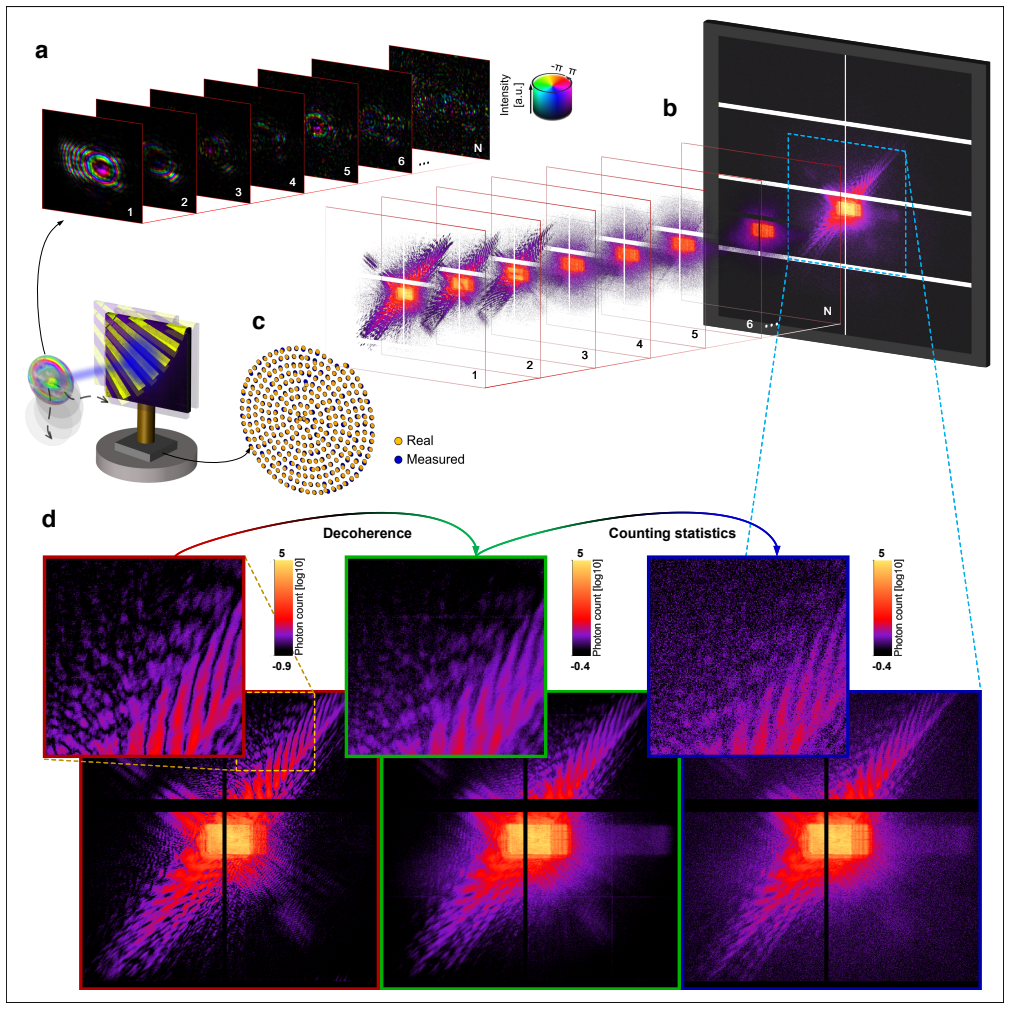
Attwood, D.Soft X-rays and extreme ultraviolet radiation: principles and applications(Cambridge University Press, 2000). 11/15 a c b d Counting statisticsDecoherence 5 -0.9 5 -0.4 5 -0.4 1 2 N 3 4 5 6 1 2 N 3 4 5 6 1 2 N 3 4 5 6 1 2 N 3 4 5 6 Figure 1.Illustration of the gap between digital forward models and physical reality that leads to imaging degrada...
2000
discussion (0)
Sign in with ORCID, Apple, or X to comment. Anyone can read and Pith papers without signing in.