REVIEW 2 major objections 3 minor 28 references
Lyapunov Stability and Optimal Error Estimates for an SIPG Method for Weakly Damped Semilinear Wave Equations
T0 review · 2 major / 3 minor · reviewed 2026-06-27 · grok-4.3
Pith's one-line read A discrete Lyapunov functional establishes stability and optimal error bounds for an SIPG scheme on weakly damped semilinear wave equations.
desk verdict The paper gives a coherent SIPG + CN-BDF2 scheme for weakly damped semilinear waves that gets stability and optimal errors from a discrete Lyapunov functional and chord-slope linearization without global Lipschitz. read the letter →
The pith
A machine-rendered reading of the paper's core claim, the machinery that carries it, and where it could break.
The reading
What carries the argument
The discrete Lyapunov functional built from the numerical solution, which encodes energy dissipation and closes the stability argument without spectral tools.
What would settle it
A computed solution that grows unbounded in norm for fixed mesh size and time step, or measured convergence rates that fall below O(h^k + τ²) in the energy norm on a sequence of refined meshes with a smooth exact solution.
Extended reading notes
Core claim
The fully discrete SIPG-CN-BDF2 scheme with chord-slope linearization admits a discrete Lyapunov functional that directly yields existence, uniqueness, and uniform boundedness of the solution, while optimal a priori error estimates of order O(h^k + τ²) hold in the DG energy norm and O(h^{k+1} + τ²) in the L² norm under standard regularity assumptions on the exact solution.
Load-bearing premise
The exact solution satisfies standard regularity assumptions that allow the error analysis to close at the stated orders.
Editorial extensions
If this is right
- The numerical solution exists and remains uniformly bounded for arbitrary time horizons.
- Optimal convergence holds simultaneously in the DG energy norm and the L2 norm.
- The chord-slope linearization preserves a discrete gradient structure without global Lipschitz conditions.
- Long-time energy dissipation behavior is inherited from the continuous problem.
Reading between the lines
- The Lyapunov construction may apply directly to other dissipative semilinear systems where spectral analysis becomes intractable.
- The absence of a global Lipschitz requirement widens the class of nonlinearities that can be treated while retaining unconditional stability.
- The observed long-time dissipation in experiments suggests the scheme could serve as a reliable surrogate for studying asymptotic behavior in physical wave models.
Editorial analysis
A structured set of objections, weighed in public.
Referee Report
Summary. The paper develops a fully discrete SIPG spatial discretization paired with a hybrid CN-BDF2 time integrator for the weakly damped semilinear wave equation. A chord-slope linearization of the nonlinearity is introduced that preserves an exact discrete gradient structure without requiring global Lipschitz continuity. Stability, existence, uniqueness, and uniform boundedness are proved via an explicitly constructed discrete Lyapunov functional rather than spectral methods. Under standard regularity assumptions on the exact solution, optimal a priori error bounds of order O(h^k + τ²) in the DG energy norm and O(h^{k+1} + τ²) in the L² norm are established. Two-dimensional numerical tests with linear, cubic, and trigonometric nonlinearities confirm the predicted rates and long-time energy dissipation.
Significance. If the Lyapunov construction and error analysis are correct, the manuscript supplies a structure-preserving, fully discrete method whose stability proof does not rely on global Lipschitz assumptions or spectral arguments. This is useful for semilinear wave problems whose nonlinearities fail global Lipschitz conditions. The explicit discrete Lyapunov functional and the optimal convergence rates under standard regularity constitute a clear technical contribution to the analysis of DG methods for hyperbolic problems with weak damping.
major comments (2)
- [§3.2, Eq. (3.8)] §3.2, Eq. (3.8): the discrete Lyapunov functional is stated to be non-increasing, but the proof that the chord-slope term exactly cancels the nonlinear contribution in the energy identity appears to require an additional summation-by-parts identity that is not displayed; without it the uniform boundedness claim in Theorem 3.1 rests on an implicit step.
- [Theorem 4.3] Theorem 4.3: the O(h^{k+1} + τ²) L² error bound invokes an elliptic projection whose approximation properties are quoted from a reference; the constant in front of the nonlinearity term must be shown to remain independent of the mesh size and time step, otherwise the induction argument used to close the error estimate may lose the optimal order.
minor comments (3)
- [§2.3] The mesh-regularity assumption (shape-regularity and quasi-uniformity) is invoked for the inverse inequalities in §2.3 but is not restated in the statement of the main theorems; adding a single sentence would improve readability.
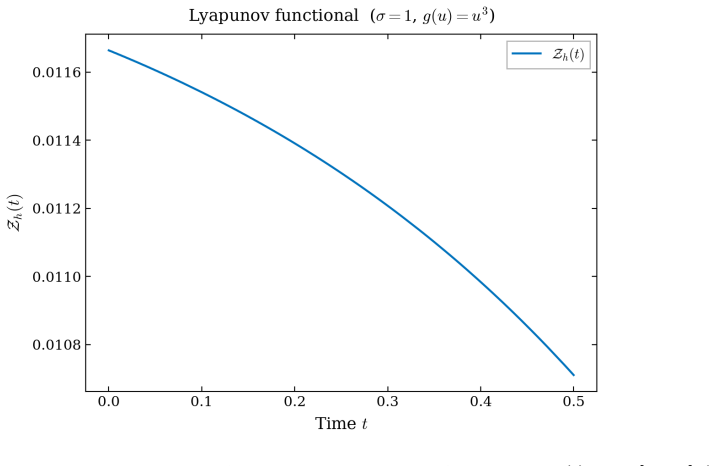
- [§5] Figure 5.2 (energy decay plots) would benefit from an inset showing the discrete energy over the first 10 time steps to illustrate the initial transient behavior guaranteed by the Lyapunov functional.
- [§4] Notation: the symbol E_h^n for the discrete energy is introduced in §3 but reused without redefinition in the error analysis of §4; a brief reminder would prevent confusion.
Simulated Author's Rebuttal
We thank the referee for the careful reading and the constructive comments on our manuscript. The suggestions improve the clarity of the stability and error analyses. We address each major comment below and will incorporate the necessary revisions.
read point-by-point responses
-
Referee: [§3.2, Eq. (3.8)] §3.2, Eq. (3.8): the discrete Lyapunov functional is stated to be non-increasing, but the proof that the chord-slope term exactly cancels the nonlinear contribution in the energy identity appears to require an additional summation-by-parts identity that is not displayed; without it the uniform boundedness claim in Theorem 3.1 rests on an implicit step.
Authors: We agree that the cancellation step can be made fully explicit. The chord-slope linearization combined with the symmetry of the SIPG form yields an exact telescoping identity that cancels the nonlinear term against the discrete gradient contribution. In the revised manuscript we will insert the required discrete summation-by-parts identity immediately after Eq. (3.8) and before the energy estimate in the proof of Theorem 3.1. revision: yes
-
Referee: [Theorem 4.3] Theorem 4.3: the O(h^{k+1} + τ²) L² error bound invokes an elliptic projection whose approximation properties are quoted from a reference; the constant in front of the nonlinearity term must be shown to remain independent of the mesh size and time step, otherwise the induction argument used to close the error estimate may lose the optimal order.
Authors: The uniform bound on the numerical solution furnished by the discrete Lyapunov functional (Theorem 3.1) is independent of both h and τ. Consequently the Lipschitz constant of the nonlinearity, when evaluated along the numerical trajectory, remains bounded by a constant that does not depend on the discretization parameters. We will add a short clarifying paragraph immediately after the elliptic-projection lemma, explicitly invoking the h- and τ-independent bound from Theorem 3.1 to confirm that the constant in the nonlinearity term stays uniform, thereby preserving the optimal order in the induction argument of Theorem 4.3. revision: yes
Circularity Check
No significant circularity; derivation is self-contained via explicit construction
full rationale
The paper derives stability via explicit construction of a discrete Lyapunov functional tied directly to the SIPG + CN-BDF2 scheme with chord-slope linearization; existence/uniqueness/boundedness and optimal error estimates O(h^k + τ²) / O(h^{k+1} + τ²) then follow from standard energy arguments and regularity assumptions without any reduction to fitted inputs, self-definitional loops, or load-bearing self-citations. All steps are independent of the target claims.
Assumptions & free parameters
assumptions (1)
- domain assumption standard regularity assumptions on the exact solution
Cite this review
Pith. "Pith review of Lyapunov Stability and Optimal Error Estimates for an SIPG Method for Weakly Damped Semilinear Wave Equations." pith.science (2026). https://pith.science/paper/4WKWDF6R
@misc{pith2026260613185,
  author       = {Pith},
  title        = {Pith review of: Lyapunov Stability and Optimal Error Estimates for an SIPG Method for Weakly Damped Semilinear Wave Equations},
  year         = {2026},
  howpublished = {\url{https://pith.science/paper/4WKWDF6R}},
  note         = {Machine review of arXiv:2606.13185}
}
abstract
We develop and analyze a fully discrete scheme for the weakly damped semilinear wave equation that combines a Symmetric Interior Penalty Discontinuous Galerkin (SIPG) spatial discretization with a hybrid Crank--Nicolson/second-order Backward Differentiation Formula (CN--BDF2) time integrator. A chord-slope linearization of the nonlinear reaction term is employed, which preserves an exact discrete gradient structure and, crucially, requires {no global Lipschitz continuity assumption} on the nonlinearity. Stability of the fully discrete solution is established through a Lyapunov-based analysis-rather than spectral arguments-by constructing a discrete Lyapunov functional that yields existence, uniqueness, and uniform boundedness of the numerical solution. Under standard regularity assumptions, optimal a~priori error estimates of order $\mathcal{O}(h^{k}+\tau^{2})$ in the DG energy norm and $\mathcal{O}(h^{k+1}+\tau^{2})$ in the $L^{2}$-norm are proved, where $h$ is the mesh size, $\tau$ the time step, and $k$ the polynomial degree. Numerical experiments on two-dimensional problems with linear, cubic, and trigonometric nonlinearities confirm the theoretical convergence rates and illustrate the long-time energy-dissipation properties guaranteed by the Lyapunov structure.
Figures


Figures from the paper (4 more)


Reference graph
Works this paper leans on
-
[1]
Solitary wave collisions.SIAM Journal on Applied Mathematics, 36(3):428–437, 1979
Mark J Ablowitz, M D Kruskal, and JF Ladik. Solitary wave collisions.SIAM Journal on Applied Mathematics, 36(3):428–437, 1979
1979
-
[2]
Conservative primal hybrid finite element method for weakly damped klein-gordon equation.Computers & Mathematics with Applications, 186:16–36, 2025
Sanjib K Acharya, Amiya K Pani, Ajit Patel, and Ravina Shokeen. Conservative primal hybrid finite element method for weakly damped klein-gordon equation.Computers & Mathematics with Applications, 186:16–36, 2025
2025
-
[3]
An efficient numerical simulation of the two-dimensional semilinear wave equation
Talha Achouri. An efficient numerical simulation of the two-dimensional semilinear wave equation. Computational and Applied Mathematics, 41(8):386, 2022
2022
-
[4]
Virtual element method for semilinear sine–gordon equa- tion over polygonal mesh using product approximation technique.Mathematics and Computers in Simulation, 172:224–243, 2020
Dibyendu Adak and Sundararajan Natarajan. Virtual element method for semilinear sine–gordon equa- tion over polygonal mesh using product approximation technique.Mathematics and Computers in Simulation, 172:224–243, 2020
2020
-
[5]
Symmetric stabilized FEM for time-fractional convection-diffusion-reaction equations.Math
Naveed Ahmed, Samir Karaa, and Abhinav Jha. Symmetric stabilized FEM for time-fractional convection-diffusion-reaction equations.Math. Comput. Simulation, 245:685–697, 2026
2026
-
[6]
M. S. Alnes, J. Blechta, J. Hake, A. Johansson, B. Kehlet, A. Logg, C. Richardson, J. Ring, M. E. Rognes, and G. N. Wells. The FEniCS project version 1.5.Archive of Numerical Software, 3(100), 2015
2015
-
[7]
A damped hyerbolic equation with critical exponent.Communications in partial differential equations, 17(5-6):841–866, 1992
Jos´ e Arrieta, Alexander N Carvalho, and Jack K Hale. A damped hyerbolic equation with critical exponent.Communications in partial differential equations, 17(5-6):841–866, 1992
1992
-
[8]
Global attractors for damped semilinear wave equations.Discrete and Continuous Dy- namical Systems, 10(1/2):31–52, 2004
John M Ball. Global attractors for damped semilinear wave equations.Discrete and Continuous Dy- namical Systems, 10(1/2):31–52, 2004
2004
Show all 28 references
-
[9]
Analysis and comparison of numerical methods for the klein–gordon equation in the nonrelativistic limit regime.Numerische Mathematik, 120(2):189–229, 2012
Weizhu Bao and Xuanchun Dong. Analysis and comparison of numerical methods for the klein–gordon equation in the nonrelativistic limit regime.Numerische Mathematik, 120(2):189–229, 2012
2012
-
[10]
Springer Science & Business Media, 2011
Daniele Antonio Di Pietro and Alexandre Ern.Mathematical aspects of Discontinuous Galerkin methods, volume 69. Springer Science & Business Media, 2011
2011
-
[11]
Split local absorbing conditions for one-dimensional nonlinear klein- gordon equation on unbounded domain.Journal of Computational Physics, 227(20):8992–9004, 2008
Houde Han and Zhiwen Zhang. Split local absorbing conditions for one-dimensional nonlinear klein- gordon equation on unbounded domain.Journal of Computational Physics, 227(20):8992–9004, 2008
2008
-
[12]
Energy-preserving finite element methods for a class of nonlinear wave equations.Applied Numerical Mathematics, 157:446–469, 2020
Mingyan He and Pengtao Sun. Energy-preserving finite element methods for a class of nonlinear wave equations.Applied Numerical Mathematics, 157:446–469, 2020
2020
-
[13]
Weak galerkin finite element methods for semilinear klein–gordon equation on polygonal meshes.Computational & Applied Mathematics, 43(4), 2024
Puspendu Jana, Naresh Kumar, and Bhupen Deka. Weak galerkin finite element methods for semilinear klein–gordon equation on polygonal meshes.Computational & Applied Mathematics, 43(4), 2024. 28
2024
-
[14]
A residual based a posteriori error estimators for AFC schemes for convection-diffusion equations.Comput
Abhinav Jha. A residual based a posteriori error estimators for AFC schemes for convection-diffusion equations.Comput. Math. Appl., 97:86–99, 2021
2021
-
[15]
Residual-based a posteriori error estimators for algebraic stabilizations.Appl
Abhinav Jha. Residual-based a posteriori error estimators for algebraic stabilizations.Appl. Math. Lett., 157:Paper No. 109192, 7, 2024
2024
-
[16]
An assessment of solvers for algebraically stabilized discretizations of convection-diffusion-reaction equations.J
Abhinav Jha, Ondˇ rej P´ artl, Naveed Ahmed, and Dmitri Kuzmin. An assessment of solvers for algebraically stabilized discretizations of convection-diffusion-reaction equations.J. Numer. Math., 31(2):79–103, 2023
2023
-
[17]
Galerkin finite element methods for nonlinear klein-gordon equations.Math
ROBERT C Kirby and Thinh Tri Kieu. Galerkin finite element methods for nonlinear klein-gordon equations.Math. Comput, 2013
2013
-
[18]
Well-balanced convex limiting for finite element dis- cretizations of steady convection-diffusion-reaction equations.J
Petr Knobloch, Dmitri Kuzmin, and Abhinav Jha. Well-balanced convex limiting for finite element dis- cretizations of steady convection-diffusion-reaction equations.J. Comput. Phys., 518:Paper No. 113305, 18, 2024
2024
-
[19]
Error estimates with polynomial growth o (ε-
Naresh Kumar, Ajeet Singh, Ram Jiwari, and JY Yuan. Error estimates with polynomial growth o (ε-
-
[20]
for the hho method on polygonal meshes of the allen-cahn model.Applied Numerical Mathematics, 211:78–102, 2025
2025
-
[21]
New solitary wave solitons, analysis and simulations of the fitzhugh–nagumo model.Mathematics and Computers in Simulation, 2026
Devraj Maurya, Ajeet Singh, and Ram Jiwari. New solitary wave solitons, analysis and simulations of the fitzhugh–nagumo model.Mathematics and Computers in Simulation, 2026
2026
-
[22]
Numerical investigation of an explicit weak galerkin scheme for a class of weakly damped semi-linear wave equations.Computers & Mathematics with Applications, 212:290–315, 2026
Achyuta Ranjan Dutta Mohapatra and Bhupen Deka. Numerical investigation of an explicit weak galerkin scheme for a class of weakly damped semi-linear wave equations.Computers & Mathematics with Applications, 212:290–315, 2026
2026
-
[23]
Virtual element methods for weakly damped wave equations on polygonal meshes.Computational and Applied Mathematics, 42(3):137, 2023
Gouranga Pradhan, Jogen Dutta, and Bhupen Deka. Virtual element methods for weakly damped wave equations on polygonal meshes.Computational and Applied Mathematics, 42(3):137, 2023
2023
-
[24]
Numerical analysis for a locally damped wave equation.J
MA Rincon and MIM Copetti. Numerical analysis for a locally damped wave equation.J. Appl. Anal. Comput, 3(2):169–182, 2013
2013
-
[25]
Nonconforming quadrilateral finite element method for a class of nonlinear sine–gordon equations.Applied Mathematics and Computation, 219(17):9447–9460, 2013
Dongyang Shi and Lifang Pei. Nonconforming quadrilateral finite element method for a class of nonlinear sine–gordon equations.Applied Mathematics and Computation, 219(17):9447–9460, 2013
2013
-
[26]
A high order numerical method for analysis and simulation of 2d semilinear sobolev model on polygonal meshes.Mathematics and Computers in Simulation, 227:241–262, 2025
Ajeet Singh, Hanz Martin Cheng, Naresh Kumar, and Ram Jiwari. A high order numerical method for analysis and simulation of 2d semilinear sobolev model on polygonal meshes.Mathematics and Computers in Simulation, 227:241–262, 2025
2025
-
[27]
Rigorous HHO Optimal Error Estimates and Simulation of FitzHugh- Nagumo Model.Journal of Scientific Computing, 105(3):89, 2025
Ajeet Singh and Ram Jiwari. Rigorous HHO Optimal Error Estimates and Simulation of FitzHugh- Nagumo Model.Journal of Scientific Computing, 105(3):89, 2025
2025
-
[28]
A Priori Error Estimates based on Lyapunov for the FitzHugh-Nagumo Model via Interior Penalty Discontinuous Galerkin method.Applied Numerical Mathematics, 2026
Ajeet Singh and Ram Jiwari. A Priori Error Estimates based on Lyapunov for the FitzHugh-Nagumo Model via Interior Penalty Discontinuous Galerkin method.Applied Numerical Mathematics, 2026. 29
2026
Reviewed June 27, 2026 · model on record in the stance chip above.
Discussion (0). Continue with ORCID to comment.