Data-Driven Equation Discovery for Nonlinear Liquid Film Flows
Pith reviewed 2026-06-27 05:48 UTC · model grok-4.3
The pith
Careful data curation with expert knowledge allows data-driven methods to recover the governing equations for nonlinear liquid film flows despite identifiability issues.
A machine-rendered reading of the paper's core claim, the machinery that carries it, and where it could break.
Core claim
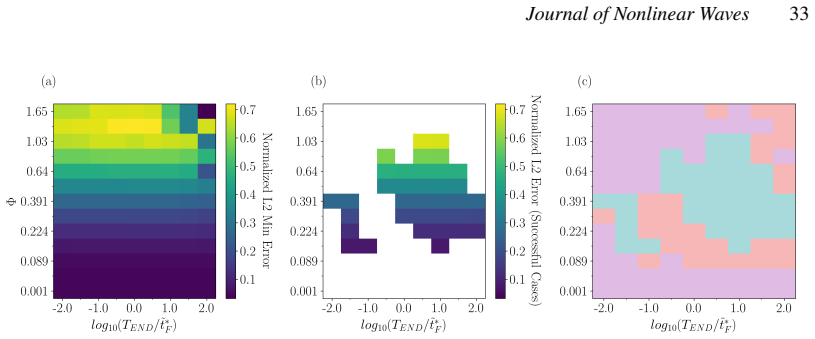
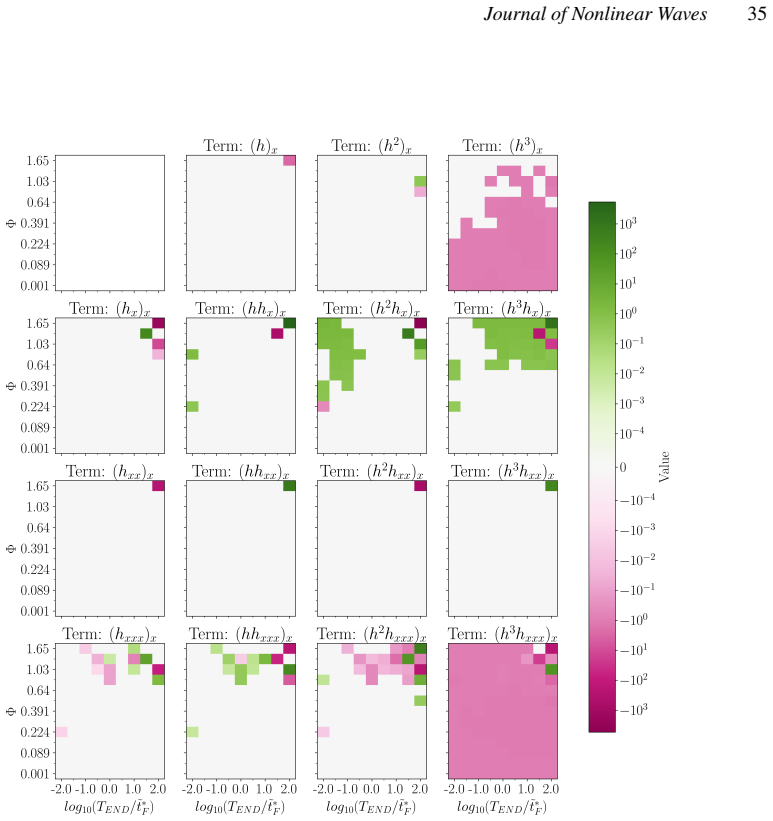
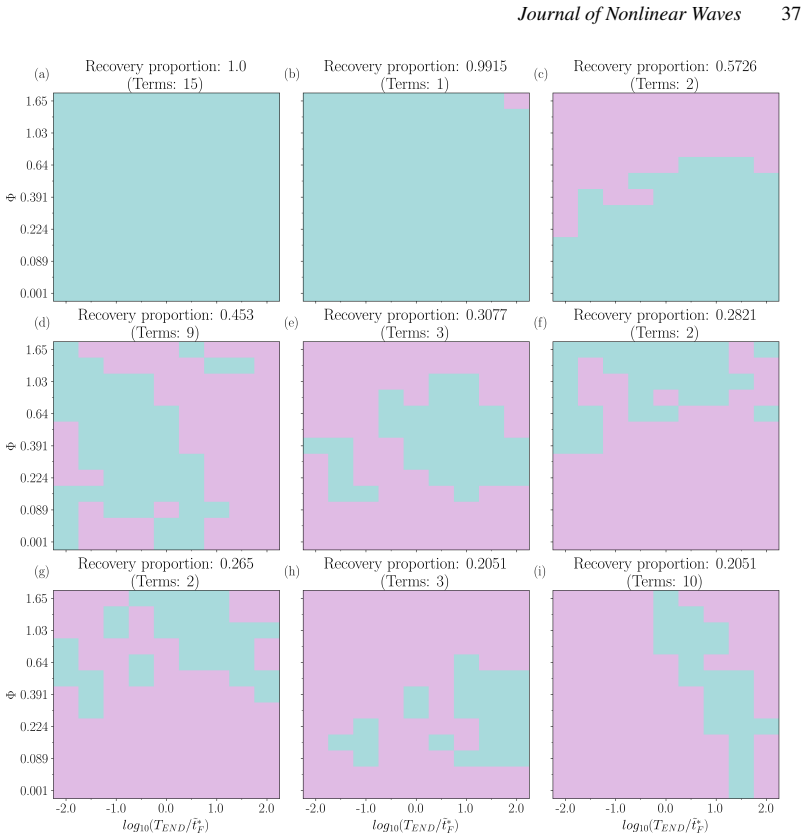
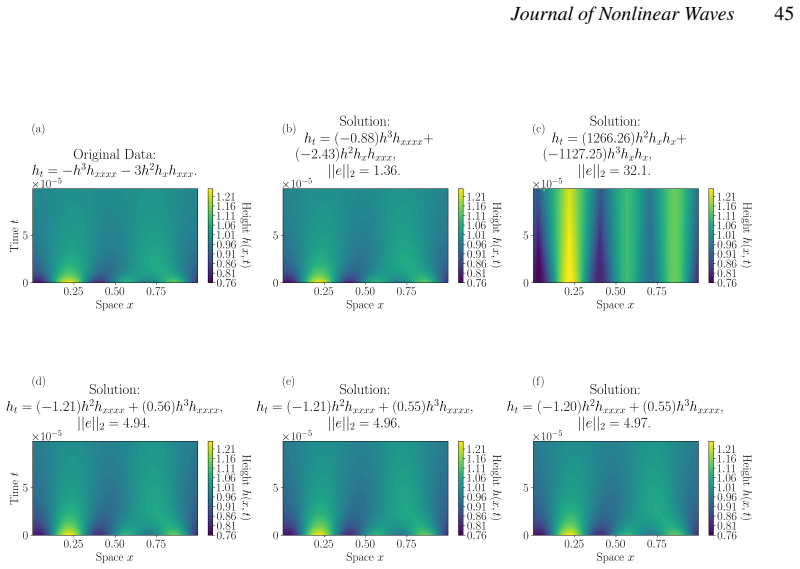
By leveraging expert knowledge and the ability to carefully curate data, we establish a best-case scenario for identifying the underlying governing equations. Even here, multi-collinearity stemming from the choice of monomial basis functions in our multi-scale flow configuration introduces complex identifiability issues. Early-time transients compound this further, as the most dynamically rich behaviour carries the largest residuals in training data.
What carries the argument
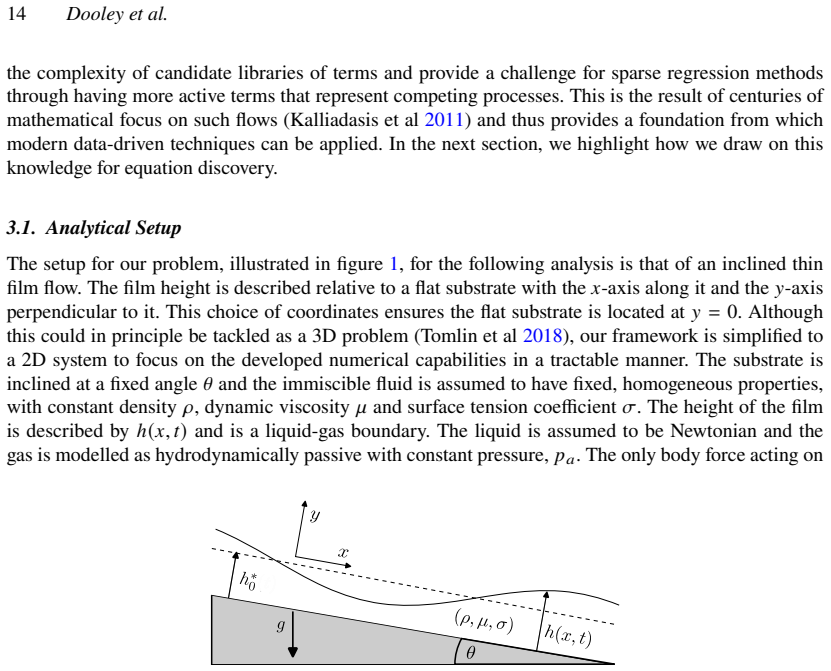
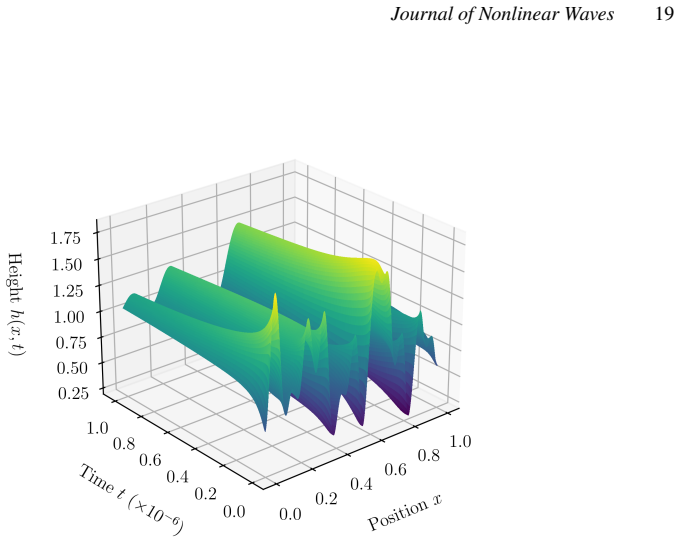
Sparse regression over a monomial basis applied to curated time-series data from liquid film flow simulations, to recover the terms of the governing partial differential equations.
If this is right
- Data-driven discovery can succeed on PDE systems such as liquid films when data selection incorporates domain knowledge.
- Multi-collinearity from monomial bases must be handled explicitly to achieve reliable term identification in multi-scale flows.
- Early-time transients require special treatment because they produce the largest residuals while containing the richest dynamics.
- Mapping these vulnerabilities guides the creation of more numerically stable discovery algorithms for partial differential equations.
Where Pith is reading between the lines
- Alternative basis choices or explicit regularization could reduce the multi-collinearity problem in similar multi-scale settings.
- The curation strategy might be adapted to experimental measurements, where noise would add a further test of robustness.
- The same approach could be applied to other nonlinear film or free-surface flows to check whether the identified limits are general.
Load-bearing premise
That a monomial basis remains usable for discovery even though multi-collinearity arises from the choice of basis functions in the multi-scale flow.
What would settle it
Applying the discovery procedure to the curated dataset and finding that it fails to recover the known thin-film equations or returns inconsistent models across data subsets would falsify the claim of successful identification in this best-case scenario.
Figures
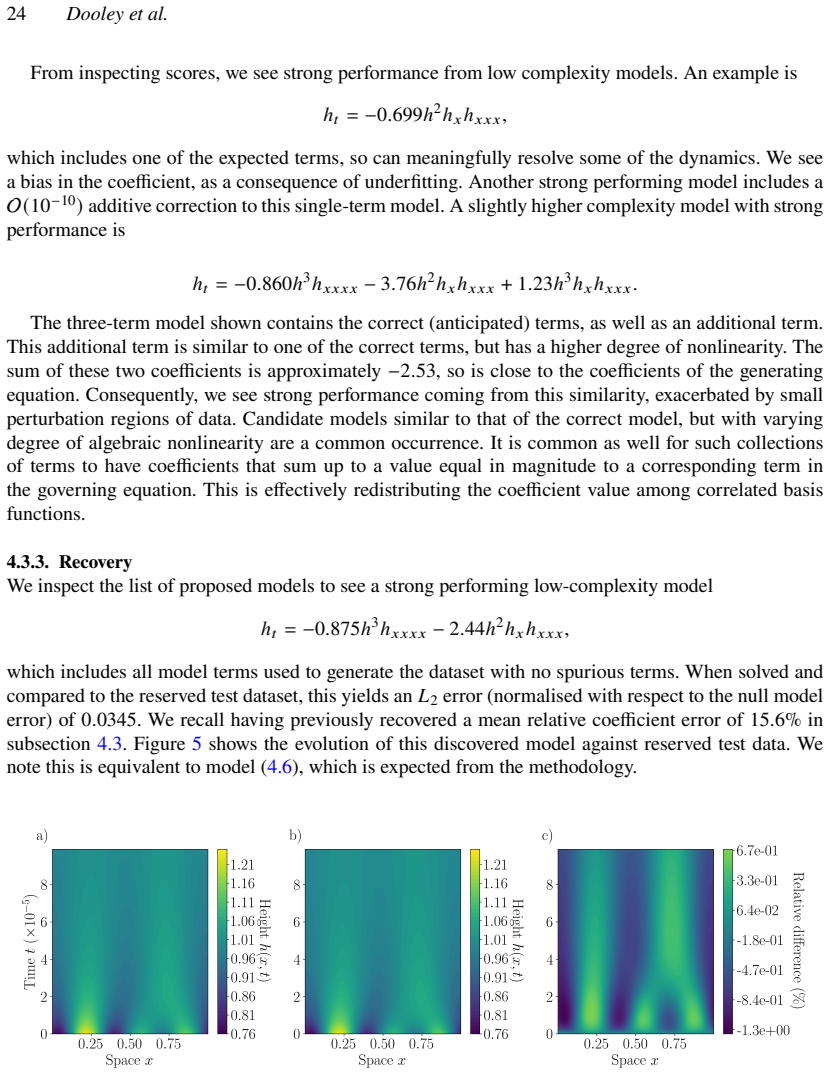
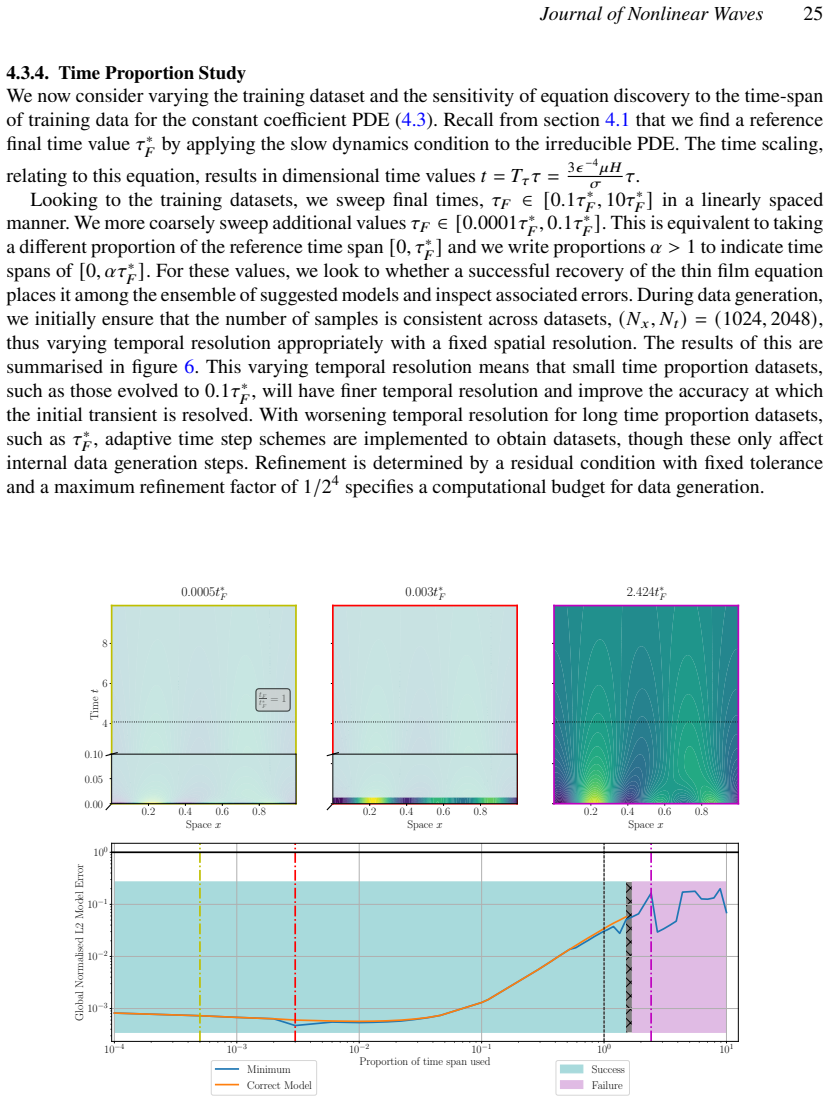
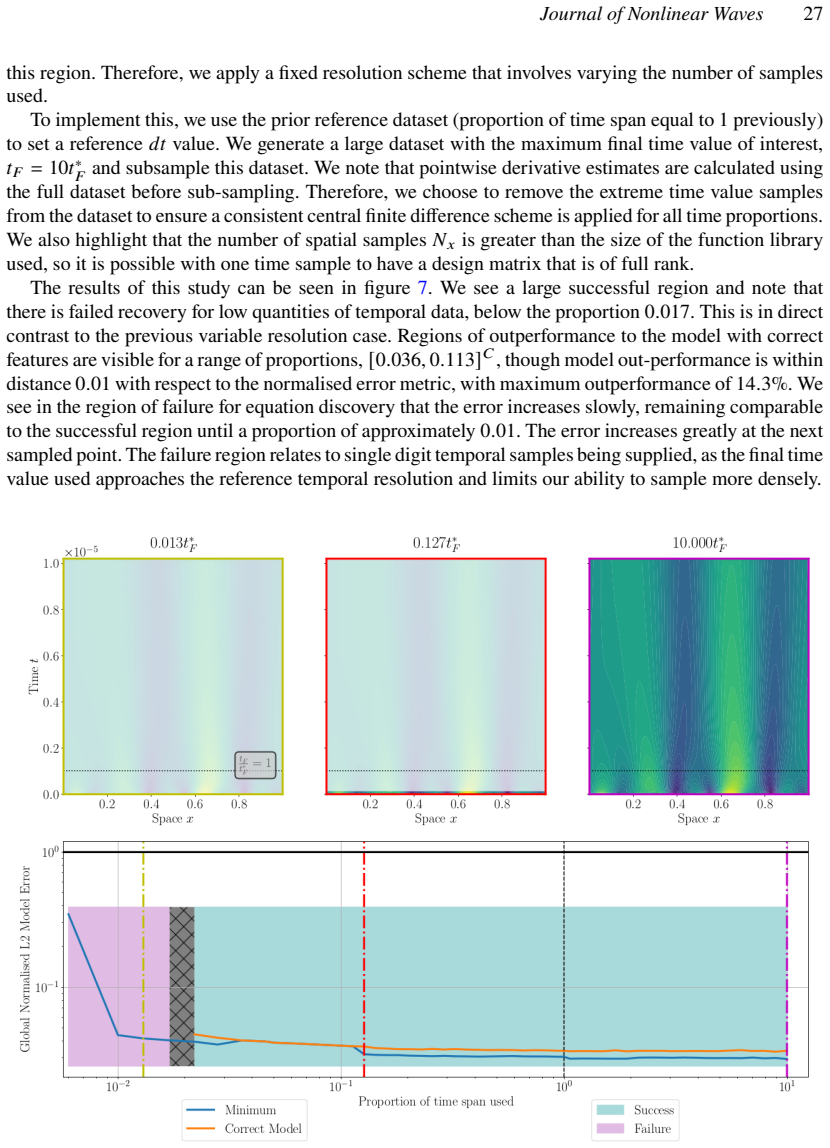
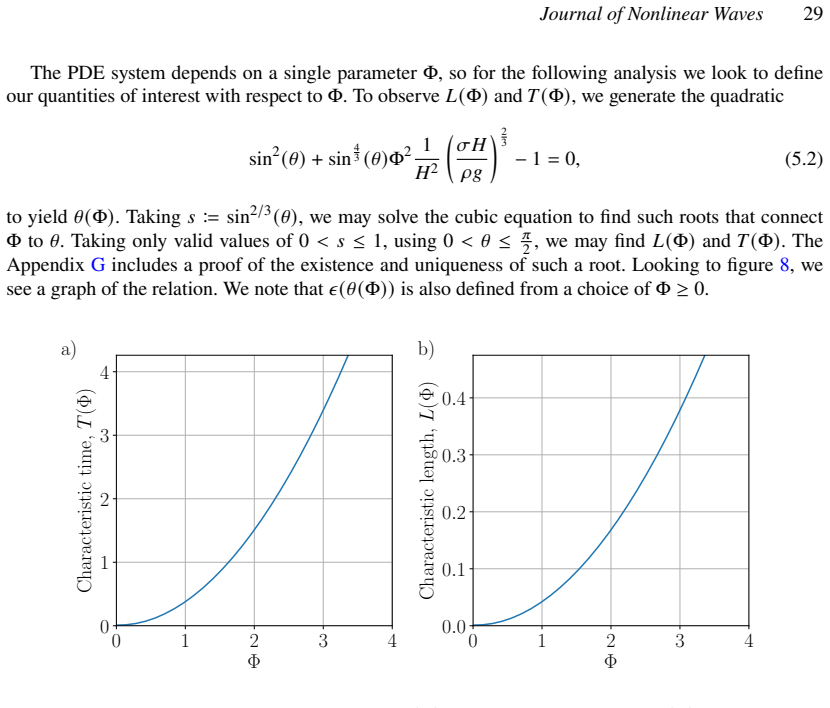
read the original abstract
Over the past decade data-driven equation discovery emerged as a powerful alternative to first principles-based methodologies traditionally used in mathematical modelling cycles. The approach provides a promising path towards deep, physical insight into systems that have previously evaded rigorous mathematical derivation procedures, often due to intractable complexity. The strengths of such techniques have been successfully established for many problem classes described by systems of ordinary differential equations and continue to be extended, with their reach into partial differential equation systems gaining momentum, though comparatively nascent. Herein we tackle such a frontier: elucidating the dynamics of liquid film flows, a problem space providing a rich backdrop in terms of asymptotic analytical building blocks. By leveraging expert knowledge and the ability to carefully curate data, we establish a best-case scenario for identifying the underlying governing equations. Even here, multi-collinearity, stemming from the choice of monomial basis functions in our multi-scale flow configuration, introduces complex identifiability issues. Early-time transients compound this further, as the most dynamically rich behaviour carries the largest residuals in training data. Pinpointing such vulnerabilities allows us to better define the boundaries of current discovery techniques and paves the way for the next generation of more resilient, numerically stable algorithms.
Editorial analysis
A structured set of objections, weighed in public.
Referee Report
Summary. The manuscript applies data-driven sparse regression to discover governing PDEs for nonlinear liquid film flows. Leveraging expert knowledge for data curation, the authors construct what they describe as a best-case scenario for equation recovery. They report that monomial basis functions induce multi-collinearity in the multi-scale setting and that early-time transients produce the largest residuals, creating identifiability difficulties that are used to delineate the practical boundaries of current discovery methods.
Significance. If the manuscript supplied quantitative demonstrations (recovered equations, coefficient errors, condition numbers, or ablation studies on data weighting), the work could usefully bound the applicability of monomial-based sparse regression for multi-scale PDE systems in fluid mechanics. As presented, the contribution remains prospective rather than substantiated.
major comments (2)
- [Abstract] Abstract: the central claim that expert curation 'establishes a best-case scenario for identifying the underlying governing equations' is load-bearing yet unsupported; the text only enumerates identifiability problems without reporting any recovered equations, regression residuals, condition numbers of the library matrix, or verification that the chosen terms match known asymptotic models for film flows.
- [Abstract] Abstract: the assertion that multi-collinearity 'introduces complex identifiability issues' is presented as a finding, but no quantitative evidence (e.g., singular-value spectrum of the regression matrix, sensitivity of selected terms to noise or weighting, or comparison of fits with/without curated data) is supplied to show that these issues actually prevent reliable recovery under the claimed best-case conditions.
Simulated Author's Rebuttal
We thank the referee for their constructive report. Our manuscript aims to delineate practical limitations of monomial-based sparse regression for multi-scale fluid systems by showing that even expert-curated data does not yield clean recovery. We agree the abstract requires clarification and quantitative support, and will revise accordingly.
read point-by-point responses
-
Referee: [Abstract] Abstract: the central claim that expert curation 'establishes a best-case scenario for identifying the underlying governing equations' is load-bearing yet unsupported; the text only enumerates identifiability problems without reporting any recovered equations, regression residuals, condition numbers of the library matrix, or verification that the chosen terms match known asymptotic models for film flows.
Authors: We acknowledge the abstract phrasing risks implying successful recovery. The manuscript's core contribution is demonstrating that identifiability issues persist even under expert-curated conditions; no clean governing equations are recovered. To address this, we will revise the abstract to state explicitly that the work identifies boundaries and limitations rather than successful discovery. We will also add quantitative metrics (condition numbers, residual distributions, and comparison to known film-flow asymptotics) in the main text or appendix of the revised manuscript. revision: yes
-
Referee: [Abstract] Abstract: the assertion that multi-collinearity 'introduces complex identifiability issues' is presented as a finding, but no quantitative evidence (e.g., singular-value spectrum of the regression matrix, sensitivity of selected terms to noise or weighting, or comparison of fits with/without curated data) is supplied to show that these issues actually prevent reliable recovery under the claimed best-case conditions.
Authors: We agree that explicit quantitative support for the multi-collinearity claim would strengthen the paper. The current text describes the source of the problem (monomial bases in a multi-scale setting) but does not include singular-value spectra or ablation studies. We will incorporate these quantitative demonstrations, including condition numbers of the library matrix and sensitivity to data weighting, in the revised manuscript to substantiate the identifiability difficulties. revision: yes
Circularity Check
No circularity: data-driven discovery uses external curated data and known physics without self-referential reduction
full rationale
The paper applies standard sparse regression (likely SINDy-style) to curated simulation data from liquid film flows, leveraging known asymptotic building blocks only for data selection and basis choice. No derivation step equates a claimed prediction to its own fitted inputs by construction, nor does any load-bearing premise reduce to a self-citation chain. Multi-collinearity and identifiability issues are explicitly flagged as limitations rather than hidden. The central claim (best-case recovery is possible with curation) rests on external data generation and domain knowledge, remaining falsifiable against held-out simulations or analytic limits. This is the expected non-finding for a well-posed data-driven study.
Axiom & Free-Parameter Ledger
Reference graph
Works this paper leans on
-
[1]
Knuth , year =
Donald E. Knuth , year =. The
-
[2]
Frank Mittelbach and Michel Gossens and Johannes Braams and David Carlisle and Chris Rowley , year =. The
-
[3]
Leslie Lamport , year =
-
[4]
The Computer Journal , volume=
Literate Programming , author=. The Computer Journal , volume=. 1984 , publisher=
1984
-
[5]
Computer Typesetting of Technical Journals on
Michael Lesk and Brian Kernighan , booktitle=. Computer Typesetting of Technical Journals on. 1977 , address=
1977
-
[6]
Maddu, Suryanarayana and Cheeseman, Bevan L. and Sbalzarini, Ivo F. and M. Stability selection enables robust learning of differential equations from limited noisy data , journal =. 2022 , month =. doi:10.1098/rspa.2021.0916 , url =
-
[7]
Rudy, Samuel and Alla, Alessandro and Brunton, Steven L. and Kutz, J. Nathan , title =. SIAM Journal on Applied Dynamical Systems , volume =. 2019 , doi =. https://doi.org/10.1137/18M1191944 , abstract =
-
[8]
AI Feynman : A physics-inspired method for symbolic regression
Silviu-Marian Udrescu and Max Tegmark , title =. Science Advances , volume =. 2020 , doi =. https://www.science.org/doi/pdf/10.1126/sciadv.aay2631 , abstract =
-
[9]
Long-scale evolution of thin liquid films , author =. Rev. Mod. Phys. , volume =. 1997 , month =. doi:10.1103/RevModPhys.69.931 , url =
-
[10]
Thin Films with High Surface Tension , volume=
Myers, Thomas H , year=. Thin Films with High Surface Tension , volume=. Siam Review , publisher=. doi:https://doi.org/10.1137/s003614459529284x , number=
-
[11]
VandenHeuvel, Daniel J and Drovandi, Christopher and Simpson, Matthew J , year=. Computationally efficient mechanism discovery for cell invasion with uncertainty quantification , volume=. PLoS Computational Biology , publisher=. doi:https://doi.org/10.1371/journal.pcbi.1010599 , number=
-
[12]
VandenHeuvel, Daniel J. and Buenzli, Pascal R. and Simpson, Matthew J. , title =. Proceedings of the Royal Society A: Mathematical, Physical and Engineering Sciences , volume =. 2024 , month =. doi:10.1098/rspa.2023.0619 , url =
-
[13]
Daniel A. Messenger and David M. Bortz , keywords =. Weak SINDy for partial differential equations , journal =. 2021 , issn =. doi:https://doi.org/10.1016/j.jcp.2021.110525 , url =
-
[14]
Bayesian uncertainty quantification for data-driven equation learning , volume=
Martina-Perez, Simon and Simpson, Matthew J and Baker, Ruth E , year=. Bayesian uncertainty quantification for data-driven equation learning , volume=. Proceedings of the Royal Society A: Mathematical Physical and Engineering Sciences , publisher=. doi:https://doi.org/10.1098/rspa.2021.0426 , number=
-
[15]
Rohit Supekar and Boya Song and Alasdair Hastewell and Gary P. T. Choi and Alexander Mietke and Jörn Dunkel , title =. Proceedings of the National Academy of Sciences , volume =. 2023 , doi =
2023
-
[16]
Discovering governing equations from data by sparse identification of nonlinear dynamical systems , volume=. Proceedings of the National Academy of Sciences , author=. 2016 , month=. doi:10.1073/pnas.1517384113 , number=
-
[17]
Data-driven discovery of partial differential equations , volume=. Science Advances , author=. 2017 , month=. doi:10.1126/sciadv.1602614 , number=
-
[18]
Fasel, U. and Kutz, J. N. and Brunton, B. W. and Brunton, S. L. , title =. Proceedings of the Royal Society A: Mathematical, Physical and Engineering Sciences , volume =. 2022 , month =. doi:10.1098/rspa.2021.0904 , url =
-
[19]
Proceedings of the Royal Society A: Mathematical, Physical and Engineering Sciences , author=
Learning partial differential equations via data discovery and sparse optimization , volume=. Proceedings of the Royal Society A: Mathematical, Physical and Engineering Sciences , author=. 2017 , month=. doi:10.1098/rspa.2016.0446 , number=
-
[20]
Multiscale Modeling & Simulation , volume =
Zhang, Linan and Schaeffer, Hayden , title =. Multiscale Modeling & Simulation , volume =. 2019 , doi =. https://doi.org/10.1137/18M1189828 , abstract =
-
[21]
Champneys, Max D. and Rogers, Timothy J. , title =. Proceedings of the Royal Society A: Mathematical, Physical and Engineering Sciences , volume =. 2025 , month =. doi:10.1098/rspa.2024.0620 , url =
-
[22]
Alexandre Cortiella and Park, K C and Alireza Doostan , year=. Sparse identification of nonlinear dynamical systems via reweighted _1 -regularized least squares , volume=. doi:https://doi.org/10.1016/j.cma.2020.113620 , journal=
-
[23]
Learning sparse nonlinear dynamics via mixed-integer optimization , volume=
Bertsimas, Dimitris and Gurnee, Wes , year=. Learning sparse nonlinear dynamics via mixed-integer optimization , volume=. doi:https://doi.org/10.1007/s11071-022-08178-9 , journal=
-
[24]
arXiv.org , author=
Best Subset Selection via a Modern Optimization Lens , url=. arXiv.org , author=. 2015 , eprint=
2015
-
[25]
G.L. Richard and M. Gisclon and C. Ruyer-Quil and J.P. Vila , keywords =. Optimization of consistent two-equation models for thin film flows , journal =. 2019 , issn =. doi:https://doi.org/10.1016/j.euromechflu.2019.01.004 , url =
-
[26]
Journal of Mathematics and Physics , author=
Long waves on liquid films , volume=. Journal of Mathematics and Physics , author=. 1966 , month=. doi:10.1002/sapm1966451150 , number=
-
[27]
Derivation of basic equations , volume=
Nonlinear analysis of hydrodynamic instability in laminar flames—I. Derivation of basic equations , volume=. Acta Astronautica , author=. 1977 , pages=. doi:10.1016/0094-5765(77)90096-0 , number=
-
[28]
Diffusion-induced chaos in reaction systems , volume=
Kuramoto, Yoshiki , year=. Diffusion-induced chaos in reaction systems , volume=. doi:10.1143/ptps.64.346 , journal=
-
[29]
SIAM Journal on Applied Mathematics , author=
On flame propagation under conditions of stoichiometry , volume=. SIAM Journal on Applied Mathematics , author=. 1980 , pages=. doi:10.1137/0139007 , number=
-
[30]
The European Physical Journal B , author=
Improved modeling of flows down inclined planes , volume=. The European Physical Journal B , author=. 2000 , month=. doi:10.1007/s100510051137 , number=
-
[31]
Further accuracy and convergence results on the modeling of flows down inclined planes by weighted-residual approximations , volume=. Physics of Fluids , author=. 2002 , month=. doi:10.1063/1.1426103 , number=
-
[32]
Reviews of Modern Physics , author =
Dynamics and stability of Thin Liquid Films , volume=. Reviews of Modern Physics , author=. 2009 , month=. doi:10.1103/revmodphys.81.1131 , number=
-
[33]
Kalliadasis and C
S. Kalliadasis and C. Ruyer-Quil and Scheid, B and Velarde, M G , year=. Falling Liquid Films , ISBN=
-
[34]
Journal of Fluid Mechanics , volume=
Validity domain of the Benney equation including the Marangoni effect for closed and open flows , author=. Journal of Fluid Mechanics , volume=. 2005 , publisher=
2005
-
[35]
Chapter 3 - A mathematical guide to operator learning , editor =
Nicolas Boull. Chapter 3 - A mathematical guide to operator learning , editor =. 2024 , booktitle =. doi:https://doi.org/10.1016/bs.hna.2024.05.003 , url =
-
[36]
Efron, Bradley and Tibshirani, R.J. , year=. An Introduction to the Bootstrap , ISBN=. doi:https://doi.org/10.1201/9780429246593 , publisher=
-
[37]
Model Selection Techniques: An Overview , year=
Ding, Jie and Tarokh, Vahid and Yang, Yuhong , journal=. Model Selection Techniques: An Overview , year=
-
[38]
An improved sparse identification of nonlinear dynamics with Akaike information criterion and group sparsity , volume=. Nonlinear Dynamics , author=. 2022 , month=. doi:https://doi.org/10.1007/s11071-022-07875-9 , number=
-
[39]
Lathourakis, Christos and Cicirello, Alice , year=. Physics Enhanced Sparse Identification of Dynamical Systems with Discontinuous Nonlinearities , volume=. Nonlinear Dynamics , publisher=. doi:https://doi.org/10.1007/s11071-024-09652-2 , number=
-
[40]
An introduction to variable and feature selection , year =
Guyon, Isabelle and Elisseeff, Andr\'. An introduction to variable and feature selection , year =. J. Mach. Learn. Res. , month = mar, pages =
-
[41]
Kutz, J. Nathan , year=. Deep learning in fluid dynamics , volume=. doi:10.1017/jfm.2016.803 , journal=
-
[42]
Mangan, N. M. and Kutz, J. N. and Brunton, S. L. and Proctor, J. L. , title =. Proceedings of the Royal Society A: Mathematical, Physical and Engineering Sciences , volume =. 2017 , month =. doi:10.1098/rspa.2017.0009 , url =
-
[43]
Lecture Notes in Computer Science , author=
Data-driven partial derivative equations discovery with evolutionary approach , DOI=. Lecture Notes in Computer Science , author=. 2019 , pages=
2019
-
[44]
Mikhail Maslyaev and Alexander Hvatov and Anna V. Kalyuzhnaya , keywords =. Partial differential equations discovery with EPDE framework: Application for real and synthetic data , journal =. 2021 , issn =. doi:https://doi.org/10.1016/j.jocs.2021.101345 , url =
-
[45]
Machine Learning: Science and Technology , volume=
Automating the discovery of partial differential equations in dynamical systems , author=. Machine Learning: Science and Technology , volume=. 2024 , publisher=
2024
-
[46]
Symbolic genetic algorithm for discovering open-form partial differential equations (SGA-PDE) , author =. Phys. Rev. Res. , volume =. 2022 , month =. doi:10.1103/PhysRevResearch.4.023174 , url =
-
[47]
ADAM-SINDy: An efficient optimization framework for parameterized nonlinear dynamical system identification , author =. Phys. Rev. Res. , volume =. 2026 , month =. doi:10.1103/dwkk-5g2h , url =
-
[48]
Nature Communications , author=
Generative Discovery of Partial Differential Equations by Learning from Math Handbooks , volume=. Nature Communications , author=. 2025 , month=. doi:https://doi.org/10.1038/s41467-025-65114-2 , number=
-
[49]
PDE-Net 2.0: Learning PDEs from data with a numeric-symbolic hybrid deep network , volume=
Long, Zichao and Lu, Yiping and Dong, Bin , year=. PDE-Net 2.0: Learning PDEs from data with a numeric-symbolic hybrid deep network , volume=. doi:10.1016/j.jcp.2019.108925 , journal=
-
[50]
2018 , editor =
Long, Zichao and Lu, Yiping and Ma, Xianzhong and Dong, Bin , booktitle =. 2018 , editor =
2018
-
[51]
Xu, Hao and Chang, Haibin and Zhang, Dongxiao , year=. DLGA-PDE: Discovery of PDEs with incomplete candidate library via combination of deep learning and genetic algorithm , volume=. doi:10.1016/j.jcp.2020.109584 , journal=
-
[52]
LES-SINDy: Laplace-enhanced sparse identification of nonlinear dynamical systems , journal =
Haoyang Zheng and Guang Lin , keywords =. LES-SINDy: Laplace-enhanced sparse identification of nonlinear dynamical systems , journal =. 2026 , issn =. doi:https://doi.org/10.1016/j.jcp.2025.114443 , url =
-
[53]
Proceedings of the Royal Society A: Mathematical, Physical and Engineering Sciences , author=
Rapid Bayesian identification of sparse nonlinear dynamics from scarce and noisy data , volume=. Proceedings of the Royal Society A: Mathematical, Physical and Engineering Sciences , author=. 2025 , month=. doi:https://doi.org/10.1098/rspa.2024.0200 , number=
-
[54]
Kaheman, Kadierdan and Kutz, J. Nathan and Brunton, Steven L. , title =. Proceedings of the Royal Society A: Mathematical, Physical and Engineering Sciences , volume =. 2020 , month =. doi:10.1098/rspa.2020.0279 , url =
-
[55]
On the numerical solution of a driven thin film equation , journal =. 2008 , issn =. doi:https://doi.org/10.1016/j.jcp.2008.04.007 , url =
-
[56]
Mathematische Annalen , year = 1928, volume = 100, pages =
Ber Die Partiellen Differenzengleichungen der mathematischen Physik , volume=. Mathematische Annalen , author=. 1928 , month=. doi:10.1007/bf01448839 , number=
-
[57]
Iterative Thresholding for Sparse Approximations , volume=
Blumensath, Thomas and Davies, Michael , year=. Iterative Thresholding for Sparse Approximations , volume=. Journal of Fourier Analysis and Applications , publisher=. doi:https://doi.org/10.1007/s00041-008-9035-z , number=
-
[58]
2006 IEEE International Conference on Acoustics Speech and Signal Processing Proceedings , volume=
Sparse approximation via iterative thresholding , author=. 2006 IEEE International Conference on Acoustics Speech and Signal Processing Proceedings , volume=. 2006 , organization=
2006
-
[59]
Quarterly of Applied Mathematics , year =
A Method for the Solution of Certain Non-Linear Problems in Least Squares , volume=. Quarterly of Applied Mathematics , author=. 1944 , pages=. doi:https://doi.org/10.1090/qam/10666 , number=
-
[60]
Journal of the Society for Industrial and Applied Mathematics , author=
An Algorithm for Least-Squares Estimation of Nonlinear Parameters , volume=. Journal of the Society for Industrial and Applied Mathematics , author=. 1963 , month=. doi:https://doi.org/10.1137/0111030 , number=
-
[61]
Deb, Kalyan , year =
-
[62]
2011 , number =
Deb, Kalyanmoy , title =. 2011 , number =
2011
-
[63]
IEEE Transactions on Molecular, Biological and Multi-Scale Communications , author=
Inferring Biological Networks by Sparse Identification of Nonlinear Dynamics , volume=. IEEE Transactions on Molecular, Biological and Multi-Scale Communications , author=. 2016 , month=. doi:https://doi.org/10.1109/tmbmc.2016.2633265 , number=
-
[64]
Data-driven model discovery and model selection for noisy biological systems , volume=
Wu, Xiaojun and McDermott, MeiLu and MacLean, Adam L , year=. Data-driven model discovery and model selection for noisy biological systems , volume=. PLoS Computational Biology , publisher=. doi:https://doi.org/10.1371/journal.pcbi.1012762 , number=
-
[65]
Journal of Computational Physics , author=
A Comparison of Numerical Algorithms for Fourier Extension of the First, Second, and Third Kinds , volume=. Journal of Computational Physics , author=. 2002 , month=. doi:https://doi.org/10.1006/jcph.2002.7023 , number=
-
[66]
Zenodo, September , year=
Pysr: Fast & parallelized symbolic regression in python/julia , author=. Zenodo, September , year=
-
[67]
and Tseluiko, Dmitri and Papageorgiou, Demetrios T
Thompson, Alice B. and Tseluiko, Dmitri and Papageorgiou, Demetrios T. , year=. Falling liquid films with blowing and suction , volume=. doi:10.1017/jfm.2015.683 , journal=
-
[68]
Model Selection and Multimodel Inference : a Practical Information-Theoretic Approach , ISBN=
Burnham, Kenneth P and David Raymond Anderson , year=. Model Selection and Multimodel Inference : a Practical Information-Theoretic Approach , ISBN=
-
[69]
Statistics for High-Dimensional Data : Methods, Theory and Applications , ISBN=
B. Statistics for High-Dimensional Data : Methods, Theory and Applications , ISBN=. 2013 , month=
2013
-
[70]
International Statistical Review , volume =
Freijeiro-González, Laura and Febrero-Bande, Manuel and González-Manteiga, Wenceslao , title =. International Statistical Review , volume =. doi:https://doi.org/10.1111/insr.12469 , url =. https://onlinelibrary.wiley.com/doi/pdf/10.1111/insr.12469 , year =
-
[71]
, title =
Pan, Victor Y. , title =. SIAM Journal on Matrix Analysis and Applications , volume =. 2016 , doi =
2016
-
[72]
cc/paper_files/paper/2021/file/ 854d9fca60b4bd07f9bb215d59ef5561-Paper
Physics-informed Machine Learning , volume=. Nature Reviews Physics , author=. 2021 , month=. doi:https://doi.org/10.1038/s42254-021-00314-5 , number=
-
[73]
Mayer, Michael Delaney and Oswald, Niall and Papageorgiou, Demetrios T. , year=. Liquid mixing and sculpting using light-actuated photosurfactants , volume=. doi:10.1017/jfm.2026.11264 , journal=
-
[74]
Papageorgiou, Demetrios T. , title =. Annual Review of Fluid Mechanics , year =. doi:https://doi.org/10.1146/annurev-fluid-122316-044531 , url =
-
[75]
Wray, Alexander W. and Cimpeanu, Radu , year=. Reduced-order modelling of thick inertial flows around rotating cylinders , volume=. doi:10.1017/jfm.2020.421 , journal=
-
[76]
and Papageorgiou, Demetrios T
Wray, Alexander W. and Papageorgiou, Demetrios T. and Matar, Omar K. , title =. SIAM Journal on Applied Mathematics , volume =. 2017 , doi =
2017
-
[77]
Oron, Alexander and Gottlieb, O and Novbari, Elena , year=. Numerical Analysis of a weighted-residual Integral boundary-layer Model for Nonlinear Dynamics of Falling Liquid Films , volume=. European Journal of mechanics. B, Fluids , publisher=. doi:https://doi.org/10.1016/j.euromechflu.2007.12.002 , number=
-
[78]
Journal of Mathematical Biology , author=
Structural Identifiability of linear-in-parameter Parabolic PDEs through Auxiliary Elliptic Operators , volume=. Journal of Mathematical Biology , author=. 2025 , month=. doi:https://doi.org/10.1007/s00285-025-02225-w , number=
-
[79]
Science , volume =
Matthew Hutson , title =. Science , volume =. 2018 , doi =
2018
-
[80]
Numerical differentiation of experimental data: local versus global methods , journal =
Karsten Ahnert and Markus Abel , keywords =. Numerical differentiation of experimental data: local versus global methods , journal =. 2007 , issn =. doi:https://doi.org/10.1016/j.cpc.2007.03.009 , url =
discussion (0)
Sign in with ORCID, Apple, or X to comment. Anyone can read and Pith papers without signing in.