Mass-imbalanced two-dimensional Bose-Fermi mixtures with boson-fermion pairing
Pith reviewed 2026-06-27 04:56 UTC · model grok-4.3
The pith
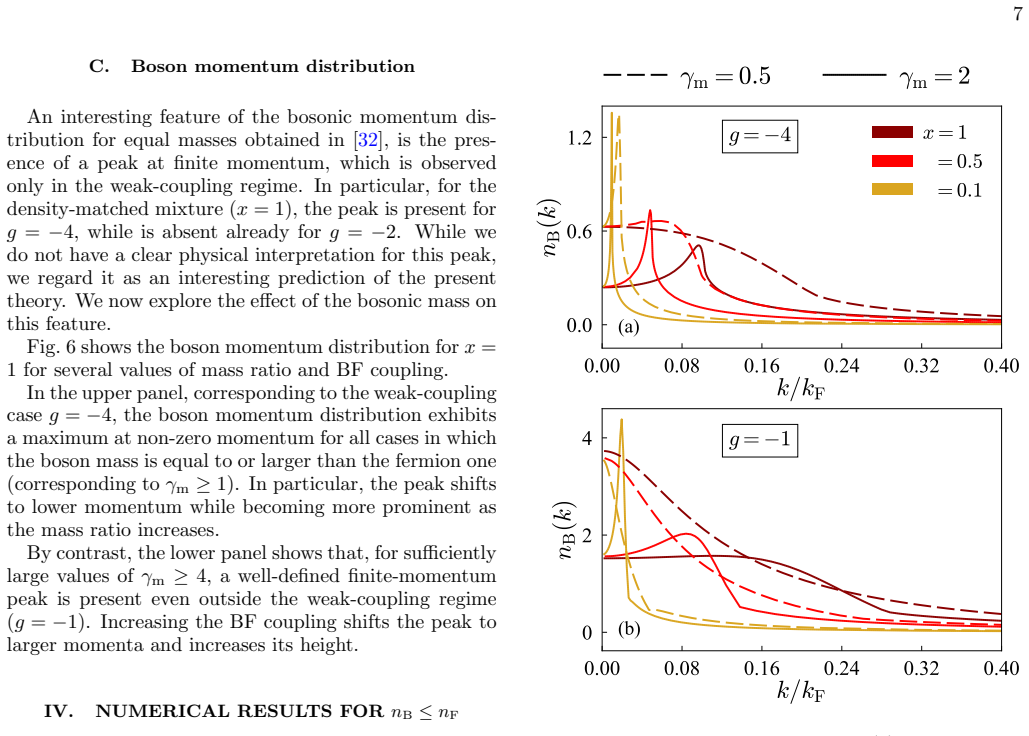
Mass imbalance enables observation of a finite-momentum peak in the boson momentum distribution of two-dimensional Bose-Fermi mixtures.
A machine-rendered reading of the paper's core claim, the machinery that carries it, and where it could break.
Core claim
Using a diagrammatic T-matrix formalism, the authors demonstrate that in mass-imbalanced two-dimensional Bose-Fermi mixtures at zero temperature, the condensate fraction exhibits near-universal behavior that becomes more pronounced for large boson-to-fermion mass ratios, while the mass imbalance qualitatively modifies the boson momentum distribution to produce a peak at finite momentum that can be experimentally accessed.
What carries the argument
The diagrammatic T-matrix approach, which accounts for boson-fermion pairing and is shown to match second-order perturbation theory in the weak-coupling regime.
If this is right
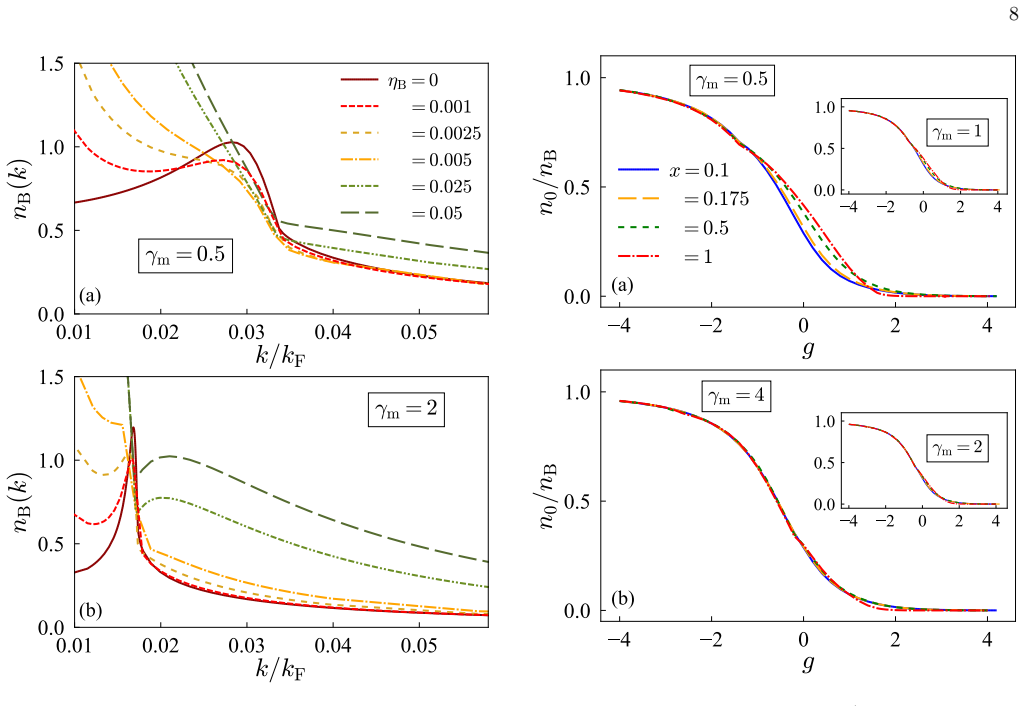
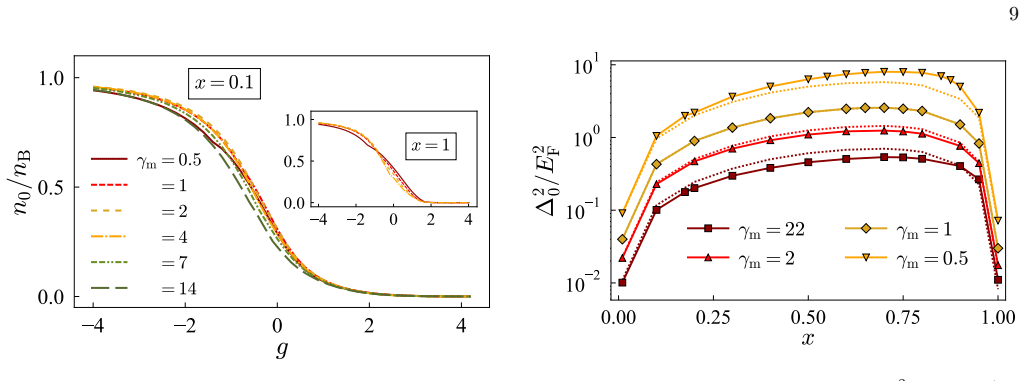
- The condensate fraction is nearly universal for different mass ratios and approaches universality more closely when the boson mass is large.
- The formalism recovers the correct second-order perturbative expansion for chemical potentials.
- Mass imbalance serves as an additional control parameter affecting the bosonic momentum distribution.
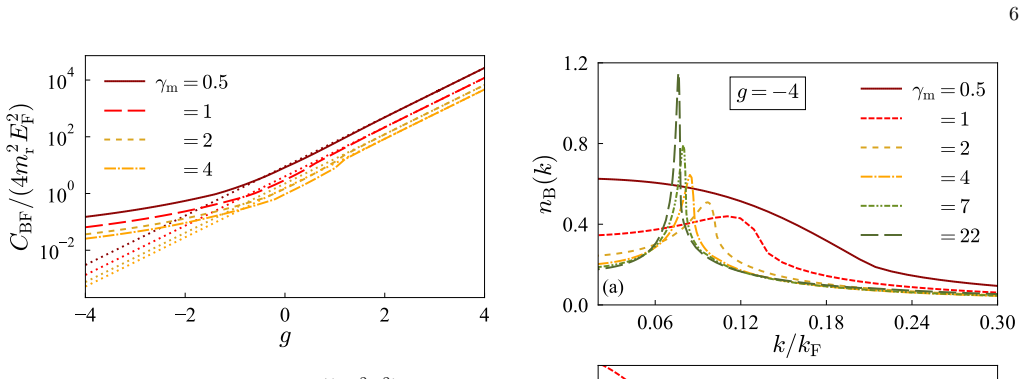
- Several thermodynamic quantities including Tan's contact can be studied as functions of the parameters.
Where Pith is reading between the lines
- Experiments could tune the mass ratio to enhance visibility of pairing signatures in momentum distributions.
- The results may extend to understanding pairing in other low-dimensional quantum mixtures.
- If validated, this suggests mass imbalance as a general tool for probing fermionic pairing effects on bosonic distributions.
Load-bearing premise
The T-matrix approach remains valid and captures the essential pairing physics at zero temperature in two dimensions.
What would settle it
A measurement of the boson momentum distribution in a mass-imbalanced 2D Bose-Fermi mixture that lacks a peak at finite momentum would contradict the prediction.
Figures

read the original abstract
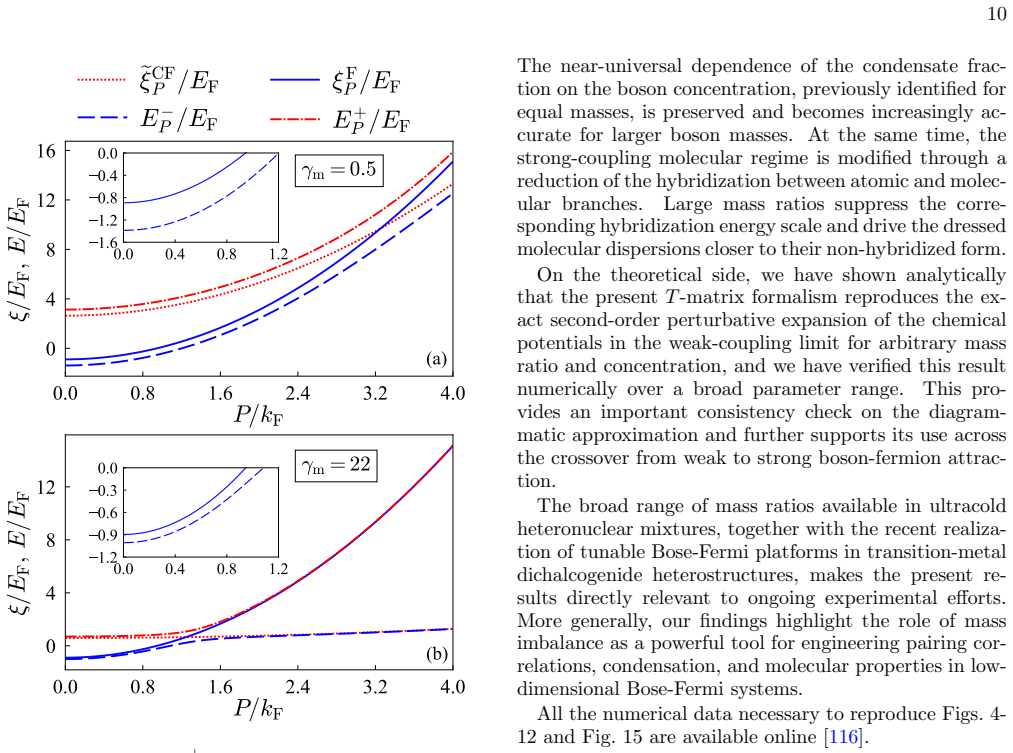
We analyze a two-dimensional Bose-Fermi mixture at zero temperature in the presence of a tunable Bose-Fermi attraction. We adopt a diagrammatic T-matrix approach and study the behavior of several thermodynamic quantities for the two species as functions of density, mass ratio, and coupling strength. These include the chemical potentials, the boson momentum distribution function, the condensate density, and Tan's contact parameter. We analytically demonstrate that the present T-matrix formalism recovers the correct second-order perturbative expansion of the chemical potentials in the weak-coupling regime, and test it numerically. The near-universal behavior of the condensate fraction already found in prior work for the mass-balanced case is confirmed for different masses and becomes even more accurate when the boson mass is large. The mass imbalance emerges as an additional control parameter that qualitatively affects the bosonic momentum distribution. In particular, we found that it can be used to allow for the experimental observation of a peculiar peak in the boson momentum distribution at finite momentum.
Editorial analysis
A structured set of objections, weighed in public.
Referee Report
Summary. The manuscript analyzes mass-imbalanced two-dimensional Bose-Fermi mixtures at zero temperature with tunable boson-fermion attraction using a diagrammatic T-matrix approach. It computes chemical potentials, the boson momentum distribution, condensate density, and Tan's contact as functions of density, mass ratio, and coupling strength. The T-matrix formalism is shown analytically to recover the second-order perturbative expansion for the chemical potentials (with numerical tests), the near-universal condensate fraction is confirmed and found to improve for large boson mass, and mass imbalance is identified as a control parameter that produces a peak in the boson momentum distribution at finite momentum.
Significance. If the T-matrix results for the momentum distribution hold, the work provides a concrete experimental handle (mass ratio) on a qualitative feature in n_b(k) that extends prior mass-balanced studies. The explicit analytic recovery of the perturbative limit for chemical potentials is a clear methodological strength.
major comments (1)
- [Results section on boson momentum distribution (and abstract)] The central qualitative claim—that mass imbalance produces an observable peak in the boson momentum distribution at finite k—rests on the T-matrix ladder resummation. While chemical potentials are verified against second-order perturbation theory, the momentum distribution is a higher-order quantity; the manuscript does not report an independent benchmark (QMC, functional RG, or exact diagonalization) for n_b(k) itself. This leaves open whether the peak is physical or an artifact of the truncation, which is known to omit vertex corrections and particle-hole channels in 2D.
minor comments (2)
- [Method section] Notation for the T-matrix equations and self-energies should be cross-referenced explicitly to the mass-balanced limit to facilitate comparison with prior work.
- [Figure captions] Figure captions for the momentum-distribution plots should state the precise mass ratios and coupling values used, rather than referring only to 'different masses'.
Simulated Author's Rebuttal
We thank the referee for their careful reading of the manuscript, the positive assessment of its significance, and for identifying the need to qualify the results on the boson momentum distribution. We respond to the major comment below.
read point-by-point responses
-
Referee: [Results section on boson momentum distribution (and abstract)] The central qualitative claim—that mass imbalance produces an observable peak in the boson momentum distribution at finite k—rests on the T-matrix ladder resummation. While chemical potentials are verified against second-order perturbation theory, the momentum distribution is a higher-order quantity; the manuscript does not report an independent benchmark (QMC, functional RG, or exact diagonalization) for n_b(k) itself. This leaves open whether the peak is physical or an artifact of the truncation, which is known to omit vertex corrections and particle-hole channels in 2D.
Authors: We agree that the lack of an independent benchmark for n_b(k) constitutes a genuine limitation of the present T-matrix study. While the formalism recovers the second-order perturbative result for the chemical potentials (both analytically and numerically), the momentum distribution is indeed a higher-order observable, and no QMC, functional RG, or exact-diagonalization comparison is available for the mass-imbalanced 2D case. The ladder approximation is standard for pairing problems in Bose-Fermi mixtures, yet it omits vertex corrections and particle-hole channels. In the revised manuscript we will add an explicit discussion of these approximations in the results section, qualify the claim about the finite-momentum peak as a prediction within the T-matrix framework, and note that its experimental observability remains to be confirmed by more advanced methods. revision: yes
- Independent benchmark (QMC, functional RG or exact diagonalization) for the boson momentum distribution n_b(k)
Circularity Check
No circularity: standard T-matrix applied to new regime with explicit perturbative validation
full rationale
The derivation relies on the established diagrammatic T-matrix ladder summation at T=0, which is solved self-consistently for the self-energies and propagators. The paper explicitly demonstrates analytic recovery of the second-order perturbative expansion for chemical potentials in the weak-coupling limit and confirms this numerically, providing an external benchmark independent of the target observables. The boson momentum distribution is obtained directly from the dressed propagators without any fitting, renaming, or reduction to prior self-citations. No self-definitional steps, fitted inputs presented as predictions, or load-bearing uniqueness theorems appear in the derivation chain.
Axiom & Free-Parameter Ledger
Reference graph
Works this paper leans on
-
[1]
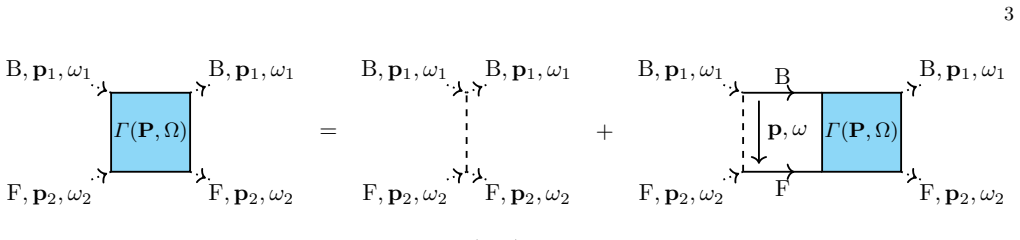
Hamiltonian In the presence of a broad Feshbach resonance tuning the strength of the BF attractive interaction, the (grand- canonical) Hamiltonian is given by 3 Γ(P,Ω) B,p 1, ω1 B,p 1, ω1 F,p 2, ω2 F,p 2, ω2 = B,p 1, ω1 B,p 1, ω1 F,p 2, ω2 F,p 2, ω2 + p, ω B F Γ(P,Ω) B,p 1, ω1 B,p 1, ω1 F,p 2, ω2 F,p 2, ω2 FIG. 1. Feynman diagrams for the particle-particl...
-
[2]
and the Supplemental Material of [102]. One can define an effective BF dimensionless coupling parameterg= ln [1/(k FaBF)] using the Fermi momentum kF = √4πnF of a free Fermi gas with densityn F, in analogy with 2D fermionic systems. With the above definition ofg, one can express the BF binding energy in units of the Fermi energyE F = k2 F/(2mF) asϵ 0/EF =...
-
[3]
We found it convenient to work with theT= 0 limit of the Matsubara formalism, that is, we work with imaginary frequencies iΩ
Many bodyT-matrix The first building block of our diagrammatic theory is the particle-particle ladderΓ, which corresponds to the many-bodyT-matrix in the absence of a condensate, and is represented diagrammatically in Figure 1. We found it convenient to work with theT= 0 limit of the Matsubara formalism, that is, we work with imaginary frequencies iΩ. The...
-
[4]
3(a), corresponding to the convolu- tion of the particle-particle ladderΓ(P,Ω) or the many- bodyT-matrixT(P,Ω) with a condensate density or a free boson propagator, respectively
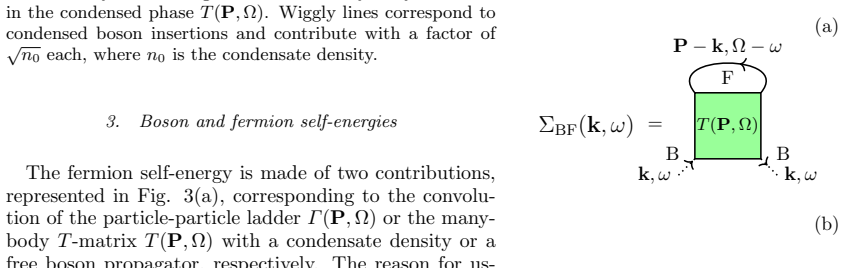
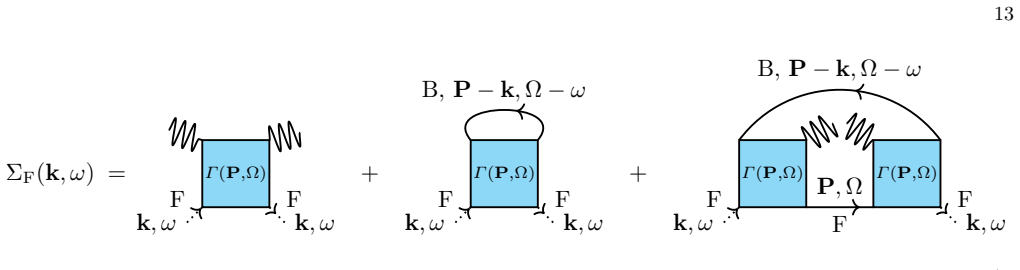
Boson and fermion self-energies The fermion self-energy is made of two contributions, represented in Fig. 3(a), corresponding to the convolu- tion of the particle-particle ladderΓ(P,Ω) or the many- bodyT-matrixT(P,Ω) with a condensate density or a free boson propagator, respectively. The reason for us- ingΓ(P,Ω) rather thanT(P,Ω) in the fist diagram of Fi...
-
[5]
Green’s functions, momentum distributions and densities The dressed fermion Green’s functionG F(k, ω) and dressed Green’s functionG ′ B(k, ω) for non-condensed bosons are obtained by inserting the (irreducible) dia- grams shown in Fig. 3 in Dyson’s equations GF(k, ω)−1 =G 0 F(k, ω)−1 −Σ F(k, ω) (12) G′ B(k, ω)−1 =G 0 B(k, ω)−1 −Σ B(k, ω) + Σ2 12 iω+ξ B k ...
-
[6]
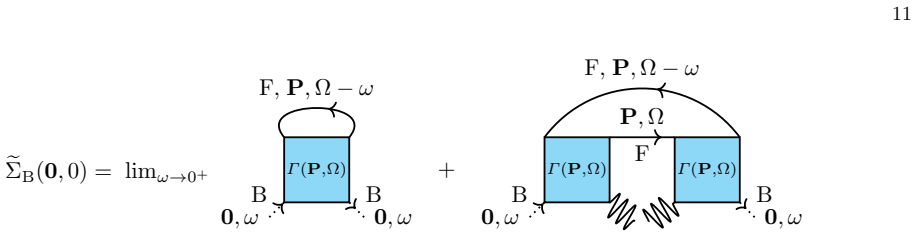
TheΓ-matrix By expandingT 2(P,Ω) in powers of 1/g, it is easy to identify the following perturbative orders of theΓ-matrix 11 ˜Σ B(0,0) = lim ω→0+ Γ(P,Ω) F,P,Ω−ω 0, ω B 0, ω B + Γ(P,Ω) F P,Ω 0, ω B Γ(P,Ω) 0, ω B F,P,Ω−ω FIG. 13. Feynman diagrams yielding the perturbative contributions to the boson chemical potential at first and second order in 1/g, arisi...
-
[7]
The boson chemical potential According to Hugenholtz-Pines theorem (18), in the absence of BB interactions, the integral that determines the boson chemical potential is ΣB(0,0) = Z d2PdΩ (2π)3 T(P,Ω)G 0 F(P,Ω) eiΩ0+ .(A4) We define the momentaP T± as the solutions of the equa- tions P= lim Ω→0+ p 2mF [µF ±n 0|Γ(P,Ω)|] (A5) respectively.P T+ represents the...
-
[8]
According to the Eq
The fermion chemical potential Let us now adapt the arguments developed for the bo- son chemical potential to the fermion case. According to the Eq. (16), the integral that determines the fermion density reads nF = Z d2kdω (2π)3 G0 F(k, ω) 1−G 0 F(k, ω)ΣF(k, ω)eiω0+ .(A11) We define the momentak ± as the solutions to the equa- tions k= q 2mF [µF ± |Σmax F...
-
[9]
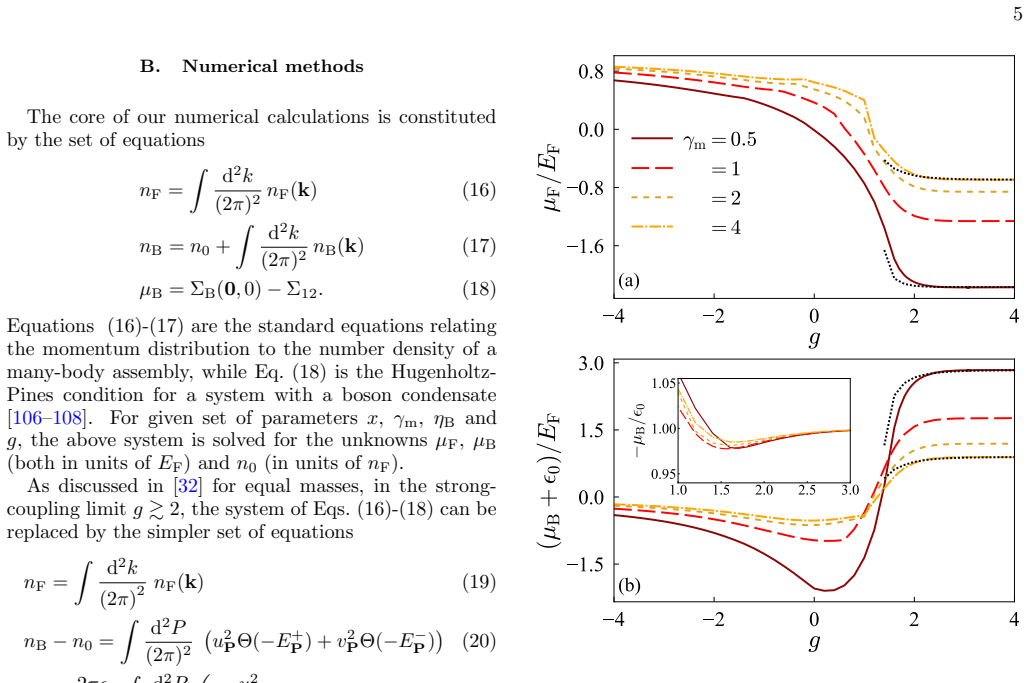
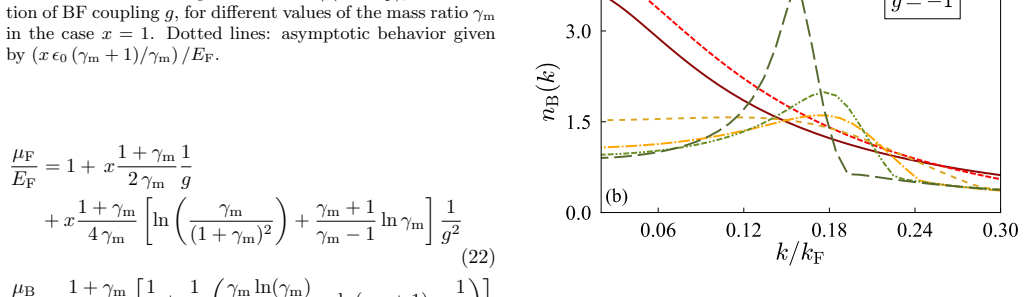
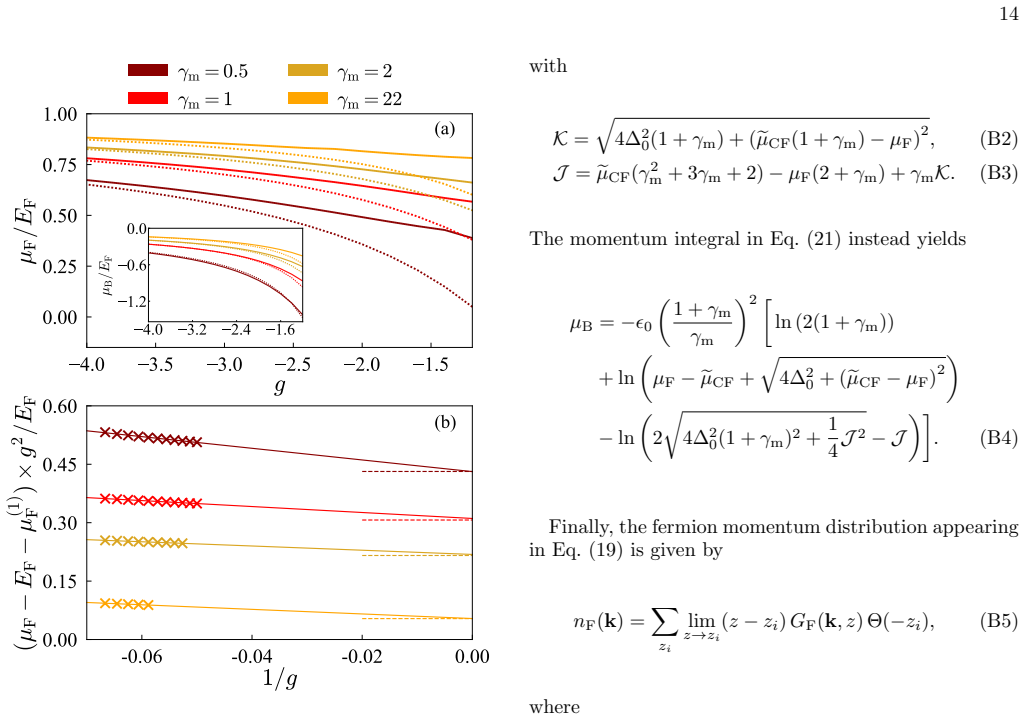
Numerical check Finally, we provide a numerical check of the results for the chemical potentials obtained by the full numerical solution of the set of equations (16)-(18) against their weak-coupling benchmarks. Fig. 15(a) shows that, in the weak coupling regimeg≲−2, the numerical results forµ F approach the asymptotic form given by (22). To isolate the hi...
-
[10]
Powell, S
S. Powell, S. Sachdev, and H. P. B¨ uchler, Depletion of the Bose-Einstein condensate in Bose-Fermi mixtures, Phys. Rev. B72, 024534 (2005)
2005
-
[11]
D. B. M. Dickerscheid, D. van Oosten, E. J. Tillema, and H. T. C. Stoof, Quantum Phases in a Resonantly Interacting Boson-Fermion Mixture, Phys. Rev. Lett. 94, 230404 (2005)
2005
-
[12]
Storozhenko, P
A. Storozhenko, P. Schuck, T. Suzuki, H. Yabu, and J. Dukelsky, Boson-fermion pairing in a boson-fermion environment, Phys. Rev. A71, 063617 (2005)
2005
-
[13]
A. V. Avdeenkov, D. C. E. Bortolotti, and J. L. Bohn, Stability of fermionic Feshbach molecules in a Bose- Fermi mixture, Phys. Rev. A74, 012709 (2006)
2006
-
[14]
Pollet, M
L. Pollet, M. Troyer, K. Van Houcke, and S. M. A. Rombouts, Phase Diagram of Bose-Fermi Mixtures in One-Dimensional Optical Lattices, Phys. Rev. Lett.96, 190402 (2006)
2006
-
[15]
R¨ othel and A
S. R¨ othel and A. Pelster, Density and stability in ul- tracold dilute boson-fermion mixtures, The European Physical Journal B59, 343 (2007)
2007
-
[16]
Barillier-Pertuisel, S
X. Barillier-Pertuisel, S. Pittel, L. Pollet, and P. Schuck, Boson-fermion pairing in Bose-Fermi mixtures on one- dimensional optical lattices, Phys. Rev. A77, 012115 (2008)
2008
-
[17]
Pollet, C
L. Pollet, C. Kollath, U. Schollw¨ ock, and M. Troyer, Mixture of bosonic and spin-polarized fermionic atoms in an optical lattice, Phys. Rev. A77, 023608 (2008)
2008
-
[18]
D. C. E. Bortolotti, A. V. Avdeenkov, and J. L. Bohn, Generalized mean-field approach to a resonant Bose- Fermi mixture, Phys. Rev. A78, 063612 (2008)
2008
-
[19]
F. M. Marchetti, C. J. M. Mathy, D. A. Huse, and M. M. Parish, Phase separation and collapse in Bose- Fermi mixtures with a Feshbach resonance, Phys. Rev. B78, 134517 (2008). 15
2008
-
[20]
Watanabe, T
T. Watanabe, T. Suzuki, and P. Schuck, Bose-Fermi pair correlations in attractively interacting Bose-Fermi atomic mixtures, Phys. Rev. A78, 033601 (2008)
2008
-
[21]
Fratini and P
E. Fratini and P. Pieri, Pairing and condensation in a resonant Bose-Fermi mixture, Phys. Rev. A81, 051605 (2010)
2010
-
[22]
Z.-Q. Yu, S. Zhang, and H. Zhai, Stability condition of a strongly interacting boson-fermion mixture across an interspecies Feshbach resonance, Phys. Rev. A83, 041603 (2011)
2011
-
[23]
Song and F
J.-L. Song and F. Zhou, Anomalous dimers in quantum mixtures near broad resonances: Pauli blocking, Fermi surface dynamics, and implications, Phys. Rev. A84, 013601 (2011)
2011
-
[24]
Ludwig, S
D. Ludwig, S. Floerchinger, S. Moroz, and C. Wet- terich, Quantum phase transition in Bose-Fermi mix- tures, Phys. Rev. A84, 033629 (2011)
2011
-
[25]
Fratini and P
E. Fratini and P. Pieri, Mass imbalance effect in res- onant Bose-Fermi mixtures, Phys. Rev. A85, 063618 (2012)
2012
-
[26]
Anders, P
P. Anders, P. Werner, M. Troyer, M. Sigrist, and L. Pol- let, From the Cooper Problem to Canted Supersolids in Bose-Fermi Mixtures, Phys. Rev. Lett.109, 206401 (2012)
2012
-
[27]
Bertaina, E
G. Bertaina, E. Fratini, S. Giorgini, and P. Pieri, Quan- tum Monte Carlo Study of a Resonant Bose-Fermi Mix- ture, Phys. Rev. Lett.110, 115303 (2013)
2013
-
[28]
Fratini and P
E. Fratini and P. Pieri, Single-particle spectral functions in the normal phase of a strongly attractive Bose-Fermi mixture, Phys. Rev. A88, 013627 (2013)
2013
-
[29]
T. Sogo, P. Schuck, and M. Urban, Bose-Fermi pairs in a mixture and the Luttinger theorem within a Nozi` eres- Schmitt-Rink-like approach, Phys. Rev. A88, 023613 (2013)
2013
-
[30]
Guidini, G
A. Guidini, G. Bertaina, E. Fratini, and P. Pieri, Bose- Fermi mixtures in the molecular limit, Phys. Rev. A89, 023634 (2014)
2014
-
[31]
Guidini, G
A. Guidini, G. Bertaina, D. E. Galli, and P. Pieri, Con- densed phase of Bose-Fermi mixtures with a pairing in- teraction, Phys. Rev. A91, 023603 (2015)
2015
-
[32]
Bertaina, A
G. Bertaina, A. Guidini, and P. Pieri, Quantum Monte Carlo study of the indirect Pauli exclusion effect in Bose- Fermi mixtures, The European Physical Journal Special Topics224, 497 (2015)
2015
-
[33]
Kharga, D
D. Kharga, D. Inotani, R. Hanai, and Y. Ohashi, Single- Particle Properties of a Strongly Interacting Bose–Fermi Mixture Above the BEC Phase Transition Temperature, Journal of Low Temperature Physics187, 661 (2017)
2017
-
[34]
Manabe, D
K. Manabe, D. Inotani, and Y. Ohashi, Single-particle properties of a strongly interacting Bose-Fermi mixture with mass and population imbalance, Phys. Rev. A100, 063609 (2019)
2019
-
[35]
Manabe and Y
K. Manabe and Y. Ohashi, Thermodynamic Stability and Effects of Bose–Bose Repulsion in an Ultracold Bose–Fermi Mixture with Strong Hetero-Pairing Fluc- tuations, Journal of Low Temperature Physics201, 65 (2020)
2020
-
[36]
Manabe and Y
K. Manabe and Y. Ohashi, Thermodynamic stability, compressibility matrices, and effects of mediated inter- actions in a strongly interacting Bose-Fermi mixture, Phys. Rev. A103, 063317 (2021)
2021
-
[37]
von Milczewski, F
J. von Milczewski, F. Rose, and R. Schmidt, Functional- renormalization-group approach to strongly coupled Bose-Fermi mixtures in two dimensions, Phys. Rev. A 105, 013317 (2022)
2022
-
[38]
Guo and H
Y. Guo and H. Tajima, Medium-induced bosonic clus- ters in a Bose-Fermi mixture: Toward simulating cluster formations in neutron-rich matter, Phys. Rev. A109, 013319 (2024)
2024
-
[39]
X. Shen, N. Davidson, G. M. Bruun, M. Sun, and Z. Wu, Strongly Interacting Bose-Fermi Mixtures: Mediated Interaction, Phase Diagram, and Sound Propagation, Phys. Rev. Lett.132, 033401 (2024)
2024
-
[40]
Pastukhov, Strongly interacting Bose-Fermi mixtures in 4−ϵdimensions, Annals of Physics468, 169745 (2024)
V. Pastukhov, Strongly interacting Bose-Fermi mixtures in 4−ϵdimensions, Annals of Physics468, 169745 (2024)
2024
-
[41]
Pisani, P
L. Pisani, P. Bovini, F. Pavan, and P. Pieri, Boson- fermion pairing and condensation in two-dimensional Bose-Fermi mixtures, SciPost Phys.18, 076 (2025)
2025
-
[42]
Gualerzi, L
C. Gualerzi, L. Pisani, and P. Pieri, Mechanical stability of resonant Bose-Fermi mixtures, SciPost Phys.19, 039 (2025)
2025
- [43]
-
[44]
K.-K. Ni, S. Ospelkaus, M. H. G. de Miranda, A. Pe’er, B. Neyenhuis, J. J. Zirbel, S. Kotochigova, P. S. Juli- enne, D. S. Jin, and J. Ye, A High Phase-Space-Density Gas of Polar Molecules, Science322, 231 (2008)
2008
-
[45]
C.-H. Wu, I. Santiago, J. W. Park, P. Ahmadi, and M. W. Zwierlein, Strongly interacting isotopic Bose- Fermi mixture immersed in a Fermi sea, Phys. Rev. A 84, 011601 (2011)
2011
-
[46]
C.-H. Wu, J. W. Park, P. Ahmadi, S. Will, and M. W. Zwierlein, Ultracold Fermionic Feshbach Molecules of 23Na 40K, Phys. Rev. Lett.109, 085301 (2012)
2012
-
[47]
J. W. Park, C.-H. Wu, I. Santiago, T. G. Tiecke, S. Will, P. Ahmadi, and M. W. Zwierlein, Quantum degener- ate Bose-Fermi mixture of chemically different atomic species with widely tunable interactions, Phys. Rev. A 85, 051602 (2012)
2012
-
[48]
M.-S. Heo, T. T. Wang, C. A. Christensen, T. M. Rva- chov, D. A. Cotta, J.-H. Choi, Y.-R. Lee, and W. Ket- terle, Formation of ultracold fermionic NaLi Feshbach molecules, Phys. Rev. A86, 021602 (2012)
2012
-
[49]
T. D. Cumby, R. A. Shewmon, M.-G. Hu, J. D. Per- reault, and D. S. Jin, Feshbach-molecule formation in a Bose-Fermi mixture, Phys. Rev. A87, 012703 (2013)
2013
-
[50]
R. S. Bloom, M.-G. Hu, T. D. Cumby, and D. S. Jin, Tests of Universal Three-Body Physics in an Ultra- cold Bose-Fermi Mixture, Phys. Rev. Lett.111, 105301 (2013)
2013
-
[51]
V. D. Vaidya, J. Tiamsuphat, S. L. Rolston, and J. V. Porto, Degenerate Bose-Fermi mixtures of rubidium and ytterbium, Phys. Rev. A92, 043604 (2015)
2015
-
[52]
Ferrier-Barbut, M
I. Ferrier-Barbut, M. Delehaye, S. Laurent, A. T. Grier, M. Pierce, B. S. Rem, F. Chevy, and C. Salomon, A mix- ture of Bose and Fermi superfluids, Science345, 1035 (2014)
2014
-
[53]
Delehaye, S
M. Delehaye, S. Laurent, I. Ferrier-Barbut, S. Jin, F. Chevy, and C. Salomon, Critical Velocity and Dis- sipation of an Ultracold Bose-Fermi Counterflow, Phys. Rev. Lett.115, 265303 (2015)
2015
-
[54]
M.-G. Hu, M. J. Van de Graaff, D. Kedar, J. P. Cor- son, E. A. Cornell, and D. S. Jin, Bose Polarons in the Strongly Interacting Regime, Phys. Rev. Lett.117, 055301 (2016)
2016
-
[55]
Wu, X.-C
Y.-P. Wu, X.-C. Yao, H.-Z. Chen, X.-P. Liu, X.-Q. 16 Wang, Y.-A. Chen, and J.-W. Pan, A quantum degen- erate Bose–Fermi mixture of 41K and 6Li, J. Phys. B At. Mol. Opt. Phys.50, 094001 (2017)
2017
-
[56]
R. Roy, A. Green, R. Bowler, and S. Gupta, Two- Element Mixture of Bose and Fermi Superfluids, Phys. Rev. Lett.118, 055301 (2017)
2017
-
[57]
B. J. DeSalvo, K. Patel, J. Johansen, and C. Chin, Ob- servation of a Degenerate Fermi Gas Trapped by a Bose- Einstein Condensate, Phys. Rev. Lett.119, 233401 (2017)
2017
-
[58]
Trautmann, P
A. Trautmann, P. Ilzh¨ ofer, G. Durastante, C. Politi, M. Sohmen, M. J. Mark, and F. Ferlaino, Dipolar Quan- tum Mixtures of Erbium and Dysprosium Atoms, Phys. Rev. Lett.121, 213601 (2018)
2018
-
[59]
R. S. Lous, I. Fritsche, M. Jag, F. Lehmann, E. Kir- ilov, B. Huang, and R. Grimm, Probing the Interface of a Phase-Separated State in a Repulsive Bose-Fermi Mixture, Phys. Rev. Lett.120, 243403 (2018)
2018
-
[60]
B. J. DeSalvo, K. Patel, G. Cai, and C. Chin, Observa- tion of fermion-mediated interactions between bosonic atoms, Nature568, 61 (2019)
2019
-
[61]
L. D. Marco, G. Valtolina, K. Matsuda, W. G. Tobias, J. P. Covey, and J. Ye, A degenerate Fermi gas of polar molecules, Science363, 853 (2019)
2019
-
[62]
Z. Z. Yan, Y. Ni, C. Robens, and M. W. Zwierlein, Bose polarons near quantum criticality, Science368, 190 (2020)
2020
-
[63]
Ye, L.-Y
Z.-X. Ye, L.-Y. Xie, Z. Guo, X.-B. Ma, G.-R. Wang, L. You, and M. K. Tey, Double-degenerate Bose-Fermi mixture of strontium and lithium, Phys. Rev. A102, 033307 (2020)
2020
-
[64]
H. Edri, B. Raz, N. Matzliah, N. Davidson, and R. Oz- eri, Observation of Spin-Spin Fermion-Mediated Inter- actions between Ultracold Bosons, Phys. Rev. Lett.124, 163401 (2020)
2020
-
[65]
Fritsche, C
I. Fritsche, C. Baroni, E. Dobler, E. Kirilov, B. Huang, R. Grimm, G. M. Bruun, and P. Massignan, Stability and breakdown of Fermi polarons in a strongly inter- acting Fermi-Bose mixture, Phys. Rev. A103, 053314 (2021)
2021
-
[66]
Schindewolf, R
A. Schindewolf, R. Bause, X.-Y. Chen, M. Duda, T. Karman, I. Bloch, and X.-Y. Luo, Evaporation of microwave-shielded polar molecules to quantum degen- eracy, Nature607, 677 (2022)
2022
-
[67]
X.-Y. Chen, M. Duda, A. Schindewolf, R. Bause, I. Bloch, and X.-Y. Luo, Suppression of Unitary Three- Body Loss in a Degenerate Bose-Fermi Mixture, Phys. Rev. Lett.128, 153401 (2022)
2022
-
[68]
Duda, X.-Y
M. Duda, X.-Y. Chen, A. Schindewolf, R. Bause, J. von Milczewski, R. Schmidt, I. Bloch, and X.-Y. Luo, Tran- sition from a polaronic condensate to a degenerate Fermi gas of heteronuclear molecules, Nature Physics19, 720 (2023)
2023
-
[69]
Patel, G
K. Patel, G. Cai, H. Ando, and C. Chin, Sound Propa- gation in a Bose-Fermi Mixture: From Weak to Strong Interactions, Phys. Rev. Lett.131, 083003 (2023)
2023
-
[70]
Baroni, B
C. Baroni, B. Huang, I. Fritsche, E. Dobler, G. Anich, E. Kirilov, R. Grimm, M. A. Bastarrachea-Magnani, P. Massignan, and G. M. Bruun, Mediated interactions between Fermi polarons and the role of impurity quan- tum statistics, Nature Physics20, 68 (2024)
2024
-
[71]
Z. Z. Yan, Y. Ni, A. Chuang, P. E. Dolgirev, K. Seetharam, E. Demler, C. Robens, and M. Zwier- lein, Collective flow of fermionic impurities immersed in a Bose–Einstein condensate, Nature Physics20, 1395 (2024)
2024
-
[72]
A. Y. Chuang, H. Q. Bui, A. Christianen, Y. Zhang, Y. Ni, D. Ahmed-Braun, C. Robens, and M. Zwier- lein, Observation of a Halo Trimer in an Ultracold Bose- Fermi Mixture, Phys. Rev. X15, 021098 (2025)
2025
-
[73]
De Martino, F
A. De Martino, F. Kiesel, J. Auch, K. Karpov, and C. Gross, Dissipationless tune-out trapping for a lanthanide–alkali-metal quantum gas mixture, Phys. Rev. A112, L051304 (2025)
2025
-
[74]
H. Ando, G. Cai, C. Chin, and T. Enss, Me- diated interactions in mixtures of ultracold atoms, arXiv:2511.09745
-
[75]
Huang, I
B. Huang, I. Fritsche, R. S. Lous, C. Baroni, J. T. M. Walraven, E. Kirilov, and R. Grimm, Breathing mode of a Bose-Einstein condensate repulsively interacting with a fermionic reservoir, Phys. Rev. A99, 041602 (2019)
2019
-
[76]
Schmidt, M
R. Schmidt, M. Knap, D. A. Ivanov, J.-S. You, M. Cetina, and E. Demler, Universal many-body re- sponse of heavy impurities coupled to a Fermi sea: a re- view of recent progress, Reports on Progress in Physics 81, 024401 (2018)
2018
-
[77]
Scazza, M
F. Scazza, M. Zaccanti, P. Massignan, M. M. Parish, and J. Levinsen, Repulsive Fermi and Bose Polarons in Quantum Gases, Atoms10, 55 (2022)
2022
-
[78]
Massignan, M
P. Massignan, M. Zaccanti, and G. M. Bruun, Polarons, dressed molecules and itinerant ferromagnetism in ul- tracold Fermi gases, Reports on Progress in Physics77, 034401 (2014)
2014
-
[79]
Wu, X.-C
Y.-P. Wu, X.-C. Yao, X.-P. Liu, X.-Q. Wang, Y.-X. Wang, H.-Z. Chen, Y. Deng, Y.-A. Chen, and J.-W. Pan, Coupled dipole oscillations of a mass-imbalanced Bose-Fermi superfluid mixture, Phys. Rev. B97, 020506 (2018)
2018
-
[80]
J. J. Kinnunen, Z. Wu, and G. M. Bruun, Inducedp- Wave Pairing in Bose-Fermi Mixtures, Phys. Rev. Lett. 121, 253402 (2018)
2018
discussion (0)
Sign in with ORCID, Apple, or X to comment. Anyone can read and Pith papers without signing in.