Pre-nova Observations of T CrB: A view from the CHARA Array
Pith reviewed 2026-06-27 02:08 UTC · model grok-4.3
The pith
CHARA Array observations measure the red giant in T CrB at 0.70 mas, matching its Roche lobe radius.
A machine-rendered reading of the paper's core claim, the machinery that carries it, and where it could break.
Core claim
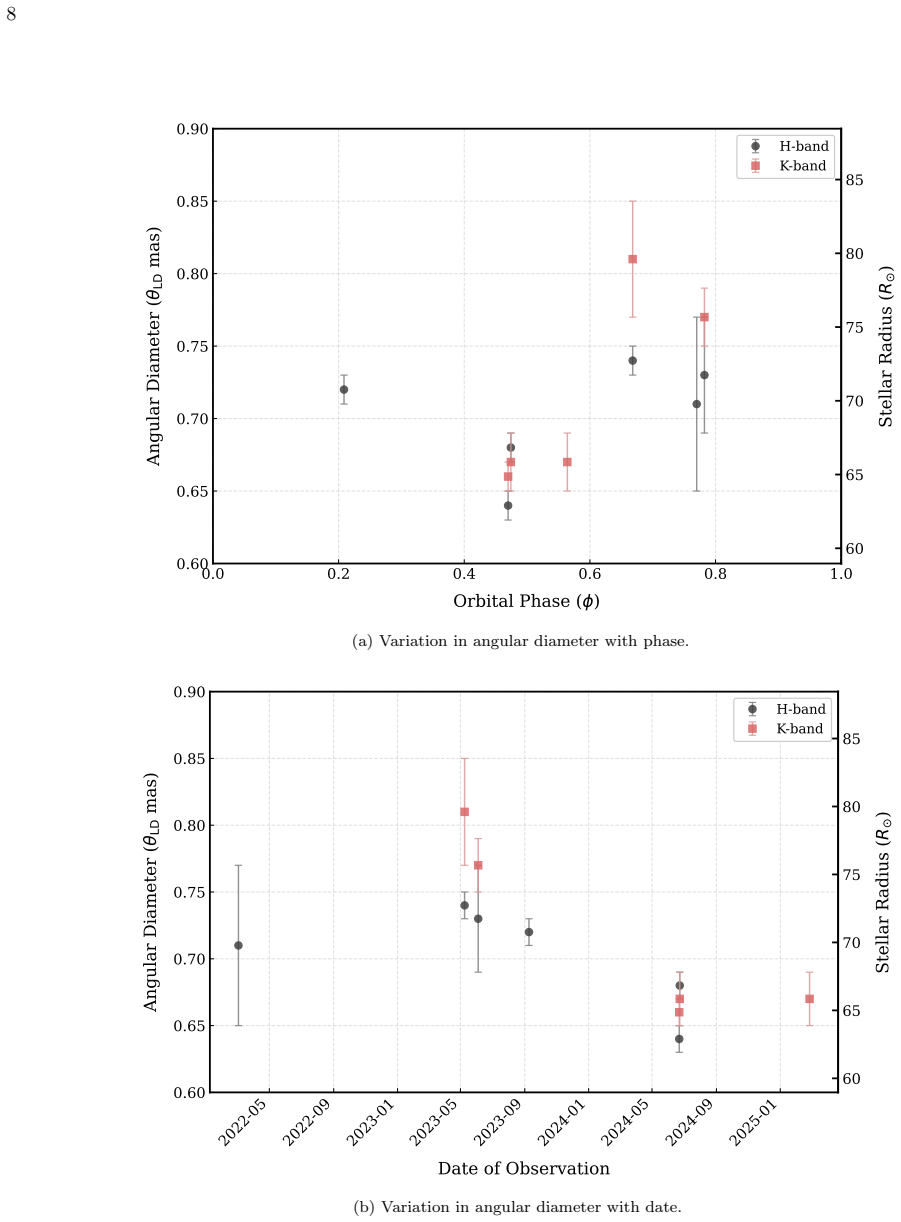
The average limb darkened diameter of the star is 0.70±0.04 mas in H-band and 0.72±0.07 mas in K-band. Adopting a distance of 914 pc, the stellar radius is 69±5 R⊙ in H-band and 71±8 R⊙ in K-band. This is consistent with filling a Roche lobe volume radius of 71 R⊙ inferred from published orbital solutions.
What carries the argument
Limb darkened disk models fitted to squared visibilities from MIRC-X and MYSTIC on the CHARA Array.
If this is right
- The red giant donor fills its Roche lobe.
- A pre-eruption angular diameter baseline is now available for T CrB.
- The radius is consistent between H and K bands.
- The measurements support models of the symbiotic binary configuration.
Where Pith is reading between the lines
- Future post-eruption observations could reveal if the radius changes.
- This approach may be used on other recurrent novae to check donor filling factors.
- Improved distance measurements would refine the radius comparison.
Load-bearing premise
The distance of 914 pc and limb-darkening coefficients from prior work apply to T CrB's red giant without change.
What would settle it
A significantly different parallax distance or interferometric diameter that makes the radius inconsistent with the Roche lobe radius would disprove the support for a filling donor.
Figures
read the original abstract
T CrB is a symbiotic recurrent nova consisting of a red giant and white dwarf with recent eruptions in 1866 and 1946 and an anticipated eruption in the mid 2020s. We report CHARA Array observations obtained with MIRC-X (H -band) and MYSTIC (K-band) in 2022-2025. We fit limb darkened disk models constrained with literature limb darkening coefficients to the squared visibilities as only the first visibility lobe is sampled. The average limb darkened diameter of the star across these epochs is $0.70\pm0.04$ mas in H-band and $0.72\pm0.07$ mas in K-band. Adopting a distance of $914^{+24}_{-22}$ pc, the stellar radius is $69\pm5~R_{\odot}$ in H-band and $71\pm8~R_{\odot}$ in K-band. This is consistent with filling a Roche lobe volume radius of $71~R_{\odot}$ inferred from published orbital solutions. These measurements provide a pre-eruption angular diameter and support a Roche lobe filling donor.
Editorial analysis
A structured set of objections, weighed in public.
Referee Report
Summary. The paper presents CHARA Array interferometric observations of the symbiotic recurrent nova T CrB in H and K bands from 2022-2025, fitting limb-darkened disk models constrained by literature limb-darkening coefficients to the squared visibilities (only the first lobe sampled). It reports average limb-darkened diameters of 0.70±0.04 mas (H-band) and 0.72±0.07 mas (K-band); adopting a distance of 914 pc yields stellar radii of 69±5 R⊙ and 71±8 R⊙, consistent with the 71 R⊙ Roche-lobe volume radius from orbital solutions, thereby providing a pre-eruption angular diameter and supporting a Roche-lobe filling donor.
Significance. If the external distance and limb-darkening coefficients prove appropriate, these are among the first direct interferometric angular-diameter measurements of a recurrent-nova donor star before eruption, supplying a concrete datum that can be compared against evolutionary models of mass transfer and eruption recurrence in symbiotic systems.
major comments (2)
- [Abstract] Abstract: the claim that the derived radii (69–71 R⊙) are 'consistent with' the Roche-lobe volume radius of 71 R⊙ is load-bearing for the central interpretation, yet rests on an adopted distance of 914 pc taken from prior literature; any systematic offset comparable to the quoted distance uncertainty (±22–24 pc) scales the physical radius by an amount comparable to the reported ±5–8 R⊙ uncertainties, removing the apparent agreement.
- [Abstract] Abstract: because only the first visibility lobe is sampled, the limb-darkened disk fits are constrained by literature limb-darkening coefficients; the manuscript supplies no quantitative fit diagnostics (reduced χ², residual plots, or tests of alternative LD laws) that would allow assessment of whether the model is adequate or whether the quoted diameter uncertainties fully capture possible systematic bias from the LD choice.
minor comments (1)
- [Abstract] The abstract should state whether the reported diameter uncertainties are purely statistical or already incorporate contributions from the fixed LD coefficients and distance.
Simulated Author's Rebuttal
We thank the referee for their careful review and constructive comments on our manuscript. We address each major comment below and indicate where revisions will be made.
read point-by-point responses
-
Referee: [Abstract] Abstract: the claim that the derived radii (69–71 R⊙) are 'consistent with' the Roche-lobe volume radius of 71 R⊙ is load-bearing for the central interpretation, yet rests on an adopted distance of 914 pc taken from prior literature; any systematic offset comparable to the quoted distance uncertainty (±22–24 pc) scales the physical radius by an amount comparable to the reported ±5–8 R⊙ uncertainties, removing the apparent agreement.
Authors: The stellar radius uncertainties (69±5 R⊙ and 71±8 R⊙) are derived after propagating the adopted distance uncertainty (914^{+24}_{-22} pc). The central values remain consistent with the Roche-lobe radius of 71 R⊙ within the reported 1σ errors. We will revise the abstract and add a clarifying sentence in the discussion to explicitly state that the consistency holds within the combined uncertainties on radius and distance. revision: partial
-
Referee: [Abstract] Abstract: because only the first visibility lobe is sampled, the limb-darkened disk fits are constrained by literature limb-darkening coefficients; the manuscript supplies no quantitative fit diagnostics (reduced χ², residual plots, or tests of alternative LD laws) that would allow assessment of whether the model is adequate or whether the quoted diameter uncertainties fully capture possible systematic bias from the LD choice.
Authors: We agree that quantitative fit diagnostics are needed to allow readers to evaluate model adequacy and possible systematic effects from the adopted limb-darkening coefficients. In the revised manuscript we will report the reduced χ² for each epoch, include a description of the visibility residuals, and add a brief discussion of the limb-darkening coefficients drawn from the literature together with any sensitivity tests performed. revision: yes
Circularity Check
No circularity: angular diameter obtained from direct visibility fit; radius uses external adopted distance and LD coefficients.
full rationale
The derivation chain consists of fitting limb-darkened disk models (constrained only by external literature LD coefficients) to the squared visibilities to obtain angular diameter, followed by multiplication by an adopted external distance (914 pc) to yield physical radius for comparison against an independent orbital Roche-lobe value. None of these steps reduces by the paper's own equations to a fitted parameter or self-citation chain; the angular diameter is a direct interferometric observable and the distance is explicitly external. This is a standard measurement-plus-adopted-constant workflow with no self-definitional or fitted-input-called-prediction structure.
Axiom & Free-Parameter Ledger
free parameters (1)
- adopted distance =
914 pc
axioms (2)
- domain assumption Literature limb-darkening coefficients are applicable without adjustment to the red giant in T CrB
- domain assumption The star can be adequately modeled as a limb-darkened disk when only the first visibility lobe is sampled
Reference graph
Works this paper leans on
-
[1]
2011, A&A, 535, A68, doi: 10.1051/0004-6361/201117719
Absil, O., Le Bouquin, J.-B., Berger, J.-P., et al. 2011, A&A, 535, A68, doi: 10.1051/0004-6361/201117719
-
[2]
Anugu, N., Le Bouquin, J.-B., Monnier, J. D., et al. 2020, AJ, 160, 158, doi: 10.3847/1538-3881/aba957
-
[3]
Demleitner, M., & Andrae, R. 2021, The Astronomical Journal, 161, 147, doi: 10.3847/1538-3881/abd806
work page internal anchor Pith review doi:10.3847/1538-3881/abd806 2021
-
[4]
2017, VizieR Online Data Catalog: JMMC Stellar Diameters Catalogue - JSDC
Bourges, L., Mella, G., Lafrasse, S., et al. 2017, VizieR Online Data Catalog: JMMC Stellar Diameters Catalogue - JSDC. Version 2 (Bourges+, 2017), VizieR On-line Data Catalog: II/346. Originally published in: 2014ASPC..485..223B
2017
-
[5]
Chesneau, O., & Banerjee, D. P. K. 2012, Bulletin of the Astronomical Society of India, 40, 267, doi: 10.48550/arXiv.1210.2507
work page internal anchor Pith review Pith/arXiv arXiv doi:10.48550/arxiv.1210.2507 2012
-
[6]
Chomiuk, L., Metzger, B. D., & Shen, K. J. 2021, ARA&A, 59, 391, doi: 10.1146/annurev-astro-112420-114502
-
[7]
2011a, A&A, 529, A75, doi: 10.1051/0004-6361/201116451 —
Claret, A., & Bloemen, S. 2011a, A&A, 529, A75, doi: 10.1051/0004-6361/201116451 —. 2011b, VizieR Online Data Catalog: Limb-darkening coefficients (Claret+, 2011), VizieR On-line Data Catalog: J/A+A/529/A75. Originally published in: 2011A&A...529A..75C, doi: 10.26093/cds/vizier.35290075
-
[8]
Colavita, M. M., Wallace, J. K., Hines, B. E., et al. 1999, The Astrophysical Journal, 510, 505, doi: 10.1086/306579
-
[9]
2019, MNRAS, 490, 3691, doi: 10.1093/mnras/stz2765
Delgado, L., & Hernanz, M. 2019, MNRAS, 490, 3691, doi: 10.1093/mnras/stz2765
-
[10]
Eggleton, P. P. 1983, ApJ, 268, 368, doi: 10.1086/160960
-
[11]
Evans, A., Pavlenko, Y. V., Banerjee, D. P. K., et al. 2019, MNRAS, 486, 3498, doi: 10.1093/mnras/stz1071 Gaia Collaboration. 2022, Gaia Data Release 3 (DR3), DOI: https://doi.org/10.5270/esa-qa4lep3, European Space Agency (ESA). https://doi.org/10.5270/esa-qa4lep3 Gaia Collaboration, Prusti, T., de Bruijne, J. H. J., et al. 2016, A&A, 595, A1, doi: 10.10...
-
[12]
2015, A&A, 579, A68, doi: 10.1051/0004-6361/201525917
Gallenne, A., M´ erand, A., Kervella, P., et al. 2015, A&A, 579, A68, doi: 10.1051/0004-6361/201525917
-
[13]
Gardner, T., Monnier, J. D., Fekel, F. C., et al. 2022, AJ, 164, 184, doi: 10.3847/1538-3881/ac8eae
-
[14]
2019, MNRAS, 489, 2595, doi: 10.1093/mnras/stz2240
Hadjara, M., Cruzal` ebes, P., Nitschelm, C., et al. 2019, MNRAS, 489, 2595, doi: 10.1093/mnras/stz2240
-
[15]
1997, A&A, 327, 199
Hestroffer, D. 1997, A&A, 327, 199
1997
-
[16]
Hinkle, K. H., Nagarajan, P., Fekel, F. C., et al. 2025, ApJ, 983, 76, doi: 10.3847/1538-4357/adbe63
-
[17]
P., Luna, G
Kuin, N. P., Luna, G. J. M., Page, K., et al. 2023, The Astronomer’s Telegram, 16114, 1 Le Bouquin, J.-B., Anugu, N., Davies, C. L., et al. 2024, CHARA MIRC-X and MYSTIC Data Reduction
2023
-
[18]
Pipeline, Zenodo, doi: 10.5281/zenodo.12735292
-
[19]
Parallax bias versus magnitude, colour, and position
Lindegren, L., Bastian, U., Biermann, M., et al. 2021, A&A, 649, A4, doi: 10.1051/0004-6361/202039653
-
[20]
Luna, G. J. M., Kuin, N. P. M., Mukai, K., et al. 2026, A&A, 707, A102, doi: 10.1051/0004-6361/202557435
-
[21]
Luna, G. J. M., Sokoloski, J. L., Mukai, K., & Kuin, N. P. M. 2020, The Astrophysical Journal Letters, 902, L14, doi: 10.3847/2041-8213/abbb2c
-
[22]
2023, The Astronomer’s Telegram, 16214, 1
Marchev, V., Zamanov, R., & Marchev, D. 2023, The Astronomer’s Telegram, 16214, 1
2023
-
[23]
Roettenbacher, R. M., & Parks, J. R. 2021, ApJ, 916, 60, doi: 10.3847/1538-4357/ac06a5
-
[24]
Maslennikova, N. A., Tatarnikov, A. M., Tatarnikova, A. A., et al. 2023, Astronomy Letters, 49, 501, doi: 10.1134/S1063773723090037
-
[25]
Merc, J., Wyrzykowski, L., Beck, P. G., et al. 2025, MNRAS, 541, L14, doi: 10.1093/mnrasl/slaf047
-
[26]
2023, Research Notes of the AAS, 7, 251, doi: 10.3847/2515-5172/ad0f26
Munari, U. 2023, Research Notes of the AAS, 7, 251, doi: 10.3847/2515-5172/ad0f26
-
[27]
2016, NewA, 47, 7, doi: 10.1016/j.newast.2016.01.002
Munari, U., Dallaporta, S., & Cherini, G. 2016, NewA, 47, 7, doi: 10.1016/j.newast.2016.01.002
-
[28]
2025, A&A, 701, A176, doi: 10.1051/0004-6361/202555917 M´ erand, A., Astro-mh, & Gomes, T
Munari, U., Walter, F., Masetti, N., et al. 2025, A&A, 701, A176, doi: 10.1051/0004-6361/202555917 M´ erand, A., Astro-mh, & Gomes, T. 2024, amerand/PMOIRED: cleanup and removing examples, 1.2, Zenodo, doi: 10.5281/zenodo.10889235 11
-
[29]
2012, ApJ, 748, 43, doi: 10.1088/0004-637X/748/1/43
Chomiuk, L. 2012, ApJ, 748, 43, doi: 10.1088/0004-637X/748/1/43
-
[30]
Orio, M., Behar, E., Luna, G. J. M., et al. 2022, ApJ, 938, 34, doi: 10.3847/1538-4357/ac8f46
-
[31]
2026, A&A, 706, A94, doi: 10.1051/0004-6361/202557346
Pei, S., Zhang, X., Su, R., et al. 2026, A&A, 706, A94, doi: 10.1051/0004-6361/202557346
-
[32]
2025, A&A, 694, A85, doi: 10.1051/0004-6361/202452833
Planquart, L., Jorissen, A., & Van Winckel, H. 2025, A&A, 694, A85, doi: 10.1051/0004-6361/202452833
-
[33]
2011, Msc thesis, K.U
Rogge, S. 2011, Msc thesis, K.U. Leuven, Leuven, Belgium
2011
-
[34]
Schaefer, B. E. 2022, MNRAS, 517, 6150, doi: 10.1093/mnras/stac2900
-
[35]
Schaefer, B. E. 2023a, Monthly Notices of the Royal Astronomical Society, 524, 3146, doi: 10.1093/mnras/stad735 —. 2023b, Journal for the History of Astronomy, 54, 436, doi: 10.1177/00218286231200492
-
[36]
Observers, T. A. 2023, The Astronomer’s Telegram, 16107, 1
2023
-
[37]
Setterholm, B. R., Monnier, J. D., Le Bouquin, J.-B., et al. 2023, Journal of Astronomical Telescopes, Instruments, and Systems, 9, 025006, doi: 10.1117/1.JATIS.9.2.025006
-
[38]
1997, MNRAS, 288, 1027, doi: 10.1093/mnras/288.4.1027
Shahbaz, T., Somers, M., Yudin, B., & Naylor, T. 1997, MNRAS, 288, 1027, doi: 10.1093/mnras/288.4.1027
-
[39]
Sokoloski, J. L., Luna, G. J. M., Mukai, K., & Kenyon, S. J. 2006, Nature, 442, 276, doi: 10.1038/nature04893 ten Brummelaar, T. A., McAlister, H. A., Ridgway, S. T., et al. 2005, ApJ, 628, 453, doi: 10.1086/430729
-
[40]
Teyssier, F., Hinnefeld, J. D., Boussin, C., et al. 2023, The Astronomer’s Telegram, 16109, 1 van Belle, G. T., van Belle, G., Creech-Eakman, M. J., et al. 2008, ApJS, 176, 276, doi: 10.1086/526548
-
[41]
K., Marchev, V., Marti, J., & Latev, G
Zamanov, R. K., Marchev, V., Marti, J., & Latev, G. Y. 2023, Pre-outburst signal in the light curves of the recurrent novae RS Oph and T CrB, doi: 10.48550/arXiv.2308.04104 12 APPENDIX A.ADDITIONAL PLOTS 10 3 10 2 10 1 100 V² E1-E2 E1-S1 E1-W2 S1-E2 W2-E2 W2-S1 model 0 50 100 150 200 250 Baseline (M ) 4 2 0 2 Residuals ( ) (a) 2022-03-03 (H) 10 3 10 2 10 ...
discussion (0)
Sign in with ORCID, Apple, or X to comment. Anyone can read and Pith papers without signing in.