Improved limits on a new Z' in B-L scenarios with the NA64 experiment at CERN
Pith reviewed 2026-06-27 01:51 UTC · model grok-4.3
The pith
NA64 sets the most stringent laboratory limits on the B-L gauge coupling for sub-GeV Z' masses.
A machine-rendered reading of the paper's core claim, the machinery that carries it, and where it could break.
Core claim
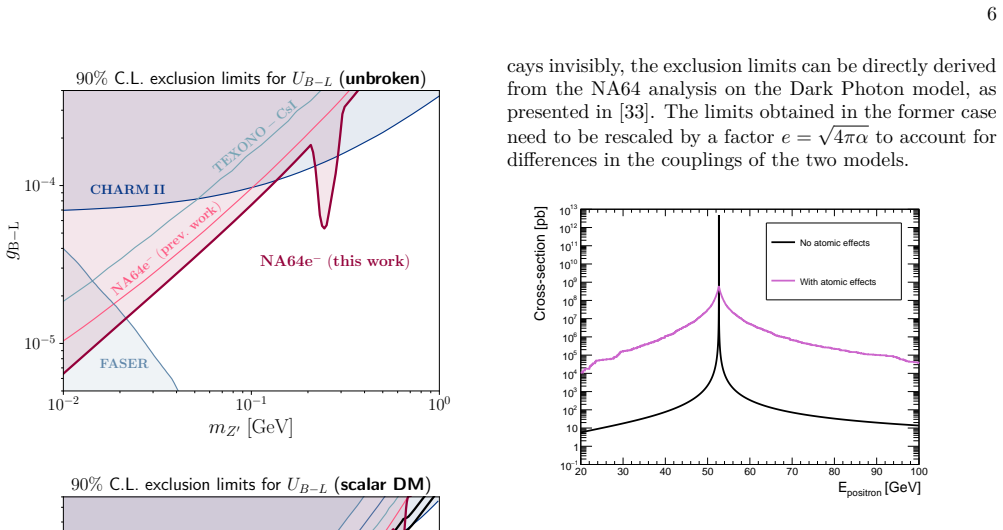
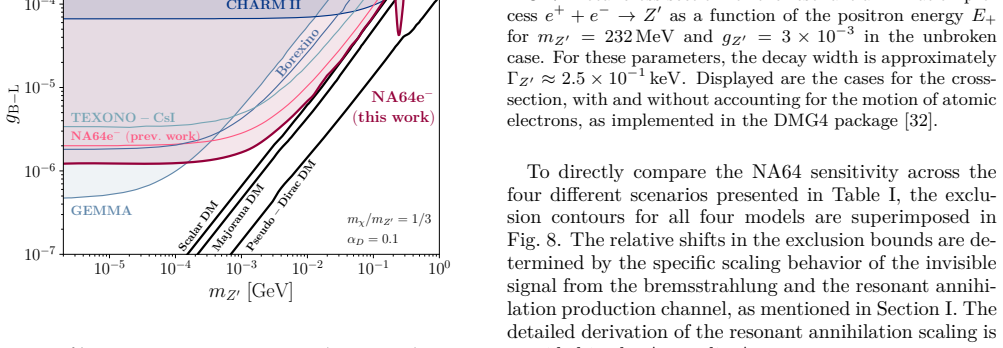
Using a dataset of (9.4 ± 0.5) × 10^11 electrons on target collected between 2016 and 2022, the NA64 experiment improves limits on the coupling g B-L of a new Z' boson in U(1) B-L extensions of the Standard Model. The analysis includes the resonant e+e− annihilation production channel, which boosts sensitivity in the 200–300 MeV mass range. For the unbroken U(1) B-L scenario, these limits exceed those from dedicated neutrino-scattering experiments and represent the most stringent laboratory bounds on g B-L for sub-GeV Z' masses. In scenarios where the Z' decays invisibly to dark matter, the limits follow from the invisible-mode analysis.
What carries the argument
The resonant e⁺e⁻ annihilation production channel for the Z' boson, which enhances sensitivity in the mass range m Z' ∈ [200,300] MeV.
Load-bearing premise
The resonant e+e- annihilation production and background modeling in the NA64 detector are accurately simulated for masses between 200 and 300 MeV with no unaccounted systematic effects.
What would settle it
A measurement of the electron beam interactions in NA64 revealing a higher rate of background events in the e+e- invariant mass spectrum around 250 MeV than predicted would undermine the claimed improvement in limits.
Figures
read the original abstract
Extensions of the Standard Model featuring an additional $U(1)_{B-L}$ gauge symmetry provide a compelling framework linking the origin of neutrino masses to possible dark matter candidates. The associated gauge boson, $Z'$, couples directly to Standard Model fermions and can be produced in fixed-target experiments through electron-nucleus interactions. In this work, we present new constraints on the coupling constant $g_{B-L}$ obtained with the NA64 experiment using the full electron-beam dataset collected between 2016 and 2022, corresponding to $(9.4\pm0.5)\times10^{11}$ electrons on target. The analysis includes the resonant $e^{+}e^{-}$ annihilation production channel, which enhances sensitivity in the mass range $m_{Z'}\in[200,300]$ MeV. The larger dataset provides approximately three times the statistics of previous analyses, thereby improving sensitivity. For the unbroken $U(1)_{B-L}$ case, the new limits exceed those from dedicated neutrino-scattering experiments, providing the most stringent laboratory bounds on $g_{B-L}$ for sub-GeV masses of the new boson. In scenarios where the $Z'$ couples to dark matter, the decay width is dominated by invisible channels, and the corresponding exclusion limits can be directly derived from the NA64 invisible-mode analysis.
Editorial analysis
A structured set of objections, weighed in public.
Referee Report
Summary. The paper presents new upper limits on the coupling g_{B-L} of a hypothetical Z' gauge boson in U(1)_{B-L} extensions of the Standard Model, derived from the full NA64 electron-beam dataset of (9.4 ± 0.5) × 10^{11} electrons on target collected 2016–2022. The analysis incorporates the resonant e^+e^- annihilation production channel to enhance sensitivity for m_{Z'} ∈ [200, 300] MeV and reports an approximate factor-of-three improvement in statistics over prior work. For the unbroken U(1)_{B-L} case the resulting limits are stated to surpass those from dedicated neutrino-scattering experiments and to constitute the most stringent laboratory bounds for sub-GeV masses; limits for invisible-decay scenarios (Z' coupled to dark matter) are obtained directly from the existing NA64 invisible-mode analysis.
Significance. If the resonant-channel efficiency, acceptance, and background model are shown to be robust under the tripling of statistics, the result would tighten the viable parameter space for B-L models that simultaneously address neutrino masses and dark matter, and would establish fixed-target missing-energy searches as competitive with or superior to neutrino-scattering experiments in the sub-GeV regime.
major comments (1)
- [Abstract] Abstract: the headline claim that the new limits exceed those from neutrino-scattering experiments and constitute the most stringent laboratory bounds rests on the resonant e^+e^- annihilation analysis in the (9.4 ± 0.5) × 10^{11} EOT dataset, yet the text supplies no quantitative validation of signal efficiency, acceptance, background modeling, or mass-dependent systematics for m_{Z'} ∈ [200, 300] MeV. This information is load-bearing for the central result and its comparison to external experiments.
Simulated Author's Rebuttal
We thank the referee for their careful reading and the constructive comment on our manuscript. We address the point below and agree that additional quantitative details are warranted to support the central claims.
read point-by-point responses
-
Referee: [Abstract] Abstract: the headline claim that the new limits exceed those from neutrino-scattering experiments and constitute the most stringent laboratory bounds rests on the resonant e^+e^- annihilation analysis in the (9.4 ± 0.5) × 10^{11} EOT dataset, yet the text supplies no quantitative validation of signal efficiency, acceptance, background modeling, or mass-dependent systematics for m_{Z'} ∈ [200, 300] MeV. This information is load-bearing for the central result and its comparison to external experiments.
Authors: We agree that the headline claim relies on the resonant-channel analysis and that the manuscript would benefit from more explicit quantitative validation in the 200–300 MeV window. While the full analysis methodology, dataset, and overall limit-setting procedure are described in the body of the paper, we acknowledge that efficiency, acceptance, background estimates, and mass-dependent systematics for this specific mass range were not presented with sufficient detail to fully substantiate the comparison to neutrino-scattering experiments. In the revised manuscript we will add a dedicated subsection (or appendix) containing these quantities, including efficiency versus mass, background modeling validation, and a breakdown of systematics, together with a direct comparison table to external results. This addition will make the central result more transparent without altering the reported limits. revision: yes
Circularity Check
No circularity: experimental upper limits from observed counts
full rationale
The paper reports new experimental constraints on g_{B-L} from NA64 electron-beam data (9.4e11 EOT), incorporating the resonant e+e- channel for m_Z' in [200,300] MeV. Limits are obtained by comparing observed event counts to simulated signal efficiency and background models; no step reduces by the paper's own equations or self-citations to a fitted input renamed as a prediction. The central claim rests on direct data analysis rather than any self-definitional or ansatz-smuggled construction.
Axiom & Free-Parameter Ledger
axioms (2)
- domain assumption U(1)_{B-L} gauge extensions of the SM provide a valid framework linking neutrino masses and dark matter
- domain assumption Electron-nucleus interactions produce the Z' via the stated channels with calculable rates
invented entities (1)
-
Z' boson
no independent evidence
Reference graph
Works this paper leans on
-
[1]
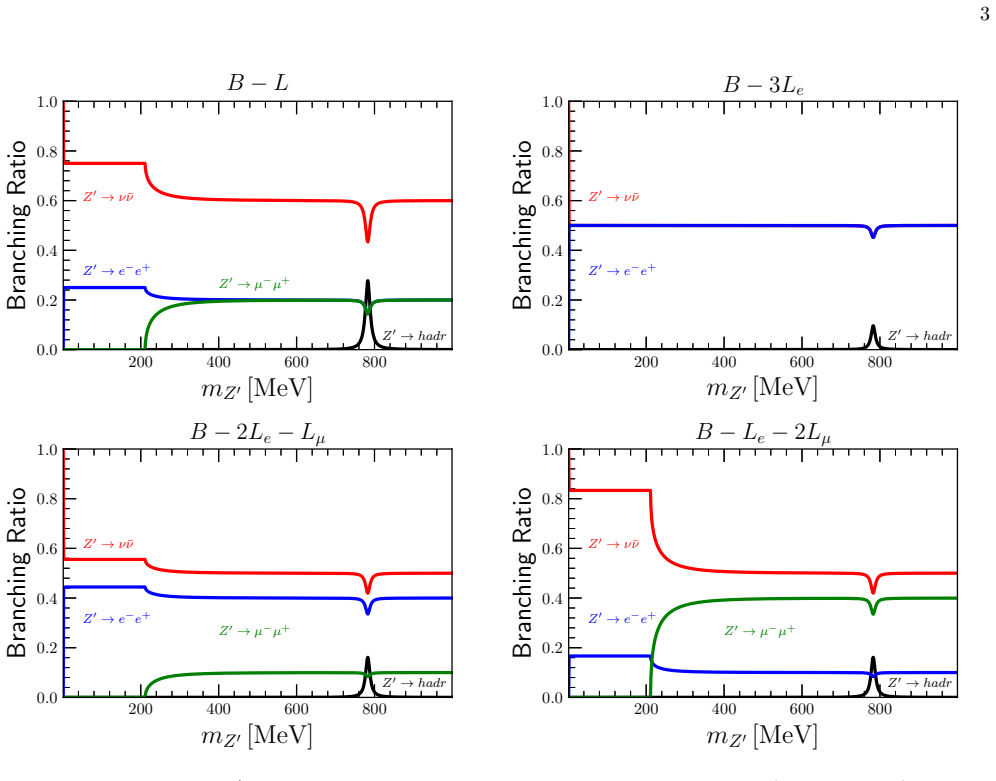
0 Branching Ratio Z ′ → ν ¯ν Z ′ → hadr Z ′ → e− e+ Z ′ → µ − µ + B − L 200 400 600 800 mZ′ [MeV]
-
[2]
0 Branching Ratio Z ′ → ν ¯ν Z ′ → hadr Z ′ → e− e+ B − 3Le 200 400 600 800 mZ′ [MeV]
-
[3]
0 Branching Ratio Z ′ → ν ¯ν Z ′ → hadr Z ′ → e− e+ Z ′ → µ − µ + B − 2Le − Lµ 200 400 600 800 mZ′ [MeV]
-
[4]
0 Branching Ratio Z ′ → ν ¯ν Z ′ → hadr Z ′ → e− e+ Z ′ → µ − µ + B − Le − 2Lµ FIG. 2. Branching fractions of Z ′ decay channels for mZ′ < 1 GeV in the unbroken symmetry case (Dirac neutrinos) described by Eq. 1 for various B − L-type models. 10− 3 10− 2 10− 1 100 101 102 103 mZ′ [MeV]
-
[5]
MembersoftheStochasticBiologygroupattheUniversityofBergenfordiscussion
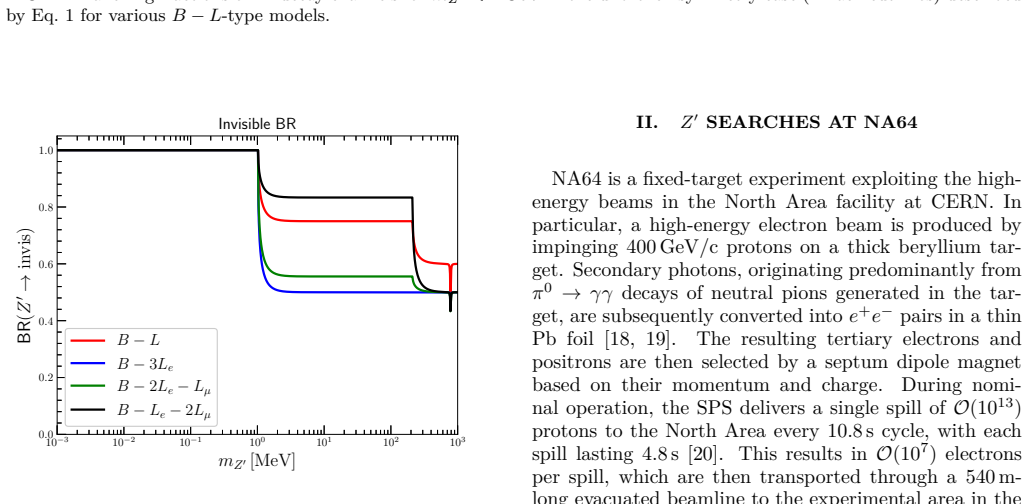
0 BR(Z ′ → invis) Invisible BR B − L B − 3Le B − 2Le − Lµ B − Le − 2Lµ FIG. 3. Invisible branching ratio as a function of mediator mass for different B − L-type models in the unbroken sym- metry (Dirac neutrinos). II. Z ′ SEARCHES A T NA64 NA64 is a fixed-target experiment exploiting the high- energy beams in the North Area facility at CERN. In particular, ...
-
[6]
P. Langacker, Rev. Mod. Phys. 81, 1199 (2009) , arXiv:0801.1345 [hep-ph]
Pith/arXiv arXiv 2009
-
[7]
J. Heeck, Phys. Lett. B 739, 256 (2014) , arXiv:1408.6845 [hep-ph]
Pith/arXiv arXiv 2014
-
[8]
S. Okada, Adv. High Energy Phys. 2018, 5340935 (2018), arXiv:1803.06793 [hep-ph]
Pith/arXiv arXiv 2018
-
[9]
P. Ilten, Y. Soreq, M. Williams, and W. Xue, JHEP 06, 004 (2018) , arXiv:1801.04847 [hep-ph]
Pith/arXiv arXiv 2018
- [10]
-
[11]
Y. M. Andreev et al. (NA64), Phys. Rev. Lett. 129, 161801 (2022) , arXiv:2207.09979 [hep-ex]
arXiv 2022
-
[12]
X. G. He, G. C. Joshi, H. Lew, and R. R. Volkas, Phys. Rev. D 43, 22 (1991)
1991
-
[13]
X.-G. He, G. C. Joshi, H. Lew, and R. R. Volkas, Phys. Rev. D 44, 2118 (1991)
1991
- [14]
-
[15]
H. Acharya et al. (LEGEND), Phys. Rev. Lett. 136, 022701 (2026) , arXiv:2505.10440 [hep-ex]
arXiv 2026
- [16]
-
[17]
X. P. Geng et al. (CDEX), Phys. Rev. D 107, 112002 (2023), arXiv:2210.01604 [hep-ex]
arXiv 2023
-
[18]
M. Atzori Corona, M. Cadeddu, N. Cargioli, F. Dordei, C. Giunti, Y. F. Li, E. Picciau, C. A. Ternes, and Y. Y. Zhang, JHEP 05, 109 (2022) , arXiv:2202.11002 [hep-ph]
arXiv 2022
-
[19]
M. Lindner, F. S. Queiroz, W. Rodejohann, and X.-J. Xu, JHEP 05, 098 (2018) , arXiv:1803.00060 [hep-ph]
Pith/arXiv arXiv 2018
-
[20]
S. Bilmis, I. Turan, T. M. Aliev, M. Deniz, L. Singh, and H. T. Wong, Phys. Rev. D 92, 033009 (2015) , arXiv:1502.07763 [hep-ph]
Pith/arXiv arXiv 2015
-
[21]
M. Fabbrichesi, E. Gabrielli, and G. Lanfranchi (2020) SpringerBrief in Physics, arXiv:2005.01515 [hep-ph]
Pith/arXiv arXiv 2020
-
[22]
See Appendix A for expressions of the partial widths
-
[23]
H. W. Atherton, C. Bovet, N. Doble, G. von Holtey, L. Piemontese, A. Placci, M. Placidi, D. E. Plane, M. Reinharz, and E. Rossa, Precise Measurements of Particle Production by 400-GeV/ c Protons on Beryllium Targets, Tech. Rep. (CERN, 1980)
1980
-
[24]
H. W. Atherton, P. Coet, N. T. Doble, and D. E. Plane, Electron and photon beams in the SPS experimental ar- eas, Tech. Rep. (CERN, Geneva, 1985)
1985
-
[25]
Prebibaj, G
T. Prebibaj, G. Arduini, H. Bartosik, and M. A. Fraser, SPS Operation and Future Proton Sharing Scenarios for the ECN3 facility , Tech. Rep. (CERN, 2023)
2023
-
[26]
Banerjee, J
D. Banerjee, J. Bernhard, M. Brugger, N. Charitonidis, N. Doble, L. Gatignon, and A. Gerbershagen, (2021), 9 dedicated to Giorgio Brianti on the 50th anniversary of his founding the SPS Experimental Areas Group of CERN-Lab II and hence initiating the present Enterprise
2021
-
[27]
Y. M. Andreev et al. , Nucl. Instrum. Meth. A 1057, 168776 (2023) , arXiv:2305.19411 [hep-ex]
arXiv 2023
-
[28]
P. deNiverville, M. Pospelov, and A. Ritz, Phys. Rev. D84, 075020 (2011) , arXiv:1107.4580 [hep-ph]
Pith/arXiv arXiv 2011
-
[29]
Volkov, P
V. Volkov, P. Volkov, T. Enik, G. Kekelidze, V. Kra- marenko, V. Lysan, D. Peshekhonov, A. Solin, and A. Solin, Phys. Part. Nucl. Lett. 16, 847 (2019)
2019
-
[30]
D. Banerjee et al. , Nucl. Instrum. Meth. A 881, 72 (2018), arXiv:1708.04087 [physics.ins-det]
Pith/arXiv arXiv 2018
-
[31]
E. Depero et al., Nucl. Instrum. Meth. A 866, 196 (2017), arXiv:1703.05993 [physics.ins-det]
Pith/arXiv arXiv 2017
-
[32]
D. P. Woodruff, Synchrotron Radiation: Sources and Ap- plications to the Structural and Electronic Properties of Materials (Cambridge University Press, 2021)
2021
-
[33]
Therefore, unless stated otherwise, any cuts on the total HCAL energy deposition refer exclusively to the first three modules
In the following, the HCAL4 module is treated indepen- dently from the other modules. Therefore, unless stated otherwise, any cuts on the total HCAL energy deposition refer exclusively to the first three modules
-
[34]
Agostinelli et al
S. Agostinelli et al. (GEANT4), Nucl. Instrum. Meth. A 506, 250 (2003)
2003
-
[35]
Allison et al
J. Allison et al. (GEANT4), IEEE Trans. Nucl. Sci. 53, 270 (2006)
2006
-
[36]
Allison et al
J. Allison et al. (GEANT4), Nuclear Instruments and Methods in Physics Research Section A: Accelerators, Spectrometers, Detectors and Associated Equipment 835, 186 (2016)
2016
-
[37]
B. B. Oberhauser et al. , Comput. Phys. Commun. 300, 109199 (2024) , arXiv:2401.12573 [hep-ph]
arXiv 2024
-
[38]
Y. M. Andreev et al. (NA64), Phys. Rev. Lett. 131, 161801 (2023) , arXiv:2307.02404 [hep-ex]
arXiv 2023
- [39]
-
[40]
Y. M. Andreev et al. , JHEP 07, 212 (2024) , arXiv:2404.06982 [hep-ex]
arXiv 2024
-
[41]
H. Abreu et al. (F ASER), Phys. Lett. B 848, 138378 (2024), arXiv:2308.05587 [hep-ex]
arXiv 2024
-
[42]
Y. M. Andreev et al. (NA64), Phys. Rev. D 110, 112015 (2024), arXiv:2409.10128 [hep-ex]
arXiv 2024
-
[43]
A6 must also be included in the total width
If the coupling to DM is considered, then the partial width in Eq. A6 must also be included in the total width
discussion (0)
Sign in with ORCID, Apple, or X to comment. Anyone can read and Pith papers without signing in.