Data-Driven Stabilizing Controller Design for Linear Infinite Networks
Pith reviewed 2026-06-26 23:32 UTC · model grok-4.3
The pith
A single set of noisy trajectories per subsystem yields local controllers that compose via small-gain to stabilize an entire infinite network.
A machine-rendered reading of the paper's core claim, the machinery that carries it, and where it could break.
Core claim
Using a single set of noise-corrupted input-state trajectories collected from each subsystem, and provided that certain linear matrix inequalities hold, each subsystem is rendered exponentially input-to-state stable by locally constructing an eISS control Lyapunov function together with an exponentially input-to-state stabilizing feedback controller. These local components are composed under a compositional small-gain condition in infinite-dimensional spaces to obtain a global control Lyapunov function and an associated stabilizing controller, ensuring uniform global exponential stability of the infinite network.
What carries the argument
The compositional small-gain condition in infinite-dimensional spaces that assembles local eISS control Lyapunov functions and controllers into a global stabilizing pair.
If this is right
- Each unknown linear subsystem admits an exponentially input-to-state stabilizing controller constructed solely from its own noisy data when the associated inequalities are solvable.
- The infinite network reaches uniform global exponential stability once the local controllers satisfy the infinite-dimensional small-gain condition.
- The resulting global controller requires only local state measurements and does not need a centralized model of the full network.
- The same data set suffices both to certify local stability properties and to enable the global composition.
- The method applies directly to physical systems whose dynamics are treated as unknown.
Where Pith is reading between the lines
- The framework could be tested on finite truncations of increasing size to check whether stability margins remain uniform as the network grows.
- If the small-gain parameters can be adjusted locally, the same data-driven procedure might extend to networks whose subsystems are only approximately identical.
- One could examine whether the local linear matrix inequalities remain feasible under larger noise bounds, which would indicate practical robustness limits.
- The approach points toward data-driven certification of stability in other distributed systems where exact interconnection strengths are also uncertain.
Load-bearing premise
The linear matrix inequalities can be solved from the collected noisy trajectories to produce valid local controllers, and the small-gain condition holds for the infinite network.
What would settle it
Numerical or experimental observation that the closed-loop network fails to achieve uniform global exponential stability even though the local linear matrix inequalities are feasible and the small-gain condition is satisfied.
Figures
read the original abstract
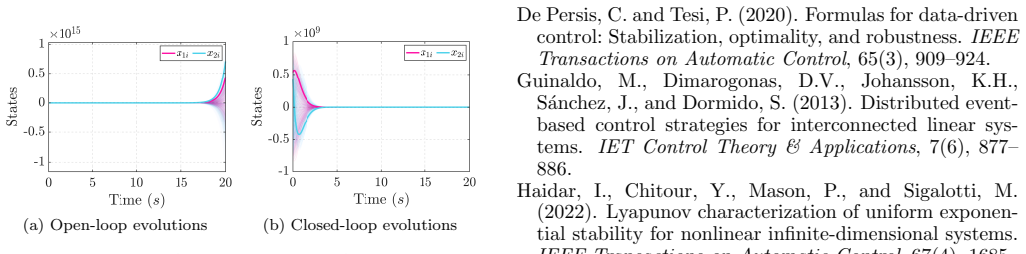
We propose a direct data-driven method for controller synthesis of infinite networks composed of unknown linear time-invariant subsystems. Using a single set of noise-corrupted input-state trajectories collected from each subsystem, and provided that certain linear matrix inequalities hold, each subsystem is rendered exponentially input-to-state stable (eISS) by locally constructing an eISS control Lyapunov function together with an exponentially input-to-state stabilizing feedback controller. We then compose these local components under a compositional small-gain condition in infinite-dimensional spaces to obtain a global control Lyapunov function and an associated stabilizing controller, ensuring uniform global exponential stability of the infinite network. The approach is validated on a physical case study with unknown dynamics.
Editorial analysis
A structured set of objections, weighed in public.
Referee Report
Summary. The paper proposes a direct data-driven method for controller synthesis of infinite networks composed of unknown linear time-invariant subsystems. Using a single set of noise-corrupted input-state trajectories collected from each subsystem, and provided that certain linear matrix inequalities hold, each subsystem is rendered exponentially input-to-state stable (eISS) by locally constructing an eISS control Lyapunov function together with an exponentially input-to-state stabilizing feedback controller. These local components are then composed under a compositional small-gain condition in infinite-dimensional spaces to obtain a global control Lyapunov function and an associated stabilizing controller, ensuring uniform global exponential stability of the infinite network. The approach is validated on a physical case study with unknown dynamics.
Significance. If the LMI feasibility conditions from noisy data and the infinite-dimensional small-gain condition can be verified, the result provides a model-free route to stabilizing controllers for infinite networks, extending data-driven Lyapunov methods to compositional infinite-dimensional settings. The explicit conditioning on data-derived LMIs and the small-gain test is a strength, as is the use of a physical case study for validation.
minor comments (3)
- [Case study] The case-study section should report the specific LMI feasibility outcomes, the computed local gains, and the numerical verification of the small-gain condition (including the value of the gain margin) so that readers can assess how close the design operates to the boundary of the assumptions.
- [Section on compositional small-gain condition] Clarify the precise statement of the infinite-dimensional small-gain theorem invoked (reference and any modifications for the eISS setting) and confirm that the composition preserves the exponential decay rate uniformly across the network.
- [Local controller design] The data-driven LMI formulation should explicitly state the noise bound assumption and how it enters the matrix inequality; if the bound is treated as a design parameter, note its effect on feasibility.
Simulated Author's Rebuttal
We thank the referee for the positive summary, recognition of the significance of the data-driven compositional approach, and the recommendation of minor revision. No specific major comments were listed in the report.
Circularity Check
No significant circularity
full rationale
The derivation proceeds by collecting noisy trajectories, solving LMIs to obtain local eISS CLFs and controllers for each subsystem, then composing them via a small-gain condition to obtain global stability. These steps are explicitly conditional on LMI feasibility and the small-gain assumption holding; they do not reduce any claimed prediction or stability result to a fitted quantity or self-definition by construction. No load-bearing self-citation chain or ansatz smuggling is visible in the stated argument structure. The approach is therefore self-contained against external benchmarks such as data-driven LMI methods and infinite-dimensional small-gain theorems.
Axiom & Free-Parameter Ledger
axioms (2)
- domain assumption Subsystems are linear time-invariant.
- domain assumption A single set of noise-corrupted trajectories suffices to certify eISS via LMIs.
Reference graph
Works this paper leans on
-
[1]
Aminzadeh, A., Swikir, A., Haddadin, S., and Lavaei, A. (2024). Compositional safety verification of infinite networks: A data-driven approach. In Proceedings of the 2024 European Control Conference (ECC), 545--551
2024
-
[2]
ApS, M. (2024). The MOSEK optimization toolbox for MATLAB manual. Version 10.1. ://docs.mosek.com/10.1/toolbox/index.html
2024
-
[3]
Bamieh, B., Paganini, F., and Dahleh, M.A. (2002). Distributed control of spatially invariant systems. IEEE Transactions on Automatic Control, 47(7), 1091--1107
2002
-
[4]
o hler, J., M \
Berberich, J., K \"o hler, J., M \"u ller, M.A., and Allg \"o wer, F. (2020). Data-driven model predictive control with stability and robustness guarantees. IEEE Transactions on Automatic Control, 66(4), 1702--1717
2020
-
[5]
and Davis, C
Bhatia, R. and Davis, C. (1995). A Cauchy-Schwarz inequality for operators with applications. Linear algebra and its applications, 223, 119--129
1995
-
[6]
Chaillet, A., Karafyllis, I., Pepe, P., and Wang, Y. (2023). The ISS framework for time-delay systems: A survey. Mathematics of Control, Signals, and Systems, 35(2), 237--306
2023
-
[7]
Chen, H., Bisoffi, A., and De Persis, C. (2025). Data-driven input-to-state stabilization of polynomial systems. SIAM Journal on Control and Optimization, 63(6), 3915--3940
2025
-
[8]
Dashkovskiy, S., Mironchenko, A., Schmid, J., and Wirth, F. (2019). Stability of infinitely many interconnected systems. IFAC-PapersOnLine, 52(16), 550--555
2019
-
[9]
Dashkovskiy, S., R \"u ffer, B.S., and Wirth, F.R. (2007). An ISS small gain theorem for general networks. Mathematics of Control, Signals, and Systems (MCSS), 19(2), 93--122
2007
-
[10]
Dashkovskiy, S.N., R \"u ffer, B.S., and Wirth, F.R. (2010). Small gain theorems for large scale systems and construction of ISS L yapunov functions. SIAM Journal on Control and Optimization, 48(6), 4089--4118
2010
-
[11]
and Tesi, P
De Persis, C. and Tesi, P. (2020). Formulas for data-driven control: Stabilization, optimality, and robustness. IEEE Transactions on Automatic Control, 65(3), 909--924
2020
-
[12]
Guinaldo, M., Dimarogonas, D.V., Johansson, K.H., S \'a nchez, J., and Dormido, S. (2013). Distributed event-based control strategies for interconnected linear systems. IET Control Theory & Applications, 7(6), 877--886
2013
-
[13]
Haidar, I., Chitour, Y., Mason, P., and Sigalotti, M. (2022). L yapunov characterization of uniform exponential stability for nonlinear infinite-dimensional systems. IEEE Transactions on Automatic Control, 67(4), 1685--1697
2022
-
[14]
and Krstic, M
Karafyllis, I. and Krstic, M. (2019). Input-to-State Stability for PDEs . Springer
2019
-
[15]
Kawan, C., Mironchenko, A., Swikir, A., Noroozi, N., and Zamani, M. (2020). A Lyapunov-based small-gain theorem for infinite networks. IEEE Transactions on Automatic Control, 66(12), 5830--5844
2020
-
[16]
Kawan, C., Mironchenko, A., and Zamani, M. (2023). A L yapunov-based ISS small-gain theorem for infinite networks of nonlinear systems. IEEE Transactions on Automatic Control, 68(3), 1447--1462
2023
-
[17]
and Angeli, D
Lavaei, A. and Angeli, D. (2023). Data-driven stability certificate of interconnected homogeneous networks via ISS properties. IEEE Control Systems Letters, 7, 2395--2400
2023
-
[18]
L \" o fberg, J. (2004). YALMIP : A toolbox for modeling and optimization in MATLAB . In Proceedings of the CACSD Conference
2004
-
[19]
Mironchenko, A. (2023). Input-to-State Stability: Theory and Applications. Communications and Control Engineering. Springer, 1 edition. doi:10.1007/978-3-031-14674-9
-
[20]
and Prieur, C
Mironchenko, A. and Prieur, C. (2020). Input-to-state stability of infinite-dimensional systems: Recent results and open questions. SIAM Review, 62(3), 529--614
2020
-
[21]
Noroozi, N., Mironchenko, A., and Wirth, F.R. (2022). A relaxed small-gain theorem for discrete-time infinite networks. Automatica, 142
2022
-
[22]
Samari, B., Incremona, G.P., Ferrara, A., and Lavaei, A. (2025). From data to sliding mode control of uncertain large-scale networks with unknown dynamics. arXiv:2502.19806
arXiv 2025
-
[23]
Schwenninger, F.L. (2020). Input-to-state stability for parabolic boundary control: Linear and semilinear systems. In Control theory of infinite-dimensional systems, 83--116. Springer
2020
-
[24]
Sontag, E.D. (2008). Input to state stability: Basic concepts and results. In Nonlinear and Optimal Control Theory, chapter 3, 163--220. Springer, Heidelberg. doi:10.1007/978-3-540-77653-6\_3
-
[25]
Taylor, A.J., Dorobantu, V.D., Dean, S., Recht, B., Yue, Y., and Ames, A.D. (2021). Towards robust data-driven control synthesis for nonlinear systems with actuation uncertainty. In Proceedings of the 60th Conference on Decision and Control (CDC), 6469--6476
2021
-
[26]
Willems, J.C., Rapisarda, P., Markovsky, I., and De Moor, B.L. (2005). A note on persistency of excitation. Systems & Control Letters, 54(4), 325--329
2005
-
[27]
Yakubovich, V.A., Leonov, G.A., and Gelig, A.K. (2004). Stability of Stationary Sets in Control Systems with Discontinuous Nonlinearities. World Scientific
2004
-
[28]
Young, W.H. (1912). On classes of summable functions and their F ourier series. Proceedings of the Royal Society of London A: Mathematical, Physical and Engineering Sciences, 87(594), 225--229
1912
-
[29]
Zaker, M., Mironchenko, A., Nejati, A., and Lavaei, A. (2026). Data-driven global stabilization of unknown infinite networks. arXiv: 2604.11024
Pith/arXiv arXiv 2026
-
[30]
Zaker, M., Nejati, A., and Lavaei, A. (2025 a ). Data-driven safety certificates of infinite networks with unknown models and interconnection topologies. arXiv:2507.10979
Pith/arXiv arXiv 2025
-
[31]
(2025 b )
Zaker, M., Nejati, A., and Lavaei, A. (2025 b ). From data to global asymptotic stability of unknown large-scale networks with provable guarantees. In Proceedings of the 28th ACM International Conference on Hybrid Systems: Computation and Control, 1--14
2025
discussion (0)
Sign in with ORCID, Apple, or X to comment. Anyone can read and Pith papers without signing in.