REVIEW 1 major objections 39 references
FLAP: FOV-Constrained Active Perception Planning for Prior-Map-Free 3D Navigation
T0 review · 1 major / 0 minor · reviewed 2026-06-27 · grok-4.3
Pith's one-line read A trajectory optimization method adds field-of-view constraints to enable safe 3D UAV navigation without prior maps.
desk verdict FLAP folds FOV constraints into differentiable 3D trajectory optimization with velocity triggers and parametric timing, but the abstract supplies no numbers to judge the gains. read the letter →
The pith
A machine-rendered reading of the paper's core claim, the machinery that carries it, and where it could break.
The reading
What carries the argument
Active perception sub-trajectory segment with parametric start-time optimization, which balances perception and motion efficiency while mitigating collision risks from late obstacle detection.
What would settle it
An experiment showing a collision due to an obstacle entering the FOV later than predicted by the dynamic model, despite the planner satisfying all constraints.
Extended reading notes
Core claim
By deriving perception constraints from the UAV dynamic model in the sensor coordinate frame and introducing an active perception sub-trajectory with parametric start-time optimization, the method incorporates all constraints into a differentiable optimization that supports active perception during arbitrary 3D maneuvers using only a simple front-end global path.
Load-bearing premise
Perception constraints derived from the UAV's dynamic model in the sensor coordinate frame handle FOV geometry precisely without unmodeled sensing delays or dynamic mismatches invalidating collision avoidance.
Signed reviews
Editorial analysis
A structured set of objections, weighed in public.
Referee Report
Summary. The manuscript presents FLAP, a planning framework for FOV-constrained active perception in prior-map-free 3D UAV navigation. Perception constraints are derived from the UAV dynamic model and expressed in the sensor coordinate frame; a velocity-triggered activation mechanism and an active-perception sub-trajectory with parametric start-time optimization are introduced. All elements are cast as a single differentiable optimization problem that accepts only a simple front-end global path. The authors state that the formulation supports arbitrary 3D maneuvers and report robust performance across simulations and real-world experiments with varying sensor configurations.
Significance. If the quantitative claims hold, the work would address a recognized bottleneck in UAV deployment by enabling safe active perception during full 3D motion without conservative speed limits or fixed perception patterns. The differentiable, constraint-based formulation that avoids a separate perception-aware path generator is a clear technical strength. The velocity-triggered and start-time mechanisms offer a principled way to trade perception against motion efficiency.
major comments (1)
- [Abstract] Abstract: the central claim of 'robust performance' and 'extensive simulations and real-world experiments' is unsupported by any quantitative results, error metrics, ablation studies, or baseline comparisons. Without these data the effectiveness of the FOV constraints, velocity-triggered activation, and parametric start-time optimization cannot be assessed.
Simulated Author's Rebuttal
We thank the referee for the constructive feedback. We address the single major comment below and agree that the abstract requires strengthening with quantitative support.
read point-by-point responses
-
Referee: [Abstract] Abstract: the central claim of 'robust performance' and 'extensive simulations and real-world experiments' is unsupported by any quantitative results, error metrics, ablation studies, or baseline comparisons. Without these data the effectiveness of the FOV constraints, velocity-triggered activation, and parametric start-time optimization cannot be assessed.
Authors: We agree that the abstract, as currently written, does not include quantitative metrics and therefore does not itself substantiate the performance claims. The body of the manuscript contains the requested quantitative evaluations (success rates, trajectory efficiency, computation times, ablation studies on the velocity-triggered and start-time mechanisms, and baseline comparisons) in the Experiments section. To directly resolve the referee's concern we will revise the abstract to incorporate specific numerical highlights drawn from those results, thereby making the claims self-contained and verifiable within the abstract itself. revision: yes
Circularity Check
No significant circularity identified
full rationale
The paper's abstract and described formulation derive perception constraints directly from the UAV dynamic model in the sensor frame, incorporate them into a differentiable optimization problem, and use a velocity-triggered activation with parametric start-time optimization. No equations, fitted parameters, self-citations, or ansatzes are presented that reduce any claimed prediction or result to its own inputs by construction. The central claim of enabling active perception in arbitrary 3D maneuvers via a simple front-end path rests on the stated differentiability and completeness of these constraints, which are presented as independent derivations rather than self-referential. This matches the reader's assessment of no visible circular reduction.
Assumptions & free parameters
assumptions (1)
- domain assumption UAV dynamic model accurately predicts motion for deriving perception constraints in sensor frame
Cite this review
Pith. "Pith review of FLAP: FOV-Constrained Active Perception Planning for Prior-Map-Free 3D Navigation." pith.science (2026). https://pith.science/paper/M2JC4ECT
@misc{pith2026260617630,
  author       = {Pith},
  title        = {Pith review of: FLAP: FOV-Constrained Active Perception Planning for Prior-Map-Free 3D Navigation},
  year         = {2026},
  howpublished = {\url{https://pith.science/paper/M2JC4ECT}},
  note         = {Machine review of arXiv:2606.17630}
}
read the original abstract
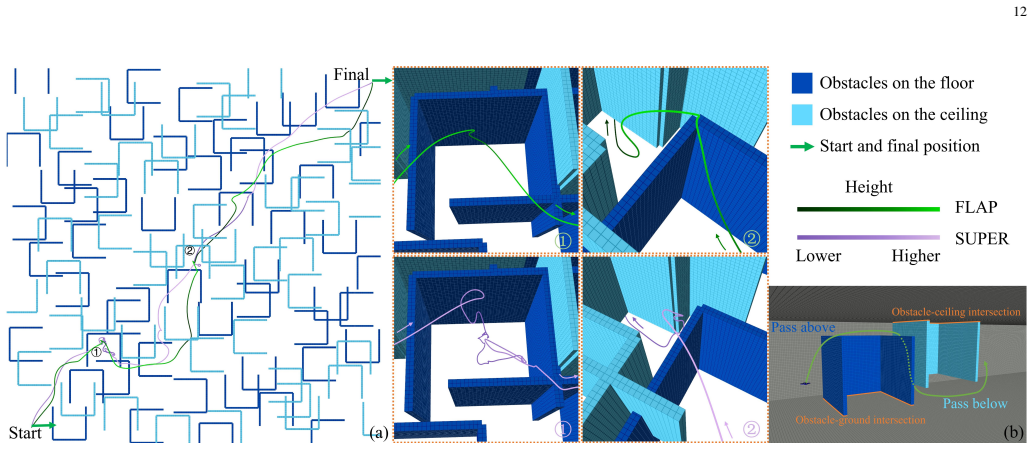
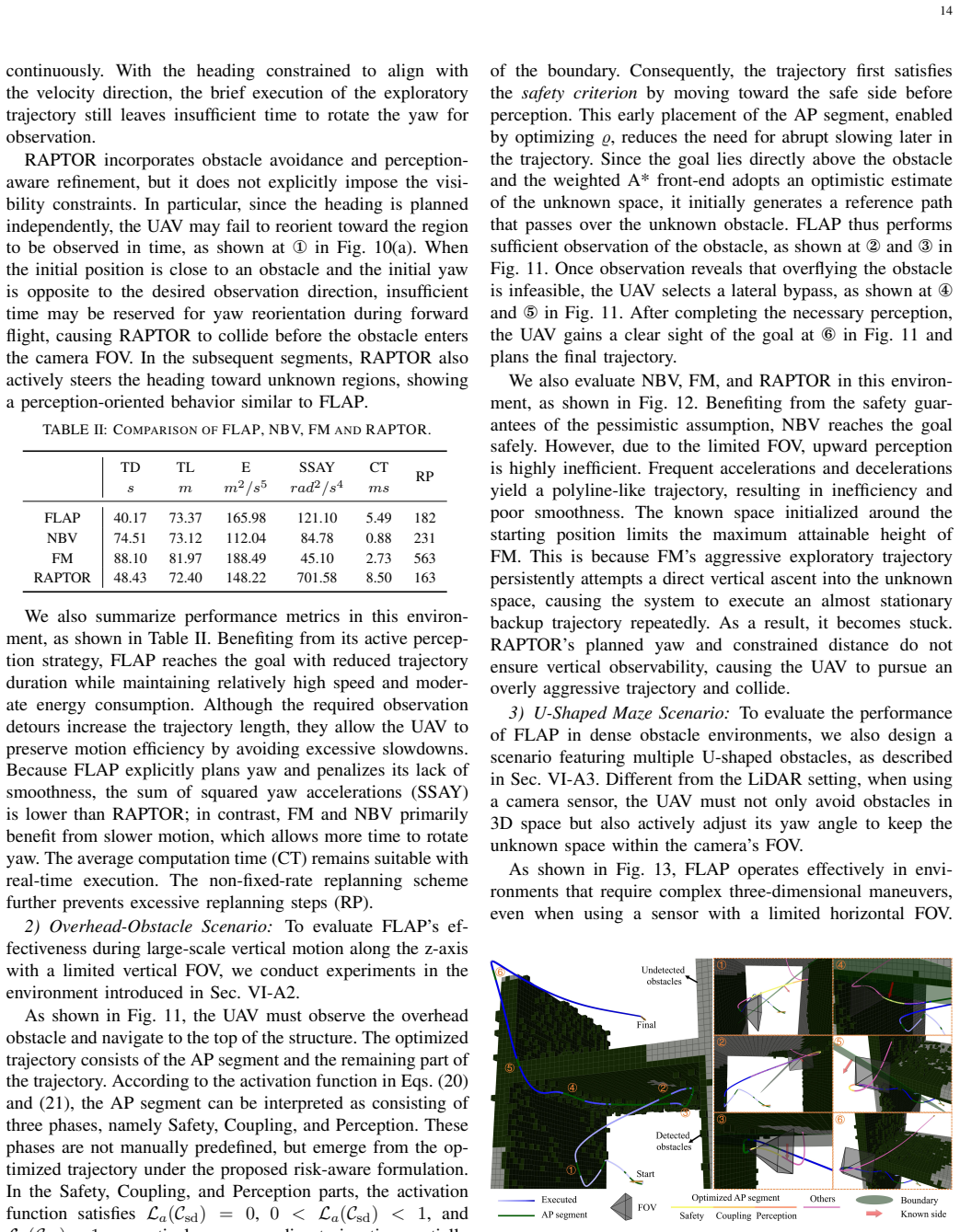
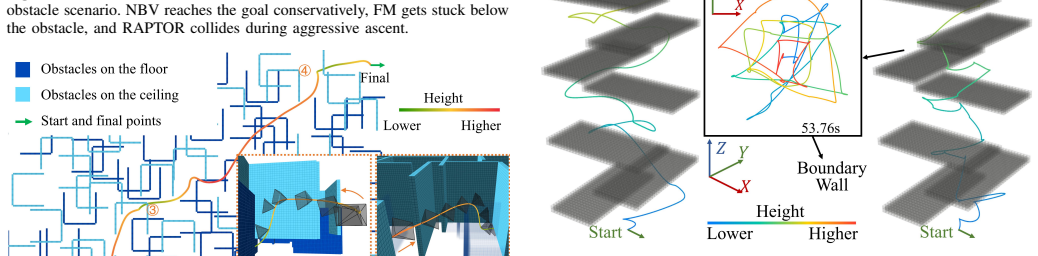
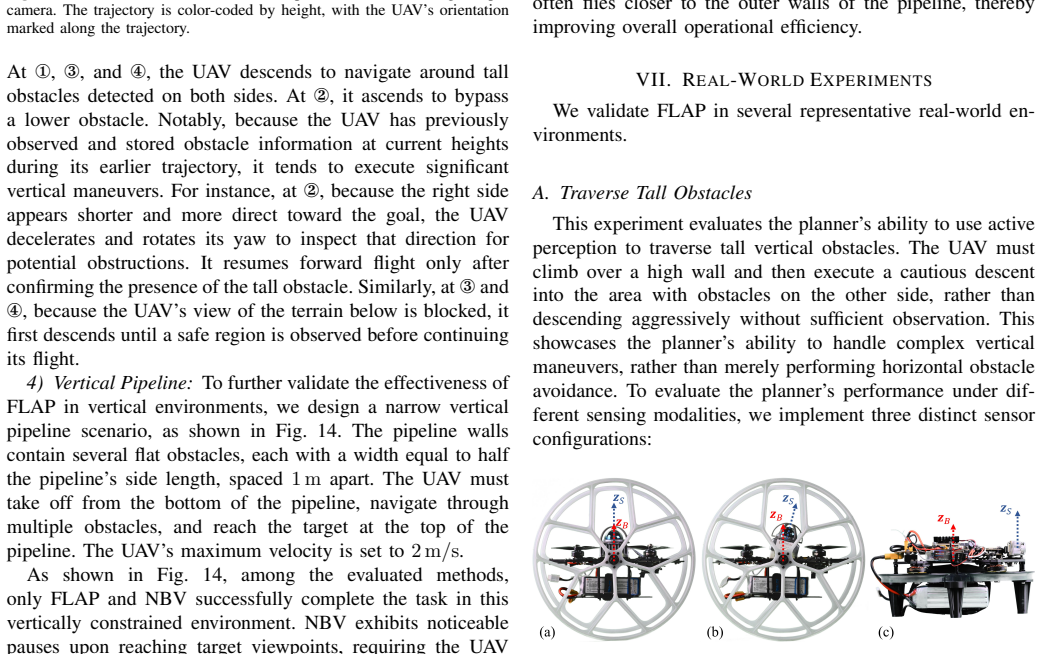
Safe and efficient trajectory planning in unknown, cluttered 3D environments constitutes a critical bottleneck for deploying Unmanned Aerial Vehicles (UAVs) in real-world applications. This challenge is further exacerbated by the limited field-of-view (FOV) and sensing range of onboard sensors. Many existing methods either make simplistic assumptions about unexplored space or rely on conservative heuristics such as speed limits or fixed perception patterns, reducing efficiency and generalizing poorly across different sensor types. In this work, we propose a novel planning framework that directly integrates active perception into trajectory optimization, thereby improving safety while preserving efficiency. The perception constraints are derived from the UAV's dynamic model and formulated in the sensor coordinate frame, which enables precise handling of FOV geometry. The velocity-triggered activation mechanism enables the planner to balance perception and motion efficiency. We introduce an active perception sub-trajectory segment with parametric start-time optimization, mitigating collision risks from late obstacle detection. Our formulation enables active perception during arbitrary 3D maneuvers, extending beyond prior methods designed mainly for horizontal motion. All constraints and penalties are incorporated into a differentiable optimization problem, so the planner requires only a simple front-end global path for guidance, rather than a computationally expensive perception-aware path generator. Extensive simulations and real-world experiments demonstrate robust performance across diverse unknown environments with varying sensor configurations.
Figures


Figures from the paper (14 more)







Reference graph
Works this paper leans on
-
[1]
Ego-planner: An esdf- free gradient-based local planner for quadrotors,
X. Zhou, Z. Wang, H. Ye, C. Xu, and F. Gao, “Ego-planner: An esdf- free gradient-based local planner for quadrotors,”IEEE Robotics and Automation Letters, vol. 6, no. 2, pp. 478–485, 2020
2020
-
[2]
Flying on point clouds: Online trajectory generation and autonomous navigation for quadrotors in cluttered environments,
F. Gao, W. Wu, W. Gao, and S. Shen, “Flying on point clouds: Online trajectory generation and autonomous navigation for quadrotors in cluttered environments,”Journal of Field Robotics, vol. 36, no. 4, pp. 710–733, 2019
2019
-
[3]
Autonomous navigation in unknown environments using sparse kernel-based occupancy mapping,
T. Duong, N. Das, M. Yip, and N. Atanasov, “Autonomous navigation in unknown environments using sparse kernel-based occupancy mapping,” in2020 IEEE International Conference on Robotics and Automation (ICRA). IEEE, 2020, pp. 9666–9672
2020
-
[4]
Universal trajectory optimization framework for differential drive robot class,
M. Zhang, N. Chen, H. Wang, J. Qiu, Z. Han, Q. Ren, C. Xu, F. Gao, and Y . Cao, “Universal trajectory optimization framework for differential drive robot class,”IEEE Transactions on Automation Science and Engineering, 2025. 18
2025
-
[5]
The determination of next best views,
C. Connolly, “The determination of next best views,” inProceedings. 1985 IEEE international conference on robotics and automation, vol. 2. IEEE, 1985, pp. 432–435
1985
-
[6]
Safe local explo- ration for replanning in cluttered unknown environments for microaerial vehicles,
H. Oleynikova, Z. Taylor, R. Siegwart, and J. Nieto, “Safe local explo- ration for replanning in cluttered unknown environments for microaerial vehicles,”IEEE Robotics and Automation Letters, vol. 3, no. 3, pp. 1474–1481, 2018
2018
-
[7]
Safe receding horizon path planning for autonomous vehicles,
T. Schouwenaars, ´E. F ´eron, and J. How, “Safe receding horizon path planning for autonomous vehicles,” inProceedings of the Annual Aller- ton Conference on Communication Control and Computing, vol. 40, no. 1. The University; 1998, 2002, pp. 295–304
1998
-
[8]
An efficient reachability-based framework for provably safe autonomous navigation in unknown environments,
A. Bajcsy, S. Bansal, E. Bronstein, V . Tolani, and C. J. Tomlin, “An efficient reachability-based framework for provably safe autonomous navigation in unknown environments,” in2019 IEEE 58th Conference on Decision and Control (CDC). IEEE, 2019, pp. 1758–1765
2019
Show all 39 references
-
[9]
Dwa-3d: A reactive planner for robust and efficient autonomous uav navigation,
J. Bes, J. Dendarieta, L. Riazuelo, and L. Montano, “Dwa-3d: A reactive planner for robust and efficient autonomous uav navigation,”arXiv preprint arXiv:2409.05421, 2024
2024
-
[10]
High speed navigation for quadrotors with limited onboard sensing,
S. Liu, M. Watterson, S. Tang, and V . Kumar, “High speed navigation for quadrotors with limited onboard sensing,” in2016 IEEE international conference on robotics and automation (ICRA). IEEE, 2016, pp. 1484– 1491
2016
-
[11]
Toward autonomy of micro aerial vehicles in unknown and global positioning system denied environments,
Y . Zhou, S. Lai, H. Cheng, A. H. M. Redhwan, P. Wang, J. Zhu, Z. Gao, Z. Ma, Y . Bi, F. Linet al., “Toward autonomy of micro aerial vehicles in unknown and global positioning system denied environments,”IEEE Transactions on Industrial Electronics, vol. 68, no. 8, pp. 7642–7651, 2020
2020
-
[12]
Aggressive 3-d collision avoidance for high-speed navigation
B. T. Lopez and J. P. How, “Aggressive 3-d collision avoidance for high-speed navigation.” inICRA, 2017, pp. 5759–5765
2017
-
[13]
Collision avoidance with limited field of view sensing: A velocity obstacle approach,
S. Roelofsen, D. Gillet, and A. Martinoli, “Collision avoidance with limited field of view sensing: A velocity obstacle approach,” in2017 IEEE International Conference on Robotics and Automation (ICRA). IEEE, 2017, pp. 1922–1927
2017
-
[14]
History-aware autonomous exploration in confined environments using mavs,
C. Witting, M. Fehr, R. B ¨ahnemann, H. Oleynikova, and R. Siegwart, “History-aware autonomous exploration in confined environments using mavs,” in2018 IEEE/RSJ International Conference on Intelligent Robots and Systems (IROS). IEEE, 2018, pp. 1–9
2018
-
[15]
Autonomous robotic exploration by incremental road map construction,
C. Wang, W. Chi, Y . Sun, and M. Q.-H. Meng, “Autonomous robotic exploration by incremental road map construction,”IEEE Transactions on Automation Science and Engineering, vol. 16, no. 4, pp. 1720–1731, 2019
2019
-
[16]
Fuel: Fast uav exploration using incremental frontier structure and hierarchical planning,
B. Zhou, Y . Zhang, X. Chen, and S. Shen, “Fuel: Fast uav exploration using incremental frontier structure and hierarchical planning,”IEEE Robotics and Automation Letters, vol. 6, no. 2, pp. 779–786, 2021
2021
-
[17]
Eva-planner: Environmental adaptive quadrotor planning,
L. Quan, Z. Zhang, X. Zhong, C. Xu, and F. Gao, “Eva-planner: Environmental adaptive quadrotor planning,” in2021 IEEE International Conference on Robotics and Automation (ICRA). IEEE, 2021, pp. 398– 404
2021
-
[18]
Speed adaptive robot trajectory generation based on derivative property of b-spline curve,
L. Wang and Y . Guo, “Speed adaptive robot trajectory generation based on derivative property of b-spline curve,”IEEE Robotics and Automation Letters, vol. 8, no. 4, pp. 1905–1911, 2023
1905
-
[19]
Learning agility adaptation for flight in clutter,
G. Zhao, T. Wu, Y . Chen, and F. Gao, “Learning agility adaptation for flight in clutter,”arXiv preprint arXiv:2403.04586, 2024
2024
-
[20]
Flight with limited field of view: A parallel and gradient-free strategy for micro aerial vehicle,
H. Lu, Q. Zong, S. Lai, B. Tian, and L. Xie, “Flight with limited field of view: A parallel and gradient-free strategy for micro aerial vehicle,” IEEE Transactions on Industrial Electronics, vol. 69, no. 9, pp. 9258– 9267, 2021
2021
-
[21]
Real-time perception-limited motion planning using sampling- based mpc,
——, “Real-time perception-limited motion planning using sampling- based mpc,”IEEE Transactions on Industrial Electronics, vol. 69, no. 12, pp. 13 182–13 191, 2022
2022
-
[22]
Bayesian learning for safe high-speed navigation in unknown environments,
C. Richter, W. Vega-Brown, and N. Roy, “Bayesian learning for safe high-speed navigation in unknown environments,” inRobotics Research: V olume 2. Springer, 2017, pp. 325–341
2017
-
[23]
Planning high-speed safe trajectories in confidence-rich maps,
E. Heiden, K. Hausman, G. S. Sukhatme, and A.-a. Agha-mohammadi, “Planning high-speed safe trajectories in confidence-rich maps,” in2017 IEEE/RSJ International Conference on Intelligent Robots and Systems (IROS). IEEE, 2017, pp. 2880–2886
2017
-
[24]
Planning in dynamic and partially unknown environments,
K. Miller, C. Fan, and S. Mitra, “Planning in dynamic and partially unknown environments,”IF AC-PapersOnLine, vol. 54, no. 5, pp. 169– 174, 2021
2021
-
[25]
High- speed robot navigation using predicted occupancy maps,
K. D. Katyal, A. Polevoy, J. Moore, C. Knuth, and K. M. Popek, “High- speed robot navigation using predicted occupancy maps,” in2021 IEEE International Conference on Robotics and Automation (ICRA). IEEE, 2021, pp. 5476–5482
2021
-
[26]
Online mapping and motion planning under uncertainty for safe nav- igation in unknown environments,
`E. Pairet, J. D. Hern ´andez, M. Carreras, Y . Petillot, and M. Lahijanian, “Online mapping and motion planning under uncertainty for safe nav- igation in unknown environments,”IEEE Transactions on Automation Science and Engineering, vol. 19, no. 4, pp. 3356–3378, 2021
2021
-
[27]
Faster: Fast and safe trajectory planner for navigation in unknown environments,
J. Tordesillas, B. T. Lopez, M. Everett, and J. P. How, “Faster: Fast and safe trajectory planner for navigation in unknown environments,”IEEE Transactions on Robotics, vol. 38, no. 2, pp. 922–938, 2021
2021
-
[28]
Multitrajectory model pre- dictive control for safe uav navigation in an unknown environment,
D. Saccani, L. Cecchin, and L. Fagiano, “Multitrajectory model pre- dictive control for safe uav navigation in an unknown environment,” IEEE Transactions on Control Systems Technology, vol. 31, no. 5, pp. 1982–1997, 2022
1982
-
[29]
Safety-assured high-speed navigation for mavs,
Y . Ren, F. Zhu, G. Lu, Y . Cai, L. Yin, F. Kong, J. Lin, N. Chen, and F. Zhang, “Safety-assured high-speed navigation for mavs,”Science Robotics, vol. 10, no. 98, p. eado6187, 2025
2025
-
[30]
Estimating visibility from alternate perspectives for motion planning with occlusions,
B. Gilhuly, A. Sadeghi, and S. L. Smith, “Estimating visibility from alternate perspectives for motion planning with occlusions,”IEEE Robotics and Automation Letters, 2024
2024
-
[31]
Negotiating visibility for safe autonomous navigation in occluding and uncertain environments,
J. Higgins and N. Bezzo, “Negotiating visibility for safe autonomous navigation in occluding and uncertain environments,”IEEE Robotics and Automation Letters, vol. 6, no. 3, pp. 4409–4416, 2021
2021
-
[32]
Safe motion planning in unknown environments: Optimality benchmarks and tractable policies,
L. Janson, T. Hu, and M. Pavone, “Safe motion planning in unknown environments: Optimality benchmarks and tractable policies,”arXiv preprint arXiv:1804.05804, 2018
2018 arXiv
-
[33]
Search-based 3d planning and trajectory optimization for safe micro aerial vehicle flight under sensor visibility constraints,
M. Nieuwenhuisen and S. Behnke, “Search-based 3d planning and trajectory optimization for safe micro aerial vehicle flight under sensor visibility constraints,” in2019 International Conference on Robotics and Automation (ICRA). IEEE, 2019, pp. 9123–9129
2019
-
[34]
Cpa-planner: Motion planner with complete perception awareness for sensing-limited quadrotors,
Q. Yu, C. Qin, L. Luo, H. H.-T. Liu, and S. Hu, “Cpa-planner: Motion planner with complete perception awareness for sensing-limited quadrotors,”IEEE Robotics and Automation Letters, vol. 8, no. 2, pp. 720–727, 2022
2022
-
[35]
Learning to plan for visibility in navigation of unknown environments,
C. Richter and N. Roy, “Learning to plan for visibility in navigation of unknown environments,” in2016 International Symposium on Experi- mental Robotics. Springer, 2017, pp. 387–398
2017
-
[36]
Raptor: Robust and perception- aware trajectory replanning for quadrotor fast flight,
B. Zhou, J. Pan, F. Gao, and S. Shen, “Raptor: Robust and perception- aware trajectory replanning for quadrotor fast flight,”IEEE Transactions on Robotics, vol. 37, no. 6, pp. 1992–2009, 2021
1992
-
[37]
A model predictive-based motion planning method for safe and agile traversal of unknown and occluding environ- ments,
J. Higgins and N. Bezzo, “A model predictive-based motion planning method for safe and agile traversal of unknown and occluding environ- ments,” in2022 International Conference on Robotics and Automation (ICRA). IEEE, 2022, pp. 9092–9098
2022
-
[38]
Robust trajectory planning for spatial- temporal multi-drone coordination in large scenes,
Z. Wang, C. Xu, and F. Gao, “Robust trajectory planning for spatial- temporal multi-drone coordination in large scenes,” in2022 IEEE/RSJ International Conference on Intelligent Robots and Systems (IROS). IEEE, 2022, pp. 12 182–12 188
2022
-
[39]
Geometrically constrained tra- jectory optimization for multicopters,
Z. Wang, X. Zhou, C. Xu, and F. Gao, “Geometrically constrained tra- jectory optimization for multicopters,”IEEE Transactions on Robotics, 2022
2022
Reviewed June 27, 2026 · model on record in the stance chip above.
Discussion (0). Continue with ORCID to comment.