Toward Quantum-Enhanced ISAC: Active-RIS-Aided Integrated Sensing and Communication with Rydberg Atomic Receivers
Pith reviewed 2026-06-26 23:09 UTC · model grok-4.3
The pith
Rydberg atomic receivers with active RIS enable a joint optimization that minimizes the CRB for DoA estimation in ISAC systems while satisfying SINR constraints.
A machine-rendered reading of the paper's core claim, the machinery that carries it, and where it could break.
Core claim
Leveraging the magnitude-only and real-domain observation structure of RARE, a unified ISAC model is derived along with a closed-form CRB for DoA estimation. This enables a joint design of BS beamforming and ARIS reflection coefficients that minimizes the CRB subject to RARE-specific SINR and ARIS power constraints, solved via an alternating optimization framework combining SDR and MM approaches.
What carries the argument
The magnitude-only and real-domain observation structure of the Rydberg Atomic Receiver (RARE), which enables the unified ISAC model and closed-form CRB for DoA estimation used in the joint optimization.
If this is right
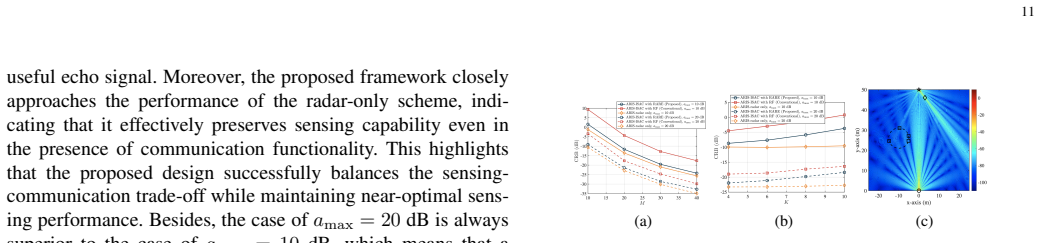
- The proposed framework outperforms conventional RF-based designs in terms of CRB minimization.
- The performance approaches that of a radar-only benchmark under the given constraints.
- The alternating optimization effectively handles the non-convex problem with SDR for beamforming and MM for ARIS design.
- RARE supports quantum-enhanced ISAC when combined with active RIS.
Where Pith is reading between the lines
- Such receivers might allow simpler hardware for sensing tasks in communication systems.
- Extending the model to multi-user or multi-target scenarios could reveal further gains.
- The closed-form CRB might facilitate real-time adaptation in dynamic environments.
Load-bearing premise
That the magnitude-only and real-domain observations of RARE permit deriving a unified model with closed-form CRB that accurately supports the joint optimization under the SINR and power constraints.
What would settle it
Measuring the actual DoA estimation error in an experimental setup with Rydberg receivers and comparing it to the optimized CRB value to check if the predicted performance gains materialize.
Figures

read the original abstract
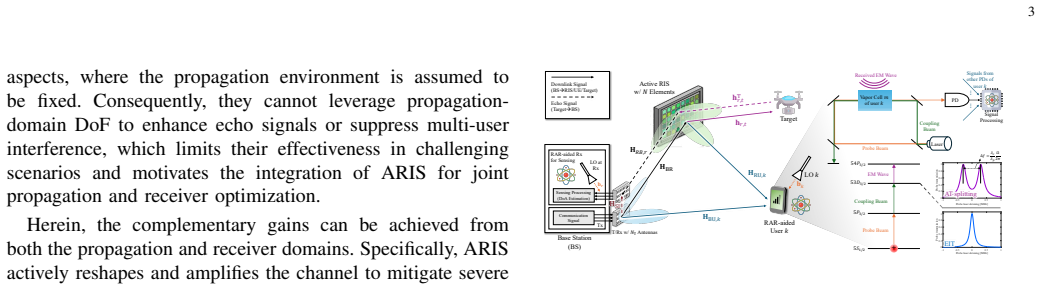
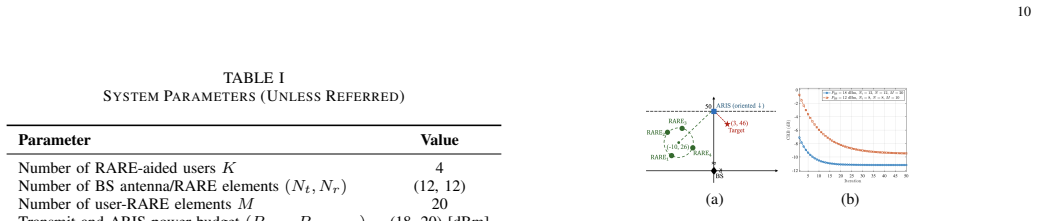
In this paper, we investigate an active-RIS (ARIS)-aided integrated sensing and communication (ISAC) system with Rydberg Atomic REceiver (RARE). Leveraging the magnitude-only and real-domain observation structure of RARE, we first derive a unified ISAC model, along with a closed-form Cramer-Rao bound (CRB) for direction-of-arrival (DoA) estimation. Based on this formulation, we propose a joint design of the {base station (BS)} beamforming and ARIS reflection coefficients to minimize the CRB under RARE-specific signal-to-interference-noise-ratio (SINR) and ARIS power constraints. To tackle the resulting highly non-convex problem, we develop an alternating optimization (AO) framework that combines semidefinite relaxation (SDR) for beamforming and a majorization-minimization (MM)-based approach for ARIS design. Numerical results demonstrate that the proposed RARE-aware framework significantly outperforms conventional RF-based designs and achieves performance close to the radar-only benchmark, highlighting the potential of RARE for quantum-enhanced ISAC with ARIS.
Editorial analysis
A structured set of objections, weighed in public.
Referee Report
Summary. The paper proposes an active-RIS (ARIS)-aided ISAC system employing Rydberg atomic receivers (RARE). It derives a unified ISAC model and a closed-form CRB for DoA estimation that exploits the magnitude-only, real-domain observation structure of RARE. A joint optimization of BS beamforming and ARIS reflection coefficients is formulated to minimize the CRB subject to RARE-specific SINR and ARIS power constraints; the non-convex problem is solved via an alternating optimization framework combining SDR and MM. Numerical results are presented showing that the RARE-aware design outperforms conventional RF-based ISAC and approaches the radar-only benchmark.
Significance. If the closed-form CRB derivation is exact and the optimization framework is free of hidden fitting or approximation bias, the work would establish a concrete pathway for quantum-enhanced receivers in ISAC, offering both theoretical tractability and demonstrated performance gains over RF baselines. The combination of magnitude-only observations with active RIS phase control is a distinctive technical contribution that could stimulate follow-on research in atomic-physics-assisted sensing and communications.
major comments (2)
- [CRB derivation (model and performance analysis sections)] The abstract states that a closed-form CRB for DoA is derived from the magnitude-only real-domain RARE structure. Because the likelihood under magnitude-only observations with multi-user interference and ARIS phase shifts is generally a non-central chi (or Rician) distribution, the Fisher information matrix does not admit a simple closed form without additional approximations (e.g., high-SNR Gaussian linearization or mean-field assumptions). The manuscript must explicitly state any such approximation, quantify the resulting bias in the CRB, and verify that the subsequent AO minimization remains valid under the same conditions; otherwise the reported performance advantage versus RF baselines rests on an unverified modeling step.
- [Problem formulation and AO framework] The joint optimization minimizes the CRB subject to SINR and ARIS power constraints. The abstract does not indicate whether the SINR constraint is evaluated with the exact RARE observation model or with an RF-equivalent approximation; any mismatch would render the feasible set inconsistent with the sensing metric being optimized.
minor comments (2)
- [System model] Notation for the RARE observation vector and the mapping from complex baseband to real magnitude-only measurements should be introduced with an explicit equation early in the model section to avoid ambiguity when the CRB is later derived.
- [Numerical results] The numerical results section should include an ablation that isolates the contribution of the closed-form CRB versus the AO solver itself (e.g., by comparing against a numerically computed CRB).
Simulated Author's Rebuttal
We thank the referee for the thorough review and valuable comments. We address each major comment point by point below.
read point-by-point responses
-
Referee: [CRB derivation (model and performance analysis sections)] The abstract states that a closed-form CRB for DoA is derived from the magnitude-only real-domain RARE structure. Because the likelihood under magnitude-only observations with multi-user interference and ARIS phase shifts is generally a non-central chi (or Rician) distribution, the Fisher information matrix does not admit a simple closed form without additional approximations (e.g., high-SNR Gaussian linearization or mean-field assumptions). The manuscript must explicitly state any such approximation, quantify the resulting bias in the CRB, and verify that the subsequent AO minimization remains valid under the same conditions; otherwise the reported performance advantage versus RF baselines rests on an unverified modeling step.
Authors: We appreciate this observation. In the manuscript, the closed-form CRB is derived exactly by exploiting the real-domain magnitude-only structure of RARE observations, which allows us to model the observations as a real-valued vector and compute the FIM directly without invoking Gaussian approximations or other linearizations. The derivation accounts for the multi-user interference and ARIS phases through the unified ISAC model. We will revise the manuscript to include an explicit statement confirming the absence of approximations and provide the full derivation steps in an appendix for clarity. The AO framework is optimized under the same exact model. revision: partial
-
Referee: [Problem formulation and AO framework] The joint optimization minimizes the CRB subject to SINR and ARIS power constraints. The abstract does not indicate whether the SINR constraint is evaluated with the exact RARE observation model or with an RF-equivalent approximation; any mismatch would render the feasible set inconsistent with the sensing metric being optimized.
Authors: The SINR constraint is formulated using the exact RARE-specific observation model, consistent with the unified ISAC model and the CRB derivation. Both the sensing (CRB) and communication (SINR) metrics are based on the magnitude-only real-domain structure of RARE. We will update the abstract and the problem formulation section to explicitly state this consistency. revision: yes
Circularity Check
No significant circularity; derivation is self-contained from RARE observation structure
full rationale
The paper derives a unified ISAC model and closed-form CRB directly from the stated magnitude-only real-domain structure of RARE, then applies AO with SDR and MM to the resulting optimization under explicit SINR and power constraints. No self-definitional loops, no fitted parameters renamed as predictions, and no load-bearing self-citations or uniqueness theorems are present in the provided derivation chain. The central claims rest on standard Fisher-information and convex-relaxation techniques applied to the given observation model, which are independent of the target performance metrics. This is the normal case of a self-contained technical derivation.
Axiom & Free-Parameter Ledger
axioms (1)
- domain assumption Magnitude-only and real-domain observation structure of RARE
Reference graph
Works this paper leans on
-
[1]
Integrated sensing and communications: Toward dual- functional wireless networks for 6G and beyond,
F. Liuet al., “Integrated sensing and communications: Toward dual- functional wireless networks for 6G and beyond,”IEEE J. Sel. Areas Commun., vol. 40, no. 6, pp. 1728–1767, Jun. 2022
2022
-
[2]
Integrated sensing, communication, and powering: Toward multi-functional 6G wireless networks,
Y . Chenet al., “Integrated sensing, communication, and powering: Toward multi-functional 6G wireless networks,”IEEE Commun. Mag., vol. 63, no. 8, pp. 146–153, Aug. 2025
2025
-
[3]
Near-field challenges in ultra-wideband ISAC: Beam- forming strategies and system insights,
Y . Kimet al., “Near-field challenges in ultra-wideband ISAC: Beam- forming strategies and system insights,”IEEE Communications Maga- zine, pp. 1–7, 2026
2026
-
[4]
Resource-efficient near-field misfocus mitigation in RIS- assisted wideband multi-user systems,
D. Junet al., “Resource-efficient near-field misfocus mitigation in RIS- assisted wideband multi-user systems,”IEEE Trans. Cogn. Commun. Netw., vol. 12, pp. 3148–3163, 2026
2026
-
[5]
AI-based beam management for FR3 FDD MIMO via online channel synthesis,
H.-J. Moonet al., “AI-based beam management for FR3 FDD MIMO via online channel synthesis,”IEEE J. Sel. Areas Commun., vol. 44, pp. 3444–3458, 2026
2026
-
[6]
AI-enhanced wide-area data imaging via massive non-orthogonal direct device-to-HAPS transmission,
——, “AI-enhanced wide-area data imaging via massive non-orthogonal direct device-to-HAPS transmission,”IEEE Commun. Mag., vol. 63, no. 11, pp. 76–82, Nov. 2025
2025
-
[7]
Bridging neural networks and wireless systems with MIMO-OFDM semantic communications,
H. Yooet al., “Bridging neural networks and wireless systems with MIMO-OFDM semantic communications,”IEEE Wireless Commun., vol. 32, no. 5, pp. 48–55, Oct. 2025
2025
-
[8]
MIMO-OFDM signaling design for noncoherent dis- tributed ISAC systems,
K. Hanet al., “MIMO-OFDM signaling design for noncoherent dis- tributed ISAC systems,”IEEE Trans. Wireless Commun., vol. 25, pp. 7792–7808, 2026
2026
-
[9]
MIMO integrated sensing and communication: CRB-rate tradeoff,
H. Huaet al., “MIMO integrated sensing and communication: CRB-rate tradeoff,”IEEE Trans. Wireless Commun., vol. 23, no. 4, pp. 2839–2854, Apr. 2024
2024
-
[10]
Cram ´er-Rao bound optimization for joint radar- communication beamforming,
F. Liuet al., “Cram ´er-Rao bound optimization for joint radar- communication beamforming,”IEEE Trans. Signal Process., vol. 70, pp. 240–253, 2022
2022
-
[11]
Intelligent reflecting surface-aided wireless communica- tions: A tutorial,
Q. Wuet al., “Intelligent reflecting surface-aided wireless communica- tions: A tutorial,”IEEE Trans. Commun., vol. 69, no. 5, pp. 3313–3351, May 2021
2021
-
[12]
Reconfigurable intelligent surfaces for 6G: Emerging hardware architectures, applications, and open challenges,
E. Basaret al., “Reconfigurable intelligent surfaces for 6G: Emerging hardware architectures, applications, and open challenges,”IEEE Veh. Technol. Mag., vol. 19, no. 3, pp. 27–47, Sep. 2024. 13
2024
-
[13]
Partition-based RIS-assisted multiple access: NOMA decoding order perspective,
Y . Kimet al., “Partition-based RIS-assisted multiple access: NOMA decoding order perspective,”IEEE Trans. Veh. Technol., vol. 71, no. 8, pp. 9083–9088, Aug. 2022
2022
-
[14]
An energy-efficient aerial backhaul system with reconfigurable intelligent surface,
H.-B. Jeonet al., “An energy-efficient aerial backhaul system with reconfigurable intelligent surface,”IEEE Trans. Wireless Commun., vol. 21, no. 8, pp. 6478–6494, Aug. 2022
2022
-
[15]
Integrated sensing and communications with reconfigurable intelligent surfaces: From signal modeling to processing,
S. P. Chepuriet al., “Integrated sensing and communications with reconfigurable intelligent surfaces: From signal modeling to processing,” IEEE Signal Process. Mag., vol. 40, no. 6, pp. 41–62, Sep. 2023
2023
-
[16]
Integrated sensing and communication with reconfigurable intelligent surfaces: Opportunities, applications, and future directions,
R. Liuet al., “Integrated sensing and communication with reconfigurable intelligent surfaces: Opportunities, applications, and future directions,” IEEE Wireless Commun., vol. 30, no. 1, pp. 50–57, Feb. 2023
2023
-
[17]
Sensing-based beamforming design for joint perfor- mance enhancement of RIS-aided ISAC systems,
X. Qianet al., “Sensing-based beamforming design for joint perfor- mance enhancement of RIS-aided ISAC systems,”IEEE Trans. Com- mun., vol. 71, no. 11, pp. 6529–6545, Nov. 2023
2023
-
[18]
Sensing for communication: RIS-assisted ISAC coordi- nation gain enhancement with imperfect CSI,
X. Liet al., “Sensing for communication: RIS-assisted ISAC coordi- nation gain enhancement with imperfect CSI,”IEEE Trans. Wireless Commun., vol. 24, no. 10, pp. 8145–8161, Oct. 2025
2025
-
[19]
Intelligent reflecting surface versus decode-and- forward: How large surfaces are needed to beat relaying?
E. Bj ¨ornsonet al., “Intelligent reflecting surface versus decode-and- forward: How large surfaces are needed to beat relaying?”IEEE Wireless Commun. Lett., vol. 9, no. 2, pp. 244–248, Feb. 2020
2020
-
[20]
Reconfigurable intelligent surfaces vs. relaying: Differences, similarities, and performance comparison,
M. Di Renzoet al., “Reconfigurable intelligent surfaces vs. relaying: Differences, similarities, and performance comparison,”IEEE Open J. Commun. Soc., vol. 1, pp. 798–807, Jun. 2020
2020
-
[21]
Active reconfigurable intelligent surfaces: Expanding the frontiers of wireless communication-a survey,
M. Ahmedet al., “Active reconfigurable intelligent surfaces: Expanding the frontiers of wireless communication-a survey,”IEEE Commun. Surveys Tuts., vol. 27, no. 2, pp. 839–869, Apr. 2025
2025
-
[22]
Active RIS vs. passive RIS: Which will prevail in 6G?
Z. Zhanget al., “Active RIS vs. passive RIS: Which will prevail in 6G?” IEEE Trans. Commun., vol. 71, no. 3, pp. 1707–1725, Mar. 2023
2023
-
[23]
Ampli-flection for 6G: Active-RIS-aided aerial backhaul with full 3D coverage,
H.-B. Jeon and C.-B. Chae, “Ampli-flection for 6G: Active-RIS-aided aerial backhaul with full 3D coverage,”IEEE Trans. Wireless Commun., vol. 25, pp. 14 259–14 273, 2026
2026
-
[24]
Passive versus active reconfigurable intelligent surfaces for integrated sensing and communication: Challenges and opportuni- ties,
M. Rihanet al., “Passive versus active reconfigurable intelligent surfaces for integrated sensing and communication: Challenges and opportuni- ties,”IEEE Netw., vol. 38, no. 3, pp. 218–226, May 2024
2024
-
[25]
Beamforming design for secure RIS-enabled ISAC: Passive RIS versus active RIS,
V . Kumar and M. Chafii, “Beamforming design for secure RIS-enabled ISAC: Passive RIS versus active RIS,”IEEE Trans. Wireless Commun., vol. 24, no. 9, pp. 7719–7732, Sep. 2025
2025
-
[26]
Cram ´er-Rao bound optimization for active RIS- empowered ISAC systems,
Q. Zhuet al., “Cram ´er-Rao bound optimization for active RIS- empowered ISAC systems,”IEEE Trans. Wireless Commun., vol. 23, no. 9, pp. 11 723–11 736, Sep. 2024
2024
-
[27]
Joint transceiver beamforming and reflecting design for active RIS-aided ISAC systems,
——, “Joint transceiver beamforming and reflecting design for active RIS-aided ISAC systems,”IEEE Trans. Veh. Technol., vol. 72, no. 7, pp. 9636–9640, Jul. 2023
2023
-
[28]
Active reconfigurable intelligent surface-assisted MISO integrated sensing and communication systems for secure oper- ation,
A. A. Salemet al., “Active reconfigurable intelligent surface-assisted MISO integrated sensing and communication systems for secure oper- ation,”IEEE Trans. Veh. Technol., vol. 72, no. 4, pp. 4919–4931, Apr. 2023
2023
-
[29]
Active IRS-assisted integrated sensing and communi- cation in C-RAN,
Y . Zhanget al., “Active IRS-assisted integrated sensing and communi- cation in C-RAN,”IEEE Wireless Commun. Lett., vol. 12, no. 3, pp. 411–415, Mar. 2023
2023
-
[30]
Secure energy efficiency for ARIS networks with deep learning: Active beamforming and position optimization,
D. Wanget al., “Secure energy efficiency for ARIS networks with deep learning: Active beamforming and position optimization,”IEEE Trans. Wireless Commun., vol. 24, no. 6, pp. 5282–5296, Jun. 2025
2025
-
[31]
Max-min fairness in active aerial reconfigurable intelligent surface-aided ISAC network,
S. Shakooret al., “Max-min fairness in active aerial reconfigurable intelligent surface-aided ISAC network,”IEEE Trans. Cogn. Commun. Netw., vol. 11, no. 5, pp. 2910–2922, Oct. 2025
2025
-
[32]
Thermal agitation of electric charge in conductors,
H. Nyquist, “Thermal agitation of electric charge in conductors,”Phys. Rev., vol. 32, pp. 110–113, Jul. 1928
1928
-
[33]
Quantum wireless sensing: Principle, design and implementation,
F. Zhanget al., “Quantum wireless sensing: Principle, design and implementation,” inProc. of ACM MobiCom, Oct. 2023, pp. 1–15
2023
-
[34]
Dual-band dual-polarized planar antenna for 5G millimeter-wave antenna-in-package applications,
Z. Siddiquiet al., “Dual-band dual-polarized planar antenna for 5G millimeter-wave antenna-in-package applications,”IEEE Trans. Anten- nas Propag., vol. 71, no. 4, pp. 2908–2921, Apr. 2023
2023
-
[35]
Antenna technologies for 6G–advances and challenges,
Y . J. Guoet al., “Antenna technologies for 6G–advances and challenges,” IEEE Trans. Antennas Propag., vol. 74, no. 5, pp. 3865–3880, May 2026
2026
-
[36]
RIS-assisted cooperative multicell ISAC systems: A multi-user and multi-target case,
X. Yanget al., “RIS-assisted cooperative multicell ISAC systems: A multi-user and multi-target case,”IEEE Trans. Wireless Commun., vol. 23, no. 8, pp. 8683–8699, Aug. 2024
2024
-
[37]
Towards atomic MIMO receivers,
M. Cuiet al., “Towards atomic MIMO receivers,”IEEE J. Sel. Areas Commun., vol. 43, no. 3, pp. 659–673, Mar. 2025
2025
-
[38]
Rydberg atomic receiver: Next frontier of wireless communica- tions,
——, “Rydberg atomic receiver: Next frontier of wireless communica- tions,”IEEE Commun. Mag., vol. 64, no. 1, pp. 146–152, Jan. 2026
2026
-
[39]
Rydberg atom electric field sensors for communi- cations and sensing,
C. T. Fancheret al., “Rydberg atom electric field sensors for communi- cations and sensing,”IEEE Trans. Quantum Eng., vol. 2, pp. 1–13, Mar. 2021
2021
-
[40]
Quantum-PROBE: Rydberg atomic receiver-based multi-AoA estimation with RF lens,
H.-B. Jeonet al., “Quantum-PROBE: Rydberg atomic receiver-based multi-AoA estimation with RF lens,”arXiv:2603.01855, 2026
arXiv 2026
-
[41]
Quantum shot noise limit in a Rydberg RF receiver compared to thermal noise limit in a conventional receiver,
L. W. Busseyet al., “Quantum shot noise limit in a Rydberg RF receiver compared to thermal noise limit in a conventional receiver,”IEEE Sens. Lett., vol. 6, no. 9, pp. 1–4, Sep. 2022
2022
-
[42]
Atom based RF electric field sensing,
H. Fanet al., “Atom based RF electric field sensing,”J. Phys. B: At. Mol. Opt. Phys., vol. 48, no. 20, p. 202001, Sep. 2015
2015
-
[43]
Atomic superheterodyne receiver based on microwave- dressed Rydberg spectroscopy,
M. Jinget al., “Atomic superheterodyne receiver based on microwave- dressed Rydberg spectroscopy,”Nat. Phys.,, vol. 1, pp. 911–915, Jun. 2020
2020
-
[44]
Electric field measurement and application based on Rydberg atoms,
B. Liuet al., “Electric field measurement and application based on Rydberg atoms,”Electromagn. Sci., vol. 1, no. 2, pp. 1–16, Jun. 2023
2023
-
[45]
Shortwave ultrahigh-sensitivity Rydberg atomic electric field sensing based on a subminiature resonator,
R. Maoet al., “Shortwave ultrahigh-sensitivity Rydberg atomic electric field sensing based on a subminiature resonator,”IEEE Trans. Antennas Propag., vol. 72, no. 11, pp. 8165–8172, Nov. 2024
2024
-
[46]
The realization of disturbance-reduction small vapor cells for broadband microwave detection with Rydberg atoms,
S. Liuet al., “The realization of disturbance-reduction small vapor cells for broadband microwave detection with Rydberg atoms,”IEEE Electron Device Lett., vol. 45, no. 9, pp. 1622–1625, Sep. 2024
2024
-
[47]
MIMO precoding for Rydberg atomic receivers,
M. Cuiet al., “MIMO precoding for Rydberg atomic receivers,” arXiv:2408.14366v2, 2024
arXiv 2024
-
[48]
Rydberg atomic quantum receivers for the multi-user MIMO uplink,
T. Gonget al., “Rydberg atomic quantum receivers for the multi-user MIMO uplink,” inProc. IEEE Int. Conf. on Commun. (ICC), Jun. 2025, pp. 4786–4791
2025
-
[49]
RAQ-MIMO: MIMO for multi-band Rydberg atomic quantum receiver,
J. Zhu and L. Dai, “RAQ-MIMO: MIMO for multi-band Rydberg atomic quantum receiver,”arXiv:2509.07832, 2025
arXiv 2025
-
[50]
A theory of single-antenna atomic beamforming,
M. Cuiet al., “A theory of single-antenna atomic beamforming,” arXiv:2601.18426, 2026
arXiv 2026
-
[51]
Multi-band quantum wireless sensing for Rydberg atomic receivers,
H. Kimet al., “Multi-band quantum wireless sensing for Rydberg atomic receivers,”IEEE Commun. Lett., vol. 29, no. 6, pp. 1476–1480, Jun. 2025
2025
-
[52]
AoA detection using a single Rydberg atomic receiver: Leveraging inner-vapor interference,
Y . Guoet al., “AoA detection using a single Rydberg atomic receiver: Leveraging inner-vapor interference,”IEEE Trans. Commun., vol. 73, no. 12, pp. 14 828–14 844, Dec. 2025
2025
-
[53]
Rydberg atomic quantum receivers for multi-target DOA estimation,
T. Gonget al., “Rydberg atomic quantum receivers for multi-target DOA estimation,”IEEE Trans. Veh. Technol., pp. 1–6, 2025
2025
-
[54]
Calibration-free Rydberg atomic receiver for sub-MHz wireless communications and sensing,
M. Chenet al., “Calibration-free Rydberg atomic receiver for sub-MHz wireless communications and sensing,”IEEE Trans. Veh. Technol., pp. 1–6, 2026
2026
-
[55]
RIS-aided ISAC withK-Rydberg atomic receivers,
H.-B. Jeon and C.-B. Chae, “RIS-aided ISAC withK-Rydberg atomic receivers,”arXiv:2601.06809, 2026
arXiv 2026
-
[56]
Rydberg atomic quantum receivers for classical wireless communication and sensing,
T. Gonget al., “Rydberg atomic quantum receivers for classical wireless communication and sensing,”IEEE Wireless Commun., vol. 32, no. 5, pp. 90–100, Oct. 2025
2025
-
[57]
New paradigm for integrated sensing and communi- cation with Rydberg atomic receiver,
M. Chenet al., “New paradigm for integrated sensing and communi- cation with Rydberg atomic receiver,”IEEE Commun. Mag., vol. 63, no. 12, pp. 104–111, Dec. 2025
2025
-
[58]
Rydberg atomic receivers for multi-band communications and sensing,
M. Cuiet al., “Rydberg atomic receivers for multi-band communications and sensing,”IEEE Trans. Wireless Commun., vol. 25, pp. 13 384– 13 400, 2026
2026
-
[59]
Fox,Quantum Optics: An Introductiony
M. Fox,Quantum Optics: An Introductiony. Oxford University Press, 2006
2006
-
[60]
Full-duplex communication for ISAC: Joint beamforming and power optimization,
Z. Heet al., “Full-duplex communication for ISAC: Joint beamforming and power optimization,”IEEE J. Sel. Areas Commun., vol. 41, no. 9, pp. 2920–2936, Sep. 2023
2023
-
[61]
SNR/CRB-constrained joint beamforming and reflection designs for RIS-ISAC systems,
R. Liuet al., “SNR/CRB-constrained joint beamforming and reflection designs for RIS-ISAC systems,”IEEE Trans. Wireless Commun., vol. 23, no. 7, pp. 7456–7470, Jul. 2024
2024
-
[62]
Active reconfigurable intelligent surface-aided wireless communications,
R. Longet al., “Active reconfigurable intelligent surface-aided wireless communications,”IEEE Trans. Wireless Commun., vol. 20, no. 8, pp. 4962–4975, Aug. 2021
2021
-
[63]
Semidefinite relaxation of quadratic optimization problems,
Z.-Q. Luoet al., “Semidefinite relaxation of quadratic optimization problems,”IEEE Signal Process. Mag., vol. 27, no. 3, pp. 20–34, May 2010
2010
-
[64]
Boyd and L
S. Boyd and L. Vandenberghe,Convex Optimization. Cambridge, UK: Cambridge Univ. Press, 2004
2004
-
[65]
Fractional programming for communication systems—Part I: Power control and beamforming,
K. Shen and W. Yu, “Fractional programming for communication systems—Part I: Power control and beamforming,”IEEE Trans. Signal Process., vol. 66, no. 10, pp. 2616–2630, May 2018
2018
-
[66]
Majorization-minimization algorithms in signal pro- cessing, communications, and machine learning,
Y . Sunet al., “Majorization-minimization algorithms in signal pro- cessing, communications, and machine learning,”IEEE Trans. Signal Process., vol. 65, no. 3, pp. 794–816, Feb. 2017
2017
-
[67]
Matrix majorization in large samples,
M. U. Farooqet al., “Matrix majorization in large samples,”IEEE Trans. Inf. Theory, vol. 70, no. 5, pp. 3118–3144, May 2024
2024
-
[68]
ARC 3.0: An expanded Python toolbox for atomic physics calculations,
E. Robertsonet al., “ARC 3.0: An expanded Python toolbox for atomic physics calculations,”Computer Physics Commun., vol. 261, p. 107814, Apr. 2021
2021
discussion (0)
Sign in with ORCID, Apple, or X to comment. Anyone can read and Pith papers without signing in.