Finite and disordered Kitaev chains: a large deviation study
Pith reviewed 2026-06-26 21:54 UTC · model grok-4.3
The pith
Large deviation statistics in disordered Kitaev chains make stronger Majorana zero mode localizations exponentially more likely than weaker ones.
A machine-rendered reading of the paper's core claim, the machinery that carries it, and where it could break.
Core claim
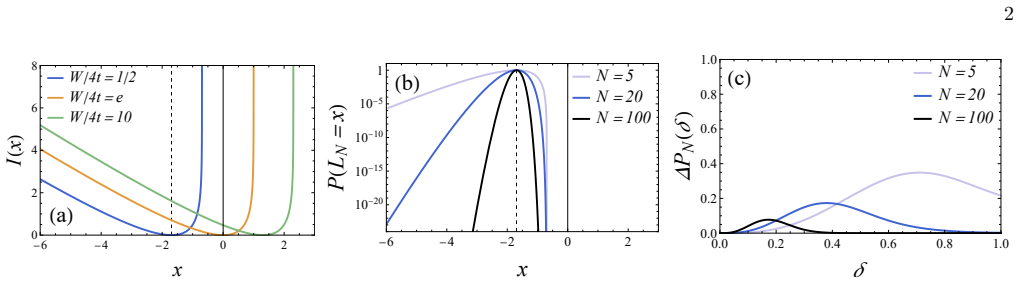
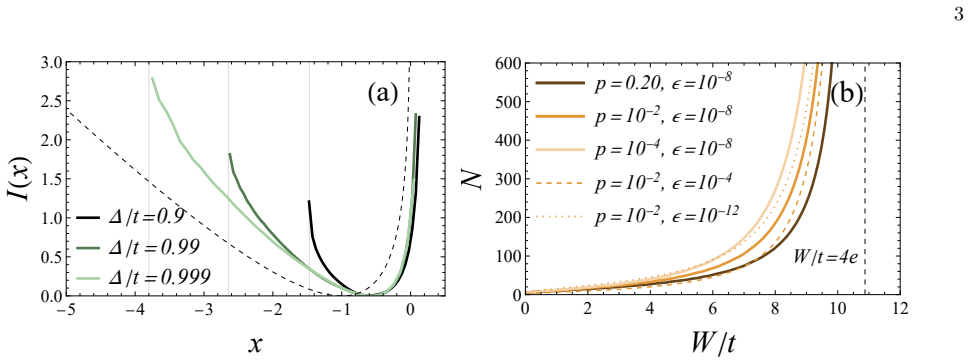
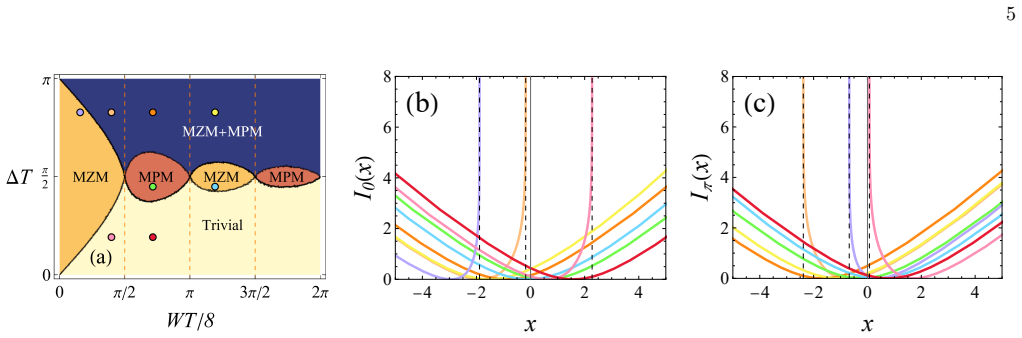
The central claim is that the large-deviation rate function for Lyapunov exponents in finite disordered Kitaev chains is asymmetric: the probability of realizing stronger edge localization decays more slowly than the probability of realizing weaker localization. This asymmetry is independent of whether the chain sits in the topological phase and endows the Majorana zero modes with additional protection against disorder. The result is demonstrated for both static and time-periodic driving and persists across broad classes of disorder distributions.
What carries the argument
Large deviations theory applied to the distribution of Lyapunov exponents extracted from transfer-matrix calculations on finite chains.
Load-bearing premise
The large-deviation rate function obtained from finite chains accurately reflects the true tail behavior of the Lyapunov exponent distribution without being dominated by finite-size corrections or by the numerical method used to compute the transfer matrix.
What would settle it
Direct sampling of the full Lyapunov exponent distribution in chains several times longer than those studied, showing that the large-deviation tails become symmetric rather than asymmetric.
Figures
read the original abstract
Topological edge states are celebrated for their robustness against disorder, yet the interplay between disorder and system size remains poorly understood. We use large deviations theory as a framework to study finite-size effects beyond the central limit theorem. We analyze Lyapunov exponent fluctuations in the static and periodically driven disordered Kitaev chain and find an asymmetry in the large deviations statistics that makes stronger edge localizations of Majorana zero modes exponentially more likely than weaker ones. We demonstrate that this fluctuation asymmetry is not tied to the topological phase. This asymmetry endows topological edge states with an additional protection against disorder and persists across a broad class of disorder distribution. We show how to use our framework to find the minimum system size required to satisfy topological quantum computing constraints.
Editorial analysis
A structured set of objections, weighed in public.
Referee Report
Summary. The manuscript applies large-deviation theory to Lyapunov-exponent fluctuations obtained from transfer-matrix products in finite static and periodically driven disordered Kitaev chains. It reports an asymmetry in the rate function I(λ) that makes stronger edge localizations of Majorana zero modes exponentially more probable than weaker ones; this asymmetry is stated to be independent of the topological phase, to persist for a broad class of disorder distributions, and to furnish an additional protection mechanism. The framework is further used to estimate the minimal chain length needed to meet topological-quantum-computing constraints.
Significance. If the reported asymmetry survives the infinite-volume limit, the work supplies a concrete statistical mechanism that supplements conventional topological protection in finite disordered systems and supplies a practical tool for sizing topological qubits. The independence from topology and the applicability across disorder ensembles are potentially valuable extensions of large-deviation methods to topological condensed-matter problems.
major comments (3)
- [Numerical extraction of rate function (results section)] Numerical results on the large-deviation rate function: the headline asymmetry in I(λ) is extracted from finite-N transfer-matrix products, yet no systematic finite-size scaling of the tail regime (e.g., collapse of I_N(λ) for increasing N or explicit comparison of different transfer-matrix factorizations) is presented. Without such controls the claim that the asymmetry constitutes a true additional protection mechanism remains vulnerable to the finite-size corrections highlighted in the stress-test note.
- [Comparison across topological phases] Independence from topological phase: the assertion that the asymmetry is not tied to topology requires side-by-side extraction of I(λ) in the topological and trivial regimes at identical disorder strength, together with a quantitative metric (e.g., difference in the slopes of the left and right tails) that demonstrates the asymmetry survives the phase boundary.
- [Disorder-distribution survey] Disorder-distribution generality: the statement that the asymmetry “persists across a broad class of disorder distributions” is supported only for a limited set of distributions; an explicit counter-example distribution or a proof that the sign of the asymmetry is distribution-independent would be needed to substantiate the claim.
minor comments (3)
- [Figures] The plots of I(λ) and the associated histograms lack error bars or bootstrap estimates that would quantify sampling uncertainty arising from the finite number of disorder realizations.
- [Methods] The precise numerical implementation of the transfer-matrix product (e.g., QR versus SVD factorization, handling of periodic driving) and the large-deviation sampling algorithm are described only at a high level; expanded pseudocode or parameter tables would improve reproducibility.
- [Introduction] Notation for the Lyapunov exponent λ and the rate function I(λ) is introduced without an explicit reminder of their relation to the Majorana localization length; a short clarifying sentence would aid readers outside the immediate subfield.
Simulated Author's Rebuttal
We are grateful to the referee for the thorough review and insightful comments on our manuscript. Below we provide point-by-point responses to the major comments. We will incorporate additional analyses to address the concerns raised.
read point-by-point responses
-
Referee: Numerical results on the large-deviation rate function: the headline asymmetry in I(λ) is extracted from finite-N transfer-matrix products, yet no systematic finite-size scaling of the tail regime (e.g., collapse of I_N(λ) for increasing N or explicit comparison of different transfer-matrix factorizations) is presented. Without such controls the claim that the asymmetry constitutes a true additional protection mechanism remains vulnerable to the finite-size corrections highlighted in the stress-test note.
Authors: We agree that systematic finite-size scaling is important for validating the large-deviation results. Although our current results show consistent asymmetry across the system sizes studied, we will add in the revised manuscript a detailed finite-size scaling analysis of the rate function I_N(λ), including comparisons for different N and transfer-matrix approaches, to demonstrate the robustness of the asymmetry against finite-size effects. revision: yes
-
Referee: Independence from topological phase: the assertion that the asymmetry is not tied to topology requires side-by-side extraction of I(λ) in the topological and trivial regimes at identical disorder strength, together with a quantitative metric (e.g., difference in the slopes of the left and right tails) that demonstrates the asymmetry survives the phase boundary.
Authors: The manuscript demonstrates the asymmetry in both phases, but we acknowledge that a direct side-by-side comparison with quantitative metrics would make this clearer. In the revision, we will include such a comparison at fixed disorder strength, providing quantitative measures like the difference in left and right tail slopes to show that the asymmetry is independent of the topological phase. revision: yes
-
Referee: Disorder-distribution generality: the statement that the asymmetry “persists across a broad class of disorder distributions” is supported only for a limited set of distributions; an explicit counter-example distribution or a proof that the sign of the asymmetry is distribution-independent would be needed to substantiate the claim.
Authors: We have tested the asymmetry for several disorder distributions, but to strengthen the generality claim, we will expand the survey in the revised manuscript to include additional distributions. While a general proof of distribution independence is beyond the scope of this work, the numerical evidence will be extended to support the broad applicability. revision: partial
Circularity Check
No significant circularity; standard LDT applied to transfer-matrix products
full rationale
The derivation applies large-deviation theory to the statistics of Lyapunov exponents obtained from products of transfer matrices on finite disordered Kitaev chains. No self-definitional steps, fitted inputs renamed as predictions, load-bearing self-citations, or ansatz smuggling appear in the abstract or described framework. The reported asymmetry in the rate function is an output of the numerical sampling rather than imposed by construction or prior author results. The central claim remains independent of the inputs and is self-contained against external large-deviation formalism.
Axiom & Free-Parameter Ledger
Reference graph
Works this paper leans on
-
[1]
M. Z. Hasan and C. L. Kane, Colloquium: Topological insulators, Rev. Mod. Phys.82, 3045 (2010)
2010
-
[2]
Qi and S.-C
X.-L. Qi and S.-C. Zhang, Topological insulators and su- perconductors, Rev. Mod. Phys.83, 1057 (2011)
2011
-
[3]
Das Sarma, In search of majorana, Nature Physics19, 165 (2023)
S. Das Sarma, In search of majorana, Nature Physics19, 165 (2023)
2023
-
[4]
M. T. Deng, C. L. Yu, G. Y. Huang, M. Larsson, P. Caroff, and H. Q. Xu, Anomalous zero-bias con- ductance peak in a nb–insb nanowire–nb hybrid de- vice, Nano Letters12, 6414 (2012), pMID: 23181691, https://doi.org/10.1021/nl303758w
-
[5]
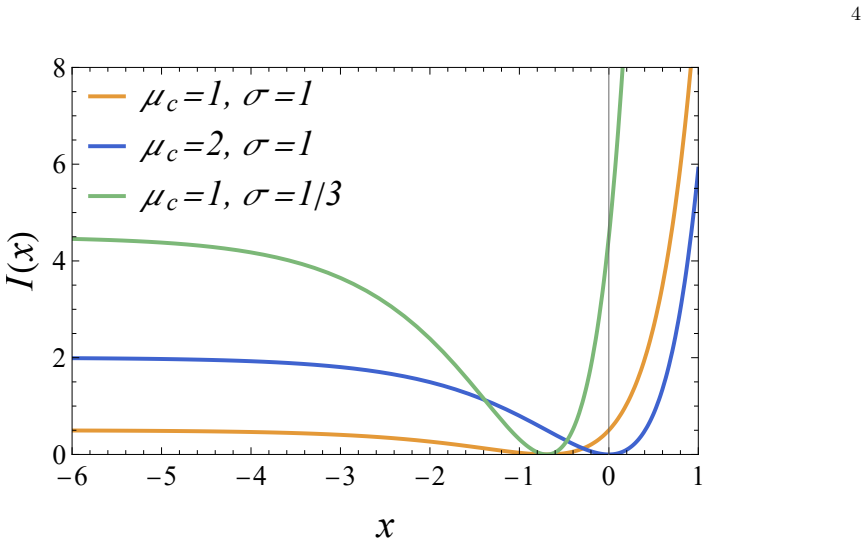
Mourik, K
V. Mourik, K. Zuo, S. M. Frolov, S. R. Plissard, E. P. A. M. Bakkers, and L. P. Kouwenhoven, Signa- tures of majorana fermions in hybrid superconductor- semiconductor nanowire devices, Science336, 1003 (2012)
2012
-
[6]
H. O. H. Churchill, V. Fatemi, K. Grove-Rasmussen, M. T. Deng, P. Caroff, H. Q. Xu, and C. M. Marcus, Superconductor-nanowire devices from tunneling to the multichannel regime: Zero-bias oscillations and magne- toconductance crossover, Phys. Rev. B87, 241401(R) (2013)
2013
-
[7]
A. D. K. Finck, D. J. Van Harlingen, P. K. Mohseni, K. Jung, and X. Li, Anomalous modulation of a zero- bias peak in a hybrid nanowire-superconductor device, Phys. Rev. Lett.110, 126406 (2013)
2013
-
[8]
Nichele, A
F. Nichele, A. C. C. Drachmann, A. M. Whiticar, E. C. T. O’Farrell, H. J. Suominen, A. Fornieri, T. Wang, G. C. Gardner, C. Thomas, A. T. Hatke, P. Krogstrup, M. J. Manfra, K. Flensberg, and C. M. Marcus, Scaling of majorana zero-bias conductance peaks, Phys. Rev. Lett. 119, 136803 (2017)
2017
-
[9]
H. Song, Z. Zhang, D. Pan, D. Liu, Z. Wang, Z. Cao, L. Liu, L. Wen, D. Liao, R. Zhuo, D. E. Liu, R. Shang, J. Zhao, and H. Zhang, Large zero bias peaks and dips in a four-terminal thin inas-al nanowire device, Phys. Rev. Res.4, 033235 (2022)
2022
-
[10]
Aghaee et al
M. Aghaee et al. (Microsoft Quantum), Inas-al hybrid devices passing the topological gap protocol, Phys. Rev. B107, 245423 (2023)
2023
-
[11]
Aghaee et al
M. Aghaee et al. (Microsoft Quantum), Interferometric single-shot parity measurement in inas–al hybrid devices, Nature638, 651 (2025)
2025
-
[12]
H. Pan, W. S. Cole, J. D. Sau, and S. Das Sarma, Generic quantized zero-bias conductance peaks in superconductor-semiconductor hybrid structures, Phys. Rev. B101, 024506 (2020)
2020
-
[13]
Pan and S
H. Pan and S. Das Sarma, Physical mechanisms for zero- bias conductance peaks in majorana nanowires, Phys. Rev. Res.2, 013377 (2020)
2020
-
[14]
P. Yu, J. Chen, M. Gomanko, G. Badawy, E. P. A. M. Bakkers, K. Zuo, V. Mourik, and S. M. Frolov, Non- majorana states yield nearly quantized conductance in proximatized nanowires, Nature Physics17, 482 (2021)
2021
-
[15]
H. Pan and S. Das Sarma, Disorder effects on ma- jorana zero modes: Kitaev chain versus semiconduc- tor nanowire, Physical Review B103, 10.1103/phys- revb.103.224505 (2021)
-
[16]
Das Sarma, J
S. Das Sarma, J. D. Sau, and T. D. Stanescu, Spectral properties, topological patches, and effective phase di- agrams of finite disordered majorana nanowires, Phys. Rev. B108, 085416 (2023)
2023
-
[17]
Pan and S
H. Pan and S. Das Sarma, Disordered majorana nanowires: Studying disorder without any disorder, Phys. Rev. B110, 075401 (2024)
2024
-
[18]
A. Y. Kitaev, Unpaired majorana fermions in quantum wires, Physics-Uspekhi44, 131 (2001). 7
2001
-
[19]
H. Ling, P. Richard, S. R. Koshkaki, M. Kolodrubetz, D. Meidan, A. Mitra, and T. Pereg-Barnea, Disorder- induced topological phase transition in a driven majorana chain, Phys. Rev. B109, 155144 (2024)
2024
-
[20]
P. W. Brouwer, M. Duckheim, A. Romito, and F. von Op- pen, Probability distribution of majorana end-state en- ergies in disordered wires, Phys. Rev. Lett.107, 196804 (2011)
2011
-
[21]
J. D. Sau and S. D. Sarma, Realizing a robust practical majorana chain in a quantum-dot-superconductor linear array, Nature Communications3, 964 (2012)
2012
-
[22]
Ryu and K
S. Ryu and K. Nomura, Disorder-induced quantum phase transitions in three-dimensional topological insulators and superconductors, Phys. Rev. B85, 155138 (2012)
2012
-
[23]
A. W. W. Ludwig, H. Schulz-Baldes, and M. Stolz, Lya- punov spectra for all ten symmetry classes of quasi- one-dimensional disordered systems of non-interacting fermions, Journal of Statistical Physics152, 275 (2013)
2013
-
[24]
B. M. Fregoso, A. M. Lobos, and S. Das Sarma, Electri- cal detection of topological quantum phase transitions in disordered majorana nanowires, Phys. Rev. B88, 180507(R) (2013)
2013
-
[25]
DeGottardi, D
W. DeGottardi, D. Sen, and S. Vishveshwara, Majorana fermions in superconducting 1d systems having periodic, quasiperiodic, and disordered potentials, Phys. Rev. Lett. 110, 146404 (2013)
2013
-
[26]
Mandal, Counting majorana bound states using complex momenta, Condensed Matter Physics19, 33703 (2016)
2016
-
[27]
S. S. Hegde and S. Vishveshwara, Majorana wave- function oscillations, fermion parity switches, and dis- order in kitaev chains, Phys. Rev. B94, 115166 (2016)
2016
-
[28]
R. R. Bahadur and R. R. Rao, On deviations of the sample mean, The Annals of Mathematical Statistics31, 1015 (1960), full publication date: Dec., 1960
1960
-
[29]
Dembo and O
A. Dembo and O. Zeitouni, Large Deviations Techniques and Applications, 2nd ed., Stochastic Modelling and Applied Probability, Vol. 38 (Springer, New York, 1998)
1998
-
[30]
den Hollander, Large Deviations, Fields Institute Monographs, Vol
F. den Hollander, Large Deviations, Fields Institute Monographs, Vol. 14 (American Mathematical Society, Providence, RI, 2000)
2000
-
[32]
We remark that it is possible to use a Bahadur-Rao approximation [28] to obtain polynomial prefactors and sharpen the LDP estimate, but this is unnecessary for our purposes
-
[33]
R. S. Ellis, Entropy, Large Deviations, and Statistical Mechanics, Grundlehren der mathematischen Wissenschaften (Springer, New York, 1985)
1985
-
[34]
Read and D
N. Read and D. Green, Paired states of fermions in two dimensions with breaking of parity and time-reversal symmetries and the fractional quantum hall effect, Phys. Rev. B61, 10267 (2000)
2000
-
[35]
C. W. J. Beenakker, Annihilation of colliding bogoliubov quasiparticles reveals their majorana nature, Phys. Rev. Lett.112, 070604 (2014)
2014
-
[36]
J. D. Sau, R. M. Lutchyn, S. Tewari, and S. Das Sarma, Generic new platform for topological quantum compu- tation using semiconductor heterostructures, Phys. Rev. Lett.104, 040502 (2010)
2010
-
[37]
Alicea, Majorana fermions in a tunable semiconductor device, Phys
J. Alicea, Majorana fermions in a tunable semiconductor device, Phys. Rev. B81, 125318 (2010)
2010
-
[38]
R. M. Lutchyn, J. D. Sau, and S. Das Sarma, Ma- jorana fermions and a topological phase transition in semiconductor-superconductor heterostructures, Phys. Rev. Lett.105, 077001 (2010)
2010
-
[39]
Y. Oreg, G. Refael, and F. von Oppen, Helical liquids and majorana bound states in quantum wires, Phys. Rev. Lett.105, 177002 (2010)
2010
-
[40]
S. B. Bravyi and A. Y. Kitaev, Fermionic quantum com- putation, Annals of Physics298, 210–226 (2002)
2002
-
[41]
Kitaev, Fault-tolerant quantum computation by anyons, Annals of Physics303, 2–30 (2003)
A. Kitaev, Fault-tolerant quantum computation by anyons, Annals of Physics303, 2–30 (2003)
2003
-
[42]
Nayak, S
C. Nayak, S. H. Simon, A. Stern, M. Freedman, and S. Das Sarma, Non-abelian anyons and topological quan- tum computation, Rev. Mod. Phys.80, 1083 (2008)
2008
-
[43]
S. D. Sarma, M. Freedman, and C. Nayak, Majorana zero modes and topological quantum computation, npj Quantum Information1, 15001 (2015)
2015
-
[44]
A. C. Berry, The accuracy of the gaussian approximation to the sum of independent variates, Transactions of the American Mathematical Society49, 122 (1941)
1941
-
[45]
Esseen, On the liapounoff limit of error in the the- ory of probability, Ark
C.-G. Esseen, On the liapounoff limit of error in the the- ory of probability, Ark. Mat., Astr. o. Fysik 28A , 1 (1942)
1942
-
[46]
Le Page, Theoremes limites pour les produits de matri- ces aleatoires, in Probability Measures on Groups, edited by H
E. Le Page, Theoremes limites pour les produits de matri- ces aleatoires, in Probability Measures on Groups, edited by H. Heyer (Springer Berlin Heidelberg, Berlin, Heidel- berg, 1982) pp. 258–303
1982
-
[47]
H. Xiao, I. Grama, and Q. Liu, Precise large deviation asymptotics for products of random matrices, Stochastic Processes and their Applications130, 5213 (2020)
2020
-
[48]
Leijnse and K
M. Leijnse and K. Flensberg, Parity qubits and poor man’s majorana bound states in double quantum dots, Phys. Rev. B86, 134528 (2012)
2012
-
[49]
T. Dvir, G. Wang, N. van Loo, C.-X. Liu, G. P. Mazur, A. Bordin, S. L. D. ten Haaf, J.-Y. Wang, D. van Driel, F. Zatelli, X. Li, F. K. Malinowski, S. Gazibegovic, G. Badawy, E. P. A. M. Bakkers, M. Wimmer, and L. P. Kouwenhoven, Realization of a minimal kitaev chain in coupled quantum dots, Nature614, 445 (2023)
2023
-
[50]
S. L. D. ten Haaf, Q. Wang, A. M. Bozkurt, C.-X. Liu, I. Kulesh, P. Kim, D. Xiao, C. Thomas, M. J. Manfra, T. Dvir, M. Wimmer, and S. Goswami, A two-site kitaev chain in a two-dimensional electron gas, Nature630, 329 (2024)
2024
-
[51]
Zatelli, D
F. Zatelli, D. van Driel, D. Xu, G. Wang, C.-X. Liu, A. Bordin, B. Roovers, G. P. Mazur, N. van Loo, J. C. Wolff, A. M. Bozkurt, G. Badawy, S. Gazibegovic, E. P. A. M. Bakkers, M. Wimmer, L. P. Kouwenhoven, and T. Dvir, Robust poor man’s majorana zero modes us- ing yu-shiba-rusinov states, Nature Communications15, 7933 (2024)
2024
-
[52]
Nitsch, L
M. Nitsch, L. Maffi, V. V. Baran, R. Seoane Souto, J. Paaske, M. Leijnse, and M. Burrello, Poor man’s ma- jorana tetron, PRX Quantum6, 030365 (2025)
2025
-
[53]
Kitagawa, E
T. Kitagawa, E. Berg, M. Rudner, and E. Demler, Topo- logical characterization of periodically driven quantum systems, Phys. Rev. B82, 235114 (2010)
2010
-
[54]
M. S. Rudner, N. H. Lindner, E. Berg, and M. Levin, Anomalous edge states and the bulk-edge correspondence for periodically driven two-dimensional systems, Phys. Rev. X3, 031005 (2013)
2013
-
[55]
Khemani, A
V. Khemani, A. Lazarides, R. Moessner, and S. L. Sondhi, Phase structure of driven quantum systems, Phys. Rev. Lett.116, 250401 (2016)
2016
-
[56]
Kishony, O
G. Kishony, O. Grossman, N. Lindner, M. Rudner, and 8 E. Berg, Topological excitations at time vortices in peri- odically driven systems, npj Quantum Materials10, 28 (2025)
2025
-
[57]
Jiang, T
L. Jiang, T. Kitagawa, J. Alicea, A. R. Akhmerov, D. Pekker, G. Refael, J. I. Cirac, E. Demler, M. D. Lukin, and P. Zoller, Majorana fermions in equilibrium and in driven cold-atom quantum wires, Phys. Rev. Lett.106, 220402 (2011)
2011
-
[58]
N. H. Lindner, G. Refael, and V. Galitski, Floquet topo- logical insulator in semiconductor quantum wells, Nature Physics7, 490 (2011)
2011
-
[59]
B. P. Truong, K. Agarwal, and T. Pereg-Barnea, Shut- tling majorana zero modes in disordered and noisy topological superconductors, Phys. Rev. B113, 064506 (2026)
2026
-
[60]
W. P. Su, J. R. Schrieffer, and A. J. Heeger, Solitons in polyacetylene, Phys. Rev. Lett.42, 1698 (1979)
1979
-
[61]
A. J. Heeger, S. Kivelson, J. R. Schrieffer, and W. P. Su, Solitons in conducting polymers, Rev. Mod. Phys.60, 781 (1988)
1988
-
[62]
Hatano and D
N. Hatano and D. R. Nelson, Localization transitions in non-hermitian quantum mechanics, Phys. Rev. Lett.77, 570 (1996)
1996
-
[63]
Hatano and D
N. Hatano and D. R. Nelson, Vortex pinning and non- hermitian quantum mechanics, Phys. Rev. B56, 8651 (1997)
1997
-
[64]
Hatano and D
N. Hatano and D. R. Nelson, Non-hermitian delocaliza- tion and eigenfunctions, Phys. Rev. B58, 8384 (1998)
1998
-
[65]
Finite and disordered Kitaev chains: a large deviations study
C. Fortin, K. Wang, and T. Pereg-Barnea, Unifying an- derson transitions and topological amplification in non- hermitian chains, Phys. Rev. B112, 174208 (2025). Supplemental Material for “Finite and disordered Kitaev chains: a large deviations study” Cl´ ement Fortin1, Kai Wang 1, and T. Pereg-Barnea 1 1Department of Physics, Regroupement qu´ eb´ ecois su...
2025
-
[66]
This trivially satisfies the first condition
In the main text, we used the uniform disorder distributionp(µ n) = 1/Woverµ n ∈[−W/2, W/2]. This trivially satisfies the first condition. The second condition follows by noticing that 1/W=µ 0 n/W, meaningβ= 0. As shown in the main text, the CGF is Λ(s) =slog(W/4t)−log(s+ 1), s >−1 (21) and the rate function is I(x) = log(W/4te)−x−log(log(W/4t)−x).(22)
-
[67]
The first condition is again trivial, and we again find β= 0 nearµ n = 0
Consider the truncated Gaussian distributionp(µ n) =e −(µn−µc)2/2σ2 /Zwhich integrates to unity over [a, b] for Z= R b a dµn p(µn), with meanµ c and varianceσ 2 <∞. The first condition is again trivial, and we again find β= 0 nearµ n = 0. Thus, the rate function is asymmetric
-
[68]
Here, it is the first condition that does not hold sinceµ n can be arbitrarily large
Consider the full Gaussian distributionp(µ n) =e −(µn−µc)/2σ2 overRwith meanµ c and varianceσ 2 <∞. Here, it is the first condition that does not hold sinceµ n can be arbitrarily large. Therefore, the rate function does not have an infinitely steep right tailI ′(x)→ ∞at somex→x ∗. However, the rate function is still very asymmetric. For this special case,...
-
[69]
Touchette, The large deviation approach to statistical mechanics, Physics Reports478, 1 (2009)
H. Touchette, The large deviation approach to statistical mechanics, Physics Reports478, 1 (2009)
2009
-
[70]
H. Ling, P. Richard, S. R. Koshkaki, M. Kolodrubetz, D. Meidan, A. Mitra, and T. Pereg-Barnea, Disorder-induced topological phase transition in a driven majorana chain, Phys. Rev. B109, 155144 (2024)
2024
discussion (0)
Sign in with ORCID, Apple, or X to comment. Anyone can read and Pith papers without signing in.