ParticleTransformer is all you need for reconstructing hadronic tau leptons
Pith reviewed 2026-06-29 05:07 UTC · model grok-4.3
The pith
Machine learning models using ParticleTransformer reconstruct hadronic tau leptons with per-mille misidentification and percent-level momentum resolution at FCC-ee.
A machine-rendered reading of the paper's core claim, the machinery that carries it, and where it could break.
Core claim
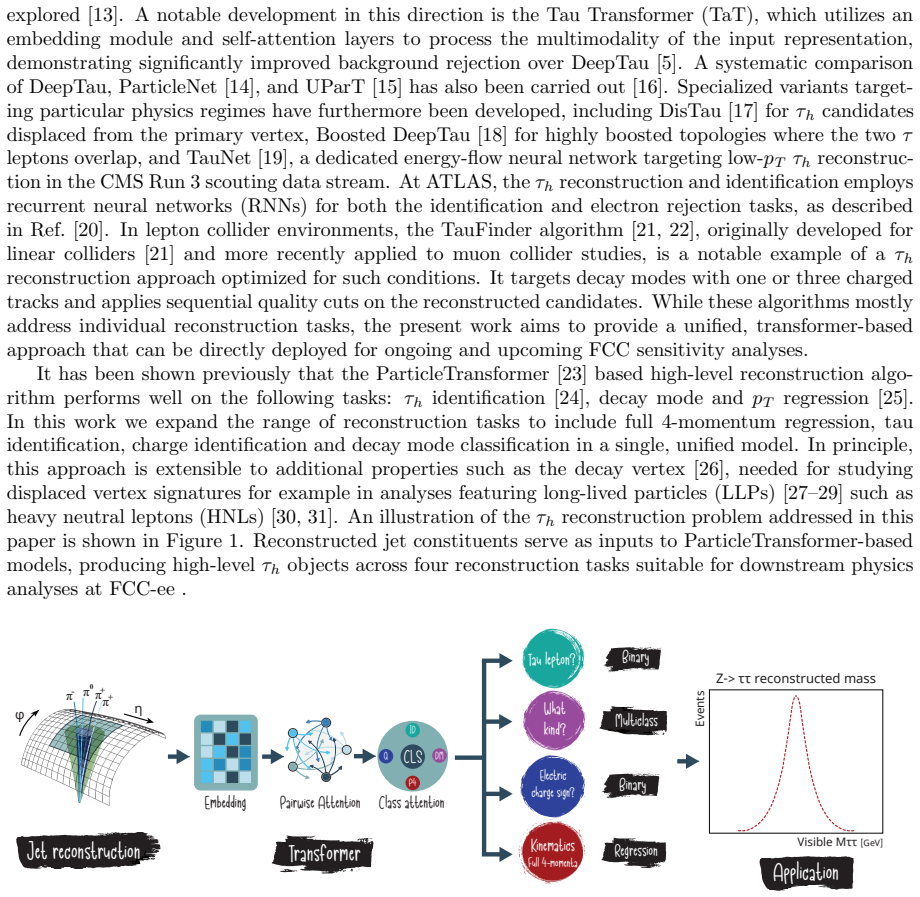
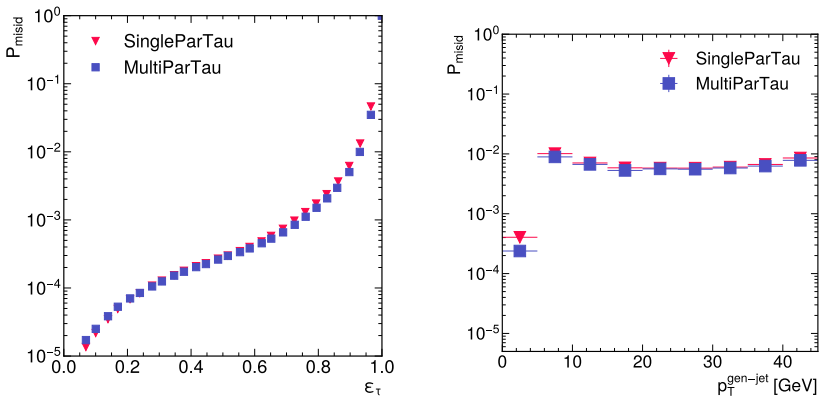
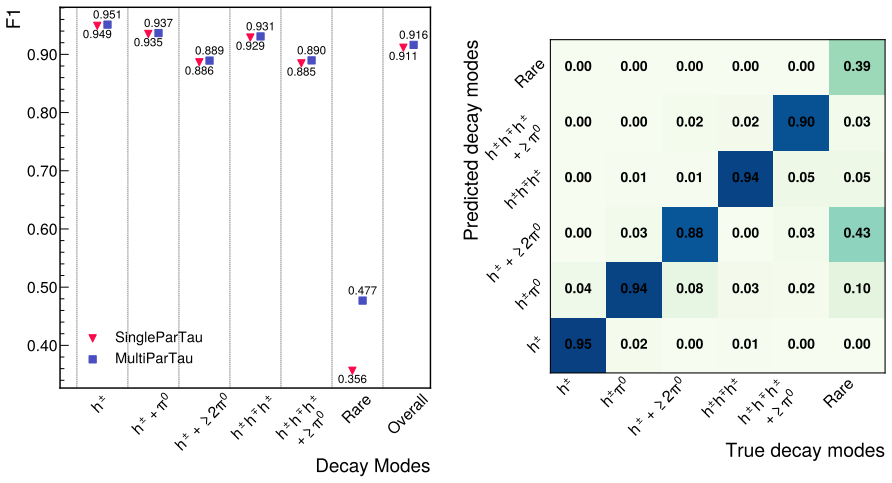
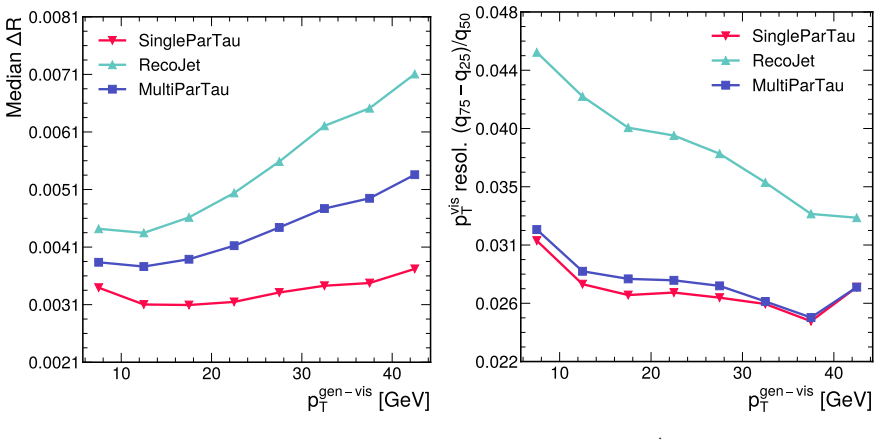
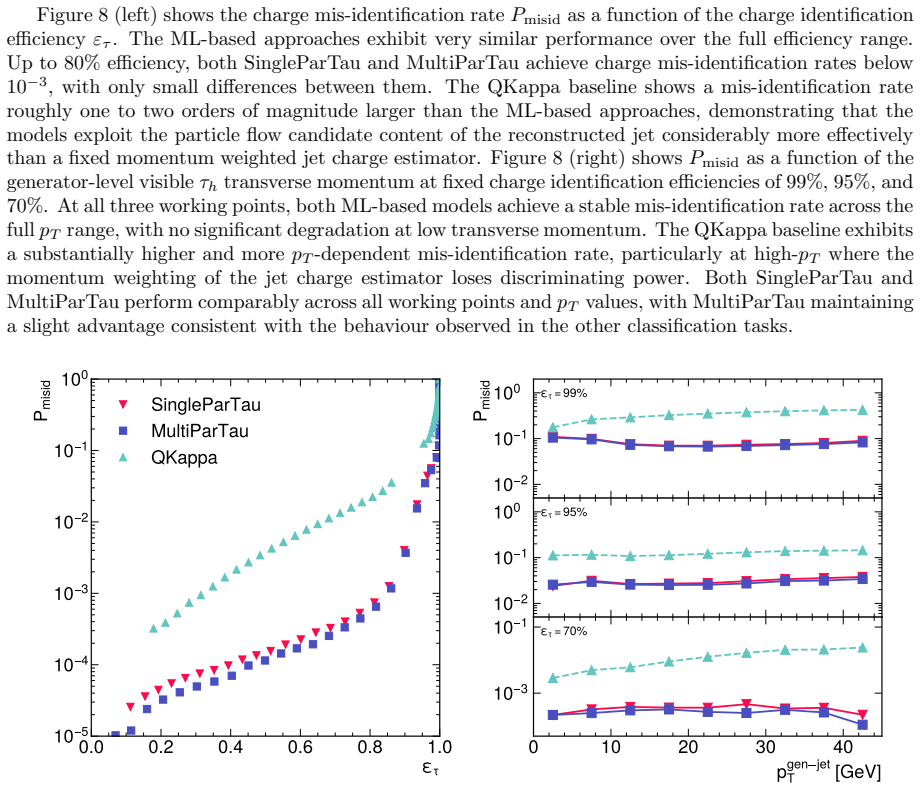
The paper claims that ParticleTransformer models trained on fully simulated electron-positron collisions with the CLD detector achieve per-mille-level tau mis-identification at high signal efficiency, decay mode F1 scores up to 0.95, sub-per-mille charge mis-identification that beats a conventional jet-charge estimator by up to two orders of magnitude, and per-mille angular plus percent-level visible transverse momentum resolution that surpasses reconstruction-level jet observables, thereby supplying a complete high-performance solution for hadronic tau reconstruction at FCC-ee.
What carries the argument
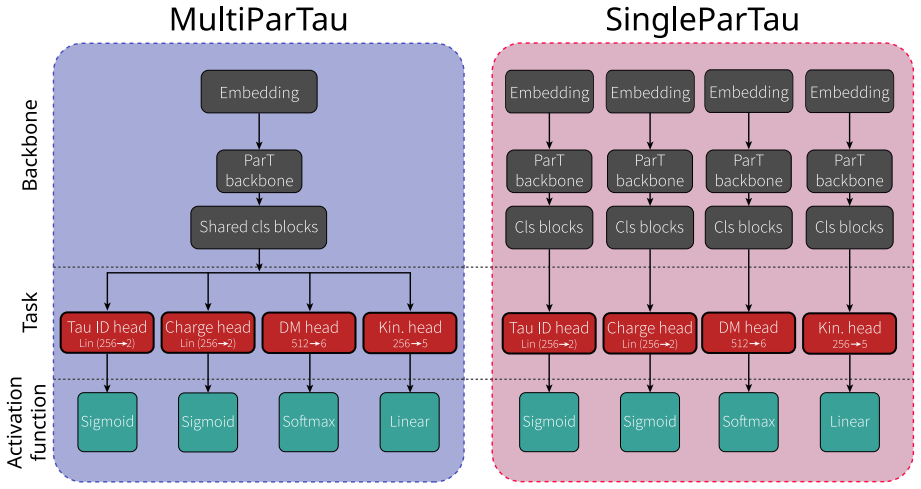
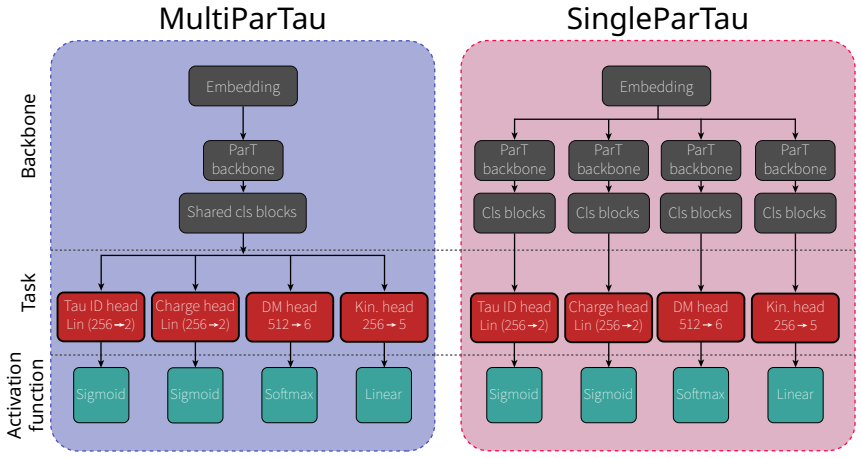
The ParticleTransformer architecture that processes sets of reconstructed particles to produce joint predictions across identification, classification, charge, and regression tasks.
If this is right
- Z to tau tau events can be used for precision Standard Model measurements and beyond-Standard-Model searches with reduced reconstruction systematics.
- Decay mode classification at F1 scores near 0.95 enables detailed studies of individual tau decay channels.
- Charge mis-identification below the per-mille level supports high-precision charge asymmetry measurements.
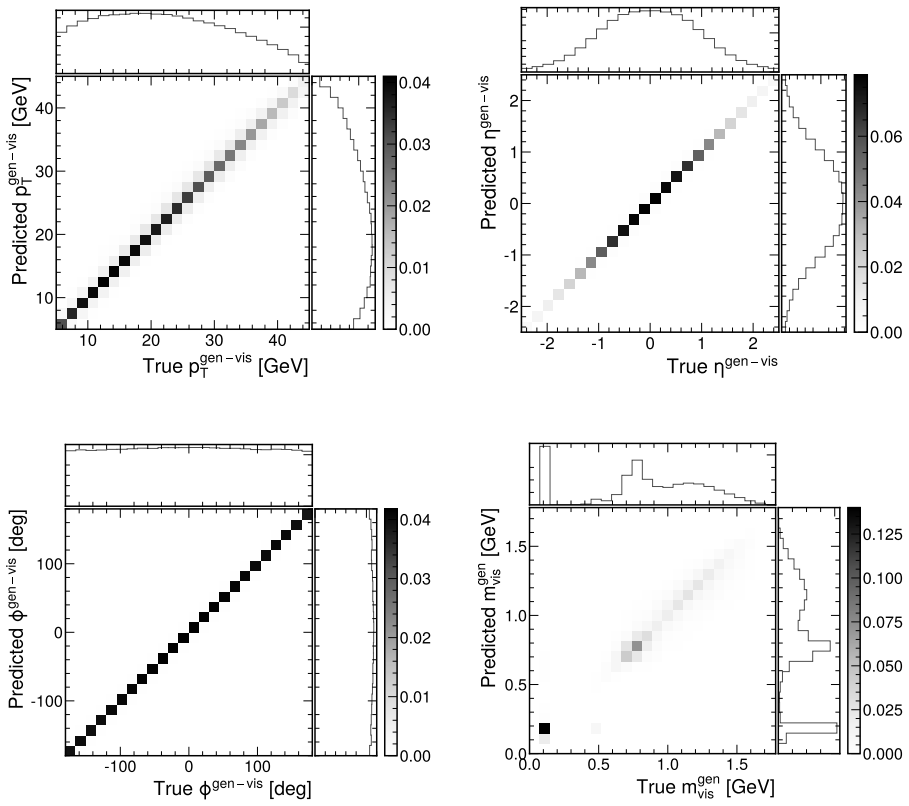
- Full four-momentum regression at percent-level transverse momentum resolution improves kinematic reconstruction in multi-tau final states.
Where Pith is reading between the lines
- The same transformer approach could be retrained on other collider datasets to address similar reconstruction problems without redesigning hand-crafted algorithms.
- A single multi-task model might eventually replace multiple specialized tau and jet reconstruction tools, simplifying analysis pipelines.
- If computational cost remains low, the models could be deployed in online triggering or event selection at future high-luminosity runs.
Load-bearing premise
Performance measured on fully simulated samples with realistic detector effects will translate directly to real experimental data collected at FCC-ee.
What would settle it
Training the models on simulation and then applying them to actual FCC-ee collision data and finding tau mis-identification rates above the per-mille level or momentum resolution no better than jet observables would falsify the performance claims.
Figures
read the original abstract
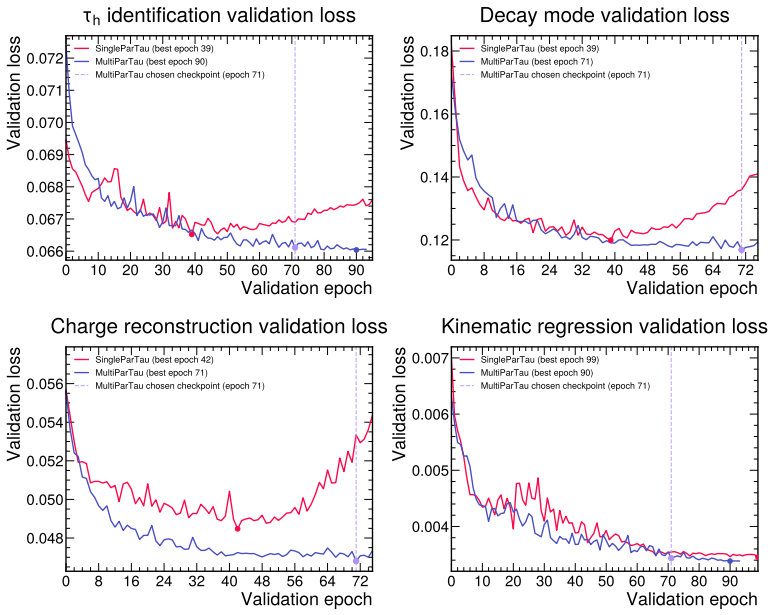
The large number of $Z \rightarrow \tau\tau$ events expected during the TeraZ program at FCC-ee will allow for precision measurements and searches for physics beyond the Standard Model, requiring accurate reconstruction of hadronically decaying tau leptons. This reconstruction is particularly challenging due to the presence of undetected neutrinos and the diverse topology of hadronic tau decays, making the design of robust heuristic reconstruction algorithms challenging. In this work, we present the first fully machine learned hadronic tau reconstruction approach tuned for FCC-ee studies. The reconstruction is formulated as a set of complementary tasks, including tau identification, decay mode classification, charge reconstruction, and full four-momentum regression. The algorithms are evaluated on fully simulated electron-positron collision samples with realistic detector effects using the CLD detector setup. We compare dedicated task-specific models with a unified multi-task model and quantify their performance in a granular manner across all reconstruction tasks. Both approaches achieve per-mille-level tau mis-identification rates at high signal efficiency, decay mode classification F1 scores of up to 0.95 for the dominant channels, and sub-per-mille charge mis-identification rates, outperforming a conventional jet-charge estimator by up to two orders of magnitude. For the full kinematic reconstruction, the models achieve per-mille-level angular resolution and percent-level visible transverse momentum resolution, exceeding the performance of reconstruction-level jet observables. The resulting models provide a realistic high-performance solution for hadronic tau reconstruction at FCC-ee, offering identification, charge discrimination, decay mode analysis and full kinematic reconstruction.
Editorial analysis
A structured set of objections, weighed in public.
Referee Report
Summary. The manuscript presents the first fully machine-learned approach to hadronic tau reconstruction at FCC-ee using ParticleTransformer models. It formulates the problem as complementary tasks (identification, decay-mode classification, charge reconstruction, and four-momentum regression) and evaluates dedicated single-task and unified multi-task models on fully simulated e+e- events with the CLD detector. The central claims are per-mille-level mis-identification rates at high efficiency, F1 scores up to 0.95 for dominant decay modes, sub-per-mille charge mis-identification (outperforming a jet-charge baseline by up to two orders of magnitude), and per-mille angular / percent-level pT resolution that exceeds reconstruction-level jet observables.
Significance. If the reported metrics prove robust, the work supplies a practical, high-performance baseline for tau reconstruction in the TeraZ program, where large Z→ττ samples will drive precision measurements and BSM searches. The multi-task formulation and direct comparison to conventional estimators are useful contributions for future collider studies.
major comments (3)
- [Abstract / Results] Abstract and results section: performance metrics (mis-ID rates, F1 scores, resolutions) are stated without any accompanying information on training/validation splits, event statistics, loss-function weighting for the multi-task model, or statistical/systematic uncertainties on the quoted figures. This absence prevents assessment of whether the claimed per-mille and sub-per-mille levels are statistically supported.
- [Methods / Evaluation] Methods / evaluation: no description is given of how the conventional jet-charge baseline is implemented, how the ParticleTransformer input features are constructed from CLD objects, or whether any simulation-level validation (e.g., comparison of input distributions or control samples) was performed. These details are load-bearing for the claim that the ML models outperform the baseline by up to two orders of magnitude.
- [Discussion / Conclusions] The manuscript reports results exclusively on fully simulated samples but provides no discussion of how the models might be validated or calibrated on data, nor any estimate of simulation-to-data discrepancies that could affect the quoted resolutions and mis-identification rates.
minor comments (2)
- [Introduction / Methods] Notation for decay-mode labels and kinematic variables should be defined explicitly in a table or early section for clarity.
- [Figures] Figure captions should include the exact selection criteria and event counts used for each performance curve.
Simulated Author's Rebuttal
We thank the referee for the constructive feedback. We address each major comment below and will revise the manuscript to incorporate the requested details and clarifications.
read point-by-point responses
-
Referee: [Abstract / Results] Abstract and results section: performance metrics (mis-ID rates, F1 scores, resolutions) are stated without any accompanying information on training/validation splits, event statistics, loss-function weighting for the multi-task model, or statistical/systematic uncertainties on the quoted figures. This absence prevents assessment of whether the claimed per-mille and sub-per-mille levels are statistically supported.
Authors: We agree these details are necessary for a complete evaluation. In the revised manuscript we will add explicit information on the training/validation/test splits (including fractions and total event counts), the event statistics of the simulated samples, the loss-function weighting scheme employed for the multi-task model, and statistical uncertainties on all reported metrics. Where relevant, we will also discuss potential systematic uncertainties arising from the simulation. revision: yes
-
Referee: [Methods / Evaluation] Methods / evaluation: no description is given of how the conventional jet-charge baseline is implemented, how the ParticleTransformer input features are constructed from CLD objects, or whether any simulation-level validation (e.g., comparison of input distributions or control samples) was performed. These details are load-bearing for the claim that the ML models outperform the baseline by up to two orders of magnitude.
Authors: We will expand the Methods and Evaluation sections to include a precise description of the jet-charge baseline implementation (including the algorithm, track selection, and weighting), a complete list of input features derived from CLD objects, and any simulation-level validation steps performed (such as distribution comparisons between signal and background or control-sample checks). revision: yes
-
Referee: [Discussion / Conclusions] The manuscript reports results exclusively on fully simulated samples but provides no discussion of how the models might be validated or calibrated on data, nor any estimate of simulation-to-data discrepancies that could affect the quoted resolutions and mis-identification rates.
Authors: We will add a paragraph in the Discussion section addressing this point. Because FCC-ee has not yet collected data, direct validation on real data is not possible at present. We will discuss likely sources of simulation-to-data discrepancies (e.g., detector modeling, particle identification efficiencies) and outline calibration strategies that could be applied once data are available, such as the use of control samples from Z decays. revision: yes
Circularity Check
No significant circularity
full rationale
The paper reports empirical performance of ML models (ParticleTransformer variants) trained and evaluated on fully simulated FCC-ee events. No equations, derivations, or first-principles claims are present; all metrics (mis-ID rates, F1 scores, resolutions) are direct outputs of model inference on simulation samples. No fitted parameters are relabeled as predictions, no self-citation chains support load-bearing premises, and no ansatz or uniqueness theorems are invoked. The work is self-contained within its simulation domain.
Axiom & Free-Parameter Ledger
axioms (1)
- domain assumption Simulated data with realistic detector effects accurately represents real FCC-ee collisions
Reference graph
Works this paper leans on
-
[1]
J. Alcaraz Maestre et al.,Tau Reconstruction with Full Simulation of the CLD Detector and prospects for the measurement of the tau polarization at FCC-ee, Mar. 2025. [Online]. Available: https://doi.org/10.17181/69a4s-7vw37
-
[2]
A New Mass Reconstruction Technique for Resonances Decaying to di-tau
A. Elagin et al., “A New Mass Reconstruction Technique for Resonances Decaying to di-tau,”Nucl. Instrum. Meth. A, vol. 654, pp. 481–489, 2011. arXiv:1012.4686 [hep-ex]
work page internal anchor Pith review Pith/arXiv arXiv 2011
-
[3]
S. Maruyama, “Stochastic mass-reconstruction: a new technique to reconstruct resonance masses of heavy particles decaying into tau lepton pairs,” Dec. 2015. arXiv:1512.04842 [hep-ex]
work page internal anchor Pith review Pith/arXiv arXiv 2015
-
[4]
Evidence for the 125 GeV Higgs boson decaying to a pair of tau leptons
S. Chatrchyan et al., “Evidence for the 125 GeV Higgs Boson Decaying to a Pair ofτLeptons,” JHEP, vol. 05, p. 104, 2014. arXiv:1401.5041 [hep-ex]
work page internal anchor Pith review Pith/arXiv arXiv 2014
-
[5]
Tau identification algorithms and study of the CP structure of the Yukawa coupling between the Higgs boson and tau leptons in CMS,
O. Filatov, “Tau identification algorithms and study of the CP structure of the Yukawa coupling between the Higgs boson and tau leptons in CMS,” Ph.D. dissertation, U. Hamburg (main), 2023, Hamburg U., Hamburg, 2023
2023
-
[6]
CP violation angles from H→τ τdecays at FCC-ee,
S. Giappichini et al., “CP violation angles from H→τ τdecays at FCC-ee,” Feb. 2026. arXiv: 2602.06635 [hep-ph]
-
[7]
Performance ofτ-lepton reconstruction and identification in CMS,
CMS Collaboration, “Performance ofτ-lepton reconstruction and identification in CMS,”Journal of Instrumentation, vol. 7, no. 01, P01001–P01001, 2012
2012
-
[8]
Theτchallenges at FCC-ee,
M. Dam, “Theτchallenges at FCC-ee,”Eur. Phys. J. Plus, vol. 136, no. 9, p. 963, 2021
2021
-
[9]
Tau-lepton Physics at the FCC-ee circular e$^+$e$^-$ Collider
M. Dam, “Tau-lepton Physics at the FCC-ee circular e +e− Collider,”SciPost Phys. Proc., vol. 1, p. 041, 2019. arXiv:1811.09408 [hep-ex]
work page internal anchor Pith review Pith/arXiv arXiv 2019
-
[10]
Reconstruction and identification ofτlepton decays to hadrons andν τ at CMS,
CMS Collaboration, “Reconstruction and identification ofτlepton decays to hadrons andν τ at CMS,”Journal of Instrumentation, vol. 11, no. 01, P01019–P01019, 2016
2016
-
[11]
Giappichini et al.,Measurements ofH→τ τcross-section at FCC-ee, Mar
S. Giappichini et al.,Measurements ofH→τ τcross-section at FCC-ee, Mar. 2025. [Online]. Available:https://doi.org/10.17181/d3y9x-8a819
-
[12]
Identification of hadronic tau lepton decays using a deep neural network,
CMS Collaboration, “Identification of hadronic tau lepton decays using a deep neural network,” JINST, vol. 17, P07023, 2022. arXiv:2201.08458
-
[13]
Recent advancements in the tau reconstruction and identification techniques in CMS,
A. Cardini, “Recent advancements in the tau reconstruction and identification techniques in CMS,” in18th International Workshop on Tau Lepton Physics, Dec. 2025. arXiv:2512.07387 [hep-ex]
-
[14]
ParticleNet: Jet Tagging via Particle Clouds,
H. Qu and L. Gouskos, “ParticleNet: Jet Tagging via Particle Clouds,”Phys. Rev. D, vol. 101, no. 5, p. 056 019, 2020. arXiv:1902.08570 [hep-ph]
-
[15]
A unified approach for jet tagging in Run 3 at √s=13.6 TeV in CMS,
CMS Collaboration, “A unified approach for jet tagging in Run 3 at √s=13.6 TeV in CMS,” 2024. [Online]. Available:https://cds.cern.ch/record/2904702
-
[16]
Comparison of the performance of tau reconstruction and identification algo- rithms in Run 3,
CMS Collaboration, “Comparison of the performance of tau reconstruction and identification algo- rithms in Run 3,” 2025. [Online]. Available:https://cds.cern.ch/record/2946445
-
[17]
Tau lepton identification in displaced topologies using machine learning at CMS,
CMS Collaboration, “Tau lepton identification in displaced topologies using machine learning at CMS,” 2024. [Online]. Available:https://cds.cern.ch/record/2904366 18
-
[18]
Performance of boosted tau lepton identification with DeepTau Framework (Boosted DeepTau),
CMS Collaboration, “Performance of boosted tau lepton identification with DeepTau Framework (Boosted DeepTau),” 2025. [Online]. Available:https://cds.cern.ch/record/2941434
-
[19]
CMS Collaboration, “Low transverse-momentum hadronic tau lepton reconstruction performance in the Run 3 Scouting dataset,” CERN, Geneva, Tech. Rep., 2024. [Online]. Available:https : //cds.cern.ch/record/2905110
-
[20]
ATLAS Collaboration, “Reconstruction, Identification, and Calibration of hadronically decaying tau leptons with the ATLAS detector for the LHC Run 3 and reprocessed Run 2 data,” CERN, Geneva, Tech. Rep., 2022. [Online]. Available:https://cds.cern.ch/record/2827111
-
[21]
TauFinder: A Reconstruction Algorithm forτLeptons at Linear Colliders,
A. Muennich, “TauFinder: A Reconstruction Algorithm forτLeptons at Linear Colliders,” 2010. [Online]. Available:https://cds.cern.ch/record/1443551
-
[22]
Tau Lepton Reconstruction at the Muon Collider: Cross Section Measurement of the H→τ+τ−Process,
M. Gallinaro et al., “Tau Lepton Reconstruction at the Muon Collider: Cross Section Measurement of the H→τ+τ−Process,”HiHEP, vol. 2, no. 1, p. 3, 2026. arXiv:2601.01674 [hep-ex]
-
[23]
Particle Transformer for jet tagging,
H. Qu et al., “Particle Transformer for jet tagging,” inInternational conference on machine learning, PMLR, 2022, p. 18 281. arXiv:2202.03772
-
[24]
Tau lepton identification and reconstruction: A new frontier for jet-tagging ML algorithms,
T. Lange et al., “Tau lepton identification and reconstruction: A new frontier for jet-tagging ML algorithms,”Comput. Phys. Commun., vol. 298, p. 109 095, 2024. arXiv:2307.07747 [hep-ex]
-
[25]
A unified machine learning approach for reconstructing hadronically decaying tau leptons,
L. Tani et al., “A unified machine learning approach for reconstructing hadronically decaying tau leptons,”Computer Physics Communications, vol. 307, p. 109 399, 2025. [Online]. Available:https: //www.sciencedirect.com/science/article/pii/S0010465524003229
2025
-
[26]
Tau kinematics from impact parameters,
J. K¨ uhn, “Tau kinematics from impact parameters,”Physics Letters B, vol. 313, no. 3-4, pp. 458– 460, 1993
1993
-
[27]
A guide to hunting long-lived particles at the LHC,
S. Knapen and S. Lowette, “A guide to hunting long-lived particles at the LHC,”Annual Review of Nuclear and Particle Science, vol. 73, no. 1, pp. 421–449, 2023
2023
-
[28]
Collider searches for long-lived particles beyond the Standard Model,
L. Lee et al., “Collider searches for long-lived particles beyond the Standard Model,”Progress in Particle and Nuclear Physics, vol. 106, pp. 210–255, 2019
2019
-
[29]
Novel signature for long-lived particles at the LHC,
S. Banerjee et al., “Novel signature for long-lived particles at the LHC,”Physical Review D, vol. 98, no. 11, p. 115 026, 2018
2018
-
[30]
The present and future status of heavy neutral leptons,
A. M. Abdullahi et al., “The present and future status of heavy neutral leptons,”Journal of Physics G: Nuclear and Particle Physics, vol. 50, no. 2, p. 020 501, 2023
2023
-
[31]
Extending limits on neutral heavy leptons,
M. Gronau et al., “Extending limits on neutral heavy leptons,”Physical Review D, vol. 29, no. 11, p. 2539, 1984
1984
-
[32]
L. Tani et al.,Fuτure - dataset for studies, development, and training of algorithms for recon- structing and identifying hadronically decaying tau leptons (Version v3). Zenodo, 2026. [Online]. Available:https://doi.org/10.5281/zenodo.20717190
-
[33]
FCC-ee: The lepton collider: Future circular collider conceptual design report volume 2,
FCC Collaboration et al., “FCC-ee: The lepton collider: Future circular collider conceptual design report volume 2,”Eur. Phys. J. Spec. Top., vol. 228, no. CERN-ACC-2018-0057, pp. 261–623, 2018
2018
-
[34]
FCC physics opportunities: Future circular collider conceptual design report volume 1,
FCC collaboration, “FCC physics opportunities: Future circular collider conceptual design report volume 1,”European Physical Journal C, vol. 79, no. 6, p. 474, 2019
2019
-
[35]
CLD – A Detector Concept for the FCC-ee,
N. Bacchetta et al., “CLD – A Detector Concept for the FCC-ee,” Nov. 2019. arXiv:1911.12230 [physics.ins-det]
-
[36]
Tani et al.,HEP-KBFI/ml-tau-data: arXiv submission (Version v1)
L. Tani et al.,HEP-KBFI/ml-tau-data: arXiv submission (Version v1). Zenodo, 2026. [Online]. Available:https://doi.org/10.5281/zenodo.20705217 19
-
[37]
A comprehensive guide to the physics and usage of PYTHIA 8.3,
C. Bierlich et al., “A comprehensive guide to the physics and usage of PYTHIA 8.3,”SciPost Phys. Codebases, p. 8, 2022. [Online]. Available:https://scipost.org/10.21468/SciPostPhysCodeb.8
-
[38]
Geant4: a simulation toolkit,
GEANT4 Collaboration, “Geant4: a simulation toolkit,”Nucl. Instrum. Meth. A, vol. 506, p. 250, 2003
2003
-
[39]
Marlin and LCCD: Software tools for the ILC,
F. Gaede, “Marlin and LCCD: Software tools for the ILC,”Nucl. Instrum. Meth. A, vol. 559, J. Blumlein et al., Eds., p. 177, 2006
2006
-
[40]
Key4hep, a framework for future HEP experiments and its use in FCC,
G. Ganis et al., “Key4hep, a framework for future HEP experiments and its use in FCC,”Eur. Phys. J. Plus, vol. 137, p. 149, 2022. arXiv:2111.09874
-
[41]
Conformal tracking for all-silicon trackers at future electron–positron colliders,
E. Brondolin et al., “Conformal tracking for all-silicon trackers at future electron–positron colliders,” Nucl. Instrum. Meth. A, vol. 956, p. 163 304, 2020. arXiv:1908.00256 [physics.ins-det]
-
[42]
EDM4hep - a common event data model for HEP experiments,
F. Gaede et al., “EDM4hep - a common event data model for HEP experiments,”PoS, vol. ICHEP2022, p. 1237, Nov. 2022
2022
-
[43]
Performance of Particle Flow Calorimetry at CLIC
J. S. Marshall et al., “Performance of particle flow calorimetry at CLIC,”Nucl. Instrum. Meth. A, vol. 700, p. 153, 2013. arXiv:1209.4039
work page internal anchor Pith review Pith/arXiv arXiv 2013
-
[44]
The Pandora Software Development Kit for Pattern Recognition
J. S. Marshall and M. A. Thomson, “The Pandora software development kit for pattern recognition,” Eur. Phys. J. C, vol. 75, p. 439, 2015. arXiv:1506.05348
work page internal anchor Pith review Pith/arXiv arXiv 2015
-
[45]
L. Reichenbach et al.,jpata/CLDConfig: MLPF and tau reconstruction samples, 2026 spring, ver- sion v1.2.5, Jun. 2026. [Online]. Available:https://doi.org/10.5281/zenodo.20541598
-
[46]
Jet reconstruction at high-energy lepton colliders
M. Boronat et al., “Jet reconstruction at high-energy electron–positron colliders,”Eur. Phys. J. C, vol. 78, p. 144, 2018. arXiv:1607.05039
work page internal anchor Pith review Pith/arXiv arXiv 2018
-
[47]
Track parameters in LCIO,
T. Kramer, “Track parameters in LCIO,” Linear collider note. [Online]. Available:https://bib- pubdb1.desy.de/record/81214/files/LC-DET-2006-004%5B1%5D.pdf
2006
-
[48]
Decoupled Weight Decay Regularization
I. Loshchilov and F. Hutter, “Decoupled weight decay regularization,”arXiv preprint arXiv:1711.05101, 2017
work page internal anchor Pith review Pith/arXiv arXiv 2017
-
[49]
Circular interpretation of regression coefficients,
J. Cremers et al., “Circular interpretation of regression coefficients,”British Journal of Mathemat- ical and Statistical Psychology, vol. 71, no. 1, pp. 75–95, 2018
2018
-
[50]
Robust Estimation of a Location Parameter,
P. J. Huber, “Robust Estimation of a Location Parameter,”The Annals of Mathematical Statistics, vol. 35, no. 1, pp. 73–101, 1964
1964
-
[51]
Gradient surgery for multi-task learning,
T. Yu et al., “Gradient surgery for multi-task learning,”Advances in neural information processing systems, vol. 33, pp. 5824–5836, 2020
2020
-
[52]
Measurement of jet charge observables in dijet events at √s= 8 TeV,
CMS Collaboration, “Measurement of jet charge observables in dijet events at √s= 8 TeV,” 2016
2016
-
[53]
Tani et al.,HEP-KBFI/ml-tau-model: arXiv submission (Version v1)
L. Tani et al.,HEP-KBFI/ml-tau-model: arXiv submission (Version v1). Zenodo, 2026. [Online]. Available:https://doi.org/10.5281/zenodo.20705279 20
discussion (0)
Sign in with ORCID, Apple, or X to comment. Anyone can read and Pith papers without signing in.