Discovery of a 24-millisecond pulsar in a very long orbit with the Murchison Widefield Array
Pith reviewed 2026-06-26 20:08 UTC · model grok-4.3
The pith
A 24 ms pulsar has been found in a binary with an orbital period of roughly 834 days.
A machine-rendered reading of the paper's core claim, the machinery that carries it, and where it could break.
Core claim
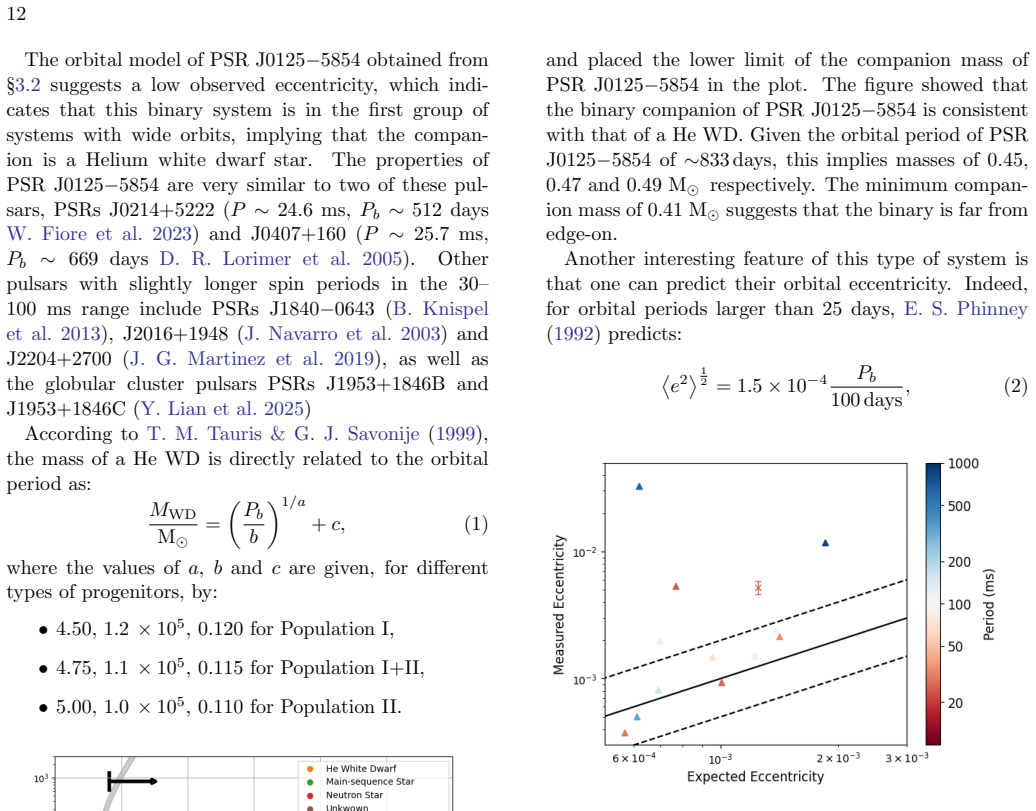
PSR J0125−5854 is a 24 ms pulsar with DM 11.66 pc cm−3 discovered in the ongoing Southern-sky MWA Rapid Two-metre survey. Timing data indicate a binary orbit with period 833.60 days, projected semi-major axis 241.36 light-seconds, minimum companion mass 0.4152 solar masses, and eccentricity 0.0052. The companion is likely a helium white dwarf and the spectrum has index −2.2. Further observations are required to refine the parameters.
What carries the argument
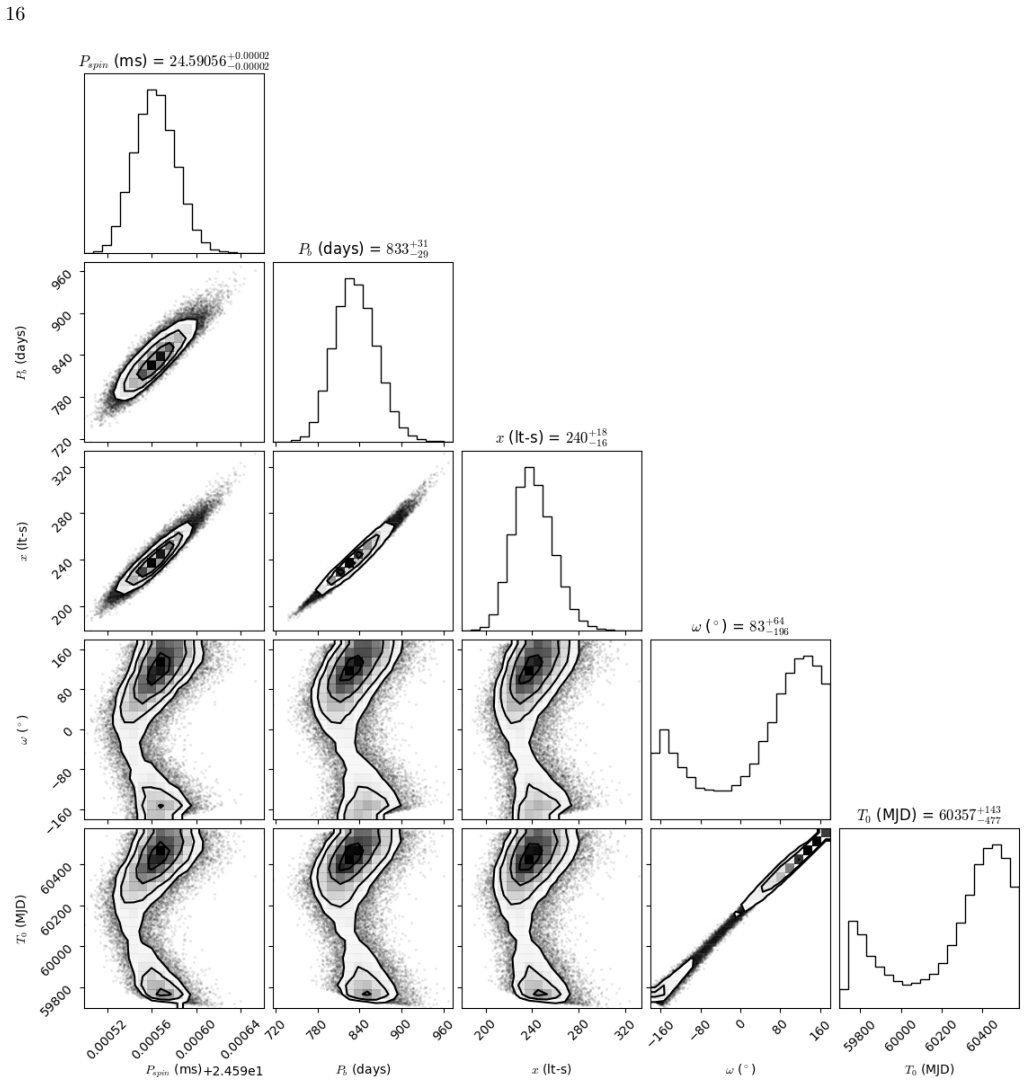
The binary orbital solution obtained by fitting pulse arrival times, which supplies the orbital period, projected semi-major axis, eccentricity, and mass function.
If this is right
- The system most likely formed via a channel that leaves a helium white dwarf companion after mass transfer.
- The steep spectrum implies the pulsar will be brighter at frequencies below those already observed.
- Processing the remainder of the SMART survey data is expected to uncover additional millisecond pulsars.
- Similar long-period systems should be detectable in planned low-frequency surveys with SKA-Low.
Where Pith is reading between the lines
- If the orbit is confirmed, the object supplies a nearby, low-DM test case for studying wide binary evolution at high Galactic latitude.
- The discovery shows that wide-field low-frequency arrays can locate pulsars whose long orbits make them hard to find in shorter pointed observations.
- Confirmation would allow the mass function to be combined with optical or radial-velocity data to constrain the companion mass more tightly.
Load-bearing premise
The existing timing data span enough of the orbit to identify the true 834-day period without aliases from incomplete phase coverage.
What would settle it
New pulse arrival-time measurements over the next several months that fall outside the arrival-time window predicted by the 833.6-day orbital model.
Figures
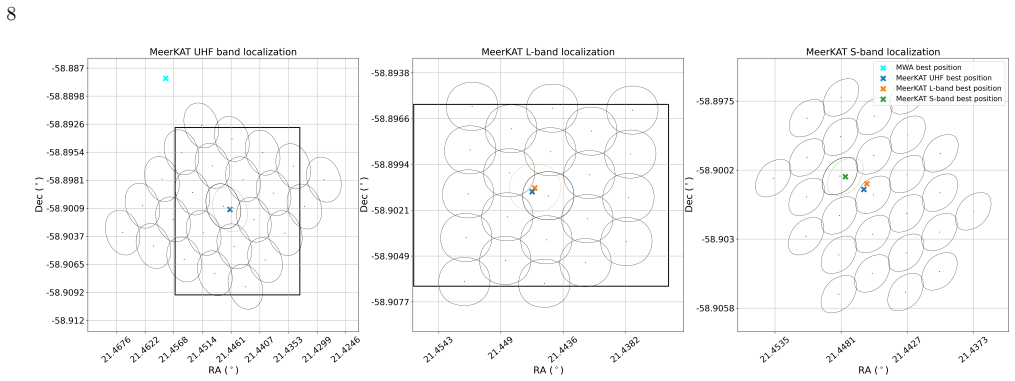
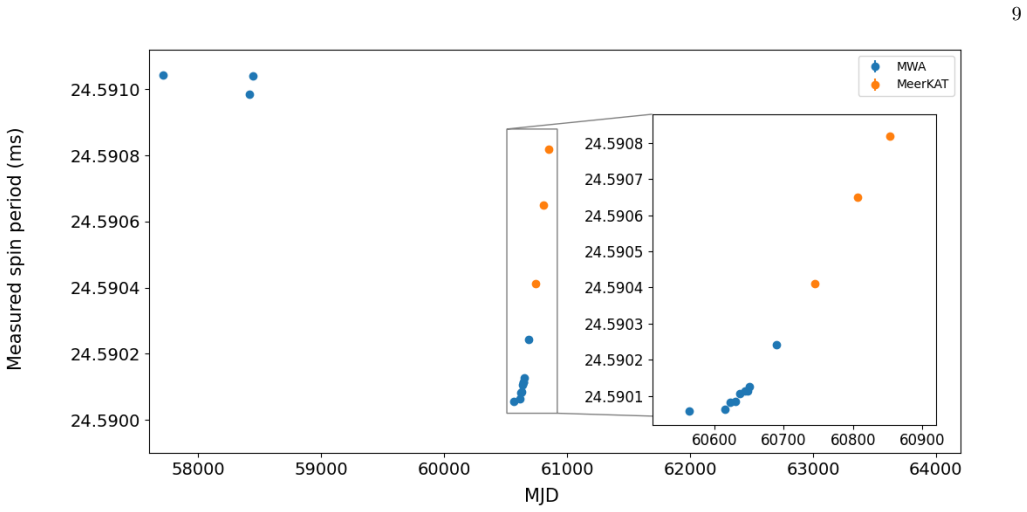
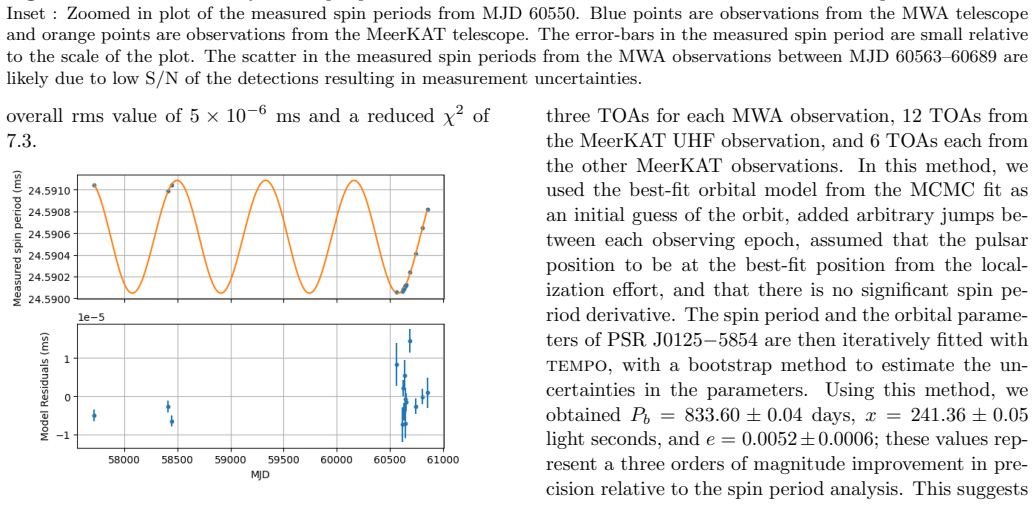
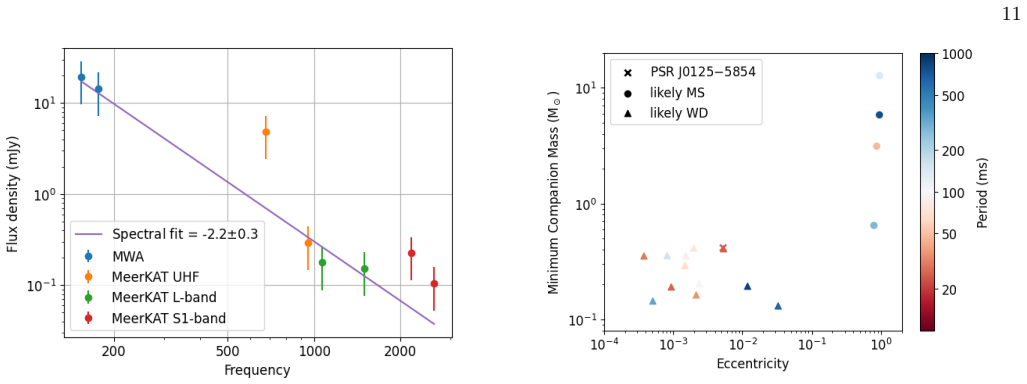
read the original abstract
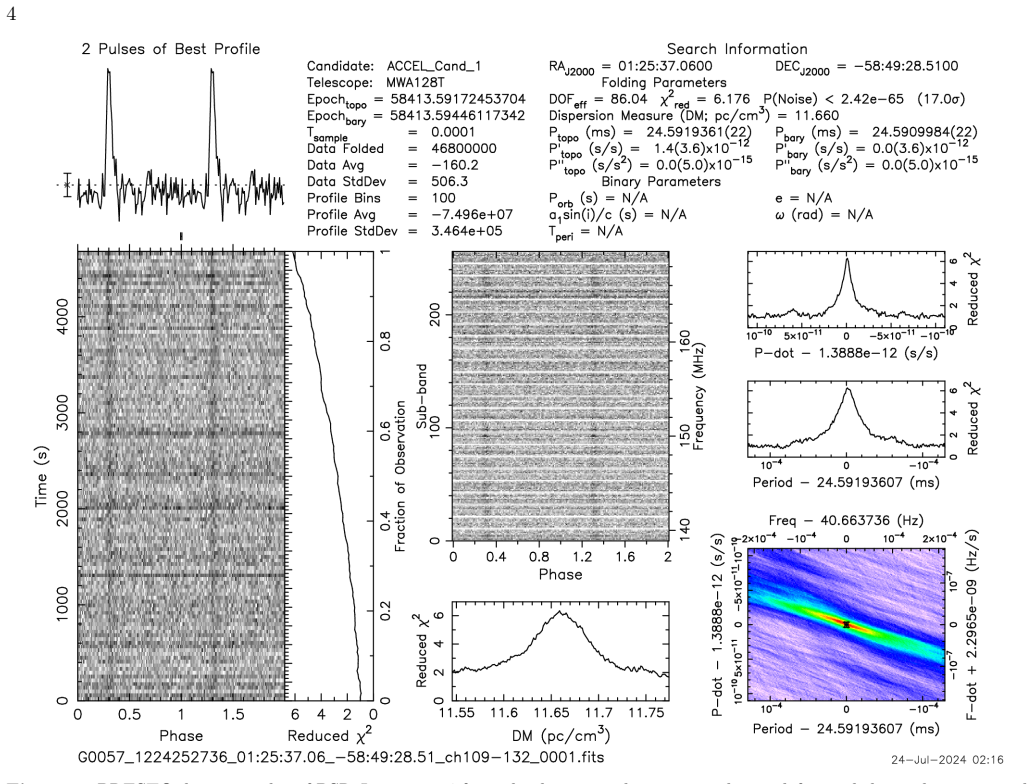
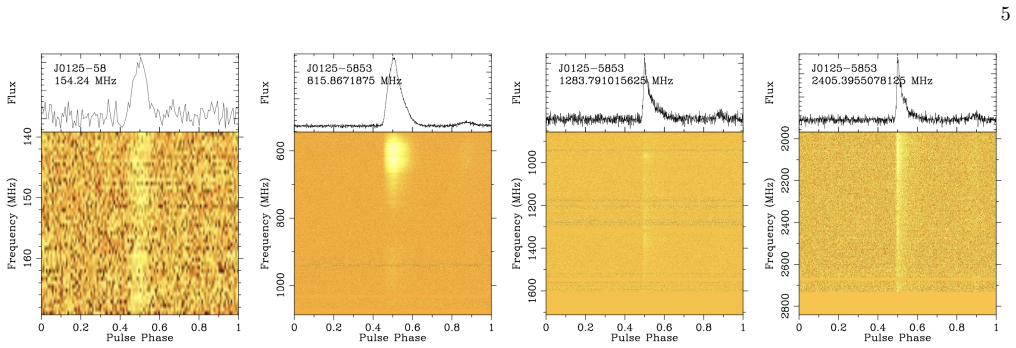
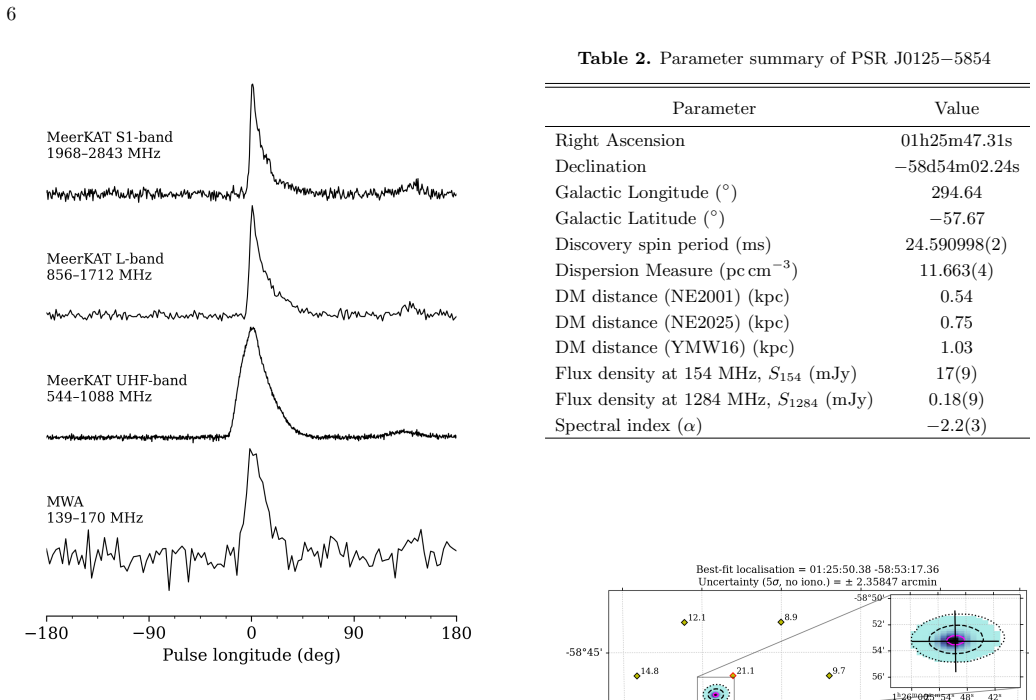
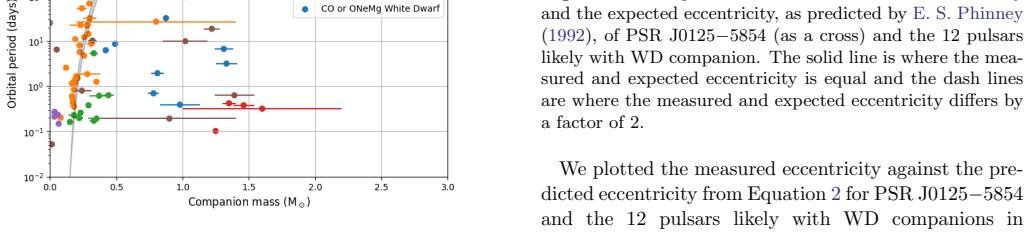
We report the discovery of PSR J0125$-$5854, a pulsar with a spin period of 24 ms and a dispersion measure of 11.66 pc cm$^-3$ in the ongoing Southern-sky MWA Rapid Two-metre (SMART) survey with the Murchison Widefield Array (MWA). The pulsar is located at a high Galactic latitude of $-57^{\circ}$, and at a distance of 0.5$\text{-}$1 kpc per the Galactic electron density models. Follow-up observations with the MWA and MeerKAT telescopes have revealed that this pulsar is in a binary system with an orbital period of more than 290 days, and a steep spectrum (flux density, $ S \propto \nu^{\alpha} $, where $\nu$ is frequency and $ \alpha = -2.2 \pm 0.3 $). Analysis of current observational data hints at a potential binary configuration with an orbital period of $833.60 \pm 0.04$ days, a projected semi-major axis of $241.36 \pm 0.05$ light-seconds, and a minimum companion mass $0.4152 \pm 0.0001$ M$_\odot$, with a low eccentricity orbit of $0.0052 \pm 0.0006$. We discuss the potential formation channels for this system, and conjecture that the companion is likely a Helium white dwarf. Further observations are required in order to better constrain the orbital and spin parameters. We discuss the implications of this discovery, which emerged after processing a small fraction of survey data, on the prospects of finding more millisecond pulsars with the SMART survey, and with future surveys planned with the low-frequency SKA-Low.
Editorial analysis
A structured set of objections, weighed in public.
Referee Report
Summary. The manuscript reports the discovery of the 24 ms pulsar PSR J0125−5854 (DM = 11.66 pc cm−3) in the MWA SMART survey at high Galactic latitude. Follow-up MWA and MeerKAT observations establish that the pulsar is in a binary with orbital period >290 days and a steep spectrum (α = −2.2 ± 0.3). Timing analysis of the available data yields a candidate orbital solution (P_orb = 833.60 ± 0.04 d, a sin i = 241.36 ± 0.05 lt-s, e = 0.0052 ± 0.0006, minimum companion mass 0.4152 ± 0.0001 M_⊙) that the authors explicitly label as preliminary; they conjecture a helium white-dwarf companion and note that additional observations are required to confirm the orbit. The discovery is used to highlight prospects for the SMART survey and SKA-Low.
Significance. If the long-period binary solution is verified, the system would be a valuable addition to the small sample of millisecond pulsars with orbital periods of hundreds of days, directly constraining formation channels that produce helium white-dwarf companions. The low DM, high latitude, and steep spectrum are observationally robust and useful for population studies at low frequencies. The fact that the pulsar was found after processing only a small fraction of the survey data provides concrete evidence of the discovery potential of the MWA and future SKA-Low pulsar searches.
major comments (1)
- [Abstract and orbital-analysis section] Abstract and orbital-analysis section: the quoted orbital parameters carry formal uncertainties (P_orb to ±0.04 d, companion mass to ±0.0001 M_⊙) that presuppose a unique periodicity, yet the text states that the data only 'hint at a potential binary configuration' and that 'the current observational data' are insufficient to confirm the period. No information is supplied on the total timing baseline, number of independent TOAs, or any search for 1-year aliases (e.g., via a periodogram or χ² landscape), leaving the uniqueness of the 833.6 d solution unverified. Because the title and abstract foreground the 'very long orbit,' this assumption is load-bearing for the central claim.
Simulated Author's Rebuttal
We thank the referee for their careful and constructive review. We agree that the presentation of the candidate orbital solution requires additional supporting details and clearer caveats to avoid any implication of a confirmed unique periodicity. We will revise the manuscript accordingly.
read point-by-point responses
-
Referee: [Abstract and orbital-analysis section] Abstract and orbital-analysis section: the quoted orbital parameters carry formal uncertainties (P_orb to ±0.04 d, companion mass to ±0.0001 M_⊙) that presuppose a unique periodicity, yet the text states that the data only 'hint at a potential binary configuration' and that 'the current observational data' are insufficient to confirm the period. No information is supplied on the total timing baseline, number of independent TOAs, or any search for 1-year aliases (e.g., via a periodogram or χ² landscape), leaving the uniqueness of the 833.6 d solution unverified. Because the title and abstract foreground the 'very long orbit,' this assumption is load-bearing for the central claim.
Authors: We accept this criticism. The quoted values were obtained from a preliminary least-squares fit to the sparse timing data available at submission, but the formal uncertainties and the foregrounding in the title/abstract do risk overstating the robustness of the 833.6 d solution. In the revised version we will (i) state the total timing baseline and the exact number of independent TOAs used, (ii) include a χ² landscape or periodogram over a wide range of trial periods (including around 1 yr aliases) to demonstrate that the reported solution is preferred, and (iii) rephrase the abstract and orbital-analysis section to describe the parameters explicitly as a candidate solution pending confirmation with additional observations. These changes will be made without altering the scientific claim that the data currently favour a very long orbit. revision: yes
Circularity Check
No significant circularity; all quantities are direct observational measurements and standard timing fits.
full rationale
The manuscript is an observational discovery report. Spin period (24 ms), DM (11.66 pc cm^{-3}), spectral index, and candidate binary parameters (P_orb = 833.60 ± 0.04 d, a sin i = 241.36 ± 0.05 lt-s, e = 0.0052 ± 0.0006, m_c,min = 0.4152 ± 0.0001 M_⊙) are obtained by direct detection in SMART survey data followed by least-squares timing fits to MWA + MeerKAT TOAs. No equations, ansatzes, or self-citations reduce any reported value to an input by construction. The text explicitly labels the orbit a 'hint' and states further observations are required, confirming the result is not presented as a closed derivation. The chain is data → standard pulsar timing software → fitted parameters, which is self-contained and externally falsifiable.
Axiom & Free-Parameter Ledger
free parameters (4)
- orbital period =
833.60 days
- projected semi-major axis =
241.36 light-seconds
- eccentricity =
0.0052
- minimum companion mass =
0.4152 M_sun
axioms (2)
- domain assumption Galactic electron density models accurately convert DM to distance
- domain assumption Standard pulsar timing analysis can extract orbital parameters from sparse observations
Reference graph
Works this paper leans on
-
[1]
Astropy Collaboration, Robitaille, T. P., Tollerud, E. J., et al. 2013, A&A, 558, A33, doi: 10.1051/0004-6361/201322068 Astropy Collaboration, Price-Whelan, A. M., Sip˝ ocz, B. M., et al. 2018, AJ, 156, 123, doi: 10.3847/1538-3881/aabc4f Astropy Collaboration, Price-Whelan, A. M., Lim, P. L., et al. 2022, ApJ, 935, 167, doi: 10.3847/1538-4357/ac7c74
-
[2]
Bezuidenhout, M. C., Clark, C. J., Breton, R. P., et al. 2023, RAS Techniques and Instruments, 2, 114, doi: 10.1093/rasti/rzad007
-
[3]
Bhat, N. D. R., Ord, S. M., Tremblay, S. E., et al. 2014, ApJL, 791, L32, doi: 10.1088/2041-8205/791/2/L32
-
[4]
Bhat, N. D. R., Swainston, N. A., McSweeney, S. J., et al. 2023a, PASA, 40, e021, doi: 10.1017/pasa.2023.17 16 Figure 13.Corner plot for MCMC fit for PSR J0125−5854 orbit, for the case wheree= 0.01
-
[5]
Bhat, N. D. R., Swainston, N. A., McSweeney, S. J., et al. 2023b, PASA, 40, e020, doi: 10.1017/pasa.2023.18
-
[6]
2003, Nature, 426, 531–533, doi: 10.1038/nature02124
Burgay, M., D’Amico, N., Possenti, A., et al. 2003, Nature, 426, 531–533, doi: 10.1038/nature02124
-
[7]
Camilo, F., Lyne, A. G., Manchester, R. N., et al. 2001, ApJL, 548, L187, doi: 10.1086/319120
-
[8]
Camilo, F., Ray, P. S., Ransom, S. M., et al. 2009, ApJ, 705, 1, doi: 10.1088/0004-637X/705/1/1
-
[9]
2021, Journal of Astronomical Instrumentation, 10, 2150013, doi: 10.1142/S2251171721500136
Stappers, B. 2021, Journal of Astronomical Instrumentation, 10, 2150013, doi: 10.1142/S2251171721500136
-
[10]
Clifton, T. R., & Lyne, A. G. 1986, Nature, 320, 43, doi: 10.1038/320043a0
-
[11]
NE2001.I. A New Model for the Galactic Distribution of Free Electrons and its Fluctuations
Cordes, J. M., & Lazio, T. J. W. 2002, arXiv e-prints, astro, doi: 10.48550/arXiv.astro-ph/0207156 17
work page internal anchor Pith review Pith/arXiv arXiv doi:10.48550/arxiv.astro-ph/0207156 2002
-
[12]
Damour, T., & Taylor, J. H. 1992, PhRvD, 45, 1840, doi: 10.1103/PhysRevD.45.1840
-
[13]
Dey, A., Schlegel, D. J., Lang, D., et al. 2019, AJ, 157, 168, doi: 10.3847/1538-3881/ab089d
-
[14]
Dong, F. A., Crowter, K., Meyers, B. W., et al. 2023, arXiv:2210.09172, arXiv:2210.09172, doi: 10.48550/arXiv.2210.09172
-
[15]
Fiore, W., Levin, L., McLaughlin, M. A., et al. 2023, ApJ, 956, 40, doi: 10.3847/1538-4357/aceef7
-
[16]
Fonseca, E., Cromartie, H. T., Pennucci, T. T., et al. 2021, ApJL, 915, L12, doi: 10.3847/2041-8213/ac03b8
-
[17]
Foreman-Mackey, D., Hogg, D. W., Lang, D., & Goodman, J. 2013, PASP, 125, 306, doi: 10.1086/670067
-
[18]
Freire, P. C. C., & Ridolfi, A. 2018, MNRAS, 476, 4794, doi: 10.1093/mnras/sty524
-
[19]
Freire, P. C. C., & Wex, N. 2024, Living Reviews in Relativity, 27, 5, doi: 10.1007/s41114-024-00051-y Gaia Collaboration, Prusti, T., de Bruijne, J. H. J., et al. 2016, A&A, 595, A1, doi: 10.1051/0004-6361/201629272 Gaia Collaboration, Vallenari, A., Brown, A. G. A., et al. 2023, A&A, 674, A1, doi: 10.1051/0004-6361/202243940
-
[20]
Gitika, P., Bailes, M., Shannon, R. M., et al. 2023, MNRAS, 526, 3370, doi: 10.1093/mnras/stad2841
-
[21]
Grover, G., Bhat, N. D. R., McSweeney, S. J., et al. 2024, ApJ, 970, 78, doi: 10.3847/1538-4357/ad509e
-
[22]
Ho, W. C. G., Ng, C. Y., Lyne, A. G., et al. 2017, MNRAS, 464, 1211, doi: 10.1093/mnras/stw2420
-
[23]
J., Eyer, L., & Paczy´ nski, B
Jordan, C. 2004, MNRAS, 353, 1311, doi: 10.1111/j.1365-2966.2004.08157.x
-
[24]
Hobbs, G., Manchester, R. N., Dunning, A., et al. 2020, PASA, 37, e012, doi: 10.1017/pasa.2020.2
-
[25]
W., van Straten, W., & Manchester, R
Hotan, A. W., van Straten, W., & Manchester, R. N. 2004, PASA, 21, 302, doi: 10.1071/AS04022
-
[26]
Hulse, R. A., & Taylor, J. H. 1975, ApJL, 195, L51, doi: 10.1086/181708
-
[27]
Johnston, S., Manchester, R. N., Lyne, A. G., et al. 1992, ApJL, 387, L37, doi: 10.1086/186300
-
[28]
N., Lyne, A
Johnston, S., Manchester, R. N., Lyne, A. G., Nicastro, L., & Spyromilio, J. 1994, MNRAS, 268, 430
1994
-
[29]
Keith, M. J., Jameson, A., van Straten, W., et al. 2010, MNRAS, 409, 619, doi: 10.1111/j.1365-2966.2010.17325.x
-
[30]
Keith, M. J., Johnston, S., Ray, P. S., et al. 2011, MNRAS, 414, 1292, doi: 10.1111/j.1365-2966.2011.18464.x
-
[31]
Knispel, B., Eatough, R. P., Kim, H., et al. 2013, ApJ, 774, 93, doi: 10.1088/0004-637X/774/2/93
-
[32]
2000, A&A, 364, L66
Koester, D., & Reimers, D. 2000, A&A, 364, L66
2000
-
[33]
Kramer, M., Stairs, I. H., Manchester, R. N., et al. 2021, Phys. Rev. X, 11, 041050, doi: 10.1103/PhysRevX.11.041050
-
[34]
Lee, C. P., Bhat, N. D. R., Meyers, B. W., et al. 2025, PASA, 42, e117, doi: 10.1017/pasa.2025.10081
-
[35]
2025, ApJS, 279, 51, doi: 10.3847/1538-4365/ade4ba
Lian, Y., Pan, Z., Zhang, H., et al. 2025, ApJS, 279, 51, doi: 10.3847/1538-4365/ade4ba
-
[36]
Lorimer, D. R., Xilouris, K. M., Fruchter, A. S., et al. 2005, MNRAS, 359, 1524, doi: 10.1111/j.1365-2966.2005.09005.x
-
[37]
R., Faulkner, A
Lorimer, D. R., Faulkner, A. J., Lyne, A. G., et al. 2006, MNRAS, 372, 777
2006
-
[38]
Lyne, A. G., Stappers, B. W., Keith, M. J., et al. 2015, MNRAS, 451, 581, doi: 10.1093/mnras/stv236
-
[39]
Manchester, R. N., Hobbs, G. B., Teoh, A., & Hobbs, M. 2005, AJ, 129, 1993, doi: 10.1086/428488
work page internal anchor Pith review doi:10.1086/428488 2005
-
[40]
N., Lyne, A
Manchester, R. N., Lyne, A. G., Taylor, J. H., et al. 1978, MNRAS, 185, 409
1978
-
[41]
Manchester, R. N., Lyne, A. G., D’Amico, N., et al. 1996, MNRAS, 279, 1235, doi: 10.1093/mnras/279.4.1235
-
[42]
Martinez, J. G., Gentile, P., Freire, P. C. C., et al. 2019, ApJ, 881, 166, doi: 10.3847/1538-4357/ab2877
-
[43]
McSweeney, S. J., Bhat, N. D. R., Swainston, N. A., et al. 2022, ApJ, 933, 210, doi: 10.3847/1538-4357/ac75bc
-
[44]
Meyers, B. W., & Bahramian, A. 2026, arXiv e-prints, arXiv:2603.04961, doi: 10.48550/arXiv.2603.04961
work page internal anchor Pith review Pith/arXiv arXiv doi:10.48550/arxiv.2603.04961 2026
-
[45]
Meyers, B. W., Tremblay, S. E., Bhat, N. D. R., et al. 2017, ApJ, 851, 20, doi: 10.3847/1538-4357/aa8bba
-
[46]
Morello, V., Barr, E. D., Cooper, S., et al. 2019, MNRAS, 483, 3673, doi: 10.1093/mnras/sty3328
-
[47]
S., Crosse, B., Sleap, G., et al
Morrison, I. S., Crosse, B., Sleap, G., et al. 2023, PASA, 40, e019, doi: 10.1017/pasa.2023.15
-
[48]
Navarro, J., Anderson, S. B., & Freire, P. C. 2003, ApJ, 594, 943, doi: 10.1086/377153
-
[49]
2015,, Astrophysics Source Code Library, record ascl:1509.002 http://ascl.net/1509.002
Nice, D., Demorest, P., Stairs, I., et al. 2015,, Astrophysics Source Code Library, record ascl:1509.002 http://ascl.net/1509.002
2015
-
[50]
NE2025: An Updated Electron Density Model for the Galactic Interstellar Medium
Ocker, S. K., & Cordes, J. M. 2026, arXiv e-prints, arXiv:2602.11838, doi: 10.48550/arXiv.2602.11838
work page internal anchor Pith review Pith/arXiv arXiv doi:10.48550/arxiv.2602.11838 2026
-
[51]
Ocker, S. K., Cordes, J. M., & Chatterjee, S. 2021, ApJ, 911, 102, doi: 10.3847/1538-4357/abeb6e ¨Ozel, F., & Freire, P. 2016, ARA&A, 54, 401, doi: 10.1146/annurev-astro-081915-023322
-
[52]
Padmanabh, P. V., Barr, E. D., Sridhar, S. S., et al. 2023, MNRAS, 524, 1291, doi: 10.1093/mnras/stad1900
-
[53]
2025, PASA, 42, e139, doi: 10.1017/pasa.2025.10102
Petrou, F., Hurley-Walker, N., McSweeney, S., et al. 2025, PASA, 42, e139, doi: 10.1017/pasa.2025.10102
-
[54]
Phinney, E. S. 1992, Philosophical Transactions of the Royal Society of London Series A, 341, 39, doi: 10.1098/rsta.1992.0084
-
[55]
Phinney, E. S., & Verbunt, F. 1991, MNRAS, 248, 21P, doi: 10.1093/mnras/248.1.21P 18
-
[56]
Ransom, S. M., Eikenberry, S. S., & Middleditch, J. 2002, AJ, 124, 1788, doi: 10.1086/342285
work page internal anchor Pith review doi:10.1086/342285 2002
-
[57]
Reardon, D. J., & Coles, W. A. 2023, MNRAS, 521, 6392, doi: 10.1093/mnras/stad962
-
[58]
Reardon, D. J., Coles, W. A., Bailes, M., et al. 2020, ApJ, 904, 104, doi: 10.3847/1538-4357/abbd40
-
[59]
Sanidas, S., Cooper, S., Bassa, C. G., et al. 2019, A&A, 626, A104, doi: 10.1051/0004-6361/201935609
-
[60]
M., Johnston, S., & Manchester, R
Shannon, R. M., Johnston, S., & Manchester, R. N. 2014, MNRAS, 437, 3255, doi: 10.1093/mnras/stt2123
-
[61]
Spiewak, R., Bailes, M., Miles, M. T., et al. 2022, PASA, 39, e027, doi: 10.1017/pasa.2022.19
-
[62]
Splaver, E. M., Nice, D. J., Arzoumanian, Z., et al. 2002, The Astrophysical Journal, 581, 509, doi: 10.1086/344202
-
[63]
Swainston, N. A., Lee, C. P., McSweeney, S. J., & Bhat, N. D. R. 2022, PASA, 39, e056, doi: 10.1017/pasa.2022.52
-
[64]
Swainston, N. A., Bhat, N. D. R., Sokolowski, M., et al. 2021, ApJL, 911, L26, doi: 10.3847/2041-8213/abec7b
-
[65]
Formation of millisecond pulsars. I. Evolution of low-mass X-ray binaries with P > 2 days
Tauris, T. M., & Savonije, G. J. 1999, A&A, 350, 928, doi: 10.48550/arXiv.astro-ph/9909147
work page internal anchor Pith review Pith/arXiv arXiv doi:10.48550/arxiv.astro-ph/9909147 1999
-
[66]
Tauris, T. M., & van den Heuvel, E. P. J. 2023, Physics of Binary Star Evolution. From Stars to X-ray Binaries and Gravitational Wave Sources (Princeton University Press), doi: 10.48550/arXiv.2305.09388
-
[67]
Tauris, T. M., Kramer, M., Freire, P. C. C., et al. 2017, ApJ, 846, 170, doi: 10.3847/1538-4357/aa7e89
-
[68]
Taylor, J. H., & Weisberg, J. M. 1982, ApJ, 253, 908, doi: 10.1086/159690
-
[69]
Tingay, S. J., Goeke, R., Bowman, J. D., et al. 2013, PASA, 30, e007, doi: 10.1017/pasa.2012.007
-
[70]
Pulsar data analysis with PSRCHIVE
Tremblay, S. E., Ord, S. M., Bhat, N. D. R., et al. 2015, PASA, 32, e005, doi: 10.1017/pasa.2015.6 van der Wateren, E., Bassa, C. G., Janssen, G. H., et al. 2024, A&A, 682, A178, doi: 10.1051/0004-6361/202348578 van Straten, W., & Bailes, M. 2011, PASA, 28, 1, doi: 10.1071/AS10021 van Straten, W., Demorest, P., & Oslowski, S. 2012, Astronomical Research a...
work page internal anchor Pith review Pith/arXiv arXiv doi:10.1017/pasa.2015.6 2015
-
[71]
Wang, P. F., Han, J. L., Yang, Z. L., et al. 2025, Research in Astronomy and Astrophysics, 25, 014003, doi: 10.1088/1674-4527/ada3b8
-
[72]
Yao, J. M., Manchester, R. N., & Wang, N. 2017, ApJ, 835, 29, doi: 10.3847/1538-4357/835/1/29
discussion (0)
Sign in with ORCID, Apple, or X to comment. Anyone can read and Pith papers without signing in.