Extracting effective scaling exponents in finite-size hyperuniform systems
Pith reviewed 2026-06-26 18:42 UTC · model grok-4.3
The pith
A protocol merges structure-factor, number-variance and spreadability estimates of the hyperuniformity exponent α and selects the value with lowest internal dispersion.
A machine-rendered reading of the paper's core claim, the machinery that carries it, and where it could break.
Core claim
The authors develop a practical method-aware protocol for robust estimation of the effective scaling exponent α in finite-size hyperuniform point configurations. The protocol combines three complementary methods with distinct roles, summarizes the method-specific estimates through a joint empirical estimator, and reports the internal dispersion among the participating methods to determine the optimal estimate.
What carries the argument
The joint empirical estimator that merges the three method-specific values of α while using their mutual dispersion as the indicator of which value to retain.
If this is right
- The structure-factor method supplies the most direct but cutoff-sensitive estimate of α.
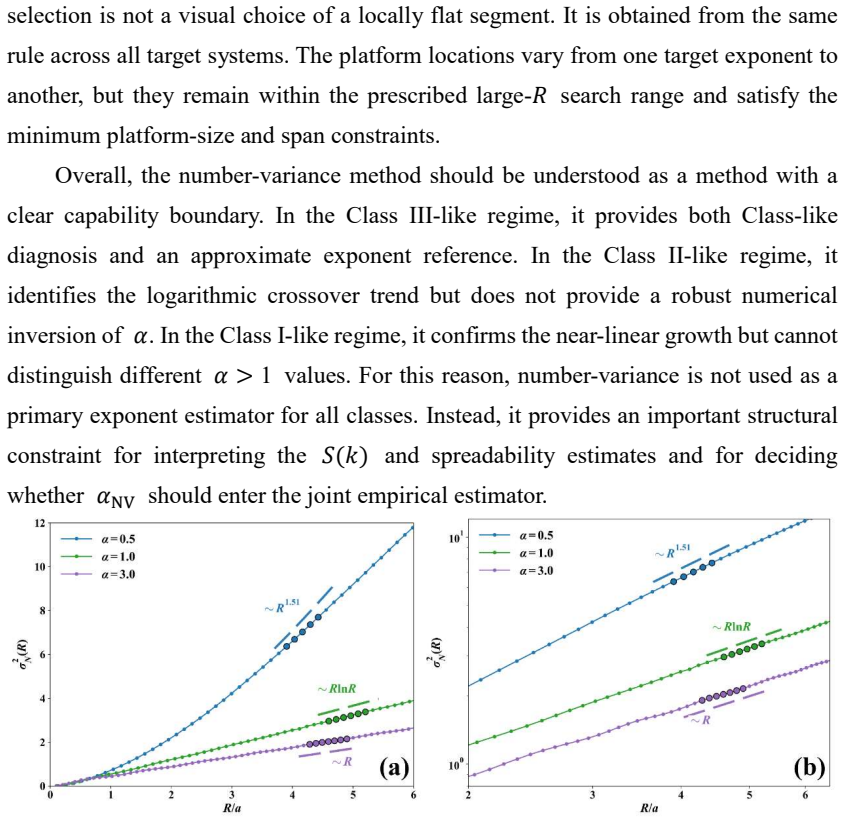
- The number-variance method contributes a numerical exponent only when the finite-size data retain Class III-like scaling information.
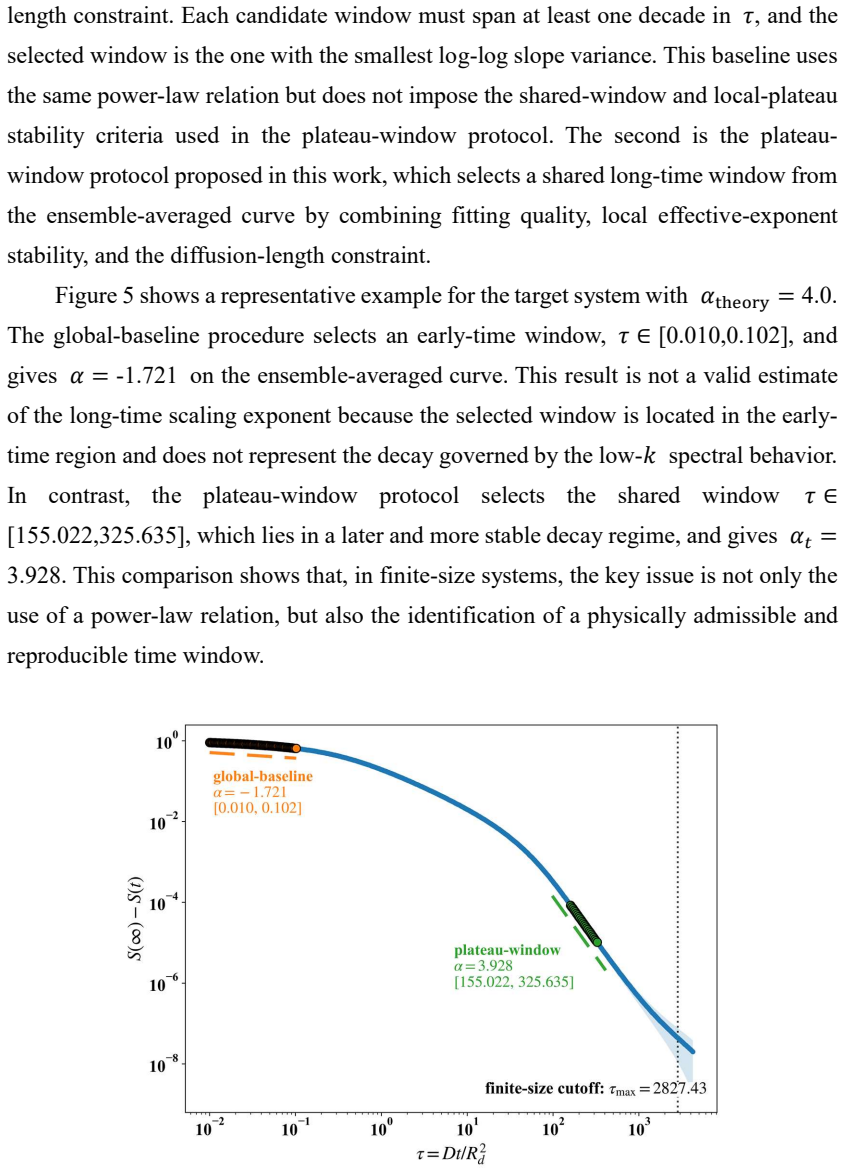
- The spreadability method supplies a smoother dynamic estimate that reduces configuration-level fluctuations provided a physically admissible long-time fitting window is used.
- Reporting the internal dispersion supplies a built-in uncertainty measure that does not require external reference data.
Where Pith is reading between the lines
- The same dispersion-based selection rule could be tested on other power-law exponents measured in disordered media.
- If dispersion stays low across increasing system sizes, the protocol would imply that the extracted α is approaching its thermodynamic-limit value.
- Application to experimental particle-tracking data would require only that the three observables can be computed from the same finite configuration set.
Load-bearing premise
The three methods supply sufficiently independent information whose dispersion reliably indicates the quality of the combined α estimate without being dominated by shared finite-size artifacts or fitting choices.
What would settle it
Running the protocol on an exactly solvable infinite-system hyperuniform point pattern and finding that the selected α deviates from the known analytic value even when dispersion is reported as low would falsify the reliability claim.
Figures
read the original abstract
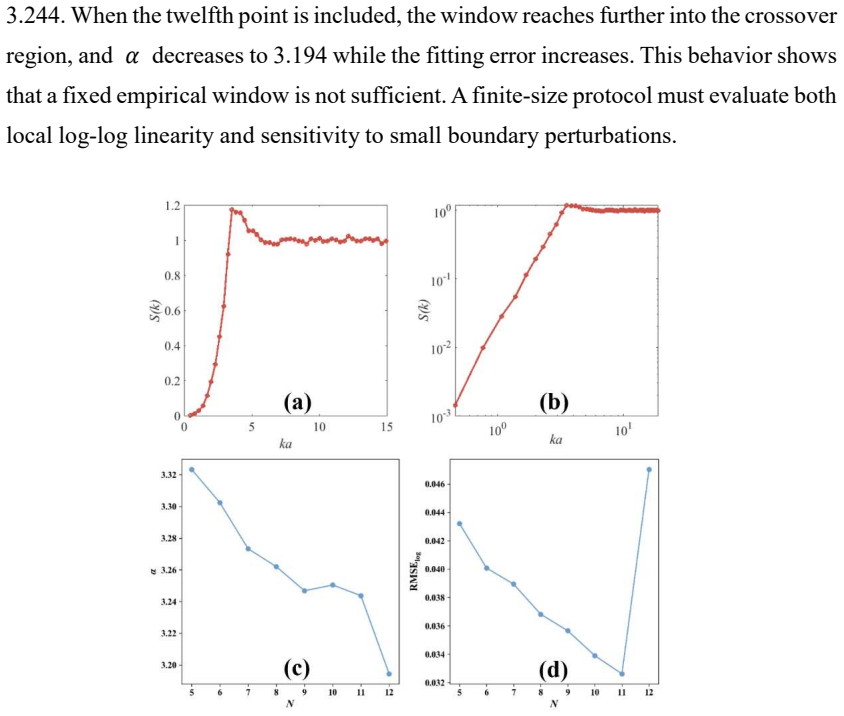
Hyperuniform systems strongly suppress long-wavelength density fluctuations, which is quantitatively characterized by the small-wavenumber scaling. In finite samples, however, accurately estimating the hyperuniformity exponent {\alpha} can be challenging. The inferred value depends strongly on the range of length scales accessible in the measurement, finite-size effects, and the specific characterization method employed, whether based on Fourier-space structure factors, real-space density fluctuations, or dynamical probes such as diffusion spreadability. In particular, the structure-factor method provides the most direct estimate of {\alpha}, but is sensitive to empirical low-k fitting cutoffs. The number-variance method offers a real-space Class-like diagnosis, but contributes a numerical exponent only when the finite-size data retain Class III-like scaling information. The spreadability method provides a smoother dynamic estimate and reduces configuration-level fluctuations, but requires a physically admissible long-time fitting window. Here, we develop a practical method-aware protocol for robust estimation of the effective scaling exponent {\alpha} in finite-size hyperuniform point configurations, combining three complementary methods with distinct roles. Our protocol summarizes the method-specific estimates through a joint empirical estimator and reports the internal dispersion among the participating methods to determine the optimal estimate.
Editorial analysis
A structured set of objections, weighed in public.
Referee Report
Summary. The manuscript develops a practical protocol for estimating the effective hyperuniformity scaling exponent α from finite-size point configurations. It combines three complementary methods (structure-factor, number-variance, and spreadability) via a joint empirical estimator whose output is selected or weighted according to the internal dispersion among the three method-specific estimates, with the goal of mitigating method-specific sensitivities to fitting windows, low-k cutoffs, and retention of Class-III scaling.
Significance. If the dispersion metric reliably flags shared finite-size artifacts rather than merely averaging correlated biases, the protocol would supply a reproducible, method-aware workflow that practitioners could apply to simulation or experimental data without ad-hoc cutoff choices. The explicit treatment of each method’s known limitations is a constructive step beyond single-method analyses common in the hyperuniformity literature.
major comments (3)
- [§3] §3 (protocol definition): the claim that internal dispersion among the three methods indicates the quality of the combined α estimate is not supported by any validation against synthetic configurations whose true α is known a priori. Without such controlled tests it remains possible that the dispersion is dominated by shared finite-size artifacts rather than independent information.
- [§4] §4 (numerical examples): the manuscript reports dispersion values but does not quantify how the joint estimator reduces mean absolute error relative to the best single method across a range of system sizes and known α values; the tables therefore do not demonstrate that the protocol improves accuracy rather than merely producing a consensus value.
- [§3.1] Eq. (joint-estimator definition, §3.1): the weighting or selection rule based on dispersion is constructed from quantities already obtained by fitting the same finite data; this construction risks circularity unless the paper shows that the dispersion remains informative after the shared low-k cutoff and window choices are varied systematically.
minor comments (2)
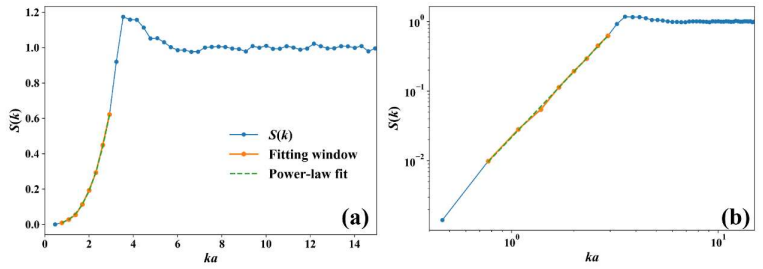
- [Figure 2] Figure 2 caption: the fitting windows for the spreadability method are stated in the text but not indicated on the plot; adding vertical lines or shaded regions would improve reproducibility.
- [§2] Notation: the symbol α_eff is introduced without an explicit definition distinguishing it from the asymptotic α; a short clarifying sentence in §2 would remove ambiguity.
Simulated Author's Rebuttal
We thank the referee for the careful reading and constructive suggestions. We address each major comment below, indicating revisions that will be incorporated to strengthen the manuscript.
read point-by-point responses
-
Referee: [§3] the claim that internal dispersion among the three methods indicates the quality of the combined α estimate is not supported by any validation against synthetic configurations whose true α is known a priori. Without such controlled tests it remains possible that the dispersion is dominated by shared finite-size artifacts rather than independent information.
Authors: We agree that the current manuscript lacks explicit validation on synthetic point configurations with a priori known α. The protocol was developed for practical use on finite data where the true exponent is unknown. In the revision we will add a dedicated section with controlled tests on synthetics (e.g., hyperuniform point processes with prescribed α) to quantify whether dispersion reliably tracks estimation quality rather than shared artifacts. revision: yes
-
Referee: [§4] the manuscript reports dispersion values but does not quantify how the joint estimator reduces mean absolute error relative to the best single method across a range of system sizes and known α values; the tables therefore do not demonstrate that the protocol improves accuracy rather than merely producing a consensus value.
Authors: We acknowledge that the numerical examples do not include a systematic MAE comparison of the joint estimator against individual methods on data with known α. The revision will incorporate additional tables and figures that compute MAE (and related error metrics) for the joint estimator versus the best single-method result, across multiple system sizes and known α values, to demonstrate any accuracy gain. revision: yes
-
Referee: [§3.1] the weighting or selection rule based on dispersion is constructed from quantities already obtained by fitting the same finite data; this construction risks circularity unless the paper shows that the dispersion remains informative after the shared low-k cutoff and window choices are varied systematically.
Authors: The dispersion is formed from three method-specific estimates that employ distinct observables and fitting procedures. Nevertheless, we recognize the potential for shared finite-size sensitivities. In the revision we will add a systematic sensitivity study in which low-k cutoffs and fitting windows are varied independently; we will report the resulting dispersion values and show that they remain predictive of estimate reliability under these variations. revision: yes
Circularity Check
No significant circularity in the proposed empirical protocol
full rationale
The manuscript presents a methodological protocol that combines estimates of the hyperuniformity exponent α from three distinct characterization techniques (structure-factor, number-variance, and spreadability) via a joint empirical estimator whose output is selected using the observed dispersion among those estimates. This construction is explicitly defined in terms of the input data and the three methods applied to the same finite configurations; no derivation chain is offered that reduces the final α value to itself by algebraic identity, by renaming a fitted parameter as a prediction, or by a load-bearing self-citation whose content is unverified. The paper does not invoke uniqueness theorems, smuggle ansatzes through prior work, or claim first-principles results. The protocol is therefore self-contained as an empirical post-processing procedure whose validity rests on external validation against known hyperuniform systems rather than on internal definitional closure.
Axiom & Free-Parameter Ledger
Reference graph
Works this paper leans on
-
[1]
Torquato, Hyperuniform states of matter, Phys
S. Torquato, Hyperuniform states of matter, Phys. Rep. 745, 1-95 (2018)
2018
-
[2]
H. W. Haslach, Jr., Random Heterogeneous Materials: Microstructure and Macroscopic Properties, Appl. Mech. Rev. 55, B62- B63 (2002)
2002
-
[3]
Torquato and F
S. Torquato and F. H. Stillinger, Local density fluctuations, hyperuniformity, and order metrics, Phys. Rev. E 68, 041113 (2003)
2003
-
[4]
C. E. Zachary and S. Torquato, Hyperuniformity in point patterns and two-phase random heterogeneous media, J. Stat. Mech.:Theory Exp. 2009, P12015 (2009)
2009
-
[5]
G. J. Aubry, L. S. Froufe-Pérez, U. Kuhl, O. Legrand, F. Scheffold and F. Mortessagne, Experimental Tuning of Transport Regimes in Hyperuniform Disordered Photonic Materials, Phys. Rev. Lett. 125, 127402 (2020)
2020
-
[6]
Florescu, S
M. Florescu, S. Torquato and P. J. Steinhardt, Designer disordered materials with large, complete photonic band gaps, Proc. Natl. Acad. Sci. 106, 20658-20663 (2009)
2009
-
[7]
L. S. Froufe-Pérez, M. Engel, J. J. Sáenz and F. Scheffold, Band gap formation and Anderson localization in disordered photonic materials with structural correlations, Proc. Natl. Acad. Sci. 114, 9570-9574 (2017)
2017
-
[8]
M. A. Klatt, P. J. Steinhardt and S. Torquato, Wave propagation and band tails of two-dimensional disordered systems in the thermodynamic limit, Proc. Natl. Acad. Sci. 119, e2213633119 (2022)
2022
-
[9]
W. Man, M. Florescu, K. Matsuyama, P. Yadak, G. Nahal, S. Hashemizad, E. Williamson, P. Steinhardt, S. Torquato and P. Chaikin, Photonic band gap in isotropic hyperuniform disordered solids with low dielectric contrast, Opt. Express 21, 19972-19981 (2013)
2013
-
[10]
Christogeorgos, H
O. Christogeorgos, H. Zhang, Q. Cheng and Y . Hao, Extraordinary Directive Emission and Scanning from an Array of Radiation Sources with Hyperuniform Disorder, Phys. Rev. Appl. 15, 014062 (2021)
2021
-
[11]
R. D. Batten, F. H. Stillinger and S. Torquato, Novel Low-Temperature Behavior in Classical Many-Particle Systems, Phys. Rev. Lett. 103, 050602 (2009)
2009
-
[12]
R. D. Batten, F. H. Stillinger and S. Torquato, Interactions leading to disordered ground states and unusual low-temperature behavior, Phys. Rev. E 80, 031105 (2009)
2009
-
[13]
Le Thien, D
Q. Le Thien, D. Mcdermott, C. J. O. Reichhardt and C. Reichhardt, Enhanced pinning for vortices in hyperuniform pinning arrays and emergent hyperuniform vortex configurations with quenched disorder, Phys. Rev. B 96, 094516 (2017)
2017
-
[14]
Chen and S
D. Chen and S. Torquato, Designing disordered hyperuniform two-phase materials with novel physical properties, Acta Mater. 142, 152-161 (2018)
2018
-
[15]
Skolnick and S
M. Skolnick and S. Torquato, Simulated diffusion spreadability for characterizing the structure and transport properties of two-phase materials, Acta Mater. 250, 118857 (2023)
2023
-
[16]
Torquato, Diffusion spreadability as a probe of the microstructure of complex media across length scales, Phys
S. Torquato, Diffusion spreadability as a probe of the microstructure of complex media across length scales, Phys. Rev. E 104, 054102 (2021)
2021
-
[17]
Wang and S
H. Wang and S. Torquato, Dynamic Measure of Hyperuniformity and Nonhyperuniformity in Heterogeneous Media via the Diffusion Spreadability, Phys. Rev. Appl. 17, 034022 (2022)
2022
-
[18]
Nocerino, Emergent properties and the multiscale characterization challenge in condensed matter, from crystals to complex materials: a review, J
E. Nocerino, Emergent properties and the multiscale characterization challenge in condensed matter, from crystals to complex materials: a review, J. Phys. D:Appl. Phys. 58, 393001 (2025)
2025
-
[19]
J. S. Brauchart, P. J. Grabner and W. Kusner, Hyperuniform Point Sets on the Sphere: Deterministic Aspects, Constr. Approx. 50, 45-61 (2019)
2019
-
[20]
J. S. Brauchart, P. J. Grabner, W. Kusner and J. Ziefle, Hyperuniform point sets on the sphere: probabilistic aspects, Monatsh. Math. 192, 763-781 (2020)
2020
-
[21]
Ghosh and J
S. Ghosh and J. L. Lebowitz, Generalized Stealthy Hyperuniform Processes: Maximal Rigidity and the Bounded Holes Conjecture, Commun. Math. Phys. 363, 97-110 (2018)
2018
-
[22]
Torquato, G
S. Torquato, G. Zhang and M. De Courcy-Ireland, Hidden multiscale order in the primes, J. Phys. A:Math. Theor. 52, 135002 47 (2019)
2019
-
[23]
Gudoshnikov, Y
I. Gudoshnikov, Y . Jiao, O. Makarenkov and D. Chen, Sweeping process approach to stress analysis in elastoplastic lattice spring models with applications to network materials, Phys. Rev. E 112, 065501 (2025)
2025
-
[24]
Jiao, Acoustic-Edge and Thermal Scaling in Disordered Hyperuniform Networks: A First Principles Theory, Phys
Y . Jiao, Acoustic-Edge and Thermal Scaling in Disordered Hyperuniform Networks: A First Principles Theory, Phys. Rev. Lett. 136, 137402 (2026)
2026
-
[25]
Newby, W
E. Newby, W. Shi, Y . Jiao, R. Albert and S. Torquato, Structural properties of hyperuniform V oronoi networks, Phys. Rev. E 111, 034123 (2025)
2025
-
[26]
Newby, W
E. Newby, W. Shi, Y . Jiao, S. Torquato and R. Albert, From point patterns to networks: to what extent does the Delaunay triangulation reproduce key spatial and density information?, J. Complex Netw. 13, cnaf040 (2025)
2025
-
[27]
J. Wang, Z. Sun, H. Chen, G. Wang, D. Chen, G. Chen, J. Shuai, M. Yang, Y . Jiao and L. Liu, Hyperuniform Networks of Active Magnetic Robotic Spinners, Phys. Rev. Lett. 134, 248301 (2025)
2025
-
[28]
Ballestero, A
E. Ballestero, A. Duclos, A. Barbacci and V . Romero-García, Emergence of hyperuniformity from reaction-diffusion interactions in Turing patterns, Phys. Rev. E 112, L062401 (2025)
2025
-
[29]
Ge, The hidden order of Turing patterns in arid and semi‐arid vegetation ecosystems, Proc
Z. Ge, The hidden order of Turing patterns in arid and semi‐arid vegetation ecosystems, Proc. Natl. Acad. Sci. 120, e2306514120 (2023)
2023
-
[30]
W. Hu, L. Cui, M. Delgado-Baquerizo, R. Solé, S. Kéfi, M. Berdugo, N. Xu, B. Wang, Q.-X. Liu and C. Xu, Causes and consequences of disordered hyperuniformity in global drylands, Proc. Natl. Acad. Sci. 122, e2504496122 (2025)
2025
-
[31]
Y . Jiao, T. Lau, H. Hatzikirou, M. Meyer-Hermann, C. C. Joseph and S. Torquato, Avian photoreceptor patterns represent a disordered hyperuniform solution to a multiscale packing problem, Phys. Rev. E 89, 022721 (2014)
2014
-
[32]
Li, Q.-L
Z.-Q. Li, Q.-L. Lei and Y .-Q. Ma, Fluidization and anomalous density fluctuations in 2D V oronoi cell tissues with pulsating activity, Proc. Natl. Acad. Sci. 122, e2421518122 (2025)
2025
-
[33]
S. Lin, Z. Du, X. Fang, G. Li and Y . M. Xie, Biological patterns and textures: From formation mechanisms to biomimetic applications, J. Mech. Behav. Biomed. Mater. 178, 107392 (2026)
2026
-
[34]
Y . Liu, D. Chen, J. Tian, W. Xu and Y . Jiao, Universal Hyperuniform Organization in Looped Leaf Vein Networks, Phys. Rev. Lett. 133, 028401 (2024)
2024
-
[35]
Mayer, V
A. Mayer, V . Balasubramanian, T. Mora and A. M. Walczak, How a well-adapted immune system is organized, Proc. Natl. Acad. Sci. 112, 5950-5955 (2015)
2015
-
[36]
N. Wang, Y . Tong, F. Liu, X. Li, Y . He and W. Fan, Turing instability-induced oscillations in coupled reaction-diffusion systems, Chin. Phys. B 34, 038201 (2025)
2025
-
[37]
R. J. H. Ross, G. D. Masucci, C. Y . Lin, T. L. Iglesias, S. Reiter and S. Pigolotti, Hyperdisordered Cell Packing on a Growing Surface, Phys. Rev. X 15, 021064 (2025)
2025
-
[38]
D. Chen, R. Samajdar, Y . Jiao and S. Torquato, Anomalous suppression of large-scale density fluctuations in classical and quantum spin liquids, Proc. Natl. Acad. Sci. 122, e2416111122 (2025)
2025
-
[39]
Y . Lu, T. Zhu, Y . Guo, Y . Li and Z. Zheng, Orientation-Modulated Hyperuniformity in Frustrated Vicsek–Kuramoto Systems, Entropy 28, 126 (2026)
2026
-
[40]
Maire and L
R. Maire and L. Chaix, Hyperuniformity and conservation laws in non-equilibrium systems, J. Chem. Phys. 163, 214507 (2025)
2025
-
[41]
Zhong and S
L. Zhong and S. Mao, Construction of digital realizations of anisotropic hyperuniform continuous random fields in two and three dimensions via generalized spectral filtering, Phys. Rev. E 112, 044136 (2025)
2025
-
[42]
C. E. Maher and S. Torquato, Hyperuniformity scaling of maximally random jammed packings of two-dimensional binary disks, Phys. Rev. E 110, 064605 (2024)
2024
-
[43]
Shang, Y
J. Shang, Y . Wang, D. Pan, Y . Jin and J. Zhang, Jamming as a topological satisfiability transition with contact number hyperuniformity and criticality, Proc. Natl. Acad. Sci. 123, e2517241123 (2026)
2026
-
[44]
C. E. Zachary, Y . Jiao and S. Torquato, Hyperuniform Long-Range Correlations are a Signature of Disordered Jammed Hard- 48 Particle Packings, Phys. Rev. Lett. 106, 178001 (2011)
2011
-
[45]
Ikeda, L
A. Ikeda, L. Berthier and G. Parisi, Large-scale structure of randomly jammed spheres, Phys. Rev. E 95, 052125 (2017)
2017
-
[46]
C. E. Zachary and S. Torquato, Anomalous local coordination, density fluctuations, and void statistics in disordered hyperuniform many-particle ground states, Phys. Rev. E 83, 051133 (2011)
2011
-
[47]
Hitin-Bialus, C
A. Hitin-Bialus, C. E. Maher, P. J. Steinhardt and S. Torquato, Hyperuniformity classes of quasiperiodic tilings via diffusion spreadability, Phys. Rev. E 109, 064108 (2024)
2024
-
[48]
Y . Liu, X. Li, J. Tian, X. Yan and G. Zhang, Impact of random spatial truncation and reciprocal-space binning on the detection of hyperuniformity in disordered systems, J. Chem. Phys. 164, 094102 (2026)
2026
-
[49]
L. E. Silbert and M. Silbert, Long-wavelength structural anomalies in jammed systems, Phys. Rev. E 80, 041304 (2009)
2009
-
[50]
O. U. Uche, F. H. Stillinger and S. Torquato, Constraints on collective density variables: Two dimensions, Phys. Rev. E 70, 046122 (2004)
2004
-
[51]
Atkinson, G
S. Atkinson, G. Zhang, A. B. Hopkins and S. Torquato, Critical slowing down and hyperuniformity on approach to jamming, Phys. Rev. E 94, 012902 (2016)
2016
-
[52]
D. Chen, E. Lomba and S. Torquato, Binary mixtures of charged colloids: a potential route to synthesize disordered hyperuniform materials, Phys. Chem. Chem. Phys. 20, 17557-17562 (2018)
2018
-
[53]
Torquato, Structural characterization of many-particle systems on approach to hyperuniform states, Phys
S. Torquato, Structural characterization of many-particle systems on approach to hyperuniform states, Phys. Rev. E 103, 052126 (2021)
2021
-
[54]
Zhang and S
G. Zhang and S. Torquato, Realizable hyperuniform and nonhyperuniform particle configurations with targeted spectral functions via effective pair interactions, Phys. Rev. E 101, 032124 (2020)
2020
-
[55]
Jiao, Spectral leakage and masking effects in the measurement of hyperuniformity, J
Y . Jiao, Spectral leakage and masking effects in the measurement of hyperuniformity, J. Chem. Phys. 164, 224106 (2026)
2026
-
[56]
Dreyfus, Y
R. Dreyfus, Y . Xu, T. Still, L. A. Hough, A. G. Yodh and S. Torquato, Diagnosing hyperuniformity in two-dimensional, disordered, jammed packings of soft spheres, Phys. Rev. E 91, 012302 (2015)
2015
-
[57]
Hawat, G
D. Hawat, G. Gautier, R. Bardenet and R. Lachièze-Rey, On estimating the structure factor of a point process, with applications to hyperuniformity, Stat. Comput. 33, 61 (2023)
2023
-
[58]
Wang and S
H. Wang and S. Torquato, Designer pair statistics of disordered many-particle systems with novel properties, J. Chem. Phys. 160, 044911 (2024)
2024
discussion (0)
Sign in with ORCID, Apple, or X to comment. Anyone can read and Pith papers without signing in.