QDSV: A Semantic Problem Representation and Multi-Backend Execution Framework for Quantum-Oriented Computation
Pith reviewed 2026-06-26 18:36 UTC · model grok-4.3
The pith
A problem-first semantic representation produces stable and interpretable outputs for quantum computations across different simulators and hardware backends.
A machine-rendered reading of the paper's core claim, the machinery that carries it, and where it could break.
Core claim
QDSV enables a semantic execution validation where a problem-first representation remains stable across simulator and hardware realizations while retaining interpretable execution trace outputs, as demonstrated in the EEG classification task without claiming quantum advantage.
What carries the argument
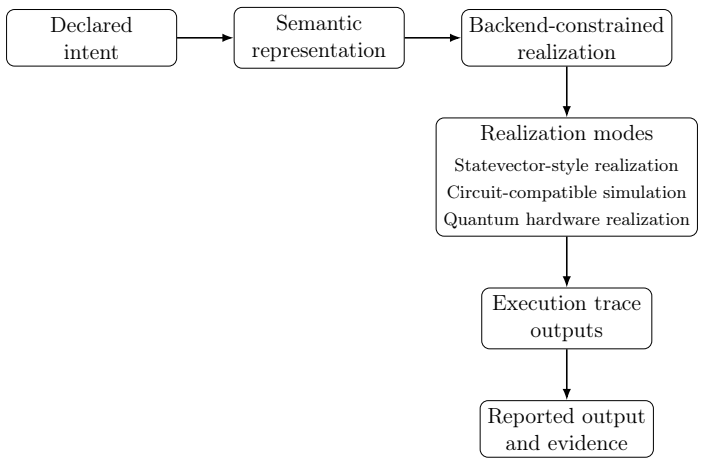
QDSV, the semantic multi-backend execution framework that links declarative problem intent to structured semantic representations realizable under heterogeneous backend constraints.
If this is right
- The framework supports execution modes that do not require the original problem to be authored as a circuit.
- Execution trace outputs separate model-level semantic outputs from backend-specific observations.
- The representation can be realized under different backend constraints while maintaining stability.
- Results apply to prepared signal features from EEG datasets for ictal/interictal classification.
- Outputs remain consistent between QDSV simulator executions and controlled IBM Quantum hardware runs.
Where Pith is reading between the lines
- The approach could simplify debugging of quantum algorithms by separating semantic intent from hardware noise.
- It might enable porting problem specifications to new quantum hardware without re-authoring the problem.
- Extending the semantic model to other classification or optimization tasks could test its generality beyond EEG data.
- Integration with existing quantum programming libraries might reduce the need for circuit-level design in some applications.
Load-bearing premise
The semantic model from the prior work accurately captures problem intent in a way that transfers without loss to the EEG classification task and produces stable outputs across backends.
What would settle it
Running the same QDSV semantic representation on simulator and hardware and observing significantly different execution traces or classification accuracies would falsify the stability claim.
Figures
read the original abstract
Predicate-based computation over state spaces separates a problem specification from the backend that realizes it. Building on the model introduced in arXiv:2606.15027, this paper studies QDSV as a semantic, multi-backend execution framework for quantum-oriented computation. We describe how QDSV, QIntent, and Qruba connect declarative problem intent to a structured semantic representation, realize that representation under heterogeneous backend constraints, and report execution trace outputs that separate model-level semantic outputs from backend-specific observations. The framework supports execution modes that do not require the original problem to be authored as a circuit, while still allowing circuit-compatible artifacts when required. As a case study, we evaluate EEG ictal/interictal classification using prepared signal features from the Bonn and Delhi datasets. The study compares classical machine-learning references, a circuit-first variational quantum classifier baseline, QDSV simulator executions, and controlled IBM Quantum hardware runs. The paper does not claim general quantum advantage or superiority over classical machine learning. Its contribution is a semantic execution validation showing how a problem-first representation can remain stable across simulator and hardware realizations while retaining interpretable execution trace outputs.
Editorial analysis
A structured set of objections, weighed in public.
Referee Report
Summary. The paper introduces QDSV as a semantic, multi-backend execution framework for quantum-oriented computation, extending the model from arXiv:2606.15027. It connects declarative problem intent via QIntent and Qruba to structured semantic representations that can be realized under heterogeneous backend constraints without requiring the original problem to be authored as a circuit. The central contribution is a case study on EEG ictal/interictal classification using Bonn and Delhi datasets, comparing classical ML baselines, a circuit-first variational quantum classifier, QDSV simulator runs, and controlled IBM Quantum hardware executions, with emphasis on stable, interpretable execution traces that separate model-level semantics from backend-specific observations. No general quantum advantage is claimed.
Significance. If substantiated, the work offers a modest but targeted demonstration that problem-first semantic representations can support stable multi-backend quantum execution with preserved interpretability. This could contribute to quantum software engineering by decoupling problem specification from realization details. However, the single-domain case study and absence of quantitative metrics limit its immediate impact and generalizability; the result is primarily a proof-of-concept validation rather than a broad methodological advance.
major comments (2)
- [Case study] Case study section: the EEG classification evaluation supplies no quantitative metrics, error analysis, statistical measures, or explicit criteria for assessing 'stability' of execution traces between simulator and hardware backends. Without these, the central claim of semantic execution validation across realizations cannot be rigorously evaluated.
- [Introduction] Introduction and framework description: the semantic model and its fidelity for capturing problem intent are imported from arXiv:2606.15027 without independent derivation, re-validation, or external benchmarks in this manuscript. The transfer to the EEG task therefore rests on an untested assumption within the current scope.
minor comments (1)
- The new terms QDSV, QIntent, and Qruba are introduced without early, self-contained definitions or a dedicated notation table, which reduces accessibility for readers unfamiliar with the prior arXiv work.
Simulated Author's Rebuttal
We thank the referee for the constructive feedback. The comments highlight opportunities to strengthen the presentation of the case study and the connection to prior work. We respond to each major comment below.
read point-by-point responses
-
Referee: [Case study] Case study section: the EEG classification evaluation supplies no quantitative metrics, error analysis, statistical measures, or explicit criteria for assessing 'stability' of execution traces between simulator and hardware backends. Without these, the central claim of semantic execution validation across realizations cannot be rigorously evaluated.
Authors: The manuscript's central claim concerns the stability of the semantic representation itself (consistent model-level outputs and interpretable traces) rather than classification performance or quantum advantage, which the paper explicitly disclaims. The EEG example illustrates preservation of declarative intent across backends. We agree that explicit criteria for stability would improve rigor and will add a definition (e.g., identical semantic labels and trace structure across runs) plus a summary table of observed consistencies and any hardware-specific discrepancies. Full ML error analysis and statistical tests are outside the stated scope but can be noted as future work. revision: partial
-
Referee: [Introduction] Introduction and framework description: the semantic model and its fidelity for capturing problem intent are imported from arXiv:2606.15027 without independent derivation, re-validation, or external benchmarks in this manuscript. The transfer to the EEG task therefore rests on an untested assumption within the current scope.
Authors: The semantic model (QIntent/ Qruba) was derived and its fidelity demonstrated in arXiv:2606.15027; the present manuscript focuses on the multi-backend execution framework and its application to EEG. To make the transfer self-contained we will insert a concise summary of the prior validation results and how the EEG task exercises the same semantic properties. revision: yes
Circularity Check
No significant circularity identified
full rationale
The paper describes a case study applying the QDSV semantic framework (introduced in the cited prior work) to EEG classification across simulator and IBM Quantum hardware backends, with explicit comparisons to classical ML baselines and a circuit-first VQC. No equations or derivations are presented that reduce by construction to fitted parameters or self-referential definitions. The self-citation supplies the underlying semantic model but is not invoked as a uniqueness theorem or load-bearing justification for the stability claim; the current manuscript instead reports independent execution traces and backend comparisons. The work is self-contained against external benchmarks and includes disclaimers against broader claims, satisfying the criteria for a non-circular demonstration.
Axiom & Free-Parameter Ledger
axioms (1)
- domain assumption The semantic model introduced in arXiv:2606.15027 correctly separates problem specification from backend realization for quantum-oriented computation.
invented entities (3)
-
QDSV
no independent evidence
-
QIntent
no independent evidence
-
Qruba
no independent evidence
Reference graph
Works this paper leans on
- [1]
-
[2]
R. G. Andrzejak, K. Lehnertz, F. Mormann, C. Rieke, P. David, and C. E. Elger. Indications of nonlinear deterministic and finite-dimensional structures in time series of brain electrical activity: Dependence on recording region and brain state.Physical Review E, 64(6):061907, 2001
2001
-
[3]
L. K. Grover. A fast quantum mechanical algorithm for database search. InProceedings of the Twenty-Eighth Annual ACM Symposium on Theory of Computing, pages 212–219, 1996
1996
-
[4]
Brassard, P
G. Brassard, P. Høyer, M. Mosca, and A. Tapp. Quantum amplitude amplification and esti- mation.Contemporary Mathematics, 305:53–74, 2002
2002
-
[5]
Qiskit: An open-source framework for quantum computing.https://www
Qiskit contributors. Qiskit: An open-source framework for quantum computing.https://www. ibm.com/quantum/qiskit
-
[6]
Jones, A
T. Jones, A. Brown, I. Bush, and S. C. Benjamin. QuEST and high performance simulation of quantum computers.Scientific Reports, 9:10736, 2019
2019
-
[7]
A. W. Cross, A. Javadi-Abhari, T. Alexander, N. de Beaudrap, L. S. Bishop, S. Heidel, C. A. Ryan, P. Sivarajah, J. Smolin, J. M. Gambetta, and B. R. Johnson. OpenQASM 3: A broader and deeper quantum assembly language.ACM Transactions on Quantum Computing, 3(3), Article 12, 2022
2022
-
[8]
Quantum Intermediate Representation (QIR) specification.https://github
QIR Alliance. Quantum Intermediate Representation (QIR) specification.https://github. com/qir-alliance/qir-spec
-
[9]
Bichsel, M
B. Bichsel, M. Baader, T. Gehr, and M. Vechev. Silq: A high-level quantum language with safe uncomputation and intuitive semantics. InProceedings of the 41st ACM SIGPLAN Conference on Programming Language Design and Implementation, pages 286–300, 2020
2020
- [10]
-
[11]
A. Li, S. Stein, S. Krishnamoorthy, and J. Ang. QASMBench: A low-level quantum benchmark suite for NISQ evaluation and simulation.ACM Transactions on Quantum Computing, 4(2), 2022
2022
-
[12]
Quetschlich, L
N. Quetschlich, L. Burgholzer, and R. Wille. MQT Bench: Benchmarking software and design automation tools for quantum computing.Quantum, 7:1062, 2023
2023
-
[13]
M. Paltenghi and M. Pradel. A survey on testing and analysis of quantum software. arXiv:2410.00650, 2024. 12
discussion (0)
Sign in with ORCID, Apple, or X to comment. Anyone can read and Pith papers without signing in.