Cyclic-Prefix OFDM Probing for Spatial-ISI-Free Distributed Acoustic Sensing via Frequency-Domain Channel Reconstruction
Pith reviewed 2026-06-26 16:17 UTC · model grok-4.3
The pith
If OFDM and cyclic-prefix lengths cover the sensing multipath memory, CP removal plus frequency-domain equalization recovers each range-bin coefficient without waveform-induced spatial ISI.
A machine-rendered reading of the paper's core claim, the machinery that carries it, and where it could break.
Core claim
Distributed Rayleigh backscattering is formulated as a finite-memory sensing multipath channel. When the useful OFDM length and CP length cover the memory, CP removal, one-tap frequency-domain equalization, and inverse discrete Fourier transform reconstruct each range-bin coefficient without deterministic waveform-induced spatial ISI, enabling spatial-ISI-free phase demodulation.
What carries the argument
Finite-memory sensing multipath channel model of Rayleigh backscattering, which permits standard CP-OFDM receiver steps to isolate range-bin coefficients.
If this is right
- Phase demodulation proceeds without deterministic inter-range-bin leakage.
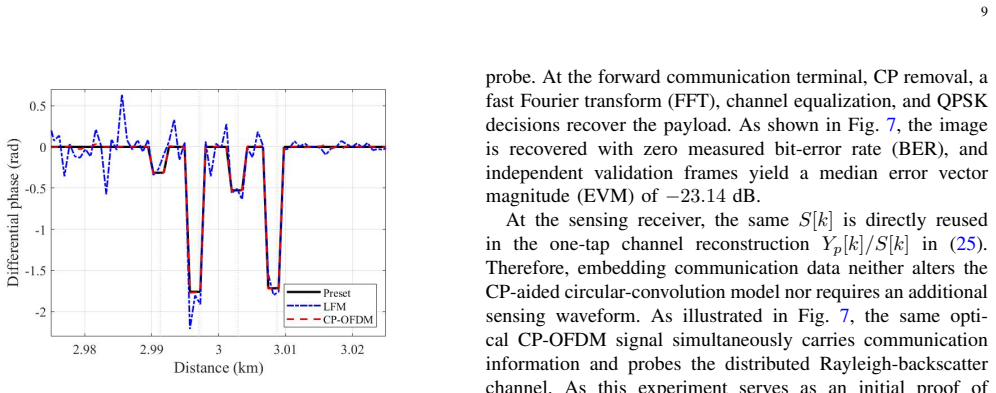
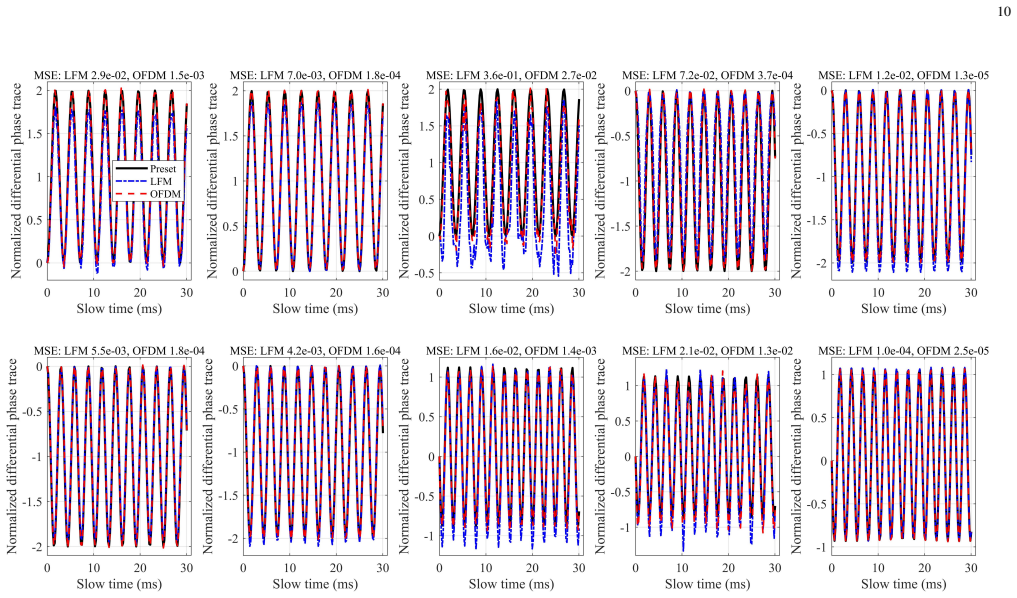
- Mean-square error of recovered phase traces improves by up to 29.55 dB relative to matched-filter compression in simulation.
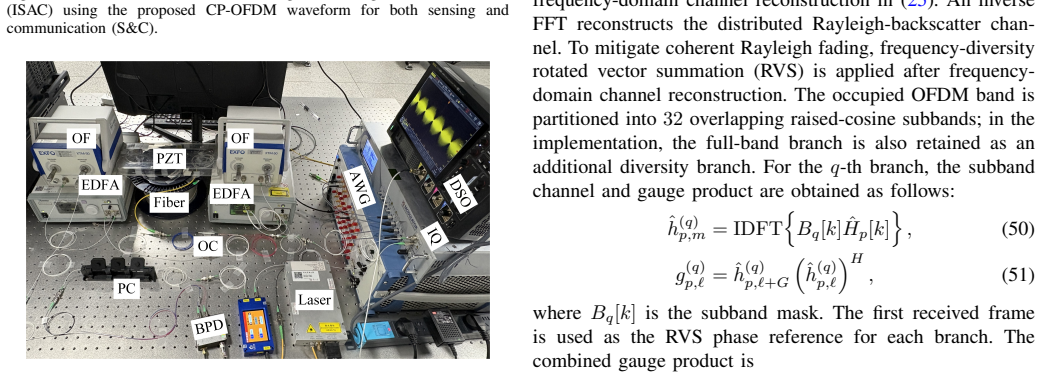
- Vibrations are localized and their waveforms recovered in a 5.2 km heterodyne experiment.
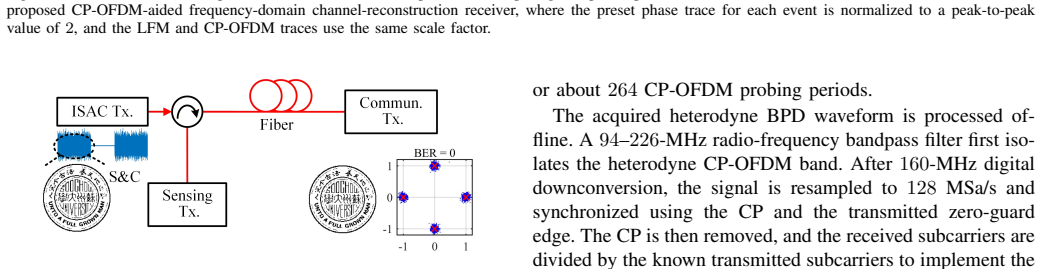
- The identical probe waveform recovers communication data at zero bit-error rate.
Where Pith is reading between the lines
- Fiber networks could support simultaneous vibration monitoring and data transport on the same optical carrier.
- The multipath formulation might apply to other distributed optical sensors whose scattering response is similarly finite in duration.
- Varying the CP length while monitoring residual leakage would directly test the memory-coverage requirement.
Load-bearing premise
Rayleigh backscattering along the fiber can be treated as a finite-length multipath channel whose exact memory duration is known ahead of time and can be covered by the chosen OFDM symbol and cyclic-prefix lengths.
What would settle it
Residual off-event leakage appearing in the reconstructed phase traces once the cyclic-prefix length is deliberately set shorter than the actual multipath memory duration.
Figures
read the original abstract
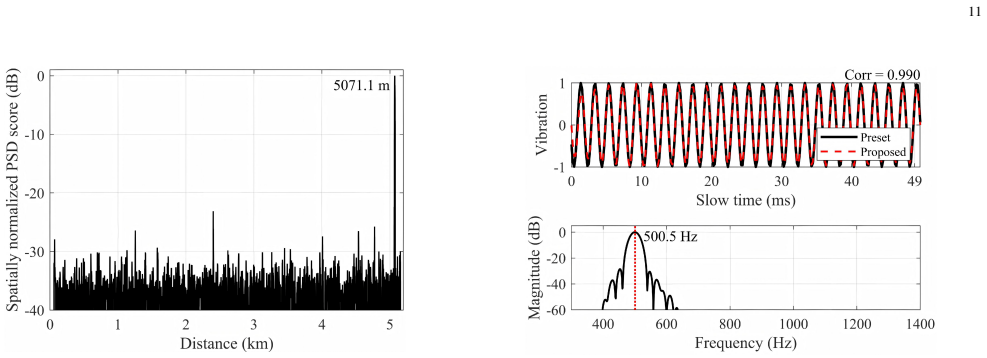
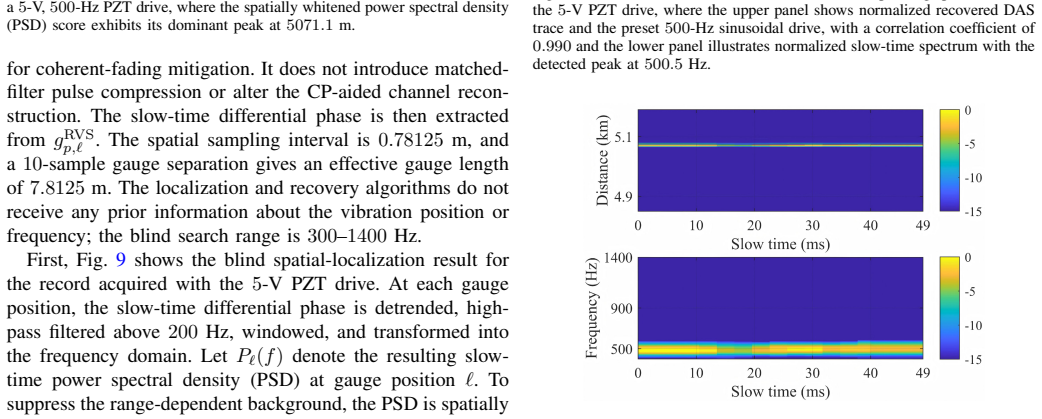
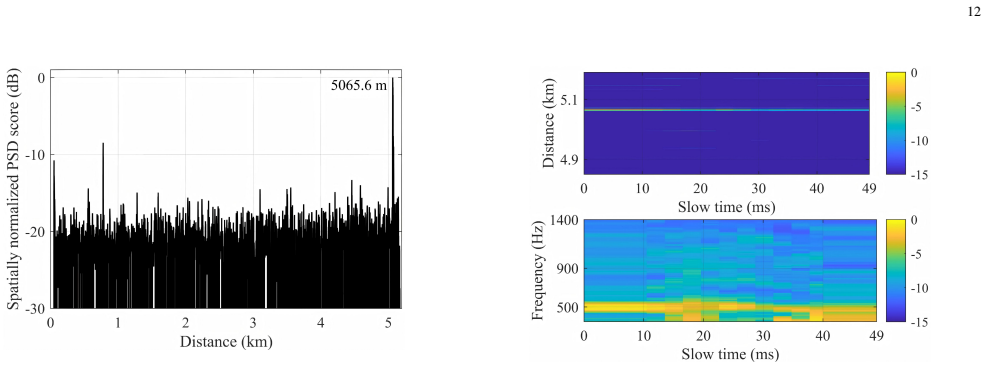
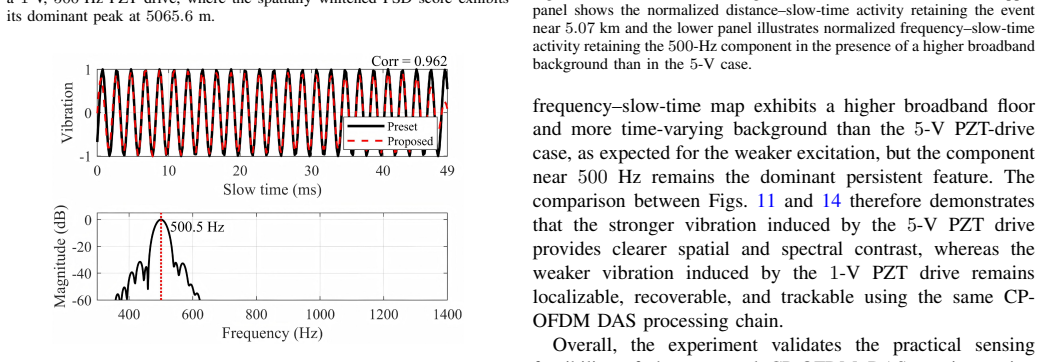
Matched-filter-based pulse-compression distributed acoustic sensing (DAS) suffers from nonzero compression sidelobes that cause deterministic inter-range-bin leakage, i.e., spatial inter-symbol interference (ISI), and false responses in reconstructed Rayleigh-backscatter traces. We propose a cyclic-prefix orthogonal frequency-division multiplexing (CP-OFDM) DAS system for $\phi$-OTDR, using a data-bearing CP-OFDM waveform as the sensing probe. It also recovers forward communication data, providing an initial demonstration of shared-waveform integrated sensing and communication (ISAC). To our knowledge, this is the first formulation of distributed Rayleigh backscattering as a finite-memory sensing multipath channel. Based on this formulation, we prove that, if the useful OFDM and CP lengths cover the sensing multipath memory, CP removal, one-tap frequency-domain equalization, and inverse discrete Fourier transform reconstruct each range-bin coefficient without deterministic waveform-induced spatial ISI, enabling spatial-ISI-free phase demodulation. For a simulated 5.2-km link with ten simultaneous strong and weak events spaced by 5.31--5.83 m within groups, the proposed receiver suppresses off-event leakage and improves phase-trace mean-square error by up to 29.55 dB over matched-filter pulse compression. In a heterodyne coherent experiment over a 5.2-km fiber link with 111.984-MHz occupied bandwidth, 500-Hz PZT vibrations are blindly localized at 5.071 and 5.066 km under 5- and 1-V drives, respectively, and their waveforms are recovered with correlation coefficients of 0.990 and 0.962. The same data-bearing probe also recovers an image with zero measured bit-error rate and a median error vector magnitude of -23.14 dB. These results validate CP-OFDM-aided frequency-domain channel reconstruction for spatial-ISI-free DAS and demonstrate its potential for shared-waveform optical-fiber ISAC.
Editorial analysis
A structured set of objections, weighed in public.
Referee Report
Summary. The paper proposes using data-bearing CP-OFDM waveforms as probes for φ-OTDR distributed acoustic sensing. It formulates distributed Rayleigh backscattering as a finite-memory linear multipath channel and proves that, when the useful OFDM symbol duration and CP length cover the channel memory, standard receiver operations (CP removal, one-tap frequency-domain equalization, and IDFT) recover each range-bin coefficient exactly, without deterministic waveform-induced spatial ISI. This enables spatial-ISI-free phase demodulation while simultaneously recovering forward communication data. Simulations over a 5.2 km link with multiple events report up to 29.55 dB MSE improvement versus matched-filter pulse compression; a 5.2 km heterodyne experiment with 111.984 MHz bandwidth localizes 500 Hz vibrations at ~5.07 km with correlations 0.990/0.962 and recovers the communication image with zero BER.
Significance. If the result holds, the work is significant because it supplies a mathematically grounded alternative to matched-filter DAS that removes a principal source of range-bin leakage. The explicit proof under the finite-memory model, the concrete simulation gain, and the dual-use ISAC demonstration (sensing plus zero-BER communication) are strengths that would be noted in any assessment.
minor comments (2)
- Abstract and §II: the finite-memory assumption is central; a short paragraph justifying why the maximum delay is known a priori from fiber length would help readers who are not already familiar with the model.
- The experimental section should state the exact OFDM and CP lengths chosen and confirm they satisfy the coverage condition stated in the proof.
Simulated Author's Rebuttal
We thank the referee for the positive assessment of our manuscript, the recognition of its significance, and the recommendation for minor revision. No specific major comments were listed in the report.
Circularity Check
No significant circularity
full rationale
The paper formulates distributed Rayleigh backscattering as a finite-memory multipath channel (an explicit modeling assumption) and shows that standard CP-OFDM operations (CP removal, one-tap equalization, IDFT) then yield range-bin coefficients without cyclic-convolution artifacts when the CP covers the modeled memory. This follows directly from the assumption plus textbook OFDM theory; the result is not obtained by fitting parameters inside the same equations or by renaming a self-citation. Simulation and heterodyne experiments supply independent numerical checks rather than being forced by the derivation. No load-bearing step matches any of the enumerated circularity patterns.
Axiom & Free-Parameter Ledger
axioms (1)
- domain assumption Distributed Rayleigh backscattering can be formulated as a finite-memory sensing multipath channel
Reference graph
Works this paper leans on
-
[1]
A. H. Hartog,An Introduction to Distributed Optical Fibre Sensors. Boca Raton, FL, USA: CRC Press, 2017
2017
-
[2]
Distributed optical fiber sensing: Review and perspective,
P. Lu, N. Lalam, M. Badar, B. Liu, B. T. Chorpening, M. P. Buric, and P. R. Ohodnicki, “Distributed optical fiber sensing: Review and perspective,”Appl. Phys. Rev., vol. 6, no. 4, Art. no. 041302, Dec. 2019
2019
-
[3]
Illuminating seafloor faults and ocean dynamics with dark fiber distributed acoustic sensing,
N. J. Lindsey, T. C. Dawe, and J. B. Ajo-Franklin, “Illuminating seafloor faults and ocean dynamics with dark fiber distributed acoustic sensing,” Science, vol. 366, no. 6469, pp. 1103–1107, Nov. 2019
2019
-
[4]
The break of earthquake asperities imaged by distributed acoustic sensing,
J. Li, T. Kim, N. Lapusta, E. Biondi, and Z. Zhan, “The break of earthquake asperities imaged by distributed acoustic sensing,”Nature, vol. 620, no. 7975, pp. 800–806, Aug. 2023
2023
-
[5]
Urban sensing using existing fiber-optic networks,
J. Liu, H. Li, H. Y . Noh, P. Santi, B. Biondi, and C. Ratti, “Urban sensing using existing fiber-optic networks,”Nat. Commun., vol. 16, no. 1, Art. no. 3091, Mar. 2025
2025
-
[6]
Distributed fiber-optic intrusion sensor system,
J. C. Juarez, E. W. Maier, K. N. Choi, and H. F. Taylor, “Distributed fiber-optic intrusion sensor system,”J. Lightwave Technol., vol. 23, no. 6, pp. 2081–2087, Jun. 2005
2081
-
[7]
Distributed vibration sensor based on coherent detection of phase-OTDR,
Y . Lu, T. Zhu, L. Chen, and X. Bao, “Distributed vibration sensor based on coherent detection of phase-OTDR,”J. Lightwave Technol., vol. 28, no. 22, pp. 3243–3249, Nov. 2010
2010
-
[8]
Field test of a distributed fiber-optic intrusion sensor system for long perimeters,
J. C. Juarez and H. F. Taylor, “Field test of a distributed fiber-optic intrusion sensor system for long perimeters,”Appl. Opt., vol. 46, no. 11, pp. 1968–1971, Apr. 2007
1968
-
[9]
Phase-sensitive optical time domain reflectometer assisted by first-order Raman amplification for distributed vibration sensing over>100 km,
H. F. Martins, S. Martin-Lopez, P. Corredera, M. L. Filograno, O. Frazao, and M. Gonzalez-Herraez, “Phase-sensitive optical time domain reflectometer assisted by first-order Raman amplification for distributed vibration sensing over>100 km,”J. Lightwave Technol., vol. 32, no. 8, pp. 1510–1518, Apr. 2014
2014
-
[10]
Phase-sensitive optical time-domain reflectometry with Brillouin amplification,
Z. N. Wang, J. Li, M. Q. Fan, L. Zhang, F. Peng, H. Wu, J. J. Zeng, Y . Zhou, and Y . J. Rao, “Phase-sensitive optical time-domain reflectometry with Brillouin amplification,”Opt. Lett., vol. 39, no. 15, pp. 4313–4316, Aug. 2014
2014
-
[11]
Ultra- long high-sensitivityΦ-OTDR for high spatial resolution intrusion detection of pipelines,
F. Peng, H. Wu, X.-H. Jia, Y .-J. Rao, Z.-N. Wang, and Z.-P. Peng, “Ultra- long high-sensitivityΦ-OTDR for high spatial resolution intrusion detection of pipelines,”Opt. Express, vol. 22, no. 11, pp. 13804–13810, Jun. 2014
2014
-
[12]
High-spatial-resolution distributed strain measurement in optical fiber with Rayleigh scatter,
M. Froggatt and J. Moore, “High-spatial-resolution distributed strain measurement in optical fiber with Rayleigh scatter,”Appl. Opt., vol. 37, no. 10, pp. 1735–1740, Apr. 1998
1998
-
[13]
Incoherent frequency modulated cw optical reflectometry with centimeter resolution,
S. Venkatesh and D. W. Dolfi, “Incoherent frequency modulated cw optical reflectometry with centimeter resolution,”Appl. Opt., vol. 29, no. 9, pp. 1323–1326, Mar. 1990
1990
-
[14]
High-frequency high- resolution distributed acoustic sensing by optical frequency domain reflectometry,
L. Marcon, A. Galtarossa, and L. Palmieri, “High-frequency high- resolution distributed acoustic sensing by optical frequency domain reflectometry,”Opt. Express, vol. 27, no. 10, pp. 13923–13933, May 2019
2019
-
[15]
High-spatial-resolution fiber-optic distributed acoustic sensor based onΦ-OFDR with enhanced crosstalk suppression,
H. Li, Q. Liu, D. Chen, Y . Deng, and Z. He, “High-spatial-resolution fiber-optic distributed acoustic sensor based onΦ-OFDR with enhanced crosstalk suppression,”Opt. Lett., vol. 45, no. 2, pp. 563–566, Jan. 2020
2020
-
[16]
Single-shot distributed temperature and strain tracking using direct detection phase-sensitive OTDR with chirped pulses,
J. Pastor-Graells, H. F. Martins, A. Garcia-Ruiz, S. Martin-Lopez, and M. Gonzalez-Herraez, “Single-shot distributed temperature and strain tracking using direct detection phase-sensitive OTDR with chirped pulses,”Opt. Express, vol. 24, no. 12, pp. 13121–13133, Jun. 2016
2016
-
[17]
Optical pulse compression reflectometry: Proposal and proof-of-concept experiment,
W. Zou, S. Yang, X. Long, and J. Chen, “Optical pulse compression reflectometry: Proposal and proof-of-concept experiment,”Opt. Express, vol. 23, no. 1, pp. 512–522, Jan. 2015
2015
-
[18]
Compensation of phase noise impairments in distributed acoustic sensors based on optical pulse compression time-domain reflectometry,
E. Pi ˜neiro, M. Sagues, and A. Loayssa, “Compensation of phase noise impairments in distributed acoustic sensors based on optical pulse compression time-domain reflectometry,”J. Lightwave Technol., vol. 41, no. 10, pp. 3199–3207, May 2023
2023
-
[19]
Time-expanded phase-sensitive optical time-domain reflectometry,
M. Soriano-Amat, H. F. Martins, V . Dur ´an, L. Costa, S. Martin-Lopez, M. Gonzalez-Herraez, and M. R. Fern ´andez-Ruiz, “Time-expanded phase-sensitive optical time-domain reflectometry,”Light Sci. Appl., vol. 10, no. 1, Art. no. 51, Mar. 2021
2021
-
[20]
Two-wavelength phase-sensitive OTDR sensor using perfect periodic correlation codes for measurement range enhancement, noise reduction and fading compensation,
M. Sagu ´es, E. Pi ˜neiro, E. Cerri, A. Minardo, A. Eyal, and A. Loayssa, “Two-wavelength phase-sensitive OTDR sensor using perfect periodic correlation codes for measurement range enhancement, noise reduction and fading compensation,”Opt. Express, vol. 29, no. 4, pp. 6021–6035, Feb. 2021
2021
-
[21]
Bipolar-codingΦ- OTDR with interference fading elimination and frequency drift com- pensation,
Y . Wu, Z. Wang, J. Xiong, J. Jiang, and Y . Rao, “Bipolar-codingΦ- OTDR with interference fading elimination and frequency drift com- pensation,”J. Lightwave Technol., vol. 38, no. 21, pp. 6121–6128, Nov. 2020
2020
-
[22]
Introducing coherent MIMO sensing, a fading-resilient, polarization-independent approach toϕ-OTDR,
S. Guerrier, C. Dorize, E. Awwad, and J. Renaudier, “Introducing coherent MIMO sensing, a fading-resilient, polarization-independent approach toϕ-OTDR,”Opt. Express, vol. 28, no. 14, pp. 21081–21094, Jul. 2020
2020
-
[23]
A fully digital MIMO-OFDM scheme for fading mitigation in coherent∆ϕ-OTDR,
S. Guerrier, C. Dorize, E. Awwad, and J. Renaudier, “A fully digital MIMO-OFDM scheme for fading mitigation in coherent∆ϕ-OTDR,” Opt. Express, vol. 29, no. 22, pp. 35149–35165, Oct. 2021
2021
-
[24]
Three- layer structure multiplexing fading elimination method in long-haulΦ- OTDR,
Y . Wu, Z. Wei, T. Li, S. Chen, Z. Liu, Q. Sui, and Z. Li, “Three- layer structure multiplexing fading elimination method in long-haulΦ- OTDR,”J. Lightwave Technol., vol. 42, no. 14, pp. 5017–5024, Jul. 2024
2024
-
[25]
Multi-frequencyΦ-OTDR DAS using timely-updated vector-based phase averaging,
Y . Wakisaka, H. Takahashi, D. Iida, T. Ishimaru, and Y . Koshikiya, “Multi-frequencyΦ-OTDR DAS using timely-updated vector-based phase averaging,”J. Lightwave Technol., vol. 43, no. 2, pp. 886–893, Jan. 2025
2025
-
[26]
Polyphase coding and asymmetric correlator receiver based distributed acoustic sensor with enhanced crosstalk suppression,
G. Deng, S. Gao, T. Zhang, J. Lv, L. Cheng, H. Liang, and B.-O. Guan, “Polyphase coding and asymmetric correlator receiver based distributed acoustic sensor with enhanced crosstalk suppression,”J. Lightwave Technol., vol. 44, no. 2, pp. 710–717, Jan. 2026
2026
-
[27]
Levanon and E
N. Levanon and E. Mozeson,Radar Signals. Hoboken, NJ, USA: Wiley, 2004
2004
-
[28]
M. A. Richards,Fundamentals of Radar Signal Processing, 2nd ed. New York, NY , USA: McGraw-Hill, 2014
2014
-
[29]
Sidelobe apodization in optical pulse compression reflectometry for fiber optic distributed acoustic sensing,
J. J. Momp ´o, S. Mart ´ın-L´opez, M. Gonz ´alez-Herr´aez, and A. Loayssa, “Sidelobe apodization in optical pulse compression reflectometry for fiber optic distributed acoustic sensing,”Opt. Lett., vol. 43, no. 7, pp. 1499–1502, Apr. 2018
2018
-
[30]
High-spatial-resolution distributed acoustic sensor utilizing a positive- and negative-swept pulse,
X. Xiao, J. He, B. Du, B. Xu, G. Chen, X. Xu, G. Y . Chen, and Y . Wang, “High-spatial-resolution distributed acoustic sensor utilizing a positive- and negative-swept pulse,”J. Lightwave Technol., vol. 42, no. 8, pp. 2991–2996, Apr. 2024
2024
-
[31]
Analysis of distributed optical fibre acoustic sensors through numerical modelling,
A. Masoudi and T. P. Newson, “Analysis of distributed optical fibre acoustic sensors through numerical modelling,”Opt. Express, vol. 25, no. 25, pp. 32021–32040, Dec. 2017
2017
-
[32]
Characterizing detection noise in phase-sensitive optical time domain reflectometry,
X. Lu and K. Krebber, “Characterizing detection noise in phase-sensitive optical time domain reflectometry,”Opt. Express, vol. 29, no. 12, pp. 18791–18806, Jun. 2021
2021
-
[33]
Noise analysis in direct detection and coherent detection phase-sensitive optical time-domain reflectometry systems,
P. J. Vidal-Moreno, C. Becerril, M. R. Fern ´andez-Ruiz, H. Martins, S. Martin-Lopez, and M. Gonzalez-Herraez, “Noise analysis in direct detection and coherent detection phase-sensitive optical time-domain reflectometry systems,”Opt. Express, vol. 31, no. 17, pp. 27450–27467, Aug. 2023
2023
-
[34]
On the sensitivity of distributed acoustic sensing,
H. Gabai and A. Eyal, “On the sensitivity of distributed acoustic sensing,”Opt. Lett., vol. 41, no. 24, pp. 5648–5651, Dec. 2016
2016
-
[35]
Shieh and I
W. Shieh and I. Djordjevic,OFDM for Optical Communications. Ams- terdam, The Netherlands: Elsevier, 2010
2010
-
[36]
Goldsmith,Wireless Communications
A. Goldsmith,Wireless Communications. Cambridge, U.K.: Cambridge Univ. Press, 2005
2005
-
[37]
OFDM for optical communications,
J. Armstrong, “OFDM for optical communications,”J. Lightwave Tech- nol., vol. 27, no. 3, pp. 189–204, Feb. 2009
2009
discussion (0)
Sign in with ORCID, Apple, or X to comment. Anyone can read and Pith papers without signing in.