Forcing-informed resolvent analysis: Identification of input-output relations in self-sustained flows
Pith reviewed 2026-06-26 16:01 UTC · model grok-4.3
The pith
Forcing-informed resolvent analysis extracts forcing and response modes that match actual self-sustained flow fields by incorporating nonlinear forcing structures from data.
A machine-rendered reading of the paper's core claim, the machinery that carries it, and where it could break.
Core claim
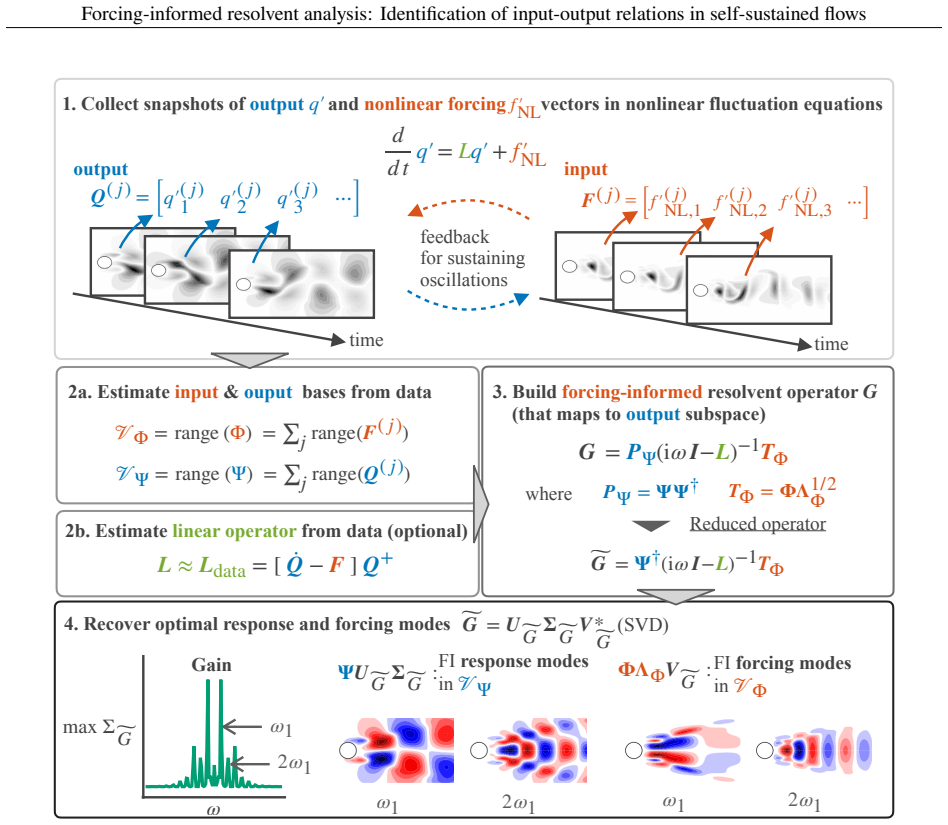
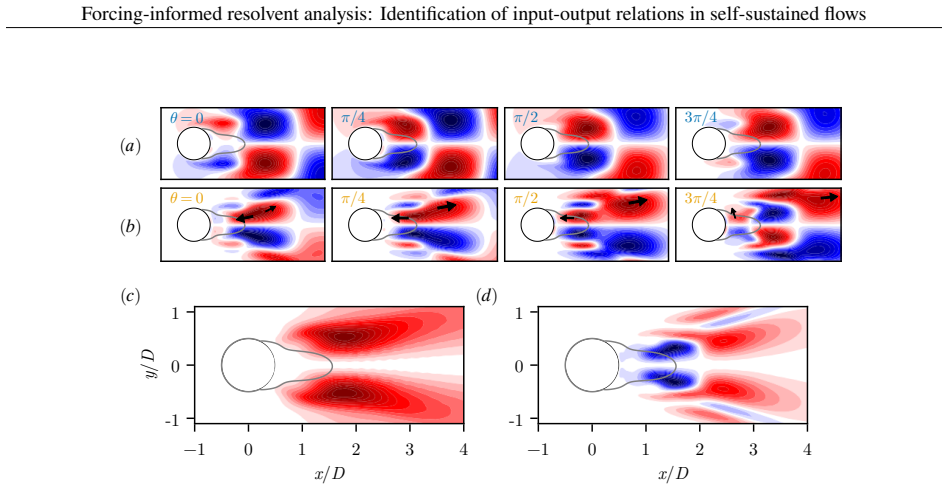
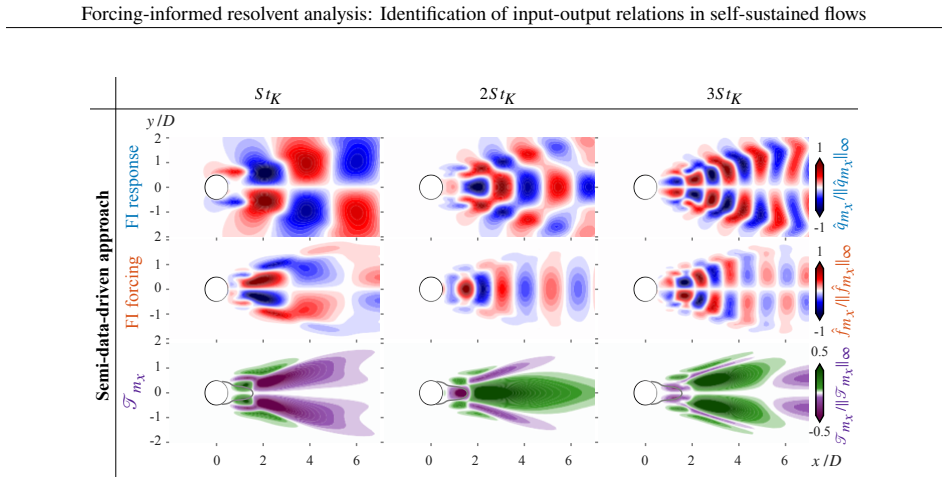
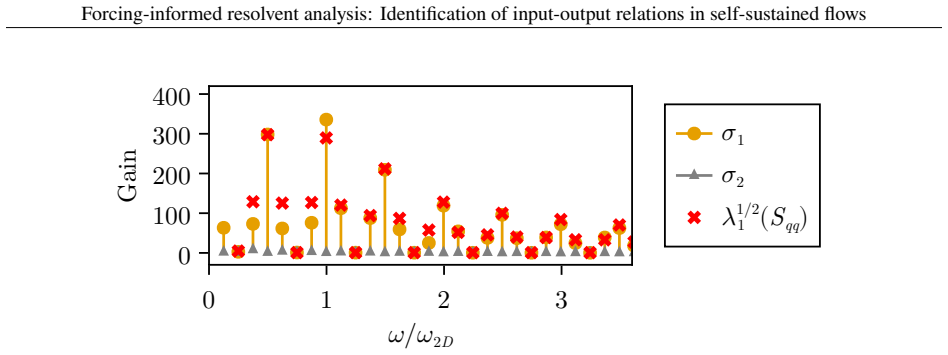
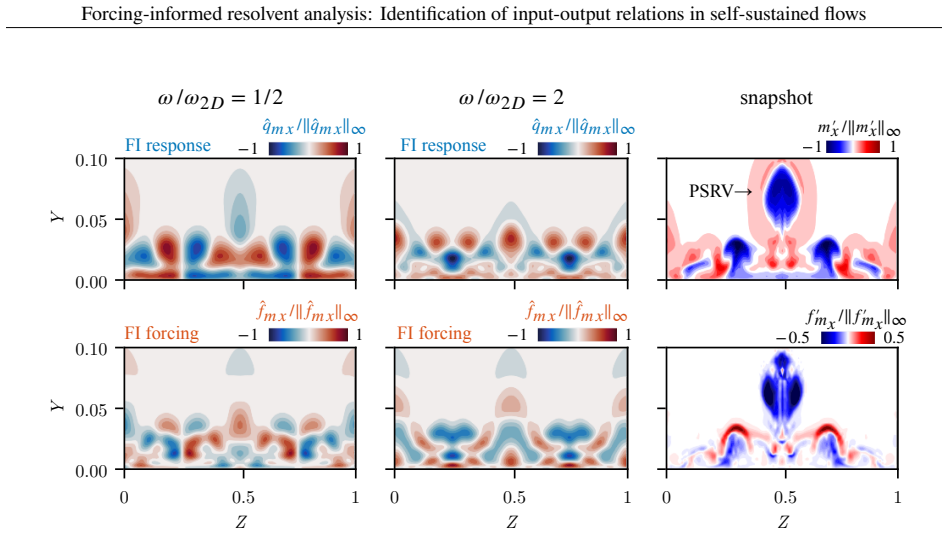
The forcing-informed resolvent operator is built by estimating basis vectors for the input subspace spanned by forcing snapshots and for the output subspace from simulation data. The extracted response modes are linear combinations of the output basis, forcing modes are linear combinations of the input basis, and the singular values equal the actual output amplitudes. These properties make the identified modes and gains consistent with the statistics of the underlying self-sustained flow, as shown on the Stuart-Landau oscillator, two-dimensional cylinder wake, and three-dimensional transitional boundary layer.
What carries the argument
The forcing-informed resolvent operator, constructed from estimated input and output subspace bases derived from nonlinear forcing and response snapshots.
If this is right
- Extracted FI response and forcing modes remain consistent with the actual self-sustained flow fields.
- Singular values of the FI resolvent operator equal the measured output amplitudes.
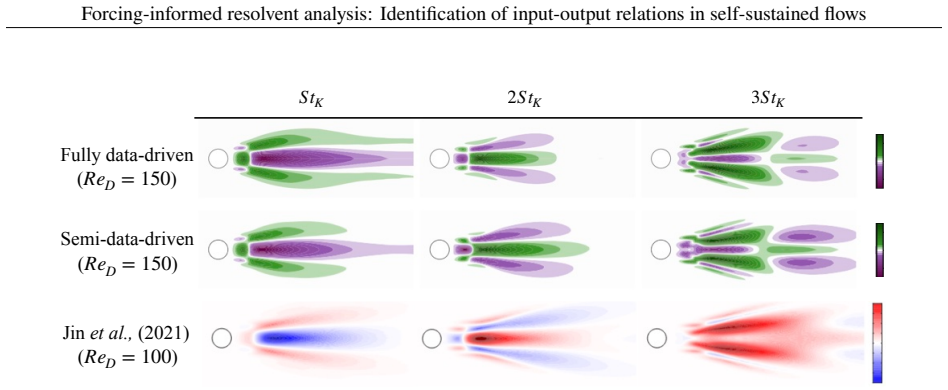
- Forcing snapshots alone suffice to build the linear operator for a fully data-driven analysis.
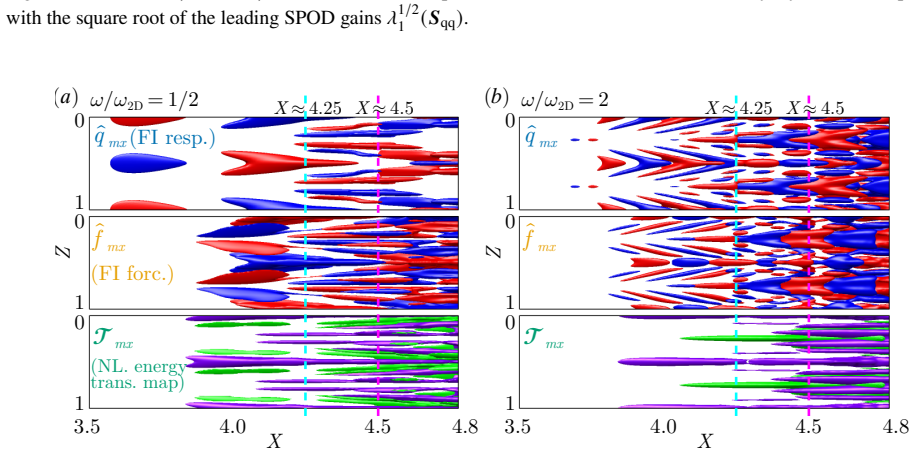
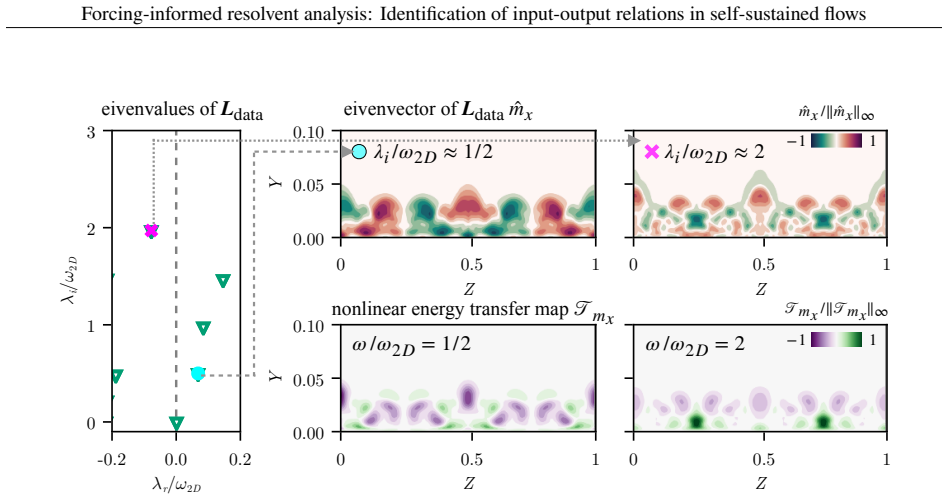
- The nonlinear energy transfer map locates spatial regions where each extracted forcing mode injects or removes fluctuation energy.
Where Pith is reading between the lines
- The energy transfer map could be used to rank spatial regions by their contribution to sustaining the flow at each frequency.
- The data-driven construction might reduce the need for an explicit mean-flow linearization when only snapshot data are available.
- The approach could be tested on additional self-sustained flows such as bluff-body wakes or mixing layers to check whether the same consistency holds.
- If the input subspace basis is truncated too aggressively, the recovered forcing modes may miss localized nonlinear structures that still affect the overall energy balance.
Load-bearing premise
Basis vectors estimated from a finite number of simulation snapshots accurately represent the relevant structures of the nonlinear terms that act as forcing.
What would settle it
If the modes and gains produced by the method on the cylinder wake at a nonlinear frequency fail to reproduce the dominant fluctuation structures seen in the original simulation data, the consistency claim is falsified.
Figures
read the original abstract
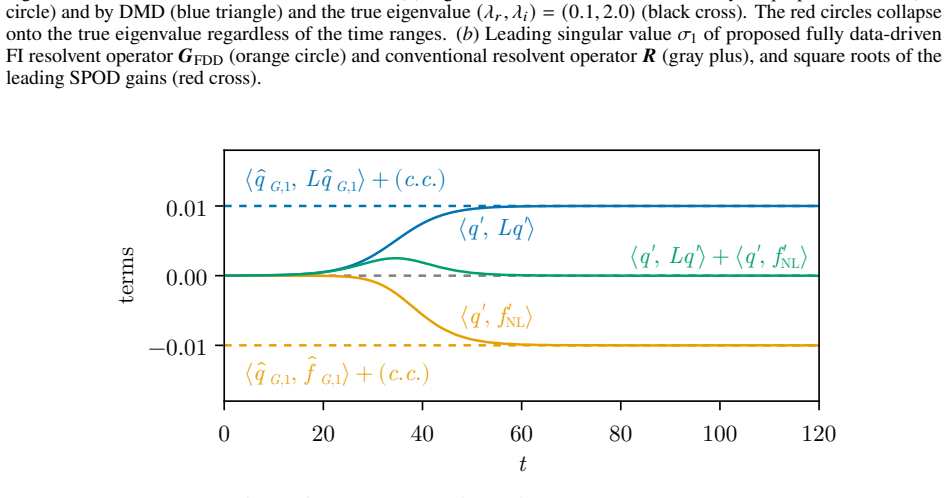
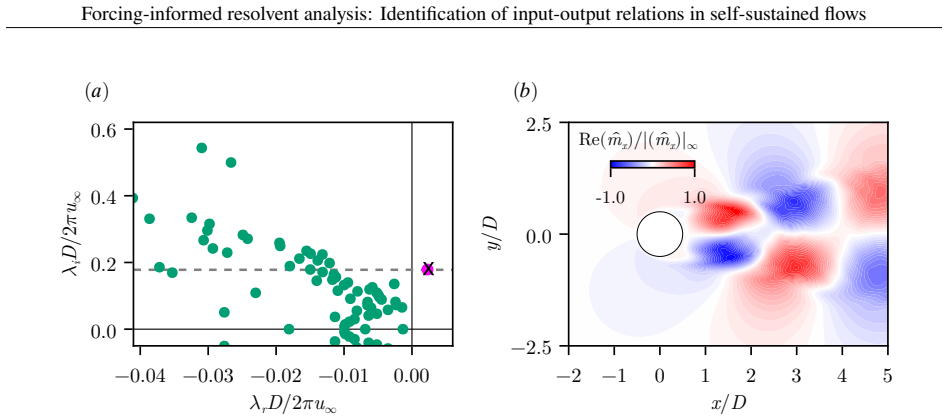
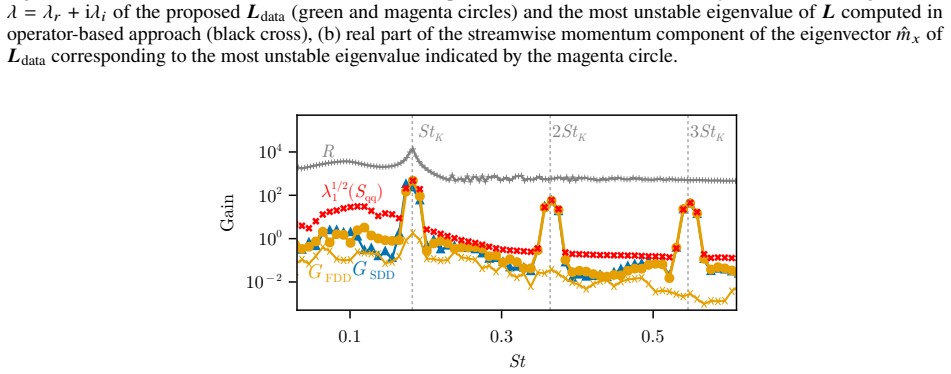
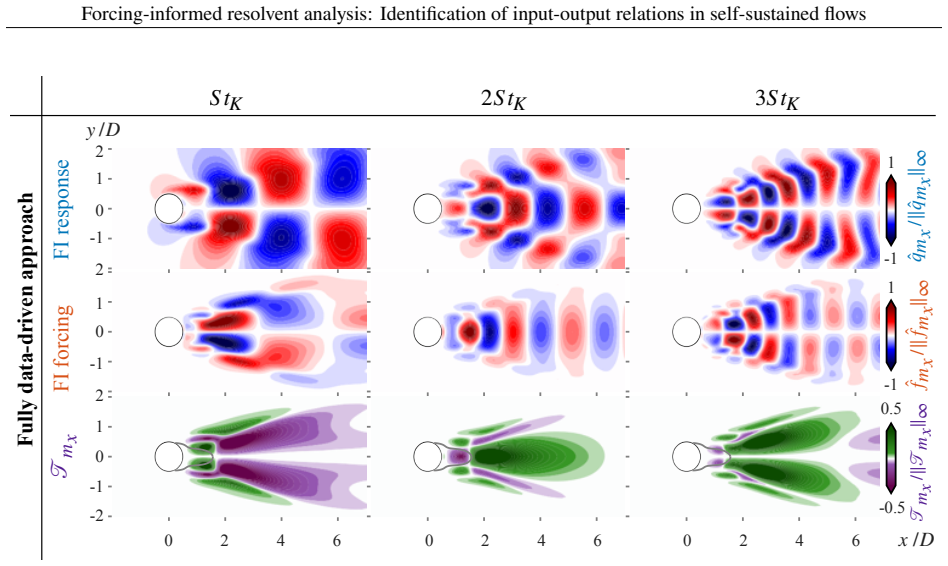
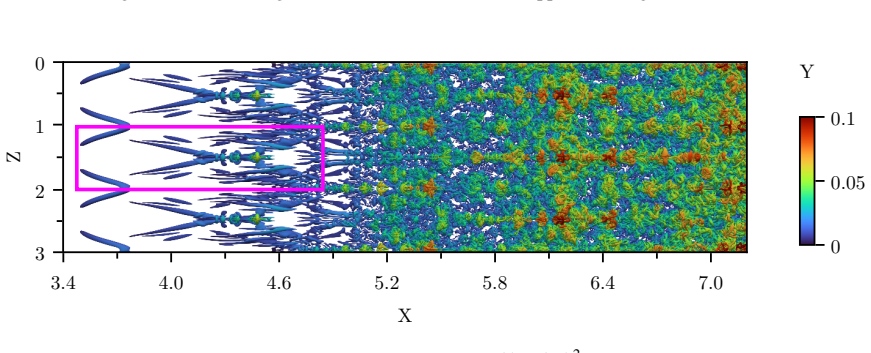
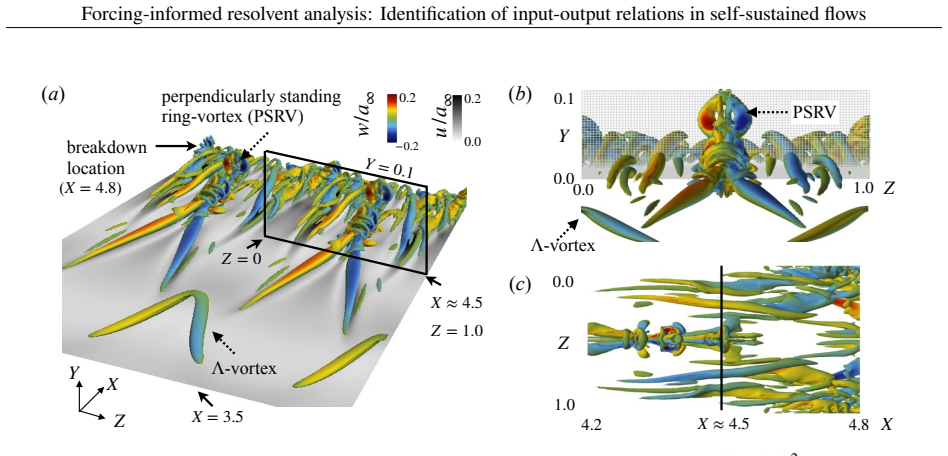
We present a forcing-informed (FI) resolvent analysis framework to identify input-output relations for statistically stationary self-sustained unsteady flows. The central idea of this method is to inform the resolvent operator about the spatiotemporal structures of the nonlinear terms that act as exogenous forcing with respect to the mean flow. To construct the FI resolvent operator, we estimate the basis vectors for the input subspace spanned by forcing snapshots and, similarly, for the output subspace, from simulation data. The extracted FI response and forcing modes are expressed through the estimated bases of the output and input subspaces, respectively, and the singular values of the FI resolvent operator correspond to the actual output amplitudes. These properties ensure that the extracted modes are consistent with the actual self-sustained flow fields. Additionally, the forcing snapshots can be used to construct the linear operator, enabling a fully data-driven FI resolvent analysis. The proposed framework is validated using the Stuart-Landau oscillator and demonstrated for a two-dimensional cylinder wake and a three-dimensional transitional boundary layer. We successfully identify the gains and the corresponding pairs of forcing and response modes, even at frequencies where the nonlinear amplification mechanism is crucial. Furthermore, leveraging the balance between the time-averaged energy amplification/attenuation by the linear operator and nonlinear forcing, we introduce a nonlinear energy transfer map that identifies the spatial domains where the extracted forcing mode injects or removes fluctuation energy, thereby providing key physical insight into the self-sustaining mechanisms.
Editorial analysis
A structured set of objections, weighed in public.
Referee Report
Summary. The manuscript introduces a forcing-informed (FI) resolvent analysis framework for statistically stationary self-sustained unsteady flows. It estimates bases for the input subspace (spanned by forcing snapshots) and output subspace from simulation data to construct an informed resolvent operator that incorporates the spatiotemporal structure of nonlinear terms acting as exogenous forcing. The extracted FI response and forcing modes are expressed via these bases, with the singular values asserted to equal actual output amplitudes, ensuring consistency with the self-sustained fields. A fully data-driven variant constructs the linear operator from the same snapshots; the framework is validated on the Stuart-Landau oscillator, 2D cylinder wake, and 3D transitional boundary layer, and includes a nonlinear energy transfer map based on time-averaged energy balance.
Significance. If the consistency properties and validation hold under scrutiny, the approach could provide a practical route to extract input-output relations and physical insight into nonlinear self-sustaining mechanisms where standard mean-flow resolvent analysis is insufficient. The multi-case demonstration and the energy-transfer map are potentially useful contributions if the data-dependence issues are resolved.
major comments (2)
- [Abstract and method description] The central consistency claim (singular values equal actual output amplitudes; modes consistent with self-sustained fields) rests on the estimated input/output subspace bases from finite snapshots accurately spanning the relevant nonlinear forcing structures. The abstract and method description do not quantify truncation or sampling error in these bases, nor demonstrate that the projected operator preserves the true energy balance between linear amplification and nonlinear forcing.
- [Validation cases and fully data-driven variant] In the fully data-driven variant (linear operator also built from the same forcing snapshots), subspace estimation errors propagate simultaneously into the operator and the forcing representation. This compounds the risk that the reported gains and modes are artifacts of the shared data rather than robust identifications; explicit robustness checks (e.g., convergence with snapshot count or cross-validation) are required.
minor comments (1)
- Notation for the estimated bases, projection operators, and how the FI resolvent is assembled should be made fully explicit (including any regularization or truncation thresholds) to allow independent reproduction.
Simulated Author's Rebuttal
We thank the referee for their thoughtful and constructive report. We address each major comment below, indicating planned revisions to strengthen the manuscript.
read point-by-point responses
-
Referee: [Abstract and method description] The central consistency claim (singular values equal actual output amplitudes; modes consistent with self-sustained fields) rests on the estimated input/output subspace bases from finite snapshots accurately spanning the relevant nonlinear forcing structures. The abstract and method description do not quantify truncation or sampling error in these bases, nor demonstrate that the projected operator preserves the true energy balance between linear amplification and nonlinear forcing.
Authors: We agree that the abstract and method description do not explicitly quantify truncation or sampling errors from finite snapshots. In the revised manuscript we will expand the method section to discuss the approximation properties: as the snapshot count increases the estimated bases converge to the true forcing/response subspaces and the singular values recover the actual amplitudes. We will also add a brief demonstration on the Stuart-Landau oscillator showing preservation of the linear-nonlinear energy balance once the snapshot ensemble is sufficiently rich. These additions will be placed after the definition of the FI resolvent operator. revision: yes
-
Referee: [Validation cases and fully data-driven variant] In the fully data-driven variant (linear operator also built from the same forcing snapshots), subspace estimation errors propagate simultaneously into the operator and the forcing representation. This compounds the risk that the reported gains and modes are artifacts of the shared data rather than robust identifications; explicit robustness checks (e.g., convergence with snapshot count or cross-validation) are required.
Authors: The concern about compounded data dependence in the fully data-driven variant is valid. Although the Stuart-Landau and cylinder-wake validations already compare against known reference solutions, we will add an explicit robustness subsection. This will include (i) convergence of the leading gains and modes versus snapshot count for the cylinder wake and (ii) a simple cross-validation by partitioning the snapshot set. These checks will be reported for both the standard and fully data-driven FI operators. revision: yes
Circularity Check
Subspace bases fitted to simulation snapshots force singular values to match data amplitudes by construction
specific steps
-
fitted input called prediction
[Abstract]
"To construct the FI resolvent operator, we estimate the basis vectors for the input subspace spanned by forcing snapshots and, similarly, for the output subspace, from simulation data. The extracted FI response and forcing modes are expressed through the estimated bases of the output and input subspaces, respectively, and the singular values of the FI resolvent operator correspond to the actual output amplitudes. These properties ensure that the extracted modes are consistent with the actual self-sustained flow fields."
The bases are obtained by fitting to the identical simulation snapshots whose amplitudes are later declared to be recovered by the singular values. Because the FI operator is the projection of the (mean-flow or data-derived) linear operator onto these bases, its SVD singular values are algebraically forced to reproduce the projected amplitudes; the claimed 'correspondence' and 'consistency' therefore reduce to the fitting step rather than constituting an independent prediction.
full rationale
The paper estimates input/output subspace bases directly from the same simulation snapshots that supply the nonlinear forcing and fluctuation amplitudes. The FI resolvent is then formed by projection onto these bases, after which the paper states that its singular values equal the actual output amplitudes and that the resulting modes are consistent with the flow fields. This match holds by the linear-algebra construction of the reduced operator rather than by independent verification; the fully data-driven variant (linear operator also built from snapshots) inherits the same dependence. No self-citation chain or external uniqueness theorem is invoked, so the circularity is moderate and localized to the data-driven projection step.
Axiom & Free-Parameter Ledger
axioms (1)
- domain assumption Nonlinear terms in the Navier-Stokes equations can be treated as exogenous forcing with respect to the mean flow for the purpose of input-output analysis.
Reference graph
Works this paper leans on
-
[1]
2001 , publisher=
Stability and transition in shear flows , author=. 2001 , publisher=
2001
-
[2]
Rockwell, D. and Naudascher, E. Review—Self -Sustaining Oscillations of Flow Past Cavities. J. Fluids Eng. doi:10.1115/1.3448624
-
[3]
Singh, A. N. and Nair, V. , journal=. Effects of harmonic forcing on self-sustained oscillations in cavity flows at low. 2025 , publisher=
2025
-
[4]
Lee, B. H. K. Self-sustained shock oscillations on airfoils at transonic speeds. Prog. Aerosp. Sci. doi:10.1016/S0376-0421(01)00003-3
-
[5]
Kojima, Y. and Yeh, C.-A. and Taira, K. and Kameda, M. Resolvent analysis on the origin of two-dimensional transonic buffet. J. Fluid Mech. doi:10.1017/jfm.2019.992
-
[6]
On a self-sustaining process in shear flows
Waleffe, F. On a self-sustaining process in shear flows. Phys. Fluids. doi:10.1063/1.869185
-
[7]
Nonlinear mechanism of the self-sustaining process in the buffer and logarithmic layer of wall-bounded flows , author=. J. Fluid Mech. , volume=. 2021 , publisher=
2021
-
[8]
Iwatani, Y. and Asada, H. and Yeh, C.-A and Taira, K. and Kawai, S. Identifying the Self-Sustaining Mechanisms of Transonic Airfoil Buffet with Resolvent Analysis. AIAA J. doi:10.2514/1.J062294
-
[9]
Jiménez, J. and Moin, P. The minimal flow unit in near-wall turbulence. J. Fluid Mech. doi:10.1017/S0022112091002033
-
[10]
Liu, C. and Gayme, D. F. Structured input–output analysis of transitional wall-bounded flows. J. Fluid Mech. doi:10.1017/jfm.2021.762
-
[11]
McKeon, B. J. and Sharma, A. S. and Jacobi, I. Experimental manipulation of wall turbulence: a systems approach. Phys. Fluids
-
[12]
Ribeiro, J. H. M. and Yeh, C.-A. and Taira, K. Randomized resolvent analysis. Phys. Rev. Fluids. doi:10.1103/PhysRevFluids.5.033902
-
[13]
Journal of Fluid Mechanics , volume=
Structured input--output analysis of compliant wall turbulence , author=. Journal of Fluid Mechanics , volume=. 2026 , publisher=
2026
-
[14]
Hydrodynamic stability without eigenvalues
Trefethen, L N and Trefethen, A E and Reddy, S C and Driscoll, T A. Hydrodynamic stability without eigenvalues. Science. doi:10.1126/science.261.5121.578
-
[15]
Componentwise energy amplification in channel flows
Jovanović, M and Bamieh, Bassam. Componentwise energy amplification in channel flows. J. Fluid Mech. doi:10.1017/S0022112005004295
-
[16]
Journal of Fluid Mechanics , author =
McKeon, B J and Sharma, A S. A critical-layer framework for turbulent pipe flow. J. Fluid Mech. doi:10.1017/S002211201000176X
-
[17]
Jovanović, Mihailo R. From Bypass Transition to Flow Control and Data-Driven Turbulence Modeling: An Input–Output Viewpoint. Annu. Rev. Fluid Mech. doi:10.1146/annurev-fluid-010719-060244
-
[18]
Page, J. and Kerswell, R. R. K oopman mode expansions between simple invariant solutions. J. Fluid Mech. doi:10.1017/jfm.2019.686
-
[19]
A reduced-order model of three-dimensional unsteady flow in a cavity based on the resolvent operator
Gómez, F and Blackburn, H M and Rudman, M and Sharma, A S and McKeon, B J. A reduced-order model of three-dimensional unsteady flow in a cavity based on the resolvent operator. J. Fluid Mech. doi:10.1017/jfm.2016.339
-
[20]
FFVHC - ACE : Fully automated C artesian-grid-based solver for compressible large-eddy simulation
Asada, Hiroyuki and Tamaki, Yoshiharu and Takaki, Ryoji and Yumitori, Takaaki and Tamura, Shun and Hatanaka, Keita and Imai, Kazuhiro and Maeyama, Hirotaka and Kawai, Soshi. FFVHC - ACE : Fully automated C artesian-grid-based solver for compressible large-eddy simulation. AIAA J. doi:10.2514/1.j062593
-
[21]
Resolvent-analysis-based design of airfoil separation control
Yeh, Chi-An and Taira, Kunihiko. Resolvent-analysis-based design of airfoil separation control. J. Fluid Mech. doi:10.1017/jfm.2019.163
-
[22]
Fukami, K. and Iwatani, Y. and Maejima, S. and Asada, H. and Kawai, S. Compact representation of transonic airfoil buffet flows with observable-augmented machine learning. J. Fluid Mech. doi:10.1017/jfm.2025.10741
-
[23]
Machine learning for fluid mechanics , author=. Annu. Rev. Fluid Mech. , volume=. 2020 , publisher=
2020
-
[24]
Fukagata, K. and Fukami, K. Compressing fluid flows with nonlinear machine learning: mode decomposition, latent modeling, and flow control. Fluid Dyn. Res. doi:10.1088/1873-7005/ade8a2
-
[25]
Data-driven transient lift attenuation for extreme vortex gust--airfoil interactions , author=. J. Fluid Mech. , volume=. 2024 , publisher=
2024
-
[26]
Deep learning to discover and predict dynamics on an inertial manifold , author =. Phys. Rev. E , volume =. 2020 , month =. doi:10.1103/PhysRevE.101.062209 , url =
-
[27]
Dynamics of a data-driven low-dimensional model of turbulent minimal C ouette flow
Linot, Alec J and Graham, Michael D. Dynamics of a data-driven low-dimensional model of turbulent minimal C ouette flow. J. Fluid Mech. doi:10.1017/jfm.2023.720
-
[28]
Exact coherent structures in two-dimensional turbulence identified with convolutional autoencoders
Page, Jacob and Holey, Joe and Brenner, Michael P and Kerswell, Rich R. Exact coherent structures in two-dimensional turbulence identified with convolutional autoencoders. J. Fluid Mech. doi:10.1017/jfm.2024.552
-
[29]
Page , author=
Computation of simple invariant solutions in fluid turbulence with the aid of deep learning: J. Page , author=. Nonlinear dynamics , volume=. 2025 , publisher=
2025
-
[30]
Taniguchi, Nobutaka and Ohmichi, Yuya and Suzuki, Kojiro. Nonlinear transient disturbance growth analysis for the compressible external flow and application to a flow around circular cylinder. J. Comput. Phys. doi:10.1016/j.jcp.2024.113374
-
[31]
Interpolatory input and output projections for flow control
Herrmann, Benjamin and Baddoo, Peter J and Dawson, Scott T M and Semaan, Richard and Brunton, Steven L and McKeon, Beverley J. Interpolatory input and output projections for flow control. J. Fluid Mech. doi:10.1017/jfm.2023.680
-
[32]
Towne, A. and Lozano-Durán, A. and Yang, X. Resolvent-based estimation of space–time flow statistics. J. Fluid Mech. doi:10.1017/jfm.2019.854
-
[33]
Martini, E. and Jung, J. and Cavalieri, A. V. G. and Jordan, P. and Towne, A. Resolvent-based tools for optimal estimation and control via the Wiener–Hopf formalism. J. Fluid Mech. doi:10.1017/jfm.2022.102
-
[34]
Yeh, C.-A. and Benton, S. I. and Taira, K. and Garmann, D. J. Resolvent analysis of an airfoil laminar separation bubble at Re=500000. Phys. Rev. Fluids. doi:10.1103/physrevfluids.5.083906
-
[35]
Physical Review E—Statistical, Nonlinear, and Soft Matter Physics , volume=
Rapid path to transition via nonlinear localized optimal perturbations in a boundary-layer flow , author=. Physical Review E—Statistical, Nonlinear, and Soft Matter Physics , volume=. 2010 , publisher=
2010
-
[36]
Physical review letters , volume=
Using Nonlinear Transient Growth to Construct the Minimal Seed for Shear Flow Turbulence , author=. Physical review letters , volume=. 2010 , publisher=
2010
-
[37]
Annual Review of Fluid Mechanics , author =
Mezić, I. Analysis of Fluid Flows via Spectral Properties of the K oopman Operator. Annu. Rev. Fluid Mech. doi:10.1146/annurev-fluid-011212-140652
-
[38]
Kim, Y. and Godavarthi, V. and Rolandi, L. V. and Klamo, J. T. and Taira, K. Influence of three-dimensionality on wake synchronisation of an oscillatory cylinder. J. Fluid Mech. doi:10.1017/jfm.2024.1079
-
[39]
doi:10.1016/j.compbiomed.2024.109162
Ohmichi, Y. Variational mode decomposition–based nonstationary coherent structure analysis for spatiotemporal data. Aerosp. Sci. Technol. doi:10.1016/j.ast.2024.109162
-
[40]
Jeun, J. and Nichols, J. W. and Jovanović, M. R. Input-output analysis of high-speed axisymmetric isothermal jet noise. Phys. Fluids. doi:10.1063/1.4946886
-
[41]
Ribeiro, J. H. M. and Taira, K. , year=. Triglobal resolvent-analysis-based control of separated flows around low-aspect-ratio wings , volume=. doi:10.1017/jfm.2024.580 , journal=
-
[42]
Lesshafft, L. and Semeraro, O. and Jaunet, V. and Cavalieri, A. V. G. and Jordan, P. Resolvent-based modeling of coherent wave packets in a turbulent jet. Phys. Rev. Fluids. doi:10.1103/PhysRevFluids.4.063901
-
[43]
Luhar, M and Sharma, A. S. and McKeon, B. J. Opposition control within the resolvent analysis framework. J. Fluid Mech. doi:10.1017/jfm.2014.209
-
[44]
Haller, G. and Kaszás, B. Data-driven linearization of dynamical systems. Nonlinear Dyn. doi:10.1007/s11071-024-10026-x
-
[45]
AIAA Journal55(12), 4013–4041 (2017)
Taira, K. and Brunton, S. L. and Dawson, S. T. M. and Rowley, C. W. and Colonius, T. and McKeon, B. J. and Schmidt, O. T. and Gordeyev, S. and Theofilis, V. and Ukeiley, L. S. Modal Analysis of Fluid Flows: An Overview. AIAA J. doi:10.2514/1.J056060
-
[46]
Fukami, K. and Taira, K. Grasping extreme aerodynamics on a low-dimensional manifold. Nat. Commun. doi:10.1038/s41467-023-42213-6
-
[47]
Taira, K. and Hemati, M.S. and Brunton, S. L. and Sun, Y. and Duraisamy, K. and Bagheri, S. and Dawson, S. T. M. and Yeh, C-A. Modal Analysis of Fluid Flows: Applications and Outlook. AIAA J. doi:10.2514/1.J058462
-
[48]
Sato, S. and Schmidt, O. T. , year=. Parametric reduced-order modelling and mode sensitivity of actuated cylinder flow from a matrix manifold perspective , volume=. doi:10.1017/jfm.2025.10733 , journal=
-
[49]
Zare, A. and Jovanović, M. R. and Georgiou, T. T. Colour of turbulence. J. Fluid Mech. doi:10.1017/jfm.2016.682
-
[50]
Towne, A. and Schmidt, O. T. and Colonius, T. Spectral proper orthogonal decomposition and its relationship to dynamic mode decomposition and resolvent analysis. J. Fluid Mech. doi:10.1017/jfm.2018.283
-
[51]
Hwang, Y. and Cossu, C. Amplification of coherent streaks in the turbulent C ouette flow: an input–output analysis at low R eynolds number. J. Fluid Mech. doi:10.1017/s0022112009992151
-
[52]
Morra, P. and Semeraro, O. and Henningson, D. S. and Cossu, C. On the relevance of R eynolds stresses in resolvent analyses of turbulent wall-bounded flows. J. Fluid Mech. doi:10.1017/jfm.2019.196
-
[53]
Morra, P. and Nogueira, P. A. S. and Cavalieri, A. V G and Henningson, D. S. The colour of forcing statistics in resolvent analyses of turbulent channel flows. J. Fluid Mech. doi:10.1017/jfm.2020.802
-
[54]
Nogueira, P. A. S. and Morra, P. and Martini, E. and Cavalieri, A. V. G. and Henningson, D. S. Forcing statistics in resolvent analysis: application in minimal turbulent C ouette flow. J. Fluid Mech. doi:10.1017/jfm.2020.918
-
[55]
Symon, S. and Illingworth, S. J. and Marusic, I. Energy transfer in turbulent channel flows and implications for resolvent modelling. J. Fluid Mech. doi:10.1017/jfm.2020.929
-
[56]
Pickering, E. and Rigas, G. and Schmidt, O. T. and Sipp, D and Colonius, T. Optimal eddy viscosity for resolvent-based models of coherent structures in turbulent jets. J. Fluid Mech. doi:10.1017/jfm.2021.232
-
[57]
Holford, J. J. and Lee, M. and Hwang, Y. Optimal white-noise stochastic forcing for linear models of turbulent channel flow. J. Fluid Mech. doi:10.1017/jfm.2023.234
-
[58]
Fan, Y. and Kozul, M. and Li, W. and Sandberg, R. D. Eddy-viscosity-improved resolvent analysis of compressible turbulent boundary layers. J. Fluid Mech. doi:10.1017/jfm.2024.174
-
[59]
del Álamo, J. C. and Jiménez, J. Linear energy amplification in turbulent channels. J. Fluid Mech. doi:10.1017/S0022112006000607
-
[60]
Rosenberg, K. and Symon, S. and McKeon, B. J. Role of parasitic modes in nonlinear closure via the resolvent feedback loop. Phys. Rev. Fluids. doi:10.1103/PhysRevFluids.4.052601
-
[61]
Barthel, B. and Zhu, X. and McKeon, B. Closing the loop: nonlinear T aylor vortex flow through the lens of resolvent analysis. J. Fluid Mech. doi:10.1017/jfm.2021.623
-
[62]
Padovan, A. and Otto, S. E. and Rowley, C. W. Analysis of amplification mechanisms and cross-frequency interactions in nonlinear flows via the harmonic resolvent. J. Fluid Mech. doi:10.1017/jfm.2020.497
-
[63]
Padovan, A. and Rowley, C. W. Analysis of the dynamics of subharmonic flow structures via the harmonic resolvent: Application to vortex pairing in an axisymmetric jet. Phys. Rev. Fluids. doi:10.1103/PhysRevFluids.7.073903
-
[64]
Rigas, G. and Sipp, D. and Colonius, Tim. Nonlinear input/output analysis: application to boundary layer transition. J. Fluid Mech. doi:10.1017/jfm.2020.982
-
[65]
Wereley, N. M. and Hall, S. R. Linear time periodic systems: Transfer function, poles, transmission zeroes and directional properties. 1991 American Control Conference. doi:10.23919/acc.1991.4791563
-
[66]
Wu, C and Zhang, X.-L. and He, G. Neural operator-based stochastic forcing for resolvent prediction of space–time turbulence statistics in channel flows. J. Fluid Mech. doi:10.1017/jfm.2025.10847
-
[67]
Chen, X. and Ying, A. and Gan, J. and Fu, L. Uncovering the forcing statistics in stochastic linear models for compressible wall-bounded turbulence. J. Fluid Mech. doi:10.1017/jfm.2025.10339
-
[68]
Kamal, O and Lakebrink, M. T. and Colonius, T. Global receptivity analysis: physically realizable input–output analysis. J. Fluid Mech. doi:10.1017/jfm.2023.48
-
[69]
Leclercq, C. and Sipp, D. Mean resolvent operator of a statistically steady flow. J. Fluid Mech. doi:10.1017/jfm.2023.530
-
[70]
Space-time POD and the H ankel matrix
Frame, P and Towne, A. Space-time POD and the H ankel matrix. PLoS One. doi:10.1371/journal.pone.0289637
-
[71]
, journal=
Welch, P. , journal=. The use of fast. 2003 , publisher=
2003
-
[72]
Poplingher, L. and Raveh, D. E. and Dowell, E. H. Modal Analysis of Transonic Shock Buffet on 2D Airfoil. AIAA Journal. doi:10.2514/1.J057893
-
[73]
On dynamic mode decomposition: Theory and applications
Tu, Jonathan H and Rowley, Clarence W and Luchtenburg, Dirk M and Brunton, Steven L and Kutz, J Nathan. On dynamic mode decomposition: Theory and applications. J. Comput. Dyn. doi:10.3934/jcd.2014.1.391
-
[74]
Herrmann, B. and Baddoo, P. J. and Semaan, R and Brunton, S. L. and McKeon, B. J. Data-driven resolvent analysis. J. Fluid Mech. doi:10.1017/jfm.2021.337
-
[75]
Exact parallelized dynamic mode decomposition with H ankel matrix for large-scale flow data
Asada, H and Kawai, S. Exact parallelized dynamic mode decomposition with H ankel matrix for large-scale flow data. Theor. Comput. Fluid Dyn. doi:10.1007/s00162-024-00730-0
-
[76]
Turbulence and the dynamics of coherent structures
Sirovich, L. Turbulence and the dynamics of coherent structures. I . Coherent structures. Quart. Appl. Math
-
[77]
Guide to spectral proper orthogonal decomposition
Schmidt, O T and Colonius, T. Guide to spectral proper orthogonal decomposition. AIAA J
-
[78]
Schmid, P. J. Dynamic mode decomposition of numerical and experimental data. J. Fluid Mech. doi:10.1017/s0022112010001217
-
[79]
Detecting strange attractors in turbulence
Takens, F. Detecting strange attractors in turbulence. Dynamical Systems and Turbulence, Warwick 1980. 1981
1980
-
[80]
A mathematical example displaying features of turbulence
Hopf, E. A mathematical example displaying features of turbulence. Commun. Pure Appl. Math. doi:10.1002/cpa.3160010401
discussion (0)
Sign in with ORCID, Apple, or X to comment. Anyone can read and Pith papers without signing in.