Intermittent turbulent fluctuations in solar coronal mass ejections
Pith reviewed 2026-06-26 15:34 UTC · model grok-4.3
The pith
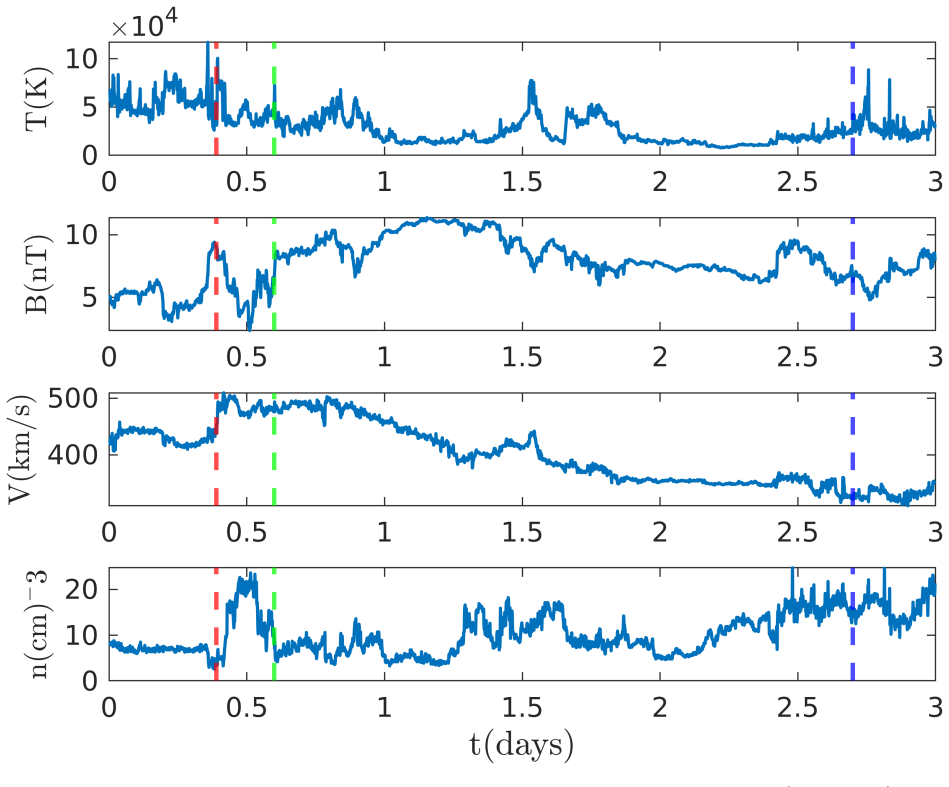
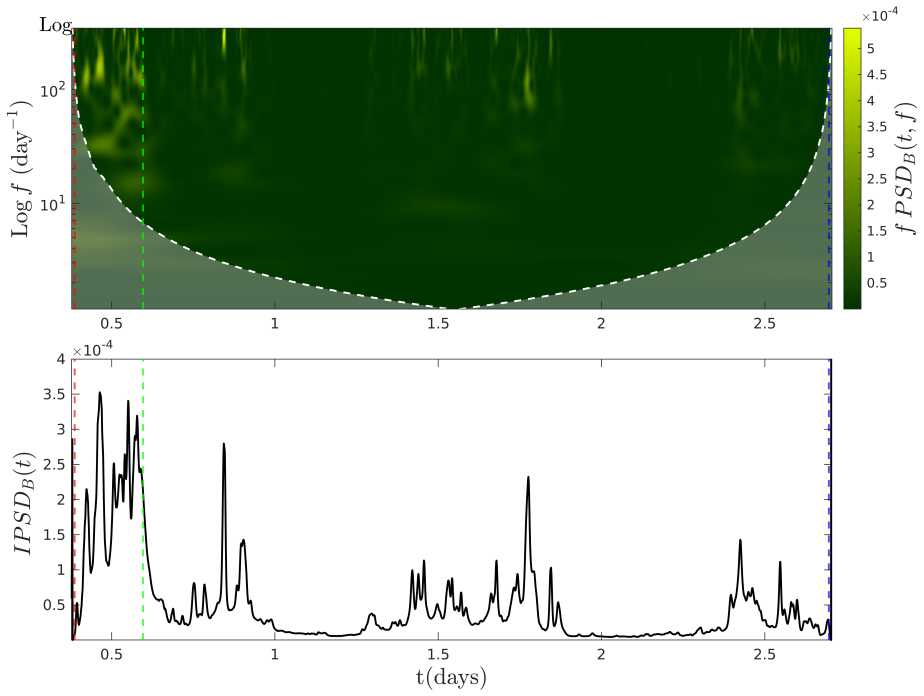
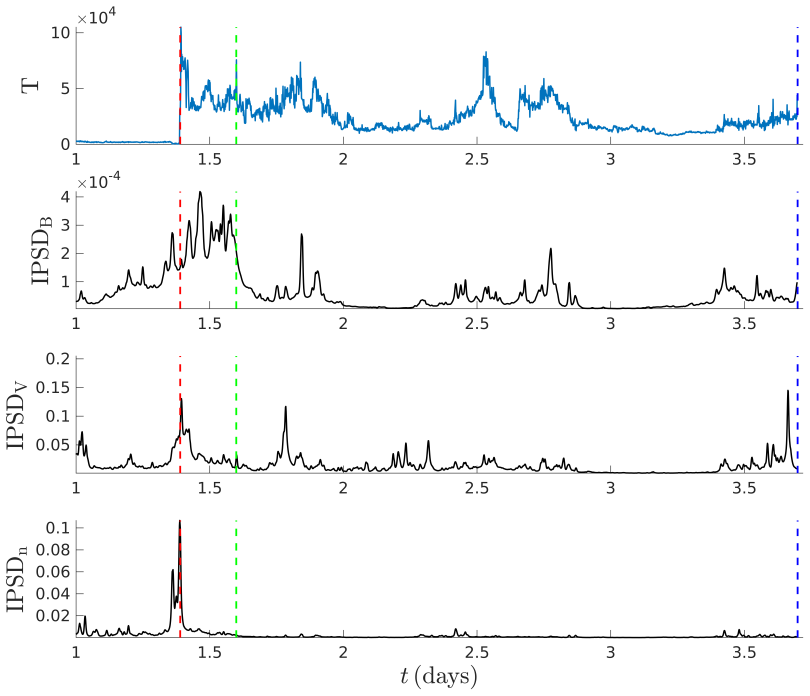
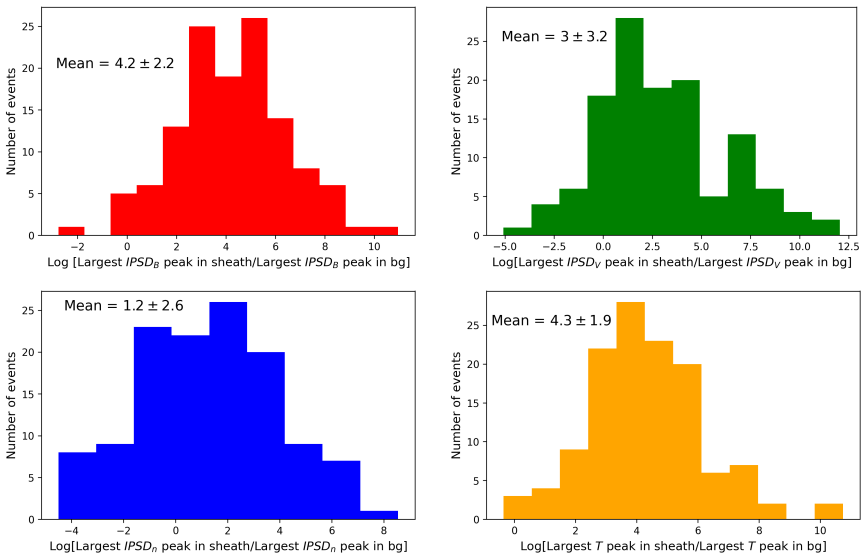
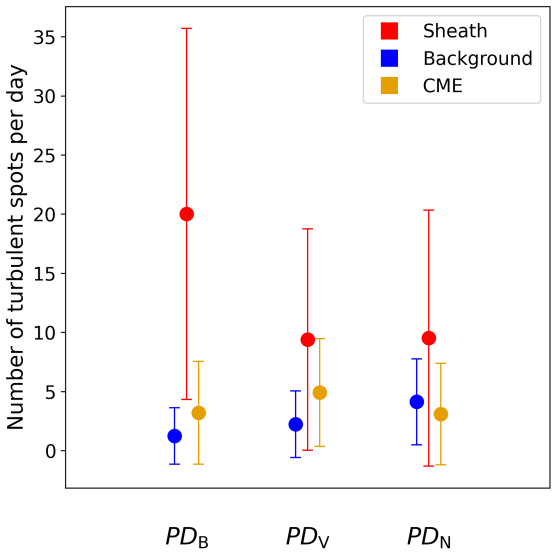
In observations of 125 coronal mass ejections, the strongest turbulent spots and their occurrence rate mark the arrival of the leading edge.
A machine-rendered reading of the paper's core claim, the machinery that carries it, and where it could break.
Core claim
Using in-situ measurements from a sample of 125 coronal mass ejections, the intensity of the strongest turbulent spot and the rate at which such spots occur serve as reliable indicators of the onset of the leading part of the CME event. Turbulent spots additionally appear as sites of enhanced proton heating.
What carries the argument
Turbulent spots: localized regions of high-intensity fluctuations that act as signatures of intermittency in collisionless plasma turbulence; they function as timing markers for CME leading edges and candidate heating locations.
If this is right
- The two turbulent-spot metrics can be applied to forecast when the leading edge of a CME reaches Earth.
- Turbulent spots supply sites where protons gain extra heat inside the sheath region ahead of the CME.
- Incorporating these metrics can refine models that predict space-weather effects driven by CME sheaths.
- The approach adds a concrete observational handle on intermittency in solar-wind turbulence.
Where Pith is reading between the lines
- Real-time tracking of turbulent-spot intensity and rate from a single spacecraft could give earlier alerts than bulk flow-speed changes alone.
- The same fluctuation analysis might be tested on other transient solar-wind structures to see whether the indicators are unique to CMEs.
- If turbulent spots are confirmed heating sites, energy-dissipation calculations for collisionless plasmas can be adjusted to weight these localized regions more heavily.
Load-bearing premise
The sample of 125 events and the method for spotting high-fluctuation regions produce indicators that hold for other CMEs and correctly isolate intermittency.
What would settle it
A collection of CME events in which the leading edge arrives at the spacecraft without a corresponding peak in either the intensity of the strongest turbulent spot or the spot occurrence rate.
Figures
read the original abstract
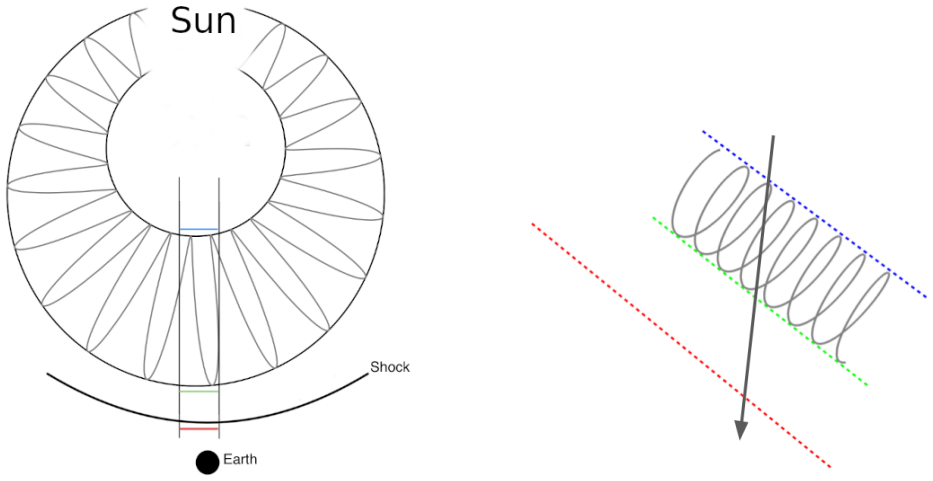
Localised regions of high intensity fluctuations are known to be signatures of intermittency in fluid and plasma turbulence. We investigate such turbulent spots using near-Earth {\em in-situ} spacecraft observations of a sample of 125 solar coronal mass ejections (CMEs). We present statistical results which suggest that the intensity of the strongest turbulent spot and the turbulent spot occurrence rate are reliable indicators of the onset of the leading part of the CME event. Our findings also suggest that turbulent spots can be sites of enhanced proton heating. The findings of this study can enhance our understanding of intermittence in collisionless plasma turbulence and can improve CME/sheath-driven space weather impact prediction models.
Editorial analysis
A structured set of objections, weighed in public.
Referee Report
Summary. The paper analyzes near-Earth in-situ observations of 125 solar coronal mass ejections (CMEs) to identify localized high-intensity fluctuation regions as signatures of intermittency. It reports statistical results indicating that the intensity of the strongest turbulent spot and the turbulent spot occurrence rate serve as reliable indicators of the onset of the leading part of the CME, and suggests that these spots are sites of enhanced proton heating, with implications for understanding collisionless plasma turbulence and improving space weather models.
Significance. If the turbulent-spot identification is shown to isolate true intermittency signatures rather than other CME structures, the work could provide useful observational constraints on intermittency in the solar wind and practical indicators for CME leading-edge arrival. The 125-event sample size is a strength for statistical claims, but the absence of reported controls for confounding structures limits the current impact.
major comments (3)
- [Methods (identification procedure)] The central claims rest on the assumption that high-intensity fluctuation regions are intermittency signatures. No details are provided on the identification threshold, any accompanying scale-dependent diagnostics (e.g., kurtosis, structure-function exponents, or spectral slopes), or controls that distinguish these regions from sheath discontinuities, shocks, or current sheets. This directly undermines both the indicator reliability and the proton-heating suggestion.
- [Results (statistical analysis)] The statistical results on occurrence rate and strongest-spot intensity as onset indicators are presented without reported error bars, sample-selection criteria, or tests against null hypotheses (e.g., randomized event times or sheath-only intervals). Without these, the generalization claim from the 125-event sample cannot be evaluated.
- [Results (heating analysis)] The proton-heating claim requires a quantitative comparison (e.g., temperature or heating-rate profiles inside vs. outside identified spots). No such comparison or control for overall sheath heating is described, leaving the suggestion unsupported by the reported evidence.
minor comments (2)
- [Abstract] The abstract states that the findings 'can enhance our understanding' and 'can improve' models, but these are forward-looking statements rather than demonstrated outcomes; rephrase to reflect what is actually shown.
- [Introduction/Methods] Notation for 'turbulent spot' and 'intensity' should be defined explicitly on first use, including any normalization or units employed.
Simulated Author's Rebuttal
We thank the referee for the constructive comments. We address each major point below and indicate where revisions will be made to strengthen the manuscript.
read point-by-point responses
-
Referee: [Methods (identification procedure)] The central claims rest on the assumption that high-intensity fluctuation regions are intermittency signatures. No details are provided on the identification threshold, any accompanying scale-dependent diagnostics (e.g., kurtosis, structure-function exponents, or spectral slopes), or controls that distinguish these regions from sheath discontinuities, shocks, or current sheets. This directly undermines both the indicator reliability and the proton-heating suggestion.
Authors: We agree that the identification procedure requires explicit documentation. The turbulent spots were identified as intervals where the magnetic-field fluctuation amplitude exceeds a threshold of three local standard deviations sustained over at least 5 minutes; this will be stated in Section 2. In the revision we will add kurtosis and second-order structure-function exponents computed inside versus outside the spots, and we will explicitly discuss how the spots are distinguished from shocks and current sheets by their occurrence well after the leading-edge discontinuity and by the absence of abrupt jumps in density or velocity. revision: yes
-
Referee: [Results (statistical analysis)] The statistical results on occurrence rate and strongest-spot intensity as onset indicators are presented without reported error bars, sample-selection criteria, or tests against null hypotheses (e.g., randomized event times or sheath-only intervals). Without these, the generalization claim from the 125-event sample cannot be evaluated.
Authors: The 125 events were drawn from the Wind CME catalog with the requirement of clear magnetic-field rotation and sheath signatures; this selection criterion will be added to Section 2. Error bars on occurrence rates and peak intensities (bootstrap 95 % confidence intervals) will be included in Figures 3 and 4. A null test that randomizes the timing of the identified spots relative to the CME leading edge will be added to demonstrate that the reported alignment is statistically significant. revision: yes
-
Referee: [Results (heating analysis)] The proton-heating claim requires a quantitative comparison (e.g., temperature or heating-rate profiles inside vs. outside identified spots). No such comparison or control for overall sheath heating is described, leaving the suggestion unsupported by the reported evidence.
Authors: The suggestion of enhanced proton heating is currently based on a visual correlation between spot locations and local temperature increases. We acknowledge that a quantitative comparison is needed. In the revision we will add median proton-temperature profiles inside versus outside the spots, normalized to the background sheath temperature, together with a control that excludes the immediate post-shock region, to place the heating claim on a firmer footing. revision: yes
Circularity Check
No circularity: purely observational statistics with no derivations
full rationale
The paper reports direct statistical counts and intensity measures from in-situ observations of 125 CMEs, with no equations, fitted parameters, derivations, or load-bearing self-citations. The indicators (strongest turbulent spot intensity, occurrence rate) are computed straightforwardly from fluctuation data without any reduction to inputs by construction or ansatz smuggling. This is the most common honest finding for observational papers lacking a derivation chain.
Axiom & Free-Parameter Ledger
axioms (1)
- domain assumption Localised regions of high intensity fluctuations are known to be signatures of intermittency in fluid and plasma turbulence.
Reference graph
Works this paper leans on
-
[1]
Anand and S
A. Anand and S. S. Diwan. Time-frequency analysis for two cases of boundary-layer transition induced by random distributed roughness.Experiments in Fluids, 61(60), 2020
2020
-
[2]
W. J. Baars, K. M. Talluru, N. Hutchins, et al. Wavelet analysis of wall turbulence to study large-scale modulation of small scales.Experiments in Fluids, 56(188), 2015
2015
-
[3]
Characterizing proton polytropic indices inside near-earth magnetic clouds and icme sheaths.Journal of Astrophysics and Astronomy, 46(2):1–15, 2025
Debesh Bhattacharjee, Saikat Majumder, and Prasad Subramanian. Characterizing proton polytropic indices inside near-earth magnetic clouds and icme sheaths.Journal of Astrophysics and Astronomy, 46(2):1–15, 2025
2025
-
[4]
On modeling icme cross-sections as static mhd columns.Solar Physics, 297(4):45, 2022
Debesh Bhattacharjee, Prasad Subramanian, Volker Bothmer, Teresa Nieves-Chinchilla, and Angelos Vourlidas. On modeling icme cross-sections as static mhd columns.Solar Physics, 297(4):45, 2022
2022
-
[5]
Turbulence and anomalous resistivity inside near-Earth magnetic clouds
Debesh Bhattacharjee, Prasad Subramanian, Teresa Nieves-Chinchilla, and Angelos Vourlidas. Turbulence and anomalous resistivity inside near-Earth magnetic clouds. MNRAS, 518(1):1185–1194, January 2023
2023
-
[6]
Characterizing the specific en- ergy and pressure in near-earth magnetic clouds.Astronomy & Astrophysics, 669:A153, 2023
Debesh Bhattacharjee, Prasad Subramanian, Angelos Vourlidas, Teresa Nieves- Chinchilla, Niranjana Thejaswi, and Nishtha Sachdeva. Characterizing the specific en- ergy and pressure in near-earth magnetic clouds.Astronomy & Astrophysics, 669:A153, 2023
2023
-
[7]
Borovsky and Herbert O
Joseph E. Borovsky and Herbert O. Funsten. Role of solar wind turbulence in the cou- pling of the solar wind to the Earth’s magnetosphere.Journal of Geophysical Research (Space Physics), 108(A6):1246, June 2003
2003
-
[8]
K¨ ahler
Matthew Bross, Sven Scharnowski, and Christian J. K¨ ahler. Large-scale coherent struc- tures in compressible turbulent boundary layers.Journal of Fluid Mechanics, 911:A2, March 2021. 14
2021
-
[9]
The Solar Wind as a Turbulence Laboratory
Roberto Bruno and Vincenzo Carbone. The Solar Wind as a Turbulence Laboratory. Living Reviews in Solar Physics, 10(1):2, December 2013
2013
-
[10]
L. F. Burlaga. Magnetic clouds and force-free fields with constant alpha. J. Geo- phys. Res., 93(A7):7217–7224, July 1988
1988
-
[11]
Magnetic clouds and force-free fields with constant alpha.Journal of Geophysical Research: Space Physics, 93(A7):7217–7224, 1988
LF Burlaga. Magnetic clouds and force-free fields with constant alpha.Journal of Geophysical Research: Space Physics, 93(A7):7217–7224, 1988
1988
-
[12]
Space Weather: From Solar Origins to Risks and Hazards Evolving in Time.Frontiers in Astronomy and Space Sciences, 9:429, December 2022
Natalia Buzulukova and Bruce Tsurutani. Space Weather: From Solar Origins to Risks and Hazards Evolving in Time.Frontiers in Astronomy and Space Sciences, 9:429, December 2022
2022
-
[13]
C. H. K. Chen. Recent progress in astrophysical plasma turbulence from solar wind observations.Journal of Plasma Physics, 82(6):535820602, December 2016
2016
-
[14]
Acceleration of coronal mass ejections.Journal of Geophysical Research: Space Physics, 108(A11), 2003
James Chen and Jonathan Krall. Acceleration of coronal mass ejections.Journal of Geophysical Research: Space Physics, 108(A11), 2003
2003
-
[15]
Coronal mass ejections: models and their observational basis.Living Reviews in Solar Physics, 8(1):1–92, 2011
PF Chen. Coronal mass ejections: models and their observational basis.Living Reviews in Solar Physics, 8(1):1–92, 2011
2011
-
[16]
Gupta, and Lalit Gupta
Xiaoqian Chen, Resh S. Gupta, and Lalit Gupta. Exploiting the cone of influence for improving the performance of wavelet transform-based models for erp/eeg classification. Brain Sciences, 13(1), 2023
2023
-
[17]
Wavelets and Signal Processing
L. Cohen.in “Wavelets and Signal Processing”, Debnath, L (ed). Applied and Numerical Harmonic Analysis. Birkh¨ auser Boston, 2003
2003
-
[18]
Dhawan and R
S. Dhawan and R. Narasimha. Some properties of boundary layer flow during the transition from laminar to turbulent motion.Journal of Fluid Mechanics, 3(4):418–436, 1958
1958
-
[19]
Jasper Edwards, Guifr´ e Molera Calv´ es, John Morgan, and Mark Cheung. An Analysis of a Coronal Mass Ejection Leading Edge by Means of Multi-Spacecraft-in-Beam Phase Scintillation.arXiv e-prints, page arXiv:2512.04337, December 2025
-
[20]
Wavelet transforms and their applications to turbulence.Annual Review of Fluid Mechanics, 24(Volume 24, 1992):395–458, 1992
Marie Farge. Wavelet transforms and their applications to turbulence.Annual Review of Fluid Mechanics, 24(Volume 24, 1992):395–458, 1992
1992
-
[21]
Turbulent Power: A Discriminator Between Sheaths and CMEs
Deep Ghuge, Debesh Bhattacharjee, and Prasad Subramanian. Turbulent Power: A Discriminator Between Sheaths and CMEs. Sol. Phys., 300(4):47, April 2025
2025
-
[22]
Radial evolution of magnetic field fluctuations in an interplanetary coronal mass ejection sheath.The Astrophysical Journal, 893(2):110, 2020
SW Good, M Ala-Lahti, E Palmerio, EKJ Kilpua, and A Osmane. Radial evolution of magnetic field fluctuations in an interplanetary coronal mass ejection sheath.The Astrophysical Journal, 893(2):110, 2020
2020
-
[23]
Birkh¨ auser Boston, Boston, MA, 2001
Karlheinz Gr¨ ochenig.The Short-Time Fourier Transform, pages 37–58. Birkh¨ auser Boston, Boston, MA, 2001. 15
2001
-
[24]
Alex Guo, Daniel Floryan, and Michael D. Graham. Self-similar, spatially localized structures in turbulent pipe flow from a data-driven wavelet decomposition.Journal of Fluid Mechanics, 971:A9, September 2023
2023
-
[25]
Reconstruction of magnetic clouds in the solar wind: Orientations and configurations.Journal of Geophysical Research: Space Physics, 107(A7):SSH–10, 2002
Qiang Hu and Bengt U ¨O Sonnerup. Reconstruction of magnetic clouds in the solar wind: Orientations and configurations.Journal of Geophysical Research: Space Physics, 107(A7):SSH–10, 2002
2002
-
[26]
E. K. J. Kilpua, H. Hietala, H. E. J. Koskinen, D. Fontaine, and L. Turc. Magnetic field and dynamic pressure ULF fluctuations in coronal-mass-ejection-driven sheath regions. Annales Geophysicae, 31(9):1559–1567, September 2013
2013
-
[27]
Magnetic field fluctuation properties of coronal mass ejection-driven sheath re- gions in the near-earth solar wind.Annales Geophysicae Discussions, 2020:1–30, 2020
Emilia KJ Kilpua, Dominique Fontaine, Simon Good, Matti Ala-Lahti, Adnane Os- mane, Erika Palmerio, Emiliya Yordanova, Clement Moissard, Lina Z Hadid, and Miho Janvier. Magnetic field fluctuation properties of coronal mass ejection-driven sheath re- gions in the near-earth solar wind.Annales Geophysicae Discussions, 2020:1–30, 2020
2020
-
[28]
K. C. Kim and R. J. Adrian. Very large-scale motion in the outer layer.Physics of Fluids, 11(2):417–422, February 1999
1999
-
[29]
Interplanetary magnetic clouds at 1 au.Journal of Geo- physical Research: Space Physics, 87(A2):613–624, 1982
LW Klein and LF Burlaga. Interplanetary magnetic clouds at 1 au.Journal of Geo- physical Research: Space Physics, 87(A2):613–624, 1982
1982
-
[30]
Ryun-Young Kwon, Jie Zhang, and Oscar Olmedo. New insights into the physical nature of coronal mass ejections and associated shock waves within the framework of the three-dimensional structure.The Astrophysical Journal, 794(2):148, 2014
2014
-
[31]
J. M. Lilly. jlab: A data analysis package for matlab®, version 1.6.2, 2016
2016
-
[32]
Majeski, M
S. Majeski, M. W. Kunz, and J. Squire. Self-organization in collisionless, high-βturbu- lence.Journal of Plasma Physics, 90(6):535900601, November 2024
2024
-
[33]
Klein, Benjamin D
Alfred Mallet, Kristopher G. Klein, Benjamin D. G. Chandran, Daniel Groˇ selj, Ian W. Hoppock, Trevor A. Bowen, Chadi S. Salem, and Stuart D. Bale. Interplay between intermittency and dissipation in collisionless plasma turbulence.Journal of Plasma Physics, 85(3):175850302, June 2019
2019
-
[34]
Coronal mass ejection shock and sheath structures relevant to particle acceleration.The Astrophysical Journal, 622(2):1225, 2005
WB Manchester IV, TI Gombosi, DL De Zeeuw, IV Sokolov, II Roussev, KG Powell, J K´ ota, G T´ oth, and TH Zurbuchen. Coronal mass ejection shock and sheath structures relevant to particle acceleration.The Astrophysical Journal, 622(2):1225, 2005
2005
-
[35]
Turbulence, intermittency, and cross-scale energy transfer in an interplanetary coronal mass ejection
Roque M´ arquez Rodr´ ıguez, Luca Sorriso-Valvo, and Emiliya Yordanova. Turbulence, intermittency, and cross-scale energy transfer in an interplanetary coronal mass ejection. Solar Physics, 298(4):54, 2023
2023
-
[36]
Detecting multi-scale coherent eddy structures and inter- mittency in turbulent boundary layer by wavelet analysis.Chin
JIANG Nan and ZHANG Jin. Detecting multi-scale coherent eddy structures and inter- mittency in turbulent boundary layer by wavelet analysis.Chin. Phys. Lett., 22(8):1968– 1971, 2005. 16
1968
-
[37]
Jian, Laura Balmaceda, Angelos Vourlidas, Luiz F
Teresa Nieves-Chinchilla, Lan K. Jian, Laura Balmaceda, Angelos Vourlidas, Luiz F. G. dos Santos, and Adam Szabo. Unraveling the Internal Magnetic Field Structure of the Earth-directed Interplanetary Coronal Mass Ejections During 1995 - 2015. Sol. Phys., 294(7):89, July 2019
1995
-
[38]
Unraveling the internal magnetic field structure of the earth-directed interplanetary coronal mass ejections during 1995–2015.Solar Physics, 294(7):89, 2019
Teresa Nieves-Chinchilla, Lan K Jian, Laura Balmaceda, Angelos Vourlidas, Luiz FG dos Santos, and Adam Szabo. Unraveling the internal magnetic field structure of the earth-directed interplanetary coronal mass ejections during 1995–2015.Solar Physics, 294(7):89, 2019
1995
-
[39]
Understanding the internal magnetic field configurations of icmes using more than 20 years of wind observations
Teresa Nieves-Chinchilla, Angelos Vourlidas, John C Raymond, MG Linton, Nada Al- Haddad, NP Savani, A Szabo, and Miguel A Hidalgo. Understanding the internal magnetic field configurations of icmes using more than 20 years of wind observations. Solar Physics, 293(2):25, 2018
2018
-
[40]
T. N. Parashar, M. Cuesta, and W. H. Matthaeus. Reynolds Number and Intermit- tency in the Expanding Solar Wind: Predictions Based on Voyager Observations. ApJ, 884(2):L57, October 2019
2019
-
[41]
Intermittency in In- terplanetary Coronal Mass Ejections Observed by Parker Solar Probe and Solar Orbiter
Julia Ruohotie, Simon Good, Christian M¨ ostl, and Emilia Kilpua. Intermittency in In- terplanetary Coronal Mass Ejections Observed by Parker Solar Probe and Solar Orbiter. ApJ, 986(2):L27, June 2025
2025
-
[42]
Turbulence properties of interplanetary coronal mass ejection flux ropes at 1 au.Monthly Notices of the Royal Astronomical Society, 530(3):3005–3012, 2024
Zubair I Shaikh. Turbulence properties of interplanetary coronal mass ejection flux ropes at 1 au.Monthly Notices of the Royal Astronomical Society, 530(3):3005–3012, 2024
2024
-
[43]
Jyoti Sheoran, Supratik Banerjee, Vaibhav Pant, Dipankar Banerjee, and M. Saleem Khan. Turbulent Properties of Interplanetary Coronal Mass Ejections Observed by Solar Orbiter in the Inner Heliosphere.arXiv e-prints, page arXiv:2601.06904, January 2026
-
[44]
A wavelet-based intermittency detection technique from piv investigations in transitional boundary layers.Experiments in Fluids, 57(145), 2016
Daniele Simoni, Davide Lengani, and Roberto Guida. A wavelet-based intermittency detection technique from piv investigations in transitional boundary layers.Experiments in Fluids, 57(145), 2016
2016
-
[45]
Space weather: the solar perspective: An update to Schwenn (2006)
Manuela Temmer. Space weather: the solar perspective: An update to Schwenn (2006). Living Reviews in Solar Physics, 18(1):4, December 2021
2006
-
[46]
Christopher Torrence and Gilbert P. Compo. A Practical Guide to Wavelet Analysis. Bulletin of the American Meteorological Society, 79(1):61–78, January 1998
1998
-
[47]
A. A. Townsend. The structure of the turbulent boundary layer.Mathematical Proceed- ings of the Cambridge Philosophical Society, 47(2):375–395, 1951
1951
-
[48]
Formation and evolution of coherent structures in 3D strongly turbulent magnetized plasmas.Physics of Plasmas, 30(4):040502, April 2023
Loukas Vlahos and Heinz Isliker. Formation and evolution of coherent structures in 3D strongly turbulent magnetized plasmas.Physics of Plasmas, 30(4):040502, April 2023. 17
2023
-
[49]
L. D. Wang, Y. Wang, F. S. Wei, X. S. Feng, B. Y. Wang, P. B. Zuo, W. Y. Zhang, X. J. Xu, Z. L. Zhou, and X. J. Song. Analysis on the Turbulent Properties of Current Sheets in the Solar Wind. ApJ, 985(1):113, May 2025
2025
-
[50]
New insights into turbulent spots.Annual Review of Fluid Mechanics, 55(Volume 55, 2023):45–75, 2023
Xiaohua Wu. New insights into turbulent spots.Annual Review of Fluid Mechanics, 55(Volume 55, 2023):45–75, 2023
2023
-
[51]
Zelenyi, Andrei M
Lev M. Zelenyi, Andrei M. Bykov, Yury A. Uvarov, and Anton V. Artemyev. Intermit- tency of magnetic field turbulence: Astrophysical applications of in-situ observations. Journal of Plasma Physics, 81(4):395810401, August 2015
2015
-
[52]
Uzdensky
Vladimir Zhdankin, Stanislav Boldyrev, and Dmitri A. Uzdensky. Scalings of intermit- tent structures in magnetohydrodynamic turbulence.Physics of Plasmas, 23(5):055705, May 2016. 18
2016
discussion (0)
Sign in with ORCID, Apple, or X to comment. Anyone can read and Pith papers without signing in.