PowerAgentBench-Dyn: A Benchmark for Agentic AI in Power System Dynamic Studies
Pith reviewed 2026-06-26 15:41 UTC · model grok-4.3
The pith
PowerAgentBench-Dyn is a benchmark for testing AI agents on power system dynamic studies that require iterative engineering judgment.
A machine-rendered reading of the paper's core claim, the machinery that carries it, and where it could break.
Core claim
The paper defines PowerAgentBench-Dyn with two tasks: the Dynamic Model Quality Review Benchmark, which checks agents' ability to validate and diagnose dynamic models against operator compliance criteria, and the Dynamic Security Risk Screening Benchmark, which tests agents' use of semantic memory and limited simulation budget to rank critical short-circuit contingencies from unseen data and propose mitigations.
What carries the argument
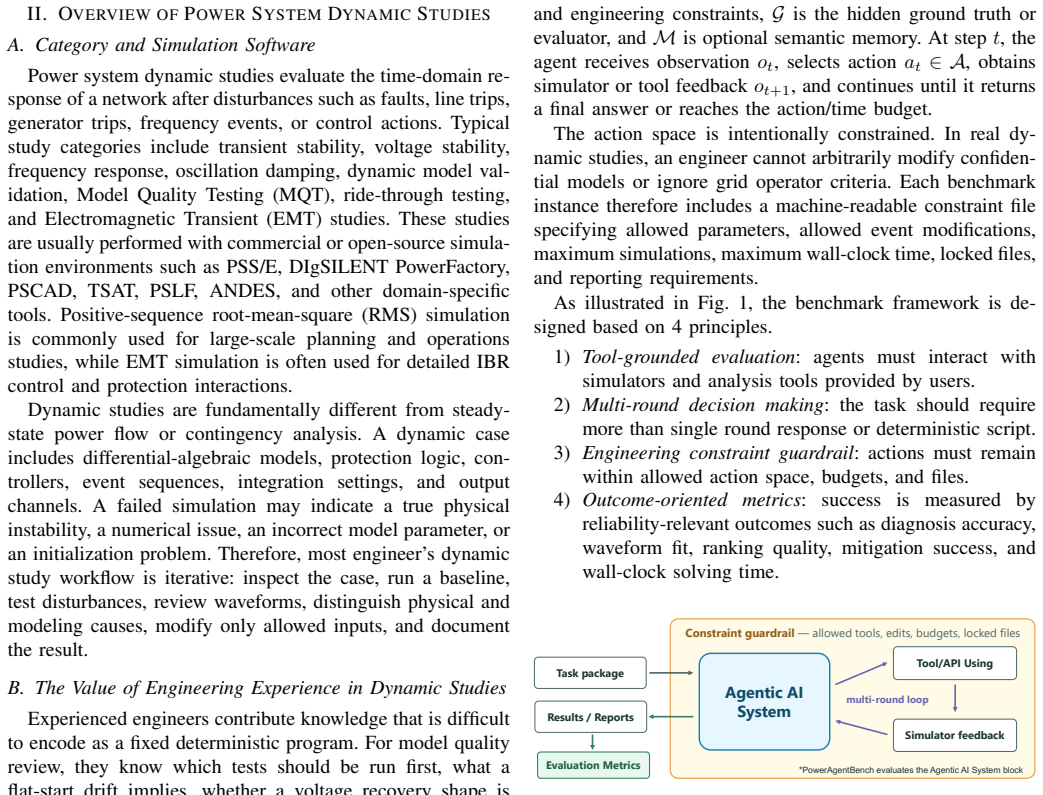
The benchmark framework consisting of simulation environments, observation and action spaces, and evaluation metrics for the two tasks, which together assess agent reasoning, tool usage, and iterative experimentation.
If this is right
- Agents can be compared systematically on their ability to handle model quality review and contingency screening under realistic constraints.
- High-performing agents could assist with parameter calibration and mitigation analysis in power system operation and planning.
- Stochastic agent behavior can be assessed reliably through repeated runs using success rates and other defined metrics.
- The framework provides a foundation for extending Agentic AI to additional dynamic study workflows beyond the initial two tasks.
Where Pith is reading between the lines
- The focus on limited simulation budgets may encourage development of agents that plan actions more efficiently across other resource-constrained engineering domains.
- The benchmark's emphasis on semantic memory could be adapted to test agents in related fields such as control system tuning or fault diagnosis.
- Releasing the cases and simulator settings as a deterministic evaluator allows independent verification by other researchers.
- Future tasks added to the benchmark might incorporate real-time operational data or renewable variability scenarios.
Load-bearing premise
The two tasks along with their observation spaces and metrics accurately represent the engineering judgment and decision-making that occur in real power system dynamic studies.
What would settle it
An experiment showing that agents scoring high on the benchmark still cannot perform actual dynamic studies to the satisfaction of practicing power engineers, or that the tasks diverge from standard engineering workflows.
Figures
read the original abstract
Large Language Model (LLM)-based agents are increasingly being used to automate multi-step engineering work flows by interacting with software tools, interpreting intermediate results, and autonomously planning subsequent actions. Power system dynamic studies represent a particularly promising yet largely unexplored application domain for these agents. Unlike static computational tasks, dynamic studies often require more time on model parameter calibration, engineering judgment, and decision making under constrained action spaces. This paper introduces PowerAgentBench-Dyn, a benchmark designed to evaluate Agentic AI systems on power system dynamic-analysis tasks. The benchmark targets problems that cannot be reduced to a single optimization or coding task, but instead require a type of reasoning, tool usage, and iterative experimentation routinely performed by experienced power system engineers. The proposed framework includes two initial benchmark tasks. The first, the Dynamic Model Quality Review Benchmark, evaluates agents' ability to validate and diagnose dynamic models based on model-quality compliance criteria specified by system operators. The second, the Dynamic Security Risk Screening Benchmark, assesses agents' capability to leverage semantic memory and a limited simulation budget to identify, rank, and analyze the most critical short-circuit contingencies from an unseen fault dataset, as well as propose and evaluate possible mitigation measures. For each task, we define the simulation environment, observation and action spaces, and evaluation metrics. The benchmark is reproducible in a metric-based sense: released cases and simulator settings define a deterministic evaluator, while stochastic agent behavior is assessed over repeated runs using success rates and other metrics. The benchmark supports the development of future Agentic AI for power system operation and planning.
Editorial analysis
A structured set of objections, weighed in public.
Referee Report
Summary. The paper proposes PowerAgentBench-Dyn, a benchmark for evaluating LLM-based agents on power system dynamic studies. It defines two tasks—Dynamic Model Quality Review (model validation against operator compliance criteria) and Dynamic Security Risk Screening (contingency ranking and mitigation under limited simulation budget using semantic memory)—along with simulation environments, observation/action spaces, and metrics. The central claim is that these tasks require irreducible iterative engineering judgment, tool use, and experimentation not reducible to single optimization or coding tasks, with reproducibility ensured via released cases and deterministic evaluators.
Significance. A well-validated benchmark in this domain could standardize evaluation of agentic AI for multi-step power system workflows that involve engineering judgment under constraints, filling a gap between static optimization and real operational decision-making. The proposal itself, however, provides no implementation, validation data, or results, so its significance remains prospective.
major comments (3)
- [Abstract] Abstract (task descriptions): The claim that the tasks 'cannot be reduced to a single optimization or coding task' but instead require 'a type of reasoning, tool usage, and iterative experimentation routinely performed by experienced power system engineers' is unsupported; no argument or preliminary result is given showing why the defined observation/action spaces for either task resist reduction to standard methods such as Bayesian optimization, Monte Carlo tree search, or rule-based diagnosis over the same simulator interface.
- [Abstract] Abstract (Dynamic Security Risk Screening Benchmark): No evidence or analysis is provided to establish that the limited simulation budget and contingency-ranking task necessitates semantic memory and agentic planning, rather than scripted search or optimization; this leaves the benchmark's claim to target distinct agentic capabilities unsecured.
- [Abstract] Abstract (reproducibility statement): The assertion that 'the benchmark is reproducible in a metric-based sense' via 'released cases and simulator settings [that] define a deterministic evaluator' is not accompanied by any description of the actual cases, simulator settings, metric computation procedures, or validation that the metrics accurately capture engineering judgment.
minor comments (2)
- The abstract refers to 'two initial benchmark tasks' and 'for each task, we define the simulation environment, observation and action spaces, and evaluation metrics' but supplies no formal definitions or examples of these spaces.
- No positioning against existing agent benchmarks or power-system AI evaluation frameworks is provided to clarify novelty.
Simulated Author's Rebuttal
We thank the referee for the constructive comments on our benchmark proposal. We address each major comment below, agreeing where the manuscript requires additional justification or detail, and outline the planned revisions.
read point-by-point responses
-
Referee: [Abstract] Abstract (task descriptions): The claim that the tasks 'cannot be reduced to a single optimization or coding task' but instead require 'a type of reasoning, tool usage, and iterative experimentation routinely performed by experienced power system engineers' is unsupported; no argument or preliminary result is given showing why the defined observation/action spaces for either task resist reduction to standard methods such as Bayesian optimization, Monte Carlo tree search, or rule-based diagnosis over the same simulator interface.
Authors: We agree that the current manuscript provides no explicit argument or preliminary result to support the claim. The observation and action spaces are defined to require sequential interpretation of simulation outputs and compliance criteria, but this is not demonstrated. In revision we will add a dedicated subsection analyzing the spaces and explaining why reduction to single-shot methods such as Bayesian optimization or MCTS is not straightforward, citing the need for iterative diagnosis of model parameters and engineering judgment. revision: yes
-
Referee: [Abstract] Abstract (Dynamic Security Risk Screening Benchmark): No evidence or analysis is provided to establish that the limited simulation budget and contingency-ranking task necessitates semantic memory and agentic planning, rather than scripted search or optimization; this leaves the benchmark's claim to target distinct agentic capabilities unsecured.
Authors: We concur that no supporting evidence or analysis is given. The task definition assumes semantic memory is required for ranking under budget constraints, yet this is not justified against alternatives. We will revise by inserting an analysis subsection that details how the unseen fault dataset and limited budget create a setting where adaptive, memory-augmented planning offers advantages over scripted or purely optimization-based approaches, grounded in the task's information-gathering requirements. revision: yes
-
Referee: [Abstract] Abstract (reproducibility statement): The assertion that 'the benchmark is reproducible in a metric-based sense' via 'released cases and simulator settings [that] define a deterministic evaluator' is not accompanied by any description of the actual cases, simulator settings, metric computation procedures, or validation that the metrics accurately capture engineering judgment.
Authors: The referee is correct; the abstract states reproducibility without providing the supporting descriptions. Although the manuscript defines environments and metrics at a high level, explicit details on cases, settings, computation procedures, and validation against engineering judgment are absent. We will revise the abstract and add a reproducibility section that supplies these descriptions and explains the validation approach. revision: yes
Circularity Check
No circularity: benchmark definition is self-contained with no derivations or self-referential claims
full rationale
The paper proposes a benchmark with two tasks, observation/action spaces, and metrics for agentic AI evaluation in power system dynamics. No equations, fitted parameters, predictions, or uniqueness theorems appear. The central claim that tasks require iterative engineering judgment is presented as a design choice for the benchmark, not derived from or reduced to prior self-citations or inputs. No load-bearing self-citation chains or ansatzes are invoked. This is a standard benchmark proposal without circular elements.
Axiom & Free-Parameter Ledger
invented entities (1)
-
PowerAgentBench-Dyn benchmark tasks
no independent evidence
Reference graph
Works this paper leans on
-
[1]
2022 odessa disturbance texas event: June 4, 2022,
North American Electric Reliability Corporation and Texas Reliability Entity, “2022 odessa disturbance texas event: June 4, 2022,” NERC, Tech. Rep., Dec. 2022
2022
-
[2]
React: Synergizing reasoning and acting in language models,
S. Yao, J. Zhao, D. Yu, N. Du, I. Shafran, K. Narasimhan, and Y . Cao, “React: Synergizing reasoning and acting in language models,”arXiv preprint arXiv:2210.03629, 2022
Pith/arXiv arXiv 2022
-
[3]
Agentbench: Evaluating llms as agents,
X. Liuet al., “Agentbench: Evaluating llms as agents,” inInternational Conference on Learning Representations (ICLR), 2024
2024
-
[4]
Toolllm: Facilitating large language models to master 16000+ real-world apis,
Y . Qinet al., “Toolllm: Facilitating large language models to master 16000+ real-world apis,” inInternational Conference on Learning Representations (ICLR), 2024
2024
-
[5]
Swe-bench: Can language models resolve real-world github issues?
C. E. Jimenez, J. Yang, A. Wettig, S. Yao, K. Pei, O. Press, and K. Narasimhan, “Swe-bench: Can language models resolve real-world github issues?” inInternational Conference on Learning Representations (ICLR), 2024
2024
-
[6]
PowerAgentBench-SS: A benchmark for agentic ai in power system steady-state studies,
C. Mylonas, M. Foti, A. Pomarico, M. Duarte, Q. Zhang, and E. Var- varigos, “PowerAgentBench-SS: A benchmark for agentic ai in power system steady-state studies,”arXiv, 2026
2026
-
[7]
Evolving symbolic model for dynamic security assessment in power systems,
F. S. Fernandes, R. J. Bessa, and J. P. Lopes, “Evolving symbolic model for dynamic security assessment in power systems,”Journal of Modern Power Systems and Clean Energy, vol. 13, no. 4, pp. 1113–1126, 2025
2025
-
[8]
A review on data-driven security assessment of power systems: Trends and applications of artificial intelligence,
A. Mehrzad, M. Darmiani, Y . Mousavi, M. Shafie-Khah, and M. Aghamohammadi, “A review on data-driven security assessment of power systems: Trends and applications of artificial intelligence,”IEEE Access, vol. 11, pp. 78 671–78 685, 2023
2023
-
[9]
Inverter-based resources model verification using electromagnetic transient playback simulation,
H. H. Sun, Q. F. Zhang, X. Luo, Z. Serritella, D. Hussey, and B. Marszalkowski, “Inverter-based resources model verification using electromagnetic transient playback simulation,” in2024 IEEE Power & Energy Society General Meeting (PESGM). IEEE, 2024, pp. 1–5
2024
-
[10]
Online risk-based security assessment,
M. Ni, J. D. McCalley, V . Vittal, and T. Tayyib, “Online risk-based security assessment,”IEEE Transactions on Power Systems, vol. 18, no. 1, pp. 258–265, 2003
2003
-
[11]
An enhanced dynamic model review tool for model quality test, validation and replication,
Y . Cheng, A. Yazdanpanah, A. Quedan, H. Davariki, J. Rose, J. Hariha- ran, and P. Gravois, “An enhanced dynamic model review tool for model quality test, validation and replication,” inIEEE Power and Energy Society General Meeting (PESGM), 2025
2025
-
[12]
Ercot dynamic model review platform development,
Y . Cheng, S.-H. Huang, Y . Zhang, and J. Conto, “Ercot dynamic model review platform development,” inIEEE Power and Energy Society General Meeting (PESGM), 2018, pp. 1–5
2018
-
[13]
PowerAgent: A road map toward agentic intel- ligence in power systems: Foundation model, model context protocol, and workflow,
Q. Zhang and L. Xie, “PowerAgent: A road map toward agentic intel- ligence in power systems: Foundation model, model context protocol, and workflow,”IEEE Power and Energy Magazine, vol. 23, no. 5, pp. 93–101, 2025
2025
discussion (0)
Sign in with ORCID, Apple, or X to comment. Anyone can read and Pith papers without signing in.